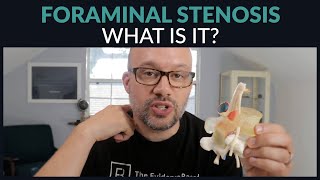
In this educational video, Dr. Jeff Langmaid explains foraminal narrowing (foraminal stenosis), a condition where the openings (foramina) through which spinal nerves exit the spine become narrowed, leading to nerve compression. He reviews spinal anatomy, describing vertebrae, the spinal cord, spinal nerves, and the foraminal canal. He identifies common structural contributors to narrowing: disc bulges, bone spurs (osteophytes), and overgrown ligaments. He outlines typical symptoms—pain, numbness, tingling, and weakness radiating into the arms or legs—depending on the affected region. Dr. Langmaid reassures viewers that the diagnosis is not frightening and emphasizes conservative, non‑surgical relief methods: staying active, reducing inflammation, using traction, and performing stretching exercises. He concludes by encouraging patients to use this knowledge to ask informed questions of their doctors.
Chapters
Hi, my name is Dr. Jeff Langmaid and today I wanted to talk to you about what foraminal narrowing or foraminal stenosis is and a few things that you can do to find relief. Foraminal narrowing or foraminal stenosis simply means the narrowing, pinching or compression on the nerves as they exit your spine. So let's take a look at a little bit of the anatomy. So can you, you can understand exactly what that means. In your back, in your neck, in your mid back, in your low back, your entire spine, you have bones, they are called vertebra on the back. This is the front of those bones that sits in you just like this. The white that you can see here is your spinal cord and the coming off the sides are the spinal nerves. The spinal nerves exit out your spine and travel down to your extremities. So the spinal nerves in your neck that exit out travel down into your shoulders, arms and hands. The spinal nerves that exit out your low back or your lumbar spine travel down into your feet, your ankles and your legs. But on the backside, this is a side view. On the backside of the bones is a notch. The top bone has a notch that does this. The bottom bone has a notch that does this. That creates, of course, as you can see, a hole. That hole or canal is called the foraminal canal. And it is right here. It's right where that nerve is coming out towards you right there. So that hole or that canal is the foraminal canal. That's what it's called. It should be wide open. That allows the nerve to travel right through, which without being pinched or compressed or irritated. But sometimes that canal can become narrowed. You can see right here, this white portion is your disc. And if the disc bulges backwards at all, bulges posterior, it can take up some space in that hole. Additionally, that is a bony canal. So if any part of this bone has a spur on it or an osteophyte, that means bone spur taking up space. That nerve can become very, very irritated. The nerves love to have nice wide canals to travel through that allows you to move and shake and do all the wonderful things you want to do throughout the day without experiencing pain. But if bone, disc or ligament enter into that canal or hole, it can compress or irritate the nerve. The that is what is typically referred to as foraminal narrowing or foraminal stenosis. Now you can have a little bit of narrowing without having compression on the nerve. Thankfully, those holes are plenty big enough where a nerve can travel through and it has some wiggle room. But if the narrowing becomes too much or too great, it's going to constrict or compress and irritate that nerve. That is what is going to lead to potentially pain, numbness, tingling, weakness traveling down your arm or your leg. That is the classic sign or symptom associated with foraminal narrowing. So if you've been told you have foraminal narrowing or foraminal stenosis, it's nothing to be scared of. But keep in mind they are telling you, your doctor is telling you that the hole where your spinal nerves travel out and down into your arms and legs and is smaller than it should be, might be due to a disc, might be due to a bone spur, or could even be due to a ligament that's overgrown. But over time, that can irritate the nerves and that can cause pain, numbness, tingling or weakness traveling down your arms and legs. So very frequently, some of the best care you can do for that is actually to stay active, to decrease inflammation, to do some traction, some stretching, that. These are some fantastic ways to find relief. So that is what foraminal narrowing or foraminal stenosis is. I hope that gives you a little bit more information, a little bit more context to ask your doctor a good question the next time you're in their office. Bye bye.