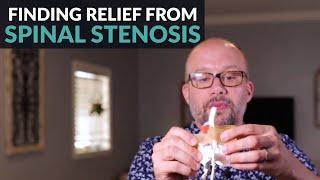
A short educational YouTube video by Dr. Jeff Langmaid explaining what spinal stenosis is (narrowing/compression of the spinal canal causing spinal cord compression), common causes (disc bulge/herniation, bone spurs, thickened ligaments), and natural ways to find relief—primarily by decompressing the canal using forward-flexion positions, traction/decompression techniques, or chiropractic flexion-distraction to open the space and reduce neurogenic symptoms like difficulty walking.
Chapters
Hi, I'm Dr. Jeff Langmaid, and today I want to talk about what is spinal stenosis? And what are some things you can do to find natural pain relief. So first, we will break down what is spinal stenosis? And to do that, all we have to do is actually look at the words spinal, meaning your spinal canal or your spinal cord. All of us in our back have vertebra or bones. In between those bones are our discs, which we're all very familiar with. But perhaps most importantly, running down the backside is what you see in white right here. That is your spinal cord. Your spinal cord runs through the hole in the back of the bones called the spinal canal. That should be wide open. As you can imagine, your spinal cord likes to have plenty of room traveling down and then out to wherever it needs to communicate to which is every organ, tissue, and cell in your body. But there are times when that hole or that canal becomes more narrow than you'd ideally like it to be. That narrowing can sometimes cause compression on the spinal cord itself. And guess what that compression is called? Stenosis. Stenosis simply means narrowing or compression. So when we put it all together, spinal stenosis is simply telling you that you have a compression, a pinch or a narrowing directly on your spinal cord. Now, what does that result in for many people when there's a pinch or a compression on their spinal cord? It can result in what we as physicians call neurogenic claudication. That's a big fancy word for saying the pipes are being shut off. The meaning people with spinal stenosis often have difficulty walking far. They either used to be able to walk 500ft. Now they can barely get to the mailbox. Quite often, their best friend is a shopping cart. If they go to the grocery store, you can barely get down an aisle. But if you have a cart to lean on, you can go all day. That is because when your spinal cord is compressed, it doesn't allow the signal. It. It doesn't allow the blood flow. It doesn't allow the nerve communication to work as well down to your legs. And as that gets interrupted and altered, it makes a big, big impact on your quality of life. That's spinal stenosis in a nutshell. What can cause spinal stenosis? Quite a few different things. You might have a disc bulge or a disc herniation that's taking up some space and pressing near that spinal cord or that spinal canal. Secondarily, you might also have a bone spur. The bones, as we age, they can sometimes become degenerative, and they have bone spurs or chunks of bone where they're not supposed to be. If that gets in and around your spinal cord or spinal canal, that can cause compression. And finally, ligaments. Ligaments can become hypertrophic or become big throughout time. That takes up extra space and can cause pinching or compression on your spinal cord. So disc bone or ligament may be getting into your canal and causing spinal stenosis. So what are some things that you can do to find relief naturally? Well, one of the best things you can do is traction or decompression. When you open up that area, when you bend forward on that shopping cart or lean forward, that typically provides relief because it physically opens the space for your spinal cord to travel through. So many people do some exercises where they're able to bend forward. Some do some exercises bending backwards. Quite often, chiropractors will utilize what's called flexion distraction. That simply is opening up that space. And when that space is opened, if you've ever seen somebody with spinal stenosis at the chiropractor's office, when that's open, there is typically instantaneous relief. Then it's a matter as a patient to do the right things outside of your chiropractor's office to maintain those results. So anytime there's a pinching or compression on the spinal cord, that's called spinal stenosis. When you can reduce that pressure and take the pinch off, you are bound to find relief. And the forward bent or flexed position is one of the best positions that you can find to provide decompression or relief on that spinal cord. So that's a little bit about spinal stenosis. A couple things you can do to find relief. My name's Dr. Jeff Langmaid.