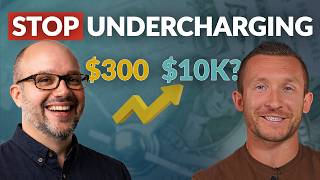
Jeff Langmaid and a practitioner discuss why charging $6,000 to $10,000 for programs actually increases referrals instead of scaring patients away. They compare this to premium restaurants booked weeks ahead, argue clinicians undervalue their work, and outline a tiered model with high-ticket core offers, lower-priced online rehab, and automated coaching that generates recurring revenue.
Chapters
You're charging a point where when we enroll a client into our program, we charge $6,000 to $10,000 to help people with low back pain. I know that I am selling them a $50,000 program at a discounted rate of $6,000. That's how I see it every time. And if you have a good sales process and you're convicted in your worth, it's easy.
Yeah, that's really impactful. And I just wanna touch on one key point and then dive deeper, which is for docs listening and watching, as you know you get great results in your practice, Understanding the value of that and understanding the value of that against what else is on the market and the challenges, as you said, the challenges, the missed opportunities, the opportunity cost if somebody's going through an advanced intervention. And I think many of us as chiropractors take this for granted every day. We're like, "Oh, well of course the patient got better," because we do great work because what we deliver with rehab and with chiropractic care works at such a high level. We can almost become blinded to the fact that most surgeons would say it's 33, 33, 33. 33% get better, 33% get worse, and 33% stay the same. And I'm always like, if we had that, we'd be mortified. We're like, we expect 90% of our patients to be doing well. And the question I think many docs haven't asked themselves is an important one, which is, what's the true value of what you do? And that's a really, really important point that you brought up that I think every doc needs to, really take a moment, sit with, rewind this conversation, and listen to Grant explain that again because it is so impactful in your ability to speak with confidence and conviction based upon the experience and care that you bring to your patients each and every day. And 90% of you are probably dramatically undercharging and undervaluing yourself. So I really appreciate you sharing that.
Yeah, and to ask myself a question—
Please.
If you're allowed. Alright, so I heard this awesome talk with Jeff Langmaid and Grant Langmaid. You know, I think I wanna charge more but wait, am I gonna get less referrals? You're charging— Gonna get less patients because I'm charging more? That's an immediate limiting belief and fear that people get. Opposite. Opposite happens. Absolutely. The most expensive steakhouses and premium restaurants in this Tampa area, they're the ones who are booked out 3 to 4 weeks. They get the most referrals. They charge the most. So when you have a value-driven system, yeah, to charge your value. If you provide no value but you're charging like you do, yeah, you're probably not gonna get great business. But if you provide results, results that are literally better than surgery over and over and over and over again, and you now are able to show and package your value better, charging more is not going to affect referrals. It's not going to affect new patients. Every doc we have worked with that we have 10x'd their pricing, the referrals have gone up. Yep. Every time.
Yep. Yeah, that's— you're 100% right. It's literally the opposite. It's you see more referrals, you see more new patients, you see— because people understand the value they they get the result and they are excited. We always say, you know, you pay, you know, pay attention inside now is pain, right? So people are paying attention inside now. Then the real question becomes, are you pricing yourself at the value that you're delivering? And too many docs aren't. For docs that are thinking about this and saying, okay, is this new patients directly into an online program? Is this my existing patient base? You know, in a hybrid-based program, how's that work?
Yeah, so here's the strategy there. We don't want to ruffle any feathers, and this is a concern for a lot of new docs that we bring on if they have like a patient base. So here's really easy way to think about it, okay, is this ideally a new sales process, a new core offer that's ideal for new patients who can go through the full process that we've set up for you. But what if there's someone who's still in the acute stage of care? What if they've only had a few visits with you? Or what if there's a maintenance wellness patient that is looking for more bulletproofing, more performance-based things? Well, those are really easy opportunities to say, hey, we don't need to sell you on a $3,000, $4,000, $5,000, $6,000 core offer. That's not necessary. But We do have a new, let's just say for the sake of context, 3-month online rehab program that focuses on this. This could rapidly accelerate the care we're already doing. You know, we have docs who jump on and they're slanging this for $1,000, $2,000 for any acute patient that's maybe 3 or 4 visits in. If there's someone who's more wellness and they're looking for strength goals, performance goals, well then we can create a strength and performance program.
Yeah.
Hey, $1,000, here's a 3-month performance program that's going to get you in the gym, coaching in the gym, cheaper than a personal trainer. And then you can actually have personal training type fulfillment that can be automated after that to now build a subscription base. This fits into any component of the practice. And once again, you don't have to do the fulfillment, it's done for you.
Yeah, that's, that's massive. You mentioned acute care and strength, strength right there. Uh, what kind of— if I'm building in a hybrid program, what's the to the extent? Is this for symptomatic conditions only? I know you are focused very heavily on low backs, and docs might be familiar with that. So give me the gamut. What types of programs can be built in, and what have you seen be the most successful?
Yeah, this is primarily designed for neuromusculoskeletal disorders, although for docs that we help go 100% online— so they have no brick and mortar anymore, they can travel and treat— we have helped people create dizziness programs, vestibular programs, anxiety, nervous system management programs. There's other Really, nutrition programs, anything that can be coached or education, you can create an online program around that. But as it pertains to treatment, neuromusculoskeletal disorders are typical. So for the sake of the conversation, neck, shoulder, knee, hip, low back, sure. For majority of people who are going to be new patients in an office, most the time they're in pain. Most the time they're coming to your office because they're in pain. So the structure of your program should be first portion is focused on pain reduction, getting them out of pain, and the second portion should then lead into a more bulletproofing, strength and conditioning type program, as any appropriate rehab protocols and evidence-based patterns would, would flow.
Thanks so much for checking out that interview. If you liked it, we have plenty more available. You can check out the next interview right here.