Why Most EHRs Fail & How AI is Solving It
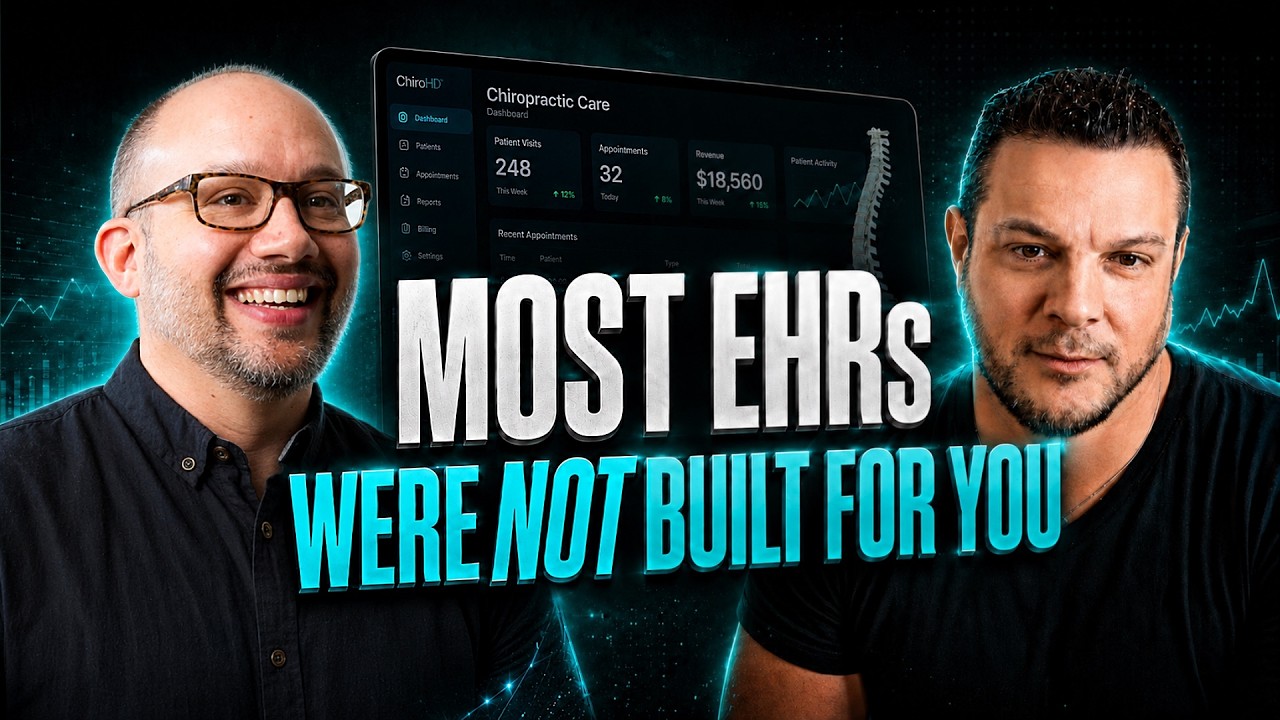
Jeff Langmaid interviews a ChiroHD representative about why most EHRs fail for chiropractic clinics. They discuss workflow challenges, HIPAA compliance risks with AI, and ChiroHD's roadmap including an AI scribe and virtual front-desk receptionist built for high-volume practices.
Chapters
I won't ask you to throw any other companies under the bus, but clearly you keep your finger on the pulse of what's going on within this industry and in the broader context of EHRs and healthcare in general. Maybe just highlight some of how you think about implementation and how ChiroHD applies it in a different way than many docs are probably used to.
Yeah, it's a great question. I think, I think this field is really tightening, which I, you know, I'm not going to say we were, I'm not going to say we were causation, but we were definitely a catalyst. Like if you look at when ChiroHD entered the market, what was available and what's happened over the last 8 years. You know, when we entered the market, we were really the second cloud-based system that was viable for most clinics. And now almost everyone's either in the cloud or about to be in the cloud. You see most people catching up there. We were really the first to have this idea of having everything in-house. So now everyone's trying to do the same thing. So I will say, like, the differentiation is always like a little— it gets tighter and tighter as people's competitive edge, uh, changes. So I think when I'm looking at strategy, first and foremost, it's serving the chiropractic community, their patients, their workflows. And they've got some very unique workflows. You know, I talk to people in other industries and in other sectors, and like, when I start talking about some of the complexities, like, their eyes glaze over. They're like, I have no idea how we would handle that. Um, case in point, uh, patient volume. Like, it's very unique to have, you know, clinics that see 100, 200 patients a day. Like, you don't see that in any other sector of— or I don't know about any, but very, very, very few places you're going to see that level of volume, which introduces all kinds of complexity, not just from scheduling, but from insurance billing and recruitments and all these different things like that. Now you're taking what, you know, a small medical office might see 8 patients a day, very easy to manage 8 claims a day type with one biller. But now you're doing 150 claims a day. For much smaller tickets. Like, there's just all these little things that compound complexity inside of chiropractic. So making sure that we're really focused on those nuances that make chiropractic a unique market and make sure that we're serving that well is, is like a really front and center thing. Um, and, and to your point, not a negative of those other EHRs, but a lot of them haven't thought through what that type of volume is. And you see that, that there's some that have solved it better than others, and you'll see that chiropractors tend to you know, if they're a high-volume clinic, there's, they tend to gravitate to one or two solutions because there, there really isn't a massive solution for it. But I think in the broader kind of outside of that sense, I mean, you know, I think security is a huge thing right now. I know we've touched on AI, but like the, the AI security breach stuff is, is only getting started. Like AI is a very powerful solution that's being used in mass attacks. So like, like we're really heavily looking at our security infrastructure. We're going through some, some additional audits and some certifications to make sure that we're, We're top-notch when it comes to the security side of things. We're also paying really close attention to compliance as we start working with like AI tools. There's a huge host of compliance things that as people are wanting to, you know, everyone wants to use AI for this, that, and the other. And I've seen doctors like take patient lists and drop them into ChatGPT without proper licensing or HIPAA acknowledgments, BAAs, those types of things in place. So we're really close to the pulse on what's happening in the legal aspect of this and trying to make sure that as you start using these tools in RHD. They, they're used compliantly and reg— in, in under regulatory, um, duress. Yeah, oversight, whatever you want to call it.
Yeah, that— yeah, I think that, that, that, that is critically important. And I'll say that's kind of the boring stuff that docs don't think about until they have to. So I think it's really nice that you guys are doing the hard work, not so they don't have to— they still need to be compliant, of course, at a practice level— but knowing, uh, that the software that they're relying on from a practice management perspective all day, every day is diligent with that is, is I think really, really important for so many docs out there, especially with so many different systems available. So knowing that your system that you're using, in this case ChiroHD, is going to give you every opportunity to stay as compliant, stay as secure as possible with what you mentioned, uh, an ever-evolving landscape, is really, really important. So for sure, if we were to look forward— let's have some fun— uh, if we're to look forward next quarter, next 6 months, um, what are some product roadmaps roadmap items that, uh, you're at liberty to discuss or hint at?
Well, I, I kind of— oh, I've mentioned two earlier that I, that I will just reiterate, is that we are looking to bring a couple AI-forward features to the market: an AI scribe tool and then also a, um, a front desk receptionist. I think those are, um, definitely in, in the near term, like, we're doing beta testing with both of those, and I think that we'll see those come up hopefully in the next quarter. I do think our scribe solution is going to be one that chiropractors haven't seen from a scribe. So I'm really excited about how that gets rolled out and how it works compared to what's in the market. You know, chiropractors have a unique thing when it comes to scribes. Most, most chiropractors are not walking through an adjustment, giving detailed oration of what they're doing. Let me— oh, I see fixation around T5 and like, like they're just not talking that way with, with, with patients, which is a challenge when you're talking about scribes versus, you know, maybe a nutritionist who's literally sitting there and talking nutrition with you for, for 30 minutes.
Yeah.
So, so there's some interesting things there. I'm really excited to get that out and demo and show how we've approached this because I think, I think a lot of people are going to be really excited about it. And in the Hint world, I think I've alluded to a few, but I'll give you a little more pieces here is, you know, AI, is incredibly powerful in certain pieces. Um, and, and one of the biggest friction points in ChiroHD right now is, is another unique thing about chiropractors is there is a million ways that they measure things. And, um, trying to get a million ways to measure things into a, into a deterministic system is incredibly difficult. And, uh, if you look at like our com— if you look at our backlog and our, uh, complaints and feature requests and things over the last 8 years, so much of it is around like flexible reporting. Um, and, and we've tried over the years to just continue to add more and more and more and more reports, and it just never seems to be enough, and people want to look at it in different ways. And, um, I'll just say that I think that that problem is going to go away sometime this year.
So, all right, all right. Thanks so much for checking out that interview. If you liked it, we have plenty more available. You can check out the next interview right here.










