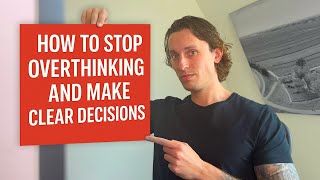
Jim Ebbelaar, CEO of a software agency, shares a four-step framework to cut through overthinking. Check if a decision is reversible, then ask if it's a clear yes or no. Weigh long-term growth against short-term pain, and align it with your top three values. If you're still stuck, trust your gut.
Chapters
What sets apart the top 1% is not their talent. It is actually the way they make their decisions. Think about it for a moment. Your life literally is the sum of all the decisions you've made up until this point. Now, to give an example on that, you can either decide to close this video and maybe miss the opportunity of a lifetime because you don't know how to make the right decision. Or you can spend just a couple of minutes so I can teach you how to do it. My name is Jim Ebelhard, and as the founder and CEO of a scaling software agency, I have to make a lot of decisions. And in this video, I'm going to break down to you my exact process so you can stop overthinking and actually start making the right decision. Let's dive into the video. Okay, so let's dive into the decision-making system. Starting off with step number 1 is asking yourself, is the decision easily reversible? This is something I've learned from Jeff Bezos, and it's one of the reasons why Amazon was able to grow so quickly. So what Jeff recommends is if the decision is actually easily reversible, most of the times you just have to pick that one, pick that option, and make the decision without really overthinking it. So as you can see right here, it's a yes, and we immediately go to decision made. Why? Because even if it turns out to be the wrong decision, it doesn't really matter because we can still learn from it, iterate again, and just do it over. So this is basically a first quick little hack you can start to implement to basically cut through the noise, stop overthinking, and start making decisions faster. But this of course only counts for more simple reversible decisions. If this is not the case, so it's a no, then we move over to step number 2, which is checking if it's a boolean choice. And what I mean by boolean choice is basically checking if the situation is a true or false kind of decision. So checking whether it's a yes or no, or accept versus decline. If this is the case, then we follow this step. So it's a yes, it is actually a booking choice, so a simple kind of yes or no. Then the first thing I recommend you to do is checking if the option actually feels like an obvious choice. So is this an obvious yes, should I actually do that? You can check this with gut feeling or with logical sense. Sometimes you just are sure that you should do something, but a lot of the times we actually say yes to things that deep down we definitely shouldn't do. And while this one might sound a bit obvious, trust me, this is so game-changing. I learned this from Naval Ravikant, which is a very inspiring tech founder. An Investor. And what Naval basically teaches is if the answer is not clearly a yes, the answer should probably be no. And this resonates with me so much because when I was scaling my software agency, there were so many things to decide on, and still up until today, but now I'm just better controlling it. What people am I going to serve? What products am I going to offer? What will my pricing be? And especially when there's a new opportunity, well, I always got excited by surfing a new industry or working on a new product, but making the decision to actually start working on those new things is causing so much mental headspace, and which basically almost always results into scattered focus and mental fog. So One thing I can highly, highly recommend you to start doing is just setting the default to no, skipping more things, both in your personal as well as in your professional life, because just this step will already allow you to start making better decisions. Back to 2.1, so if it actually does feel like an obvious yes, then what we do is we move over to step number 3. 3. And we also arrive at step number 3 if the choice was not a boolean choice, which I just explained. So step number 3 is checking whether an option is resulting more into short-term and long-term potential and pain. And what I mean by this is basically first checking is one of the decisions that I can make aligning more with where I want to head in life. On the long term. And the interesting part here is that our brains are naturally wired to seek comfort in the short term. That is why, for example, it's so easy to just scroll social media or skip the gym, because behaviors like those, they release a lot of dopamine. So if I scroll, I release a lot of dopamine, and that's why it's easy to do. But behaviors like this and decisions like this almost always result into feeling bad in the long term. And this is both on micro level with examples like scrolling and skipping the gym, but also on macro level when you have to make the bigger decisions. So choose short-term discomfort if it leads to long-term growth. And that is why you should take the pain in the short term. So if there is a clear winner in long-term versus short-term potential, pick that option. But if this is again a no, Then we arrive at the final step, which is values alignment. And what this means is basically checking if there's an option that clearly is more aligned with your top 3 values. And if you don't know your top 3 values, I highly recommend you to do some research and gain some insights on what those are. So you can check out the link in the description to InnerSights. That's our platform. It's an AI self-discovery platform. And we also have a module that will give you more insights in your top 3 values, as well as an AI chat with this decision framework in it that you can use for free to start making better decisions. But if you don't want to use it, you can of course just check online what are values, personal values, and pick 3. So mine personally are Number 1: growth. Number 2: purpose. And number 3: having fun day to day and just living an overall fulfilled life. So when I have to make a difficult decision and step 1, 2, and 3 are not able to help me making the right decision, I check with those 3 values which decisions align best. And then most of the times this results into me being able to pick the right decision. But if we still can't make the right decision based on those 4 steps, it's still a no on this side, then what I recommend is going inward. Because some things you just can't decide on with logical sense, with thinking. Some things just require feeling and going inward and checking your gut feeling. Because most of the times this is actually the decision that you have to make. Make. Okay, and that was it for today's video. Thank you so much for staying till the end. If this video resonated with you, it would be very nice if you can leave a like and maybe subscribe to the channel. That will also help the algorithm so more people can find this video and start making better decisions. For now, I wish you a wonderful day, and hopefully I will see you in the next one. Goodbye.