The Productivity Trap — Why You’re Stuck & How to Fix It
Jim Ebbelaar, a burned-out agency owner, explains why longer hours kill productivity and introduces the ADHD Productivity Trap: a cycle of overwhelm and task-hopping driven by the Zeigarnik effect. He outlines a system using the 80/20 rule, flow cycles, and the eliminate-automate-delegate framework to build sustainable energy and momentum without burnout.
Chapters
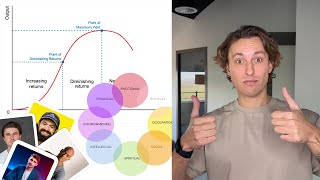
Do you ever feel like no matter how hard you're working, you just can't seem to get it done? You feel like you're falling behind, which is making you feel overwhelmed. You try that new productivity hack, that new tool, that this time, maybe this time it will work, but you just can't seem to get it done. Well, I've been there a little over a year ago when I was running my digital agency while actually burning out. And in this video, I will show you the exact system that I've been using to get out of this burnout, double down my business, but more importantly, doing it in a stress-free way. So let's start off this video with this very first question: So does more hours equal more money? Or does more hours equal more success? Or so to say, is more input always more output? Or is it actually making you less productive? Well, let's dive into this concept of the law of diminishing returns. So to explain this law, I have listed this chart over here that is quite interesting. If we take a look at this chart, it's basically split it up into 3 areas: the increasing returns, the diminishing returns, and the negative returns. And to further explain this, I want to give some examples. So starting off with the increasing returns, we can look at this chart from a micro level or from a macro level, so a longer period of time. But let's look at the micro level and see this as a working day. So you start off your day and so you see you need some time to basically get in the zone, get to focus, and then the chart is going steeper, steeper, steeper up until a point where you reach diminishing returns. So this first area actually is the green zone. This is the area where you mostly want to operate from because you're in the, you're in the zone, you feel the flow and you just get things done. But there also is a point where you basically cross that and that's the point of diminishing returns and This is where you basically don't have that much focus anymore, or maybe you didn't sleep well, so you instantly start operating from this point. It's basically meaning that more input is not converting exponentially anymore into more output. Here you can see the exponential growth, and then here it's basically going less and less steep. Of course, it's completely fine to operate from this area, yeah, sometimes. I mean, you can't always have the exact amount of right focus and get your things done. But try to optimize for this area. And then if we look at this point, that is really the danger zone because if you don't watch out, you basically cross this point called the point of maximum yield. And why is that a dangerous point? Because what we can see here is that our input is actually not growing anymore. No, it's basically going into a negative direction, going downwards. So this basically means that our input is converting into negative results. And to give an example on that, maybe you're really tired, it's end of the day, but you still have the feeling that you complete this— have to complete and send this email, but you accidentally make a mistake, which can really mess up and result into a bad client or maybe a stressed team. So that is basically the point where your input is converted into negative output, and it might have been a good idea to just stop and take some rest. So to further dive into this concept, I've created some extra diagrams to zoom in on this and also explain how I implemented this into my life. But before that, let's dive into a bit about my journey and who I am and also why I am actually making this video. So back in 2016, I started as a digital entrepreneur while still studying. So I studied software development and afterwards I did a study Business IT and Management. And during this period, life was going fine. I mean, I had some struggles, especially with keeping up with my routine and things like administration. And yeah, sometimes I struggled with deadlines. I just couldn't really get the work done until I really felt the pressure for something. But I mean, everyone had these struggles and yeah, nothing really special in that period. But then something flipped and it was actually back in 2021. During this period, I completed my studies. And that kind of let me fall into this hole where I had no routine and structure that school was basically providing. So I could do everything on the times that I want, when I want to do it, decide my own deadlines. And that basically messed up a lot of my, yeah, habits, my routines and structure. So this basically resulted into me falling into this hole. So that was when I started learning about productivity methods and finding out how I could to get things done. But I started with following neurotypical methods because I didn't know that I had ADHD. So I started reading books like Getting Things Done, trying a lot of different online tools to, yeah, to make to-do lists and get a better scheduled calendar and stuff like that. And also at that same time, I really got influenced by the so-called hustle culture. And for those of you who don't know what it is, Hustle culture basically is the culture that we see online where people are inspiring us to grind for your business, which of course is a good thing, but some take it quite to the extreme. And I've listed some examples here, maybe you know them, maybe you don't, doesn't really matter. But for me it was quite tough because what I saw online is those people making 100-hour weeks and just grinding, grinding, going all in. And I was like, okay, I can't even manage to get get normal tasks done. I can't keep up with my administration. And that basically resulted into the question, what is wrong with me? I tried to find it by switching from project to project because I thought maybe this is just the wrong thing that I'm doing and that's why I don't have discipline and motivation. I just didn't feel willpower. Yeah, so a combination of all those things really got me to that question, what is wrong with me? And that is actually when I went to the doctor in 2022. And then I got diagnosed with ADHD, and at first this was great because I finally had an answer to all my struggles. And yeah, it was really nice to understand that there was actually something wrong with me and that I'm not crazy. Or actually, you are crazy. Well, to have a look on that, in that period I also started taking ADHD medication and Yeah, this is not medical advice, so I'm not a doctor or something. This is just my personal story on how the meds went for me. Starting off, it actually went great because the medication really allowed me to get good focus, build routines, build habits, and especially focus all day and yeah, get things done, keep up with routines, get my administration on point. So at first it was going great, but It did— didn't take very long, I think around 1.5 years where it really took a downside. So I got really, really dependent on this medication, especially with work. And basically it also resulted into me becoming pretty obsessed with productivity because it allowed me to focus for such a long period. I was really able to commit and do the work without taking any breaks, and I basically became obsessed with productivity. And this is basically also the phase where I learned the hard way that more work isn't always more success. Because I basically burned out. This was a very sad period where I was just sitting behind my desk all day trying to do as much work as possible. I started skipping the gym more and more, I started eating less healthy, I started to skip social activities and stuff like that. Up until a point where I was just me sitting at my desk and thinking: what am I actually doing with my life? And then I felt into, I got into a burnout. And that basically also brought me something because that got me into the new phase. The phase starting from 2024. I was doing yearly reflection thinking, okay, I really have to flip things around. So I decided to start skipping the ADHD meds and started to prioritize my well-being and try to fix myself from the inside out instead of being instead of taking medication. And what I did is I did a lot of research online, read books, see some podcasts, listen to podcasts, and that really teach me a lot about well-being, health, and also business. And that's where I actually am today. So I started prioritizing my personal well-being, put that in the first place above everything. So not business first, no, me first, and then comes the business. And first make sure that I'm healthy, happy, rested, and able to actually be the person that the business needs to do the work. And up as today, I can honestly say that I'm running quite a successful digital agency. Why successful? Well, we double down our numbers every year. So the fun fact is that while actually work less compared to last year, we did again double our numbers. So that's quite an interesting fact. But even more importantly, I am feeling happy, I am well rested, and I can run the agency without having the stress that I had back then. So to summarize that, I'm basically using a system that is working with my ADHD brain and not against it. So that was enough about me, now let's dive into the next concept which I call the ADHD productivity trap. AKA the trap that got me into this burnout. And to make this, to explain this to you, I've created this diagram that basically explains the cycle. That got me. So it starts off with feeling overwhelmed and behind because you can't commit to do the work. Then you start comparing yourself to others. So for me, that was this whole hustle culture thing online, seeing people grind, make those long days, booking results. And I was like, okay, I feel overwhelmed, I can do this. So you really start feeling behind and this makes you trying to force productivity. But the problem is that you're forcing to get focus instead of actually fixing the system, aka you yourself. And that is resulting into overworking and not solving the problem, but it actually creates more unfinished tasks because you can't force it. And yeah, this way you won't be able to finish it. Well, then finally it results into having too many open tasks because you try all these new different things, but you don't, uh, um, you're not able to finish them. And this creates a lot of mental load. And this mental load, you really can compare this to a computer system, for example. When you have too many open tabs, the computer is getting slower and slower, and eventually it just crashes because it isn't able to process the information anymore. There's also an interesting theory called the Zeigarnik effect, and that is basically this illustration. And what this is teaching us, that on the left we see memory retention for a finished task, then we see that just a small part of the brain is actually being taken up by this finished task. But if we look at this brain scan and we check at an incomplete task, so something that we didn't finish yet, you can see that it takes almost the full capacity of the brain. So this means that things that are in our head that are not finished yet but we actually are feeling motivated to finish are taking up a lot of brain capacity. So this is causing all the mental load, which is basically resulting into decision fatigue. Your system is overloaded and you basically don't know what to do anymore, when to do it, and what are the next steps to take. So the problem is your brain is overloaded with unfinished loops and not actual workload. So this makes you feel overwhelmed by unfinished tasks and your brain seeks quick dopamine relief. So especially if you're someone with ADHD, You really feel bad because of this, and then you are basically automatically starting to look for the easy way out. Because you feel bad and your body is seeking this dopamine to start feeling better. So that's the point where you start novelty seeking, aka chasing dopamine. And this will probably make you jump between tasks. So for example, there is something on your to-do list and you know that this is very important. But you just can't seem to get it done. So you end up doing the easy things that are quickly dopamine-releasing, like checking your email and yeah, just doing stuff that is not important at that point. And this actually makes you into a state where you feel very busy but you're not actually being productive. And this is if you're actually still able to do the work. If you basically get to the point where this gets worse, it will also result into you just scrolling social media, maybe eating junk food, or do other things that are very very bad for you. Well, the problem is that you chase quick dopamine hits instead of meaningful results. And this is basically an endless loop. So this cycle repeats itself into again feeling overwhelmed and behind. And then the cognitive dissonance is showing up. And what is cognitive dissonance? I've put this illustration here to quickly explain it. It's a very simple thing. Cognitive dissonance is basically when you have two beliefs and there's an internal conflict. So on the one hand you have your perception and there's the reality. And there's basically a conflict in belief and that's why you start maybe to self-sabotage or just start feeling even worse. Because on the one hand you know exactly what you need to do to get the needle moving. But you just can't seem to get it done and start novelty seeking by chasing dopamine. So that's what I call the ADHD problem. Productivity trap. How did I manage to get out of this? Well, starting off, I really had to, uh, yeah, dive in this paradigm shift. And what I started doing is basically, um, flipping things around and really started seeing my business as a reflection of myself, or my work as a reflection of myself, and also results a reflection of my health. And that is basically when things started to change. So instead of focusing only on business, You need to optimize all areas of your life. If your health, relationships, and mind are a mess, your business will be too. And this is so true. Maybe if it's not the case yet, it will become, but trust me, if you're stressed out or if you're not feeling well, this will result into the circle around you. And to further explain this, I want to dive into this concept of the 8 dimensions of well-being. And if we look at this, we can basically see all those dimensions of well-being. And as you see, this yellow circle over here, which is the occupational dimension, basically includes everything related to your work, your career. So this is also your business, but those dimensions are interconnected. So you already have to look at this from a holistic perspective. So if you're physically not feeling well, this will result into problems into your business. And so is that with every dimension. So To give a personal example from me, when I was taking the medication and feeling bad in that period, I started sleeping worse. So yeah, my energy was drained. I started eating more junk food. So yeah, also draining my energy. I also started skipping the gym more and more. So this physical dimension really was going down, down, down, down, down, up until the point where I also skipped social activities. So also this dimension was going bad. And I'm really an extroverted person, so for me it's really important to be around people, getting those fresh new energies, new ideas, because that also will result into better business results. Then if we take a look for spiritual, for example, if you don't know who you are on a deeper level and you don't know why you're actually doing the things that you want to do, it will be very hard to stay motivated and do the work for your business because you don't understand who you are and why you're doing the work. And then one final example, if we, for example, look at the intellectual one, especially now in the digital space with the whole AI trend being around, things are moving so quickly. And if you don't invest your time and energy into learning new things, it probably won't be taking very long until you will get replaced. So I think those are enough examples. Maybe you can also check for yourself how you're doing in every dimension. And that is also something that I recommend, but more on that later in the end of this video. Now I want to dive in the new diagram that I've created where basically I started flipping things around, implementing the, uh, uh, science and knowledge from above. I created this diagram called the ADHD Productivity Accelerator, and this accelerator basically, uh, doesn't start with forcing productivity. But it actually starts with putting you first and your energy first, your well-being. So we start by actually tracking our energy. And we start with checking, did I sleep well, do I feel rested, am I the person that is actually able to do the work at this point. And then if we start working, we start by applying Pareto's principle. And it's a very easy principle. Pareto's principle, also known as the 80/20 rule, is basically teaching us that 80% of the results are mostly generated by 20% of the input, aka 80% of the output is generated by 20% of the input. And this can be applied to almost everything. So it's in business, it's in science, it's economics, it's in the stock market, and it's also with your productivity. Most of the times, you know exactly what the tasks are that actually are moving the needle forward. So try, really try to focus on that task first instead of just seeking quick dopamine relief. Then when we do this task, which is probably a harder task because it is the task that is actually moving you forward, we try to work in flow with natural cycles. And for me, that means doing the work in the, in the morning because I'm really a morning person, and this allows me to, yeah, get in the flow state early, start early, so also the clients are not able to call me yet, and just having my own time to really focus on that 20%. What also helps a lot is actually setting tight deadlines for yourself. So there's a law called Parkinson's Law, which basically is teaching us that you always take the time that you have for something, but this is also resulting into really not working in an efficient manner. And this is something that I also learned during my studies. So for example, when I was doing my thesis, I had months to do it and I planned out days to start working on it. But yeah, when I started sitting at my desk, I just really didn't got the focus. But as soon as the deadline came closer and closer and closer, up until there was just like a week left to actually finish the thesis, that was the point where I actually started entering in the hyperfocus mode and was able to work very, very hard. So you can cheat this for yourself by actually setting deadlines for yourself, or maybe find an accountability partner so you can do this with them. And then the outcome of actually tracking your energy, focusing on the 20% and doing it in natural cycles will allow you to have sustainable energy and perform. Better energy is better decisions. So to further work on this, you have to create a clear system. And what I personally use is eliminate, automate, delegate. And we do this to try to be optimizing in the diminishing returns chart. So we try to be in the green zone that we just talked about. So we start off by checking what can I eliminate. So a lot of times there are things on your to-do list that are actually not that important. It are just ideas for someday, but they are actually causing that mental load that we talk about, which is kicking off the Zeigarnik effect where your brain feels very loaded. So I recommend you to maybe split up into another list where you, for example, list the things that you want to do someday but are not actually that important right now. Then also check what you can automate because there are so many good tools nowadays available to make things easier, especially with AI, things like ChatGPT and almost every program got automation by AI natively integrated these days. So check the things that actually can be automated so you don't have to do them themselves. And delegation. This is so important and I wish I knew, I started implementing into this into my life and my business earlier on. Because if you're, especially if you're someone with ADHD, you find it really hard to do things that you don't really love to do. But it can be so much easier to actually start delegating them. And in the beginning this can be quite hard, but there's a really nice book on this called Buy Back Your Time that is basically teaching you systems on how to delegate efficiently. So yeah, eliminate, automate, delegate, and then We have the single focus on that 20% and we know exactly what to do and how to do it. What is very important at this point is that we also set clear success metrics. So for example, if it's a really large task, split it up into multiple smaller tasks because by creating this clear success metrics and also being able to check them off your to-do list, you actually start completing things. And this is basically building momentum and confidence because you Basically get that cycle running where you started finishing those important tasks and you build the confidence to actually continue with this. And the outcome is a clear mind and focused execution. And then focus creates momentum. This will allow you to reinvest your time. So you're saving a lot of time by implementing the above and this time then can be reinvested into your own well-being and your own growth. And of course also back into your business, but as I just mentioned, start with yourself and with your own well-being before scaling the business and investing more into the business. And when we do this, we also want to track ROI. ROI stands for return on investments. It's something that a lot of businesses apply and for example if you start investing into something, you probably also want to know what you get back from this and you can apply this to money hours, but you can also apply this into your own well-being. So I, for example, use Whoop. It is a really advanced health tracker that is allowing me to track my habits and also see how this is impacting me and my life. So for example, my sleep metrics, my health data, how much I work out, did I meditate, yes or no. So all those things I can track it. But of course you don't need something really advanced. You can start really simple by just journaling and keeping a log where you basically log How well did I sleep? Did I work out this day? Did I meet my friends and stuff like that? And then see how those habits are basically impacting your well-being and your work. And by implementing this, you will be able to scale your business without burning out. And the outcome is sustainable growth and fulfillment. And this is basically again an endless loop, but this time it's a positive feedback loop, which I call the upward spiral. And each win is basically making you a stronger person, a stronger version of yourself, and also resulting into better business results. Okay, so that was the ADHD Productivity Accelerator. Now to finalize this video, I have 4 summarizing— listed 4 summarizing points down here. So let's go through them and then yeah, that was it for today. So instead of actually forcing productivity, we start off by tracking and managing our energy. We make sure we are the person that the business needs to actually do the work. And instead of getting this mental overload of all this unfinished work, we try to reach systemized clarity by automating, delegating, and prioritizing the preto principle tasks. So the really the 20% that is actually moving the needle. And I also listed the 5-minute rule here at the mental overload. So what this actually means is if a task is taking you less than 5 minutes, just do it instantly. Because I still fail at this sometimes. There's something that just taking me 1 or 2 minutes, but it's just so bad to do. For example, returning a package to the, uh, something you ordered to the shop. That is something that I really hate to do, even though it takes me 5 minutes. Sometimes I skip it for days, but it is all building mental load in your head. So if something's taking you less than 5 minutes, just do it instantly so it doesn't even have to come on your to-do list. Then there's dopamine chasing. Jumping between tasks for quick dopamine hits that keep you stuck in busywork. Well, this is again something we want to skip and instead do the hard things first. And there's a book called Eat the Frog that really dives into this concept of doing the hard things first, which will basically create the momentum. So for me, this is what I do early in the day. I start with tackling the hard tasks first, build momentum, so I can continue to work afterwards. And all of this hopefully will result into you not burning out, not feeling exhausted because you just measure success by the hours that you work and how much business results you are making. No, instead of that, you actually take your time and you reinvest it into your growth and your well-being. Okay, and that was it for today's very first video. Thank you so much for staying until the end. If you like this video, I highly recommend you to subscribe to the channel, maybe also like this video, and hopefully I will see you in the next one. If you want to access the material that I used in this video, there's a link in the description that basically will give you access to all the material that I used, and it's completely free. So yeah, if you like that, have a look, and hopefully I will see you in the next. Thank you and have a wonderful day.