Developing Your Weight Loss Skills
Jim Katsoulis teaches weight loss as a learnable skill across three domains: mindset, lifestyle, and eating. Instead of fighting cravings, you build repeatable habits like slow eating and structured meals until they become automatic, the way brushing your teeth does.
Chapters
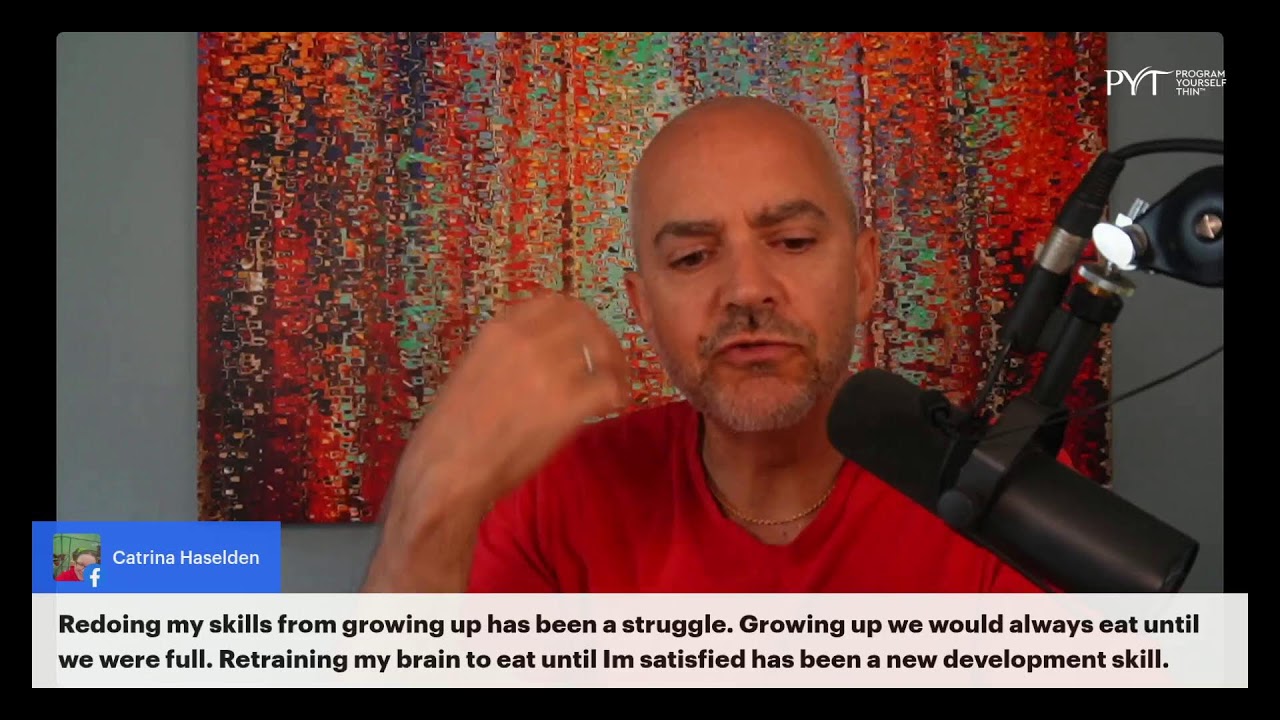
I think that is one of the most important frames you can have when approaching your weight loss, because most people approach their weight loss not as if they need to develop skill, but as they need to stop themselves from doing the wrong thing. And so a lot of people are internalizing weight loss as a process of restriction and kind of holding yourself down. But that's a temporary process. You can only kind of resist against yourself for so long, simply because The thoughts and behaviors that kind of happen, that you're fighting against, happen automatically. So it's very easy to crave the wrong foods, to want to overeat when you're eating dinner automatically. And what weight loss is about for most dieters is fighting against those automatic natural impulses. So the flip side here is that we're going to approach our weight loss by understanding that it's really an accumulation of skin. And if you can develop very specific skills, you can take much better control of your weight. So we're not going to go into weight loss assuming that you know everything you need to know and you just need to force yourself to do it. We're going to take a step back and realize that your weight ultimately is a reflection of your automatic skills. Now, in Program Yourself Thin, we break that down into 3 specific categories: how you think, how you live, and how you eat. Mindset, lifestyle, and eating. But all three of these, you already have skills of how you think, of how you live, and how you eat that are getting you the weight results that you're getting. And I think this is a much better way to look at it because if you think about why you may be struggling with your weight, it's happening on autopilot. The way you eat, the way you think, the way you live, the way you deal with things all goes into your weight. And if you get better at those things in terms of weighing what you want, the whole process is different. So instead of just fighting against our emotional eating, we understand and start practicing how to be more skillful at dealing with emotions genuinely without needing food. And if you develop that skill, it's going to be easier to say, oh, I feel sad. Let me activate my strategies that help me when I'm feeling sad genuinely. that have nothing to do with food, as opposed to the dieter who gets sad and wants to eat everything and now has to fight against themselves. No, no, we're on a diet. Don't do it. You can see the difference. And that applies to everything else. The way you think about this, your motivation, your self-image, your habits, your emotions, your thinking, your maintenance plan. All of these things are skills that you most likely have never really worked on developing. Your lifestyle piece, your sleep, your hydration, your relaxation. Uh, your breathing, your nourishment, your movement, your meditation, your gratitude. These types of things are skills that if you start to get good at them, you start to have way more control and ability to influence your eating and ultimately your weight. And then finally, your eating skills. Again, you may not think of it as a skill to overeat every dinner, but we're not judging skill as good or bad in this context. We're just saying, how am I getting the result of being overweight Oh yeah, because I've automated a lot of the skills that keep me overweight. That's the reframe here. And if we buy into that idea, then the solution is going to be, well, I'm going to develop the skills that keep me at my goal weight. And so when it comes to eating specifically, and you start looking at your eating patterns, your eating habits and behaviors, as you start looking at those as skills that you've learned along the way and now just do automatically, it changes the whole context of what we're doing here. Because again, as a dieter, you're just going to fight against those skills. But in Program Yourself Thin, we develop new skills so that you naturally eat just the right amount of food, so that you automatically don't snack in between meals, whatever it may be for you. But if you start looking at it as a skill, it changes the whole frame. And one of the most important reasons why now is because we start to have a better sense of the time frame needed to do that, because The idea of dieting, that tomorrow's Monday and I'm going to completely change everything, is so appealing because we get fast results that way. No one's questioning that. The big problem that always comes due is that you've got to keep doing it, and almost no one is able to maintain that strict way of being for very long, even when they get to their goal weight. 85 to 95% of dieters that get to their goal weight are estimated to put it back on. So the alternative is to look at it as skills and to give ourselves the time necessary to develop those skills. So you almost look at managing your weight almost like you're learning to play the piano. You break it down into different pieces, you practice the skills in a comfortable way consistently, and what happens is you start to develop the skills of being able to think, live, and eat the way that you want to so that you can be at your goal weight. So this is the reframe. And if you take a second and just imagine the skill of eating, right? So think about this. You eat at a certain rate and speed, most likely, especially like dinner. Maybe you're a fast eater. So instead of fighting the fast eating and saying, I got to stop eating fast, we start to develop the skill of being able to eat slowly. With the goal being that eventually it's just going to be automated, and that's just how we eat. But it starts by thinking about what would the skill of eating slower feel like? If you take a second right now and relax your face, your shoulders, your chest, your stomach, let them relax completely. Now connect to your breath. Take a few deep breaths. Let them out slowly. Connect to your breath. Connect to your body and relax. And now imagine yourself sitting down where you typically eat dinner and typically used to eat fast, but imagine yourself eating slower. Imagine the rhythm and the pace of eating slower when your body feels grounded and calm, when your mind's centered and present, when you're enjoying the food, being grateful for it. Appreciating the moment where you get to eat this in a safe, nice environment. And imagine yourself breathing slower, being more relaxed, eating from this place physically, mentally, and emotionally. Putting your fork down, enjoying the food and chewing it completely. If you're eating with someone, you can have conversations. If you're by yourself, maybe you're reading an article or a magazine or your phone. The whole rhythm and pace begins to shift, and now you get a sense of what it's like to have the skill of eating slower. And again, this is just one example out of literally hundreds that you can start to develop. And what I'm trying to ultimately say to you is that you've been approaching your weight as if you have to fight against yourself instead of developing the skills that get you the result you want. And once you make that shift, the whole process begins to change. And if you want to experience this firsthand, you can click the link in my bio. You can go to programyourselfthin.com, or if you're on Facebook, you can click— you can type mind, M-I-N-D, uh, into the chat and it will automatically send you a link. But I want to give you a free hypnosis session that helps you experience this firsthand, where you create this internal sense of calm and peacefulness and you begin to use your mind intentionally to get the results you want. You begin to work with yourself as opposed to fighting against yourself, and it makes all the difference in the world. So go check that session out. Uh, if you have any questions, feel free to ask them. Again, I am here every Monday through Friday, um, to talk to you all and hopefully, you know, spread some, some wisdom and some new ways of seeing things, and sometimes even helping people get through their own Kind of personal challenges, and I've worked with every kind of diet there is. So if you have any weight loss questions, feel free to ask them. I see Gene saying, "Hmm, I never got the free meditation you said you would send." Gene, where did? I don't know where you got stuck. Okay, so what I would suggest is write an email to support at programyourselfthin.com. We'll get that set up. Sometimes things kind of get lost in the shuffle. So. Not sure exactly how far you got in the process, but we'll be able to get that fixed up for you quick because that session is there. And I'm super excited, actually. I got a new, a real exciting free program getting ready to go. I don't want to tell you about it yet. I'll surprise you with it tomorrow. I'll talk about it. Will I have it done tomorrow? Maybe, maybe it's ready to go. I just got to tighten up a few back things. But anyways, regardless if it's ready to go tomorrow or not, if you go get that free hypnosis session I was talking about, Uh, when I drop my new, uh, program that I'm giving away for free, uh, you'll be one of the first ones to hear about it. And, uh, yeah, can't wait. That's gonna be pretty exciting for you all to get. That is pretty cool. So anyways, it's coming, but, but, but we'll, we'll get there. Uh, but yeah, if there's any questions, feel free to ask them. I know it's kind of a weird week. I don't know. I've been doing some coaching calls and, uh, people kind of working to get themselves back into another year. So, uh, sometimes the summer's kind of ending, the fall's beginning, right? And then, I don't know, Labor Day was in a weird spot this year and all the rest of it. So, uh, one thing we're talking a lot about in the program this week is the idea of kind of refocusing a bit, uh, and, you know, we talked about yesterday on the podcast, but kind of a 2-phase process of reflecting on how the year has gone, what's worked, what hasn't worked, and then Refocusing for the rest of the year, you know, and refocusing and taking action doesn't have to be all to nothing. So if you've been a bit off track, the answer is not, okay, next Monday, then I'm really gonna dive into my plan. That's one way to do it, this all-or-nothing sort of dynamic. But another way to approach all that is that you could start small. And so you could use the fall season that's approaching as an opportunity to start with little things, maybe drinking some more water, maybe walking a little bit, maybe eating an apple in the afternoons. And if you live anywhere near I am, it's actually apple season coming up here. So put this on your calendar if you've never done it and it's available around you, is go pick some apples. I really am such a big fan of picking apples. I think picking apples was probably one of the first things, one of the first things I ever like, like healthiest eating thing I ever did. Uh, I did some other things, but like there's something magical in my opinion about picking a food, boop, and then eating it. There's a whole philosophy on kind of life force. You know, people see food differently. It's very interesting, food and how we think about it, because It was really about the 1960s. Ansel Keys, big wow! Did this guy ever know he would have the impact he would have on so many people's nutrition? But he did a big report, and one of the things that came out of that is that that was really the start of looking at our food as macronutrients and breaking it down into calories, macronutrients, and almost thinking of food in its. More of its parts than as the sum of it, of all the pieces. And, uh, I think we've lost a little bit of the magic of food, um, as we've made it more scientific and as we've broken it down into its macronutrients and its component pieces. Now, again, I think there's a lot of value in that, but I do think we gave some of something away a little bit when we did that because There's another way to look at food, I think, and it's very, I guess, primitive or intuitive—not to be confused with intuitive eating—but you start to look at food in its natural form and how you would eat it or how we have eaten it as human beings for a million years on Earth. And I think that's all the knowledge you need. To kind of follow this plan, you don't need any nutrition knowledge. You don't need any you know macro micronutrient knowledge. None of that stuff. You just use your own kind of instinctive wisdom. And when you think about food, you start thinking about whole natural foods and how they serve your body. And I think the best way to kind of play around with that is to get yourself in a situation where you are eating something that is freshly picked. It doesn't have to be an apple. Apple's an easier one typically, but any pick-your-own is, is I think ideal, right? That's number one. And below that though is literally if you find a farm near you where they've picked the food within the last 24 hours, say, right? And a lot of people have that, especially now this time of year. And if you go eat some fresh, whole, natural food, In a mindful way, where you consider philosophically what exactly is food in your life? What does it represent? You know, we've been so led astray our entire lives at this point. I mean, we just we have been steeped in bullshit our whole lives when it comes to food and nutrition. So I think a counterbalancing kind of piece is just trusting yourself, your own body. Wisdom, but then go eat something whole and natural that's fresh and eat it mindfully. Pay attention to the subtleties. What does food mean to you? You don't have to live this way, so don't let it make you feel bad. But what is food? It sounds like a silly question, but when you really think about it, you know what? What's food? What's the role? What are we supposed to do with it? Because a lot of times we don't know because we've lived in bullshit world where food is entertainment and food is a way to feel better and food is a way to. Celebrate, and food is a way to deal with depression. It's just food has been overtaken in our culture and completely reframed, and it's unbelievable because as humans, food for a million years has been the main focus of our entire lives for a million years, and yet in 50 years, we just. Practically wiped it out completely. It is, it's, it's insane. It really is insane when you consider it that the last 50 to 100 years, the way we eat has completely changed and transformed, um, and not for the better. And so I think you've got to balance, I think, um, balance out how you think about food, you know, because I think a lot of people, myself included, I went through this and I'm continuing to go through it, but it's like I thought of food primarily as a, like, entertainment practically, you know what I mean? Like, it was, it was, it wasn't nourishment first. Let me put it that way. It was fun. It was entertainment. It was stimulation. It was something to look forward to, you know? I mean, it was literally, it was just meal to meal to meal to meal to meal, just flowing through it. And, and there's nothing wrong with that. I don't think there's anything wrong with that. But It's so unbalanced, you know. So program yourself. Then we talk about like clean eating versus pleasure eating, or eating for fun versus eating for fuel, you know, just as a as a comparison. And I like both of them, right? But in this culture, all we get is the fun piece, you know. From the time we're born, I mean, everything is aimed at our brains conditioning us to think about food mainly as fun. And we don't think about it as fuel. I mean, you really have to kind of go out of your way to think about it as fuel, practically. And if that's going on, and it was for me, it's very difficult to get yourself to eat well. Because if you think of food primarily as entertainment, well, the second you reduce your entertainment, it becomes, what's the point? Even if I lose weight, well, what's the point? What am I doing? Am I looking forward to— how am I dealing with— how am I— what am I doing? And so I think the start of Really reprogramming your mind starts with how you think about food, and starting to kind of meditate almost on what food is really there for and what it does for your body. And I think you take that a step further when you go and put yourself in front of some fresh food. Ideally, you pick it and eat it because there's something that happens there that's non-scientific. I'm sure we could explain it scientifically, but but there's some I don't know of life force. I don't know if it's life force. I don't know if it's Chi, I don't know what it is, and I'm probably sounding a little woo-woo-y, but I do think that something's going on there. And I think the more you tap into that, the more compelled you are to eat whole natural foods because you start feeling like a human because humans eat whole natural food. That's what we've been doing for a million years. Humans have never eaten the bullshit that we're surrounded by nowadays. Yeah, this isn't a judgment. It's not a judgment, but it's a, it's a, what's the word? It's just an explanation of the fact, you know, that the food in front of us is, it's just lost its meaning. You know, we gotta get it back. Uh, what's up, Sanjita? Sanjita says, hey Jim, this is Sanjita 2.0. All right. Yes. That's what I was talking about here. Again, we wanna take our weight loss rapid and personal development. Just losing weight's not enough. If you're gonna do all this work to lose weight, you might as well do a little extra and become the person you want to be on top of it. Plus, ultimately, your weight's gonna demand it. If you want to weigh what you want to weigh, I think you got to become a better version of yourself. I don't think you can just lose weight and then just live at that weight. I don't think so. Most people can't, you know. It doesn't mean you can't, just means you got to do it a different way. And that's what we're always talking about here, uh, over at, uh Program yourself to land over here. I know I forget why I can't see the comment now, but I am. Oh yeah, it's Karen. Yeah, steeped in BS junk and poisons. Yes, on top of all the conditioning with the food. Yes, on top of that, uh, it's also got a bunch of bullshit in it as well. Um, it's not very helpful. Yeah, Cindy, so I'm so excited. Thank you. Yes, that's about the, the free program I got coming. So again, stay tuned in. Uh, I will have it coming soon. For those in the program, yes, the Walk Yourself Thin sessions will be coming this week. I know it's a week late, and that's just how it is sometimes, but it's coming. Uh, what's up, Jane? Jane says, I love eating fresh corn on the cob straight from the farm. It is what I look forward to at this time of year. Yeah, exactly. I just had some fresh corn the other day. Our— it wasn't that great. It was not sweet corn. It was— I don't know what the hell it was. It looked like— you ever seen that corn that's like kind of dark-kernelled, and it's usually I don't know if everyone has this in the country, but in New England anyways, we have like these dark corn kernels and we use them mostly as decoration during the fall and Halloween. Well, anyways, we got this, I don't know, heirloom corn or whatever, and it was all dark kernels. It was weird. It was weird. I didn't hate it. I didn't love it. It wasn't sweet. It was kind of, I don't know, it was kind of nutty. Talking about whole foods, it kind of, it tasted whole food grainy, you know? It was interesting. But yeah, corn I think is a great one. Again, go for the— start with the, the easier stuff: corn, tomatoes, apples, peaches, whatever, you know. Um, and again, fit it to your situation. If you can go to a farm, that's ideal. If you can pick yourself, that's ideal. If you can go to your local market and they got a local section, great, you know. Um, but make it a point. This is where I'd put my energy because the There's something magical when you eat the whole natural food. It like breaks you out of your trance. It really does. I mean, listen again, no judgment. I was there, but I mean, there was a lot of my life where I never eat. I never ate whole natural food. I was eating processed bullshit to processed bullshit to processed bullshit to relatively okay healthy to processed bullshit. That was the typical pattern, and so I've increased the whole natural food. Uh, and decrease the, the processed bullshit, that's done a lot of the heavy lifting for me. You know, what you eat leads to the next cravings. I always think, you know, you eat a packet of candy, it's basically, uh, cravings on layaway. You know, you eat that candy now, you can be guaranteed within the next 2 to 5 hours you're going to be craving more sugar. But the same thing holds true on the other side. When you eat something whole and natural, you feel Like you light up and that feels really good too. And you start craving that feeling. That's where I'm at. This was part of what I'm talking about. You know, this is a strategy that's built for long-term because it's hard to fight against yourself forever. It's not hard to change your programming and start to work with yourself. It's really not. You just never tried it. You never once said, how can I lose weight in the easiest, most enjoyable way possible? You've never asked that and tried to figure it out. So, you know, what have you done? Every single thing you've done is you trying to force yourself to follow some real strict, hard, difficult-to-follow plan. And so now you just assume weight loss has to be really hard. It's got to be miserable. It's got to be difficult. That's just what weight loss is. No, it's not. That's one version of it— dieting. And dieting is bullshit right down the, right down the line. It doesn't matter if you're doing Weight Watchers, keto, Whatever, they're virtually all bullshit because they're not how you normally act and never become how you normally act. It's you forcing yourself to act a way that's not really you. And most people, the vast majority, 85 to 95% of people, are not going to keep that up. So what's the alternative? Well, the alternative is to change your programming so that living at your goal weight is the natural thing you do. It ain't that hard. It takes some effort. I'm gonna say it's just, you know, listen to some hypnosis sessions, you just transform. But there's a pretty predictable, reliable system to make it happen. Uh, Jane says, in the last 50 years, the media has sold us on speed of preparation and the fun of eating certain foods. Yes, absolutely, absolutely. Um, yeah, even the, the how fast we need to eat, you know, that's such a big thing. I talk about that a lot. It's the, the idea of logistics and preparation of food is really one of the big myths missing pieces for a lot of people. Um, they'll— they may start their plan and have a good sense of what they should eat, but knowing what to eat is just a small part of the puzzle. I mean, you also have to have the things there so that you can make it. You have to have the knowledge of how you're going to prepare it. You have to have the time frames in your head. You have to have the schedule and the planning ready to go so it's ready when you're ready. You have to have your hunger in control so you can make it so that you can eat it. There's a lot going on there. A lot of times we just simplify things and that causes a lot of problems. It's, I gotta eat healthier. Holy shit, gotta eat healthier. That, that's all— that's carrying a lot of, a lot of load. There's a lot of things you got to do to eat healthier, you know. And, uh, I mean, even, even healthier, like even cooking something new, the cognitive load goes way up. You've all done this. Oh my God, when you cook something genuinely new, it's like you gotta look at the recipe, you're kind of looking at it constantly, you gotta go to the store, you're not sure what you need with this. It takes cognitive load to look at your list, get all the stuff, track everything. Bring it home. Okay, now the recipe. You gotta think about it. Gotta use that pan right. You don't know how to do it, so it takes lots of cognitive load, lots of energy. Then you eat it. You like it. You don't like it as much as you thought. Now you're a little disappointed, perhaps. All of that takes tons of cognitive load, and most dieters just jump right into that every meal of the day until you know for as long as I can keep it up. Problem is you can't keep it up that long. You know most of you dieters can keep it up for a couple days, a couple weeks, and then you just you. You're too depleted. You just go back to what you always do naturally, automatically. That's what happens every time. Even the people that stick with it long enough to lose weight, it's the same story. Eventually gets to the point, ah, I can't keep this shit up. Getting tired of this. I'm bored. Oh God, I mean, I had a piece of bread in 3 months. I lost 20 pounds, but I haven't had a piece of bread. I can't have pizza. It's the point, you know. Yes, Carolyn. Carolyn says, yeah, picking blueberries and popping handfuls in the mouth. Yes, it's one of the funnest things. Blueberries, I would say, probably my favorite. Probably my favorite pick your own. Now, by the way, I just want to share because this is, this is what I'm here for. It's to— I've gone through this journey. I'm still going through it for sure. But, you know, I think the first thing I ever picked on my own was, uh, apples. And since then, I've been lucky enough that there's a It's called different things. It's like a farm share, a CSA, community supported agriculture. Um, I forget the other names of it, but sometimes places, farms will offer like a CSA or a farm share. So you give them some money at the beginning of the, in the spring, and then you get, you know, shares of vegetables every week. But I found such a great one. It's called Red Fire Farm. Um, and it's here in Western Mass. But not only do you get the shares of all the vegetables and stuff, But there's also pick your own pretty much the whole season. So we start with strawberries, then we move into blueberries. We have different beans that we're picking, you know, then there's tomatoes, and then there's peaches, and then there's apples. And, and there's other things too, but those are the big ones. But oh man, blueberries. I just gotta say, they're so good picked fresh. You know, raspberries too. I will say I did have— what did I have? I had black raspberries. Those were weird tasting, but still fun. Again, you just feel it if you go and pick your own. I don't have to— I'm not gonna sit here and explain it to you. I'm not gonna explain it scientifically. I just want you to get the vibe. Catch that vibe of eating something fresh off a vine, fresh, fresh picked. Eat it. Do it a couple times. See what I'm talking about? You feel your whole— you feel your whole insides coming to life. I'm not being dramatic. If you do it kind of mindfully, it feels that way. Everything in society is promoted making life easier for ourselves. I remember reading that we were going to gain an extra day per week just by using these time-saving ideas. Yes, yes, for sure. Um, yeah, we're always bullshitted, you know what I mean? You gotta stop being bullshitted and just start doing the right work. Um, you know, I think the, the secret The secret to, in my opinion, the secret to making things easier, let's just food-wise, let's just talk about food. In my opinion, making food easier, cooking for yourself, eating, let's just say. And that to me is fundamental. I think, again, if we look at program yourself thin right here, if you look at the eating— oh, sorry, TikTok, you can't see this. If you look at this, this is the goal weight pyramid. But if you look at the eating, you know, first is awareness, becoming aware of what you typically do. But then there's structure. And the reason we have structure is simply because it makes it easier. Because when you're structured, someone— now again, it's not super strict structure, please understand. It's a general sense of how you're going to eat. What do you typically eat for breakfast Monday through Friday? What do you typically eat for breakfast on the weekends? What do you typically eat for lunch? What do you typically eat for dinner? Right? What typical snacks do you have? So it's not about changing everything all at once, being strict with what you're doing. It's about understanding the patterns that you already follow, right? You already have structure to your eating. I promise you, even if you think you don't, I guarantee you got structure to your eating. And once you realize the structure you already have, then we start working on creating structure that's gonna give you the body you want. But it's built around structure because that's how you save energy. To me, everything we do in the program is built around cognitive load. You can only take on so much at a time. That simple. And diets have conditioned you to take on so much that you're overwhelmed. And it's just a matter of time until you feel too depleted and you just quit and you go back to what you always did. In Program Yourself Thin, we're very aware of that and we're managing that. And part of what we're doing to change our eating is we're structuring it. So if you wanna eat better It's not enough just to say, oh, when dinner comes tomorrow, I'm gonna eat better. No, you're not. Not if you're eating the same things you always overeat. Not if you eat the same time in the same state and the same hunger levels you always do. You're gonna eat the same as you always did. So we start to look at the eating patterns we have and we start optimizing them. And we do that because it makes it easier. Your brain wants to do what's easier for it. And dieting is always harder. Dieting is always harder. For me, I've programmed myself to do the things that keep me at my goal weight. And because I've programmed, because I've worked on automaticity, I've worked on reducing cognitive load, where I'm at now, 30 years after dropping 50 pounds and maintaining that 30— that 50-pound weight loss over 30 years, is because I made it easy. I made it easier for me to do the things that keep me at my goal weight than to do the things that make me overweight. It's that simple. I came up with easier strategies for me, and I programmed them into my mind over time, and now I do them automatically. The closest thing I can give you as an example is brushing your teeth. You installed the skill, the ability of brushing your teeth at certain times. And so now you can be pretty sure that when you wake up tomorrow morning, you're gonna have your toothbrush in the spot where you don't have to think about it. Your toothpaste is where you need it. You got a whole routine of how you brush your teeth. You always do it at the same time every day. And you do it all on autopilot, but you've got a system there that makes it easy. And now you don't have to think about brushing your teeth, you just do it. And this is what I'm talking about when you start to focus on your subconscious mind in this part of your brain that's called procedural memory, which can make you do things very complex easily. Driving a car is a complex behavior you do on autopilot now. You develop that skill. Reading and writing were really hard to learn, right? But now you do it so automatically that you can't not do it. And there's hundreds, if not thousands, of these types of skills and behaviors you've developed, and now you just do them automatically. And so if you approach your weight this way, this is how you live at your goal weight, not just get there for a couple days or a couple weeks. You know, this is how you make it last. What's up, Sanjita? Sanjita says, I'm living at my goal weight of 55 kilograms, lost 10 kilograms in 7 months, Jim. Loving the new me. Uh, you've been an imperative part of my journey. Well, thank you, Sanjeev. I'm super proud of you. And, uh, yeah, keep that up, right? And a little screenshot of that. I always love my, my success stories. That's another thing coming is, uh, actually I'm putting the final pieces into a testimonial gathering system. So I cannot wait. Um, all my clients, you'll be getting information on that probably next week, um, asking you to share, uh, any of your stories. I've got Literally just hundreds, if not thousands, of screenshots of testimonials, which I'm going to be working on. But I'm going to get some some of those coming your way. Kathy says, "Do you offer hypnosis in Western Mass?" No, I don't actually do. I don't really do one-on-one sessions anymore. I do them occasionally again. I I am one of the highest paid hypnotists on the planet. People don't necessarily know this. It's twenty five hundred dollars to book a session with me. You can at jimkatsoulis.com. I don't really promote them very much because I don't do a lot of them, but that's available. But no, I have put all my energy into Program Yourself Thin, which is an online program and support system to help you achieve the goals. And it ends up being, I think, more effective even because you get a lot more exposure. And I think of it like a hypnotic cocoon, helping you reprogram your mind to become thin and healthy. And I put all my energy into that, and so you can go check that out at programyourselfthin.com. So yeah, I think it's more effective and is absolutely more a lot more affordable for people. So Jane says, "When I was a teenager, I went away to a ranch with a friend for a couple of weeks, and my mom sent me a care package with fresh apples in it. And I'll never forget how delicious those apples tasted." Yeah, all right, Jane. So you go down memory memory lane here, Jane, right? So corn and apples—the more you focus on those, Jane, the more you start to crave them. This is what I'm talking about. You know, craving is not some magical thing, and craving is not the exclusive domain of shitty processed foods. Please understand, um, whole natural foods are extremely addicting, extremely crave-worthy as well. Not in the same ways, I'll grant you that. You have to quiet down a little bit, I think, to really appreciate it. But once you do, the craving is just as strong, in my opinion. I say this all the time. I don't know, you may not agree. I don't give a shit. But for me, I crave Now I've had an alcohol issue, so I know what it's like to be caught up, you know, in behaviors. I know what it's like to be caught up in addictive thoughts. And for me, I feel as addicted to my water, my sleep, my meditation, my nourishment, my salads, my yoga, all the things that are good that I do. I love having them in my life. And if for some reason I start missing them, I start— I start to get a little itchy, you know. So I think absolutely we can Um, we can get addicted to, to healthy things too. We can crave healthy things. And again, that's the whole goal of Program Yourself Thin. We want it to be natural and automatic. If you crave healthy foods, guess what? It becomes a lot easier. All right. Um, oh, okay. Yeah, Carolyn says, yeah, my backyard. Yeah, it's even better. I remember growing up, I had a blueberry bush. Um, that was, that was probably, I guess, the first actual picking I did. Uh, man, it was so good. We used to always fight with the birds. I remember that the birds used to always eat the blueberries before we could get them a lot of times. So we bought this— this actually worked, I will say it worked— is we got a blow-up owl, right? I think it was like this big. We got a blow-up owl and put it in the— kind of put it in, tied it to the branch or whatever, and it kept the birds away. So we did get blueberries. But yeah, that's my goal. I remember when I moved my house, uh, geez, 15 years ago now, the first year I planted blueberry bushes and I don't know. They are literally the same size as when I planted them. I don't know where I live. It's just not the best growing in my particular yard. Anyways, uh, Katrina, how's it going, Katrina? Katrina says redoing my skills from growing up has been a struggle. Growing up, we would always eat until we were full. Retraining my brain to eat until I'm satisfied has been a new development skill. Yeah, but, but great, Katrina. I love the way you're describing that though. Yeah. Absolutely. I'm not saying this stuff's just easy. I'm not saying that. But holy shit, folks, you all have put so much effort and work and time and energy into losing weight, and you have not really got any of the real benefits you deserve. To me, it's like just stop chasing the shortcuts and the quick fixes and just commit yourself to mastering your mindset, your lifestyle, and your reading so that you can live at your goal weight for the rest of your life. Maybe it'll take you 3 months. Maybe it'll take you a year. Maybe it'll take you 5 years. Who gives a shit? Imagine if it took you 5 years, and 5 years from now you never had to worry about your weight. You had it all dialed in, you had it all figured out. Dieting has gotten us so addicted to just instant results that we're not— we're not willing to put the time and effort in. No, I, I don't blame you because there's no real plan laid out there, but dieting has really screwed with our time frame so bad. We just expect like instant results. We don't get instant results, we're not interested. You know, but it's like y'all been chasing instant results for decades at this point. You know, good Lord, just do the work. Just do the work. And the work starts again. I give more stuff away for free than probably anyone, but you can go get that free hypnosis session I give. I give you a bunch of stuff. I give you a training reprogrammed how to live your goal weight without the fight. That's free. I give you. I got a whole new thing coming in a couple days here. You're gonna love it. So yeah. Good job, Katrina. Keep it up. Because again, the other thing with skills, if you keep working on them, they keep getting better. It's pretty ob— you know what I mean? Like, it's pretty, pretty cut and dry that way. Uh, Jane says, I'm craving natural foods right now. I have apples, blueberries, and Greek salad in the fridge. Looking forward to eat them. Yeah, perfect, perfect, right? Again, remember, it's, it's about— see, this is the thing too. It's not just about forcing yourself to eat them. It's having kind of an idea in your mind of when you're gonna eat them, how you're gonna eat them, how you're gonna enjoy them. Because you actually have more wiring in your brain for the anticipation of pleasure than the experience of it. So looking forward to what you're going to eat, and especially when it's healthy, is a huge part of the puzzle. So nice job, Jane. All right, I'm gonna get out of here again, everyone. If you're not in my world, please click the link in my bio or go to programyourselfthin.com. If you are in Facebook, you can just write mind, M-I-N-D, into the comments and you can get that free hypnosis session. It'll instantly send you the link and you'll be all set. If you like this, I'm here every Monday through Friday, usually around noon Eastern. And if you can't make the live, it's also a podcast. You can search Program Yourself then any podcast platform. It'll pop up and there you go. So, all right, everyone, have a super duper day and we'll talk soon. Bye.
More from Jim



Weight Loss Visualization: Wake Up in Your Dream Size #programyourselfthin #weightlosshypnosis



What If You Pretended to Be Thin for One Hour? #programyourselfthin #weightlosshypnosis




