How To Choose Your Perfect Weight
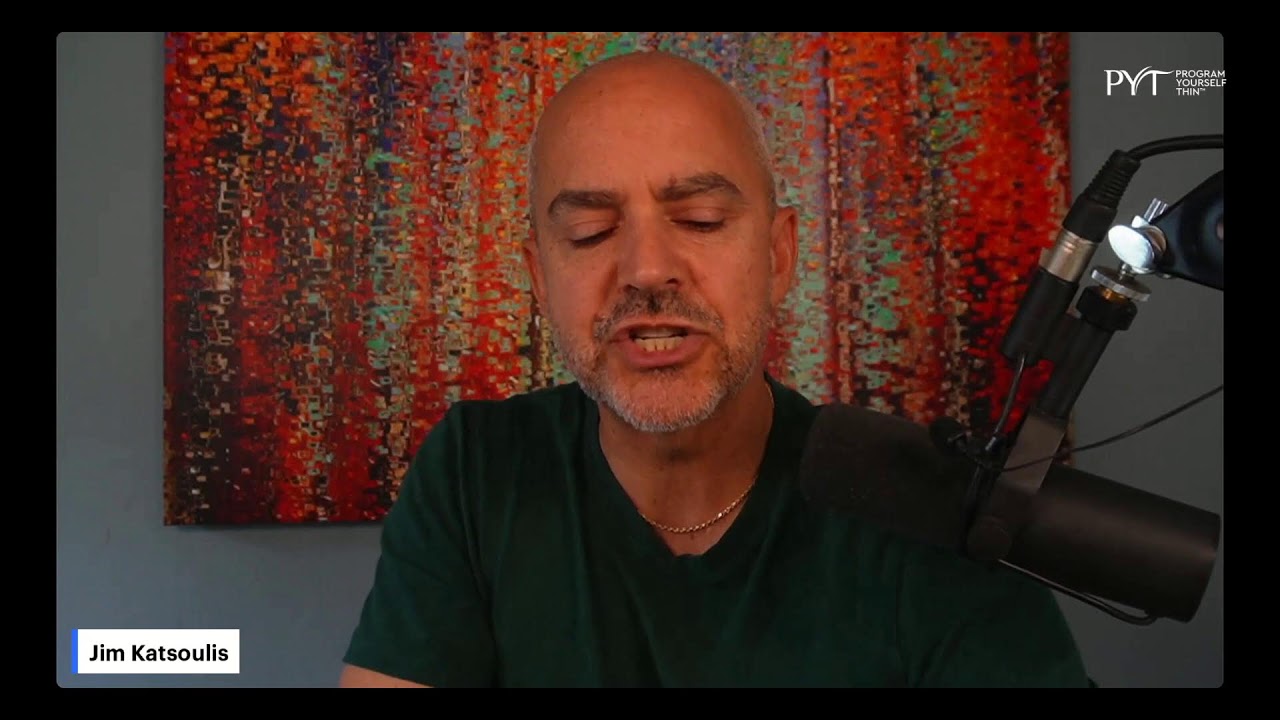
In this live video Jim Katsoulis explains that finding your "perfect weight" is not about hitting a low number on a BMI chart, but about achieving the best quality of life by balancing the weight you want to be at with the lifestyle you can sustain. He argues that weight alone does not determine wellbeing; the effort required to maintain a weight must also be considered. Using personal anecdotes, he shows how his goal weight has shifted over time depending on life circumstances. He introduces the concept of the Goal Weight Pyramid (mindset, lifestyle, eating) and promotes his "Program Yourself Thin" system, which includes a free hypnosis session, a 20‑minute "Reprogrammed" training, a goal‑weight quiz, and a daily email program. Throughout the session he answers live questions, discusses the limitations of GLP‑1 drugs, emphasizes the importance of long‑term maintenance over short‑term diets, and highlights community support and personal‑development integration as essential for lasting weight management. The video ends with calls to action for viewers to join his program, access free resources, and listen to the podcast.
Chapters
How to choose your perfect weight. I believe all successful weight loss starts with this answer, and choosing your perfect weight, in my opinion, is a lot more than just looking at a BMI chart to do it, because I believe that your perfect weight involves a lot more than just a number on a chart that your doctor could tell you or a magazine could tell you. I think that your perfect goal weight is the weight that gives you the best quality of life. And in order to understand what that is, we've got to take both sides of the equation into account. And most people only look at the weight side of it. They pick the lowest weight they think they can get to, as if that's the answer to the weight that's going to give you the best quality of life. But it's not, because the other side of that equation is, what do I need to do in order to live at this weight? We've got to take that piece into account, because if we choose a weight that's too low, that we're not willing to live that way and eat that way in order to do it, that's not the best quality of life. Please understand this, right? You've already gone through this. You've chosen a low weight, and to do it took so much effort and difficulty that you didn't want to keep it up. In other words, you chose a lower weight, maybe started— you reached it, but your quality of life went down. Weight by itself does not control your quality of life. If it did, no one would have a weight issue, because if just being at your goal weight made everything absolutely amazing, then everyone would be at their goal weight. But what ends up happening for a lot of dieters is they get to their goal weight, but they're so miserable or overwhelmed or stressed out about doing it that they don't keep it up. So your perfect weight is really a balance. It's the best return on investment for yourself of the energy you put in and and the weight that you wanna live at. And to drive this point home, for me, my goal weight is a malleable thing, it's a variable. So I have dropped 50 pounds and I've maintained it for over 30 years. 15 years ago, I put 25 pounds on. It was an extremely challenging period of life. I— we moved, we're redoing our house completely, I had a new baby who doesn't sleep well, I'm running a business, there was a lot of stress. And so in that situation, it was a lot harder for me To live my normal routine. Now, I dropped my— you know, I put 25 pounds on, I took 15 pounds off it off, but I raised my goal weight by 10 pounds in that situation. Because yeah, I could have got it down to that other weight, but to do that in that period of time was a lot of extra effort and time and energy I did not have. So for me, in that phase of life, raising my goal weight up was the sweet spot for me to have the best quality of life. So this is how I want you to start thinking about this. So it's not just a number that you're picking off a chart or some arbitrary number that you've been saying to yourself for 30 years, but you start to realize, how am I wanting to live my life? What do I want to eat? Do you really want to live a life where you never eat a carb again? That's going to lower most people's quality of life. So we want to find the sweet spot between what we want to eat and what we want to weigh. And when you take both these into account, you set yourself up to pick a much more, um, accurate number for yourself because now it takes into account both real things. We can't just pick the number. It's kind of like if someone says, well, how much money you want to make a year? I'll make a billion dollars. Well, okay, to make a billion dollars, you got to work 150 hours a week. You know, it's like, I want the money, I don't want to work 150 hours a week. So again, it's the same thing with the weight. We can't just pick arbitrarily low numbers because we just want to weigh that without taking into account what we're going to have to do in order to achieve it. And once we look at both, I think we're able to make a much more adult, grown-up, um, realistic decision. So let's just kind of symbolize, you know, internalize all this in a way that makes sense. And I want to go into the idea of the perfect weight. I want you to relax your body for a second. Relax your face, your shoulders, your chest, and your stomach. Relax them. Take a deep breath in and slowly let it out. I would ground yourself, ground yourself. And I want you to imagine you're at your perfect weight. Now, your perfect weight is not a number at this point. So I want you to think of perfect weight as an arbitrary concept. So I don't want you to attach a number to it right now. I want you to just imagine yourself at a weight where you felt good, where you could wear the clothes you wanted to wear, where you could move the way you wanted to move. Where you felt like the person who you wanted to be, where you felt good about your body, you felt good about yourself. Then on top of that, you felt good about how you were living and eating too. You didn't have to cut out your favorite foods. You still ate anything you wanted to. Now you may eat it differently, but you can still eat what you want strategically and be happy with your weight. And again, before we get into the specifics of the weight, I want you to just imagine this experience that you were happy with your body, happy with your weight, happy with your lifestyle and eating patterns, so you could imagine yourself living this way for the rest of your life because it was all in flow, it was all in congruence, everything was working together, and it was a goal you set accurately by looking at the full picture. And the full picture isn't just what you want to weigh, but it's also how you want to live. And I want you to imagine that you figured it out even before you have. And I want you to imagine that you're at your goal weight, happy with your weight, happy with how you're living, happy with who you're being. And I want you to remember this feeling. And this is the feeling we take and we figure our goal weight out with. But that's another process. If you want to get that process, I actually do have a goal weight quiz, um, that I give all the people on my list. But to get that, go get the free hypnosis session I give you. Again, I give you more free stuff than anyone. But click the link in my bio if you're on TikTok. If you're on Facebook, you can just write mind, M-I-N-D, into the comments and it'll automatically send you the link to go get that training. And/or you can just go to programyourselfthin.com and go get the free hypnosis session I made for you. Um, in addition to that session, like I said, I give you a training called Reprogrammed: How to Live at Your Goal Weight. 20-minute training. I think it's the best one I've ever done. Explain the whole approach to you, and then I, I send you the goal weight quiz as well. So Go check that out. And if you have any questions, feel free to ask them. How's it going, Pamela and Elena? How's it going? Hope you're all having a nice day. With the chat window open, all right, we got the little comment mine scrolling around. We got like a news station over here, over in Facebook anyways. On TikTok you can't see this, but, um, I use Restream, so I simultaneously am streaming to Facebook and, uh, YouTube. Not TikTok, not Instagram anymore. No more Instagram. Um, to be honest, it was a pain in the ass. It was extra step. Yeah, TikTok, of course, where we got it all— got the start. TikTok was really my start on social media, I would say. What's up, Beverly? How's it going? Yes, so, uh, started off on TikTok and now we're over here, probably on Facebook more, I would say, because Facebook— the thing with Facebook is that it allows you to have kind of more types of content. You know, and I think that part's good. But and it allows you to watch the replays of these lives. You do these lives every day, every day Monday through Friday, every weekday I guess is what they would call that. Crystal says, "What is a day of eating for you as a vegetarian?" You know, it's not much different than someone who eats meat. I mean, there's just no meat. But you know, I know I get I'm kind of joking and laughing, but I know what it's like. I used to be a meat eater, and I was a big ass meat eater. I wasn't just a meat eater; I was a meat. eater literally every day of my life, at least once, twice a day meat eater. I ate a lot of meat. Um, and so now I'm vegetarian, or a pescatarian technically, but pretty much vegetarian. I don't really eat much fish. But, um, yeah, so what's a day look like? I mean, you know, breakfast is— I'll usually have Ezekiel toast and peanut butter and apple and peanut butter. That's usually my breakfast. Um, a big-ass salad for lunch Monday through Friday. That's a typical lunch. Um, dinner, you know, is usually Some sort of grain, some sort of protein, which is usually usually bean based. You know, is what it's going to typically be. Usually vegetables, you know, things like that. So it's not much different. You know, I'd say the big difference is the meat's usually traded out for some sort of bean option. Is probably the the clearest way to kind of talk about. But I mean, last night I had sockeye salmon. You know what I have? Sockeye salmon, rice pilaf, grilled vegetables. Shit was fire, was so good. So yeah, it's meat, I guess. But, but yeah, but, but on another night, I would, you know, just have, um, who knows, what would I have? Oh, all kinds of beans. Taco Tuesday, rice and beans, um, lentils. And, you know, listen, I will tell you this too, that meat, meat is really a, uh, sauce flavor delivery tool. Typically, the meat by itself, for, for most people, the meat's really not the enjoyable part flavor-wise, just so we know, right? You know, eating a steamed chicken breast, he's grilling a steak with nothing on it. Probably not, right? It's served with sauce. So that was, that was probably the biggest thing I noticed going from a meat eater to a vegetarian is that it was almost always everything other than the meat that I really enjoyed. Down to— I will tell you an experience that my wife and I had when we were kind of transitioning from, from meat eating to vegetarian. is we would get grinders all the time. And I remember, um, we get cold cut grinders, and then it started to be like turkey grinders. And then one time my wife's like, let's get a grinder without the turkey in it, everything else is the same. And I'll tell you what, it tasted virtually the same. And, uh, yeah, never looked back. So a lot of times when you switch, it's not as dramatic as you may think, you know. Do you have a program to follow? I do. It's called Program Yourself Thin. Again, I would say that the first step is always listen to the hypnosis session, watch the Reprogrammed training that I made for you. Reprogrammed, again, is a— it's a training I put together completely free, and it takes you through the entire process, I think, in the most efficient way possible. But ultimately, Program Yourself Thin, what we're doing strategically is we're following the Goal Weight Pyramid: mindset, lifestyle, and eating. So we're We're actively in Program Yourself. Then you're really actively looking to develop the skills of thinking, living, and eating like a thin, healthy, happy person customized to you. And you also learn how to program your mind, how to run your mind, um, so that you can do those things, right? Because there's knowing what to do and there's being able to get yourself to do it. That's the two sides of things. And in Program Yourself, then we cover both of those, right? So, um, yeah, that's the program. But Again, if you, if you go and, uh, type MIND in Facebook or click, uh, the link in my bio on TikTok, uh, go sign up for that because, you know, as soon as you sign up, it takes you a couple minutes to send you the session, but I, I bring you to the, the training right away and you can watch that immediately. And, uh, I think it's a pretty eye-opening training, uh, because, you know, basically— well, you tell me, where are you hearing how to live at your goal weight for the rest of your life? Where are you hearing that? You don't even hear that kind of language. So I would say if you care about your weight at all, that you really owe it to yourself to go watch that training. And yes, that is free, something I just give you. Um, what's up, Pat? Pat says, hey Jim, had follow-up appointment with doctor from June appointment. I'm on my 8 weeks with your program. My numbers have never looked this good. A1C down from 6.1 to 5.0. Um, blood pressure excellent, lost 5 pounds in 3 months with you. I watched your podcast for a year before I joined the program, so glad I joined. All right, Pat, thank you. We'll screenshot that. This is perfect too. Keep an eye on your inbox, um, Pat, because actually one of the things I am going to be doing next week is sending out, um, to my previous clients, um, a way to offer testimonials or your experience with the program. Um, that's something I've been wanting to do for a long time and just kind of haven't gotten to it, but I've got it all figured out now and Uh, you'll be able to kind of type it in or make a video if you choose to, however you want to do it. But that is awesome, Pat. Nice job. Keep it up, right? It's just getting started. Um, that's so amazing. And I, I appreciate you sharing that too because I don't know, we live in an age now where, you know, people think the only thing that could potentially work is GLP-1s. Um, I'm not saying GLP-1s don't work. I'm not saying that. But it's funny, I was reading, um, I was in a forum yesterday and someone was like I said, what's your experience on GLP-1s? And it was interesting, it was very positive. But in all of those positive responses of how amazing it was, almost all of them mentioned that they were on it for a period of time. And I said, uh-oh, ruh-roh. Uh, one of them really stuck out to me. Then they were like, oh my God, it's amazing, the food noise is quieter and I've lost this much weight and it's amazing. And I only plan on being here for another 2 months, but it's— oh, it's been incredible. And I said, well, what do you mean you're only going to be out for 2 months? Because that is— I don't think people have— it made me realize, and then I read this over and over again in one form or another, but it made me realize that GLP-1 really is not a long-term solution. At best, it's going to work while you're doing it. It's not going to work when you stop it. I mean, the companies themselves will tell you that. The studies prove that. So, you know, this is something I think people haven't really fully comprehended and wrestled with. Yeah. Is that the GLP-1 is is literally um a a something you do. You're you're only going to manage your weight when you're on it. The second you come off it, you physiologically change, and you're going to go back to what you did. I I'm not trying to be negative here, but but I think it's important that you realize that so that you're not disappointed. Um, and again, it just shows uh what sorry, I'm a little distracted here. Um. That that I I think think that's something to wrestle with. I'll just leave it there. Um, Pamela says Jim's a good egg. Thank you. Thank you. Appreciate that. All right. Is this done? Better. I think acting weird. All right. That's not fully charged. That's the problem. Okay. Anyways. Um. Yeah. Carol says yeah. The day why works so well. They take away the happiness of food. Well, there's that too. You know. So again, I always say the worst person to ask about how to lose weight is a person who's actively losing weight because they don't. Give a shit what they're doing. If someone's losing weight, it is just like, you know, they're almost on a high. And it's like most people will trade the, the pleasure and excitement of the food for the pleasure and excitement of the weight loss, you know. But they're just trading one high for another. And once the weight loss high stops, I'm curious to see where things go from there, you know. But anyways, uh, what's up Susan? Susan says, I've just discovered soups with butternut squash and cauliflower. They have a nice creamy rich mouthfeel. The immersion stick blends it nicely. Yes, Susan, yes. And that's what we're talking about in programming yourself. Then it really is the acquisition of skills and knowledge and strategy. Okay, and so this is exactly the type of thing that I've— this is the path I've been on in all sorts of different ways. I'll just randomly like discover something. Sometimes it's a meal or a food or a nutritional fact. Sometimes it's a kind of a health thing, or sometimes it's something helps me sleep better or something. Helps me move more effectively, whatever. We walk this path and then we kind of figure something out and we take it, we internalize it. So now Susan has another option for healthy lunches or dinners. That's wonderful. And so, so often you'll get in Program Yourself, then we're looking to collect a kind of basket of recipes that fit within our calorie ranges, easy to make, easy to get. And relatively enjoyable to eat. And when you have a basket overflowing with options like that, guess what? It's a lot easier to manage your weight. But the big mistake dieting makes— dieting, again, dieting is not a mindset, it's an anti-mindset. It's just about fighting against yourself and stopping yourself. Stop, stop, stopping yourself, fighting against yourself. It's not really built for the long term. The things that are built for the long term are skills, strategies that we internalize, that we have available to us. And that's how we operate as humans. So nice job, Susan. I'm happy for you. That's nice that you got another option here. Carolyn says, yeah, the GLP-1s have so many symptoms. My daughter has zero energy and iron a mess. Biotin needed can be unhealthy. Yeah, I mean, obviously you are doing this thing again. Whatever. I'm not— it's not an anti-GLP-1 space, but it's an honest GLP-1 space. And Yeah, there's positives, there's positives and negatives to everything, and I would say including that. Um, but yeah, and again, I don't want to say— I'm not going to even ask people what their negative, um, experiences with it are because I don't want to, I don't want to pile on top of it, you know. But, um, yeah, just know that this is a welcoming space for GLP-1 users. A lot of people in the program on them. Um, but those people at least are reprogramming their mind and learning how to run the system So that when they do come off, they're prepared to stay at that weight. If you're not doing any of the work and then you come off it, you're going to put the weight back on. I mean, every study shows that there's— and why wouldn't it? What would be different? This is— but this I find fascinating. The reason I'm stuck on the GLP-1 thing of people that lose weight and then say, oh my God, 2 more months on it, I want to— I'm going to do 3 months and lose the weight. Well, and then what? And I'm like, holy shit. They're applying that diet mindset now to the GLP-1 because— and I was like, wow, that's brilliant because it really puts dieting in an even clearer light because dieting is the same thing. What, you're going to diet for what, for 2, 3 months to form, however, you know, whatever your situation is, you're going to diet until what? Until you get to your goal weight. And then what? And it's like, that is the part that's missing from this process. Dieting is just a phase of weight loss. You don't understand. Like, it's just a phase of weight mastery. Because your goal isn't to lose weight. Your goal is to live at your goal weight. You notice the difference there? And so diets are all about losing weight, getting to your goal weight, but they don't set you up to live at your goal weight at all. And so what happens for most people is they do the diet, then they stop the diet, and then they put the weight back on. Well, guess what's going to happen with GLP-1? You're going to do the GLP-1, you're going to lose the weight, then you're going to stop the GLP-1, and guess what? You put the weight back on. And it ain't good to do this. You know, one thing we've learned, and again, dieting kind of sits on this information, sort of, um, but the same thing with GLP-1s. Every time you're losing weight, and if you're losing weight quickly, you're losing that weight and you're also losing a lot of muscle. And this is the scary thing in GLP-1. If there is— and I'm not a scaremonger with this— this is probably the scariest thing I would say that I've seen. And I'm curious to see how this plays out over time with more people, um, because again, you gotta understand GLP-1s have been studied for over 20 years with diabetics. It was originally a diabetic-focused medicine, and then they realized, you know, it has this impact on other people. And so there has not been large, long-term scale studies of people that are not diabetics using GLP-1s. So, you know, to some degree, it's kind of a live study going on now. Um, the other piece though, again, the scariest piece of GLP-1 is that you lose weight quickly and you also lose muscle mass. And what they have found is that when people come off the GLP-1, they put weight on very quickly. And what's happening is they're changing their body composition through this process because when they're losing the weight really fast, they're losing extra muscle mass than you do when you lose weight slowly. And then they're putting the weight back on fast and some of their body composition has changed. They have less muscle, more fat. And this is something I've really got my eye on. I'm curious to see what happens because I think most people are not going to want to stay on GLP-1s because the thing that's hiding in plain sight is that GLP-1s make your enjoyment of food lower because GLP-1s, when they're working, make you feel like you're full up to feel like you're just below feeling nauseous. Right, GLP-1s partly work by activating your aversion system. So when you think of times when you've, you've eaten a lot of food and you're full, or you think about times when you're just not— you're feeling a little nauseous— that's kind of where we're at in those situations. Do you enjoy food? So yes, I know food noise down is, is great when you're losing weight, but as a long-term solution, you're signing up to a life of really Muted enjoyment of food for the rest of your life. So I don't give a shit. I just want to weigh what I'm weighing. Fine, you say that now, but when Christmas comes and you don't really care about any of the special foods you used to enjoy, when special occasions come and you don't really give a shit about what restaurant you go to, when you go on the vacation and you don't really give a shit about what you're eating that much because you just don't care about food anymore—that's what I'm curious to see. And and I think that's a legitimate question, you know. But we will see. And so if people do want to come off it, I think that's where the problems are going to show up with GLP one because I think that the weight loss is. Unnaturally fast, and the weight gains unnaturally fast. And I think that's not great for bodies. And if you're a woman in her 60s, um, it's more impactful. So again, I don't know, maybe I'm wrong. I, I don't know. But I'm just gonna say, you know, what I read— I study this stuff a lot. And, um, you know, I think it's something I would consider if I was gonna consider doing that. Let's get that little ticker off there in Facebook land. Uh, Yes, Pat says you're the only one who teaches us how to maintain. I agree with that. I really do. Um, I, I think, I, I think I, I'm planet Earth. I think I'm one of a handful of people, um, that's really absolutely obsessed with how to live at your goal weight naturally. I, I don't even know. There's a copy of Corinne, you know, she's awesome. Um, there's not a lot of people really teaching you how to live at your goal weight because diets are all about how to get there. Diets are not long-term strategies, folks. There's not a single diet that rises to the top of the list of being a good, a good long-term strategy. Uh, what's up, Kimberly? Kimberly says, I'm 67, depressed because nothing seems to work. Social media— sorry, that's how I found you— so confusing. I wish I had found you years ago. Is it too late to really change things around? Used to run, stay active, work outside, take care of horses, but now my body doesn't respond. My sister using GLP-1, and I'm scared for her, but she's happy. My scale won't budge, stuck at um yeah okay yeah please help um yeah it's definitely not too late. I mean I got people in the program their mid seventies you know just killing it um because what you bring at that age what you bring into the process is a lot of wisdom and experience um problem is you've never learned how to use your wisdom experience that goes for all of you dieters. Dieting is a is a switch. It's a binary experience. You're either doing it 100% or you're not doing it at all. And what that leads to is that you do it for a little while, then you come back to normal. Do it for a little while, come back to normal. You never get better at something. You know, it'd be like I don't know. Think of some subject in school you that was hard for you. But imagine you studied it really intensely for a week and then didn't think about it for three months. Then you study it really intensely for 2 weeks and then you don't study it for 6 months. Then you study it really intensely for 6 days and then you don't study it for 4 months, right? How much of that would you know? You wouldn't know any of it. And that's what you've done dieting-wise your whole life. You go up and then you come back down to normal, go up and do everything, and then come back to normal, and you're never moving your normal. And Program Yourself Thin, we're looking to take advantage of all the experience we've had. I would say at this point, Kimberly, you have a really good, rich Understanding of what things work for you and what things do not work for you. You've just never learned how to utilize all your wisdom experience and put it into a system that works for you. That's why Program Yourself Thin is so unique, because what we're looking to do strategically is we're looking to follow this process: mindset, lifestyle, and eating. We're looking— I want you, Kimberly, to be able to think, live, and eat like a thin, healthy, happy Kim. Well, what is that? You don't even know right now. Because it's a lifetime of dieting, of people telling you what to do. None of it really resonated with you, so you reject it all out of hand. But you have, you know, you could have used that time. And that's why that's always the regret part of programming yourself. Then people always say that, I wish I'd found you a long time ago. I get it. But, um, you know, it's like the Buddha's saying that the best time, best time to plant a tree is 20 years ago. The second best time is today, right? Same thing. Your quality of life can go way up because the main issue is not your weight, Kimberly. The main issue is not that your weight's stuck. The main issue is that you feel depressed, you see. So you absolutely emotionally can feel so much better, and I'm pretty sure you can change your weight too. Um, but you absolutely can feel a lot better, and that's the key thing. Yeah. And here's just so you know, Kimberly, just as little— I didn't write these, but Patch says, I'm 77, it's never too late. Patch has shared how they're 5 pounds down and their numbers are improving just in the last 8 weeks. And, um, Pamela is 75 over here. So, yeah, I mean, like I said, we have a lot of— I would say most people in the program, I would say certainly 45 plus, the majority are probably late 50s, mid-70s. I would say that's the, that's the vast majority of people. But again, what we're doing is we're approaching this strategically. So you're learning how to think, live, and eat like a thin, healthy, happy person, but you're learning how you do it. So we customize everything to you. Um, the goal is to create a one-size-fits-one plan. Yeah. Because what, what works for Kimberly isn't what works for Pam. What works for Kimberly isn't going to work for me, you see. So it's more of a process of kind of figuring out these things for you, how, how to apply it to you. And that's something you've never done. You've tried to follow rules that were given to you, and it always felt like it's sure and difficult because it was never built for you. So when you start to figure out, you start to understand who you are, what works for you, What doesn't work for you, which is just as important, and you start to create a path forward that is really customized and designed around who you are, you end up in a much different place. So yeah, but you absolutely can change it. But what I would suggest, Kimberly, is you can just type— well, you said you found me, so I don't know if you're on my email list. That's the big step I would suggest you take is go— you can type Mind, M-I-N-D, into the Facebook chat. And it'll it'll send you a link to go get the hypnosis session I give you. But I also I'll give you a tray as soon as you opt in. There's a training for you to watch, like twenty minutes reprogrammed how to live at your goal weight without the fight. That's just there waiting for you to watch it. And I think that'll that'll put a bunch of light bulbs on in your mind, and you'll understand things a lot more clearly what I'm talking about. But yeah, yeah, if anyone's got any questions, feel free to ask them. Crystal says I lost forty pounds fasting and now trying to figure out how to keep it off. Uh, yeah, and that's a good question because the way we lose it is the way we have to maintain it. So if the way that you lose it is really difficult and it was a real fight, then the way you're gonna have to maintain it's gonna be really difficult and a real fight. So yeah, fasting is a real challenging way to lose weight. It's a real outlier way. It's a temporary extreme way for a lot of people. Now again, the good news is that fasting really is just a sneaky way to reduce your calorie consumption, but There are other ways to reduce your calorie consumption that are a lot more comfortable, and that's really where you're at. So Crystal, please, please listen to me here. I'm on here every Monday through Friday, and I'm happy to talk to you and happy to help you as you kind of figure it out. But I'm really here for people just like you. I'm really here for people that have actively done something and have lost weight because I know you're willing to do the work. And I know the main thing you're missing is a system and a strategy and a plan for how to live there. I mean, I literally wrote the book on how to live at your goal weight. It's the Tao of Living at Your Goal Weight. But the key word here is living at your goal weight, living at it. Not— I didn't write the Tao of Getting to Your Goal Weight. That would be a diet, right? A diet's about let me do some crazy shit just so I can get to my goal. I just want to get there. Great. We've all done that. Okay, but that's a completely different thing than living at your goal weight. So what I would say, Crystal, is you've done so much work that now you're in a new phase where you're learning how to live here. And I'm one of the few people that, that really, I think, explains it clearly and how to shift gears. Um, and I think, you know, there is no time to waste with this. You put a lot of work and effort in, and, um, you know, at the very least, go Sign up for the hypnosis session I give you and watch the training. Please watch the training. It's 20 minutes. You're watching it. Ah, it's a bunch of bullshit. Fine. Or you're like, oh God, I didn't think about that stuff. And you'll have a completely new understanding and map for how to maintain your 40-pound weight loss. Okay, but all you need to— you're on TikTok, so click the link in my bio. Go up to a little picture of me on the left. Click it. There's a link in my bio. Click that. It'll take you 2 seconds to sign up. You're on my email list. I send you another thing. This is the coolest part. Starting Sunday, just for free, I got a whole email program I'm going to start sending everyone. It's free. I think my email program, I think, is the best program on the planet. It's just free. So again, I, I stand by very, very strongly that, uh, I don't know anyone that gives you more free stuff than I do, and I take that very, very, uh, personally and passionately. So Um, go get that, go check that out. I promise you there's better answers than you got in your head right now, is what I'm trying to say. Um, yeah, Ken says, Kimberly, I joined PYT 2 years ago, comfortably living on my goal weight. I enjoy food more than I ever did. I love that, by the way. I love that he says that, that I enjoy food more than I ever did. I think that's a key part too. I do as well. I enjoy food more than I ever did, um, and I eat less of it. How's that possible, right? Well, that's the holy grail. That's the holy grail, I think, of weight loss. Yeah, exactly. And Kent says, best part is you start feeling better about yourself on day 1 and it never ends. I think that's so true. And what Kent's referring to, the way I describe that a lot, is that we take the weight loss and program yourself— then we take the weight loss and we wrap it in personal development. So the reality is that the weight loss is almost secondary in this process, which is really important Because it's going to be, um, it's going to be something that you can do forever. The reason I'm as motivated to manage my weight now as I was when I was actively losing weight— I dropped 50 pounds— the reason I'm more motivated now than I was then is because this is about me being the person I want to be. And at some point, the weight just stops, you know. At some point, you get your goal weight And then you gotta ask the question, what do I focus and think about then? How do I keep myself motivated and engaged and moving forward then? And that is why we wrap personal development over, because for me, I'm never, you know, how good can I feel? How many good routines and habits can I have? How clean can I make my eating? How much nourishment can I put in my body? It's just something I'm always working on. And it's fun. It's like a puzzle, you know, it's like a hobby. And again, but just to give you more context though, I'm always managing this. So I'm always working on these things primarily, how to think, live, and eat like a thin, healthy, happy person. And I'm always working on these things. To me, it's no different than when I play guitar. And it's like, I'll be working on a guitar forever and just, I don't know, just different stuff. I'll play different songs and sometimes I'll practice chords and sometimes I'll practice scales, sometimes I'll practice melodies, sometimes I'll practice rhythm. I just break it up into all these different pieces and I just keep practicing different things. I just keep getting better. It's fun. And that's how I feel about my weight, my health. But again, it's got this personal development wrap around it where it's always kind of interesting. There's always places to go. And that's really important as a human because we need to be able to look forward to things. We need to expect progress and achieve it in order to feel really good. And dieting doesn't do that for you. Dieting gets you to a point and then that's it. You know, and people always walking around the whole once I get to my goal weight that because I always said, what are you going to do once you get your goal weight? How are you going to maintain it? I'll figure it out then. Why would you? Why would you just magically figure it out when you get to your goal weight? You've never done it. You've been at your goal weight. Every person here has been at their goal weight. So if it was so incredible and so amazing and so motivating and answered all the questions, then why are you overweight now? It's not enough just to get to your goal weight. Just getting to your goal weight doesn't make some magical thing happen that you never have to think about weight again. It's, you know, managing your weight is like managing your teeth. I mean, if you want, you know, a certain set of choppers, you got to take care of them a certain way, and weight's no different. So we need to shift our focus and realize this is a forever process, and that's not a bad thing. It's a— in my opinion, it's one of the greatest engines of happiness and satisfaction accomplishment that I have in my life. So just to reframe though. No. Um, Pamela says free. Yeah, it's free, but it's just emails, Pam. Don't worry. I think you're in the program, so you, you get all the hypnosis sessions, all the trainings, the live Q&A. Um, you know, listen, I give most stuff away for free, but I don't give everything away for free simply because I hate to tell you, um, if you give— people value what they pay for. I will say I've been doing this for over 21 years professionally. I have literally given everything away for free. There have been times where I've literally given the entire program away for free. But I can see on the back end who's using it. And almost without exception, when people receive the program for free, they did not use it. Now, on the complete opposite flip side of that, it's $25,000 to work with me privately. Guess what? Those people use the program. I mean, they squeezed everything out of it. So, you know, I hate to say it, but, you know, we value what we invest in, you know, as a thing. But, but yes, Pam. So, so yes, it is free, free emails and amazing stuff. Um, but yes, what you have is, is a much different thing. Uh, Elena says, you are amazing. Your daily effort to help us is unbelievable. You are truly a 5-star. Well, thank you. Thank you, lady. I appreciate that. I'm just passionate about it. You know, I say this all the time. Um, my journey really began— my father died of a heart attack when he was 54. I was 9 years old. And so that was obviously, you know, the, the, the thing that led me to be here right now. So for me, weight is not just a You know, about looking good in your skinny jeans. It's about your quality of life. It's about how long you're gonna live. It's serious shit. And so, um, I take it seriously. It's really important to me. But on top of that, I think, you know, managing your weight— and not just because you're going to be at a certain number, but the process of managing your weight, at least the way I see it, because I see managing your weight as a process of thinking, living, and eating like a thin, healthy, happy version of you. And, uh, I think all the things you do here that help you get to your goal weight also help you in all the other areas of your life. So that's why it's got the personal development piece on it. Uh, what's up, Rhonda? Rhonda says, you're my daily encourager. I'm making better choices by feeling the feeling of the bad choice. Yes, 5 minutes later, I want to be proud of my choices. Self-esteem boost. Thanks so much. All right, Rhonda, nice job. I appreciate you saying that. Yeah, and that's what I'm here for. I'm absolutely here to be an encourager. And, um, that's why I'm excited. Again, if you've not opted into my— for my hypnosis session, do it, because one of the cool— it's starting Sunday. Starting Sunday, I'm giving you a free email program every day, forever, as long as you want it. You know, you can unsubscribe at any time you want, but it's, um, literally we'll have a focus each week, um, and each day there'll be a little lesson for you. A little bite-sized lettuce lesson, um, and it's going to help you think differently, you know, because again, this is my mission in life, is to help as many people as possible live at their goal weight. And so this is the next kind of phase of that, is this free email program on top of the free training, on top of the hypnosis session. And I got another thing I'm cooking up in the back, but I'll wait to tell you that one. But, um, yeah, if you're on my email list, you'll automatically get it, you know. And again, you can, you could choose to continue to get it or not if you want to. Kimberly says, sorry, another question. Don't be sorry about questions. That's what we're here for. Ask any questions you got. If you have time, how do you cope when you're surrounded by people that don't try to eat healthy? I love them, but I'm at the point I feel selfish taking care of myself. Again, 67 and trying to change. Thank you for your help. That's a great question, Kimberly. And again, I think that is such an important piece of the puzzle that most programs never address. And that is, what is my new way of eating going to do to my relationships in life? This is such an important factor. And for most people, when you start to— when you start to change your behavior in a positive, healthy way, it actually makes the relationships you have in your life feel rockier. And there's a lot of reasons for us. I'm not going to go into it. But the main thing you said, and you're already— there's a decent amount of self-awareness there, Kimberly. And which is exactly what I was referencing. Again, as you get older, you get wiser. You just haven't learned how to use that wisdom to propel you. So the key thing you said is, I'm at the point I feel selfish taking care of myself. That's the main thing my coaching brain goes right like a, like a laser beam into what your question is. I go right into, I feel selfish taking care of myself. And, um, that's the core issue right now for you. You see, um, because let's put it a different way. That selfish feeling you have. Another way to put that is there's kind of this tug-of-war going on in you. Part of you wants to get really healthy, part of you doesn't want to break rapport with the people in your life. And so it's like a tug-of-war of 2 equally matched sides, and you're just staying in the same spot. So your previous question, you said, I feel stuck, stuck, stuck, stuck, stuck. Yeah, well, now you know the subconscious reason why you're stuck. One of them— there's more, but this is an example of it. This is an example of the subconscious reason you're stuck. On one side, I want to get healthier. They said, I don't want to rock the boat with the people in my life. And so you wonder why you're stuck. Well, it's just tug of war with 2 evenly matched teams and you can't get anywhere. So in Program Yourself Then, we handle that almost immediately with the first thing we do in Program Yourself Then is we go into motivation. This, by the way, what I'm holding here is the Goal Weight Blueprint. So this is something you get in the program, um, 144 pages. This is your roadmap. This is your literal roadmap to get to your goal weight and live there as part of the program. This is just kind of the general, you know, structure we're following within it. But the first thing that you need to figure out, Kimberly, is that you're not motivated. You're not motivated enough, let me say. Does that make sense? You can't be motivated enough because now let's switch the metaphor. Let's go to a hot air balloon. Okay. We got a hot air balloon which represents your desire to become slimmer and healthier. Okay, so that's lifting up, but then you got this heavy, um, stone that it's tied to that's keeping it stuck in place. And the stone represents your fear or worry of what your new behaviors are going to do to your relationships. And so you're in this hot air balloon and you're in the balloon, you're like, I don't understand, I got the gas, I got the— the balloon's lifted up, I want to— I don't understand it. And then you look down though and you realize, oh, I'm tied to a rock that's holding me in place. Well, that rock that's holding you in place, you got 2 ways to deal with this, right? You either make the balloon 5 times bigger so it just lifts the rock up too, or you cut the rope and let the rock go and start lifting up, right? There's different ways we could approach this. Um, but long story short is that your motivation is conflicted. It's incongruent. Um, you're, you're, you have 2 motivations. Let's put it that way. You're motivated to lose weight, and you're also motivated to not change how you behave because of the people in your life. So you've got two motivations that are firing off, and it's kind of like having your foot on the brake and the gas pedal of your car. And so we need to we need to get that congruent because you're not truly motivated right now. So hope that helps. I hope that means something to you. Yeah, Carolyn says people don't value free. It's true. It's true. Yeah, Pamela loves it. It's a good program. It is a good program. I think it's the best program in the world, you know, for managing your goal weight and. I'm proud to say that. What's up, Jen? Jennifer says, hi Jim, long time no see. 22 months at goal and going strong. Yeah, there it is. I love that. Take a little screenshot of that. I always like to see Jennifer's updates, right? Again, long-time member of the program. Uh, imagine folks what I want you to put this idea in your minds. You never hear this, you know. If you think about it and you've seen literally millions of diet ads in your life, literally millions of them, and every single time it's about how much weight the person lost How quickly. And I want you to notice, if you hang around here, what you hear a lot of is how long people been at their goal weight. So I want you to take a second and I want you to internalize what it would feel like to be at your goal weight for 22 months. And what you don't know— Jennifer can't write this every time— is that she's there in an easy and enjoyable way. So not only is she at her goal weight, but she's at her goal weight in a way that's comfortable for her. So again, I just want you to take a second and imagine what it's like to be at your goal weight for 22 months. It's almost 2 years. That's the mindset. That, that's what happens when you have the skills and the mindset, um, to get the results you want, right? How do we sign up for that email? Um, Elena, you're already in. You're already on my list, so you'll get that. You'll get it automatically if you're on my email list. You'll already get— you'll get the free one. Um, if you're already— if you're in a program Um, it— you, you kind of already get it, just plus a lot of other stuff. So, um, you're already getting that. But this basically what the free program is, it's just a kind of stripped-down version of the full program, the full Thrive program. So it's my way to kind of keep you somewhat in the loop, um, to kind of frame your weeks, right? Because sometimes most of you don't have any support, you know what I mean? Like, that's, that's probably at the end of the day, this is why I think Weight Watchers— I think all the diets are ineffective. There's not a single diet over the last 100 years that rises to the top of being effective. Weight Watchers is probably at the top of the list, and it's simply because they have that social component to it. Okay. And so, um, but, but as a strategy, it's goofy. It's just gamified calorie counting. But, um, anyway, so support is important, very important. And most likely you have no support with your weight loss because if you're like most dieters, you're always trying to do it yourself. And especially as you get older, because now you get embarrassed. So now you don't want to tell anyone you're trying to eat better. That can lead to other pressures, by the way, is that, um, you know, it's like, well, I want to eat better, but I don't want anyone to know I'm trying to eat better. So now it's back to probably— I bet Kimberly, I bet if we asked her, I bet there's a little bit of that, that even at this point, part of you doesn't want other people to know you're trying to eat healthier because you don't want them to know you're trying to lose weight so that they can realize you fail again. That happens to a lot of people. Okay, but the truth is that most of you are on your own, and so part of my goal with the free email program is to frame your week so that when Sunday comes, it's an opportunity for you to have a focus, and it's a different focus than you get in diet world. You know, so I'll be able to kind of share the program yourself then approach. Every week we focus on a certain area to practice and to get good at. And, um, and then the, the daily emails kind of reflect some of that. And then Friday we have a check-in. And so it starts to bookend your week so that you, you know, you have a sense of structure to your week. Because without that, listen, we all know, dieters, you all know, when you're not dieting, weeks turn into months real quick. Real quick. Okay, we can't have that. You can't have, you know, again, in Program Yourself Thin, one of the big philosophies we live by, we're not all or nothing. We're all or something. So the goal is not to be perfect, it's to be engaged a lot of the time. It's really consistency is our main focus. And so I'm going to be able to offer that to you for free through this email program, to be able to give you some consistency of thought so you start thinking about these things. Um, so you start, you know, kind of interacting with some stuff that's going to help you think better and help you frame the week more effectively. So anyways, Um, yeah, Mickey says, yep, yeah, support's so important. It is. We all know this, right? And again, I don't think you get the right support in most places. Even Weight Watchers, I don't think, is great support. I mean, it's better than nothing, okay, but I don't think Weight Watchers is great support. It really comes down to who you get the luck of getting sometimes. But I think what they're actually teaching is— it's, it's, it's so simplistic and ineffective, I find, you know what I mean? Like, again, just, just purely like even what Weight Watchers calls mindset work to me is just like preschool. It's silly to me, you know what I mean? Like, whatever. And I'm not saying it's not— I know a lot of people have done decent with Weight Watchers. I'm not knocking. I have people in the program, I have a lot of people in the program, um, that have succeeded with Weight Watchers, that have done it. I have a lot of people that are in the Lifetime program that successfully manage their weight. So Again, Weight Watchers is probably the best out of the bunch, um, but it's woefully inadequate, you know. And that's why people join Program Yourself Thin even when they're passionate about Weight Watchers, because, um, Weight Watchers doesn't give you the level of detail and understanding, um, you know, of your mindset, lifestyle, and eating, um, that Program Yourself Thin does. Uh, but yeah, support's super, super huge. Yeah, Mickey says people will judge. Yeah, of course we don't want to be judged. And so a lot of times if you struggle with weight for a long time, you start a plan and stop plan Um, it's normal for people— you start getting 45, 50 years old, it gets really hard to even want to start a plan because you don't want other people to see it, and you don't want to feel judged. You want to feel embarrassed. You want to feel like a failure. You know, that's just real. You know, it's a real thing. Um, hey, there's Rachel. All right, what's up, Rachel? Rachel says, hi, PYT helped me maintain for over 2 years now in a way that's comfortable and easy. I'm turning 60 on October 1st. My doctor couldn't find anything wrong with me at my last visit. Thank you. That is awesome, Rachel. I hope you're doing awesome. And Rachel is so awesome because, um, and then she— to me, Rachel's the embodiment of taking the weight loss and wrapping it in personal development. And I'm just going to share real vague, and I don't— you don't mind this. I've never asked this before, Rachel, but Rachel not only got to her goal weight and figured out a way to stay there comfortably, but in addition, during the process, Rachel literally became an author. Because one of the things that she did is she used the times when she would do behaviors that weren't the healthiest, and she instead began writing during those times. And next thing you know, she used those times to start writing more. And she literally— she's published— how many books you written now, Rachel? Like, written in public, like sells them now, you know? So I love that story because again, yeah, cool. She's been at her goal weight for 2 years too, right? I don't want to— I don't want to speed past that, right? Because that's what we're all here for. We're talking about weight. Um, but again, like I'm saying, it's not enough to just say I lost a bunch of weight. For me, it's how long have you been there? You know, that, that's what we're focused on in Program Yourself In, is living at your goal weight. And then again, Rachel's just like that— 6 books, holy shit! So there you go, Rachel's— she's written 6 books. It's been 2 years, and I don't think she's even writing the whole time. So that's what I mean, taking the weight loss and personal development. I promise you folks, what a great example of taking like a A pattern of— because we all have patterns of when we do stuff. So if, you know, you look at like nighttime, let's just say nighttime snacking, and all of a sudden instead you're doing nighttime writing, not only do you lose weight, but now she's written 6 books. Do you think that might change her self-image and how she thinks of herself? That might change her confidence or emotions she experiences regularly? Me thinks it would. And I think all those things support her living at her goal weight. Nice job. Nice job, Rachel. Hey, Rachel says, once the lifestyle mindset part clicked into place, it was freedom from dieting, and I was able to pursue so many other things that were so much more interesting to me. I love this, Rachel. You know what, I'm going to— I don't know if you were here when I just said this, but one of the things I'll be doing next week is sending out— I gotta screenshot all this, it's so good. Um, I'm gonna be sending out a, um, like a tool to give a, a testimonial of your experience. And there's an opportunity to do a video if you want to do one, but you're a good writer too. But I would just love to get your story. You're, you're, you're a good communicator, right? And I think your story is just wonderful as well. But yeah, that's such a good point though, that, you know, when you— that's such a good example that it's not just about the weight. When you figure out things like how you operate, when you learn how to influence your habits and you know how to motivate yourself and what motivates you, and you put that all together, the weight loss is almost the least of it, you know, and it's a big piece of it. But again, it's the other things, you know, all of a sudden you start living more in flow, you start living more in alignment, more in congruency, um, with who you truly are. Again, the goal of Program Yourself Then really isn't just to lose weight, it's to become the person that you want to be. It's to be the best version of you. The weight's a piece of that, but it's just a piece, you know what I mean? Like, there's all these other things we're working on because managing your weight takes effort, it takes time. It takes energy, and so if you're going to put the time, energy, and effort into it, you might as well get the full array of benefits that you can get from it. And the weight is just one benefit. You know, you get all these other things from it, and that's what I think people don't realize. You can not only lose weight and program yourself then, but you can feel so much better. So that's awesome. Ashok says, "How do I get on the program?" I would say the easiest thing, Ashok, is if you type mind M I N D into the comments, you're over on Facebook. If you type mind into the comments on Facebook, it'll automatically send you a link. Go get the hypnosis session. Watch the training I give you. If you you do those things and you're just interested in the program, there's kind of a path to go sign up. But that's the path I would do it because again, we want to make sure it's the right thing for you. We don't want people in the program that it's not a good fit for. So Lisa Lisa says you're my favorite lifestyle health creator. Always the truth and what makes sense. I appreciate that. I appreciate you saying that. Um, falls up the first time I did Weight Watchers, they yelled out your lost gain to the group. Now, you know, listen, some people thrive with that, but, but, you know, for most people that's like, oh, who wants that? And again, it's just that, that weird energy that's all just part of diet culture, you know. I don't like it, but I'm glad you're here, Lisa. Yes, and I appreciate you saying that. Um, Says, I need to be in the loop with a mullet to smack me on my head when I don't do what I'm supposed to and resist listening. Oh, I get it, Elena. Yeah, for sure. Elena, you in the Thrive program? You should be in the Thrive program. Are you in there? You should be if you can do it. Uh, Rhonda says— oh no. All right, now we got that back on the, on the questions. All right, I gotta get out of here. I got another call coming up in 10 minutes, so I gotta get— I gotta get ready for that. So thank you so much, everyone. I appreciate it so much. I really appreciate Today we got a bunch of cool testimonials. I was kind of wasn't expecting that again. Keep an eye on your inbox, you testimonial people that are killing it because I'm gonna be asking for your story in a more specific way. So that'll be coming. So keep an eye on that. If you're not in my world, please click the link in my bio. If you're on TikTok, click the picture of me and then click the link in my bio. If you're on Facebook, just type mind M I N D into the comments. It'll automatically send you a link to get the session. Uh, as soon as you get the session, I give you a training. Um, I got an email program you get for free starting Sunday, and I'm here every Monday through Friday, uh, to help you all out. So again, please take advantage of it. This is my service to the world, so I'm happy to work with you every day. I'll talk to you every day about whatever you're going through weight-wise, um, in an attempt to kind of coach in the right direction. And if you can't make the lives and you like listening to this, it's also a podcast, so you can search Program Yourself Thin on any podcast platform Um, and it'll show up and you can listen anytime you want. So, um, oh yeah, and I keep forgetting to say this, and there's a book available too. So if you're, you're interested, this book is available over on Amazon, The Tao of Living at Your Goal Weight. Um, super book, got a bunch of reviews. Go check it out, read it, and, uh, see if it helps you. So thanks a lot everyone, have a super duper day, and we'll talk soon. Bye.
More from Jim



Weight Loss Visualization: Wake Up in Your Dream Size #programyourselfthin #weightlosshypnosis



What If You Pretended to Be Thin for One Hour? #programyourselfthin #weightlosshypnosis




