Little Things That Help You Lose Weight
In this 30‑minute livestream Jim Katsoulis argues that sustainable weight loss comes from mastering many small, easy‑to‑maintain habits rather than drastic diets. He frames weight as a system composed of eight lifestyle pillars—sleep, hydration, relaxation, breathing, nourishment, movement, meditation, and gratitude—each of which subtly influences food choices, metabolism, and overall well‑being. He explains why the brain resists big changes, how habit loops work, and why replacing bad habits with better ones is more effective than sheer willpower. Throughout the session he fields live questions, discusses the limits of GLP‑1 drugs, and promotes his "Program Yourself Thin" program, which combines weight‑loss tactics with personal‑development tools such as self‑hypnosis, mindset training, and daily email coaching. The talk is conversational, motivational, and peppered with practical micro‑actions (e.g., add one glass of water in the morning, go to bed 30 minutes earlier, stretch twice more per day).
Chapters
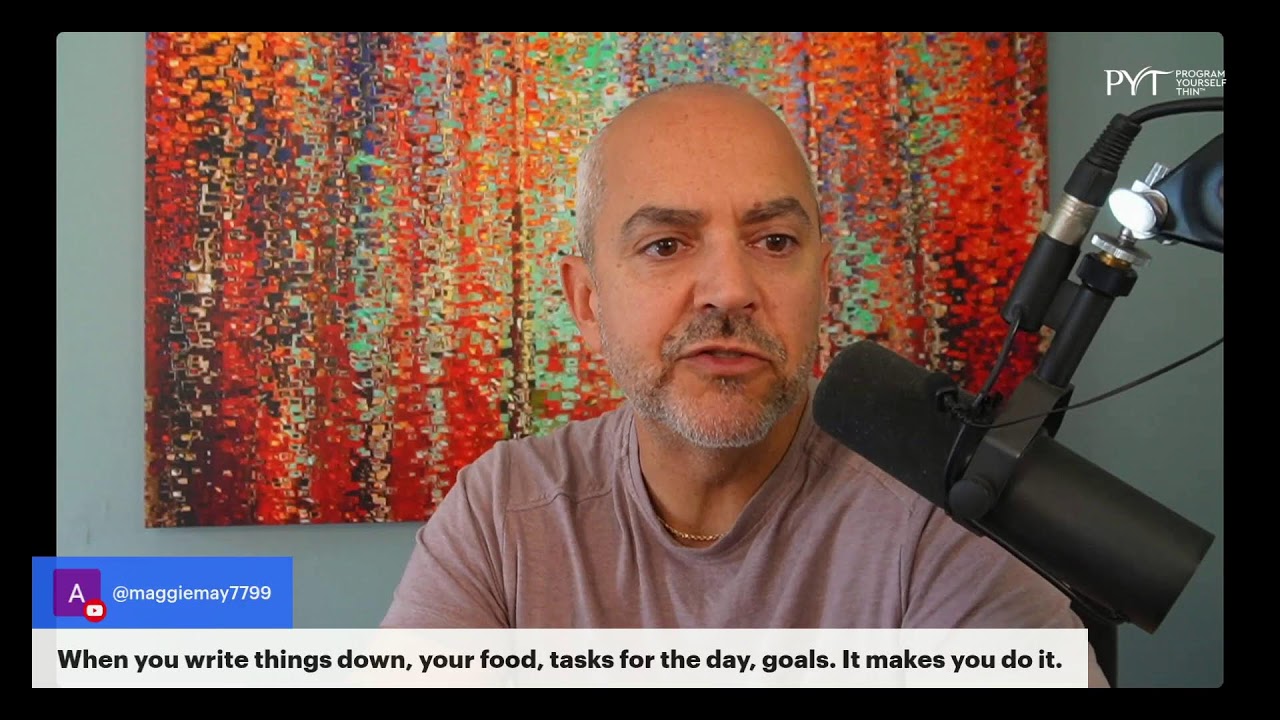
Help you lose weight. This is how I want you to approach your weight loss. Instead of focusing on the big thing you can do to lose weight, you focus on the little things because you can keep the little things up a lot longer than you can keep up the big things. You're going to be able to keep up your extra glass of water more than you're going to be able to keep up no carbs or 16 hours of not eating, a lot easier. And that's the secret, is making your weight loss easier and more comfortable for you. And that starts by focusing on little things, little things that you're able to change and keep up. That's the secret. So what are some of the things that will lead to your weight loss that are little? Now, it's almost unlimited in a way. There's so many things, but I want to break it down into basically 8 categories that I think of, and I consider them the lifestyle ones. And in order of importance, it is sleep, hydration, relaxation, breathing, Nourishment, movement, meditation, gratitude. Anything in these areas is typically going to support you managing your weight more effectively. And to really appreciate them, you got to kind of start looking at your weight as a system. It's a system. It's not just a calorie in, calorie out model. Like, in a very technical, specific way, it is calories in, calories out, right? If you were in gym jail and I controlled your calories, I could make you lose weight. regardless of what you did, but you live in the free world. And so your hydration, your sleep, your relaxation, all these other factors really have a huge impact in what food you decide to eat, how much of them you decide to eat, and how your body handles them once they're in there. And as you start to develop a strong network underneath you and around you that supports your success, the entire process of weight loss starts to change because it's less about you forcing yourself to do the right thing. And it's more like you feel like you're being supported and lifted up by all of these other factors. So again, it starts, it's small, it's small little things. And before I go into all of them, I want you to understand that your brain is always gonna minimize these. I'm gonna tell you these things and your brain is gonna say, nah, it's not gonna, that's not gonna change anything. That's not gonna change. I need to do this big thing. Because you've been conditioned by the diet industry to only appreciate big, giant whacks at the problem, right? Again, if it doesn't start on Monday with 100% focus and effort, then it's not worth it. Okay, you've got to reject that out of hand because that's unsustainable. So the little things that really make the biggest difference are small a lot of times right now. Obviously, you can keep getting better. You can have perfect hydration, perfect sleep, perfect relaxation. But what I'm talking about is where you're at now. Most likely, increasing your hydration is going to have a huge positive impact. Improving your sleep a bit. Is going to work wonders on you and so on. Little improvements overall really show up to support you in a much more powerful way than changing everything. And it's easier. So again, we start in order. Sleep, right? And sleep can be as simple as starting to go to bed a half hour earlier, getting a better sleep time routine, improving your sleep environment, learning how to calm and relax down more. And all of a sudden your sleep starts to improve, which improves everything. Your hydration— you don't have to go straight to 8 glasses of water. You start with where you're at. If you drink a lot of water already, maybe a little bit more. See how you feel. If you don't drink much water, let's add a glass to morning. See how that affects you. Again, one extra glass in the morning, if you don't drink much water, has a way bigger impact than you realize, and it helps you make better choices. Relaxation and breathing— I like to combine them. But a minute. Do it right now. Take a second. Relax your body. Bring your attention inwards and relax your shoulders, your chest, your stomach, your face. Now connect to your breath. Take a deep breath in and slowly let it out. Tell me that didn't make you feel better. Again, not perfect, but better. And it was easy and it was quick. Nourishment. Again, you know, your eating doesn't have to be perfect. How about you add an apple into the afternoon routine? You add a salad Monday Wednesday, and Friday at lunch. It doesn't have to be big, it just needs to be little. And little things like that start to really dawn on you. Wow, I feel better. That would— I feel nice. I feel alive. Okay, movement. Any little bit of movement. It could be as simple as getting up from your desk 2 more times a day just to stretch out and then sit back down. It could be parking 2 more car lengths away from the, the door so you can walk a little further. Little, little things. Meditation. If you've never meditated before, fine, 5 seconds, 10 seconds of just closing your eyes and going inwards. Ah, feels nice. Okay, so you don't have to become a Zen monk. You can just do a little bit of meditation and inward introspection for a second and feel better. And then finally, gratitude. Practicing gratitude, you know, really stepping into seeing the world in a more grateful way. There's Doesn't mean you have to become a master of gratitude right away. You just express gratitude a little bit more, maybe once a day, right before you go to bed. You give something you're grateful for. And as you start to work on these different things, there's other things you work on as well. But these 8 really start to kind of weave a supportive network around you that support you making better food choices. And this is how you make weight loss easier. This is how you make little simple things help you lose weight. Yeah. And it's a completely different approach than what you've probably tried with the diets. And I think you're gonna find that it's a lot more effective and a lot more enjoyable. And if you wanna go deeper into this process and kinda just hit the turbo button, click the link in my bio or go to programyourselfthin.com and go get the free hypnosis session that I made for you. It's called The New Thin Me, and, uh, it is completely free and waiting for you. And on top of that, once you opt in, I've got a training I made for you called Reprogrammed: How to Live at Your Goal Weight Without the Fight. And you can watch that for free, and it'll explain everything I'm talking about here in detail and show you how to do it. So again, you can go to my bio and click the link. You can go to programyourselfthin.com, or you can go— if you're on Facebook, you can type mind, M-I-N-D, into the chat window, and it will automatically send you the link. So go ahead and do that. But again, it's going to help you out. All right. So if you have any questions, feel free to ask them. Let me turn this thing off. Hold on. There we go. Yeah, hope you're having a nice day. What is it, Thursday? Oh man, these days, they fly by. Uh, just got out of a meeting. You're gonna jump right in here. What's up, Karen? How's it going? Yes, Karen says healthy food tastes so much better. Healthy food does taste better, you know, and if you don't believe that, it's because you're not eating enough healthy food. This is true. Um, junk food, I don't know whether it's intentional, they just figured it out this way, but you Junk food, um, in studies, it— I don't even need to tell you this, but when the more junk food you eat, the less natural food you eat. It's like the junk food somehow changes your taste buds in a way that the natural healthy food just doesn't taste as good anymore. And that's, that's real stuff. That's, that comes from real studies. I don't know what they're doing. I don't know if it's intentional, but again, the intentional or not, the effect's the same. So, um, Yeah. It's, it's something to keep in mind. But yeah, if you don't like healthy food, that's kind of— to me, that's your, your signal to go eat some healthy food. Because again, we like what we're exposed to, right? And so if you never eat healthy food, yeah, you're probably not gonna like it. Um, so go eat some healthy food. Go eat your favorite food. That's the secret. Don't go and eat your least favorite food. That's what people tend to do. I don't like healthy food, so I'm going to force myself to eat healthy food all week, all— especially the food I hate. Don't do that. Start with the food you kind of like, you know, pick, pick a fruit, you know, apples, grapes, bananas, something, you know, kind of enjoyable, and start there and then branch out into the other, uh, fruits and vegetables. What's up, Jane? How's it going? How's it going, Pamela? Jane said, I heard a podcast about how GLP-1s do quiet down the food noise, but that when you do eat, you still crave sweet foods. It is your mind compensating. Oh, very interesting. Yeah, I mean, there's no shortcuts in life, folks. I don't know. There's just no shortcuts. I've never seen one anyways. But the GLP-1s, again, they're a supplement. They're a tool. But I don't think they're the whole tool because I don't think this problem requires just one tool. Yeah, Deb said, I'm finding that on my Govee. Yeah, I think— me thinks My biggest— I don't know what the word would be— concern or curiosity about GLP-1s, or what happened to people. Again, when you're actively losing weight, whatever, um, you're excited, just you're happy losing weight. But my big concern is the bigger issue of what's life like when you don't really give a shit about food? Because for a million years on Earth, food's been the central focus of humans. And obviously we've gone, you know, a little too far with it, right, where food means too much. But at the same time, food means things. And to live a life where you're at your goal weight, but you don't ever really enjoy grandma's cookies, or you know, you know your aunt's lasagna recipe, or you know when you go on vacation your favorite place. You know, to live a life where you don't really give a shit about the food anymore. I don't know. People people need to look forward to things. People need to enjoy things. And so this sugar thing. Um, I don't know. I think, I think, I wonder if it's an overcompensation for living a life now where you don't really give a shit or get that much pleasure out of food. Think about how much you enjoyed food and built your life around it. Maybe too much, granted. But now all of a sudden you go on this medicine, the food noise goes away. I don't give a shit about food. And maybe the sugar is the one thing that kind of breaks through that and you still get a little, little, little buzz, a little pleasure out of it. And if that's the case, I don't know. I was curious. You'll probably still lose weight, but I don't know if it'd be the healthiest weight loss. And I don't know. Again, at the end of the day, I'm just going to say it here. And by the way, please, this is a GLP-1, you know, welcoming space. There's a lot of people in the program that are on GLP-1 or GLP-1s. But I don't think that means I can't mention potential issues with it either. And I think, I, I think when you're taking the GLP-1, it's this huge powerful thing you're putting in your body unnaturally. No one has this much GLP-1 in their body, okay? It's an unnaturally high level, and it's going to have a systemic effect. When you start thinking about your body as a system, it's going to have systemic effects. Now, the systemic effects you're hearing about are all positive ones because the, you know, the pharmaceutical companies still control the narrative. So the positive ones you typically hear— oh, it helps people stop gambling, and now they don't give a shit about alcohol. Because you actually have GLP-1 receptors in your brain, you know, and throughout your body, not just in your gut. But again, it's dramatically changing things in the system that is you. And yeah, I wouldn't— I'm not surprised that there are, you know, still things kind of popping through, you know, which again, you know, and yeah, and Jane just said that I certainly have cut down on ice cream though. Again, I think that's what you may find. You may still crave sweet stuff, but you eat less of it and you're still losing weight. The question I'm always thinking about is what percentage, though, of your eating is sugary or not that healthy? I'm always focused on that because to me, you know, even if you put me on a GLP and I'm not hungry anymore, I'm concerned with what I'm eating. What am I putting in my body? And I think a lot of times with dieting, it just really—it's not about health a lot of times; it's really about just losing weight. And I think that's scary with GLP-1s because people lose weight quickly. And if you ever decide to go off them for whatever reason, you put weight on quickly. And in that process, you tend to lose muscle overall. So going on GLP-1 and coming off it a few times—I'm curious to see what happens to physical makeup there. That is an issue. You know, yeah, Jane says still not eating very healthy. Yeah, that's what I mean. So to me, again, now I know most people don't give a shit. They just— I just want to lose weight, Jim. I just want to lose weight. It's like, I understand that, that point of view. Obviously, I've been working in weight loss professionally for over 21 years. I get it. I know a lot of people just want to lose weight, but if you can just relax for a second and look at the big picture To me, it's really about the quality of the calories you're eating as well. It's not just about weight loss. Holy shit. You know, I don't know. But anyways, so, um, yeah, so ultimately, what— GLP-1 or not, you know, changing your eating to healthier is something you're gonna have to do on your own. GLP-1 may make it a little bit easier, maybe, and then again, it may not. But ultimately, at the end of the day, regardless, You're gonna have to change your mindset, your lifestyle, your eating in a fundamental way if you really want the results you you want to get. Hope that makes sense. Yeah, Jane says very little little in the way of fruit and veggies. Yeah, so yeah again it's just it all depends on goals. If all if all someone cares about is just losing weight, then I think it's wonderful. But if you really care about being the best version of yourself, having the highest quality of life, you know, a really high quality of health, then the GLP-1 is not— is not like this magical answer. It's not. It's a magical weight loss answer, I'll give you that, for 70% of the people. But, uh, as soon as you expand your criteria beyond just weight, I, I, you know, it's— I don't know. That's my thoughts, but I don't know, everyone's got different opinions about how they approach it, right? Um, what's up, Roshi? Roshi says, I'm stuck somewhere. If I control the food noise, eat less. If I face constipation, still reach there. It's a circle. Um, yeah, well, people get lots of circles they get stuck in, and I think the secret is to— when we get stuck in a circle A lot of times we're in the circle just going round and round and round. I think the secret is to kind of float up above it and recognize the circle, recognize the pattern, and start to ask the question, how can I create a better pattern for myself? Yeah, but yeah, it's a challenge. Yeah, Jane says most the time I choose is carbs like bread. Yeah, so, you know, again I don't know. Again, but I mean, that, that's, that's the ultimate. And I don't know that I've dealt with this because it's no different to me. The GLP-1s, really, I, I think of them as just another diet in the sense that people's mindset remains the same. I've said that. I've been talking about this this week, that, um, a lot of, a lot of people on the GLP-1s, they talk about it as a temporary thing, that they're going to be on it for a few more months. And I hear them talking just like dieters because dieting is thought Thought of as a temporary thing. You're gonna diet until you get to your goal weight, you know? And so there's no focus on living at your goal weight. There's no focus on wrapping your weight loss and personal development, the best person, best version of yourself you can be. That's not what GLP-1s are about. They imply it. They imply it, but they the fucking implication is that if you are a certain weight, that's the best you can be. That's what you gotta watch out for. It's the same shit that diet has been telling you for 100 years. You want to be your best? You got to be this weight. You got to look like this. I'm not talking about that. I'm talking about you being at your best is when you're nourished, you're calm, you're grounded, you're present, you're happy, you know how to run your mind, you feel good about your behaviors, your lifestyle, who you are. What the fuck? Do those things matter at all, or is the only thing that matters what size you are? You know what I mean? It makes me nuts, but whatever. It is what it is. I know the culture we live in. I'm not stupid. I, I see it. But that doesn't mean you gotta fucking fall for it. Talk about trances. I'm a hypnotist, so it's like I understand trances and, um, people, people caught in them. Now most people are caught in a diet trance, but the diet trance— part of the diet trance is that you only give a shit about looking better. And the irony is that you think that's, that's enough motivation. I said, well, that's not enough motivation. No, Jim, you don't understand. I really want to look better. Oh yeah? Well, how long have you wanted to lose weight for? 20 years. Okay, maybe, maybe wanting to look better is not enough motivation if it hasn't worked for you. And there's no wonder it's not enough motivation. I mean, what the fuck? It's 2026. Do you not know that just because you're a certain weight doesn't mean you're necessarily happy? I mean, are we crazy? I'm not saying you don't want to look a certain way either. Don't give up on that goal. I, I want to look a certain way. I get it. But holy shit, can we value some of the things under it a little bit too? Your energy, your happiness, your quality of life. I mean, people just gloss over that shit, just want to wear their— the dress they got their eye on. It's just— this is crazy. Anyways, that's a story for another day, I guess. What's up, Zara? Zara says yes, mindset has to change to lose the weight and keep it off. Yeah, of course, of course it does. Right? If you want to live as a thin, healthy, happy person, you've got to think like a thin, healthy, happy person again and program yourself. Then we use the goal weight pyramid: mindset, lifestyle, eating. I don't know how you're ever going to live at your goal weight if you don't fix this stuff. Oh, I'll just be on GLP-1. Okay, fine. That's fine. But you might be able to manage your weight that way, maybe. But will you be able to manage your quality of life, your happiness? Your energy, your moods? You think you will because you think that being at your goal weight, everything's going to be magically perfect. People think that all the time though, but I'm not here to ruin your day, but just getting to your goal weight doesn't mean everything's magically perfect. And that's what people think though. They do subtly deep down in their subconscious mind because your entire life you've been hit in the face with diet marketing, which is always telling you that once you get your goal weight, everything's Fine, everything's great. Financial stresses, worries, relationship work—no, everything's great when you're at your goal weight. But that's fucking bullshit because you all been at your goal weight. Every one of you have been at your goal weight. If it was so magically amazing, then why did you ever put the weight on from there? Why do 85 to 95 percent of dieters that get to their goal weight put the weight back on if getting to your goal weight is so amazing? Now it is amazing in a way. I'm not sitting here trying to you know. You know, minimize how great it is to live at your goal weight. But being at your goal weight is not enough. If it was, 85 to 95% of people that work to get there wouldn't put the weight back on. But they do put the weight back on. Why? Because they start eating more. That's why. It's not— you know what I mean? Like, so anyways, the big difference is this: you got to stop focusing on losing weight and you'll start focusing on living at your goal weight. Living. living at your goal weight. All right, How's it going? Says, can you talk about breaking old bad habits please? Yes, for sure. Um, I think it requires a reframe. You can't— a basic principle of neuroscience is you cannot get rid of old wiring. So one of the big mistakes people make is they think they're gonna basically, by suppressing their bad habit, that it's gonna make it go away. Has that been your experience? I know most of you here have been in this spot where you have been doing great at something for a while. I mean, sometimes months, years, and all of a sudden you get off track a little bit and boom, the old, the old habit comes right back. Well, yeah, that's how your mind works, and it's important to understand that again and program yourself. Then we have a whole section on habits. Habits. Because if you're going to be able to master your weight and manage it the way you want to, you better understand the science of habits and how to to deal with habits intelligently. And the idea of trying to suppress them is silly. Metaphorically, it's like, have you ever held a ball underwater? You ever done that? It's like the further down you push it, the harder it gets. It's unstable. Eventually it pops up every time. Why? Because the ball is just doing what it does. It rises to the surface. Your muscles are pushing down on it. They get tired. You get bored. You get to lose focus. The ball pops up. Well, it's no different than when you try and stop a bad habit with willpower, repressing it, suppressing it. So what do you do? You understand the habit, the bad habit. You understand it. And, and again, in that real general sense, there's a habit loop. There's a trigger, a behavior, and a state change. So we understand it scientifically, and we can understand the pattern of the bad habit. Then we can say, okay, I'm gonna use the same trigger. I understand how the habit fires off. It's not just random. It's very specific. You just may not realize why. We understand the pattern that enacts and we understand what we're aiming at, primarily emotionally, but, but the rewards we get out of it. And then we come up with a better behavior at that time. So we're not stopping a habit. We're replacing a habit with a better one. So we're keeping the structure of the old habit, the time or the situation when it fired off. But we're changing the behavior that you do automatically to get to a better reward even. And how could that not be a better strategy than trying to fight your bad habits? It just makes no sense to fight your bad habits. It makes zero sense. There's no logic in it, even though that feels like that's what you should do because the diet industry has taught you to think that way. But that's what I'm trying to say. That's why I'm here every day for free. The diet industry's taught you all sorts of stupid shit that doesn't work. And so you're walking around believing all sorts of stupid shit. It's not your fault. We've all— every one of us in this culture have just been dumped on by the diet industry our entire lives at this point, constantly. So when we think about weight loss, we think like a dieter, and a dieter doesn't lose weight long term. A dieter doesn't live at their goal weight. So we're set up for failure right from the beginning because we got the wrong mindset. The wrong mindset. If you're an overweight person, your mindset's probably bad habits. I gotta stop them. All right, tomorrow's Monday. No more sugar. No more sugar at night. Yeah, how is how does that go? How has it gone and how do you think it's going to go in the future when you when you do it again? Because you're going to do it again. You're going to try and stop your bad habits, right? You're not going to try and understand your habits. You're not going to try and understand, God forbid, the positive intention behind your bad habit. You're not going to try and do that. You're just going to fight it. No more sugar, no more carbs, no more bakery goods, no more pizza. That's it. No more. Okay, call me in a week. Let me know how it's going. Oh, you made it a week? Give me a— call me back in a month. Let me know how it's going. Oh, you made it a month? Call me in a year. Let me know how it's going. Yeah, it ain't going. That's how it's going. Come on, man. You all know this, folks. So yeah, you got to replace bad habits with better habits. That's the secret there. But again, and I don't know, Baked by Jackie, I know you've been here a while, but if you all are in my world, you haven't watched the Reprogram training, you've got to watch it. I explain all this stuff in a lot more detail. Let's go check that out. And you get it by just opting in for my hypnosis session. So if you're on Facebook, just type mind, M-I-N-D, into the comments and it'll automatically send you a link. If you're on TikTok, just click my picture and you'll see the link in the thing. Um, Pamela says do not lose weight while eating bread. You can absolutely lose weight eating bread. Jane's gonna lose weight eating most of— most of the time choosing bread. Why? Because she's on a GLP-1 and her hunger is artificially low. So even though she's eating bread and sweets and ice cream It's still lower calorie than she used to eat, so she will still lose weight. I was just celebrating. It's coming up on a one-year anniversary of me making sourdough bread, and I have eaten so much more sourdough bread in the last year than I've ever eaten bread in the last twenty years. My weight's gone up five pounds, I would say, but. I'm okay with that right now, and I'm gonna get it back down anyways while I continue to eat bread. But I think it's important to realize there are no prohibited foods. I don't say none, but there really doesn't need to be. You know, once you really— you get control of this process, you can just engineer, and you can, you can strategically put whatever food you want in there. You know, you might have to eat them different, you know. But again, the main point is this: that you could eat bread all day long. If you're eating less calories than you used to, you're still going to lose weight. Very important to understand that, and that's what all the GLP-1s prove. Because you're getting literally a whole population that have all the things that we're told prevent weight loss, right? Insulin resistance, type 2 diabetes, Hashimoto's, you know, metabolic disorders. You know, all these things are happening. All these people are taking GLP-1s with these conditions, and what are they doing? They're losing weight. Why are they losing weight? Not because the GLP-1 magically fixes your metabolism, because it makes you feel full and you eat less calories. Your weight is always a reflection of your average calorie consumption, and that point is really important because sometimes we can get a little confused and we could think it's it's what form the calories are in. Now the form of the calories does matter. Don't get me wrong. I mean, if you eat you know um you know 500 calories of junk food versus 500 calories of whole natural food, um even though they're technically both 500 calories, where it shows up is what you eat next. So if you eat 500 calories of junk food, I can almost guarantee over the next 24 hours you're gonna eat more food than the person who ate 500 calories of whole natural food. So yes, in that exact meal, apples to apples, 500 calories is the same, but it has an effect as it goes on. You eat 500 calories of sugar versus 500 calories of salad. Yeah, they're both 500 calories, but let's see how the next 24 hours go. Let's see how the next week goes for each of those. Christina says, I'm really struggling. What are you struggling with? I was saying this yesterday. I would say the number one thing I do as a coach is help people get more specific, because a lot of times, you know, we just get so discouraged and so frustrated, so feeling overwhelmed that we just get stuck in that space. And dieting doesn't help you with that because dieting is always about like one fix, right? Every diet is one fix for the whole problem. And I'm here to tell you, there's no one fix I've ever seen work. I believe you need a comprehensive holistic strategy, which again is represented in this mindset, lifestyle, eating. I think you need a strategy and a plan for all those, and you need to run your mind. I don't see any other way that you're going to be able to change your weight long term without doing that. I don't, I don't know. You know, so struggling— what are you struggling with specifically? Specifically, what's the struggle, right? Start chunking it down and you'll start to feel like you can deal with it. But if you chunk it up into, I am struggling, which is about as vague as it can get, it's just going to hit you with a feeling of overwhelm and powerlessness. Like, I don't know what to do, because you're thinking at such a big vague level that your brain just gets stuck in the feeling of overwhelm. So get more specific. What are you struggling with specifically? And we would keep drilling down there to the point that you felt, I can make some progress with that, right? But I'm still struggling. I'm really struggling. There's no way out of that. Uh, what's up, Vanessa? All right, Vanessa. Vanessa says Jim's program's incredible. The food noise is way down so far. Yes, I say this all the time. I've been dealing with food noise for over 30 years. GLP-1s were not the first, you know, thing to think about food noise. I've been thinking about food noise in a natural way and how to deal with it for over 30 years, 21 years professionally. And there's absolutely ways to dial down the food noise naturally. You want to know what they are? Get your mindset right, your lifestyle right, and you're eating right, and the food noise is going to go down. And you'll do it in a way that you can keep up forever, that you don't need to inject yourself or, you know, never be able to really enjoy food again. This way here, you enjoy food more than you ever have, because there's no way to enjoy food more than when you eat it at your goal weight moderately. I think that's the highest form of enjoyment you can get out of food. That's what I think. But thank you, Vanessa. I appreciate you saying that. And keep an eye on your inbox because I gotta— I'm gonna be sending out to all my clients, um, kind of a testimonial form. You can make a video, write a thing, but I'd love if you'd share your stories. It's kind of a cool way for me to, um, put it all together and, and, uh, so other people can see that as well. I want people to know that this really works, you know. Yeah. What's up, Lynn? Lynn says, I'm currently struggling with snacking after my evening meal. I always seem to reach for peanut butter or whatever is in the cupboards, but mostly nut butters. Yeah, okay. So again, the first step is, you know, what do you want to do here? Do you not want to eat anything at night? Do you want to eat something at night but have it be healthier? Um, or do you want to eat what you're eating but just eat less of it? So great job, Lynn, right? Because I was just talking about, you know, somewhere I'm really struggling, but you, Lynn, were much more specific. I'm currently struggling with a very specific behavior, very specific pattern. A very specific program that runs automatically, that after your evening meal, maybe an hour or two after, you feel this desire to snack. And when you snack, you end up reaching for peanut butter or whatever's in the cupboards, mostly nut butters, right? So pretty specific. But what's missing from that is the the articulation of what the solution is. And you may or may not know, you know. And even if you think you know, that may or may not be the right answer. So you kind of experiment with it. But what's the answer moving forward again to? Eat less peanut butter to not eat any peanut butter, not any nut butters. What would you like to do at night? You say, "Well, I don't want to eat anything." Okay. Well, have you eaten enough during the day to actually support that? Are you hungry after dinner because you haven't eaten enough all day? You know what I mean? So again, we need to get even more specific now. So nice job starting specific, but now we get you get more specific. You're you know you really have to look at your I think. Your weight is a reflection of your calorie consumption, and your calorie consumption is a sum of all of your eating behaviors or eating programs. You are programmed to eat a certain way, but each one's its own program. So you may have a breakfast program, you might have a Monday through Thursday breakfast program, you might have a weekend breakfast program. You may have a Monday lunch program, a Friday lunch program. You know what I mean? Like, again, it's very, very specific. You have to stop thinking that your eating is all just your eating and start to realize your eating is actually a bunch of different programs that run virtually on autopilot. You're not eating brand new shit every week. I know you're not. You're not eating like, I've never tried this food before every week. Oh, I went to this brand new place every week. No, you're not. You're going— you're doing the same things over and over. Obviously there's some new stuff that gets in there, but primarily you're eating week to week is the same. And even if it looks different— so, well, no, Jim, I travel every week, I'm always in a different place. Okay, I guarantee that every place you get to, you've got a certain pattern. There's always a pattern because our brain's a pattern-oriented machine. So we have to recognize what our patterns are. We can't just think the solution to Eat better at breakfast is the same solution to not snacking after dinner. Now dieting has taught you that that's the answer because it says, "Well, it's just willpower. Just say no here, no there, no there, no there." It's easy. You just say no all over the place. But that's not how your brain works. Your brain says, "Okay, it's Monday. I do my routine." You eat the same shit at the same times in the same places in the same quantities regularly. I know there's some variation, but primarily it's the same. And that's good news because that's how your brain works. You run programs, programs that you've learned. Now you run automatically, like brushing your teeth. You just do it naturally. You don't have to think about it. Morning's up, you get out of bed. Next thing you know, you're brushing your teeth. You didn't even think about it. You're getting ready to go to bed. Next thing, brushing your teeth. I didn't even— oh, you just do it. Well, your eating is the exact same thing. And yeah, willpower is not up to the task because it's a completely different part of your brain. And it ain't up to the task of stopping your automated part. Jane says, when we are overwhelmed, we look for quick fixes for that and we gravitate to food to make us feel better. Yeah, yeah, well, that's exactly right. But so, Jane, the answer is to figure out a better quick fix. We've been given the quick fix of food. We've been trained to use food as the quick fix for so many things in our lives. Conditioned by literally hundreds of—not hundreds—but probably tens of millions of ads in your life. Yeah, yeah. Deb says that's my issue. Yeah, that's a lot of people's issue. I mean, we can define that in a general way as emotional eating, right? Just as a blanket term. But what's emotional eating? Emotional eating is using the food to what you think is experiencing emotion, but reality, emotional eating is more using the food to distract yourself. from some emotion that you're feeling you don't want to feel, or some feeling you're not feeling. So you're feeling lonely or sad, you go and eat food. Now the food does make you feel a little bit better. It has— it activates your pleasure center. So there is a physiological effect eating food where there's a little bit of, uh, it's a pain reliever to some degree. So that's legit, that's real. But really what's driving it is you have learned to associate, oh well, if I eat this ice cream, it's exciting. I'm bored and lonely. If I eat ice cream, it's exciting for a moment. So it's associated emotion to it, and there is a little bit of pleasure to it, but the main thing it does is it distracts you. So you're feeling sad and lonely now, or bored, and you're just looking around. I don't know, I got nothing to do. Oh, food. All of a sudden becomes something to focus on. And then you finish the food, and what do you do? You don't feel like— see, this is the thing. This is how you know emotional eating is an illusion. Because you feel lonely or bored and you go and eat. Now you finish eating. Do you feel excited and stimulated and happy? Or do you start to feel lonely and bored and now regretful and disappointed in yourself as well? You see what I mean? So emotional eating—the trick of emotional eating—is it never actually resolves the emotional problem genuinely. So if you're lonely or bored, you might use food to distract yourself from feeling lonely or bored for a moment. And then go back to feeling lonely or bored. But a better strategy may be to say, what am I feeling? Lonely and bored. What do I want to feel? Connection, stimulation. Let's just say here's where the magic happens. How can I stimulate myself? How can I feel more connection in a way that doesn't involve food? Now everyone's gonna have a different answer, but that answer is your golden ticket. To dealing with emotional eating, because let's just say, oh, I can call a friend of mine. I'll start calling my friend, or I'll join this club down the thing, or I'll start going to this social event. Well, now all of a sudden you go and do that, and not only does it distract you from being lonely and bored, but now you're in an environment where you're being stimulated. And when you leave there, you still feel stimulated, you still feel connected, as opposed to the food which drops you right back down. So, you know, again, emotional eating is really about genuinely dealing with the emotion. And, um, yeah, so we may look for quick fixes. There's no judgment. It's nothing wrong with it. You're— but you're looking for quick fixes, Jane, and the only quick fixes you're finding are the ones you've trained yourself to have, which are all related around food. So I would suggest that the better path forward to genuinely resolve this is when you feel overwhelmed Okay, that's the problem state. What would you like to feel? See, because you never even articulated the, the thing you want to feel because you don't even think in those terms. None of you do. You feel overwhelmed and you want to not feel overwhelmed. Well, the easiest way to not feel overwhelmed, to not feel lonely, to not feel bored— go and eat something. Because it's a whole process, you understand? It's not just eating. It's the second you decide it, now your mind focuses on that instead of focusing on feeling bored. So it's a whole psychological experience in addition to a physiological one. And you go and eat your thing, and then as soon as the food's over, you go back to feeling overwhelmed, but more overwhelmed. So again, the answer is, what do you want to feel when you're overwhelmed? Well, I'd like to feel relaxed. Okay, what can you do to feel relaxed when you feel overwhelmed? I'm bad at relaxing. Okay, what could you do to get better? What's something you can do that makes you feel relaxed when you do it? Do you feel more relaxed when you relax your shoulders and take a deep breath? Yeah. Okay, can you do that next time? Is that quick enough for you? I guess. No, now you might forget, but at least that's a better path. We're on the solution path. Can you feel the difference there? I hope. Says solution is to lock the cupboards. Just kidding, probably need to get busy with some other activity that breaks the feeling of being bored. Yeah, exactly, Lynn. Yeah, that's exactly it. So now again, Lennon, you're getting more specific now. So now it's not— so you started, you said, I'm currently struggling with snacking after my evening meal. I always seem to reach. So you're telling— you're describing me your behaviors, but you're not describing what's, what's powering them. And what's powering them now, based on what you're saying, is that you feel bored. That's really important information because now you have a much more interesting conversation instead of wondering why you keep doing the wrong thing. You can say, oh, I get bored and I go use the pantry as a way to kind of entertain and stimulate myself. Great. Now you can start asking the magical question, what are some other ways I can entertain and stimulate myself that don't involve food? And once you have a better answer, you're going to find how easy it is to change your habits. What if I said, just as an example, let's say, say you get bored and your favorite thing in the world is to go to baseball games. And I say, here, I got a month of season tickets to your favorite baseball team. And so now it's nighttime and you're starting to get bored, and now it's like you got the option to go to a game you really want to go see. Are you going to forget that? Are you going to struggle to take that option? I said, listen, you go to this game you love seeing, or you can have some peanut butter. I want to go to the game. That's way more interesting and exciting. When you start to put real interesting, exciting, genuine, fulfilling things in front of you, you're going to be amazed at how quickly the food fades away because it's not Satisfying you. It's not satisfying you emotionally. It's not doing anything for you emotionally. Carolyn says I have the same issue. Lynn says I think it's just a habit that comes from when we were kids and having those snacks before bed. Yeah, Lynn agreed. It's partly that too. Yes, our habits and our behaviors are multifaceted. So yes, there's usually an emotional component to it. There's a habitual component to it that's just been trained into our nervous system. There's a mindset component to it. There's a lifestyle component to it. So yes, again, I wish it was simpler, folks. I wish it was. I wish there was just one answer I could tell you and it would fix your weight. I've never seen that. I've been doing this for over 21 years professionally. I've never seen someone just change one thing and now they live at their goal weight. I've seen people approach this system systematically in a comprehensive holistic strategy system and be able to do it, but I've never seen anyone just be like, oh, I'm not gonna eat carbs anymore, and then they magically lived at their goal weight forever. Oh, I stopped eating for 16 hours a day and I'm magically my goal weight forever. I've never seen that. It doesn't answer all the problems. It doesn't address everything. Um, Carolyn says, and want to give something even better right after more food that you really wanted to have in the first place. All right. Because I've listened to you non-stop for quite a while now, I do find myself thinking about how I'm feeling and how I will feel if I eat that food. I'm progressing, although sometimes it feels like I am not. Um, yeah, no, I get that. I mean, that's just how it is. Progress is that way. I, I do lots of different things where it always feels that way. Everything, literally everything, everything is slower progress than you want it to be. I, I don't know, you know, it's just something you just have to acknowledge and accept, you know. But I mean, it also helps to have some measurements of how you've improved. You know, but those are huge things anyways, Jane. Thinking about how how I'm feeling and how I will feel if I eat that food. That if that if that's all you've gotten so far, that's enormous. You know, now the question is to double down on it. So you start asking that more, start thinking it more. Yeah, but you can't. I don't know. Tony Robbins had my favorite thing ever in terms of time frames. He used to always ask the question, like, how long would you give your kid to learn how to walk, right? So say you're teaching your kid how to walk, and, um, how long would you let them try and learn how to do it before you just said, ah, you know what, you're done? You know, you give it a couple days, a couple weeks, right? And it's a funny question because it's like everyone's answer is like, give them as long as they— it took. There is no limit. What? Huh? There's no limit on it. There's just, you do it until you can do it. And, and that, that has always stuck with me, and I think it's so valuable. Because a lot of times we're always measuring ourselves, um, on some fake-ass arbitrary timeline of like, well, where am I at? I should be here. What's that based on? What are you basing that on? You know what I mean? It's just some arbitrary thing you've thought of. It's bullshit. And, um, it takes you as long as it takes you. What's the alternative? You're just not going to think about this? You know what I mean, Jane? What are you just going to not think about how you feel and how you're going to feel after you eat? You say, you know, fuck this. You're going to be eating for the rest of your life. You're going to be feeling for the rest of your life. You better get good at those things. I don't see— I don't see the alternative path to getting obsessed on how you feel and how you're going to feel after this food decision. I don't see any other path than being very aware of that and building your eating around that. What's the alternative? No, I just— I just want to eat what I want to eat. I don't think about it. Okay, great. That sounds like not a good plan to me. I've done that and it's like, yeah. There's consequences to that that I don't want to live with. So yeah, you know, good job, Jane. You're right where you should be. Jane said, when I was working, I had plenty to do but ate because I was tired. But now I'm retired and find myself bored more often. I try to keep myself busy with pickleball and dance but can't do it all the time. Yeah, but okay, Jane, but you just— you literally articulated the real issue. And to be honest, it goes beyond— it goes beyond weight. And I don't talk about this enough, but, um, this is why GLP-1s, schmee LP-1s. Because what you're all gonna find out, mark my fucking words, I want you to hear this in your mind, deep in your mind, that at best you're gonna get to your goal weight and you're gonna realize you got other big problems in life. I said this yesterday, we had a coaching call yesterday, we had a group coaching call, people I've been working with for a long time. And it's always the same story that they get this level of success and they realize, oh, there's other big-ass problems in my life I have to deal with. And here's where the problem shows up. GLP-1 ain't fucking helping you deal with your relationship issues. It's not helping you deal with your work stresses. It's not helping you deal with your boredom. It's not helping you with any of that stuff. What's going to help you with that? Well, you have no idea. That's why Program Yourself then takes the weight loss and wraps it in personal development, because it's about— it's always about bigger things than the weight. I promise you. You don't believe me? I don't care. It's fine. You'll find out. It doesn't matter to me. I've done— I've done over 6,000 private weight loss sessions. I know what I'm talking about. The weight— the weight's not going to fix everything. Sorry to tell you that. It's awesome. There's lots of cool things about it, no question about it. It does not fix everything. It doesn't even fix the most important things in your life, sorry to say. Sorry to say, and that's the bullshit that dieting's taught us our whole lives—is that I'll get to my goal weight and everything's gonna magically better. It's a fucking fairy tale we've been sold, and it's bullshit. And the quicker you realize it's bullshit, the quicker you can let the dieting go and start genuinely turning yourself into the person you want to be. One piece of that is weighing what you want. The other piece of that, for Jane, for example, is having a schedule and a reality that excites her. That is stimulating, that is interesting, that fills you with joy, that you can't wake up to— can't wait to wake up tomorrow and live. The weight's not going to fix that. It's just not. I could snap my fingers and put you your goal weight. You're gonna be just as bored tomorrow. I, I don't— I'm not trying to be negative here, folks. And I know a lot of people— you know what, I don't give a shit because I will say this stuff because this is, to me, is a borderline I draw on the sand. Because if all you think— if you think I just need to lose weight so my life can be great, Then you're in the wrong spot anyways. And if you're not, you know, I think you're in the right place because it's more than just the weight. It's just more than the weight. Every single person, every single person I've ever worked with, it's always the same story that there's some bigger things than your weight. But the good news is that the same stuff we use in programming— it's built this way because, you know, I'm gonna tell you a little secret. I love personal development. I'm obsessed with it. And at one point I said, I'm going to teach personal development, but it was kind of too big and vague, so I didn't like it because it was general. And so I said, I'm going to teach personal development, but I'm going to teach it through the lens of weight, living at your goal weight, weight mastery. So the reality is Program Yourself Thin is really 2 programs in one. Don't worry, it's just one program, but it's really 2 layers of the same thing. And what's happening is on one level, you're, you're obviously learning how to manage your weight. So you can live at the weight you want to live at. But the other level that's more important is you're learning how to work with your mind. You're learning how to understand your mindset and deal with it. You're learning how to structure your lifestyle. You're obviously learning how to structure your reading. But those key parts, these things that you learn in the program, the mindset piece, the lifestyle piece as well, obviously the eating, but the mindset piece especially, and the part where you learn how to run your own mind because program yourself, then part of it revolves around the program yourself then technique. It's a 60-second self-hypnotic mental rehearsal technique used at night. The power of that is that you learn how to influence your own mind. And once you know how to influence your own mind, that's what frees you up. So it's like once you learn how to drive a car, you don't just have to go to the places you practice driving. Once you know how to drive a car, you can drive to all kinds of different places. The world opens up to you. It's the same thing once you know how to drive your own mind. Once you know how to run your own mind, It's not just weight that you're going to fix. You're going to start to work on your relationships. You're going to start to work on the feelings you want to feel. So again, Jane, I point you back to the Goal Weight Blueprint. Jane, listen, mindset, right back to emotions. I'd strongly suggest that you take some of your time that you got today now that you're retired and go watch the 20-minute training on emotions. Go through the questions on emotions and figure out what emotions you'd like to feel regularly. And then put together the strategy to feel them. Because you're right, you can't do pickleball and dance all day long. Yeah. He says, hey Jim, where is the freezer program that you were talking about located? Freezer program? I don't know, maybe did I misspeak or something? Maybe. I don't know, I'm not sure what a freezer program is. A free program. Um, what's up, Josh? Josh says if you want to reduce your hunger, eat broccoli and egg whites, fiber and protein. Yeah, agreed. I would agree with that. Fiber and protein is the magic formula for reducing your hunger. You want to quiet food noise down. Um, put some fiber first. Now protein's important, but you all get enough protein. I'm not worried about your protein intake. I'm worried about your fiber intake. I can almost guarantee you all need some more fiber. All right, Shell says, yes, you're so right. Thank you. It says, so true. Well, thank you. Uh, what's up, Maggie? Maggie says, when I learned to live in the present moment, my mindset changed. Oh, agreed, agreed 1,000%. I agree. I couldn't agree with that more. And I think that's so important because being able to exist in the present moment, it really is a practice at this point because we've been so conditioned to live outside of the present moment. And so I absolutely think that regularly kind of grounding yourself, that's where meditation really comes in. Because meditation, you're taking a few moments and you're just stepping into the present moment, you know, looking to kind of disconnect from your thoughts for a little bit of time here. And when you disconnect from your thoughts, you, you step into the present moment, you kind of download into it. So absolutely, I agree 1,000%. All right. Yeah. Maggie says, I learned to let the past go. Agreed. And I think that happens somewhat naturally with meditation. I think that's one of the side effects that happens for a lot of people. Is it the more time you spend in the present for just whatever? Something kind of magically happens where it's easy to just let go of the past. I have found that exact thing for sure. Jane says, "I've been working hard at controlling my emotions. I tend to get worked up about things, being an overthinker, but have been working hard to get better control over my emotions. This is because of you." Nice job, Jane. I'll give you a slight reframe. It's not so much controlling your emotions as it is. Because ironically, um, it's not so much about controlling your emotions as it is being able to generate the emotions you want. There's a slight reframe, okay? And that's why, Jane, please go through the emotions section of the blueprint today. It's 15-20 minutes if you watch the training, um, or you can just go through the questions, take you 5 minutes. But I want you, Jane, to get clear on what emotions you'd like to experience in your life and then come up with a plan for how you can feel them more. So you see what I'm saying? It's a proactive step, Jane. So instead of waiting for the negative emotions to fire off and you try and control them, you start to intentionally set yourself up to feel the emotions you want to feel regularly. There'll be moments where the negative emotions come up and you want to control them too, but that ability will be much more improved when you're regularly nourishing yourself emotionally. A lot of people out there are emotionally malnourished. The reason you're emotionally malnourished is because you're emotional eating. Emotional eating does not resolve your emotional requirements. That probably doesn't make any sense to people, but I'm just gonna leave it there. All right, Maggie says, "I love your channel. You help me do that." Thank you. Oh, you're welcome. I love hearing that, Maggie. That makes me so happy. I really appreciate you saying that. That's what I do this for again. It's a mission in life for me is to help as many people as possible live at their goal weight, and I'm here every Monday through Friday. Uh, at noon Eastern to do that. This is a mission in life for me. My father died when he was 54 of a heart attack. So for me, weight is a real mission because it's so much more than just you just fitting into your skinny clothes or looking a certain way. I want you to have those things, but more importantly is I want you to live as long as you can, have the best quality of life while you're here, right? And I'm very passionate about that, uh, so follow me. Um, Vicki says free. Yeah, free. Where's the free program that you were talking about? Um, the free program Uh, yeah, you don't want that, Vicki, because you already get the, the member version of it. So it's, um, it's something you're already getting. It's just there's a kind of a stripped-down version of it that's free. So you wouldn't want that. You're already getting kind of the full, the full, uh, one. All right, I gotta get out of here though. Oh wait, here's Maggie. Maggie says when you write things down— your food, tasks for the day, goals— it makes you do it. Um, yeah, certainly nudges you towards it. I think that's a great strategy too. Um, but you know, as well, you don't need to write them down either. I think writing down is nice. It's a different modality, so that's pretty good. Um, but also just thinking about what you're going to do. That's a lot of what we do in Program Yourself Then is we imagine doing the things we want to do. Um, and we do it frontwards and backwards. So we go through the day and things we weren't happy with, we imagine ourselves how we would have done them if we go back in time, and then we imagine tomorrow doing the things we want to do. So Yes, writing them down is another level, but also just imagining and thinking about what you would do is very powerful in and of itself. Um, Ken says, I don't think I could have enjoyed my retirement nearly as much without POIT. I appreciate you saying that, Ken. I— a lot of my private clients— again, it— I'm one of the highest paid hypnotists on the planet. I'm not here to be a bragging asshole, but it's $25 grand to work with me privately. A lot of people I end up working with are very successful. Um, a lot of times they're at the end of their careers or they're stepping into retirement. And I, again, that's a perfect example that what we learn in Program Yourself Then absolutely supports you in retirement, because what we learn in Program Yourself Then is how to structure your mindset, your lifestyle, and your eating so that you can have the happiest, healthiest, most enjoyable life quality, you know, possible. And part of that's being at your goal weight as well. So a lot of the skills you learn— again, Program Yourself Then is a personal development program at its heart. And so when you go through it, you're not only going to gain the ability to master your weight, you really also gain an ability to run your own mind more effectively and to look at your life to be able to set it up to get the results you want. Most of you don't really have a strategy to really feel the things you want, to do the things you want to do. Again, that's why you break it down into these parts. Life gets a lot easier when your mindset's right, lifestyle's right, and eating's right. Everything gets a lot easier. You know, and then retirement. I can talk about that all day because it's been fascinating working with people retirement. Um, because the big thing I'll tell you is that a lot of times people, it's just funny, they think they're gonna have all day long, but it's like time starts to take its own structure, you know. And it's very interesting, but another conversation for another day. But, um, yes, yes, yes. Josh says the free program is learn to keep Jim's monologues in your mind already. Yeah, absolutely. And that's free. I just give that to you. So Again, if you are not in my world, folks, go get the free hypnosis session I made for you. You can click the link in my bio if you're on TikTok and go to programyourselfthin.com. Or if you're on Facebook, you can just type M-I-N-D into the comments and it'll automatically send you the link. But as soon as you do that, I give you the hypnosis session, which is called The New Thin Me, and it's designed to clarify and connect you to your goal weight and get you fired up and motivated completely free. You get Reprogrammed. It's 20-minute training I put together. I think it's the best one I've ever done, showing you how to reprogram your mind and live at your goal weight without the fight. And I send you PYT Daily, which is just a daily email program I send you. It used to be a program I used to charge for, so I mean, it's legit, I think, content. Um, and it's, it's there for you every day. So I'm so excited about that because every Sunday we have kind of a theme for the week, and then every day you get a little message, um, exactly like you said, to kind of keep this way of thinking fresh in your mind. And once you've done that, it just opens up opportunities and insights and ideas that you, you probably haven't had. Yeah, Shell says it's fantastic. Thank you so much. Yeah, this is the first kind of full week it's really been out there, and it's just going to keep getting better. But, um, oh, because I got another free thing coming. I'm not going to tell you this one yet. Okay, I will. No, I don't know. Okay, no, I'm gonna wait. I'm gonna wait. I'll wait till tomorrow till it's officially done. It'll be done tomorrow. I'll tell you what it is, but You'll have to wait. Um, yeah, I think he says no worries. Thanks for all you do. Thank you, Vicki. I appreciate that. Yeah, again, you, you've already got that, Vicki, anyways. Um, all right everyone, thank you so much. Have a super day here. Again, if you're not in my world, click the link in my bio or go to programyourselfthen.com. Or if you're on Facebook, just type Mind, M-I-N-D, into the comments. Um, and go get that free hypnosis session. Get into my world. See, see what it's all about. Um, for people that really resonates with, it's life-changing. And if you hate it, you could just, you just unsubscribe. You'll never hear from me again. But go check that out. And if you like this, I'm here every Monday through Friday at noon Eastern. So you can pop on here, ask whatever questions you have. This is my mission. I'm happy to help you, coach you, do whatever I can to move you forward. And if you can't make the live, it's also a podcast. Okay, so you can go to any podcast platform, search Program Yourself, then it'll pop up and you can listen anytime you want. All right. All right, everyone, have a super duper day and we'll talk soon. Bye.
More from Jim



Weight Loss Visualization: Wake Up in Your Dream Size #programyourselfthin #weightlosshypnosis



What If You Pretended to Be Thin for One Hour? #programyourselfthin #weightlosshypnosis




