Losing Weight Like A Boss
Jim Katsoulis argues mindset is what most diets miss, and walks through his approach: eat whole foods with more protein at breakfast, use hypnosis daily for eight weeks. He answers questions about hunger and digestion, and points to free resources including his "New Thin Me" session.
Chapters
Hey, everyone. Welcome to today's program yourself Thin podcast. Today we're talking about losing weight like a boss. And I'm kind of laughing about this because it's kind of a funny phrase, but I think it's really meaningful and helpful when it comes to weight loss, because I think most people approach their weight loss the opposite of that, whatever that may mean to you. So when I say like a boss, what I mean is, is with confidence, like you're successful, like you're in control, like you're, you know, the big boss, right? Like you're a queen, a king, you're in charge, you're powerful, right? So it's kind of tapping into that energy because so often when people want to lose weight, they really do it on their heels, right? They're really nervous and scared and worried and really kind of shrinking themselves. And so it makes it so much easier to approach this with the right mindset, with the right mentality that you are a boss, right? Most likely. Okay, so again, I guess you got to decide that. But certainly in areas of your life, you feel in control, you come at things with a much more confident mindset. And even if you don't understand something, you'll figure it out, right? I promise you, there's areas of your life that you're good at. And if all of a sudden challenge arises, you deal with it, right? You deal with it strategically. You look at it from different angles. How am I going to figure this out? And you stay grounded and calm, confident, and move forward and through it. And when you look at how you typically approach weight loss, most likely it's none of that. You know, you're just, again, you're worried and fearful, reflecting on your past failures and what hasn't worked, and you start to live in this narrative that you can't do it. You know, that you're powerless, that you don't have the ability to deal with the cravings, the hunger, all this different stuff. And it's not true. You have way more ability and potential within you than you typically are connected to. And so to kind of mine that, to connect to that full potential, it starts with the intention, you know, with the focus on it. So even if it. Even if we don't feel like we're a boss when it comes to our weight loss, we start the process off saying, what would it be like if I did approach this like a boss? If I did approach this with confidence and a sense of certainty, how would that be different? And even when you start imagining it, it changes instantly. Because you can see yourself saying and thinking and feeling different things than you typically do when it comes to your weight loss. Know, again, typically, you're probably thinking the worst, you know, again, minimizing your strengths. And when we flip that around and start to maximize our strengths, start to reflect on how we are in situations.
We start to reflect on situations that we're good at and how we handle things there. I think that that's really the powerful piece of the puzzle that a lot of people miss. Because, again, what it does, it doesn't. It doesn't just automatically make you into a superhero. It's not like all of a sudden you just become a boss. But we act as if, you know, we act as if we're confident, as if we're in control. And that posture and that attitude tends to set us up to get through the challenges, to develop those strengths. Right? Because, again, the alternative is that, well, here I go again. I'm going to try again, but it never works, and I'm not going to be able to do this, and I'm worried about that, and I'm scared of this, and I'm fearful of that. That whole posture is just set up for failure, as you can imagine. But I think a lot of times we don't really take a step back to reflect on this. And when you do, I think it becomes pretty obvious pretty quick that the way you think about this situation and specifically the way you reference yourself within it, because again, most likely you have lots of experience in the past or where you failed or you felt like you didn't succeed the way you wanted to. So it's natural and easy for your mind to reflect back on that and say, oh, we're just going to do that again, you know, but you've got to kind of draw a line in the sand and say, okay, that happened there. However, that's not me. That's not who I am. I'm a person who can do this, and I can take it systematically, I take it strategically, and I can overcome this challenge. I've done it here, I've done it here. I've done it here in my life, and now I want to do it here with my weight. And so we come into the whole process grounded in a different space. And that grounding sets you up to really, again, deal with the challenges that are waiting for you. Because, again, whether you have confidence or don't have confidence at the beginning of the journey, it's the same journey, you know, I mean, you've got the same challenges that are in front of you. So whether you think like a boss or whether you think like, you know, you have no power, the same path is in front of you. The question is, how are you going to walk it? How are you going to approach your challenges? How are you going to respond and deal with them? You know, and that's the part that I think a lot of people don't really reflect on. They just kind of, like, reactively, you know, go into it, and then as soon as something goes wrong, they just kind of collapse and fall apart. And so we need to be ready ahead of time to arise for the challenges and to meet them in the most effective way possible. And again, for each person, that's a little different. But reference in your life, successes, challenges, overcome. Times when you've shown up to something that you did not know how to do and, you know, weren't sure what you were gonna. What was gonna happen, but you went into it with a sense of confidence, with a belief that no matter what happened, you could overcome it and deal with it. Right? So take some time and really steep yourself in that kind of mindset so that as you approach this, you're ready for the challenges, you're ready to deal with the things you're going to come across, and you're ready to deal with them in the most effective way possible. Right? With all of your resources ready to go. And if you take some time and do this, obviously, clearly your chances of overcoming those challenges and getting to the other side of them go way up. Because, of course, your mindset and what you think about things has a huge impact on how you approach them and ultimately what the results are going to be. So hope this helps you out. And if you have any. If you want to go deeper into this whole process of really working on your mindset when it comes to your weight, click the link in my bio. Go get the free hypnosis session I made for you. Watch the training I made for you, the three steps to master your weight. Read the emails I sent to you and, you know, check out all the stuff I give you. All of it's free. Okay. I do have a program, but all this stuff that I give you right in the beginning is all free, and it'll help you out and help you see this more clearly. And if you have any questions, feel free to ask them. See, Suzanne says you make so much sense. Thank you. Yes, thank you. I. I do attempt to make sense. So that is always a big.
Always a big deal, right? It's making sense because I Think a lot of weight loss doesn't make sense. I think dieting doesn't make sense right at the very core level. Now, again, dieting makes sense in the sense that, okay, here's a thing you could do to try and lose weight for a little while, that part makes sense. But where, where it doesn't make sense is that being told what to do and being able to get yourself to do it consistently long term are two totally different things. And I can't think of a diet out there really that sets you up for long term success. I don't know a diet out there that really helps you with your mindset. So again, it's, it's so weird to me with dieting that they always overlook the most important piece, which is your mindset. You know, clearly at this point, I mean, most of you have been trying to lose weight for decades at this point, you know, so you got to realize it. This really is not primarily an issue of knowing what to do. It's an issue of being able to get yourself to do it. You know, the two totally different things. And I think once you realize that, you can focus your energies in a, a more appropriate way, a more effective way. Hulu says, please give me tips to get a stronger digestive system. Okay? Now, you know, when it comes to digestive systems and people, there's a lot of people on the planet, so I will give you general rules of thumb, and general rules of thumb are general, okay? So there's always people out there that what I will say is not going to work for them, okay? So I just want to make that clear. Everyone's got their own unique situation they're dealing with. However, in general, the best way to create a stronger digestive system is to eat more whole natural foods, right? So across the board, now that's a, that's a, that general rule is pretty much true for everyone. Now which specific natural whole foods you eat, that's, that's where you have to get specific because some people thrive on certain ones and, you know, don't do well on others. So again, we have to kind of figure out what works best for your body, right? But the, the, the main thing I'm aiming at right away when I want a strong digestive system, which I do. Okay. Because a strong digestive system is a strong metabolism. And you definitely want a strong metabolism and digestive system for this process. It makes everything else easier. And you know, looking at it that way, I think is, is good too because you start to stack up benefits you're getting. You see I think a lot of times again, dieters just look at the calories and they think about cutting calories. They don't think about the shift in the calories themselves. And so for me, what I want to do is I want to transform the calories so I'm not just cutting the same calories down. I'm transforming the calories from unhealthy ones, processed food, fast food, junk food, to more whole natural calories. Now a lot of times just doing that's gonna reduce the calories anyways. But even if it doesn't, it's a good first step because it regrounds you and it starts to transform your digestive system. It starts to change your microbiome, starts to take on a different makeup when you start eating more whole natural foods and reduce the processed foods. So yeah, that would be my number one suggestion to get a stronger digestive system which I would suggest all of you should want. But my main suggestion is to eat more whole natural foods. Right. What's up? Lois loses. I signed up for your program but I haven't received the email to open and log in. Does it take a while to get the email? No, there's something, something's up there Lois and I will, I will get that fixed as soon as this is over. So congratulations, welcome to the program and yeah, I will make sure you get that. I'm not sure what happened there but might just been a little glitch. We'll get that fixed. Karen says it's working to help change my mindset. I'm dropping pounds and look forward to listening to you AM and PM and sometimes in between. Thank you. Well Karen, screenshot that always I collect the testimonials. I never show them to anyone. Someday I'm going to show them to people. Great job, Karen. Yes. And again in our program and program yourself thin it's very strategically laid out and so there is a hypnosis component to it and the way it's set up, it's the number one hypnosis program on the planet. And, and that's just one component of the program. But this hypnosis system set up strategically to have it's an eight weeks system and so every morning each day you get a different five minute hypnosis session. Right. And it's always different. So again you're having the same experience of relaxing and centering and becoming aware what's going on in you and you're getting positive ideas put in your mind and every day it's a little Slightly different message, which keeps it fresh. And then at night, you get a. A core weight loss session that you listen to. You listen to the same one each week, okay, so you get a different one each week for an eight total. But what ends up happening basically from that process is you bookend your days. You start your day with a 5 minute hypnosis session, ended with a 10 minute session, and what happens is you bookend your day in this calm, relaxed, peaceful state where you're getting all these good ideas put into your mind. And so, yeah, so great job, Karen. Yeah, it does, it does work to help change your mindset. That's the point of it. You know, hypnosis is extremely effective at helping you change your mindset. Probably. Probably the most effective thing there is, I would imagine. And so, yeah, that's an important piece of the puzzle. And so great job, Karen. Keep it up. Keep it up. LOS says thank you. Yes, los. I will take care of that for you as soon as I get through here. So, yes, if anyone has any questions, feel free to ask them.
Friday. Friday. Been running, met with my daughter. Rushing back to get on here. Got calls, a lot of stuff to do. A busy couple days.
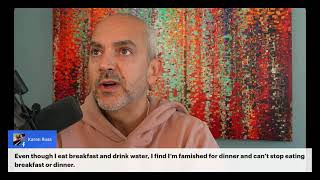
That's not a problem with me now. So let me look. All right, you know what? I'm actually, I'm gonna cut this one short today. I gotta. I'm gonna. A call that kind of came through and I'm going to hop on it right after I answer. Karen here. Karen says even though I eat breakfast and drink water, I find I'm famished for dinner and can't stop eating breakfast or dinner. Even though I eat breakfast and drink water, I find I'm famished for dinner and can't stop eating breakfast or dinner. That's interesting. My first thought there is, great job paying attention. Okay? The first step's awareness. So once we understand what's going on, we can tweak it and optimize it. Okay, so great job. Drinking water, eating breakfast, paying attention to what's going on. I find I'm famished for dinner. The first thing that pops out at me is I'm not hearing any mention of lunch. So I'm getting the feeling, Karen, that your strategy is, oh, I meant lunch or dinner. I got you. Even though I eat breakfast and drink water, I'm finding I'm famished for lunch or dinner and can't stop eating breakfast or dinner.
Okay, well, water, water is not gonna take care of your hunger. I mean, water is a great strategy to in the short term, kind of deal with the hunger and move forward. But at the end of the day, what I'm hearing, Karen.
The first step here, I meant lunch or dinner. So you are eating lunch, you're eating dinner, you're just hungry all the time. Now if that's the case, you're eating breakfast, lunch, dinner, you're drinking a lot of water and you're always hungry. My next question goes, what are you eating typically for breakfast, lunch, dinner? And the big first category categorization I'm looking at is are you eating whole natural foods or eating processed foods during these meals? Process, primarily. That's the next big question I'm asking.
That's what, that's what I want to know. Right. So again, you got the three meals set up. The fact that you're famished.
I don't know. There's something going on there, you know, so it's either. Now, again, I kind of start with the nutritional side of it, the cal. The physical side of it. If you're like, no, I'm eating all natural whole foods, you know, then I'm going to go into the emotional side of it. What's going on? Are you stressed out? Are you anxious? This is a crazy part of time in life or whatever. I'd want to know that. Because if you're like, no, no, I'm totally calm, I'm totally at peace and I'm relaxed and I'm calm and I'm eating whole natural foods for breakfast, lunch, and dinner. I'm drinking my water, I'm sleeping enough and I'm just starving all the time.
Yeah, I Shredded Wheat with raisins and milk for breakfast today. Yeah. Okay. Well, there you go. I would. That's an okay breakfast, potentially. Shredded Wheat, though. Like, just look up Shredded Wheat with shredded wheat.
With raisins.
Ingredients. No nutritional information.
So let's just see.
So if you're. If we're talking now again, I'm just. I'm picking one here. What is this stuff? Raisin Wheats? I've never heard of Raisin Wheat. I've never seen this box. This is from like 1910.
Is it raisin Wheats? Is that what you're eating?
Are you Raisin Wheats? Is this even for real? This is the weirdest looking package. I've never seen this in the store, although I never walked down the cereal aisle. Shredded whole Wheat with raisin in the middle.
Are you eating wheats? Let me know because I want to get specific. But it probably won't matter what you Say we'll see.
Shredded Wheat with raisins. Oh, you added the raisins. Okay, so you just had Shredded Wheat. Let's look up shredded Wheat. Because I want to. I want you to see how this plays out. And again, I want you to notice I'm calm and I'm relaxed and I'm kind of looking at what you're doing. So I'm leaving the emotion. Right. Data over drama. I'm leaving the emotion over here. I'm just going to look at what you're eating. I always start with the first meal, the day, the breakfast. Okay, so you tell me you're eating shredded wheat. You add the raisins with milk. Okay? So right off the bat, that. That's not ideal is what I'm going to say now. That's what I would say now. If you ate that and you felt totally satisfied until lunch, I'd say, fine, keep doing that. But the fact that you tell me I'm really starving by lunchtime makes me think that what you're eating at breakfast is not the right thing. Okay. And we'll look why and see. See if there's a reason why.
In a second here. And I think we'll find it. Shredded Wheat.
Nutritional label info. Let's see. There we go. Shredded Wheat, post shredded Wheat. Let's look up and see. Okay. Key nutritional information. And the first thing I'm looking is I'm going right to sugar. And I don't see much sugar. Right. Very low to low to zero, high in fiber, whole grain. So again, there's a lot of good stuff right on the ballpark. I'd love to see their actual.
I'd like to see the ingredients. Okay. There we go. Okay. So yeah, total sugars, no added sugars. Okay. This looks great. This is a great looking. Right off the bat. I'm feeling good about this. There's fiber in it. Shredded Wheat, Original shredded Wheat. Looking good. Post Shredded Wheat. I like it. All right. As much as we could like it. Cereal. Not a huge fan of cereal, but this is about as good as I would say it would get. Okay. And then you're adding some raisins. Nice as well. Okay. But now we got to look at your experience, and your experience is not filling you up. And yes, we see. Someone said it already. No protein. You might want to add some protein to that. Right. So you added some fiber. Great. But now I would test out the protein, you know, and I would look to see. So maybe.
I mean, it could be anything you want. I mean, you could make.
You can have protein in a million ways. You can eat, you know, some beans with it. I know that sounds weird. You could have some toast with peanut butter. But what I would do is I would. Look, Karen, to make breakfast more satisfying. Yeah. Post Shredded Wheat. Yeah. So, Karen, post shredded Wheat sounds great. It's natural. It's relatively healthy. Fiber, no sugar added. Super duper right. You put some raisins in there. That's okay, too. But again, it's just not satisfying you. Doesn't milk have protein? Not much. Not enough for you. And I'm not a big believer in milk. That's why I don't eat cereal. I don't want to drink milk. I'm an adult. I'm not a baby cow. And so I want to eat human food. That's. That's me saying that humans aren't good at measuring liquid calories anyways. You process liquid calories different than meal calories. Because we evolved in an environment where we never.
We never had liquid calories. You know what I mean? Like, in the natural world, we stopped drinking milk when we were children, and we never. There was no liquid calories. So your body and brain aren't good at measuring liquid calories. So, again, for me, personally, I have issues with milk anyways, and I think there's better ways to spend your calories. But. But that being said, even if you don't want to, you know, change the milk up, I think that adding some protein sources to your breakfast is probably what I would look at. A little bit of protein, maybe a little bit more fiber. Having a piece of Ezekiel toast with some natural peanut butter might be something that all of a sudden satisfies you till lunch. Now, what you have to deal with most here is your brain saying, well, if I add pro, if I add toast with peanut butter, I'm going to weigh. Boost my calories up. Because what we tend to do is we look at the perfect meal plan when we're thinking it out. I'll eat this for breakfast, this for lunch, this for dinner. So we think, oh, that may be perfect. I'll just do that. But then the reality happens, and we eat the perfect breakfast. Now we're starving by lunch. Now we weigh over, eat lunch. We weigh over, eat dinner. And so the thing we planned didn't come to pass. So, again, what the first thing we got to figure out, Karen, is what breakfast can I eat that's relatively enjoyable, relatively easy to make, and satisfying, meaning it comfortably gets me to my next meal, which would be lunch? And so that's what I would focus on. I wouldn't try and change all my meals. I would focus all my energy on coming up with some breakfast. One or two, probably, depending how much variety you require, come up with 1, 2, 3 breakfast options that fit the bill. They fit kind of your calorie ranges where you want to be. They fit your nutritional ranges, and they're relatively easy. But most importantly, they satisfy you for a while. Okay? That's the key thing. And if you spend a week or two on that, Karen, I can almost guarantee you'll come up with better strategies than what you got right now. All right.
Just Jay said, Jim, I just saw this guy, Dr. Robert Lustig, on a recent podcast. Say a food has a label on it. It's a warning label. Love that. Made me think of you. I. I like Dr. Lustig.
Am I blanking on this? I think I'm. I'm. I get these two confused. I know Lustig's not this guy.
Yeah, I like. I like Dr. Lustig. I'm thinking. I wanted to think who I'm thinking of.
Who's the nutritarian guy?
Deferment, ferment. And I like him, too, but I think he takes it too far. But yeah, that's funny. I think that's the warning label. That's pretty good. I do like that. All right, everyone, I do have to get out of here. If there's any more questions, if I missed any questions, I apologize. Gotta get going. I got a thing I got to do real quick. But. But thanks for listening. Thanks for the comments and questions. Appreciate them. If you're not in my world, click the link in my bio, go to program yourself, then get the hypnosis session I give you. It's completely free. It's called the New Thin Me. It's a kickstart session. It's 10 minutes long. It's going to really help you. I also give you a training that's really going to be helpful for you, and.
I got a bunch of free stuff for you. Okay? And then if you like this, I'm here every Monday through Friday, usually around noon Eastern. You can ask any questions. I'm happy to help you out. And if you like listening to some Ms. The Live, you can go any podcast platform search program yourself. Then I'll pop up and you can listen to it whenever you like. So. All right, everyone, have a super duper weekend and we'll talk soon. Bye.
More from Jim



Weight Loss Visualization: Wake Up in Your Dream Size #programyourselfthin #weightlosshypnosis



What If You Pretended to Be Thin for One Hour? #programyourselfthin #weightlosshypnosis




