Program Yourself Thin Live 5-14-26
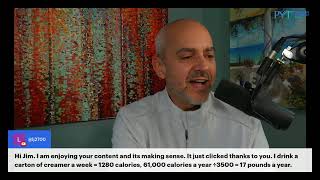
Jim Katsoulis argues most extra calories come from daily habits you don't notice, not occasional binges. Become a calorie detective, fix your single biggest habit with small changes, and weigh yourself daily as neutral data. Skip extreme diets and cut 10-20% of what you eat now.
Chapters
Everyone, welcome to today's Program Yourself Thin podcast. Today we're talking about where are the calories coming from. If you want to manage your weight, you really need to start thinking yourself as kind of a detective and you need to find out where these calories are coming from. And no, you don't know because your brain has been caught up with the few things you're aware of. So you may be aware that you pigged out on cookies yesterday or that you, you know, eat ice cream sometimes. But the way your brain works, you're missing probably 70% of where your extra calories are coming from, because usually your extra calories aren't coming from the big binge that happened, but the consistent way that you're eating and living. Well, eating specifically. And so this requires its own phase. You can't just assume that you know where the calories are coming from. Please, please believe me. This is what— the kiss of death— to think that you know where the calories are coming from without really focusing on it for a little while and really seeking to understand it, you're not going to know. You're not going to know. And that's going to cause you to focus on the wrong things. And what most people focus on are the big kind of binge-y type things or the big obvious mistakes that they're making, because that's what their brain has glommed onto. When in reality, what's really driving the process is the day-to-day, week-to-week habits that you have going on consistently. So you need to become a detective and you need to start looking at, um, where are these calories coming from? Where are the extra calories coming from? And the way that I always suggest people start this is by focusing on the number one habit that is bringing in extra calories. So your highest calorie habit. Now your highest calorie habit is going to be one that's showing up every day or multiple times a week. It cannot be Thanksgiving. Thanksgiving is not your highest calorie habit once a year. That's not the problem. It's the consistency. You need to look for the consistency. So you're looking for behaviors that show up again daily or multiple times a week. Some of the big ones, typically late night or evening snacking, overeating at dinner, grazing in the afternoon, eating sweets after lunch, things like this. And so what you're looking for is where are the highest numbers of calories coming in? And once you recognize that, then you can go to work on that one thing. But the first thing we do is recognize it. And a lot of times the consistency of where these calories are coming in, in, in an odd way, almost creates your blindness to them. Things that we do on autopilot, things that we do naturally without thinking about it. We tend to be unaware of. That's why I say this phase of just recognizing where the calories come is just so important of itself, um, because most of the time the calories are coming in and things that you have unintentionally kind of been avoiding, um, or you just aren't seeing them because they're not part of your paradigm. Um, and again, your mind is usually triggered on the big things, the big kind of flamboyant things, because because that's what sticks in our memory. Um, but it's the consistency that is really creating your weight ultimately. So what things are firing off for you consistently? Uh, and again, daily things like snacking, overeating at dinner, uh, grazing during the day, poor choices for lunch. Those are daily examples. And then weekly examples are things that happen multiple times a week. Um, going out to eat, takeout, eating at specific restaurants or places, certain situations, you know, maybe it was an office party every Friday. Again, it's dependent on what your situation, your schedule is. But start looking for the routine eating, not the random binge. That's not what's doing it. It's the routine eating that's running all of it. And so once you realize that, then you can strategically start to focus on those things And I would also suggest, because it's kind of embedded in what I'm saying here, that what I'm talking about is really a fundamentally different approach to managing your weight because we're not trying to do it consciously. We're not trying to micromanage our eating behaviors to lose weight. We're looking to recognize our eating behaviors that run habitually and then strategically seek to change them. Now, we can't change all of them at once. Okay? We have to focus on one at a time. If you're going to have the best chance of success. So for you, if, uh, you know, after dinner snacking is your biggest challenge, that's where you put 80% of your energy is to managing your eating after dinner. Because if you can make a fundamental shift in any of these habitual behaviors, that is how you make the most dramatic change in your weight, uh, in ways that you almost don't even feel. Okay. It's kind of the, it's the behaviors running in the background consistently that are more impactful on your weight than the random overeating that happens. Okay. And so when you start to make changes in this background, um, fundamental automatic running behaviors, that's what's going to show up. And again, it shows up almost, uh, a common thing you hear from my clients is almost like, I almost don't even know how I'm losing weight. And now again, they know they're changing things, but we're focusing this way on the automatic behavior. So intensely, that it— when you make the changes there, when you, when you're able to dial down your dinner consumption by 20% comfortably, that starts to affect night after night after night after night after night. That starts to have a huge impact right now. Again, your mind doesn't appreciate it because your mind appreciates the big things. So it wants to, you know, be able to go, you know, to your friend's house and not eat the cookies, right? So it's focused on kind of acute unusual things more than the consistent habitual patterns that are most responsible. So you almost have to— it's almost going to feel counterintuitive to you. The emotion is tied to the big thing, the random thing, the unusual thing. But again, it's the unemotional kind of thing that almost slides by the radar of consistently overeating. That's usually the main thing responsible for the weight issue. So again, my suggestion to you is that spend a couple of days at least and really start thinking about what are the routines. And the best way to find this is not even to think about it so much as to be aware each time that you're eating for the next few days. So every time you're about to eat, ask yourself, is this a routine behavior for me or is this kind of an outlier thing? And we want to start to focus in on the routine behaviors and really optimizing those, because once you get those in place, then it's a lot easier to deal with the outlier-ish, more unusual, random things. Okay, so give this some thought and good luck with it. And if you want to go deeper into this way of approaching your weight with the mindset piece, click the link in my bio or go to programyourselfthin.com and go get the free hypnosis session that I made for you. It's called The New Thin Me. It is designed to kickstart your weight loss by clarifying your goal weight and connecting you to it. So you feel this motivation pulling you towards your goal, um, so you don't need to push as much, um, as you've had to in the past. And again, that's completely free, uh, just go to programyourselfthin.com or click the link in my bio. Uh, if you are in Facebook or YouTube land, I will put the link in the chat now. And if you are on TikTok, you can just click my picture up on the top left there and you'll be brought to my bio and the link will be there. You can click it Take 2 seconds, get yourself going, and, uh, there it is. So yes, if anyone has any questions, feel free to ask them. We're here to talk about your weight, your eating, what's working, what's not. I am here to help you out as best I can. I've been doing this for over 20 years professionally, and a lot of times I can help people kind of navigate the most common kind of pitfalls of dieting, I guess, is how I would say it. Uh, D17 says, what are your thoughts on not weighing ourselves during weight loss? It's very triggering. Um, I get that. And before I answer the question, I think there's no right or wrong answer necessarily. I think there's only what works for you. So if weighing yourself is absolutely devastating to you and triggering and you just cannot handle it, then don't weigh yourself. Okay. But don't weigh yourself at all. Okay. Don't tell me how triggering it is and then be like, oh, so I'm only going to weigh myself once a week. That is the kiss of death. It's one of the cruelest things you can do to yourself. So if you're so triggered and so unable to regulate your emotions in terms of the scale, then don't use it at all. Fine. I've seen people succeed that way, but the majority of people I see succeed are people that use the scale and weigh themselves regularly, if not daily. And part of my suggestion to do that also includes managing and learning to manage your emotions and mindset while you use the scale. So we are not just going to leave your scale opinions and mindset and responses the same and just force you to step on the scale. We are going to use stepping on the scale each day as an exercise and a tool to also manage your mindset, to practice being able to use the scale as a tool. Because to me, This idea that you're going to be so triggered and so scared of the scale, it's almost like a chef who cuts himself with a knife and now is terrified of this, of the knife. So what? So how are you going to be a chef then? You cannot be a great chef who's terrified of knives. It's the main tool of your craft. Well, if you're really serious about your weight, if you're really serious about it, I can't understand why you wouldn't want more data. More feedback, a tighter feedback loop that you could work within. And on top of that, if you're so triggered or at the mercy of the scale and the emotional avalanche that falls on you every time you do it, that's a huge red flag of something that you're most likely going to have to deal with. To have all of that emotion in there that just comes bursting out the second you step on the scale and it's a little bit up is really an indicator of a deeper problem. It's not the scale that's causing all that. The scale's just revealing it. And I think anyone that has that much emotional, um, you know, uh, reactivity to this scale, I think has got bigger issues than the scale personally. So I think using the scale makes the most sense on a logical level because you're working within a shorter feedback loop. And without question, scientifically, the best results come from smaller feedback loops. That makes sense. The quicker you get feedback, the quicker you can course correct. The quicker you can kind of re-motivate yourself, refocus. So the longer the feedback loop is, you tell me the science of longer feedback loops creating better results, right? So, so feedback loop, I think it's pretty black and white, cut and dry. That's a better plan. So now we get to the emotional piece. And to me, the scale ought to feel like the speedometer of your car. That's where we want to get to, where it's just one more data point that you're using to succeed with. Using to manage your approach so you get the results you want. And so if we have to manage our mindset, our emotional response to the scale, that seems like really valuable, great work that's going to support all of your weight management attempts. So I tend to say weigh yourself every day when you're actively losing weight. I did it. I recommend it to my clients out the box. There are always situations where, you know, again, if you absolutely hate the scale, you don't want to use it, then go ahead, do that and walk that path. And if you're able to succeed with that path, great. We don't have to talk about it anymore. But if you feel like you have to walk that path and 5 months from now, 10 months from now, a year from now, you haven't lost any weight, then I would suggest maybe that's not working. And let's, let's reconsider this. So I find myself very— I try to be really, really practical with the advice that I give. And so, because I hear a lot of people tell me, no, Jim, I can't step on the scale. If I step on the scale every day, I'll absolutely be triggered and I can't do it. I need to step on it once a week. Okay. Have you managed your weight? Oh, no. Well, so what, what's working then? Well, if I step on the scale, I'll get triggered. But what if you got through that though? What if you stepped on the— what do you think is going to happen if you step on the scale every day for 30 days? Do you think you're going to be as triggered 30 days from now stepping on the scale every day? Or do you think you're going to acclimate to it, get used to it? Don't you think that's a better version of you in terms of being able to manage your weight than the one that's so reactive that you almost can't be in the same room as a scale? I, again, I think that scale reveals a lot of mindset and emotional regulation issues that are there, you know. So I hope that helps, but I know that's kind of a contentious issue. People have their opinions on it, so do whatever works for you. But again, if what you're saying— a lot of people tell me what works for them, but it's not working for them because they haven't mastered their weight. So something to keep in mind. Uh, so yeah, any questions you have, feel free to ask them. Um, this one says, I exercise every day and I have low self-esteem. Um, yeah, I mean, the two don't really have anything to do with each other necessarily. I mean, exercising you know, biochemically can support, you know, feeling better, but it doesn't necessarily change your self-esteem at all. Um, I think there's plenty of examples of people that over-exercise because they have low self-esteems. So yeah, I mean, but that, that's to a deeper point anyways that I talk about all the time, that the weight doesn't fix everything, folks. You know, the weight doesn't fix everything. It, um, if you're, if you're sad and then you start eating less and lose weight You'll be a thin sad person, most likely, you know. So it can improve some things for sure, but it doesn't just fix things. And that's why in Program Yourself Thin, it's an inside-out approach where again, we use the goal weight pyramid, but, uh, we follow the goal weight pyramid, right? So, so we got mindset, lifestyle, and eating. But notice mindset's on the bottom, right? Because again, just losing weight's not going to fix your mindset. It's not just going to fix your self-esteem and all the rest of it. Neither is the weight loss. So, um, we usually need a more robust plan. How can I change it, Unc? Um, I don't know. I mean, how do you change your self-esteem? You know, that's a big question, but I can tell you that just, just exercising is not going to do it. And you have to do a little bit of mindset work, if I had to guess. Uh, Tanuha, how's it going? Says, I've been using the scale every day for 2 years now. At first it was hard, now I have insight on fluctuations and don't mind at all. It actually helps now. Thank you very much for writing that. Thank you. Okay. That's what virtually everyone— that's virtually what everyone who starts weighing themselves every day and sticks with it ends up saying. Yeah, it's hard at first, but why is it hard at first, folks? You know why it's hard? Because it, it negates what you think about weight loss, because what you think about weight loss is bullshit. No offense. You think like a dieter. And diets have filled our heads with bullshit our whole lives. And the idea of how quickly we can lose weight and how weight works has been completely— what's the word? It's completely wrong from how it actually works. So to me, the other piece of weighing yourself at exactly that is that you'll start to recognize how weight works in your body. And it's not how you think. Your weight's constantly fluctuating. You know, it reminds me— I might be saying this wrong, but the way your eyes work is kind of similar. It reminds me of this because when you look at how your eyes work, it's very counterintuitive. Um, you think you kind of look at things, so you're like, you're looking at something, you look at it, then you look at this, then you look at this, then you look at this. That's not how your eyes work. It's called— and again, I might be pronouncing this wrong, but saccades or saccadus. Um, basically your eyes are constantly flickering. They're constantly scanning, moving. Constantly. And what happens is you do stop for seconds at a time, but your brain's— your eyes are constantly doing this, but your brain creates a static image, but your eyes are always still kind of constantly. And so your weight's like that. Your weight's always moving. And so it's not so much that we're looking for just like the weight loss, we're looking for the trend line to change. And I think that's a completely different paradigm to exist within, because if you just look at his data points and you start eating better and the weight should go down, But that's just not how weight works. And you'll find that if you start weighing yourself every day, because what you'll find is your weight fluctuates within a certain range. Maybe it's a pound, maybe it's 2 pounds on average. And then there's always outlier fluctuations as well. But you're going to notice that your weight fluctuates and that when you start eating better, when you start lowering your calorie consumption, what happens is the fluctuations still happen, but the trend line goes down. And that's how weight loss really works. And I think understanding that is crucial because if you don't do that, if you don't understand that, weighing yourself once a week, you don't even know where the hell you're at within your fluctuations. So you might weigh yourself Sunday night and you might be— you might be down— you might be fluctuated down 2 pounds that night and then you eat well all week and you drop 2 pounds, let's say. During the week, but you get on the next week and you fluctuated up 2 pounds. So now it looks like you didn't lose any weight, but if you weighed the next day, you'd see you're down 2 pounds. So again, if you're not weighing every day, you don't even know how your body loses weight. No, you don't. You know you don't. Okay, I've had this conversation for 20 years. No, if you've never weighed yourself every day, you don't know how your weight works. No, you don't. Why would you? Why would you? And this gets us to a deeper heart of the whole issue, and And again, it's not your fault. You've all been conditioned to think like dieters, but dieters think wrong about a whole bunch of shit, but they're super defensive about the wrong shit they believe in. Dieters are some of the most defensive people on the planet. 30 years they've been doing what works for them and they're overweight. Why are you saying it works? People saying, oh no, Jim, the only thing that works for me is when I'm really strict with my calories. The only thing that works for me is when I eat 1,200 calories. Okay, then why are you overweight? Well, because I couldn't keep it up. Then why are you saying it works for you? Well, that's how I lost weight. Okay. Lost weight for what, a month? And then you couldn't keep it up. So that didn't work for you. Stop saying the thing that doesn't work for you is how— what works for you. Dieters argue for their limitations more than any people I know. And you don't realize you're doing it, but it shows up in the scale as well. People resist the scale every day, all the time. But if you really take a step back and think about it with some of the things I'm mentioning to you, What kind of logical— if we were going to debate using the scale, how do you think you're going to beat me in a debate? You think you're going to convince people that weighing yourself once a week or weighing yourself once a month is really the better plan than being able to calmly step on a scale every day? If your goal is weight loss, if you're serious, I mean, that's like running a business and looking at the sales figures, uh, once a week. Now again, I get what you're saying. You can feel this minutia, but again, you've all stepped on the scale as dieters. So again, it's not the fucking scale because you all stepped on the scale once a week and it's just as triggering. But you think, oh, cutting the triggering down by 6 days is the answer. No, it's not. It's relieving the trigger response is the answer, not avoiding it, because you're all so scared of the scale. That posture is really not a posture. Again, the chef who's scared of his knife, how good of a chef can he be? Or she be— I'm using he pronouns. But, um, again, there's tools of a trade, you know. How good is the writer who's terrified of the keyboard? You know, it's just— it's a weird thing to be so scared of and so reactive to, in my opinion. But people have different opinions, I suppose. What's up, Queen Victoria? Queen says, I'm Jim, I'm inspired every time I see you online. I keep, keep up the wonderful work. Well, thank you, I appreciate you saying that. And that's why I'm here every day, inspire you all. This is my mission in life and I love serving it. It really is. I'm a very lucky person, I get to do this for a living. I absolutely love it and I love being able to come in here every day and be able to speak to you all. It's just a dream come true. It really is. Victoria follows up by says, we're looking for climate change rather than weather change. Rainy days happen. Yes, absolutely, absolutely. I think that's a perfect example. Again, it's which, which paradigm are we in? And dieting trains you to think small, right? Diets— the time frame of diets is days, weeks, and months. The time frame of weight mastery is months, years, decades, and forever. They're two completely different scales, exactly like the weather. I think that's a perfect example, um, climate change versus weather change. Don't be one of those people who says climate change isn't real because it's cold one day. Don't be that person. That, that, that puts you out there as someone who's, who's kind of ignorant about science and what we're talking about. Don't— I don't mean to offend anyone, but there are, there are realities of life, okay? And you can— if you want to argue about climate change, then argue about climate change, but argue on that level. Don't conflate the levels to try and prove points. And I think the same thing happens with the scale. I think that weighing yourself once a week, you're arguing for your own limitations, in my opinion. I think you're, you're arguing for your own emotional reactivity with a scale. You're arguing for your fear of the scale. I don't— I'm not gonna argue for that. I want you to be in charge of the scale. I want the scale to be below you. You're in control of it. You're a big powerful being. And the scale is just a little tool you use. That's what I want you to feel. That's what I want you to think. And I think that feeling is much closer to your goal weight than being absolutely terrified of a scale. And she says, I lost 13 pounds. However, I weigh myself every day. Okay, there you go. You know what I mean? Again, I— it's always kind of one— people are one side or the other, either seemingly. They either weigh themselves every day and they're almost always the people getting better results and maintaining their better results, or there's someone who is terrified of the scale and struggling to get results. That, that's the pattern I've noticed. You know, there are also some people that never weigh themselves and that also get control of their weight. There's a lot less of them, and I can understand why. Okay, um, but those are the numbers I've seen, and, you know, That's why I think that. What's up, Ken? Ken says, great introduction today, the Jim we know and love. Yeah, get all worked up. I know the scale thing does kind of work me up because I have this conversation all the time, which I don't mind having the conversation. I'll talk about all day long. Um, I just feel like sometimes it's kind of a— it's funny because I think it's logically, it's such an open and shut case. But most people don't feel that way. Uh, what's up, Jane? Jane says sometimes people avoid the scale because it tells you what you already know and are afraid to admit it. It reinforces that we are overweight when we may want to forget it. Um, agreed, Jane. I agree with that 1,000%. Um, and if we go down that path, right, if we avoid the scale because we don't want to be reminded of the reality we're unhappy with, that's a denial technique which is going to prolong your suffering. Because instead of facing the truth and dealing with it, You're dealing with the truth by trying to avoid it. So how is that— how is that a good strategy to succeed? I, I— you'd have to convince me. I, I don't know. To me, that doesn't make sense. To me, if I'm fearful of something, if I'm scared of something, if I don't want to look at the truth of something because I don't like it, I want to work through that. I want to be able to interface with the truth regularly. And so I look at stepping on the scale every day as really beyond just getting data points. Primarily, it serves as an opportunity to manage my emotions and my mindset. Let me practice stepping on the scale and being calm and relaxed and just seeing it as data. And, and if you do that, you get to the other side of it where now you're not scared of the scale. Wouldn't that be freeing? Wouldn't that be beneficial to you? You may think it's impossible, and I'll, I'll— I can acknowledge you may think that, but, but you'd have to meet me at least that if, if given the choice of being absolutely terrified of the scale and not being able to step on it more than once a week, um, versus being able to step on the scale and being calm and relaxed and being able to use it every day, You don't think that that's going to be better for your results? Like, how would that work? So I don't know, but I think you're right, Jim. He hit the nail on the head. Marta says, I still don't know what truly works for me to lose the weight. I still believe I have to keep my total calories in a deficit, but that creates hunger deprivation and I'm right back where I started. But if I eat regularly, normal, healthy meals, I just stay at the same weight. Okay, Marta, I'm really glad you brought this here. And again, Marta, remember One other way I like to put weight loss with my clients metaphorically is it's kind of like they come to me with a tangled ball of yarn. Okay. And we're untangling it together. And the untangling is usually some combination of mindset issues and strategy issues. And we keep kind of pulling on it and untangling it. Okay. And so, Marta, each time you go through this and you start realizing the problem more and more clearly, And so the problem I'm hearing you say— let me know if I'm accurate here— when I hear you say this, from what you just said, is that I still don't know what truly works. I still believe I have to keep my total calories in a deficit, is what I heard Marta say. I have to keep my calories in a deficit, but every time I go into a deficit, it creates hunger and deprivation. I can't stick with it. But then if I eat in my normal range, I'm not losing weight. So Marta tells me that I either need to go into a deprivation— I need to keep the calories low and go to a deficit, or I keep the calories the same and I don't lose weight. And so this is all-or-nothing thinking, right? You either go into a deficit or you keep them normal, you don't lose weight. And there's no other option here for Marta, unfortunately. Now, the big question is, what's a deficit mean, Marta? What's a deficit? Because if you're an average dieter, a deficit could be anything from 30% to 70% of your normal calories. Right. Most dieters wildly whack off a ton of calories on day one. That's what a calorie deficit typically means to the average dieter. So what is the gap, Marta, between your normal eating and your deficit eating? And my guess is it's probably in the 400 to 800 calorie range. If I had to guess, I don't know if you're here to answer that question. So I'm going to give you a crazy idea. Maybe it'll work, maybe it won't. But what if instead of cutting 400 to 800 calories, if that's where it is, what if you cut 200 calories and see how that is? Because I hate the word deficit personally for so many reasons. Words have meaning, and I think deficit creates all sorts of subconscious problems. So in Program Yourself Thin, we're not talking about creating a deficit. 'Cause who the fuck wants to live at a deficit for the rest of their lives? It implies deprivation right, right next door to it. So what I say is we start with our average— your weight, your starting weight is always a reflection of your average calorie consumption. Marty, you've confirmed this. You say my normal calorie range is my weight right now. Okay, so we start with your average calorie consumption. That's the starting point. Now I think what you're saying is that I need to create a deficit But the deficit is probably like here, and now you trigger your hunger and your deprivation. But what if, what if we dial down your average calorie consumption in a comfortable way? What if we dial it down by 10, 15, 20%, no more than that, and see how that feels and start to work on making it comfortable, normalize it, get used to it. Once we normalize to it, then if we want, we can dial down some more comfortably. So I don't know if you're still here, Marta, but let me know if that makes sense. But for a lot of you, that's going to resonate because again, you've been stuck in the all or nothing. Okay, so here Marta says, yes, I track and I see some changes, but just one meal and I only maintain most likely around 400 to 600 calories. Okay, so there you go. 400 to 600 calories is potentially, um, now again, 400 to 600 calories, I'm just going to say right off the bat, and I just do this, believe it or do it or don't, whatever. I always believe the numbers we come up with are underestimated. So I always add a little bit more. So when you tell me 400 to 600 calories, I bet it's closer to 500 to 800 calories. I know you don't believe that, but that's what I bet. And 500 calories is probably close to 20 to 30% of your calories, um, when you're cutting. But I bet you try and cut more because I get when you get— I bet when you get into deficit mode, you want to cut as much as possible. And so you're trying to cut even more and you're probably closer to 700, 800 calories, I would bet. And so again, Marta, you're looking at calories and you're trying to lop off. Um, yeah, maybe 1,600 to 1,700 calories suggested for my weight and age is not enough. Yeah, Marta, because see, here's the thing. Most people don't track very accurately when they're not trying to lose weight. So they don't really know what their baseline calorie consumption a day is. So what if Marta is consuming 2,500 calories a day? Let's just say so. Every time she's going to go on a diet, the diet is 1,600, 1,700 calories. That's the only way I can lose weight. But have you ever tried dropping 300 calories? 200 calories? 300 calories? Now, you might not get the— the weight loss might not show up as fast, but 200 calories might be pretty comfortable, and you might be able to maintain that for the next year. That could be 20 pounds. We've got to start thinking longer, folks, because this is what— this is what 99% of dieters do is they give themselves the option. They say deficit, but really what they're saying is extreme deficit. They're not giving that any gray area because deficit is a range, folks. Anything less than your normal calorie consumption is a deficit technically. But what most of you are defining as a deficit is usually 30 to 70% calorie cut. Which is dramatically overwhelming for your nervous system. It's a huge shift. It just fires off alarm bells and warnings and all the rest of it. Yeah, Marta says, interesting, I have to look at dropping just 200 calories. Yes, Marta. Now, Marta, I'm not saying 200 calories for good. Do you understand? Please understand this, folks. I'm not saying you're just going to drop 200 calories and get to your goal weight. I'm saying you're going to drop 200 calories, and for the first time in your life, Marta, you're going to realize lowering the calories wasn't that hard because you're going to look— Marty, you're going to look at your typical eating over a week and you're going to say, where would be the easiest place for me to shave out 200 calories? It might be from one thing. It might be from adding two things, but you're going to look for the easiest place possible in a typical week where you could shave off 200 calories. Then you're going to work on making that happen. And now you're going to shave 200 calories a day off and it's going to be relatively comfortable. and you're going to start to normalize to that reality. We're going to acclimate to that. Might take a couple weeks, might take a couple months. Who gives a shit? Because then once we acclimated to it, and you will, then we say, okay, let me cut another 200 calories. I want to cut my weight to go a little bit lower. Then we do 200 more calories, same exact thing. Where's the easiest place for me to lop them off? Let me do that. Let me work on it. Let me acclimate. Let me normalize it. Once we get there, great. Let me get 200 more calories. That's the process, folks. Doesn't that sound more comfortable than you all trying to lop off 700 calories all at once day one? 1,000 calories day one? You've got to stop doing that. It doesn't work. It's too overwhelming for you. You want to argue with me about it? You want to convince me it's not overwhelming? It's not hard, Jim? No, that's what I got to do. If you're going to argue with me, you better be at your goal weight. If you're not at your goal weight, don't fucking argue with me and tell me that that's how you got to do it. I— please don't tell me that. You can't do that if you're unsuccessful with something. You can't argue with me about how you have to be successful to do so, you know what I mean? Like, I, and again, I say this with love, Dieters, that, you know, I love all of you. I'm here every day for you, but sometimes you need a little tough love, and Dieters need to get the old shut the fuck up. What you're doing is not working. Stop, stop and listen. Relax, relax, take a breath and realize what you've been doing and how you're going about it doesn't work. And relax and open your mind up to other ideas. You have been trying these diet ideas for fucking decades at this point. They didn't work for your mom. They didn't work for any woman you know. Practically, they ain't working for you. It's not because you're broken. It's because the strategy does not work. So I always say, like, like metaphorically chopping out 60% of your calories on day one That's so overwhelming. It's the equivalent of I want to learn to play the piano and I— the only way I can play is if I play 8 hours a day. It— oh, you're gonna play 8 hours a day? Maybe you'll get through the first day, maybe. Second day you wake up, your fingers are gnarled, your back's killing you, you hate the piano, and you got to force yourself to do it all over again. Get through the next day, you can do it again. Oh my God, it's too much. What is our rush? How long have you all been trying to shave off 50 to 70% of your calories every time you're going to try and lose weight? I bet it's 30, 40, 50, 100 times. Why do you think it would work on the 101st time? It's not. I'm not saying that to be negative. I'm saying that to get you off the diet fucking path. Stop it. Please stop dieting. Please stop dieting. Follow me. Get on my— get my email list. Please get the hypnosis session I gave you. Watch the training I made you. Read the emails I send you for free. All of it is free. And I will help. I have a program that costs money, but I give you a bunch of stuff for free just to wake you the fuck up and get off the dieting path. You're not going to lose weight on a diet long-term. There's no diet. Think about this, 100 years of diets. There's not a single, there's not one diet out of the, all the thousands of diets that come down the pike that is considered more effective for long-term weight loss than any other. They all have shitty results. All of them. Weight Watchers might be at the top of the list by a little smidgen because of the social piece. And that is it. Dieting doesn't work. And it's not because you're in menopause. It's not because of your genes and your hormones. It is because of your mindset. You are thinking like a dieter, acting like a dieter, and dieters are overweight. And so you've been programmed to think like a dieter, which is to say you've been programmed to be overweight. You've got to change your programming because now Marta has a new approach. It's not the same fucking thing for the thousandth time. Because by the way, never mind just the strategy, but how do you think you're going to approach a strategy that hasn't worked for you a thousand times, a hundred times? How do you think you approach it the 101st? How motivated and fired up can you be doing something the 101st time of something that hasn't worked? You really— what, you think you're giving it all? You're giving it your all? You're motivated. You believe it can happen. No, you know, you need to do things differently. And now Marta's got a way to do things differently. Will she lose weight as quickly as if she cuts 1,000 calories a day out? No, not initially. Will she be lighter if she follows that path next year at this time? Almost guaranteed. Again, most people overestimate how much weight they can lose in a month and underestimate how much weight they can lose in a year. The diets have your entire life focused you on that month. And this is one of the biggest things you got to change. You've got to stop. It's like trying to make investments with trying to maximize your returns this month. They, you said they don't go together. If you know anything about investments, you need to give it long. You need to give it time. Time's the most important factor of investing. So imagine I say to you, okay, I need to have this kind of rate of return this month. Well, there's a lot of stress to it and anxiety and tension because you can't do it. It doesn't, it doesn't match. It doesn't coincide. I need to get my college degree this month. Well, you can't. It takes 4 years. I don't know what can I tell you? You got a timeframe mismatch. You got a timeframe goal mismatch as a dieter because dieting has literally conditioned you to think about weight loss in such short timeframes. And that creates, it makes problems the rest of the way. Yes, yes, yes, Marta. I will try to be around 2,000 calories a day and see how I feel. Yes, yes, because Marta says, I find myself very hungry in the evening, I just go to sleep. I'm not a big eater in the morning, evenings are my issue. I'm going too hard with calorie restrictions. Absolutely, Marta. And what you're finding is what everyone finds, is that you're doing pretty good restricting in the early part of the day until about the afternoon, and then it starts to become increasingly more difficult. It's just like holding your breath, folks. If you haven't held your breath in a long time, I suggest you do it because you're going to have a really interesting experience. Because when you first start holding your breath, you're going to feel irrationally confident that you're going to be able to hold your breath for a long time. And that confidence is going to be there for a while. But then all of a sudden, you're going to start to feel it getting chipped away as the time moves forward. And you're going to start to feel this exponential erosion of confidence. That turns quickly into panic and fear. It's very interesting because again, the, the, depending on your lung capacity, you know, the, the first 30, 40%, you're irrationally confident, and then how quickly it starts to turn into irrational fear and panic is, is very interesting. But to me, it's a great example of what it feels like when you try and restrict food and you're able to do it pretty easily in the morning, kind of easy at lunch. Oh, by the time afternoon comes and then by the time you have dinner, you can't keep— you can't keep a handle on anymore. Okay. And I will say one other thing, Marta. Maybe you're not a person who eats in the morning. Um, that may be true, but also understand that your morning eating, folks, is dependent on what you've done in your life. So if you have consistently tried to not eat in the morning, and then that has caused you to eat more at night, that pattern leads to you not being hungry in the morning as well. So don't believe too quickly that your patterns of eating are like some genetic predisposition. Um, more often than not, it's just the programming that you've kind of installed into yourself or had installed of how you eat. And I would keep the door open that if you start changing the way you eat, you may find that you can be hungrier in the morning. If you eat less at night, you can be hungry in the morning. And Marta, that shift would be profound for you because eating right before bed is one of the worst things you can do, um, because it impacts your sleep negatively, typically. And so you're not getting the quality sleep that you can get. You're waking up more tired. That makes it more likely you're going to overeat the next day or make poor food decisions. So shifting your eating to earlier in the day, less at night, less eating before bed tends to make your sleeping better. You wake up with more energy, you nourish yourself off in the beginning, and the whole day starts to change. But that's a strategy, Marta, for getting to your goal weight and living there for the rest of your life, as opposed to just drastically doing something for a little while. Yeah, Marta says, I used to be on very restrictive diets with 1,200 calories. I thought the 1,600 to 1,700 was enough. Thank you for saying that, Marta, because that's a lot of you. A lot of you have tried to live at 1,000, 1,200 calories, um, and now you think, well, 1,500 ought to be enough, and maybe it will be at some point. But if you're at 2,500 calories, going to 1,600 calories is almost a 40% reduction in calories. A 40% reduction in calories sends all sorts of alarm bells off in your system. It's too much, and you're going to feel you're white-knuckling it. Um, 10 to 20% is much more under the radar, uncomfortable. And again, we're doing a little bit at a time so we can normalize to it. I go back to the piano metaphor. Please don't start playing the piano, practicing 8 hours a day. You're gonna just hate the piano and send all sorts of bad nervous system programming to your, your body. Instead, start with 15 minutes, get comfortable with it, enjoy it. You want to play a little bit longer, go ahead. And then once you get comfortable with 15 minutes, if you want to get better and play it, boost up to 25 minutes. You know, this is a much better approach. So I really appreciate you sharing all this, Marta, because I know a lot of this is relevant for a lot of people. Um, says, my body feels good because it's big and strong. I strength train but looks bad. I want to lose weight to look better, but I'm very comfortable in this body. I lose a couple of pounds and gain it back. That's very interesting combination. And so, boy, there's really a conflict there, right? You can hear that in the question. I would definitely spend some time thinking about what it is you're looking for. What does looking good mean? A, okay, get really crystal clear on what looking good means to you and why you want to look that way. What's your motivation? And then I would start to think of if you're accurate in what you're thinking. So get clear. I'm saying get congruent, because what you're feeling right now— I can see it right in your question— there's ambivalence, right? Party wants to look, look different, right? Party feels amazing and strong and great, and there's some conflict there, right? So, um, there's a tug of war going on, right? Party's pulling you one way, party's pulling the other way. We need to get all the horses pulling in one direction. And the way we do that is to reflect on what is your goal specifically and why. What do you expect to get out of that goal of looking better? Again, what do you want to look like specifically? And if you're able to achieve that, how is that going to help you gain other things that you want to get? Jane says, every day before I climb on the scale, I like to predict what it will be, and I am almost always correct based on how I ate the day before. Yeah, again, Jane, that's another piece I never really get to, but when you start stepping on the scale every day, you start getting much better at connecting what you did to what the effect is. And that's really powerful too. One little coaching advice I'd give you, Jane— Jane's in the program, so I can do this— um, I would absolutely change the word climb. I would change the word climb on the scale to step on it. Climb implies this big event. Okay, we just want to step on the scale. It's just, it's one more— we brush our teeth, we step on the scale. It's just one piece of our routine. That reinforces our goal. Our goal is to get to a certain weight and live there. So the scale is just a feedback mechanism, and we're just going to step on the scale, see what it says, move on. We don't want to climb on the scale. I hope that makes sense. Anita says, can't wait to concentrate mostly on the routine. We must master the routine. I'm on the thought of climate change exists. Uh, I'm of the thought climate change is— yes, exactly. I know a lot of people here are. Um, and again, I don't want to get into that discussion, but there is a difference between weather and climate as well, and that's less of an argumentative, uh, discussion. So keep out of the politics. But yes, climate and weather are two different things, and we need to use words. Words have meaning, okay? So we can argue about lots of things, but we're not going to argue about the meanings of words. Not here anyways. Or we can, but we're going to come up with some, some agreement. Yeah. Emery says, I never count, just eat sensible. Yeah, I am there with that. I am a big— I prefer that method, but with a lot more structure to it. So the idea that you're just going to intuitively eat and lose weight, I think, is bullshit. I don't think there's a lot of validation for why that would work. I do think that paying attention is necessary and important, but I don't believe you need to count calories, you know. And so I think sensible is doing a lot of lifting there that most people aren't going to be able to accomplish. But That is what we ultimately look to do with Program Yourself Thin, is get you to a place where you can trust yourself and kind of eat what you consider to be sensible and just make it, make it happen that way. Sanjita says, what should my mindset be when I step on the scale, Jim? I'm scared to take my weight daily. Kindly advise. Yeah, I mean, a couple things, you know. Again, it's, it's, it's for each person, it's a little different. But stepping on the scale, I would say I loved it because I went through this. So you step on the scale and I like to like just sit with the fear. What am I scared of? I'm already, I am what the scale's gonna say I am. So I'm already there. So the only difference is I'm either gonna know the number or I'm not gonna know the number, but everything else is the same. And you say, yeah, but that difference is completely, cause if it's, if the number's higher than what I thought, then I'm gonna have a terrible day and everything's gonna fall apart. If the number's what I thought or better, then everything's gonna be amazing. Well, if you're living that life, you're fucked. You're in real big trouble. If you're at the mercy of the scale that much, you're always gonna struggle with your weight. So when you start doing this every day, you really start to feel a sense of balance and calm. So I would say, I wanna step on this scale 'cause I wanna know what the number is because I'm so committed to achieving my goal weight and live there because I wanna be the best version of me possible. I wanna live as the best version of me possible. And that means I need to nourish myself, I need to get my health in the right place, I need to have the right lifestyle, And I want my weight to be where I want it to be because I want to be able to have the energy and the intensity in the life that I want to live. And I want to get my, my weight there. So it's supporting me to be my best. And so stepping on the scale, it's a little frustrating because sometimes it's not the number I want, but I want to step on the scale being calm, grounded, and relaxed no matter what the number is. And if I weigh every day, the fluctuations are a pound or two typically. And when they're outlier numbers, there's almost always a reason for that happening. And anytime that happens, I'm going to learn from it. But every time I step on this scale, it's another commitment to myself that this is really serious to me. I really am taking this seriously because I want to live the best life I possibly can. And part of that is having my weight, my eating, my lifestyle under control. I want to be in control of my eating. I want to be in control of my weight. I want to see the exact number on that scale that I want to see. And it starts where I'm at now. And that's okay. It may take me a little while. It may be a journey. I'm going to have to go through a lot of trials and tribulations to get there. But I'm here for it because this is one of the most exciting adventures I'm ever gonna go on in my life. And if every day I step on this scale, and if every day I stay focused and committed, and every day I use this scale to get me back on track when I've made mistakes, then I know I'm going to succeed eventually. I may not succeed this week, I may not succeed this month, but I know if I do this month after month after month, year after year after year, I know for a fact that I'm gonna master my weight 'cause I'm not scared of this shit anymore. I'm in control, not the scale. The scale is just reflecting something back to me, and I am strong enough and my mindset is bulletproof enough that I can step on this scale. And no matter what it says, I'm going to continue and have a great day today because I love my life and I feel lucky that I'm alive. And I'm going to celebrate that and honor that by having a healthy, happy day that's going to help me master my weight as well. So there's an example of something I would say and have said to myself. Jane likes that. Yeah, step on, not climb. There we go. Climb. That's so funny. You get your rappelling gear. He's like, okay, hey, that's so funny though. But, but where's that meaning, right? Um, LJ says, hi Jim, I'm enjoying your content. It's making sense. Um, it just clicked thanks to you. I drink a carton of creamer a week, 1280 calories. Oh my God, okay, that's what we're just talking about, right? I just said where are the calories coming from? That the creamer— I should have— I didn't get into the specifics of it because there's a big specific list. But yeah, the creamer thing, oh my goodness, right? There you go, 17 pounds a year. Now, by the way, LJ, here's the secret though. This doesn't mean you have to get rid of the creamer completely. All right, you could start going to half that creamer would be the first thing, or a third of the creamer to half. That's where I would start. Okay, but great job, great job. That's exactly what I'm talking about. So thank you for driving the point home. I really appreciate that. Uh, Marta says, I've been, uh, so crank since Mother's Day brunch. I was too busy at work to join your live. I feel so much better today. Thank you. You're welcome, Marta. Yes. And that's just another thing, folks. If you're in the program, if you're in program yourself, then use these lives as another coaching opportunity. We have like an official Tuesday one where it's just, just clients get on there and we have a live Q&A and I work directly with you, um, during that to help you. But please use these lives because I always give preference to my clients. And so if you're struggling with something, you couldn't make the live, ask a question here. I promise I'll get you back on track. I've been doing this a long time. I'm pretty confident, um, that I can help you. So Marta, that's great. And by the way, for all you moms out there and those of you that aren't moms, Mother's Day holidays can, can knock us off course. That's completely normal. So the goal is to recognize that may have happened to you and then work to get yourself back on track. All right, it's not a big deal if we get knocked off track. The important thing is to recognize it, understand why it happened, and then nudge ourselves back on track. So great job, Marta. Um, Sanjita says thank you. You're welcome. Yeah, I hope that helps you out. Amy says I went from 258 to 180 and being bullied that I lost muscle because of some fasting, but I changed my A1C. Um, yeah, Amy, again, it's It's, it's— I'm still upset that I'm judged for my struggle, but I love your content. Well, thank you, Amy, and congratulations on what you did. And I want you to take a few moments today when you get a chance and really internalize what an accomplishment you've achieved. To go from 258 to 180, you know, that, that's, uh, that's literally like a 30% reduction in your body weight. That's tremendous. What an accomplishment. Again, I don't know how long you've kept it up, but that's wonderful. And there's always pros and cons to everything we do. Okay. And so, you know, you can hear what people say to you, but one of the greatest things I ever learned in my NLP training is to kind of imagine an invisible force field around you. And when negative suggestions hit it, they just hit it and fall to the ground and they don't get to you. And it's just kind of a fun way to kind of imagine it because people can say what they want. Who gives a shit? You do ultimately have control over what you let in and what you don't. And so focus on all the benefit you've gotten out of your decision and your commitment and the results you've gotten. Okay, great job, great job. Keep it up and, uh, yeah, keep listening. Okay, Dana says, hi Jim, what are your concrete tips for daily mindset work and reinforcing reaching your best self? Um, that's a great question. I could talk about this for an hour and I gotta get out of here. Um, my best tip for you just on the quick is to click the link in my bio or go to programyourselfthen.com and sign up for that hypnosis session. Because what I'm doing now is not just giving you a hypnosis session, not just giving you a special training that I made for you, But now every day, if you want, you get an email and it's a support email and it'll give you every single day. It's a little bit of what I'm talking about here in real simple, easy form. All of that's free. And so that would be the concrete tip, I would say, because now all of a sudden, if you, if you take the minute to go sign up for it, now you don't have to think about anymore because it's going to show up in your inbox. So now you've got a reminder automatically. And that's why I set that up for you all completely free. So every day you get— and I mean, this is what I'm sending you, by the way. I just want to be clear. This was from a program I used to charge for. This was one of my coaching programs I used to charge for. These are real content-heavy emails. They're not sales emails. They're not trying to sell the program. They're legit emails that are going to help you manage your weight. It's completely free. So that would be the concrete tip I'll give you for now, just because I got to get out of here. If I had more time, I would give you more concrete ones, but that one will cover you. Okay. And that'll get you started. with your everyday focus. Okay, so, um, beyond that, again, get my— get that hypnosis session. Uh, but I'm also here every Monday through Friday, um, usually around noon Eastern. So if you have any questions, feel free to pop on and ask them. Um, maybe I can help you. And if you, um, are looking for something quick to get to help you, there's this book, The Tao of Living at Your Goal Weight, and that is my book. Uh, this will take you through the entire program yourself, system in a very subtle way. It's 40 stories, um, it's 40 chapters. Each chapter is a page or two. Each chapter is a hypnotic story. It's going to change your weight for good. So go check that out. It's over at, um, over at Amazon. You can get it for less than $10. So thank you so much, everyone. Have a super day, and we'll talk soon. Bye.
More from Jim



Weight Loss Visualization: Wake Up in Your Dream Size #programyourselfthin #weightlosshypnosis



What If You Pretended to Be Thin for One Hour? #programyourselfthin #weightlosshypnosis




