Program Yourself Thin Live 6-19-26
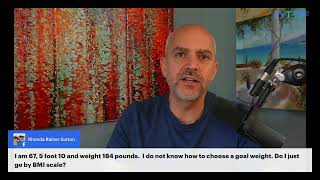
Jim Katsoulis argues willpower-based dieting fails and proposes reprogramming your default eating habits instead. Start with one meal, optimize it over weeks, and weigh yourself daily as neutral data. Skip calorie counting and BMI charts; focus on food quality and how you actually want to feel.
Chapters
Everyone, welcome to today's Program Yourself Thin podcast. Today we are talking about How to take control of your eating. Now, most likely in the past, when you tried to take control of your eating, you tried to use your willpower to force yourself to do the right thing. And the right thing might be to not eat the wrong thing or to get yourself to eat the right thing. Okay. They're kind of two sides of the same coin. But what you did is you went to the idea that you had to consciously fight against your impulses, fight against your cravings in the moment. To do the right thing or stop yourself from doing the wrong thing. And this approach has not worked for you. It may work for a little while, right? So there have been times when you've been able to string together a couple of days, a couple of weeks, couple of months and lose some weight, right? You pay attention to every decision you're making and you make the right one. But what always ends up happening is you go back to eating your normal way. You go back to eating normal. What's that mean, though? Right? If we look under the hood, what's really happening? Well, it means that while you were dieting and changing your weight, you were consciously focusing and making the right decision. And then at some point, you forgot to make the right decision. You didn't realize you made the wrong decision. You don't have the energy or the ability, seemingly, to make the right decision, right? You realize it, but you just can't get yourself to do it. The craving wins. Okay. And you go back to what you normally do. You go back to your default setting. And it is this default setting that is actually controlling your weight. This is what your typical weight is. So what I'm trying to tell you is that it's not enough to try and consciously control your eating because that's never going to work long term because you can't maintain that focus. It's kind of like if I said, okay, from now on you got to remember to breathe. Well, most of us are going to die quick because we can't remember to breathe because we get distracted with other things. And it's the same thing with your eating. At some point you get distracted with life, you run out of energy, you run out of focus, you get in a bad mood and your attention shifts to something else and your eating goes back to normal, back to what you do on autopilot. Yeah. So the way to control your eating is not to micromanage it and try and make every great decision in every moment. It's to take a step back and start changing your eating strategies, your eating programs, the way that you eat normally, your default eating settings. So instead of trying to micromanage every little thing, we're going to the strategies and the routines that you typically have, and we're looking to change them. So, for example, if for breakfast you typically eat, you know, Froot Loops and Wonder Bread with Jif peanut butter, instead of trying to eat something right there, what we want to do is we want to change the way we eat breakfast. So we don't want to just in that moment say, I'm gonna eat a banana. We're just gonna eat a banana one day, or, or even worse, not eat the cereal, not eat the toast, eat nothing. Which is what a lot of dieters do, because again, most of the time, dieters, when they're trying to control their eating, are focused on what they're not going to do. So they're not going to eat the wrong thing. Right. If you're— if you're focusing on doing the right thing, you're— at least you're a notch ahead. Okay. But the point is that we look at the behaviors, the routines, the patterns, the habits we have, and we work to optimize them. So we look at breakfast and we say, what is the best breakfast I could have? Or even better, What's a better breakfast I can have than this typical one that I usually eat? And you start thinking about it and you come up with a better strategy, a better idea than the Froot Loops, perhaps. Right. You say, well, maybe I'll have, you know, I don't know, whatever you consider to be healthy. I'll let you decide that. And we start to focus on breakfast and you make sure you have the stuff ready to eat at breakfast time. You remind yourself to make sure you eat that during breakfast time. So you're still using willpower, by the way, but you're using willpower to change the habit rather than using willpower to eat, make all the right food decisions all day long. I don't know if this makes sense to you, because typically with dieting we think, okay, Monday, it's my day to start my diet. And it feels like a starting point where I have to always make the right choice, always make the right choice, always make the right choice. And you do that until you make the wrong choice. Then you feel like you blew it and then you stop. Yeah. But what would happen if you said, okay, it's Monday, I'm going to start focusing on my breakfast now until I master it. That's it. So you have a good breakfast, you have a bad breakfast, doesn't matter. Eat the rest of the way you want during the day. You're not even paying attention to that. You're not using up spending all your willpower trying to micromanage every food decision all day. You're spending it strategically on breakfast. Monday breakfast. Tuesday, you're focusing on breakfast. Wednesday, you're focusing on breakfast. Thursday, you're focusing on breakfast. Friday, you're focusing on breakfast. Saturday, right? It doesn't— you can take the weekend off if you want. Okay. But you get the idea. You're focusing in on breakfast. And what do you think would happen if you really focused on optimizing your breakfast for the next 2 months? Don't you think that you would be much better at having a healthier, nourishing breakfast than you have now? Now, again, you may already have a nourishing breakfast, so maybe we'll switch it. Maybe you focus on dinner. Maybe you focus on lunch. It doesn't really matter. I like to start with breakfast because that's the first meal of the day. And it does kind of, you know, nudge the rest of the day in different directions. So if you don't have a good breakfast routine, that's where I would suggest starting. But regardless, the philosophy is the same, that regardless of what you do, focus on one thing, one habit, one pattern. Focus on dinner for the next 3 months, no matter what happens with the other meals or at dinner. You're just going to optimize your dinner day after day after day after day after day after day after day after day after day after day. And where do you think you end up? You end up in a place fundamentally different. And the difference is not just something that you have to consciously control. It's something that you start to work into your normal default routine behavior. This is how you change your weight. This is how you change your weight long term. And I hope this makes sense to you. Okay. And so if you want support approaching your weight this way with this kind of mindset, click the link in my bio or go to programyourselfthin.com and go get the free hypnosis session I made for you. Uh, it is there ready to go, and I give you a bunch of other free stuff as well. So go check that out. If you have any questions, feel free to ask them. Any questions are welcome. I work with people doing all kinds of diets, so anything you might be struggling with, feel free to, uh, ask a question. Maybe I can help you out with it. Maybe I can shed some light on something you're doing that will change it in a fundamental way. and allow you to get great results. All right, Marston says, hey Jim, yesterday I was 76 kilograms and now I'm 74.9 kilograms. Um, well, good job, Marston. Again, I am here to be supportive. Uh, I will let you know that that's a good job. That's all I'm going to say. Nice, nice work, nice work. So it sounds like you're weighing yourself every day, which I'm a big fan of. I like weighing myself every day. Um, What's up, Natalie? Natalie says, this is one of your best podcasts, explained so well and so simply, makes great sense. Well, thank you, Natalie, I appreciate you saying that. I always like to hear, uh, what people think about what I'm talking about, right? Talking about— I'm talking about like different stuff every single day, but it's always kind of similar. So I always like to see like what angles kind of hit, um, most effectively. That's what I love so much about this work. I love it so much. Um, it— to me, I think of my work of helping people live at their goal weight. It's like the world's biggest puzzle. That's how I think of it. And every day I make— I'm putting pieces in. That's how it feels. Every day I get a little bit further, and I love that. So thank you, I appreciate that feedback. Uh, what's up? Beck says, I've heard that when we lose weight, the hunger hormones go up to force us to go back to the old weight. Um, yeah, okay, that's a great— I'm glad you brought that up because that is a, a common, um, idea people are walking around thinking. A lot of that is actually based on the Biggest Loser studies they did. And what I would say is that it's true. It's true, right? We tend to have a set point. We get kind of accustomed to a certain point and our body will nudge us hormonally to get back to that point. So that's true. Okay. But I think there's a lot of other context around that. So I think, first of all, Biggest Loser people are not the people I want to study. I think they're the worst. I think they've That Biggest Loser show is so terrible for our culture, in my opinion, and I think it's a terrible thing for weight loss because it really is just the epitome of the diet mindset that you're going to just go all in and lose the weight. But when you go all in, again, there's a huge difference between getting to your goal weight and living at your goal weight. So, you know, to me, I think when you drastically cut calories, when you drastically overexercise to burn calories, I think that that rapid shift causes other issues, and I don't think it sets you up for long-term success. So do hormones, hunger hormones go up and all the rest of it? Sure. And they do with those people, apparently. But there's other ways to manage that. So again, even Biggest Loser, it's really a fixation on calories, and I'm more obsessed with the quality of the calories. So I'm not just cutting calories. I'm looking to transform the calories I'm consuming into a healthier and more nourishing version. And I think that that supports and helps deal with those hunger hormones, you know, and help you live where you want to be. So Carolyn— Carolyn says, yes, that makes sense. I had to do that with late day snack. Um, yeah, the pounds started dropping off. Yeah, it, um, uh, yeah, I mean, again, I was just— what I was just talking about, it's— I don't know, it's like simple and obvious when you hear it, but we never think about it because we've all been conditioned by diets. Um, says you're a big fan of daily weighing. Was that the case when you were very far from goal weight? Um, yeah, I was— I'm always a fan of, of weighing every day regardless of what your weight is. You know, the, the— your weight, how far you are away from your goal weight is really irrelevant because if you're serious about managing your weight, the scale is one of your main tools. And I say this all the time, it's, it would be like a chef being scared of their knife. You know, like, like the scale is your friend in this journey because it's just one more data point. Right. You don't have all the emotions you feel for your scale. You don't feel those for the speedometer of your car. Right. The speedometer of your car is just a measurement point. It just, it reflects back, you know, a piece of data for you. And so I know most people when it comes to the scale, well, they don't feel that way. They feel controlled by the scale. If they step on the scale and it's gone up a pound, oh my God, terrible, worst day of my life. If they lose a pound, the best day of my life, you know? And to me, that emotional reactivity with the scale is an issue in and of itself that can be worked through most effectively, in my opinion, by weighing yourself every day and not just weighing yourself to step on the scale and see what the number is, but to step on the scale every day so that you can relax and calm down. Because if you step on the scale every day, what happens is you start to notice the actual fluctuations of your body. It's shocking to me that people have been dieting for 30 years, don't understand how their weight fluctuates moment to moment, day to day. I just find that a huge piece of information that you're missing. Because if you start stepping on the scale every day, you start noticing that, that your body Weight fluctuates in ways that's completely counterintuitive. Count— completely, like 100% counterintuitive. So counterintuitive that I could sit here and say, I'll give you $100 if you guess right whether you've gained or lost weight or are the same as yesterday. You're going to lose that bet a lot of times because you don't know. It's called recency bias, you know. So how you ate most recently is going to impact what you think your weight's going to be. But what I'm trying to say is that if you don't weigh yourself, it doesn't have to be every day, but, but every other day at least. But if you don't weigh yourself regularly and consistently, I don't know, I just— you're getting less data. How— when is less data better when you want to make a change? Now, again, I know what you're all going to say. You're so— well, mindset, you know, if I weigh every day, oh my God, drive me crazy, I'll go insane. I can't do it, you know. But again, that's the problem, that you're so emotionally reactive with your weight and with the scale that the scale is just revealing the problem. It's not the actual problem itself. The problem isn't the scale, folks. The problem is that when you step on the scale, it really lays bare the fact that you don't know how to manage your weight. You don't know how to manage your weight. If you're overweight, you don't know how to manage your weight. Obviously, I know that's obvious, but that's the problem with the scale. It's not the scale itself, it's that it reflects back that you're not sure what you're doing. And that's frustrating, and I get it, but I don't think the answer is to not look at the scale anymore. I I did use the scale. I use the scale from the very beginning every day, and I use that scale for a number of reasons. Number one, I wanted to learn how my body— how weight interacted on my body. Well, you all think you just stay the same weight all the time. That's not true. If you start weighing every day, you notice there's fluctuations, you know, and it's different for different people. But for me, the average was 1 to 2 pounds a day. I'd go up or down. And then outlier issues. I'd go up 5 pounds. I can't remember ever being down 5 pounds, but it's like, I do remember times— that's an outlier for me. 5 pounds, like, in a day is the most, um, kind of shift for me. But, uh, I started to notice a lot of things about how my body actually responded to weight and what I was doing. So that was huge. Number 2 is I worked through the fear. I no longer had terrified fear that I was gonna step on the scale and see what I was gonna see. I did it every day, so I just normalized to it. Okay. And then third of all, stepping on the scale every day was just an actual reminder to me, a physical thing I was doing to reinforce that this is important to me. So I'm going to step on the scale today and I'm going to look at that number and see what it is. And I'm going to say that number is that because of what I did yesterday, this week, whatever. And that number is going to be impacted by what I do today and this week coming forward. And so again, folks, I don't know. I'm just saying, if you're so triggered by the scale, don't you think that's an issue? Don't you think that level of fear and terror is not going to be helpful to your weight loss? Because I know you're thinking like you have to hide from the scale in order to stay motivated. But is that— I just, I don't understand that. It's almost like the scale's a bully and you're just— you found a real hiding spot to hide from it. Is that the solution you want? Is that the life you want to lead where you're terrified of the scale all the time? I just— it's a weak posture. It's a weak positioning. You're trying to lose weight on your heels. And so fuck that scale, you know what I mean? Like, you're, you're the boss of the scale. It's a different attitude. It's a challenge mindset. Bring it on. Okay, let me step on the scale every day. I'm gonna do it. I'm gonna work through a fear. I'm gonna be able to stand on the scale in a neutral and different way. Whatever it says is just feedback to help me make better decisions today, tomorrow, and this forever so that I can get to the number I want, be the person I want to be, and stay there. That's my goal. I, I just prefer that mindset, you know. Uh, what's up, Kent? Kent says, back from vacation. Ah, shit, I just lost it for a second. Hold on. Kent says, back from vacation and back on track. Actually feels good to get back to my eating routine. Yes, classic, classic, classic. Um, Kent's in the program, superstar. And this is what I hear from all my successful people is they come back from vacation and we all say the same thing. I can't wait to get back to my normal routine. And that in a nutshell is the difference between program yourself in and a diet. Because think about the last time you got back from vacation and said, I can't wait to get back to my keto plan. I can't wait to get back to tracking points. I can't wait to not eating until noon. When's the last time you went on vacation and then said that? And yeah, probably never. And so people all the time, because why? In Program Yourself Thin, we seek to manage our weight in the easiest, most enjoyable, most comfortable way possible. And so part of that is figuring out eating strategies and routines that really, really work for us, that are the most optimized thing we can come up with, meaning we enjoy it. It makes us be the weight and the health we want to have, and it's relatively easy to do. Those are the big three. And so when you ultimately come up with a, a way of eating that's really customized to you and your lifestyle and your personality, and you optimize it so that it really flows in your life, this is exactly what happens is you go away and get off track for whatever reason, and then you get back and you can't wait to get back on track. That's how you know when you can't wait to get back on track. That's why it's easier to live at your goal weight. Does that make sense? Again, you have to understand dieting's about getting to your goal weight, Program Yourself Thin's about living at your goal weight. And so you tell me, if you couldn't wait to get back to your normal eating routine, don't you think that would be a huge piece of being able to live at your goal weight, as opposed to just force yourself to get there for a day or two before you start putting the weight back on? That's all the difference in the world. So great job, Kent. I appreciate you sharing that too. Uh, I can't read that name, but it says, hello, I've started Pilates and stopped emotional overeating for 2 weeks now, but I haven't lost any weight. Yeah, that's okay. 2 weeks is nothing. 2 weeks is nothing. I know, I hate to say it, you know, dieting industry has really conditioned us to expect results today. But that's just not how it goes, you know. So great job. Celebrate that you've started doing Pilates and you're moving more and connecting with your body more. You know, celebrate that your eating's improved. And no, you know, I guess through faith and the belief that we live in a physical reality where cause equals effect. And that if you start eating better, if you start connecting with your body, that you're going to be able to manage your weight more effectively. And what I always say is that weight— weight is very inconsistent and unpredictable in the short term and very consistent and predictable in the long term. So again, in this scheme of things, 2 weeks really just doesn't even— it just doesn't matter much, you know. Um, he says, I always enjoy your live. You're amazing, so kind and so supportive. Thanks so much, Jim. Well, you're welcome. Thank you. It's a nice thing to say. Um, Carolyn says, yes, concerned about how many ways the scale can be wrong due to so many reasons. I'm digging what you're saying. Always fear the scale. Um, yes, concerned about how many ways the scale can be wrong due to so many reasons. That's interesting. I don't know what that means. I don't know what that means. You're concerned about— yes, concerned about how many ways the scale can be wrong. I don't know how many times the scale can be wrong. I'll tell you what I find it to be cruel is weighing yourself once a week. I think that's the cruelest option on all of them. Like, you really don't want to use a scale, fine, you don't have to use a scale, but don't use it. But if you're going to use the scale, using it once a week is crazy to me. Crazy. Oh, I just want to see the trends. No, no, no, because you step on that scale and then for 6 days you're just in fantasy land and if your eating's been good, you think you've lost 10 pounds. If your eating's been bad, you think you put 10 pounds on, and that affects you. That affects you each day that goes by, and you think you're doing really great, or you think you're doing really awful, is going to affect you. And if you think you're doing really great, well, it's great until you step on the scale a week later and you find out you didn't lose 10 pounds, you're the same weight. But if you weighed yourself the day before, you might have been down 3 pounds. You know what I mean? That's why weighing yourself once a week— I don't know, you all, you can explain it to me if you want. I don't know. I don't see the, the wisdom in that at all. I don't see the wisdom in that at all. But I know people are gonna say, oh my, if I step on a scale every day, I'll just be a raving lunatic, I'll be an emotional mess. Well, that's a problem, you know what I mean? Like, like, that's a problem in and of itself. Again, if your answer is I have to, I have to hide from the scale, I just don't know. It doesn't sound like a very empowered place to come from. Uh, Nina says, I'm away from home and in a place where sourdough bread is baked daily, so I've been loving it for breakfast with fresh grated tomatoes and drizzled olive oil. At lunch, I go back for a tuna salad. I'm not having sugar cravings or going crazy with bad snacks, but I still hear that old voice that tells me, you are bad, you can't have this or that. Um, I do weigh myself every day, but I didn't bring it with me. My holiday ends on Monday. I think not weighing every day is making me feel insecure. I do know I'm doing better than ever before, thanks to you. Um, well, thank you. Yeah, Nina, I think that's a great post you're making, and I think that it's real legitimate. I think that going away and all of a sudden you're, you changed up your routine a bit, you don't have your scale, it can feel a little disorienting, you know. So I think that response you're having is normal. Um, to, to the old voice that tells you you're bad, I don't think you're bad at all, you know, because you're in a different spot, all the rest of it. You know, and at the end of the day, remember this, that you're gonna get back to a scale and you're gonna see what happened. If you put 10 pounds on, then you adjust. If you're the same weight, cool, you readjust there as well, you know? But again, there's no need to be fearful and worried. I mean, again, you're paying attention to what you're doing, so you're not just going wild, you know, and all the rest of it. But it's important to see things accurately. And so right now, what I would remind you of, Nina, is that you don't really— you can't see things accurately yet. Until you step on that scale. And so tell that voice, you know, bullshit. Um, and I've gone through this. I started making sourdough in November, and I have made probably 1,000 loaves of bread since then. I make a lot of bread. Okay. And, um, I have not put— I put a little bit of weight on. It had nothing to do with the bread because I was making the bread for 5 months. Weight was staying the same. And then life got a little wild here. And, um, put a couple pounds on. But, uh, again, that's why I think weighing yourself regularly is good, because you break through a lot of limiting beliefs and ideas you probably have, you know. And I think the scale just makes you more accurate, and that's what I think. Yeah, if anyone's got any questions, feel free to ask them. Oops. Yeah, Carolyn says, going to jump on right now. Oh, I see, Carolyn. Yeah, I'm agreeing, no longer want to fear the scale. Yeah, now fearing the scale is wonderful, it's very empowering. Again, that's what I'm trying to say. Um, if you feel such terror and fear for the scale, that is a symptom of a deeper problem. Your mindset is in a bad place when you're terrified of the scale. I mean, how could you argue that? What wouldn't it be more empowering to feel in charge of the scale? Don't you think that— how do you think you're gonna— how do you imagine the next month of eating if you're terrified of the scale, or you're fine with it, you're empowered, and you know you're in control of it? Which one— which path do you want to be on? To me, it's kind of obvious, but whatever, you know. And again, I, I only say this, and I know this might sound weird to you if you're kind of new here, but it's, um, we've been so conditioned to think and have the wrong mindsets when it comes to weight. This is why 74% of the adult population in America is overweight or obese. We've been conditioned to think incorrectly, uh, in order to manage our weight. But that's all intentional too, you know, it's all intentional. Um, the diet industry is really the food industry, so they don't want you to eat less food. So that's why you've been— had diet shoved down your throat your whole life, because they That's what the diet— the food industry wants you to think like. They want you to think like a dieter because dieters are overweight. And it's a— I don't know, it's a pretty direct line in my world from one to the other. What's up, Vicki? How's it going? Yes, happy Juneteenth. And, uh, yes, happy Friday on top of it. The double. Um, yeah, it's kind of nice. All right, let me get out of here though. But Vicki, I'm going to send that out today. Actually, I did just put the, uh, the book— the audiobook is up and, um, it's in the members area. It turns out chapter 33 got cut off, so I got to fix that. But it is in there, it's playing, so we got that fixed. Um, it is in there ready to go. I'll send a link out to it a little while. I gotta, I gotta fix that other recording, but, uh, everything else is good to go there. All right. Uh, Rhonda says, I'm 67, 5'10", and weigh 184 pounds. I do not know how to choose a goal weight. Do I just go by BMI scale? Um, no, I don't think so. I think that, uh, I think that, um, do I just go by a BMI scale? Absolutely not. Okay, because first off, let me just say, you all, your weight is one of the most important and basic freedoms you have in life. You get to choose what you're going to weigh. All right, so if a BMI chart says you need to weigh this, that's bullshit. Because honestly, with the BMI chart, from the normal range to easily halfway into the overweight range, your health— the health factors are the same. Your health outcomes are very much the same there. So once we realize that health-wise, you can be from, you know, kind of like this normal range to this middle overweight range, Once you realize that, where you choose in between here is up to you. And so we have to ask a different question. We have to say, what weight would give me the best quality of life? Because we can't just answer that by looking at a chart and being given a number. The number can't define what your goal weight is alone, because you've got to live and eat a certain way in order to achieve that weight. And so if you look at a chart and the way that you need to achieve that weight, it tells you you should be makes you miserable, how the fuck could that be your goal weight? Because to me, your goal weight should be the weight that gives you the best quality of life. And so we're looking for that sweet spot between whatever number the BMI chart might say or whatever you say and where you're comfortable living. But no one ever takes this part into account. So a BMI chart is fine as one data point, but ultimately the biggest question is What do you think, Rhonda? How do you feel? How do you feel at 184 right now? That's my question to you, you know. And if you feel great, congratulations, that's your goal weight, you know. Now again, you might want to look at the BMI chart, you know, if you're into the obese category, you know. I think if you're, if you're in the obese category or close to it, I think it makes a lot of sense to get that down. Health-wise, if you care about your health and longevity, I think it makes a lot of sense to get yourself out of and away from the obese range, because statistically that's when the health issues start showing up. But again, health-wise, if we can get there, it's similar, it's very similar. And now it's just a matter of, well, why do you want to weigh what you want to weigh? You know, no one ever thinks that, you know what I mean? Because fuck that BMI chart. First of all, that BMI chart was based on white, um, European middle-aged men. It's not necessarily an inclusive, um, I wouldn't say it's necessarily inclusive table, you know. It's just, it's one data point. I think there's some legitimacy to it. I think, I think, again, I use it as a reference point, but it's not the whole— it's— I, I, there's more to that. I just— to take it one step further, what I mean is, at one point, um, 15 years ago, I had a real stressful period of life and I put 25 pounds on. And so I took 15 pounds off because there was physical effect, there was effects I didn't like. So I got that down. Um, but then I raised my goal weight 10 pounds because at that time in life, living the same way where I was 10 pounds lighter than that, it was just, it was overwhelming, you know. So I kind of let go a little bit. Um, let the weight go up a bit so that I could just kind of ease out a little bit. And that increased my quality of life because to force myself to get the 10 pounds down in that time period would have decreased my quality of life. It would have tired me out. It would have been too much. It was just a lot too much to focus on at that point. I didn't want to do it. I had other things I had to do. So I raised my goal weight 10 pounds. And that, that I hope is instructive of what I'm talking about in a real practical way, that you're in charge of what your weight's going to be. And ultimately, you've got to look at where am I most— where do I get the best return on investment of where I want the weight to be? And how I want to live and eat and find that sweet spot. I think that's the secret to finding your goal weight. And, um, again, if you're not in my world, I got the goal weight quiz that kind of takes you through a process to help you discover that. Okay. But at the end of the day, it's, it's always a process to figure that out. But, um, so Christina, Christina says, first time in a long time I slept for 6 and a half hours uninterrupted. Thank you, Jim. Yeah, you're welcome. That's awesome. I'm super proud of you for testing that out. Christina's in the coaching program. We were talking about sleeping the other day, made a few little tweaks, and there you go, right? Again, you know, instead of getting upset that we're not sleeping, calm down, relax, take a step back and look at the whole situation and see if you can optimize anything. A few pretty super simple, like once you see them for Christina, like once we saw those things, they're super simple tweaks to make. It's seeing them. That's kind of the hard part sometimes. So Super job, Christina. That's why you're a superstar. You, you do the work and then you implement it. So nice, nice job. Um, I have— Freon says, should I include alien abductions in my medical history? Sometimes. Well, there you go, folks. I don't read the comments before I read them. I, I just read them out loud. Maybe I shouldn't do that. Yeah, yeah. Z says, yeah, if you have BMI, if you have a big frame— yeah, BMI is not perfect if you're, you know, outlierly short, if you're outlierly, um, you know, muscular. There's a lot of, you know, asterisks to the BMI chart, I would say, you know. And again, ultimately it's about your quality of life, you know. Uh, all right everyone, I'm gonna get out of here. Thanks so much, I appreciate you all, and, um, this was a great call. Uh, if you are not in my world, please click the link in my bio and go get the free hypnosis session that I, uh, made for you. I'll give you a bunch of free stuff. All you need to do is opt in to get that. Uh, you click the link in my bio or go to programyourselfthin.com and go get that. And, um, hey, look at that, Susan. Susan says, I've lost 4 pounds since listening to you, 2 weeks only. Well, nice job, nice job. Keep it up, keep it up, Susan. That's wonderful. Little screenshot of that. We always like the testimonials. Um, and, uh, if you like this, I'm here every Monday through Friday, uh, usually around noon Eastern, uh, to help you all out. I'm happy to talk to you, help you in any way I can. Uh, this is what I, I live to do. Uh, and if you can't make a live, it's also a podcast that you can listen to anytime you want. Just search Program Yourself Thin, uh, and you'll find it. And, uh, yes, this book's available, The Tao of Living at Your Goal Weight. Um, that is available over at Amazon. Go get it. Uh, one of the best books you'll ever read about your weight, and, uh, just waiting for you. So, all right everyone, have a super duper weekend and we'll talk soon. Bye.
More from Jim



Weight Loss Visualization: Wake Up in Your Dream Size #programyourselfthin #weightlosshypnosis



What If You Pretended to Be Thin for One Hour? #programyourselfthin #weightlosshypnosis




