Program Yourself Thin Live 6-2-26
Jim Katsoulis discusses the "happiest weight," where your goal aligns with a life you actually enjoy living. He argues extreme diets fail because they sacrifice happiness, and covers stress, processed foods, and practical tools like the 3 R's and portion-control tricks to build sustainable change.
Chapters
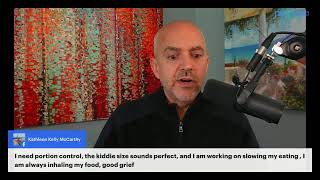
Everyone, welcome to today's program, Yourself Thin podcast. Today we're talking about What weight makes you the happiest? This is one of the most important questions you can ask yourself, uh, when you want to lose weight. And this question is a little more in-depth than you may be thinking. Uh, so a lot of times people will hear this question and just choose their goal weight, whatever they've been saying for the last 30, 40 years, uh, that pops into their head. But we have to understand that happy is is really the key word here, because when we talk about happiness and what makes you happiest, we've got to look at both sides of the equation. Meaning just choosing a number on a scale is not enough. That's not going to be enough to make you happy. If only getting to a certain number on a scale was the only thing you needed in life to be happy, then virtually no one would be overweight. But the problem is you can get to a certain number on a scale and still not be happy. I know it might be hard to believe, but it's really true. And you need to recognize this because there's a good chance that the way that you have chosen to lose weight in the past actually makes you unhappy, even if you lose weight. Think about this. In the past, you've done things to lose weight, right? Counted calories, cut carbs out, restricted. You've done these things to lose weight. And you've lost weight. Were you the happiest though? It's the question. I gotta be honest. Hold on. I know. Oh yeah, I was happy. I was happy. Okay. If you were so happy, if it was so amazing, then why did you ever stop? Why did you ever put the weight back on? If you were so happy and everything was so great? And the answer is it wasn't so great. Yes, the scale was going down. Yes, you were happy that you were losing weight. But when you take into account how you had to live your life, how you had to count every calorie, how you had to focus obsessively on food and weight, how you had to say no to going out and doing anything fun. When you take that part into account, you realize, well, I guess overall I wasn't that happy. And this is the difficult truth you're going to have to wrestle with, that the way that you've attempted to lose weight in the past makes you unhappy even if you lose weight. And that's just the truth of it. And you're never going to intentionally choose a way of living that does not make you happy if you don't have to. So the real secret to this question is not in the number that you want. It's in thinking about what you're willing to do in order to achieve that number and finding the sweet spot where you get the best return on investment of your energy. Where is the sweet spot with the number you want compared to the life you're willing to live? That balance, that sweet spot is the happiest weight. The weight that's going to make you happiest is the sweet spot between the number that you're happy with and the lifestyle and way of being that you're happy with. That's how you find the happiest weight. It's not choosing the lowest weight. That does not define your happiness. No, it doesn't. And so you have got to think about this because if you keep thinking that it is your weight that is going to define your happiness, you are going to be stuck. There's more to it than that. It's how you're living your life. So. Once you start to reflect on this, I hope you start to open up your mind to the idea that how you're going to manage your weight is really the game we're playing here. That is the secret to managing your happiness. So that when you are able to shift your mindset, reframe weight loss, transform your lifestyle, and take control of your eating, in a way that works for you and still gives you joy, that is what we're really aiming after. We can't just aim at a number. We need a more comprehensive, holistic goal so that, yes, the number's a piece of it, but it's not the whole thing. We have the number and then we have how we're going to achieve that number. And we've got to take both into account in order to hit that sweet spot of finding the weight that makes you the happiest. And if you want some support in finding this weight, click the link in my bio or go to programyourselfthin.com and go get the free hypnosis session I made for you, because it may be the first time you've ever experienced calm, relaxing weight loss. And as you can imagine, when you're able to control your weight in a calm, relaxed way, that is usually the path that's going to bring you to the happiest weight possible. So go get that session. And listen to it. And if you have any questions, feel free to ask him. If you would like to get that session and you're in Facebook or YouTube, I will put the link into the chat window. If you are on TikTok, you can just click my picture up on the top left and go get that. There we go. And I suggest you do it because not only do you get the hypnosis session, but I give you a lot of, uh, a lot of things. Um, to help you master your weight. So, oops, there we go. All right, just fixing the camera. So, all having a nice day? Any questions are welcome. Any weight loss questions, any questions about your specific weight loss, um, what's working for you, what you're struggling with, any of those questions are welcome. Uh, so Jim Katsoulis says, very true. Yes, I got it. Yes, there you go. So again, when you're thinking about your goal weight, think about it in bigger terms, not just what the BMI chart says, not just what your doctor says, not just what, um, you've been chasing for decades. Uh, that's all conversation itself. Choosing your goal weight is, is an art and a science, um, that's worthy of its own conversation. Uh, but The point here is that we've got to take into account what we're going to do to manage our weight, because I think for most of you at this point, if you consider, I don't know, keto, let's just say, because keto is a miserable diet, it's miserable, it's extreme, miserable, sucks. No, stop it. Stop it. Don't tell me. No, once I get into it, I love it. No, you don't. If you loved it, then you'd still be doing it. You know, keto is a miserable diet. But so let's take that for as an example. You start your keto plan and you lose a couple pounds. Now you stick to your keto plan, you lose a little bit more. But the entire time, even though you're losing weight, the way of following that keto plan in your life is so miserable, it's so restrictive, it's so difficult, it takes so much energy that even though you're losing weight, you still don't feel great about it. And this is what most of you experience when you consider weight loss is that the way that you're doing it is miserable and it literally overrides the joy of losing weight. I hope this doesn't shock you. I mean, I mean, does this not explain— does this not describe what your experiences has been when you've tried to influence your weight? And I think it is. What's up, Lois? This is so true. Yes, and I think you all know this, right? You experienced it. You may not have defined it this way though, and sometimes that can be helpful to see it more clearly. Um, Jen says, I've read for years how cortisol levels affect weight. Is this something that's real or just an excuse? Um, I think it's a little bit of both, you know. I definitely think it's real. I definitely think cortisol impacts weight. That's my belief. I believe it affects women even more. Women between the ages of 45 and 75, I think affects them even more. So I believe cortisol is very real. Now, I also think that cortisol is a symptom of a deeper problem too, where the deeper problem is causing more problems than just the cortisol in your body. So yes, it seems— now again, everybody's different, so not everyone responds the same way, but overall, in general terms, the more cortisol, the more your body kind of fights to hold on to the weight. So yes, cortisol levels and weight, um, are important. They affect each other. That being said, what tends to lead to higher cortisol levels is stress. And beyond just the effect of the cortisol on your weight. To me, the bigger picture is if the cortisol levels are increased because of stress, the stress is the way bigger story to me. Because yes, cortisol may affect you biochemically, how your metabolism runs, how you let go of fat, things like that. And, and again, all the details of it, I don't think we know yet. But I think the bigger thing is if you're stressed That's going to affect your weight way more. So if you're a stressed person, I believe that practicing and developing relaxation and calm groundedness, peacefulness is the most important thing you can do. And so that applies to all of you. How about that? I have not met a person in my career who's like so relaxed and calm and grounded that they couldn't use some more of it. So yes, I think cortisol is real, but I also think that, uh, I also think the bigger story is stress for most people that are dealing with cortisol issues. Because when you're stressed, you think differently, you feel different, you behave different, you metabolize different. Everything's affected by that without question. And so again, whatever may be impacting your cortisol levels, deal on that, focus on that, and work to fix it. What's up, Jody? Jody says hypnosis sessions last 2 days is coming through Circle again so much easier. I'm glad to hear it, Jody. That makes me happy. So yes, um, we'll keep that going. I feel like that's an easy solution. I don't know what happened to that at some point. Some point that just kind of fell away. I'm not sure exactly why, but I'm glad you enjoy it. Um, I know some other people have mentioned they appreciate that. And it was literally triggered and started by someone who, um, was struggling to get a hold of those. So I'm glad, glad it's working out. And, uh, yes, that's good. Um, Lois says the idea of diet and joy, yeah, used to be foreign to me. Lifestyle and joy go together nicely. Yes, exactly. The idea of losing weight and joy don't go together for most people. Uh, dieting is a miserable, unpleasant experience for most people, and this is very intentional. Dieting is not your friend. The diet industry is just a branch of the food processing industry. And they are there to sabotage you because they just want you to keep eating food and they don't want you to lose weight. So again, everything you've learned— not everything, but most of the stuff you've learned from dieting is, um, give you the opposite effect of losing weight. What's up, Shell? Shell says, it's such a mind shift eating the good healthy foods you like and still maintain or lose weight. Yeah, of course, right? And folks, you can eat the foods you like and lose weight. And control your weight. You have to eat them differently, but there is no reason that you have to give up your favorite foods in order to manage your weight. That is a, a big mistake a lot of people make. And again, that goes right back to the happiness too, because if you think you have to be miserable and unhappy in order to manage your weight, uh, you're gonna have a real tough time because no one wants to be miserable and unhappy for long. So yes, it's true. If anyone's got any questions, any, anything they're working on, feel free to ask them. She'll follow up and says, food you like is the big difference. I'm enjoying my meals. Yeah, of course you got to enjoy your meals. You, you listen, folks. Yes, you can make yourself miserable and lose weight for a little while. I'm not arguing that. What I am arguing is that you're not going to do it for long because you're not going to live a life of being miserable. If you can help it. And so dieting really fails with that big problem right off the bat. You're not going to live a miserable, unpleasant life just to control your weight, because your weight doesn't control your happiness. It's a factor, but it's not the whole thing. And I think people forget this. Uh, Jan Jan says, yes, I'm fat, LOL. I used to be slim, 3 stone too heavy. I didn't know I was stressed. I try to meditate every day. Still fat, lol, but no sleep. But I found you and have been listening, so maybe slimmer. All right, yeah, well, again, trying to meditate every day is usually not enough either. I hate to say it. I mean, again, I say this every day because I think it's so important that to manage your weight, I believe you need a holistic, comprehensive strategy. And again, in Program Yourself Thin, our kind of core document we've based what we're going to do off of is this goal weight pyramid. And you can see there's mindset, lifestyle, and eating. Oh, let me switch this over. TikTok, you can't see this. Um, mindset, lifestyle, and eating. And if you go to lifestyle, you're going to see meditation is right there. Whoops, right there. Um, so meditation is absolutely part of a healthier lifestyle, a more relaxed, calm, grounded lifestyle, but it's not the whole thing. Okay, so a lot of people try to meditate, it doesn't do much for them, and they quitter. So it just doesn't work, okay? It's a tool. It's one tool out of many that you use. It's one tool in your toolbox. So don't give up on that, Jan, but add to it. I see no sleep. So it sounds like you're not sleeping well. One little tip you can do is to meditate before sleep. That's a nice way to meditate and to potentially improve your sleeping as well. But great job getting the meditation down. Okay, it sounds like you've kind of implemented that. You're doing that every day, so great. Um, but now add a little bit more to it. Okay, add some water to it. Make sure you're hydrated. Um, work— focus on your sleep. Get your sleep a little more solid. Um, just do some general relaxation techniques. Go take a short walks, right? So again, if you keep doing those things you'll start to notice a difference. It's impossible not to. Impossible. It's not impossible to meditate a little bit and not have any change happen. You need to create a comprehensive, holistic web strategy that you live in if you really want the results you want. But again, it's no one's fault. I mean, dieting has taught us that we're just one thing away from changing our weight, right? Keto— you're just— you're carbs. If I just get rid of carbs, my weight will take care of itself. Nowadays, if I just start consuming more protein, the weight will fall right off of me. If I just start meditating, I'll, I'll start being calm, grounded, and lose all the weight. You know, it's never just one thing, it's multiple things. We have to create a web, a network of success, a strategy, a system. I don't know, I don't know any other alternative that I've ever seen. Uh, what's up, Jane? Jane said, I saw you— I saw somewhere that you said you didn't care if people put hot fudge on their salad as long as they start eating salads. So I had a good big spinach salad yesterday with blue cheese dressing and it was so good. Jane, thanks for listening. I, I, it's so funny. I remember posting that video. I love that video so much. I think it's, it's funny and it really proves such an important point in my opinion. But, but you, Jane, have put it in a more real way. So thank you for sharing that. Um, and I can, this is my opinion. Okay. I would much rather have you put a higher calorie blue cheese dressing on your big salad and eat all that than to have saved the calories on the dressing and not eaten any salad. Because again, maybe in that moment, maybe in that hour, you would have saved some calories, but let's look at the whole day. So I would, I joke around, put hot fudge on my salad if it'd make me eat more salads. But what I mean is, again, it's this all-or-nothing thing that dieters do where they're like, oh, I need a salad, but I only like blue cheese dressing, so I won't eat a salad because it's a lot of calories in it. And then they, they don't do that. And then they go and eat a burger and fries. And there's something very strange that happens. I don't have a good word to explain this, but I see it constantly. And so I'll just describe it is that when it comes to like healthy things, So let's just say a salad. A lot of times dieters get really like pure. So if it's going to be a salad, it's going to be a perfect salad. So I can't put blue cheese. I can't put a creamy dressing on it. No way. Right. But okay. But what do you normally eat for lunch? Oh, you usually have a, you know, tuna melt and a bag of chips. Oh, you see, but it's like when it's like, it's a priming thing going on, but it's like when we're doing something healthy, our brain, it's like, we've got to be perfectly healthy. And this really screws a lot of people up because they do this purity thing with the healthy food, and then they're completely blind and oblivious to when they're eating unhealthy food. And it's a real trap. So again, what will serve a lot of you is to become a bit more flexible on the healthy food. Have a salad, a big healthy salad with blue cheese dressing. Ah! Well, yeah, well, what were you going to have? You know? So I love that you did that because what happens is, yeah, okay, so you have the calories of the blue cheese dressing, but then you get all the benefit of those micronutrients and greens from the salad that you ate. And now that salad may fill you up and satisfy you longer. So now you eat less calories at dinner. You know what I mean? We've got to start thinking bigger. Dieting conditions you to think very small in the moment. And it's a recipe for disaster and failure. So I think that's wonderful, Jane. And like, Jane followed it up and said, I don't generally like salads, so that was good. Yeah, it's really good because not only did you have a salad yesterday, that's great, but let's actually look into the future too. What if you actually enjoy this salad with blue cheese dressing? And what if for the next year, every day for lunch, you have a salad, a big salad with blue cheese dressing? Well, at the end of that year, you probably like salads a lot more than you liked them yesterday or the day before yesterday. And then you can start to say, oh, you know what? I kind of— I'm starting to like salads. I'm going to dial down the blue cheese. I'm going to use 25% less. Oh, I'm going to use a different dressing. I'm gonna try a different dressing, which may be a lower calorie. You know what I mean? So we don't have to change everything all at once. If you all start getting a lot more salad and greens and healthy fruits and vegetables into your body, that benefit is tremendous. So nice job, Jane. Proud of you. Um, I heard to say this, Froa, thank you. Yes, your TikTok videos have been a great help. Well, thank you. Yes, that's what they're there for. So that makes me happy to hear. I'm here to help you all out as best I can. This is what I do for a living. This is my mission in life.. And these videos are one piece of it. So I'm so happy, um, when people get some value out of those. It makes me very happy. That's why I do this as well. I'm here every Monday through Friday, um, usually around, uh, noon Eastern. A little late today, but, um, usually around noon Eastern. And, um, this is also a podcast, Program Yourself In, as well. So check that out. Um, Emile says, how to jaw clenching— how to stop jaw clenching? Yeah, jaw clenching is a thing. Uh, I would suggest that again, comprehensive holistic strategy, but relaxation is one of the key things. Um, learning to relax your body, relax, relax, relax, practicing that is usually the path. Um, Daisy says, how do you get rid of food noise? Well, you're never going to get rid of food noise, okay? You can dial it down. Um, and I think that it's a combination. We want more food noise for healthy, good food. And we want less food noise for unhealthy processed junk food, right? So more specifically, we don't want to just get rid of food noise. We want to increase the food noise for the healthy stuff, decrease the food noise for the unhealthy stuff. So how do you do that? There's a lot of ways. I mean, again, Program Yourself Thin is literally an entire system designed to do that. So I'd be lying if I could just said I could just give you a tip and do that. You do it, but I'll give you a couple ideas. Um, the first thing, and it's so obvious, but I'm just going to say it. One of the easiest ways to dial down food noise ultimately is to eat less junk food, fast food, processed food. Processed food in any of its forms is literally designed in laboratories by multi-billion-dollar companies that employ chemists to find the most addictive food noise creating products possible. So right off the bat, anytime you're going to eat processed junk food, fast food, food, you are going to crank up your food noise. It's that simple. So just like I used to work a lot with cigarette smokers and they thought that every time I stopped smoking, my cravings go wild. No, you got it backwards. It's the cigarettes that create the cravings, not the absence of them. And yes, you may have a spike of cravings initially after your last cigarette, but eventually you're going to normalize back down to a normal level. So it's not— the food noise is created primarily by these foods. That's number one. Number two is that you are surrounded and bombarded depending on what your entertainment situation is. If you're watching just regular old cable TV, you are being bombarded with food noise and hypnosis sessions designed to increase that food noise. Every single food commercial is a hypnosis session to get you to think about food constantly. So another way to dial down the food noise is to start to dial down how many food commercials you're exposed to. That's just another one. Um, 3, but this is the harder one, and this is what we do in the program, is you learn how to influence your mindset. You learn how to influence your internal dialogue. How do you speak to yourself? What you say to yourself. And that's a bit of a bigger process, you know, that takes some, some more commitment and time. Um, but I think ultimately that's the most important one. Um, but yes, your environment matters a lot too. And so again, the more processed junk food, fast food you avoid, the more you tend to dial down the food noise ultimately. And then the other things I mentioned. So hopefully those help you. But yeah, food noise is crazy, and it's not a surprise. I mean, we live in a culture that is literally, um, all about cranking up the food noise. You know, Daisy says, thanks for the tip about the food noise. Do you— do sugar-free foods like Jell-O make me want more? Uh, yeah, yeah, because again it's a, it's a, in hypnosis we call it a double bind, right? So if I say, um, listen, do you want to buy this? Uh, say I'm selling books. Do you want to buy this book with cash or with a credit card? Which do you want to do? Right? So it seems like I'm giving you a choice, but really I'm not, right? I'm implying, I'm assuming that you're going to buy it. I'm giving you the choice of how you want to pay me for it. That's not really a choice. Okay. And so when it comes to sugar, non, you know, uh, sugar-free foods, people in their minds are always subconsciously comparing them to sugar-full foods. So you're saying, okay, well, I could have sugar— regular Jell-O with sugar in it, or I could have the sugar-free version with no sugar. That's got to be better. Well, it might be better than regular sugar-full Jell-O, although there's— the debate's out. But let's compare it to an apple, right? So let's, let's see the full picture. And so yes, I do not think— I think if you're gonna eat Jell-O, sugared or sugar-free, both of those things are hyper sweet, hyper palatable foods that are going to trigger your food noise and your cravings. And so if it's sugar, well, it's sugar. So not only is it sweet and has the flavor, but it has the response in you. That's what you really like, by the way. It's the sugar. It's the spike of the sugar being absorbed in your system almost instantaneously That's what you're really after anyways. But when you have the sugar-free thing, it is unnaturally sweet and it triggers your mind to think and expect that here come the calories because your whole life you've eaten sugar, sweet calories. Now all of a sudden, sweet, no calories. So now what happens is sweet, crank up the metabolism, we're going to have some calories coming. Now there's no calories. And they've done plenty of studies on diet sodas that they tend to gain more weight. And so again, sugar is going to crank up your sugar cravings. Sugar-free foods are going to crank up your sugar cravings. You may treat those sugar cravings with sugar-free products, but they're both going to crank up your sugar cravings, your sweet cravings, because they're unnaturally sweet. And so, yeah, I would Again, you have to never eat them, but I would seek to minimize sugar-free things as much as I would sugar things. And me personally, I don't eat any sugar-free stuff, and I wouldn't. I want just real food, and sugar is closer to real food than sugar-free to me. So I would consume sugar, um, over sugar-free products. I don't know exactly what the process is that sugar-free does to your body, but I can only imagine that it's can't be good to signal to your body, here comes a bunch of calories, and not give your body those calories. I think that's going to crank up your eating overall, if I had to guess. So those are my thoughts on it. Um, Fran says, so true what you're saying. Thank you, Fran. Um, Jane says, so now the issue is not having ice cream because it is hot here and I had just played pickleball. It has become too much of a habit. Okay, Jane, but let's just— let's give ourselves a couple other options because remember the 3 Rs of weight loss. There is reduce, replace, remove. So most likely, if I know you, Jane, I'm thinking you're thinking I have to remove the ice cream habit from after pickleball, right? You're giving yourself one option. I either go and get the ice cream or I get rid of it and I don't get any more ice cream. Black or white. Diet dynamic thinking. Binary. I'll either eat the ice cream like I always do, or I won't get the ice cream. Remove. That's remove. It's the hardest one out of the three. Okay. So I will give you another alternative. The first one is that you get a smaller ice cream. I say this as someone who does this. Okay. I literally order the kiddie size ice cream when I get ice cream. I don't like doing it. I feel like a jerk. I don't like it. I don't like ordering a kid-sized ice cream. I feel like I'm being judged. I don't like it. I wish there was just a cooler name for it, but I do it. Okay. And, um, yeah, so Jane says, yes, you're right, all or nothing again. Yeah, of course. And so it's fine though. So, you know, if you go— I don't know what size ice cream you get. You probably get a small, a medium, whatever. But a kiddie size can literally be like 60, 70% less. 50 to 70% less is what I've noticed. Yeah, okay, so Jane says, I do get the smallest ice cream. Okay, so, um, again, is it the smallest? I'm just— I'm saying, because this is the thing, are you getting a small, one scoop small, or are you getting a kitty? Because I have seen the difference from what I've experienced from, from ice cream places. The difference between a small and a kitty is at least 50% most of the time. So that, that's my first thing. Um, second, you know, you could— I've done this before. Now again, this is before I got the kitty. The kitty thing has really hit the sweet spot for me. I mean, it's the, it's the perfect amount too. Um, I enjoy the ice cream. I, I don't get phlegmy afterwards. I feel fine about it. Okay, but before that, I would get ice cream. They give me like 2 scoops Okay, Jane says Dairy Queen does not have a kitty cone. I've asked. Okay, so here we go. In that situation, and because I've done this too, now it takes some work. I want you to understand, all of these take work. Reduce, replace, remove— they all take work. If your norm is to order a small, then to reduce, that's going to take work. If you get a medium, to get a small is going to take work. It all takes work. To do something different. But what you can start to work on is reducing, Jane. Okay, reducing. What that means is you go and get the ice cream, and I've done this two ways. I find one way works better. So before I got the kiddie ice cream, I would get a small a lot of times. And I am telling you, more often than not, when I got the small, I would get like two scoops on there. So it would not be unusual for me to grab a napkin grab the first scoop on top and throw it in the trash and then eat the rest. So if you just get one scoop, you could do the same thing. You could take a napkin and grab half of it, toss it in the trash. You just knocked out half of it. It's an option. I'm not saying it's— oh, I never do that. Don't do that then. I don't care. I'm just giving you options, ways to think about things. Okay, so the first thing I'm looking at is, okay, the ice cream Dairy Queen after pickleball and you get the smallest size. Okay, so right off the bat too, okay, so what? This is another thing we do sometimes. We get fixated on the, the small Dairy Queen ice cream I have. Um, okay, so it's a soft ice cream, but I do get it as a chocolate dip cone. Okay, so I would probably work to skip the chocolate dip cone, honestly. Like, again, here's what I'm saying. Yes, yes, I guess maybe the dip part has to go. It doesn't have to go. Let's just change this language real quick. I was just thinking of this on the way over here. A lot of times the way we describe things, we describe it like we've got someone telling us what we have to do. So even that languaging, and again, it's, it's, it's qualified a little bit in the beginning, I guess, maybe, but then the last part says the dip part has to go. It doesn't have to go. You could keep eating it, but if you would like to live at a lower weight, It may make sense to get rid of the chocolate dip part. Notice how I said that different though. Okay. And the reason I said it different is because that always gives you your autonomy. Autonomy is crucial. We need to feel like we're making a choice. We're the ones that are in control. And as soon as I say to me, like, oh, chocolate dip cone has to go. As soon as I say that, I start to feel, I feel the little rebellious part of me starts to wake up. What? What? Who's telling us it has to go? You know, so I don't like to frame things that way. I like to say things like the chocolate dip does not have to go. I can keep eating a chocolate dip cone exactly where I'm doing it. But if I would like to live at a lower weight, which I kind of do, then maybe I'll start working on reducing that chocolate dip cone, just getting a regular one. Okay. I think you're right on the money, Jane. Now you can still have the chocolate dip cone sometimes, but turn it into a treat, turn it into a special occasion thing. And that alone could be 100 calories every time you get ice cream, perhaps, you know. So this is the way we want to think— small incremental improvements. Maybe you get rid of a little bit of ice cream, maybe you get the— get rid of the chocolate dip a few times, and these things add up. Okay, so, so good job thinking about this. All right, um, Fran says, I just had a big piece of cake with coffee because I am very stressed. Well, great job putting it together. That's not unusual. When we get stressed out, we tend to not make the best food choices. So, um, that's not unusual. But here's the big difference, Fran, is now you ask yourself right now— again, in Program Yourself Then, we would redo this, right? When we make a decision we were not really happy with, we redo it in our mind. Because you, Fran, have an option ahead of you right now. You can either beat yourself up that you ate a big piece of cake and feel like a failure and feel like you let yourself down, all the rest of it, or you can learn from it. And the big thing you want to learn is, what else can I do when I'm stressed? Because right now, at this moment in time, I'm going to guess that your best strategy for dealing with stress that you believe in is eating, and probably eating sugary foods. That's probably your most reliable strategy for dealing with intense stress. So I don't think you're a bad person because you had a piece of cake. I think that you're a person who doesn't have a lot of options for how to genuinely deal with stress. And I think if you had a better option to deal with stress, there's a good chance that you would use that option next time you got stressed instead of the cake. So I don't think you should beat yourself up for doing the wrong thing. I think you should go to work on finding a better alternative to dealing with stress than eating cake. Hope that makes sense. Julie says, is your Audible book out yet? No, not yet, but we're halfway through the recording, so, um, I'm hoping this week. We'll see. I'm working on taking more time for myself. I, I have made that a point to to take my foot off of work a little bit. I'm not making excuses, it's true. Um, but that has affected the how quickly the book's coming out. So again, I was gone this weekend, uh, meet people this week. And so, but I'm gonna— I'm aiming to still get it done this week. That is my goal. And honestly, on top of it, um, where I'm recording is loud this week, and that, that should be fixed too. But I still should be able to do it. I'm aiming to get it done this week.. I will let you all know when that's finished, but it's all lined up and ready to go. Just got to get it, get it finished. Thanks for asking. What's up, Kathleen? Kathleen says, I need portion control. The kitty size sounds perfect, and I'm working on slowing my eating. I'm always inhaling my food. Good grief. Um, now again, just another little— I just, I love picking on words because it's some of the easiest wins you can have. Don't— people get annoyed when you pick on words, myself included, but You don't need portion control, Kathleen. You don't need it. You might like it because it'll make it a lot easier to control your weight. But there's a big difference between, um, I want to get a lot better at portion control, I want to work on it, it would be great if I got better at it, than I need it, I have to portion control. Those imply that there's some force making you do it. And when something makes us do something, we tend to rebel against it. Push back against it. So, um, but, but I— yeah, the kitty size practice, that and work on developing portion control. You know, you don't need it as if it's something you need to get. It's something you develop, and you only develop things you want. You know, I hope that makes sense. Language is important. I could talk about language all day long. I was just listening to a training by Mr. John Grinder, and that's one of the best language— man, is he a great speaker. Every word he says, I just I just love it. I love John Grinder. I love Richard Bandler too. Those two guys are the two inventors of, uh, creators of NLP. And, um, boy, I'm forever grateful to the two of them. But yeah, John Grinder, my God, I could listen to this guy speak all day long. It's wonderful. But words matter. He's a linguist. So yes. Um, Ina says, I love your 'no food tastes as good as thin and healthy feels.' I quote it daily. Yes, thank you. And I'm glad you said that because a lot of people get really triggered by that because Um, you know, that used to be kind of a diet-y, you know, phrase back in the day. Nothing tastes as good as skinny feels. But of course, we're adults, we can make distinctions between nothing tastes good as skinny feels, which only cares about what you look like and your weight, and the phrase nothing tastes as good as thin and healthy feels, which is a different saying that implies and means different things. So I'm glad you enjoy that phrase, and I use it as well constantly. Miss Moss says, I ate out recently and ordered the kids meal. It was plenty and gave me the flavors I wanted. Yes, yes, folks, I can't stress this enough, and I know you won't believe me, I don't expect you to, but it is shocking how when you get a smaller amount of food, how you go into it thinking you're going to be starving on the back end of it, and how when you actually eat it, it's so much more satisfying than you imagined. That's a very common thing. So yes, that's, that's a big realization, Miss Moss, and I'm glad you realized that, and, uh, take it forward. Um, Naz says stomach fats, how to lose. Um, I mean, you lose stomach fat the same way you lose any fat. There's no such thing as spot reduction. You can't just lose weight in your stomach. Um, weight loss is a systemic thing, and so to lose stomach fat, you have to lose overall fat. So, um, oh, a pup cup. Okay, there we go. Is that even smaller? A pup cup might be even smaller than a kiddie cup. So there you go, Jane. Um, but again, you're in control how much ice cream is. Again, a napkin gives you control over exactly how much ice cream you want to eat. That's another strategy that, um, works really well. You get whatever size they give you and you take 20% out of it with a napkin and boom, it's gone. You know, that's a very effective strategy. Yep. Ina says there's no way of losing weight one specific region. Yes, true. Um, Tiger Lotus, I think that's great advice. Yes, deprivation breeds resentment. Yes, yes, yes, Tiger Lotus, I was just I was just talking about this, that that's the biggest thing. Diets— again, diets are not your friend. Diets are trying to sabotage you. And diets really train you to starve yourself so that you get so hungry you really can't resist. You can't, you can't control yourself anymore. The secret is slight hunger. Slight hunger is the sweet spot, um, that you want to exist in when you want to control your weight. Okay, and, um, Mac, really hungry is not So yes, I absolutely agree with that so, so much. All right everyone, I gotta get out of here. I got a lot of stuff going on, so I'm gonna scoot out. If you're not in my world, please click the link in my bio, go get the free hypnosis session I made for you. I give you a bunch of free stuff, but I can only get it to you once you opt into my email list. So go do that and, um, and get that. Uh, if you like this, I'm here every Monday through Friday, usually around noon Eastern, uh, to answer your questions, talk to you, uh, do what I can to help you move forward. And this is also a podcast, so go search Program Yourself then on any podcast platform, it'll pop up. You can listen anytime you want. And, uh, this is my book. It's out available. Go get it. If you want to read a book about how to live at your goal weight in a comfortable way, go check that out. So thank you so much, everyone.
More from Jim



Weight Loss Visualization: Wake Up in Your Dream Size #programyourselfthin #weightlosshypnosis



What If You Pretended to Be Thin for One Hour? #programyourselfthin #weightlosshypnosis




