Program Yourself Thin Live 6-30-26
Jim Katsoulis teaches a non-diet approach to weight loss through habit and mindset shifts. He covers reading nutrition labels to spot marketing tricks, breaking binge cycles by fixing daytime eating and stress, and building eight lifestyle pillars including sleep, hydration, and movement. The core idea: change your identity from overweight person to thin and healthy through practice and skill-building, not restriction.
Chapters
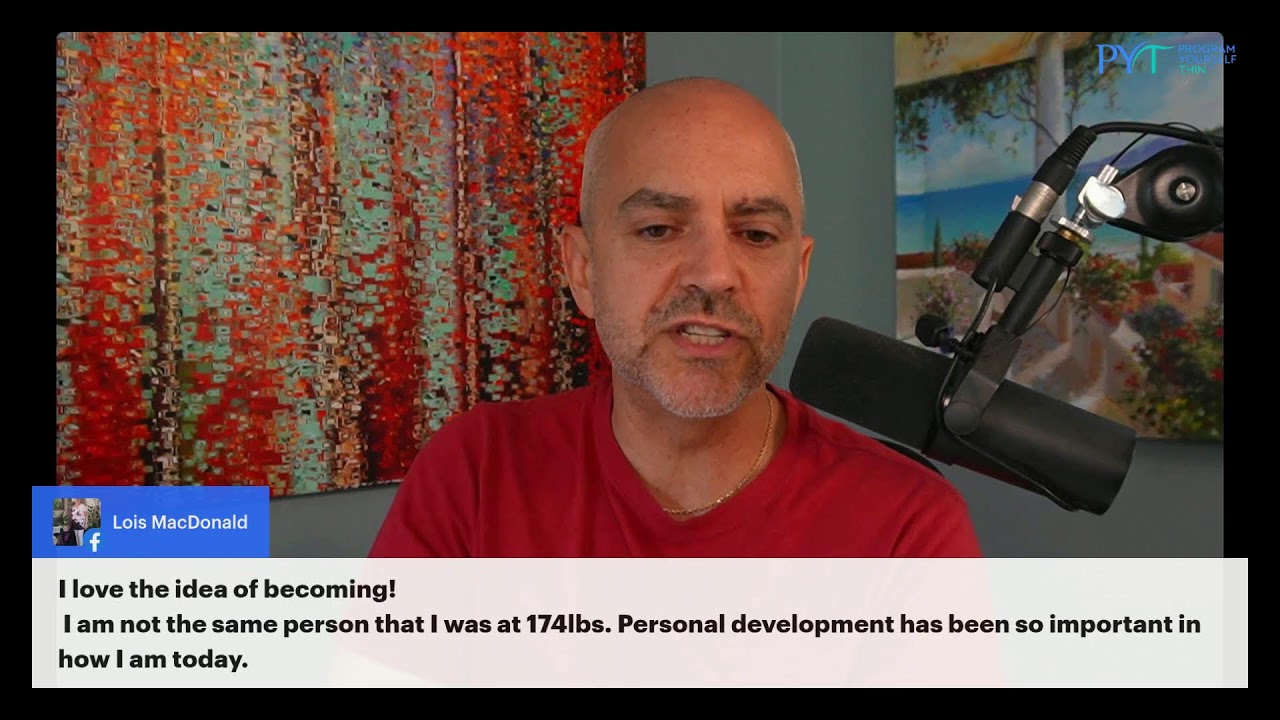
Hey everyone, welcome to today's Program Yourself Thin podcast. Today we're talking about why you should always flip the box over before you eat it. This applies to bags too. Uh, you have to be careful this day and age. You have to understand, we're up against a kabillion-dollar food industry, and they will do everything in their power to trick you to eat things that aren't really good for you. And so when I talk about flipping the box or the bag over, it's to look at the nutritional label, start to become nutritional label literate. Look at that label and understand what it's telling you, because it's not that hard. There's not that much there. The key things— calories, calories per serving. How big is that serving? How much sugar? How much added sugar? Proteins, carbs, and the rest of it. Fine. But those are the big ones. And also, in addition to the nutritional labels, is also the ingredients. And this is one of the biggest things that you can really start to look at and pay attention to, because if you only look at the front of the box, you're going to get tricked These companies are very good at tricking people. And one of the biggest things they do, it's called the halo effect. They will put one big thing on the front of the box to distract you, to put your subconscious mind to sleep. And right now it is probably going to be protein added, extra protein. Protein is kind of the it girl of the nutritional world here right now. But, um, In previous iterations, it was carb-free, gluten-free, low sugar, low salt. You know, I don't know, Atkins certified, whatever. They're putting something big on the front of the box to distract you from the rest of it. Natural flavors added, 100% whole grains. They put these big giant things on the front of the box to make it seem like what you're eating is healthier than it actually is. So you need to be able to see through that to the back of the box, the back of the bag, and notice what the ingredients are. What's the nutritional information of this? Uh, when it comes to ingredients, understand that the ingredients are listed in terms of volume. So whatever the highest ingredient is in that food, it's going to be listed first and so on. So one thing to watch out for, the companies know this, one thing to watch out for is that they will put 10 different sugars in the product because then they can split it up. So they might have beet sugar, cane sugar, um, you know, some other name for sugar over here, honey over here. And really it's all sugar, but it allows them to break it up so that sugar is not first. Okay. So that's a little trick they do, but start to get used to looking at the back of the bag or the box and look at the ingredients. Sometimes just looking at the ingredients can be so sobering because you start to read all these words that you can't pronounce and that you have no idea what they are. And sometimes that allows you to see through the marketing, to be less impacted by the marketing and see what it actually is that you're about to put into your body. And the ingredients are typically a lot less craving-inducing. Than the front of the box with their beautiful pictures and their big claims. So get in the habit of doing this again. Marketing is there to trick us, especially with food. They're looking to distract you and basically put the cheapest ingredients they can possibly put into your body for the most profit. And the best way to see through that is to become— I don't even want to say nutritionally literate. It's not even that because you honestly don't even need to know much about nutrition it's to be able to understand what it is you're kind of eating, to understand if it's real whole food or if it's a bunch of chemicals or preservatives or additives. And you don't need to know anything else about nutrition to be able to look at the ingredients and get a sense of that, to get a feel for where you land on that spectrum. And so as you start to do that, you can almost guarantee that your food choices are going to improve because you understand what the food options are more clearly instead of just looking at the bullshit on the front of the box. And so I hope this helps you out. If you want to go deeper into this ability to see through the marketing and to really make decisions from your best place, click the link in my bio and go get the free hypnosis session I made for you. It's called The New Thin Me, and it is designed for you to get excited and motivated about your goal weight and your goal body. So go check that out. If you're over on Facebook or YouTube, I just put the link in there. Go, go check it out. And yes, Carolyn, I was late today, but this one I actually forgot to mention more than anything. Tuesdays I do have an appointment. So the earliest I can be here on Tuesdays is about 1:00. So I didn't really even think about that until today. So, uh, yeah, Tuesdays I will be an hour late, but the rest of the days we're still shooting for noon. Reading labels so scary, and the portion sizes. Yes, portion size is another one. I didn't spend too much time talking about that, but, um, again, understanding portion sizes I think is valuable because a lot of times what we assume a portion size and what an actual portion size is on the box are two totally different things. And usually the portion size they're talking about is way smaller. And so that kind of makes a lot of the nutritional information less applicable and relevant. But again, understanding portion sizes, understanding general healthy, whole natural foods versus more processed foods, I think that's a great starting point. So go check that out. Get Fit with Natalie says, how to break the habit of nighttime bingeing and sugar addiction. Um, all right. Yeah. I mean, that's a common one, right? A lot of people struggle with that. Uh, my answer is going to be a little different than what you may be expecting or what you typically hear, because most people are going to focus on the nighttime bingeing, but I'm not because I tend to believe that a lot of times where the problem shows up is not where the problem was created. So when I hear about nighttime bingeing, uh, I am— my first question is, okay, well, what did you eat all day? Because if you have not eaten anything all day and now you're wondering why you're overeating at night, it's a pretty easy answer. You're really hungry. So I am not a big believer that your weight loss should be built around you being really hungry. I think that's a very, very bad strategy, uh, to rely on. So if I had an issue of eating at night, which I did, um, what I want to do is I want to pay attention to what's going on before it. And I will tell you, me personally, the first bad habit that I focused on when I changed my weight was my nighttime eating. I would eat dinner and about an hour or so after, I would basically snack all night. And I did this 7 nights a week. So that was the first thing I wanted to focus on. But I focused on that behavior and I paid attention to the things that were happening before it that were influencing it. And I paid attention to what the impacts of it afterwards were. But one of the first things I did when I wanted to stop eating at night is I started eating more at dinner. Now I can already hear what you're saying. You're saying, yeah, but if I do that, I'm not going to lose weight. Yeah, but I didn't give a shit about losing weight right off the bat. I cared about getting that habit out of the way. And so I thought about things in phases. And so I knew the first phase was I've been eating at night for so long, the idea of not eating at night feels super weird. So my first goal is I just want to put together some nights where I don't eat at night. I don't care about losing weight. So I would eat a lot more at dinner so I could feel really full. And that made it easier to not eat at night. Not easy, easier. And then I had some nights. Now, again, I'm compressing this. Dealing with my nighttime snacking habit took me probably— now I can't remember exactly because it was over 30 years ago, but I mean, it was 6 months to a year working on my nighttime snacking habit. So again, when you have really ingrained habits, it's going to take you a little while. Dieting gives you this bullshit idea that, well, now I'm motivated, now I'm motivated, and now I'm just not going to snack at night anymore. Well, that's not how human behavior works, unfortunately. So you can say that and you can intend it, and that's great, but it's probably not going to be how it is. So, um, again, if you focus on the nighttime binging, first step, what's going on during the day? How are you eating? Are you nourished? Are you eating enough? Then how's the nighttime going? Is it easier to deal with the binging and the sugar addiction if you're nourished as you move into the evening? Um, next thing after that, your stress levels. Next thing after that, how are you dealing with your emotions? What emotions going on with you? Hey, are you grounded? Are you calm? Are you peaceful? Are you centered? Or are you stressed out, lonely, depressed, angry? All right. So that's the next thing to focus on. So again, it's a process. Nighttime bingeing is a whole thing that we've got to really get a handle on. And you're not just going to stop doing it. That's what willpower is for, right? That's what you think, that, right? Dieting teaches you that willpower is there to stop doing the bad thing. And not only are you going to stop doing the bad thing, you're going to stop doing all the bad things. And you're going to make yourself do all the good things. And that's how most people approach weight loss, by changing everything completely. And I would suggest that that's not a very strategic approach because it's very difficult to keep that up. So again, for me, what I did is I focused on the nighttime snacking and I really deconstructed— I really began to understand the factor that my hunger played, the factor that my emotions played, the factor that my nourishment played. The factors of my relaxation played, the factors that my sleep played, factors that my hydration played, the factors that my hobbies played. They actually factored into that. Turned out I didn't really have a lot to do at night other than watch TV and eat. And so, yeah, that was basically my entertainment too. So part of the solution was doing more interesting things and, uh, filling my time and my evenings specifically up. With things that were interesting to me, stimulating, entertaining, that had nothing to do with food. So it was a bigger, bigger process than just stopping it. You know, that's the first part. Now, obviously, from there, you know, your mindset matters. Obviously, you know how you think about it, um, you know, but, but that's a good starting point, I would suggest. What's up, Natalie? Natalie says, adore your message and your delivery. Well, thank you, Natalie. I appreciate you saying that. Um, yeah, it's a pleasure. I, I feel very fortunate and lucky that this is my— this is my job, this is my life. I get to come on here and talk about something that I'm very passionate about on top of it, and hopefully it gets to help some of you out, um, because that's what I'm here for. My mission in life is to help as many people as possible live at their goal weight, uh, in the easiest, most enjoyable way possible for the rest of their lives. That's the goal, right? Um, yeah. Carolyn says, yes, right. Wow. Never thought of it like that. Food is entertainment at night. Yeah. I mean, you know, listen, folks, we live in a culture where we've been conditioned since birth to equate food with entertainment. And certainly we've been conditioned to use food as our main emotional management strategy. So I think that, you know, getting control of your emotions— you know what, let me rephrase that. I don't like that phrasing at all. Sorry. Learning how to manage your emotions, how to feel the emotions you want, how to deal with the emotions you don't want more effectively, I think is a better strategy than just ignoring them. That's why in Program Yourself Thin, we follow the goal weight pyramid over here. But you'll notice that it's got mindset, lifestyle, and eating, and then we break it down and, uh, you'll see emotions right there. Because I believe you've got to learn how to manage your emotions without food if you're gonna have any chance in hell at being able to live at your goal weight. You're gonna have to become better at managing your emotions genuinely. And the beauty of that is that, yeah, it's gonna help you lose weight, but guess what? There's an even better— can you believe there's things better than losing weight even? And what those things are, are feeling the way you want to feel, feeling more emotionally balanced, feeling more optimistic, hopeful, brighter. You know, these things are really, really nice. And so that to me is a huge part of managing your weight, is being able to manage your emotions. And I have found that most people don't really have much ability to do that simply because you just never learned. You've never really learned how to manage your emotions. And the funny thing is, it's really not that hard. I— and I don't say that lightly. I really mean that. It's a lot easier to feel the emotions you want to feel than you think. I promise you. Yeah, Natalie, you're welcome, you're welcome. Glad that helped. Hope that helps you out a bit, and that's what I'm here for. So yeah, if you all have any questions, feel free to ask them. I'll take my best shot at it. What's up, Connie? Connie says, hi Jim, thank you. I am doing so well changing my thoughts to enjoy food, to be calm, relaxed, and happy eating and cooking. No guilt, no stress. Weighing every day, going down 0.4 or so a day. Wow, great job, Connie. So it sounds like you're on a nice path there. And, um, again, it's not just about the weight loss. It's not just about restriction, folks. That's not gonna work. Okay? We need a comprehensive holistic strategy to manage our weight. And the beauty is that you can even do it in a way that's enjoyable and comfortable. I know dieting would have you believe that the only way to lose weight is to struggle and strain and be miserable, but I promise you, it's a lie. It's not true. The best way to lose weight is to do it easily, comfortably, enjoyably. Yes. And, uh, yeah, not only does it feel better, it's more effective. So double bonus, double bonus when you lose weight differently. What's up, Ames? Hi, I love the content. Thank you, thank you. Yes, I appreciate you all saying that. Um, that's what I'm here for, is to give as much content away for free as possible, to help you all out. And, uh, that being said, I do have a new training coming out called Reprogrammed: How to Live at Your Goal Weight Without the Fight. Uh, I am working on that this week, so that should be available, um, I believe this week. Okay. And so the easiest way to get that is to sign up for that hypnosis session. Uh, once you're on my email list, I send you all sorts of free stuff, but that's one of the free things I will be sending you this week. And I know it's Fourth of July, so I shout out to everyone here thinking about your weight and your health and your happiness, even on a Fourth of July week, which I don't know if people know this. I mean, you probably— I'm sure you know this, but Fourth of July is kind of like the counterpoint to Christmas. And knowing that those are the two times a year where people are most disengaged with their weight, typically. So I shout out and respect to all of you that are here and engaging with your weight, your health, and your happiness. Even on 4th of July. Okay. And I think there's a, there's a wisdom to that because, you know, even me, I think I've, you know, I don't know, I get a little looser with my eating. I would say right around now, you know, I go to a 4th of July party and just in the summer mode and, you know, that can happen. But I'm still engaged, you know, and that's the secret and program yourself. Then we talk about being all or something as opposed to being all or nothing. And all or something is engaging, touching at least, you know, at least being somewhat engaged with it. Doesn't have to be perfect, you know. And I think that that sense of flexibility is so valuable, uh, when you think about managing your weight, because dieting is not flexible at all. Dieting is a complete rigid approach to losing weight. And, um, you know, most people can do rigid things for a little while and then they can't do it anymore. And, uh, that's probably what most of you experienced, that you can do the really strict, rigid hard thing for a while, and then you stop doing it, and that's that. And you've probably gone through that a lot of times, you know. Um, yes, enjoyable and comfortable, Connie. Exactly, exactly. That's the secret. If you're not losing weight in an enjoyable and comfortable way, uh, I'm worried for you because I don't think you're going to keep it up. So, uh, Kimberly, how's it going? It says, what is your opinion on eating chia pudding or flax seeds to increase fiber and curb hunger? Is it worth the calories? I, I don't really have any specific opinions with chia or flaxseed specifically, but I kind of have an issue with the framing of this question and the approach that this question implies. And I may be right or I may be wrong with what you mean by this, but a lot of times when I talk about fiber, which I think is essential to managing your weight, and being the healthiest, happiest person you can be, I will almost always get someone looking for kind of a supplementary solution to it, meaning I will— what about Metamucil? What about— what is it, the Husker— Husker Wheat or whatever? Or what about flaxseeds or chia pudding, right, as a way to add fiber in? Yes, those are better than nothing. Again, I always think of on a spectrum, right? So I think of someone getting no fiber over here and someone getting a lot of fiber over here. And adding fiber through Metamucil or chia seeds or flax seeds or whatever, it's better than nothing. Okay. And I'm sorry, I can't use my hands. This mirror— this video, I still haven't got used to it. Still haven't gotten used to the video not being mirrored. So when it looks like I can't use my hands, I know how to use them anyways. Okay, so here we got all the fiber you need. Here we got none of the fiber you need. And then there's everything in between. So again, having chia seeds, flaxseeds, Metamucil, it's better, right? It's bringing you halfway at least. Okay, better than nothing. But what I really want to do is I want you to change your whole paradigm of fiber, and I want you to put fiber into your body through whole natural foods. So instead of thinking of it as a supplement you're going to add on top of everything, you think about it as right to the core of how you choose food, right to the core of your diet. You start to add fiber-rich foods. Fiber-full foods is what we're looking for. And the easy solution to that is virtually all apples, all fruits, vegetables, um, beans, grains to some degree, whole grains. These are all great sources of fiber. And so you don't have to get into the minutia of grams of fiber, all the rest of it. The more whole natural foods you eat, the more fiber you're basically putting in your body. Are there exceptions? Sure. But the vast majority of foods that you're going to eat in the form of fruits, vegetables, whole grains, and beans are going to have a good amount of fiber in it. And I would always prefer getting my fiber out of the core foods that I'm eating. Again, I have no problem with chia pudding, no problem with flaxseeds. I don't really have a problem with fiber, you know, additives and supplements necessarily. But me personally, a core philosophy I have about food is I want to eat whole natural foods that humans have been eating for history for millions of years. That's what I'm looking for, ideally, because when you organize around that, you tend to avoid a lot of the micromanaging, right? Once you're consuming a more whole natural food diet, you're usually going to get a lot more fiber. You're going to get a lot more micronutrients. You're going to get a lot more micronutrient diversity that your body needs. You're going to get a lot more hydration typically in whole natural foods. Right. And you're going to get a lot more satiety satisfaction from those foods compared to processed foods. So I like to keep it simple. I'm not a nutritionist. I like to keep it simple. I don't really like diving into the weeds of nutrition. I like looking at the bigger picture. And so instead of diving into the weeds of specific nutrients and things like that, I want to look at the bigger picture that the more whole natural foods I put in my body, the better I'm going to do for specific reasons that they know about and things that they probably haven't even discovered yet is what I believe. And I have found that the more whole natural foods I eat and consume and live off of, everything else just kind of flows out of that. I just think there's so many benefits. So I think both are true. You know, if right now having some chia pudding or flaxseeds or some other supplement puts more fiber in your body, it makes you feel better, do it. But know that there's a level beyond that where you're getting that fiber in whole natural foods. And I think that's a higher level as well. Okay. So we can aim for a medium goal and know that there's another goal to aim at after that. And you're free to choose to aim at either one of them whenever you choose to. But I hope that helps you out. Great question though, because again, fiber is so valuable. I think fiber is one of the most valuable things you can put in your body, uh, when it comes to weight loss for a million reasons. Um, fiber is really important. Oops. Ames says, what happens if a person just genuinely enjoys food? How do you control portion size? Um, yeah, great. I genuinely enjoy food. I, I really, I love food. Okay. Which is why I would never give up my favorite foods. Program yourself then. We build our whole meal structure around our favorite food, our pleasure meals, chocolate cake, ice cream, pizza, pasta, whatever cookies that's what we build around. So we want to keep the most enjoyable food that you have in your life. Now we may eat it differently. Okay. So to your point, and we have to back up a little bit more because what most dieters do, okay, I'm gonna go on my diet, I have to get rid of all the foods I love, right? That's kind of how we do it, it's all or nothing. Dieting is an all or nothing mindset. So I'm going on my diet, I gotta get rid of all that food. I can't eat that stuff and lose weight. Bullshit, yes you can. You may not lose weight as fast, I'll give you that. But you can absolutely lose weight and still eat your favorite foods But you're right on the money that we've got to dial down the portion sizes. Okay. But I have found that it's way easier to dial down portion sizes and focus on that than it is to completely eliminate your favorite foods. Right. So if you're a person who genuinely loves to eat, what kind of strategy is it to say, I'm going to take— I love food, so I'm going to take the food I love the most and I'm going to say I can't eat it anymore. The second you do that, even if you lose weight, your quality of life has gone down. So me, I would rather set up, okay, I want to lower my weight, but I love food. So I'm going to keep the food I love the most, but I'm going to start eating it differently. And I'm going to work. I'm going to get better at portion sizes. I'm going to get better at eating more moderately. And people say, yeah, well, I tried that. I'm not, I'm not good at, I'm not good at eating moderately. Well, no shit. Very few people are good at things the first time they do it. And unfortunately, when it comes to eating again, because of the diet industry, we've been conditioned to have very fixed mindsets. Well, I tried eating moderately and it didn't work, so I can't do it. Well, guess what? Eating moderately is a skill. Portion sizing is a skill that you can absolutely develop. But most dieters give it kind of one shot and it either works or it doesn't. Usually doesn't. They quit. But they make up a whole story. Almost someone can control my portions. Oh yeah, how about this, Ames? What if I said you eat your favorite food but you have to eat half of it as much as you normally do? And you saw I could never do that. What if I said I'll give you a million dollars if you eat half of it this week? You can— you have to eat it every day, but you have to eat half of what you normally eat. You get to the end of the week, you did it, I'll give you a million dollars. Would you still not be able to do it? Or would you find that you did have the ability to do it after all? Okay. So a lot of things come down to motivation. So when people say, well, I really love food. Granted, I love food too, but you know what? I love even more being alive. I love living, um, feeling good physically, mentally, and emotionally. I love it. Being the person I want to be, I love even more. Okay. And I associate all of these things with being at the weight I want to be. So yes, I love food, but I also want to live as long as I can. My dad died at 54 of a heart attack. He loved more food more than anyone I know. He was literally— people refer to him as an eater. His life was literally organized around food. He loved it. Hardworking, awesome guy, loved food, celebrated it too much, I would say. He died at 54 of a heart attack, and before that he had health issues directly related to his eating, his weight, and his health. So in my mind, as much as I love food, there's also other things that I love even more. But the good news is I found a place and a way of being where I can have all the things that I love. And that's the question. I think that's a better question is how can I eat the foods that I love and have the body I want to live in? And what you'll quickly get to with that question is I'm going to have to control my portion sizes more effectively. But controlling your portion sizes more effectively is no different than learning how to swing a golf club in the sense that it takes practice. Okay. If you want to, you could read a book on how to swing a golf club. That doesn't mean you can do it. You've got to get out there and practice it. And what does practice mean? It means you do it and you hit the ball perfect. You say, okay, how do I do that? Okay. And you try and remember and think about all the little things you did. You go swing, you hit the ball terrible. Wait, what happened? I was a little tight here and I got to loosen up and relax it. So every time you swing the club, you are paying attention to it and you're readjusting for the next swing. Why can't you do that with your eating? Because you haven't done that with your eating. No, you haven't. You get all excited and all hot and bothered to lose weight. Okay, I'm gonna eat perfect. And you try and control everything until you don't control it, then you completely quit. You're not every day practicing eating moderately. Think what diet is telling you to do that? What diet have you ever done where you're consistently practicing to eat moderately? Good day, bad day. That's what we do in Program Yourself Thin, is we keep practicing. We practice the skills that allow you to live at your, your natural goal weight. And if you practice skills, you get better at them. But most people have never practiced eating moderately, and it's a skill. I promise you, I promise you, it's a skill. People don't believe that though, you know. Ah, I can't do it. What? Think about all the things you've learned to do in your life. Think about all the things you've learned how to do in your life. I promise you can eat moderately. Your strategy to learn how to eat moderately is the problem, because dieting never teaches you how to eat moderately. It just tells you to eat moderately. It just tells you to do it. But again, I can tell you to swing the golf club perfect. It doesn't mean you're going to do it. I hope that makes sense. What's up, Vicki? How's it going? Yes, happy Tuesday. Uh, yes, I am live today. A little bit late, a little bit late, but that's okay. Again, I, I met— isn't that funny though? This is, this is what I mean. You know, I, I talk about the starting at noon just to show you the impact of mindset. Okay, I do this all day long. I've been doing this for over 30 years personally, over 20 years professionally. I've been talking about starting at noon. Yesterday I started at noon. I was so excited. I got my Post-it note off, my alarm went off, everything went off. Started at noon, perfect. And then I'm even ending the podcast yesterday. I'm saying, you know what, also I'm every day at noon, I'm here every day at noon, I'm here, I'm gonna be here at noon tomorrow, every day at noon this week, I'm gonna be here at noon. The whole time knowing that I got an appointment on Tuesdays that I can't be here at noon. I just wasn't in that mindset though, and it completely disappeared from my reality. So anyways, uh, here today an hour late, and that's how it is on Tuesdays, but the rest of the day is noon. Uh, Vicky says, portion control is something I'll continually working on, sometimes more successfully than others, but staying in the game for the long haul with your support encouragement helps me immeasurably. Yeah, and again, Vicky's a superstar. Vicky's a perfect example of practicing, working on the skills that allow her to control her goal weight. Um, a lifetime Weight Watchers member, but she's always getting better, always improving, always sharpening the saw. And I feel the same way. My portion control is not just this fixed thing. Again, we go back to the golf club. My golf club swing is not going to be a consistent thing all the time. Sometimes my shoulder hurts and it's tight and I'm not swinging normal. Sometimes I'm feeling great and I'm swinging awesome. Sometimes I'm just sore and tired. I'm not swinging as good. You know what I mean? Like, there's always factors that are impacting us, folks. You dieters are so all or nothing, and it's the exact wrong model of how to look at yourself. Because you can't be all or nothing for long. So again, for me, my portion control, it's variable now. It's changed. My portion control used to be like I would eat this much. Some days I ate more, some days I ate less, but I ate a lot. I was 50 pounds heavier than I am now. Okay. But over time, I moved this down to here now. And now here I am, 50 pounds lighter. And this is where I live. But notice there's variation here. I'm not, I'm not a robot. I don't eat the exact same thing every day. Close. But even, even though I eat very similarly day to day, there's still a fluctuation. Okay. So folks, you've got to, you've got to make some room for your fluctuations. You're not, you're not a robot who's going to do the exact same thing, eat the same exact thing every day. Because each and every day is different for you, you know. So you gotta leave yourself a little bit of space. But again, Vicki, um, understands that. It's always working on it, you know. Uh, Digital Encore says, I love your laugh. Well, thank you, appreciate you saying that. Um, but yeah, I do find— I mean, the dieting, dieting, I don't like dieting because dieting is not your friend, right? Dieting is the enemy. Dieting is just a branch of the food processing industry, and, uh, it's wolves in sheep's clothing. And I hate it for that, you know. But a lot of things we learn from dieting are completely, uh, unhelpful and ultimately really, um, harmful, you know. Um, Carlos says, coming to realize the impact sleep affects managing one's weight. Oh yeah, sleeping is, is essential. So again, understand, right? So Feel free to copy this, by the way. Please understand, I believe that if you have any chance of managing your weight long term, you need to have a holistic, comprehensive approach. Dieting is not that. Dieting just tells you what to do and leaves you on your own. We all know how effective dieting is. I believe you need a comprehensive, holistic strategy to manage your weight. And in Program Yourself Thin, we follow the goal weight pyramid, the blurry one. Okay, there we go. Mindset, lifestyle, and eating. Mindset, lifestyle, eating. Okay. And then we break them down into subcategories. But if we go to lifestyle, which at the end of the day is probably the most important one— mindset's really important too, but lifestyle for maintaining is really, really key. But what's the first one that we focus on? Because it's the most important— sleep, followed by hydration, then relaxation, breathing, nourishment, movement, meditation, and gratitude. But sleeping is the first one. So, yes, if you are going to be serious about managing your weight, I believe you've got to be serious about your sleep. And the more you dedicate to becoming a better sleeper, because guess what? Just like portion control is a skill, so is sleeping. Sleeping is a skill, folks. I was one of the shittiest sleepers you've ever known. Now I am probably one of the best sleepers you'll ever know. I actually made a program called Sleep at Will. Because I'm that good at it. And I got good at it because I learned how to influence my body and my mind and my sleep environment. And I have optimized my sleeping. So yes, Carla, sleeping is a central piece of managing your weight. And I think all of you, that the more energy you put into sleep, the more benefit you get. That's one of those leveraged focuses. There are certain things where you put kind of like 1 unit of energy into it, you get 10 units back. Sleeping is one of those things, okay? The more you put into sleep, the more benefit you get in all the areas of your life. So I agree 1,000% with that. And you can get very good at sleeping when you pay attention to it and learn how to do it properly. Uh, Kimberly says, went to Cheesecake Factory, ate the cheesecake but only a third at a time, separated over a week. My weight stayed the same. I got to enjoy the cheesecake. Hey, Kimberly. Yes, yes, yes, yes. That's the kind of thinking what we're talking about here. Okay. That's exactly it, folks. You're going to eat calories. Okay. We don't— dieting, it's just like you get in this mindset. You just always have to keep the calories as low as possible, but it's because you want to get the fastest results possible. The second you switch your focus from getting the fastest results possible to to the longest lasting results possible, you open yourself up to strategies like that where, yes, you get to have the cheesecake, but you eat it more moderately. You space it out over time. So now you got to eat the cheesecake, and I would say that's even more enjoyable than eating the cheesecake all at once. You still got to eat the exact same amount of cheesecake, but what you got extra is you got to look forward to it more because you knew you had the third— the other third and then the final third. So you get to look forward to it more. So you got more dopamine enjoyment out of that one piece of cheesecake. You maximize dopamine enjoyment by spacing it out. But the big thing you got is the consequence phase. Remember, folks, there's three phases of eating: anticipation, consumption, consequence. Okay. So for Kimberly, she dialed down the consumption pleasure by two-thirds. Okay. So instead of eating the whole piece at once, she only ate a third of it. So yes, she dialed down and got two-thirds less consumption enjoyment, but, but she got a lot of consequence enjoyment that wasn't there because after you eat a whole piece of cheesecake, now again, I'm not demonizing one piece of cheesecake either. Everyone's got different quantities and all the rest of it, but let's just say you overate. Dessert. Let's just keep it general. You overeat dessert. Now, as soon as you take that last bite, the consequence phase starts. And now if you're overweight and you want to lose weight and you know that this dessert's a problem and you just overate it again, what's the consequence? Well, the consequences are you're frustrated, you're annoyed, you feel bad, you're hopeless, you're discouraged. All these negative feelings and emotions come up. You're saying mean things to yourself. You're angry at yourself. You're beating yourself up. That's the consequence phase. Your sleep's affected, your energy's affected, your weight's affected, all of it negative. Now we dial it down to a third, and now the consequence phase starts. And now what happens? Now you're proud of yourself. You're like, holy shit, look what I did! Oh my God, I got to eat cheesecake and I'm still in control. And now you know, Kimberly, that you ate the cheesecake and your weight didn't go up. So now you get to know, oh my God, I got a real plan here. I can eat cheesecake and beat the weight I want. Holy shit. Holy shit. I could do that forever. I don't have to give up cheesecake forever. I just need to space it out a little bit more. Oh my God. You feel hopeful. You feel excited. You sleep better. You wake up with more energy. You're happier, healthier. You're on the right path. So the consequence phase blows up when you act that way and eat that way. So again, you have maximized your enjoyment. You've maximized your pleasure, Kimberly. By eating it that way. Wonderful job. And again, I don't know if you're at your goal weight yet, but when you get to your goal weight and you're doing that, now you got everything. You got your cheesecake and your body too. Wonderful. Great, great strategy. Thanks for sharing that. That's a smart way of thinking about it though, tell you that. Smart. That's just strategic, intelligent, smart. Miss Ma says, I have such a hard time not seeing sleep as giving away hours of my life. That's That's interesting. And that's fair enough because I think that's, again, part of the programming of sleep is one of the hardest things to overcome in America. We really devalue sleep. I will let you know this. It's a subconscious belief that most clients I've worked with have. I had it. I'll sleep when I'm dead. I got, I got stuff to do. I want to live my life. I want to get most out of it. So yeah, that's a belief that you've got to deal with. You know, and so I don't know how much you sleep, Miss Moss. I think there's a, you know, we all got to kind of come to the sweet spot, the best return on investment where we feel like we still have time to live our lives. Um, but we also have the energy and the, the, you know, the focus and the, the sleep quality to live that life too. Right. So, so there's a, there's a balance there and it's different for each person. You got to figure out for you, what's the, what's the right amount. You know, for me, um, it's about 8, 8 hours, um, 8, 9 hours. And again, there's a difference between sleep opportunity and sleep. You can't control sleep as much as you can control the sleep opportunity. But again, you got to find that sweet spot for you, Miss Moss, right? So I'm assuming there's probably some nights where you go to bed really late and you're, you're grabbing all those hours of life, but then when you wake up the next day, you're kind of a zombie and those hours of life aren't really that great. So again, there's a sweet spot for you, and that's one of the first things you got to figure out. Because again, if I— see, this is a perfect example. If I tell Miss Moss, oh, you just got— you got to sleep more, and she has the belief in her mind that I'm giving up my life, I'm giving up hours of my life by sleeping, if she has that belief, it's not going to matter what I tell her about how important sleep is or how valuable it is or how to sleep better. None of that's going to matter. She's going to block it all out. Because she's got the core belief that sleeping gives up hours of my life. And I'm not— I'm not even arguing that belief. I'm saying for you, okay, fine. Get specific though, because you must have some number you're okay with. Obviously, staying up all night is not an option, right? Getting those 8 hours of awake time, you know, that's not good because again, you're awake the next day is going to be terrible. You're going to feel like shit. So what is your time frame? 6 hours is okay. That's where I can live the best quality of life. 7 hours, 8 hours, 9 hours. Where is the specific number that you're okay with that you think is the optimal number that you're aiming at? You probably don't have a number like that because you've just been living with this general idea that, you know, sleep is giving up hours of my life. Okay, fine. But you know sleep's necessary, but you also know too much sleep is, is not good either. So where's the sweet spot for you? How many hours are you shooting at? How many hours is ideal for you, and then you aim at that and work to optimize around that. But I think that's a legitimate, um, belief people have it all the time. Needs to be dealt with if you're going to kick up your, your sleep time. But even if you wanted to though, you know, you may not want to because of that belief as well. Um, Cheryl says, there's something about the word diet that has me gritting my teeth. I've always failed at those. I'm working on lifestyle changes with a healthier food plan. Um, yeah, agreed, agreed. Dieting absolutely is associated with, um, pretty negative stuff at this point. Why wouldn't it be? Um, you all have tried dieting so many times and failed at it that how could you not have a negative association to it? Agreed. Um, at the same time, now again, I only say this, Cheryl, because I, I take the no bullshit oath and I'm here to be, you know, I'm here to help everyone. And so sometimes I'll see certain things and I want to call it out because no one in your life might ever call this out. I'm working on lifestyle changes. I hear this sometimes. People say, I can't diet anymore. I need to— I need to have a mindset change. I need to make a lifestyle change. And it sounds great, but then I will usually ask them, what does that mean? What does that mean? Lifestyle changes and healthier food plan are vague. So I'm not saying you don't have more specifics here. I'm just making sure that you do have specifics there, because lifestyle I've asked a lot of people this, what's lifestyle mean to you? Most people give me a very vague idea what it is. That's why in Program Yourself Thin, and here's your answer if you want it, if you don't have this already, in Program Yourself Thin, we define lifestyle by these 8 habits. There's actually 2 bonus ones, but the core 8 ones are sleep, hydration, relaxation, breathing, nourishment, movement, meditation, gratitude. So those are the 8 lifestyle habits we really work on weaving into our lives. Okay. But it's very specific. And again, each one of those 8 has its own chapter where we dive into it and work on how to actually implement that in. So again, that's a specific definition of what a lifestyle is. And sometimes people say, well, I need a healthier lifestyle. What does that mean exactly? What does it mean to you? Because again, there's a thing. There's just knowledge and literal knowledge. Just knowledge is a lot of times what people say when I'm like, I got to make lifestyle changes. I got to make a mindset shift. Well, what do you mean by that? Um, you know, nope. What do you mean? Cause if you're just like, ah, you know, that's not good enough because to make a change, you really need a clear plan to follow forward. Making a change is not easy. You really need to be organized and specific with how you're going to do it. And so get specific about what you mean with lifestyle and healthier food plan. What does that mean? What does that mean exactly? Because again, weight loss is not about healthier food. It is a component to it potentially. But ultimately, your weight really is a, is a statement of calories, average calorie consumption. Because again, if I put you in gym jail, I can give you the shittiest food there is. But if I dial the calories down from what you normally eat, you're still going to lose weight. Now, again, healthier processed food, that, that, you know, uh, spectrum does matter, I believe, with the food you're going to choose and your weight. Um, but a lot of times not the way most people think about it. So again, I, I agree, dieting is a shitty word. And I would say at this point, I'm going to say it, most of you at this point have failed with dieting so much that you don't have a chance in hell of ever succeeding with a diet. If you haven't succeeded with a diet— because please understand, the diets are all exactly the same. A vegan diet and a carnivore diet are exactly the same. And you say, huh? Because it's the exact same mindset. Carnivore, vegan, you're gonna pop in on Monday and do it 100%. That's the mindset problem. With dieting is this all-or-nothing strategy. It's bullshit. So dieting doesn't work. If you have tried dieting for 20 years and it hasn't worked, I got bad news for you, or good news, hopefully, if you look at it this way. Dieting is never going to work for you, so stop. Because A, it doesn't work anyways. It didn't work before you had all the negative evidence that it doesn't work. But now you've got 10, 20, 30 years of proof that dieting doesn't work. And how that shows up is even if you start losing weight, you still have the belief in your mind, well, so what? I've lost weight before. I'm never going to be able to stick to this. And that's where most dieters find themselves, in a state of chronic apathy where they think about losing weight 24 hours a day, but they can't get themselves to actually do anything consistently to make it happen. All right, uh, Carlos says, the ironic thing is sleep— sleep is— the ironic thing is sleep doesn't take away hours of your life. Contrary, it gives you hours. I agree with that, Carla. I agree with that. Um, the big question is if Miss Moss agrees with that, you know, again, people do this a lot. I mean, this is— I've done a lot of coaching over the years. I've done over 6,000 private weight loss sessions. Um, but I'm not in the business of, you know, combating people's limiting beliefs. I'm in the business of highlighting them and allowing people to do what they want with them, you know. But again, if Miss Moss believes the opposite, nothing you say is going to matter. So it's up to Miss Moss to figure out what number of hours, you know, at what point, 10 hours a day. Oh my God, that's way too much. I'm losing hours of my life. 3 hours a day of sleep, you know, that's not enough. I won't have a good quality of life while I'm up. So she needs to find that sweet spot that she thinks maximizes her quality of life. And then we can go from there about making it a reality for her. Right. But I agree too. I do agree that, um, getting more sleep has absolutely increased the quality of my life. Significantly. Yeah. Uh, what's up, Natalie? Now he says, if you had to lose 20 pounds, where would you get started? What would be your game plan? Um, and then follows it up with, yes, we know what to do, but for some reason we feel like we don't deserve the weight loss. Self-sabotage, limiting beliefs. Um, well, I'll start there. I don't believe that. I don't believe it's self-sabotage. I, I don't believe that. No, I don't. Um, I think it's the wrong word. I think you all don't know how to live at your goal weight. Again, if I sit you in front of a piano and you've never played before and I say, play me a song, and you say, I don't know how to, I say, no, you know how to, you're just sabotaging yourself. I say, huh? No, you're just sabotaging yourself. Play me a song. I want to hear a song. I don't know how. You're sabotaging yourself. That's the wrong word, right? The correct word would be, I don't know how to play. I don't know how to play a song. And I believe it's the same thing here. Yeah, I think you know how to white-knuckle some diet for a little while and lose some weight, but I don't think that when you finally get to the end of your willpower and the end of your focus and motivation and you can't keep it up anymore and you stop, I don't consider that self-sabotage. I consider that evidence that you don't know how to live at your goal weight in an easy, comfortable, enjoyable way. Because if you did, when Would you sabotage yourself if you knew how to manage your weight in a comfortable, enjoyable way that was like second nature to you? Would you go out of your way to stop it? You might— some of you might think you would, but would you though? Really? I don't think you would. And so I think self-sabotage and limiting beliefs, there's a— they're a factor. But I think the biggest factor of all is that you don't— I'm going to say this, Natalie. Do you know how to think like a thin, healthy, happy person? Do you know how to live like a thin, healthy, happy person? Do you know how to eat like a thin, healthy, happy person? If you answer yes to those, if you know how to think, live, and eat like a thin, healthy, happy person on near autopilot, then I'll say, okay, yeah, maybe you're self-sabotaging yourself. But if you say, um, actually, no, no, I don't know how to think like a thin, healthy, happy person. I'm not really sure how to eat, how to live. I don't really know. I bet you're more on the side of I don't know how to do those things. And if you don't know, then you'll learn. It's not rocket science. You just never learn how to do this. And so let me get specific. I just gave you the literal lifestyle thing. Let me go through the mindset piece. Okay. So let me break down mindset a little bit more. So it's not just this vague general concept. What I— in Program Yourself Thin, when we go through the mindset, in order, we specifically go through your motivation. Do you know how to motivate yourself? Like, do you know how to turn the dials of your motivation so you can turn it up? Intentionally? So if your motivation goes down, you know how to think in a way to crank it back up so you're motivated again. Do you know how to do that? Or are you more like the type of person that all of a sudden you get really upset about your weight and you jump into a diet and you do it for a little while and then you stop it? And once the motivation goes away, you have no idea how to turn it back up. So most likely have no idea how to really motivate yourself. Do you know how to shift your self-image? Do you know how to think of yourself? As a thin, healthy, happy person? Do you have the ability to imagine yourself, to believe yourself as a thin, healthy, happy person? Or are you stuck thinking about yourself as an overeater, a dieter, an overweight person who can't control their eating? Which do you think of yourself as? Habits. Do you know how to strategically, neuroscientifically backed way, know how to influence your habits, meaning knowing how to dial down the unhealthy habits and how to crank up and install the healthy habits. Do you know how to do that or not? Do you know how to manage your emotions without food? Do you know how to feel the emotions you want to feel in your life more? Do you know how to manage the emotions you don't want to feel in your life? So you feel them less? Do you know how to do that without food? Do you know how to think like a thin, healthy, happy person? Do you know what questions to ask, what words to say, what mantras to think? Do you know how to maintain? I don't mean maintain your goal weight. I mean, do you know how to maintain your thinking, your lifestyle, your eating? Week after week, day after day, month after month, year after year? Do you know how to maintain? Do you know how to get back on track after you've made a mistake? Do you know how to manage times of stress and struggle? I don't know. I can't answer that for any of you. But if you say no, I— oh no, I don't know how to do that. No, I don't know how to do that. No, I don't know how to do that. No, I don't know how to do that. Well, that's not self-sabotage. That's that you don't know how to do it. And unfortunately, most dieters never learn how to do this stuff. I mean, I know you've never thought about this. If you, if you've never heard of me before and you're seeing this, I know you've never internalized and conceptualized weight loss in this way because most diets are about this much of the pyramid. See that little tiny part at the top? That's me telling you, that's me giving you a meal plan. That's me telling you, don't eat any more carbs. That's about as much of this pyramid as most of you have engaged with. And so this is a different approach, and it's built on different knowledge, knowledge that you probably don't have. So once you have this knowledge, once you have these skill sets, you have different abilities, and it's all learnable. So that's where I would start if I had 20 pounds to lose. See, and even that, even that right away I don't talk about having 20 pounds to lose because talking about having 20 pounds to lose— back to self-image, back to self-image right here— when you talk about having 20 pounds to lose, you're referencing your 20— your weight right now. You're referencing your overweight body. Most of you do this. It's not a judgment, it's just an acknowledgment that when you say, I've got 20 pounds to lose, to lose, you're thinking about yourself being overweight and being 20 pounds lighter, but your main self-image is still anchored in your overweight self. The alternative to that is to say, Jim, if you wanted to live at X amount of pounds in this situation, it would be 20 pounds minus your current weight would be the X. If I wanted to live at X amount of pounds, how would you go about starting that? It's 20 pounds lighter than where I'm at now. Great. How do I be this X amount a pound person? Does that make sense? I know it doesn't, because a lot of times with dieting, you're always thinking about what you're going to lose, right? It's all about losing weight, losing weight, losing weight. What I'm not going to be— I'm not going to have this weight, I'm not going to eat that way, I'm not going to do that, I'm not going to do this thing. What are you going to be? What are you going to eat? What are you going to feel? How much are you going to weigh? Who are you going to be? So programming yourself in is all about being the person you want to be. See, a lot of people think of dieting as this process of losing. I think of living at your goal weight as a process of becoming. So you're thinking about losing 20 pounds. I'm thinking about how do you live as the person who's 20 pounds lighter naturally for the rest of your life? How do you live at X amount of pounds for the rest of your life on your autopilot? We're asking totally different questions, but those questions orient us completely different now and as we imagine the future. Hope that makes sense. I know I get a little, a little philosophical here, but, but it's important. Um, yeah, okay, Vicki. Yeah, yep, yep, true, true. Sometimes you can't control the sleep opportunities if you're dealing with someone who disturbs your sleep. True, true. This is a true story. Um, and so yeah, I love when I can sleep for 7-8 hours. That's the sweet spot for sure, for sure. Yeah, yes, yes. Carolyn says, yeah, a bunch of nos. Manage lifestyle, peer pressure. Yep. Again, it's, um, in my opinion See, a lot of you dieters as well always tell me, I know what to do, Jim. Jim, I know what to do, I just got to get myself to do it. I said, that's bullshit. You don't know what to do. You don't know how to think like a thin, healthy person. You don't live like a thin, healthy person. You don't know how to eat like a thin, healthy person, and you don't know how to run your mind. So no, I don't see— I don't see the evidence that you know what to do. And I say that to every dieter that tells me that. I don't see— if you're overweight, I don't see the evidence that you know what to do. So that's my thoughts on that. And Digital Encore says, do you know the song Landslide? I've been afraid of changing because I built my life around you. Yeah, for sure, that's a real thing too, Digital Encore. Again, that's back to self-image. We always live up or down to our self-image. And folks, if you've been overweight for 10, 20, 30, 50 years, you have built your personality around being overweight. So you think of yourself as an overweight person, and that needs to be addressed, that needs to be dealt with. That's why in Program Yourself Thin, we're not just losing weight— we're— let me back it up one second. In Program Yourself Thin, we take the weight loss and rapid and personal development. So it's not just losing weight, it's, it's the opposite of GLP-1, right? GLP-1 is literally inject yourself, you're not hungry anymore, and your weight goes down. I don't like that one bit. Just not about— it has nothing to do with weight. But I feel like if you're going to put the effort and work into changing your thinking, your lifestyle, and your eating, why not do it for more benefit than just the number on the scale? So to me, take your weight, wrap it in weight and personal development and become the person you want to be. That's the focus, not the weight, the person you want to be. The weight's a piece of that. But there's a bigger goal here. The person you want to be, because your weight, your eating, your lifestyle, your thinking are impacting all the areas of your life. The most important areas of your life are being directly impacted by those things. This is not just an aesthetic visual thing going on here. Never mind how you look in a picture in a bathing suit. How about how much energy do you wake up with typically on a day? Let's talk about your emotional balance throughout the day. Let's talk about your physical comfort throughout the day. Yes, looking a certain way has its own motivation. I'm not denying that, but it's not enough. It's not the only thing you can focus on. There's more to it. And so yeah, though, you're absolutely right, Digital, that, um, in Program Yourself Thin anyways, this isn't just losing weight, it's becoming another version of yourself. And I think that's important. I think it's necessary. Yeah, yeah, digital, you're totally right. Digital, digital says, yeah, I heard that song last night, it struck me. Been huge my whole life. My life is built around big me. Exactly. And by the way, just so you all know, the way our nervous system works, anything different is pretty panic-inducing. So logically you're saying, I want to lose weight, I want to lose weight, I lose weight. Subconsciously, you don't want to lose weight. So our, our whole nervous system is a status quo machine. Our brain is designed to predict the future so that we can survive as long as possible. And so the more stable things are, the better. Our body and brain want to keep things stable, even if it's not great, even if we're overweight. Here's a quote that might drive that point home. Most people prefer a known hell to an unknown heaven. So you may not like being overweight, but you are familiar with it. You know how to get through in the world as a big person. You know how people respond to you, how you respond, self-deprecating comments you make, the way you think about yourself. That is all programmed in now, and it needs to be changed if you want to live at a lower weight. Digital Encore says, have to let that person go. It's like an identity to let go of. Well, I'm going to push back here. You're not letting go of it. Okay, let me give you an example what I mean. Um, I'm gonna assume you speak English. You probably lived in America your whole life. If I send you over to China, you may learn Chinese. You're never gonna forget English. So you can't let go. In neuroscience, there's a principle that you can't get rid of old wiring. So no, you, you're not going to let go of your old personality. What, how does that work? We're just going to walk around? Because if you just let go of your old personality, there's There'd be people walking around sometimes that have no personality because they let it go. Whoops. You know, so that's actually, that's not accurate language. So what you're really looking to do is to develop, to create, to install, to become another version of you. And we focus on it just like a language. You can learn to speak Chinese. And I know what you're saying. Oh, but I'm always going to have the big version of me in there. Yes, you are. Yes, you are. You are always going to have the thoughts that made you big are going to be there too. You're never going to get rid of them. The only path forward I see is that you understand those thoughts, you hear them, you're aware of them, and you choose different thoughts moving forward. You begin to choose the thoughts of the slimmer, healthier, happier you, whatever size that may be for you. But no, you can't let it go. You can't just let go of your old personality. That would be like letting go of English. You're never going to let go of a language. You couldn't. How could you? You can learn a new language though, and you can live in that place. Uh, so Lois, Lois says, I love the idea of becoming. I'm not the same person I was at 174. Personal development has been so important how I am today. Exactly. Same with me. Um, I mean, at the core, we're all kind of who we are. You know what I mean? Like there's a part of us that just seems like changeless, timeless. Okay. But how we express that in our reality, in our world is changeable. And I can tell you the version of me at this weight is different than the version of me that was 50 pounds heavier. Not visually. Yes, there's visual differences too. I'm not going to argue that, but to me, it's, it's bigger than that. It's the energy I've had. It's the not having to worry about weight. It's the not having to worry about eating. It's the feeling good about myself. It's the feeling grounded, feeling centered, um, knowing I have a plan that I can trust. It's being the person I want to be that has the energy to do the things I want to do. That's what I'm talking about, and I'm obsessed with it. And I just keep— again, the beauty of personal development over just weight loss, because weight loss hits a— hits a— when you lose weight, you get to your goal weight and that's it. That's a big problem. You get to your goal weight and that's it, you did it. What are you looking forward to now? Oh, just being thin. Well, problem: there's a thing called hedonic adaptation. You adapt to whatever it is you live. And so even if getting to your goal, it's the most amazing thing in the world, eventually it just becomes your weight. You've done this all with your car. You've all got a new car, or new to you at some point car, and it's amazing. You're telling everyone you love it, you get in it, you can't wait. A couple months later, becomes your car. Same thing with your body. So we need something that transcends and goes beyond just the weight loss. And to me, that's the personal development. And I'm on that path still. I've been at the same weight for 30 years, but each and every day I'm excited to live it because I get a little bit better. And I never know exactly how I'm going to get better, but it's exciting. And the idea of thinking 10, 20, 30, 100 years in the future where I just keep getting better is exciting to me. It drives me. But that's the personal development piece because I expect to be at the same weight the whole time, you know. Yep, Judas says yes, it's about changing identity and visually how you're going to feel and act. Yes, yes, agreed. Um, the identity shift is, is just so important, so important, you know what I mean? Um, yeah, says yes, longevity of weight control, we need to address the whole person. Yes, yes, exactly, of course, right? Again, you dieters, I always explain this this way, that if you're overweight, it's because you have an overweight mindset, because your mindset is just what you do naturally. So if you're a person that if you stop paying attention to food and exercise and all, you're just living your life, you're overweight, you have an overweight mindset. And that's what most people have because we've been conditioned by the society to have an overweight mindset. Nonstop food advertising and food culture. Most of us 74% of the adult population in America overweight or obese. Okay. So what you do naturally, the thoughts you think, the lifestyle you live, the eating you do keeps you overweight. Now, dieting is not a mindset. Please understand, dieting is an anti-mindset. All dieting is saying, I'm going to say no to everything I think naturally. So you say, that's it. I want to have a cupcake. No, I want to do this. No, no, no, no, no, no. And you know yourself down to your goal weight. Guess what? Same problem exists. That you still got an overweight mindset. You never dealt with that. You just knowed it down to your goal weight. Same problem exists. You still got an overweight mindset. This is why 85 to 95% of dieters that lose weight put it back on, because they never ever changed and addressed their mindset, their personality. So Programming Yourself Thin is unique in the sense that we're focused on creating a new mindset, because it's not enough just to know yourself down to your goal weight. For me, I want to be able to live at my goal weight on near autopilot. And that's what I've done. That's what I do with my clients. It's not enough to fight yourself down. We need to figure out a way where living at your goal weight feels almost second nature, feels almost automatic. Now, I want to be clear, I still— I always got an eye on my behaviors. So it's not complete autopilot. I'm very clear about this. I've never seen that happen, but near autopilot. So I'm pretty much, you know, able to just do what I do and I'm at my goal weight. But that to me is kind of the holy grail and the part that, um, dieting never addresses. Yeah, Digital Encore says that's helpful. Good, I'm glad, I'm glad, because it's more specific. Um, Judah says, what do you think of BMI? Uh, it's just one more data point, you know what I mean? Like, it's certainly not the end-all be-all. It's, um, not inclusive. It's really a chart built primarily around middle-aged white East European men. So I don't think it's inclusive for all, you know, nationalities, ethnicities, and sizes. It's not great for, for, you know, outlier short people, outlier muscular people. There's a lot of things with that. And still, at the end of the day, you really— you don't need to let a chart tell you what you should weigh, you know. So again, I think it's a relevant, helpful data point. I think there is some value in it. But I don't think you have to go right to the point it tells you to. There's a wide spectrum that you get to choose where you want to be, um, within it. So I'll kind of leave it there. And I don't think it really helps you choose your goal weight. I think it just gives it to you. Um, just as I've— so I've lost nearly 3 stone. I'm gonna assume— I don't know what Stockton is, so I'm gonna imagine 3 stone. And at 5'4" and weighing at 10 stones according to my BMI, I'm overweight. Yeah, that's what I mean, Judith. I was just gonna say that the BMI chart, this is general, but I'm going to say this because I think a lot of people know from normal range to more than halfway into the overweight range, there's a lot of studies that show the health markers are pretty much the same. You know, once you start getting towards obese category, you know, now the health factors start to show up more statistically. But, you know, really from normal weight to mostly into the overweight range, you're going to be about just as healthy. Generally, okay, there's always exceptions in different situations. So then what I'm saying to you is that you get to choose what weight you want to be in there. Then it becomes your own personal opinion. Where do I want to be in this range? You know, and again, in Program Yourself Thin, one of the things I do is to, um, I have a quiz, a goal weight quiz, to help you decide your goal weight because most people have never learned how to decide their goal weight. Choosing a number on a BMI chart is not choosing your goal weight. That's having it chosen for you. So again, choosing your goal weight, um, I believe your goal weight should be the weight that gives you the best quality of life, a definition that most people have never really considered. And so I think when you build around your goal weight as the weight that you consider to be the best quality of life, you bring a lot more motivation into the process, I'll tell you that, as opposed to just some number that was given to you by a doctor or a chart or a magazine or, you know, someone else. Um, yeah, Get Fit with Natalie says, how do thin healthy people deal with anxiety? I usually eat to soothe. Yeah, I mean, again, but, but Natalie, you know, right, how do thin healthy people deal with anxiety? Um, you should ask the question, how— what would be a better way for me to deal with anxiety? You know, I mean, I think your question's a good one and it brings us to the place— I'm not going to speak for every thin healthy person because everyone does it a little differently, right? So you might have some thin healthy happy people like to do yoga, and so they do lots of yoga. You might have some thin, healthy, happy people that like to dance. They go dancing. Some might like to do needlepoint. They do needlepoint. You know what I mean? Like, there's no one answer, but the question gets you to what's right for you. So the question becomes, when I get anxious— now, again, you've got different patterns of anxiety that show up at different times. But as you start to notice your patterns of anxiety, you ask the question, what could I do to deal with that without food? How could I deal with that anxiety? Now, the other thing I'll tell you is I know you don't wanna feel anxious. So what would you like to feel in those situations? Probably some sense of calm, peaceful, relaxed, grounded. Great. So the question becomes, in this scenario where I usually feel anxiety, when I go home, when I'm on my way to work, when whatever the situation is, one pattern at a time, how could I feel more relaxed and calm in that situation? When I start to feel anxiety, What can I do to relieve it and feel more calm and grounded? That's a better question. It's a solution-oriented question that aims you at the solution. The more you focus on that, the more solutions you're going to develop. So great question, and, um, it really comes down to asking better questions to that. Okay, so I gotta get out of here. All right everyone, thank you so much. This was awesome. You guys are so awesome, and it's great to hear from so many different people. Um, I really appreciate it. You always make this interesting to me. And I hope you found some value in it. If you're not in my world, please click the link in my bio or go to programyourselfthin.com and go get that hypnosis session I made for you. I just put the link in the— if you're on Facebook or YouTube, I just put the link in the chat window. Go check that out. I'll actually put it in Instagram too. Boop, there it is. You just go get it. Takes 2 seconds to go get that session. Then you're on my email list and I send you a bunch of free stuff anyways. Um, and here I'm here every day, Monday through Friday at noon Eastern. Um, check it out if you got questions or like listening to this. I'm happy to help you out in any way that I can. And if you can't make the live, it's also a podcast. Um, so search Program Yourself then on any podcast platform, it'll pop up and you can listen anytime you want. And then, um, yes, this is my book. It's available now at Amazon. Uh, go get it. The Tao of Living at Your Goal Weight. Again, the focus being living at your goal weight. Not the Tao of losing weight as fast as possible, the Tao of living at your goal weight, how to live at your goal weight. And this is a, a real nice book, um, that talks about how to do it. Real, um, got a lot of good feedback on that, so go check it out if you're interested. So, uh, thank you so much everyone, I really appreciated this today. Have a super day and we'll talk soon. Bye.
More from Jim



Weight Loss Visualization: Wake Up in Your Dream Size #programyourselfthin #weightlosshypnosis



What If You Pretended to Be Thin for One Hour? #programyourselfthin #weightlosshypnosis




