Program Yourself Thin Live 6-4-26
Jim Katsoulis argues weight loss works by eating low-calorie-dense foods like fruits and vegetables, not by eating less. An apple has far fewer calories than a stack of cookies at the same volume. He rejects restriction diets in favor of an "all-or-something" mindset: consistently doing something right rather than aiming for perfection.
Chapters
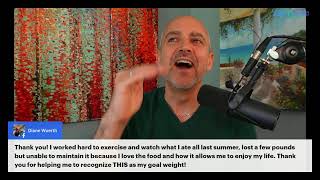
Everyone, welcome to today's program here, Self Thin Podcast. Today we're talking about eating to lose weight, eating, eating food to lose weight. I think this is a better way of looking at it because typically what you think when you diet or try to lose weight is I'm going to stop eating to lose weight. And this really sets you up for failure because What happens is you start orienting around the idea that I need to not eat, not eat. Don't, don't, don't do it. Don't do it. And it's almost a guaranteed straight line path to extreme hunger. So when we focus on what we're not going to eat and not eating, we get really hungry. And then what happens? What happens when you over-restrict and you get really hungry? You probably overeat. That's what most people will do, myself included. When I get really, really hungry, I overeat. So focusing on not eating, ironically, right? Again, maybe logically it makes sense that you're going to eat less in order to lose weight. It makes sense on the surface, but technically what you're doing to lose weight is you're reducing calories. And there is a way to eat more and reduce your calories. And to understand how to do that, you need to understand the concept of calorie density. Calorie density is simply the amount of calories in a volume of food. So we can take, you know, a stack of cookies versus an apple so that they take up the same volume. It's the same size. But the cookies are going to have 2 to 3 to 4 times as much calories in that volume as the apple does. Okay. So if we eat the apple, we're eating the same amount of food, but we're getting less calories. Matter of fact, you could probably eat 2 apples, double the amount of food you're eating, and still reduce the calories that you would get from eating the same volume of cookies. So this is the secret to really mastering your weight, is to focus on eating to lose weight, eating to be the weight you want to be. And what this does is it focuses you on what you're eating instead of what you're not eating. And that is the magical difference. And of course, the diets don't want you to think this way because the diets are all owned by the food companies. And so they want to get you focused on what you're not going to eat rather than focusing on what you're going to eat. And so the easiest path to mastering your weight is to start eating more less calorie-dense foods. Less calorie-dense foods simply are natural foods. Fruits, vegetables, whole grains, greens, natural foods, meat. Natural foods tend to have less calories in them than processed foods. And when it comes to natural foods, even in foods just in general, the highest calorie density foods are butter, oil, cheese. These have lots and lots of calories packed into a small space. So the more you start to dial down the butter, dial down the oil, dial down the cheese, you tend to dial down the calories. And as you start to consume more whole natural foods, which tend to not have oil, butter, cheese, you know, is a little bit of a mix over, but less butter and oil typically in whole natural foods. What ends up happening is you can eat more, you can feel fully satisfied, and you can lose weight. This to me is the holy grail of mastering your weight because it allows you to reduce calories and lose weight without being hungry. As a matter of fact, if you really max this idea out, you can actually feel more satisfied than you've probably ever felt in your life. Because unless you've ever had a period of time in your life where you've consumed a lot of whole natural foods for a while, then you've never even experienced what real true satiety and nourishment even feels like. And it feels amazing. What ends up happening is the food noise dials way down. Okay. When you eat more whole natural foods, not only do you tend to produce more GLP-1 anyways, but you start to nourish yourself on a much deeper level. That quiets the food noise down in ways that you could never imagine possible completely naturally. And so this is the secret, in my opinion, to mastering your weight is to mastering your eating and to eat in a way that really allows you to live at your goal weight comfortably. And in order to live at your goal weight comfortably, you cannot be starving. You need to feel satisfied to feel comfortable. So take some time to think about this. And if you want some support with the mindset piece of this, click the link in my bio or go to programyourselfthin.com and go get the free hypnosis session that I made for you. Uh, it's right there on my website, completely free, and I give you a bunch of other free stuff too. So go check that out. Uh, and if you are in Facebook or YouTube, I'll just put the link in the chat window. Uh, yeah. And if you have any questions, feel free to ask them. Any weight loss questions are welcome. Talk about anything here, any and all diets here, although I'm not a big fan of diets, I will say. So, but that's okay. I understand everyone's on a diet, so there's no judgment, um, only, only an attempt to show you a better way than dieting. That's kind of my, my focus and my goal is to kind of— I'm not trying to convince you, I suppose, but, but to just, uh, display You know, that there is an easier way to manage your weight than dieting. And I'd even go so far to say that the diets are intentionally set up for your failure. I would say that. I think the diets, which actually most of the big diets you know of are owned by the big food companies. And I think dieting is just a branch of the food processing industry. And I think it's there to make us stuck, to program us in the wrong way. That's what I think. But yeah, but any weight loss, uh, questions you may have. I was, uh, speaking with someone today. I hear protein, protein, protein. I don't know, I, I think we live in a time— I don't know what's talking about this, but this is just something that came up today. It comes up all the time. I hear people now so often talking about protein. Just consuming more protein. And it's just so crazy. It's just that, that's the moment in time we live in. But my big fear personally is I, I think protein becomes the only thing measured. But you know, how about if you're consuming your protein in a package of saturated fat? You know, then I, I don't know. I don't know if that's a good idea. But yeah, anyways, the bigger picture is when it comes to weight loss in this culture, it is it's, it seems like it's so confusing, and it is, but I think that's part of the plan because I think a confused mind is a stuck mind, and the stuck mind just keeps doing the same thing. So I think the confusion a lot of people feel about what am I supposed to do, what should I eat, what am I supposed to do, it's one thing one week, one different thing the next week, um, I think that's part of the, the confusion process, and it's very intentional. As someone put it, it's kind of like if you're going to do a puzzle and never mind someone's taking the pieces, what's even more diabolical is adding another 200 pieces that don't go to the puzzle, but kind of look like they do. And that's what happens with the weight loss industry is they just bombard us with so many different messages that it's very difficult to set a straight course forward, um, with how to manage your weight. So it's kind of, kind of crazy. So Ken says, heading out on vacation, 10 days of fresh seafood and a little extra wine. I'm sure I'll be— well, Ken's in the program, so I know I'm sure he'll be fine. Yeah, I'll be ready to get back on track when it's over. Yeah, exactly. And, you know, again, that's another piece that I think most people never even consider because most people never even get to their goal weight. But when you get to your goal weight, you— well, to get to your goal weight, A, and then to live at your goal weight, You need to be able to have flexibility in your life. You need to be able to kind of dial it in when you're at home and in a, in that mode, and then be able to go on vacation and kind of loosen up a little bit, go on vacation mode, then dial it back in. And I think again, that's just one more example of a skill and strategy that most people don't have and don't really even think about is that you need to be able to transition from one mode to the other. Now again, a simple way of explaining this is that most dieters are all or nothing, right? They got an all or nothing mindset. They're either all doing everything perfect or they're not doing anything at all, not thinking about any of it. But in Program Yourself Thin, we're all or something. So we're always doing at least something. And I think that that is part of what sets you up to be more flexible in your mindset and in your approach for how you're dealing with your eating, your weight, you know, your life. So that's wonderful, Kent. Yeah, so again, for Kent, I know he will go into the vacation with a focus on enjoying himself as much as possible. And he will enjoy himself moderately, I would imagine, because the most pleasurable consumption is moderate consumption. Stuffing ourselves silly, it's enjoyable in a very short-term sort of way, I guess. But overall, it's not really the most pleasure you can get, right? If you're going to eat your favorite food, It's not as much as possible that you can eat that dictates the most pleasure, right? So think of whatever your favorite food is. Let's say pizza. Okay, say you love pizza, and you can substitute anything you want, but you can love pizza. But, but how do you get the most pleasure out of it? Eating 2 large pizzas? Is that how you maximize your pleasure, the most quantity possible? No, of course not, right? Because then you're gonna feel sick. So what's the most pleasure you can get out of pizza if you love pizza? Well, some sweet spot where you, you eat it and you enjoy it, but then you stop without feeling sick afterwards. Because the— we can't just measure the enjoyment we get out of pizza with just the eating phase of it. We can't just measure our enjoyment of pizza by just the, um, 10 minutes it takes us to eat it. We've got to also look at, okay, here's the eating piece, but then we got to look at the part afterwards, which is the consequence phase. You eat the pizza, but then there's another 10 hours that are going to happen. Are you just not going to consider those? Are we not going to count those in the pleasure equation? Does pleasure only happen while we're eating? We're just not going to count afterwards, right? Because imagine you go shopping. Well, if you're only going to measure and only think about shopping in the moment, well then buy everything in the store. But you don't do that. Why? Because you consider what happens afterwards. Right, so the idea is that, you know, understanding like the maximum pleasure you can get out of food, we can't just look at the eating piece. We've got to look at the following hour, 5 hours, to get a real sense of what the ultimate pleasure we're going to get is. And that's where moderation becomes really the fine— the dial you fine-tune your pleasure to. Uh, what's up, Desiree? Desiree says, do you answer GLP-1 questions? I might answer some of them. I get asked that all the time. I mean, this isn't really— GLP-1s really are just about weight loss, right? So you take the GLP-1s, you feel full, you don't eat as much, you lose weight. Okay, that's it, right? So you don't want to think about mindset, you don't think about your lifestyle, you don't want to really transform your eating. You just want to take something, inject something, never have to think about it, and you just eat less, you lose weight, and you're ready to do that for the rest of your life. In Program Yourself Thin, we're taking the weight loss, we're wrapping in personal development. And so Program Yourself Thin is really a personal development program where you learn to master your weight as well, but the goal is different. So in Program Yourself Thin, we're not just focused on losing weight. That is one part of the goal, but it's just one part. The bigger goal is that you're working to become the best version of yourself, the person you want to be. And how do you become that? And it's not just by weighing something, it's becoming the version of you you want to be. So in my opinion, that's transforming your mindset, your lifestyle, and your eating so it really supports you being the best version of you possible so that you can have the relationships you want, you have the financial, um, reality you want, you can spend your— the life you want to live, you can perform and produce and work the way you want to. Whatever is important to you in your life, you can do it at a higher level. That's what Program Yourself Thin's about. So Again, they really are two totally different things, even though both of them will probably help you lose weight and live at a lower weight. That's about it. That's about the only thing they have in common, you know. But, but I— yeah, I'm happy to take a swing at, at some GLP-1 questions. Ken says, more than the weight loss, my family comments on how relaxed and calm I've become. Thank you, Jim. Yeah, Ken, that's awesome. Again, Ken's a superstar, just really working the program well. And I appreciate you saying that, Ken, because that's what I was just kind of talking about too, right? That Program Yourself Thin, our goal is not just weight loss. That is a real shit goal, folks, in my opinion. You know, I think— I mean, obviously you want to lose weight, but wouldn't you like to also be more relaxed, be more calm, be more grounded, have a quieter mind, feel more flexible, have more energy, feel more balanced emotionally? You know what I mean? Like, set your goals higher, set your aspirations higher, in my opinion. And there you go, Ken saying it. You know, his family literally noticed. Noticing that he's a lot more relaxed and calm. And folks, when you're a more relaxed, calm version of yourself, you're almost always a better version of yourself. So that's awesome, Ken. Desiree says it was a health question, wasn't sure if you would know or not. Um, yeah, I don't know, I'm not a doctor, um, but I, I have read quite a bit about GLP-1s, so like I said, I have to take a swing at it. Um, what's up, Lindsay? Lindsay says, hey Jim, I never eat the same lunch twice in one week. I am always switching up my meals, dinners to feel satisfied. I need whole foods to feel satisfied, but I also need variety. I am struggling to build a routine because I can never get myself to eat the same thing frequently. Do you get what I'm saying? Yeah, absolutely. And that's just a reality, right? And again, we're all, we're all our own person, right? We're all unique human beings, unique snowflakes, one of a kind. And so everyone has their own variety requirements. And so it sounds like you're Again, the variety requirements are kind of on a spectrum. So I might be the opposite of you, Lindsay, because I can eat the same thing, um, for breakfast and lunch every day of the week, at least Monday through Friday. I don't care. Um, you need a lot of variety, so respect, you know. I'm not going to sit here and say, no, no, Lindsay, no, no variety for you, right? No, I honor you and I respect you, and I think you should build your strategy and your structure around your requirement for a lot of variety. Now, understand though that there's good and bad to everything. And so to, to have more variety, you're going to need to have more cognitive load to track all that. It's easy for me to track my breakfast and lunch cuz they're the same Monday through Friday. So I can, you know, on Sunday I can get all my lettuce and my stuff that I need to make salads all week. It's pretty easy. Um, you know, weekend I can make sure I've got, you know, the Ezekiel bread and peanut butter. And apples I need for breakfast every day. So I, because I have less need for variety, there's less cognitive load that I don't need to think about as much. You have a higher degree of variety requirement. Okay. Totally fine. But it's probably going to take you a little bit longer to figure all this out because now instead of having to track one thing for 5 days, you got to track 5 things for 5 days, right? So that, that's a lot more to keep track of. So you better give yourself a little bit more time because you've got a harder path ahead of you in that way. But that's just your path. So what, you know, there's other parts of the path that you, you know, would have an easier time than I would, you know. So again, this is how it is, but you want to eat whole foods. So what I would suggest is that you create kind of categories. So like you said, I never eat the same lunch twice in one week. Fine. I never eat the same dinner twice in one week. Right? So, so that's fine. Um, so come up with 5 to 10 lunch ideas that are all within your kind of nutritional requirements. Okay, so, so brainstorm 5 to 10 different lunches, 15 lunches, however many you need. Um, brainstorm those lunches, and then you can start to figure out how to be able to prepare those, right? So again, you could stack together. Let's, let's just say, again, I don't know how much variety you need. So if you had like a, a rice-based lunch here, maybe you don't want rice the next rest of the week. So again, I, I don't know exactly what your variety requirements are, but you get kind of the idea. Start to come up with a group of lunch, whole natural food lunches that you could eat, 10 to 15 of them. I can't imagine you need more than that. Right? Then do the same thing for dinner. You might need a few more of those, maybe. Okay. And then start working from that list because at least that'll make it feel like, okay, here is a, a categories of lunches that I can choose from and whatever. Because what you don't want to be doing is like, oh, every lunch is something brand new because that's not what's happening anyways. No one is going eating a brand new lunch every single day. You're going to eat that. You might do that for a little bit and then you're going to land on favorites. So again, you might notice that, oh, Mondays I can have this for lunch. Maybe you have to switch Mondays up. Okay. But that's the idea. I promise you there's still a pattern. You just need to have a bigger pattern for it to work for you. So I hope that helps you out. Um, so Jane, Jane says, do you think that when you eat a lot of pleasure foods day after day, it becomes a stronger pull to do it again the next day? It feels that way. If I get on a roll with the clean food, I can maintain it for a while. But then one day of pleasure eating and boom, more days of eating pleasure foods. 4 days in a row of it now. Um, oh yeah, absolutely, Jane. I absolutely, without question, think if you start eating more pleasure foods— we'll just use that vague terminology again. If you're not on the program, you may not understand exactly what that means, but, um, but yeah, if you start eating more processed foods, more, um, sweets, more, uh, junk food, or fast food, you start eating those things, you're going to crave it more. Those foods are literally engineered in labs to be as addictive as possible. So yeah, the more you eat them, the more you're going to crave them. It's kind of like if you start smoking cigarettes, you're going to start craving cigarettes. Okay. It's a, it's an addictive substance. So yes, Jane, absolutely. But I will say, Jane, this is why in Program Yourself Thin, we, we create the schedule of having pleasure and clean days. And we start to structure that. So for me, I've got Monday through Friday afternoon on my clean days, and Friday afternoon to Sunday is my pleasure days. Okay. They're both structured, but they're structured around different goals. The goal for clean days is really the primary goal is fuel. That doesn't mean I only eat for fuel during those days, but that's the main goal. And then the goal on pleasure days is to eat more for pleasure. Now I'm still fueling myself too, but the main goal is kind of pleasure and enjoying the foods I'm eating. Sensorily wise, right? Whereas the fuel days are more just about kind of nourishing my body. I enjoy them, but not as much as the pleasure foods. Okay. But that model of having— now again, so that's my clean pleasure days. I started with one clean day a week, Monday. So, so I'm not saying you just jump into 5 days of clean. That, that's what I— where I've landed now after doing this for 30 years. But the concept's the same that we, even if you're just starting from nothing, Let's start one meal clean. Let's make one day clean, two days clean, and then you can build from there. But the key idea is that we have clean days, pleasure days, and then clean days. And if you start to structure that around your schedule, for a lot of people, Monday to Friday, Saturday, Sunday, or Monday to Wednesday, and the rest of the week's kind of pleasure, whatever. Um, the idea is that you have in your mind fuel, fun, fuel, fun. And what you're doing with that is you're practicing going from fuel to fun to fuel to fun to fuel to fun to fuel. You're doing that every week. And what that's doing, low-key, kind of like the Karate Kid, who's— he's waxing cars, but he's actually learning martial arts. When you do the clean pleasure, clean pleasure, clean pleasure, what you're actually training into yourself is how to get back on track, right? Because every Sunday, every Monday, I'm getting back on track. And I'm practicing that every Monday. So I've gotten really good at getting on track again. It's not a big deal to me. And yes, so I can still get off track. I can still get caught up with stuff. And, um, you know, all of a sudden the pleasure— now I, it's still better because even when I'm getting a little wobbly lately, wobbly for me is eating more bread. I make sourdough bread, so I might eat more bread, but that even if I start eating more bread on my clean days, I'm still anchored into my clean days. So I'm still having my really healthy, nourishing I'm still having my salad for lunch and there might be more bread sometimes, but I'm still anchored into having a clean day. Okay. Um, but again, every Monday I'm practicing getting back on track. So that's completely and totally normal, Jane. And you're going to do that forever. What you're, what you're going to do, you're never going to get to a point where you never eat ice cream or where you never have a pleasure day where you get caught up. We are always and forever going to get caught up in the food sometimes, folks. We're human beings. Living a human life, you're going to have ups and downs, and your ups and downs are going to influence your eating. This one, I'm trying to say, dieting sets you up to be perfect. So it's just this, it's this outlier experience that you do for a little while. And then what do you do? You always go back to normal. In Program Yourself Thin, we're looking to make normal the fact that you get off track sometimes. Let's get back on track. You know what I mean? Again, that's why we're all or something. We never want to get completely off track. That's why I say, even if I'm overeating bread one day, I'm still meditating. I'm still eating my salad. I'm still drinking my water. I'm still getting my sleep. I'm still doing lots of good stuff. I'm not just stopping everything. Okay. So same thing for you, Jane. Start to look at again for you. Now Jane's in the program. So I'm kind of speaking program speak here a little bit, but this is why lifestyle pieces are so important, Jane, because those lifestyle habits anchor you to your clean days, to your, your healthy kind of state of mind. And then what happens is Yeah, some days I eat ice cream, some days I don't, but that's happening on top of a more solid base of lifestyle. Okay. And as you move forward, yeah, the ice cream's kind of the challenge for you. Um, but again, don't let the ice cream be the only decider, the only thing that dictates whether you had a good or bad day. Drink your water, get your sleep, do some relaxation, eat an apple, um, go for a walk and then eat ice cream or don't eat ice cream. It's not the end of the world, you know what I'm saying? So don't let ice cream be the only thing that defines whether you had a good or bad day, all right? And that is the first step to managing the ice cream though, okay? Because it sets you up on a much more solid foundation than rather the idea that, you know, oh, it was a perfect day, I didn't eat ice cream, oh great for me. Hey, hey, oh, I ate ice cream, boohoo, oh, I'm a loser and I'm never gonna succeed. You can't do that, folks. You can't do that and succeed, you know? So, um Yeah, hopefully that helps. Yep, that gives a thumbs up. That was helpful. Good, good. Yes, Lindsay, that helped. Okay, good, good. And again, that's why I'm here, folks. I'm here to literally answer your questions for you. This is a service I do. It's kind of my dharma. In yoga, they call it dharma. It's my way to give back. I'm one of the luckiest people on the planet, I believe. Um, I have a lot of information that can help a lot of people in terms of their weight and health that you never get to hear. And so I am gladly here to help you out and answer any questions you may have. I can't say I'll get it right, I can't say I'll help you, but I will absolutely do my best to do that. Okay, I am here to help you. So I hope that helps you out, Lindsay. Um, what's up, Aponte? Uh, but they says my docs— my doc said no to GLP because I had a stroke. Okay, yeah. Um, I, I don't think that— I don't— I, I don't think I know they're making a selling GLP-1s like the, the magical mystery cure of the, of history here, but I just, I get, I'm not against it, so I want to be clear, um, but I just don't like, I don't know, I guess I, I, I tell you, I just personally, I got a real issue with like prescription medicine marketing in general. It, it's so weird because I never, I don't watch ad, ad TV at all. But I've been watching like the NBA playoffs and, uh, it's like, my God, it's like, it's like, see, like 50, 60, 70% of the commercials are pharmaceuticals now. And it's just, it's such a crazy world we live in. And the GLP is just part of that. And again, I'm not saying it's not effective, you know, I'm not against it. I think it's a great solution for some people. Um, yeah. Uh, Sexy Hun says, can you tell us your meals? Um, you know, again, I, I don't have a problem telling you my meals, but I tend to like just not because there's just such a weird thing in dieting that people just want to tell me what you did. Tell me what you did. Why? I mean, how many times you've been told that someone who's lost weight's done and then you didn't do it? Like, it's not a matter of knowing what to do, it's a matter of knowing how to get yourself to do it consistently. So if I tell you the foods that I like, you know what I mean? That's like asking me like what music I like to listen to. Like Again, I get it on one point, but it's like you may or may not like that music. So anyways, but I will tell— okay, so my clean breakfast, breakfast, my clean ones are typically like Ezekiel toast. I'll eat— it's a complete protein, it's really good. Um, natural peanut butter on that, an apple with peanut butter, uh, and water. That's a typical breakfast I'll eat Monday through Friday. Uh, for lunch Monday through Thursday, I'll usually have a giant salad. Red leaf lettuce, mixed greens, carrots, celery, radishes, peppers, cucumber, onion. It's a little bit of blue cheese in there, you know, it's different stuff. But, um, banana with peanut butter, I might have those for lunch. And then dinner, usually some sort of whole grain, vegetable, beans, something like that, a lot of times. And again, that's just a couple of them. I obviously eat other stuff than that, but those are some of the, the regulars of my meal plan. Man, if anyone's getting questions, feel free to ask them. Uh, Rhonda says, I find it is hard to do moderation with foods with sugar and flour process focus, wanting more and more with increased cravings and brain chatter. When I turn to artificial sweeteners, I wanted more 1 to 3 Coke Zeros turned to a daily habit. I don't want to have an all-or-nothing mindset. How do I navigate this and throw out diet mentality? Um, that's a great, great question. Okay. And so I absolutely think you can have an all-or-something mindset and eliminate sodas from your life. Do you know what I mean? Like, and I hope that— that may sound like that's a contradiction, but, um, I don't think it is because I think the all-or-something mindset is all or something. And so if you— like, I, I'm an all-or-something mindset, but I'm all the way vegetarian. Well, I guess I'm pescatarian. I'm all the way pescatarian. I don't eat any land animals. I just don't eat them. That 100%, don't eat them. And so, um, but I'm still in an all-or-something mindset. So I, what I, what I say about that is that I didn't just cut meat out of my life. It just kind of slowly went down and then disappeared. So I kind of used that all-or-something kind of approach to get to kind of a zero space. So that's one example of that. But then there's other things where I've used an all-or-something approach to get to You know, a very limited amount of it. So to your point, I find it's hard to do moderation with foods with sugar and flour and processed foods. Yeah, I agree. Right. These are addictive foods I treat. I treat like— so my addictive foods, let's say, right? I'll just keep it vague so you can insert whatever is addictive to you or you find struggle moderating, whether it's sodas, whether it's desserts, whether it's sweets and flour, whatever it may be, I treat those foods like I treat alcohol. So I still drink alcohol. I drink wine and I drink beer, um, and I treat it with a lot of respect. So not only do I moderate it, but I moderate it because mindset-wise I have a lot of respect for alcohol. I've had an issue with alcohol in the past. I can get caught up in it. So what I've done is I have restricted alcohol. I, you know, I shouldn't say restricted because that's the wrong word. It doesn't feel that way. I have eliminated, which is a different thing. Um, restricted feels like I'm trying to fight against it. Eliminated— I really have gotten rid of alcohol from my life most Mondays through Thursday to Friday night. So if I'm drinking, um, wine, it's usually like a Friday and Saturday night. It might have a little bit Sunday night, maybe little remnants. Um, and I keep kind of working it down. And so I used to drink every single day. I wasn't drinking a lot, but I could easily drink, you know, a big 16-ounce IPA or something every single day at least, and then more on the weekends and stuff. And so I slowly kind of worked it down. I drank less on nights where I drank multiples, and I drank none on days that I used to drink one. And I'd start on one day, I'd take this day to cut the drink down from 4 to 3, you know, then 3 to 2. So I kind of systematically worked it down, but I always kept it. And so now, like, I will have, um, like, I'll have wine tomorrow night. I know that, and I look forward to it. I'm really looking forward to— I'm excited about it. And it's kind of hitting a sweet spot for me because if I drank every day, um, that wouldn't be the most pleasure. There's net— there's more— if I drink every day, there's more negative effects than pleasure overall. Okay, now again, in every moment I drink, I'm like, oh, this is great. But the overall effect in terms of my sleep, you know, the calories, how it makes me feel, it affects my metabolism, is negative. And it gets more and more negative the longer I keep it up. So I don't want that. I believe at this point, the amount I'm drinking, the couple days I do it, is— I don't think there's any negative, really any negative effects to it that are enough for me to stop, let me say. Okay. So I would say you go about it the same way, Rhonda, that, um, you start recognizing which foods, A, give you the most pleasure. So when it comes to flour, sugar foods, what's your absolute favorite one? And put that on the menu each week. I know this sounds strange and program yourself then the meal plan that you create, which is crafted around who you are and your situation. Oddly, we start the whole thing by picking your favorite food in the world. Does that sound strange? I don't know. But in Program Yourself Thin, we start with your favorite food in the world— ice cream, brownie, cookie, cake, blah blah blah. What— it doesn't matter what it is. We put it smack dab on the middle, wherever you want to put it in your, your meal plan. It's there, and you know you're going to have it within 7 days. That really does something psychologically to a person, because every time you've gone on a diet, you try and resist it for as long as you can. Scientifically, that's a terrible approach. It's proven to not work well. So to put it on the menu and then start working on moderating it, I find to be much more effective. So again, with alcohol, I will have it tomorrow and I'm excited. I'm looking forward to it. I can't wait. Every night it's fun because I don't do it very much. So when I do it again, everything's relative. So having 2 glasses of wine feels more than enough. Now when all of a sudden I'm drinking 1 every night, now Friday night feels like 3 or 4 has to be the right amount, right? So by dialing down to zero on some days, now when I do do it, to have two, I feel it and it's enough. So it's kind of a sweet spot for me. And I approach the food the exact same way. So same with the Coke Zero. I wouldn't work to— if I was drinking three sodas a day, let's say, my first goal would be to cut down to two sodas a day, a couple days a week. Then once that felt comfortable, I worked to cut it down to one. Once that felt comfortable, then I worked to cut it down to zero a couple days, see how that feels. And then decide where I want to sit. I might never get to no sodas at all, but I might save the sodas for when I would enjoy them the most— a Friday night when I'm watching my favorite show, um, Saturday afternoon when I'm out on the porch reading a book. Well, whatever it may be for you. But I think most people don't do this. They want to lose weight and they start stripping away all their favorite things, you know. So again, I hope that helps out. Um, T says, can't read that. That's something going on in my brain. I just— someone, I don't know if that's— that looks like the Netherlands. What do they speak? Dutch? Danish? Then I don't know. Someone— T is speaking in a different language. I thought I was going to read it. No, okay, I don't understand that. Uh, Lindsay says, I have a degree in marketing. We live in one of the only countries who allow pharmaceuticals to be directly marketed to the consumer. Yeah, I know that, and I know that's a relatively recent thing, relatively. And, um, that's why I say, like, I used to watch a shit ton of TV, you know, decades ago. And so it's just, it's, it smacks me right in the face, these pharmaceutical companies. I just think it's, it just seems so, um, I don't know what the word is, it just seems wrong. I don't— it does not seem good, it does not seem right. It's just, oh, it breaks my heart. I don't— it really does. It bums me out, you know. Jane says, I did have an apple and Greek salad and danced yesterday, but ended the day eating a ton of ice cream. Okay, Jane, so, so again, good job doing the good stuff, and then, you know, eating a ton of ice cream is the problem. You know, how could you have eaten less of it? You know, you go to work on that. It's not the end of the world. You know, here's the thing, I'm just gonna say this, and this isn't just to you, Jane, but I'm gonna say this to everyone. It's like, you know, like, well, I, I could say this to Jane because Jane's in the program, so she has a different frame of reference, and all you dieters won't understand what I'm saying. But, um, this idea that, you know, you, you try to do things right and you do things right most the day, and then you eat a bunch of ice cream at night. And it's like, I can even hear the way you're saying it, Jane, because I know, like, I see the butt, you know, and, and it's like I did have an apple and Greek salad and I danced yesterday, but I ended the day eating a ton of ice cream. So bad day, you know, but it's not a bad day. It's a good day with a behavior at the end that, that isn't one you want. And you know, I know, I know, Jim, you're just talking your shit. You're just talking your happy horse shit. No, I'm not. What sense does it make to completely— because you know what you all do? You remember like Family Feud and you, you say your answer and it would be— you remember that X? I remember that X. If you watch Family Feud, remember that X? I'm talking about the old, the old one growing up, not, not Drew Carey or whatever, Steve Harvey. I'm talking about the old one with Richard Dawson. And, uh, they had that X, man. And that's what you all do, right? So he's like, oh, you had a great day, had an apple, I had Greek salad, which I never eat salads, and that was amazing. I never eat fruit. I had a piece of fruit. I was dancing and everything. I was feeling so good., but then I ruined the whole day. The whole day gets a red X. Well, the whole day wasn't a red X though. And how does it serve you to have this binary measurement of your day? How does it serve you to have 80% of the day is wonderful behavior, 20% is not, and you nullify the entire day with that 20%. How does that serve you? Being so cut and dry, so binary, so pass/fail with your, your measurements and your judgments. How does that serve a person? I don't think it serves you at all. And I think this is one more example of how dieting is a mindset that's setting you up for failure, because when you diet, it's an all-or-nothing thing. And you either— you either— if you're not perfect, then you failed. If you're 80% amazing and 20% wrong, then you're 100% wrong. How does that serve a person to succeed? I have no clue. I don't know. Now, I know most people just never even question that, but when you do question it, what is the response? How is measuring your day pass/fail? And by the way, so pass/fail is what? In school, pass/fail could be anything over a 60, anything over a 70. So it sounds like you, if we look at the whole day, you got like an 80%. So it's like you got an 80%, you're still failing you. And that's what a lot of you do. And I don't know how that's serving you. I, I don't know how that's going to help you. Someone says— I can't see their profile— says, I need help, I'm in a plateau and I can't get out of it. My big question is, how long have you been in the plateau? That's my big one. I, I can't tell you the number of people that tell me on their plateau and they're freaking out, they can't get out of it, and I say, how long? And they go, it's been a week. You know, weight loss is inconsistent and unpredictable in the short term and very consistent and predictable in the long term, and that's just the way it is. Um, so without knowing how long you've been in a plateau, I would not be able to answer that. What's up, Christina? Christina says, listening and swinging on my garden swing, it's truly a beautiful way to be. Yes, nice job, Christina. Again, Christina's in the program. Program. And, um, boy, just a superstar in the making. It's really just a joy. And, and she is an example of what I'm talking about because, I mean, yes, she's lost 70 pounds, um, in her journey so far, but the bigger amazing thing is just the mindset shift. It is— it's just unbelievable. I just wish everyone could experience what I've experienced in my career. It's almost magical. I live in a magical world. I live in a world where people lose weight and keep it off. Do you know what I mean? Like, I live in like a fairy tale world. I expect to see like little elves and fairies floating around. I mean, it's a magical world I live in because I, I interface with things that most of society thinks is impossible, doesn't exist, you know. But I see it every day. And Christina, your example of that Says thank you for all your great advice and teaching. You are welcome, Christina. Thank you for using it. Corey said exactly how I lost 120 pounds. Nice job. Yeah, I'm not sure exactly what you're referring to, but everything I'm talking about is, is relevant to that because everything I say comes out of studying people who have lost weight and kept it off. So I hear that every single day. I'll be talking about things and people that have lost 120 pounds, 100 pounds, 80 pounds, 50 pounds. They've lost all this weight. That was— that's what I did. That's what I did. That's how I did it. That's why I did it. And it's not dieting. It's this other way of approaching it, you know? And it's because that's where I learned it. I learned it from people that had lost the weight and kept it off for at least 2 years. That's the secret. They think different. And so I just talked to a bunch of them and codified it into a program using some of the most powerful mindset programming techniques available, though, too. I did bring that piece of it to it. The NLP, the neuro-linguistic programming, hypnosis, um, coaching, all of that knowledge, you know, I use to speed the process up too, though. What's up, Vicki? Vicki says you sound great. How's the audiobook coming? Audiobook's going great. We're halfway through. I gotta kind of block off a little time to record. I might, might do it today. It might do it today a little bit. So I'm so close, and it's tech— it's all set. So it's like once I finish that last part, it's ready to go, and it's going to be done quickly. So Um, next week for sure. Next week I promise you will have the audiobook. I— you heard it here first. Guaranteed next week I will have it available. Um, at the very least it'll be available to my customers because I'm going to put it up in the members area and you'll be able to listen to it. And, um, I don't know how long the whole Audible process takes, but, uh, that will be— we'll see. The process will get started next week, that I can promise you. And, um I'll keep you up to date with it. Uh, Lindsay says the United States and New Zealand are the only developed countries who allow pharmaceutical companies to market directly to the consumer. New Zealand, huh? Shocking. Shocking to me. That's shocking to me. Yeah, no, I don't think it's a good decision. I just don't see any benefit to that one either. Um, Ali says, does your family eat the same as you? Um, no, no, yes and no. We, we eat the same types of food kind of, right? We eat the same dinners, um, but my breakfast— I'm kind of the only one that really— no, I'm not. My daughter eats all breakfast, but, but no, yeah, yes and no. I don't know, they don't eat exactly the way I do. I have kind of my own specific thing, um, but we eat very similar, I'll put it that way. But I will say, when I first started doing this, my family did not eat like me at all, and that was very hard. It's hard to change within the environment you live in. It's, it's hard, and I think people really underestimate that. So, um, Lindsay says, you're doing good things in this world by being here helping people. God bless. Thank you, Lindsay, appreciate that. All right, Tia says, if I eat potatoes or pasta, I still crave something sweet in the evening. How do I solve this? Um, well, you could solve it by eating something sweet in the evening. You know, I know that sounds like a strange solution, but if you consume less of the sweet thing than you may have eaten in the past, then you might lose weight. So again, a lot of times in Program Yourself Then we talk about the 3 Rs of weight loss: reduce, replace, remove. You have 3 options. Humans like options because when you're told what to do, you tend to rebel against it. Okay? So the idea that we just have to get rid of things a lot of times can feel like pressure and we fight against that. So giving ourselves, you know, autonomy and decision and choice to do what we want is important. So again, the problem isn't that you're eating something sweet in the evening. Most likely it's that you're eating too much of the sweet thing in the evening. So the first step might be just to reduce it, replace it, eat something sweet that's not very calorie dense, like an apple or grapes, cherries. That's another option. So I'll just leave it, leave it out there for you. Um, he says, I have many of those days. Love that you're happy. Horseshit, because we need a perspective. Very good, very good. Uh, Diane says, I keep wanting to lose 5 to 10 pounds, but maybe I just need to accept my current weight by eating the way you recommend and accept me at this weight at age 63. Yeah, I agree, Diane. I, I'm sure she's probably listening, but I have a client and she is fascinating because working together, she, she has gotten to her goal weight and she's been at her goal weight for a year or two now at least. But what was really interesting, especially in the beginning is she would hit a stressful point of life, whatever, work, personal, that doesn't matter. But, but stress would show up in her life. She's at her goal weight. Stress would show up in her life and she'd go, I feel like I need to lose weight. So sometimes, you know, we're kind of conditioned just live in this constant chronic state of, I need to lose weight, I need to lose weight, I need to lose weight. You don't, you don't need to lose weight. You get to choose what your goal weight is. And the goal weight you choose should be the weight that gives you the highest quality of life, the best quality of life. And so for you, Diane, the best quality of life may be being the weight you're at and accepting it. Accepting you're at the weight you want is a thing you have to work on, folks. You don't know how to do it, especially if you're a woman, because you have lived your entire life being conditioned to hate your body no matter what weight it is. And I think that we have to do intentional work to accept our body, women especially. And so you can sit this week and practice just imagining that I'm at the weight that makes me the happiest, because yeah, if I could magically take 5, 10 pounds off, that'd be cool. But I don't want to change my lifestyle. I don't want to change my eating. I don't want to focus on it more. I don't want to work out. I want to do those things. I'm happy with my life right now. And by accepting myself at my weight and who I am and letting all of that shit go and just enjoying my life as it's going is the best move for me to make. Folks, you can change your goal weight. I talk— I was doing this— I was talking about yesterday. 15 years ago, I put 25 pounds on in a very stressful period of life and put 25 pounds on. And in that period of life, I decided to take 15 of it off because I was there was negative effects that were showing up that I didn't like. So I took 15, 15 pounds off, but I raised my goal weight by 10 pounds because at that moment in time, with all the responsibilities and things I had to do to get my eating and lifestyle where it needed to be, was taking more energy than I wanted to put into it. So I raised my goal weight up. We're the ones that get to choose our goal weight. We get to choose the goal weight we want to live at. And, um, Diane, if you haven't, um, I have my goal weight quiz that I give you all. It's free, right? So again, if you haven't signed up for my hypnosis session, do that because I give you a bunch of free stuff. One of the things I give you is the goal weight quiz because the truth is you probably have no idea how to choose your goal weight. Again, in this culture, we have been shown— we've been given our goal weight, right? Because if you look at BMI chart, they give you the goal weight that you should, you should be at. But that's bullshit because the BMI chart, by and large, if you're in the normal range or the overweight range, most of it, as you start getting closer to the obese range, things change a little bit. But the first two-thirds of the overweight range and normal range, the health markers are very similar. And in some cases, being overweight has healthier numbers than normal weight range. So again, anywhere in the normal range to two-thirds of the overweight range, The health thing is, it's all the same. And so now within that range, it's up to you. What weight you want to live at? What, what weight are you willing to live at? Where's the best quality of life for you? And I think that's worth your time and energy to think, Diane. And I'm really— I think you're— it's great that you're asking that question. And I think, let you know, it's not something you're gonna answer in a day. Let yourself kind of gently mull it over for the next week or two. What weight do I want to be? You know, if I just let all that go and then my life was this at this weight, how would that be? What's going to happen 5, 10 pounds from now that's going to be so much better? Compare that to how it would feel to be 5 or 10 pounds heavier and never have to worry about your weight. You know, that, that's a good— I would say that would be a good exercise for you. Amy says, I'm so thankful to you because you changed my life. Your message speaks to me. I finally get it. All right, Amy, I'm proud of you. That's what I love. I mean, this is why I love this work, you know. It's, it's just, it's life-changing. I, I try and stress that to you, folks. Losing weight is difficult no matter how you do it. Even if you— well, shit, you know, if gastric bypass is intense, obvious. I think most people know that one, I hope. Um, but even injecting yourself— make it a pill, make it a fucking pill, okay? But it's still intense, dude. Well, you're gonna live your life feeling full all the time. You don't think that's messing with your head? And it's weird and difficult. So you can go on that medication, but it's still work. And then obviously, if you're going to lose weight the old-fashioned way by changing your mindset, your lifestyle, and your eating traditionally, it's work too. So if you're going to put that work in, why not get more benefit? Why not get more benefit than just weight loss? That's what I think. I think you can get so much more benefit out of your energy to lose weight than what dieting has taught you. So thank you, Amy, for sharing that. I really appreciate that. And that's why I do this. Again, I'm here for you all. I genuinely— to me, weight is life and death, and I am here to help you in any way I can because I believe your weight is probably the biggest thing that is going to dictate how long you're alive. And certainly it's going to be one of the biggest factors, if not the biggest factor, in your quality of life during those years. So to me, this is so important, and I really want you to succeed, uh, and get the results you deserve. You know, Cindy says, thank you, really missed your positivity. I've been with some sweet but very intense clients, wasn't able to eat 100%, um, like I would like, but only went up 2 pounds, quickly back on track. Couldn't do it without you. Cindy, this is what I mean, right? That's, that's living it. That, that's That's living at your goal weight, what Cindy just wrote. Do you see what I'm saying? Like, like, folks, listen, if you think about how you think about weight loss, it's an all-or-nothing thing, right? You think about weight loss, you think about being on your plan perfectly, but, but you can't just be on your plan perfectly forever. That's a fairy tale. You're gonna have ups and downs. And so what Cindy said, that's living at your goal weight. That's this book here. I'm gonna flip this around so you can see it on TikTok. Back even though they've restricted me. Um, the Dow of living at your goal weight. That's what Cindy just said. Cindy's the example of the Dow living your goal weight, right? I've been some with some intense clients, wasn't able to eat 100% like I would like but only went up 2 pounds but quickly back on track. That's the Dow living your goal weight. My weight goes up and down. I'm up 5 pounds. I'm freaking out. I'm just dialing them back in, and that's how it goes. I, I'm not freaking out. This is the difference. And I'm not freaking out because I have gotten really good at living at my goal weight. Part of living at your goal weight is being able to absorb when you go up a little bit, when you get off track, when life goes crazy. Nixon for— no way, no way, you New York fans. You're all gassed up. You got a tired Spurs last night, but there's no way they're winning in 4. All right, with that, I gotta get out of here. Oh, there's Diane though. She says, thank you. I worked hard to exercise and watch what I ate all last summer, lost a few pounds, but unable to maintain it because I love the food and how it allows me to enjoy my life. Thank you for helping me to recognize this is my goal weight. Yeah, you're welcome, Diane. I'm glad you said that. And, and by the way, Diane, let me, let me say, let me share something else. You could take the summer and just live at this weight now and just see how it feels. Because guess what, Diane? You're never gonna believe this. You are never gonna believe this. You can decide next month or in September that you'd like to drop 5 more pounds, right? Our, our goal, our weight is, is a— we decide what it's going to be. It's like the speed of your car, right? You, you can adjust it accordingly. So enjoy your work, Diane. Enjoy what you've done so far fully.. And if you want to go deeper into it, play with that. If you want to stay where you're at, stay where you're at. You're the decider. You get to choose. And congrats on all your hard work, right? Enjoy it though. Again, sometimes dieters, they always get in this place where they, they can never get to feeling good. There's always more they got to lose. There's always more they got to change, you know? So just enjoy yourself a little while, Diane. See how that feels. It might feel amazing. So, all right, I got to get out of here. If you're not in my world, please click the link in my bio or go to programyourselfthin.com. Uh, go get the free hypnosis session that I made for you. Um, I give you a bunch of free stuff anyways. I'm here Monday through Friday, so if you like this, uh, pop in, ask any questions you want. I'm happy to help. Uh, it's also a podcast. You can search any podcast platform search program yourself, then it'll pop up and you can listen anytime you want. Uh, and this book is available, so if you ever want to read a book about living at your goal weight, uh, go check it out. Go check it out. It's on Amazon and it's, uh, It's a pretty, pretty low price to get that much wisdom in your brain in that form. So thanks so much, everyone. Have a super day. We'll talk soon. Bye.
More from Jim



Weight Loss Visualization: Wake Up in Your Dream Size #programyourselfthin #weightlosshypnosis



What If You Pretended to Be Thin for One Hour? #programyourselfthin #weightlosshypnosis




