Program Yourself Thin Live 7-15-26
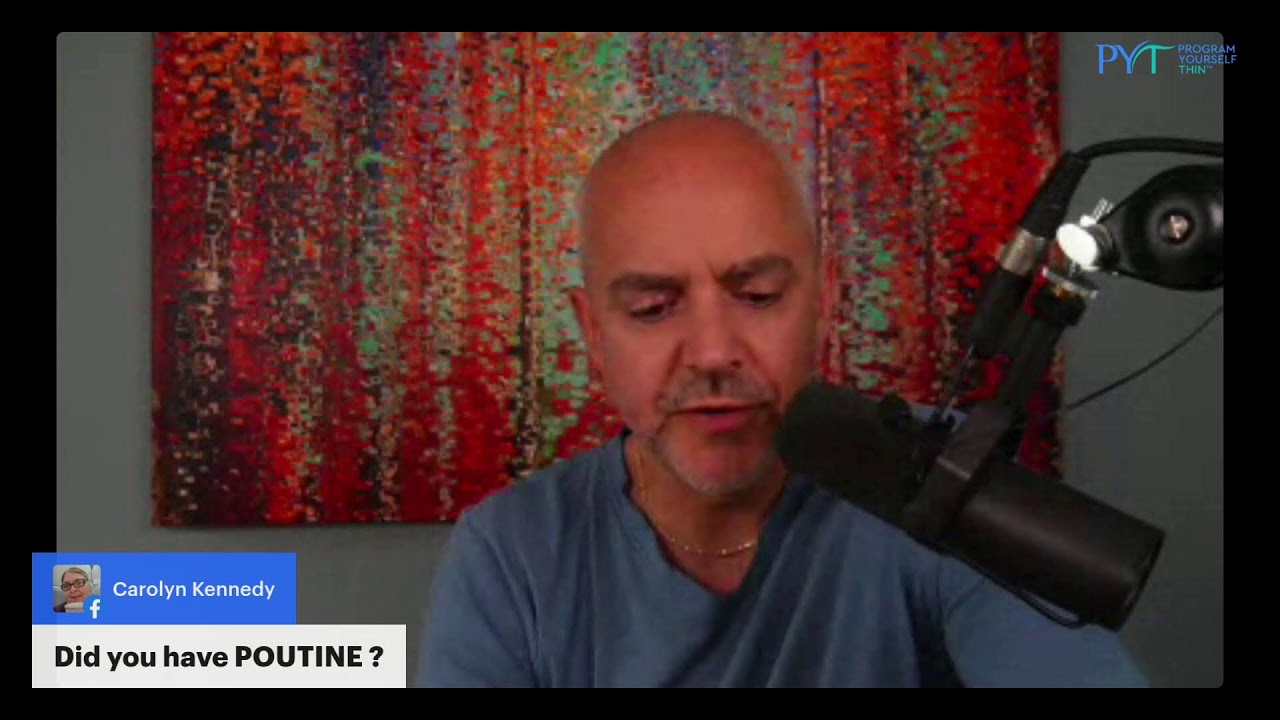
Jim Katsoulis explains why single diet plans fail and introduces backup plans for slip-ups. He argues weight loss works when built into your nervous system like brushing teeth, not managed through willpower. Sleep, hydration, and movement matter as much as the diet itself.
Chapters
Hey everyone, welcome to today's program, Yourself Thin podcast. Today we're talking about Having a plan for the days that you mess up. This is one of the most important things that you need to lose weight and get control of it, because what you have done the entire time you've ever tried to lose weight is you got one plan, Plan A, right? Perfection, everything going perfectly. And then as soon as things fall apart, even just a little bit, you You don't know what to do, right? Because you're thinking all or nothing. You're either doing it perfectly following Plan A or you're doing nothing, not even thinking about it. So we need to have a Plan B, C, and D and E maybe, right? But we certainly need more than just a Plan A because you can't just operate at perfection all the time. That's impossible. And so you can still lose weight even if you just get a little bit better. Once you start realizing that, we start to have different gears for different situations. And there's nothing wrong with that, right? It's actually really, really useful, really helpful. And it changes the whole game because now you're not trying to do the impossible, which is trying to be perfect all the time. It's hard enough to be perfect for a little while. So having a plan B, C, D is really just a concept first. And then you figure out what works best for you. So again, if you're going to try and do a keto plan, maybe Plan A is that you're going to go into ketosis, no carbs at all, right? I'm just going to completely go into ketosis. That's my Plan A. That's what I want to do. Great. But what if you can't stick to it 100%? Okay, let's have a Plan B. I'm not going to eat carbs for breakfast and lunch, whatever. Right. On Mondays, I'm not going to eat any carbs. Right. You can break it up into different categories. But what happens is to realize that there's a gradient between all or nothing, and it's called something, right? And again, it's relative to whatever your philosophy is, what you want to do. But again, keto is not just either not thinking about it at all or being in ketosis. There's also a whole bunch of stuff in between. Same with Weight Watchers with the points. Yeah, obviously I want to be under my points. That's plan A. Okay, but what if you go over them? Okay, if I go over them, I just want to go over a little bit, right? It's It's starting to think of that gray space and having a plan for when you mess up. And so what you do to really get good at this, though, is you start recognizing what are the typical mess-ups? What do I typically do where I mess up? Because most people's mess-ups run in patterns. So maybe in the afternoon, right? And so let's just say your goal is to not eat any cookies in the afternoon. You normally do, and you're not going to do that now. So yeah, the first goal is to not have any cookies in the afternoon. But the plan B might be if I have a cookie, I can have one, but then I gotta go eat an apple, or I have one and then I gotta go for a walk, or then I gotta have some water, whatever. It's just a plan B. And again, you may need a plan C and D as well, but the idea is that you've got different gears you can go into in different situations. And wouldn't that make more sense? Because what are you expecting, that at some point in your life you're going to get to this situation where you can just always be in one gear of perfection? You're just always going to be perfect, always make the right choice? When has that ever happened? Who have you ever seen that can do that? So why, why live in the fairy tale that that's possible and that's what you're expecting? Instead, start to plan for reality. Look at your past and understand how cravings just hit us sometimes. Sometimes our habits are just too entrenched to break them right away. And so we recognize how we can make mistakes and still be on track. That's the secret. Because when you start to realize you can make mistakes and still succeed, it takes a lot of pressure off. And for the first time in your life, it starts to feel possible because being perfect forever does not feel possible. And if you try and follow that perfection path and that's the only one you have, again, eventually the stress of it and the mistakes just happen, and then you feel yourself kind of falling off track. So The easiest way around that is to have some alternative plans as well, especially when you make a mistake. And when you build these other plans, these alternative plans around your most common mistakes, again, it starts to give you options, all options that are better than the status quo. And that's what we're looking for, to get a little bit better over time. Of course, we want to hit the grand slam and get our success immediately, of course. But if we can't do that, let's have a Plan B. And if we can't do that, let's have a Plan C. And that's how we keep moving forward in multiple ways, really fast, fast, and kind of slowly, but they're all moving forward. And that's the secret to getting the results you want. And if you want some support in this process, click the link in my bio, uh, or go to programyourselfthin.com and go get the free hypnosis session I made for you. It's called The New Thin Me, and it is designed to do exactly what I've been talking about here, help you start thinking more like a thin, healthy, happy person, and to have the mindset and the strategies that really serve you well and get you the results you want. So go check that out. If you're over in Facebook or YouTube, you, you should see the link there in the chat window. And I'm noticing I'm blurry again. I got to look this up now. I don't know what's going on here. I thought I did something yesterday that would have fixed that. So I'm a little surprised. No idea why. Let's take a look now, actually. Yeah. And if anyone has any questions, feel free to ask them, please. You're welcome to ask any questions. Oh, okay. Maybe this is it. Let's try this. Yeah, I don't know if that'll fix it, but we tried something. So if you have any questions, feel free to ask them. Any weight loss questions are welcome. I'm usually here every Monday through Friday at noon Eastern to talk about weight loss. I've been doing this for over 20 years. Professionally, and I take a different kind of path to help you master your weight. So it's not just about dieting, it's about really the mindset piece. And specifically what I always reference— okay, let me switch that up. Oh, okay. Wait a second now, wait a second now. Uh, what's up, Dolores? Dolores says not blurry here. All right, very good. Yeah, I see it on Instagram, it looks blurry. I don't know, it's, uh, it's been doing that, and then— so I don't know, I have no clue why, no clue why. So strange, but I appreciate you letting me know that. Yeah, not blurry there. And I'm trying to spin this around. They have switched. That's not it. I don't know what does it. Oh, okay. TikTok has changed their, their video. I, I don't know how to turn— I don't know how to unmirror the video anymore. I was going to show you all a picture, but now I'm not gonna because it'll show up. Remove background noise. Oh, they'll do that. But yeah, if you got any questions on weight, feel free to ask them. Um, what's up, Don? How's it going? Clear here. All right, Facebook's clear. Well, good, good. Maybe it's, uh, just Instagram, and maybe it's just my computer. Who the hell knows? I will tell you, boy, I've worked on— I've been doing online stuff for almost over 20 years. Holy crap, that's crazy. Um, yeah, and technology is technology. It sometimes gets all screwy for no good reason, and that's one of the most frustrating parts, I think. You know, when there's a problem, you can chase down and fix it. At least, you know. But a lot of times it's stuff you'll never— you'll never know why. But that's how it is. But it is funny. I mean, like, I think that, you know, even with weight, you know, back to the technology and the weight piece is that even with your weight, you don't know why you're unable to lose it. So the answer is not to approach your weight with the mindset of you think you know what to do and you just need to get yourself to do it. It's much more that you need to figure out, you know, what's going on exactly, what's the pattern, and then dive into that, understand it more. And that's when you can start to usually fix things. The generalized, you know, willpower fixes everything move is not very effective typically because it's just you're overrelying on willpower. So that is a big part of Programming Yourself Thin in a nutshell, is that we're looking in Programming Yourself Thin It's not really building your weight around your willpower. It's really building it around your subconscious programming. And the goal is that you will ultimately be able to rely on your programming to first help you lose the weight and then help you live at that goal weight, right? So that you're not relying solely on willpower to fight against yourself. You're using the willpower to program yourself so that you naturally do the things that get you to your goal weight and keep you there. And I think one of the best examples of how that kind of feels is brushing your teeth, right? Most of us brush our teeth pretty consistently. And if you look at that, it's a routine habit that you installed. You weren't born with it. You installed it by practicing it over and over and over and over again until eventually Uh, your nervous system basically is what's managing your toothbrushing habit. Uh, you're getting ready to go to bed and next thing you know, you're brushing your teeth first, or you wake up from bed next, you know, you're brushing your teeth. You don't even remember doing it. And that is the power of subconscious programming that it runs on autopilot. And this is the secret to changing your weight because your weight is just too big of a thing to micromanage. And to put that in context, it's kind of like if all of a sudden I say, okay, now you're in control of your breathing. You got to remember to breathe now. All right. Most of us are going to be dead. You know, we're not going to remember to breathe. And so the idea that you're just going to consciously take control of all your eating is just as overwhelming. It's estimated you make over 200 food decisions a day. Thing is, most of those decisions are being made in the background without you realizing it. And so another way to put all of this is that you are currently— if you're overweight, you are currently programmed to be overweight. You're not trying to be overweight. As a matter of fact, you're trying everything you can to stop yourself from being overweight. But the stopping yourself is really the secret to this, to the success here, because trying to stop yourself from doing something that you naturally and automatically do, that's the problem. We're not trying to stop ourselves from doing something. We're looking to install new behaviors that run on autopilot that do the things that get us the results we want. And that shift in thinking about it, I think it makes all the difference in the world because again, dieters are really just— dieting is basically fighting against yourself. How long? I always think of dieting like an endurance test. How long can you fight against yourself for? How long can you suppress your, your cravings? How, how long can you force yourself to do things you don't want to do? And that's what dieting feels like. And of course it's difficult to maintain something really hard for a long time, but dieting— and again, if you think about, reflect on how you internalize dieting, you see it as a stress and a deprivation and boring and hard and difficult and unpleasant. And so when you take all those feelings and you say, okay, I'm going to do that for the rest of my life, it doesn't feel good. This is why in your mind it's hard for you to conceptualize the idea that you're going to diet forever, right? Just feels, feels awful. What an awful way to live. And this again is so revealing. It's revealing that the way you're thinking about your weight is the core issue with your weight. And so again, the, the idea of shifting your mindset to control your weight to me is, is fundamental. And yet in the weight loss world, it's not that common, right? There really aren't a lot of mindset-focused weight programs out there. You're never really taught it. And so the most important thing is never explained or taught to you. And that's where most dieters find themselves, is full of knowledge and information about what they should do and have very, very little ability to get themselves to do it. And that's where most dieters find themselves, and that's the, the problem they fight against literally their whole lives, most dieters. What's up, Tina? Tina says, more about habit than willpower. Yes, absolutely. And again, we're using willpower, just using it differently. Dieters use willpower to fight against their habits in Program Yourself, then we use our willpower to program our habits because ultimately we're looking to install the habits that get us the body we want to live in. But the, the— I think the wisdom of that approach is that when you focus in on your habits, eventually the habits kind of run themselves, right? It's kind of this, this self-perpetuating machine. And I think that's the more intelligent approach. Than the idea that you're going to micromanage your eating for the rest of your life. That sounds awful. What's up, Don from Australia? All right, Australia. I get a lot of people from Australia. I always say Australia's probably number 3 after Canada, England, then Australia, I would say, um, after America. Uh, those are— they're not America. I was up in Canada and they said, don't listen, I live in America too. I said, okay, fair enough. So I gotta remember, call it, I guess, the States. They say that's okay. Yeah, Carolyn says willpower has never worked for me. Yeah, willpower works, it's just you have to use it appropriately. But using willpower to micromanage every food decision is just not a smart strategy. It doesn't work for anyone, it really doesn't. And the people that you know who've succeeded, if you know any that have long-term succeeded, um, they're not using willpower to manage everything, I promise you. I've studied so many of them, and while it may look like willpower on the outside if you're not aware. Um, when you start speaking to them the more in depth, you start realizing that it is always their programming has shifted. They have the habits, the thought patterns, the routines, the responses in their nervous system that keep them on the goal weight path. We'll put it that way. No one's micromanaging their behaviors long term. It's just now your brain's set up. Uh, what's up, Sanjita? Sanjita says, hey Jim, I am going for a 10-day family holiday trip to Geneva. I'm worried about the wrong food. The fondue, the cheese, and so on. Some advice please on how to stay at my goal weight. Um, you know, here's the first thing is a 10-day trip to Geneva. My goal wouldn't be to stay at my goal weight. Honestly, when I go on vacation or have a holiday where I just want to kind of relax and enjoy it, especially I'm going somewhere and want to enjoy the food, my goal is not to maintain the same weight. My goal is usually I don't want to put more than 5 pounds on, you know, 5 pounds kind of the max of where I want to let my weight go up to. But I'm not trying to maintain my goal weight when I go to someplace cool. So that's the first thing, because again, I'm not worried about a 10-day trip. To me, is an outlier thing unless you travel a real lot, and that's a different story. But if you're a person who, you know, maybe once or twice a year you're going away for 7 to 10 days, I'm not worried about that because that's not what's controlling your weight. What's controlling your weight is the other 50 weeks a year. And so if you go away for 10 days and you increase your calorie consumption for 10 days, yeah, maybe your weight will go up, but then you're going to come home back to your normal routine and then your weight's going to go back down. What's wrong with that? You know, I, I think to me that's a very healthy way to live, that I think I want to maintain my weight in this, this area normally, and then when I go away for a 10-day cool vacation, I might eat more and so I might put a little weight on. Okay, so what? Then I bring it back down. I'm not saying you have to do that, you know. Of course you can obviously be really strict and maintain your goal weight too. But for me, I always try and make the point that for me, Program Yourself Thin is not really— it's not primarily about the weight. It's really about the quality of life. I want to live the best quality of life I possibly can, and part of that quality of life is my weight. But part of that quality of life is also my experiences, what I get to eat as well. You know, I, I think that's kind of it too. So, um, you know, that's how I think of it. So she just says, I travel every month, Jim, for 2 to 3 days. Yeah, okay. But I mean, so, so I would make a huge— to me, those are big differences, right? So if I travel every month for 2 to 3 days, that now all of a sudden is not an outlier thing, right? Compared to a family trip for 10 days to Geneva, that sounds like a more rare, random thing. So all of a sudden, the 2 to 3 every month is not rare and random. It's every month. And so now I'm going to work on how can I travel for business more effectively? I'm, I'm putting way more energy into that because at the end of the year, that's, you know, 20 to 36 days every year. So that's going to have a bigger effect than a random, you know, one, one-off 10-day trip, family trip. So I'm really— I'm always looking at what is recurring, what's the more statistically— what's the bigger percentage of time. And so the 2 to 3 day business trip is more— and I don't know if it's a business trip, you didn't say that actually, but, but the 2 to 3, 3 to 2 to 3 day trip you take every month, I would focus on that more than even the 10 days. Now, don't get me wrong, I'm not looking to go away for 10 days and just stuff myself silly. Please understand that. I know a lot of dieters kind of think all or nothing. So if I'm not on a diet, then I must just be free for all. No, I'm looking to moderate. I'm looking to still stay in control, moderate. I usually, when I go away, I kind of start the day strong and I will tend to eat more at the dinner times, after dinner times, you know, but I look to keep the earlier parts more in check. And so I'm still moderating, but I'm not looking to maintain my weight because I will probably eat more when I go on a special vacation than I will at home in my normal reality. Hope that makes sense. But I think that's a huge part because I think that, um, again, a lot of people don't give themselves real strategies, you know. Cindy says, Jim, please suggest, please suggest. I want to be careful. It has been a journey to lose 7 kilos of menopausal weight. Um, yeah, I, I get it, I get it. I, I— but here's the thing, I mean, like Here's— I don't know, then don't put any weight on, you know, just eat great. I don't— you know what I mean? Like, that is an option. Obviously, you can go away and you can eat great. So how do you do that? How do you go away for 10 days and maintain your goal weight? Okay, well, first thing you got to do is you have to really go in there motivated. You have to say, geez, every, every kilo I lost, every pound was so difficult and so hard that I refuse to put even half a kilo on. Okay, fine. So you go there with that motivation, and then when the fondue comes out or the outlier stuff, you know, that you don't normally eat, you say, no thank you, my weight's way more important to me. It's— I've fought tooth and nail to lose this weight, and I'm not going to put it back on for anything. And then just eat, make all great decisions. Okay, and that can be plan A, Sanjita, that can be plan A. Great. But if you get there, because what I notice a lot of times is that when we go into vacation mode, it it slowly creeps on you. Vacation mode a lot of times doesn't click just like a dial. Sometimes it does too, but I've noticed that I can be at home— I can't tell you the number of times I've done this— where I'm at home and I'm like, I'm gonna go away somewhere, and I'm like, oh yeah, when I go away here, I'm just gonna eat perfect. I'm not gonna do that. I'm not gonna get off track. I'm not gonna drink any beers. I'm not gonna do that. I'm gonna follow my plan. And then like the second I kind of click into vacation mode, it starts shifting, and next thing you know, oh, oh, So, you know, if you're not like that, cool, then just stay in Plan A mode and just eat perfect. But again, what I do now is I kind of take more of the Plan B route where I'm more focused on moderating and minimizing the damage and minimizing the damage for me as I want to, you know, not put on more than 5 pounds during the week or the 10 days or whatever. Maybe that's my path. But again, both of them are options and you always have options. You always— again, your weight, folks, is your choice. One of the most profound freedoms we have in life is to be able to choose what weight we want to live at, how we want to eat, you know, how we want to do it. So I think it's always important to remember that and reinforce that autonomy, that you're in control of your weight. You're the one who's in control of it. You can do whatever you want with your weight. You want to dial your weight down, you can do that. Obviously, if you want to dial your weight up, you can do that too. So it's important to stay connected and remember though, you know, Sanjeeva says, I'm going on vacation every month for 2 to 3 days, so I need to be careful, Jim. Thanks a lot. Yeah, I mean, if you're going 2 to 3 days every month, you know, you— I mean, I don't think of being care— I mean, yes, okay, you gotta be careful, but what's being careful mean? You know, to me, if you're doing something 2 to 3 days every month, you get to practice it and work on it. And so You figure out, you know, you just optimize it each time you do it. So those are kind of two different things in my opinion, because if you're just going on a random 10-day trip to Geneva, how are you going to optimize it? You're there for 10 days and that's it. But if you go on a 2 to 3 day travel every month, well, now you can work on it every month. You can keep optimizing and making it better. So it's not so much about being careful as much as it is having effective strategies for when you go away for 2 to 3 days. What do you, what foods do you bring? Where do you eat? Um, when do you eat? Um, shit. Traveling to me a lot of times is more about the soft skills anyways. It's more about like optimizing your sleep when you're not in your normal sleep environment, uh, making sure you got water and hydration, uh, making sure you maintain, you know, your movement strategies and habits, making sure you're still calming your mind down and grounding yourself. So, you know, when I'm traveling, those things are as important, if not more important than the food piece of it. So again, it's not just enough to go on vacation. I'm gonna eat perfect when I go. You need to have strategies that help you actually do that. And a big part of those strategies are not just what your eating plan is, although that's important too. Um, it's always, you know, ultimately comes down to lifestyle. I'd show you, I don't know, it's so funny. TikTok has gotten rid of the mirror, so I'm gonna show you this and it's just gonna be mirrored now. Yep. This is annoying as hell, and I know if I flip this thing it's just gonna— maybe this is it. Oh, there we go. Oh, look at me, figured it out. So yeah, anyways, this is what I'm talking about in a nutshell. This is it: mindset, lifestyle, and eating. Okay, so yeah, eating is up here and it's really important, especially when it comes to your weight, but these things lie underneath it. And they really dictate how the eating is going to go. And I think most diets just give you a little bit of the eating part. They really give you about that much of it. That's most diets. Most diets are about this much of the Gold Weight Pyramid, and that is don't eat carbs, uh, don't eat for 16 hours, um, count your points, um, restrict the calories, keep them under 1,000. That's, that's that little part right there. That's what that is. And then you've never done any of the rest of this, and you wonder why you can't stick to things. I must be broken. Metabolism, menopause, I can't do this. I don't know. No, it's not. It's, it's like your mindset's probably broke, your lifestyle's probably not supporting your weight, and you have no real eating strategies for how to eat as a thin, healthy, happy person. So without that information, it's gonna be pretty hard to manage your weight, no? I say this to you with love too, because it's like, I know you dieters are trying. I know you're putting the work and the effort in, but you're not getting the results you want. And eventually the only rational explanation feels like it's, uh, it must be something wrong with me. Something's wrong with me. What the shit? I keep trying. I keep failing. What's wrong with me? What's wrong? Well, what's wrong with you is you don't know what to do. It reminds me, it's funny, I went to Montreal this weekend and, um, For whatever reason, uh, my internet, my phone service like is instant shit the second I cross the border. I knew this too. I should have looked up some solution. There's got to be some fix to this. So it's like, I get the second I get into Canada, it's like the phone, it's practically a brick. It's like it works, but it's so slow it might as well not. I mean, so, so I get to Montreal and of course I'm just like everyone else at this point, you know, I want to go somewhere beepity beep, there it is, and I just follow the lines. I'm not even thinking. And so here I go though, and I'm like, okay, how do I get back here? And now it's just hanging up, hanging up, hanging up. It's not working. Now, now, now here I am in the middle of Montreal. I don't know how to get anywhere because the internet's not working. And so it's like, oh, I'm still a person who can— I can know how to drive, I know how to follow directions, I can do it if you give me the directions. But without the directions, I'm powerless. And that is how a lot of you people are with your weight. You know, the dieters amongst you, um, that's how you are with your weight. You have no map to get to your goal weight and stay there. You have no plan because this isn't a plan. It's not a plan to just say, oh, don't eat carbs. That's not a real plan. Yeah, that's like, that's directions like saying, oh, I want to go here. Oh yeah, okay, go west. That's about how valuable those plans are for you, those diets. Being told what to do is literally equivalent to just go west. Well, that shit's so vague, it's never gonna work. It's not gonna help me. I need more detailed information. I need more detailed, uh, directions. And that's what we do in Program Yourself Thin is we break down the deeper pieces of it. Again, the lifestyle, how to think like a thin, healthy person, how to live like a thin, healthy person, how to eat like a thin, healthy person. Makes all the difference in the world, as you could imagine. Uh, Carol says, did you eat poutine? No, I didn't. We wanted to eat poutine too, we just never got to it. Um, but boy, yeah, we ate, man, I had some good food. Oh my goodness gracious, I will tell you. I mean, and again, for me, and I try to make this point, when I go, literally anywhere I go, it's, it's almost always at least half of it's about the food for me. I love food. Trying to— I'm trying to explain this to you. I'm not a person who's just like living my goal weight because I hate food. I, I love food. I want to eat as much as I possibly can. So yeah, I go to Montreal. Oh my goodness, went to some, you know, homemade pasta Italian place on, uh— oh my God, the first night was so good, you know. Then, um, the next morning went Old Montreal, already this place— oh my goodness, all fresh, fresh pastries and— oh, so good. That was good. Um, oh my God, get gelato at night, you know. Like, it was so— the food was good. Then we ate— where are we? We had a place, it was, uh, I don't know if this would have— my pick, it was, it was really good though, but it was, um, a sushi place that was actually all plant-based. That was, that was pretty good too, gotta say. High-end stuff, it was nice, it was good, good food. Enjoyed that, but did not have the poutine. I wish I did though. I gotta get that. I've had poutine before anyways, but I love poutine, but I didn't get any this weekend. Some amazing smoked meat too. I'm a vegetarian, so I probably won't eat the smoked meat, but yeah, I bet, I bet. Yeah, they got a lot of good stuff up there. Yeah, cities tend to, right? So, uh, yeah. All right, looks like we're good with questions right now. I'm gonna skedoodle, skedaddle, got a lot of work to do. All right everyone, have a super duper day here. If you are not in my world, please click the link in my bio or go to programyourselfthin.com and go get the free hypnosis session that I made for you. It is just there waiting for you to listen to it. Um, go check it out. And if, um, you like this, I'm here every Monday through Friday, usually around noon Eastern, uh, except for Tuesdays at 1. And, uh, yeah, if you like this, uh, and you can't make the live, it's also a podcast so that you can, um, go to any podcast platform, search Programming Yourself Then, and it'll pop up, um, and you can listen anytime you want. All right, have a super duper day and we'll talk soon. Bye.
More from Jim



Weight Loss Visualization: Wake Up in Your Dream Size #programyourselfthin #weightlosshypnosis



What If You Pretended to Be Thin for One Hour? #programyourselfthin #weightlosshypnosis




