Program Yourself Thin Live 7-2-26
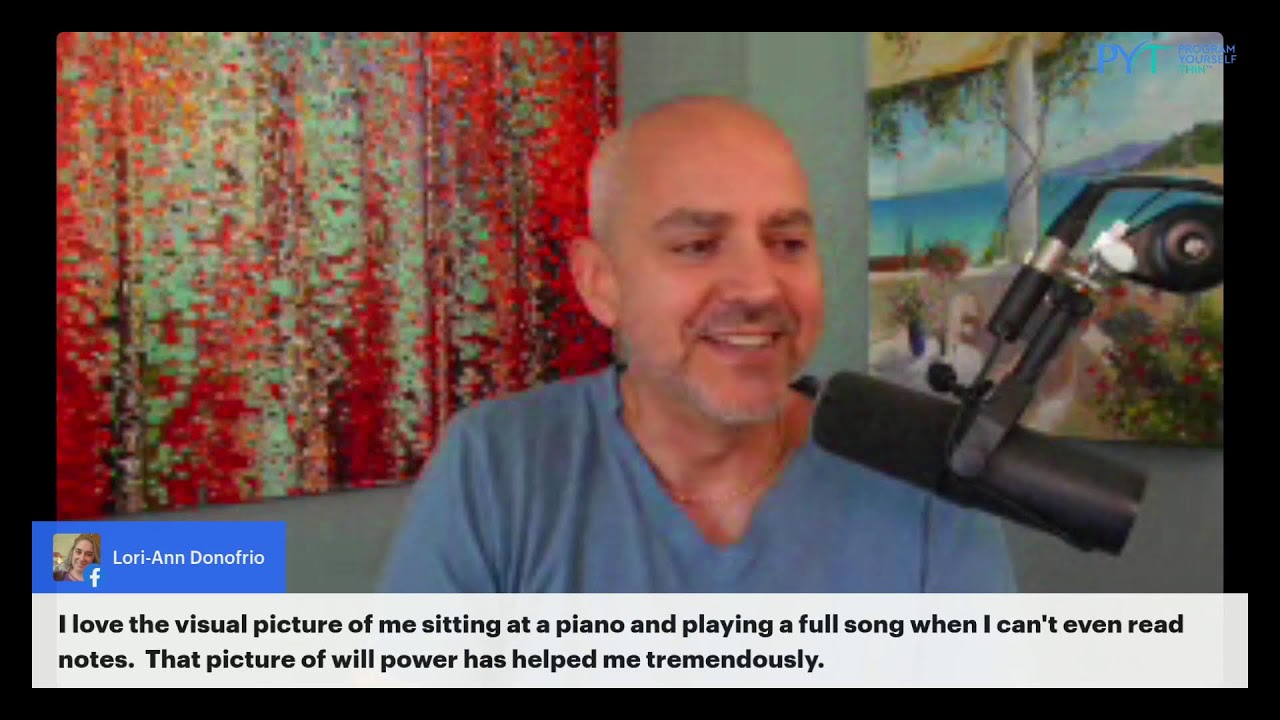
In this live podcast, Jim Katsoulis presents a philosophy for sustainable weight loss centered on making the process easy to win. He argues that most people set themselves up for failure by attempting massive, overwhelming changes—intense workouts, drastic diet overhauls, and strict calorie counting—leading to learned helplessness and a sabotage mindset. Instead, he advocates starting with tiny, manageable actions (e.g., a daily apple, a short walk, a bottle of water) that build consistent success, shift mindset, and create lasting habits. He introduces the "Goal Weight Pyramid" (mindset, lifestyle, eating) and a flexible plan system (Plan A‑E) that allows for daily adjustments based on energy, mood, or health. He explains calorie density as a practical nutrition tool, recommends balancing "clean" and "pleasure" days, and debunks the myth that willpower alone can sustain weight loss, using a marathon vs. sprint analogy. Throughout, he emphasizes mindset reframing—moving away from the idea of "self‑sabotage" toward learning how to live thin—and offers free hypnosis sessions, daily coaching emails, and community resources to support long‑term change. The session also includes numerous participant questions and real‑world examples illustrating the principles.
Chapters
Oh, come on. Everyone, welcome to today's Program Yourself Thin podcast. Today we're talking about making it easy to win. This is a philosophy that I believe is going to serve you very well if you start to follow it, because What you have been doing with your weight is you've been making it really hard to win. You kind of expect too much out of yourself. You take on too much too soon. You overwhelm yourself and you feel and almost expect at this point that you're going to lose. So shifting that entire paradigm around is so impactful, not just because of the benefits you get out of what you're doing, But mindset-wise, it is a game changer because you start to realize that most likely if you've been trying to lose weight for decades, you got a negative mindset. There's a concept called learned helplessness, right? If you've tried to lose weight many, many, many times and it's failed, it's natural to create the belief that I can't do this, I can't succeed. But if we zoom out a little bit more and reflect on how you've actually tried to, to win the weight game, you really have overwhelmed yourself every single time. I mean that. It's like every single time, every single way. Let me give you an example. Let's say you want to start working out more, exercising more. Okay, if you've ever thought that, most likely like, okay, I got to start going to the gym, I got to do an exercise routine, I got to do 30 minutes on the treadmill, I I have to work out with a fitness trainer. I've got to do this intense class. It's almost always something intense. It's not, I'm going to start doing push-ups for 3 minutes. I'm going to do some bodyweight squats. I'm going to, you know, go for a walk around the block. It's never something easy. It's always something really hard. And then you look at the actual change of eating that you expect, right? Every single plan you've ever done, every single plan, you've started off the same way. You start off by changing your eating 100%. I'm going to track every calorie. I'm going to never eat a carb again. I'm going to, you know, manage, track every single point and stop eating, you know, junk food completely. No more ice cream. And it's like, holy shit, this is a lot to take on all at once. And so again, this is what I mean. You're setting yourself up for failure. You're making it hard to win. So making it easy to win is so simple, but the biggest thing you're gonna have to fight against is this voice in your head that says, ah, what's that gonna do? What's that gonna do? What's a walk around the block gonna do? We got so much weight to lose, that's not gonna help. And that's what you're saying to yourself. Oh, you start eating an apple every day? Well, what's an apple gonna do? I've got so much weight too, it's never gonna help. You have to deal with that voice. I don't know how you're gonna do it, but you got to deal with that voice. Oh, there's a number of ways to do it. Depends on the person. Um, but when you start to build around simple, small, easy things to change, what happens again, not only do you start doing more good things consistently and there's that benefit, but again, it's that mindset benefit of actually feeling like, oh, I could eat an apple. Yeah, I could start eating an apple Monday through Friday in the afternoon. I could do that. It's not too hard. I could drink a bottle of water, you know, a day. I could do that. I could go for a walk around the block. I could do that. And what happens is your mind starts thinking, this isn't that hard. It feels good. I'm glad I did it, right? You know, it's not changing everything. It's not the fastest way to lose weight, but it's something. And what starts to really change is in your mind, you're like, wow, I could do this for a long time. That's the secret. That is the secret, because you have never thought that with your weight loss. You have never, ever with your weight loss, even if you've been successful with it, you've never thought, oh yeah, I can do this forever. Oh yeah, I got this. I could keep this up. You've never thought that because every time you've tried to lose weight, it's this Herculean effort that you have to constantly be focused and motivated and disciplined, and it's hard to stay that way. So when we dial it back and make it simple again, this is in another way. If you're familiar with Program Yourself Then, you're familiar with the all or something philosophy. Okay. So yeah, we can go all in, right? We can go all in and do everything perfect. Sure. I'm not taking that away from you, but we want to also have a something plan, a plan for when you're feeling tired or sore or sick or depressed or angry or whatever. We want to have a plan A and a plan B. And honestly, you want to plan C, D, and E probably. Okay. But the idea is that you focus on the baseline and at least have something you're consistently doing. Make it easy to win. Don't worry about 12 glasses of water a day. If you don't drink any, let's just get one. Let's make it simple. Don't worry about walking 10,000 steps a day if you usually walk 1,000 steps a day. Let's just get up to 2,000. Okay. And make it easy for you to win because then you start to feel a deeper sense of motivation that comes from the belief, holy shit, I could do this. Because every time you try and change your weight or try and become healthier, no matter what you've done, that little belief underneath you is, oh my God, how long can I keep this up for, right? It feels— it's hard, it's difficult, you avoid it, you don't want to do it, you feel negative about it, you don't believe you can keep it up. That is not a mindset foundation to build on top of. It's not solid. When all of a sudden you start to have a stack of things like, oh, that's not that hard, I can do that, I could keep this up, all right, this actually feels pretty good, it's not even hard to do, That's a whole different mindset. And I know again that when you do small things, you think in your mind, oh, this is going to be slower results. It's not, because slow's a relative term. And so you could go all in and do everything perfect for 3 months and lose 30 pounds and then put it all back on. You've done that before, I imagine. But when you start to lose 30 pounds over a year in a way that seems really easy and sustainable then you'll start to appreciate that this approach is a lot better. So I hope this makes some sense to you. If you want to go deeper into this way of thinking, click the link in my bio or go to programyourselfthin.com and go get the free hypnosis session that I made for you. It's there, it's waiting for you, uh, to be listened to. And as someone told me yesterday, a longtime client, they went back and re-listened to it and, uh, they said, they said it was an absolute game changer because they were gonna go shopping. They said, before I go, I'm gonna listen to this session, and she said it completely changed the shopping she did at the grocery store. So again, completely free session there waiting for you, and I give you a lot of other stuff as well. So go check that out. Uh, if you're over in Facebook or YouTube, you can click the link I just put in the chat window and go check that out. If y'all have any questions, feel free to ask them on this hot Thursday day. Hello, Lisa Spencer Doodle. I like that, Spencer Doodle. It's like the dog, right? What's the dog called? A golden doodle. My brother's got one of those. Uh, what's up, Digital Encore? Says, so big mobility challenged, I had to train myself to think I'm a badass for even 50 extra steps. Yeah, that's what I mean though. We'll all start from our own spot that we're, we're in, you know what I mean? That's why, like, again, you can be motivated and inspired by a plan that you see, but then please adjust it to your situation. You know, if you're mobility challenged, my God, you know what I mean? Like, don't jump into some of these real big challenges. And I know, listen, the appeal of the giant challenge that's really hard is kind of obvious, right? It's that if I do this crazy thing, I'm gonna get a really fast, dramatic result. But you, you gotta sidestep that. I know, I know it feels exciting, but it's fool's gold. It's not— it doesn't last. You know, we can't just build around that inspired motivation that if I do all this really hard shit, I'll lose weight by next week, you know, and you got to kind of take a step back, relax, ground yourself, and plan for the long-term success. And I think the long-term success almost always starts by adjusting what you expect out of yourself based on your current situation. And if you're mobility challenged, again, adjust your goal to that situation. And yeah, 50 extra steps might feel like a lot. Again, there's no judgment. Everyone's in their own unique position. Don't compare yourself to other people. Compare yourself to you. Aim to get 1% better every day. And I think that's the path forward. All right. That's what I think. So nice job, Digital, though. That's smart. That's a smart approach. Um, so Watch Me Become Her says, hello, I'm ready to program myself. All right, nice. I think that's a smart move. I think programming yourself is the only real path forward, um, you know, to really changing your weight long term. That's what I think. In history. But yeah, if y'all have any questions, feel free to ask them. What's up, Susan? Susan says, I'm finding that watermelon is my friend when I'm losing weight. I feel full and my hunger goes down. Um, yeah, of course. I mean, that makes a lot of sense because if you understand the concept of calorie density It's about the amount of calories in a volume of food because it's not just calories that satisfy your hunger. There's a number of things that satisfy your hunger. And one of the big ones is volume of food. It's estimated that we eat a similar volume of food every day. We kind of have some internal mechanisms measuring the volume of food we eat. So one of the easiest ways to lose weight while not feeling hungry— and again, they're synonymous in my mind. I don't think you can be really hungry and lose weight long term. You can certainly fight against your hunger and lose some weight. I'm not arguing that. I'm talking long term. Very difficult to fight your hunger long term. Okay. And when— so in my world, right, Program Yourself Thin, we want to manage our hunger. And one of the easiest ways to manage your hunger is understanding calorie density, to eat a lot of volume of food with a little bitty bit of calories. And what was it like, Aladdin? That made me think of Aladdin. You ever seen Aladdin with Robin Williams? What do you say? Big giant genie and tiny little living space. That's what you want, though. You want big food, little calories. And watermelon is at the top of that list, right? Takes up a lot of volume. It's hardly calories. It's mostly water, right? Fiber, micronutrients. So I think that, um, that makes a lot of sense. And, you know, you can follow that path. Fruits, vegetables, whole grains. Uh, these are very solid choices. Because they can take up a lot of space and have a lot— very little calories. And again, think about, you know, a big cookie versus an apple, right? They might have a similar volume, but the cookie has, you know, 4 to 5 times the calories in it of the apple. So again, that's a great strategy, and I'm glad you found that out, Susan. And for those of you who haven't figured that out yet, test it out, right? Eat some watermelon. You go to a Fourth of July party— I will use this strategy this, this week. Um, you go to a Fourth of July party, go eat a bunch of watermelon. You can still have chips, burgers, potato salad, all the bullshit, but fill yourself up with watermelon. It's gonna help you consume less calories, I promise you. Comfortably, naturally, automatically. They did a— they did a study where they took two groups of people. In one group, they gave them a very specific diet, and they trained them, and they had coaching. Um, so they were well supported. The other group, they said Eat whole natural foods. That was it. And you know what happened? The whole natural food group, um, on average consumed 500 calories less a day naturally without tracking, without counting, without anything, because whole natural foods usually are less calorie dense and they satisfy you in ways that processed foods don't. So again, I mean, one of the simplest decisions you can make in terms of managing your weight is to start consuming more whole natural foods. So there really is a reason why you feel that way, Susan. So thanks for sharing that. I hope other people are inspired by that. Uh, Susan says, how long does it take to make this mindset a habit? Um, forever. You know what I mean? Like, I, I say that because how long does something take to turn into a habit? You know, I used to believe what everyone— you know, I think we all kind of have heard the same stuff. Well, at first I heard 28 days. You know, and then I heard 90 days and, uh, bullshit. I've done this long enough. I've done this professionally for over 20 years and I'll tell you what, and I've been doing this myself for over 30 years. A habit takes as long as it takes to become a habit and each thing is different. So my water habit took me a long time, like, like years. It felt like I still have to work on it. My meditation habit. Well, it took a long time too. Now it's, it's very solid, solidified, and I don't have to really think about it. Just runs automatically. Um, so some things, some habits form quickly, some habits form slowly. And I think that's the most honest answer because I think as soon as you set some, cause I did that, I remember for a while I would do something and I would do it for 28 days. And then I, and then I would expect, oh, I got it. No, I did not got it. 28 days is way too low. I know that for sure. But, um, and, and I, it reminds me, Tony Robbins just always, he said one of my favorite things. He used to say like, how long would you give your kid to learn how to walk? Right? You got a kid and they're learning how to walk. How long would you let them try and learn how to walk before you said, that's it, no more. You're never going to, you just, you're not getting it. Forget it. You're done. You're cut off. Right. And it's a funny question because you'd never, you don't even think that, right? When it comes to your kid, there is no end point where you say, ah, that's it. Oh my God. Yeah. You had a week. It's been 2 weeks. You're done. You're never going to get this. So, so again, what I'm speaking to is this mindset. Of saying, okay, I got this long to set a habit in. Because what happens if it doesn't happen in that period of time? Oh, there must be something wrong with me. That's what I used to think. Oh my God, I did it for 30 days and then it just disappeared. Oh my God, what's wrong with you, Jim? What's going on with you? Nothing's wrong with you. That's a bullshit thing. That's a bullshit thing. I promise you. Some people, again, some habits, different things, some things, habits forms quick, some things, habits form slow. And I will tell you the mindset of thinking like a thin, healthy, happy person. Is a forever process. So I want you to know that because we don't live in a vacuum, folks. We're not living in a vacuum. So it's not like you create this mindset. Now you can just be this person. You are constantly being conditioned and influenced and hypnotized by commercials, by the culture, by the food that you're surrounded by, by the environment. So you can't, you know, you do it. I think of this work, Program Yourself In specifically, I think of it kind of like a garden. And, you know, when you think about a garden, a lot of that work's front-loaded, right? Meaning that if you're going to take, you know, a plot of land to get a garden ready, a lot of the real heavy work is in the beginning. You got to fix the soil, you know, get it set up, hide, you know, irrigation and all that stuff, plant the seeds, all the rest of it. But then it starts to go into maintenance mode, right? And so you still have to engage, pull weeds, you know, engage with it. But the effort goes way down. From the beginning part. And I think of this process being very similar, that there's certainly an initial, you know, again, we go through the Goal Weight Blueprint, you know, you learn how to program your mind, you listen to hypnosis sessions, um, you, you do all this stuff, but then you get to a place where it's more maintenance-based and you're coasting more. Um, you're not creating a lot of this stuff, you're kind of maintaining it, and that's an easier process. But you're going to do it forever because until we live in a culture and an environment that really nurtures our health and our happiness, you've got to take this on yourself and have to, to some degree, have something supporting it. You know, uh, Watch Me says, I have a lot to lose, so I have always lost motivation super quickly. Well, yeah, again, I mean, most people, um, yeah, that's, that's, that's most people, right? And so Watch Me continues and says, I'm currently at 450, 454 pounds and have started an account to keep myself accountable. And visually see like a public diary of how I'm doing. I'm hoping this will motivate me more and more. Um, let's talk about that because no, it won't. I hate to tell you, it's not— it's a, it's a decent strategy. It's better than maybe what you've done in the past, but you're putting a Band-Aid on a gunshot wound here. Having an account to motivate yourself, if you're not doing the right things, it's still not going to work. Okay. And where you do have a big journey ahead of you, I think focusing on the weight only is a huge mistake, because if you only focus on the number and the weight, it's gonna feel really long and you're gonna lose motivation, right? And this happens to everyone. Again, you've got a longer path than some people, um, but it's really— I, I know you don't get upset with me because I, I work with all sizes of people, okay? And I'm telling you whether it's 300 pounds you want to lose or whether it's 100 pounds or 50 pounds, it feels very similar to all the same people. Life is a relative thing. And so whether you want to lose 50 pounds, 100 pounds, 300 pounds, it all to that— to each person, it feels really far away. Okay. And so this is a core motivation issue we've got to deal with when it comes to weight, because when it comes to weight loss, we've all been conditioned by the diets. And the diets really only focus on the weight. So the only thing you're measuring is when you stand on the scale and you see what the number on there says. That's the only thing you're measuring. Maybe you're going to measure inches or you're going to do tape measure stuff. That's it. That's what people measure when it comes to weight loss. Now you say, well, no shit, Jim, what are you going to do with the weight, scale weight and okay, size weight? Fine. What else would you measure? Well, what else you'd measure— grab my goal weight blueprint here so we can see this, because this I think is the secret to motivation. It's the beginning of it anyways, is that I think you need to, you need to focus on more than just the weight if you're going to get through this process to where you want to be. Okay. And so in Program Yourself Then, we follow the goal weight pyramid: mindset, lifestyle, eating. Okay, and obviously there's subcategories here, but these are the big things we focus on. And so what this does is it's kind of like, let's, let's— you don't even have to know about any sport, but I'm going to pick basketball. Okay, um, basketball. You might say, okay, I want to play basketball and I want to win. I want to win the game. I want to score the most points, right? And if you focus on that, so yeah, no shit, of course that's the point of basketball. When you play, you want to win, you want the most points. Okay, great. But in order to be the person who's able to score the most points and win most the time, you're also going to have to go backwards and break down your game into smaller categories. Okay, we can't just focus on games. There's no good basketball player— and you can put any athlete in here— there's no good basketball player that just focuses on winning the game, that just goes to the games, it just does that. They all practice. And what do you do in practice? You break it down. Kobe Bryant is really good with this because he, he's really— he to me is the epitome of this mindset where every time he played basketball is always a focus on him. He was always playing himself, he said, first in practice, in games. He was always trying to do better than he did yesterday. And so when he would practice, he would break down basketball into categories: dribbling, shooting, passing, defense, um, you know, all the different— he'd break it all down, break that down, break that down. And so he's living in this matrix of all these different categories that he's focusing on and improving on. That's his day-to-day reality that allows him to show up to a game and dominate. But what he's really living in moment to moment, his actual reality is not the game, it's all these little micro things he's paying attention to. So in Program Yourself Then, We're paying attention to all of these things. We're not just paying attention to eating and weight because there's not enough motivation there. So what I would suggest is that you start to focus on why you want to lose the weight in the first place. What emotions do you want to feel? What do you want to feel at your goal weight that you think you don't feel now? Well, you might say confidence, mobility, Happiness, optimism, whatever. So let's just stick with mobility. Okay, let's focus on mobility too, because let's think about your mobility now and how it can improve over the next month. You see what I'm saying? So you're still focusing on your weight. Please understand, we're always focusing on the weight piece too. We're just adding more to it. So now maybe you're focusing on, oh, my hydration's a little off. Let me start drinking some more water. You're tracking that and getting better at it. Your mobility, you're going, you know, 100 more steps than you did yesterday. Great. I feel great. You know, I'm tracking that too. My sleep. I'm getting better with my sleep. My dinner eating is better. So we're tracking lots of little things that are going to lead to the ultimate goal we want to achieve. But by focusing on the little things, we start to engage with little things that give us good feelings. So it's not just the scale that lets us know if we're succeeding or not. It's, oh yeah, my water has gotten better. Oh yeah, my sleeping's gotten better. Oh yeah, my mindset's getting better. My motivation's better. My emotional management's better. This is better. This is better. This is better. This is better. This is better. That's how you maintain the motivation to get to that final weight that you want to be at. But what most people do is just look at the scale. What's my weight doing? What's my weight doing? You know, I've had this conversation literally hundreds of times with people that have successfully been losing weight. And they will hit a plateau and they'll say, geez, I don't— I know I'm not losing any weight. I say, okay, I get it, I get it, but what else is better now than where you started? And when I— when they finally get back in, so, well, you know, I, I feel better, I'm sleeping better, I have more energy, I'm happier with myself, I'm moving more, I'm eating healthier, um, my stomach feels better. There's all these benefits, but a lot of times dieters just ignore those because they're always so fixated in on the weight piece alone. The weight piece just ain't enough. If it was, you all wouldn't have weight issues. So again, by the way, watch me— the— that's why in Program Yourself Thin, we start with mindset, really. And the very first thing we do is focus on motivation, because most people don't know how to motivate themselves. So that's a skill in and of itself. I think you're right to ask that question, you know. So again, the public diary is a good idea, but let that public diary reflect more than just what your weight is. Okay, let it reflect your mindset shifts and changes that happen along the way, the improvements that happen along the way, the lifestyle shifts that happen along the way, the small eating changes that you start to improve along the way. Appreciate the small pieces too, in addition to just what the weight does. And I think that'll train you to start to notice these things we're talking about. And I think they're going to set you up to go in the direction you want with your weight way more effectively. Light. So I hope that helps you out. Uh, what's up, Carolyn? Carolyn says, wow, your video is a very bit blurry and distorted on my end. Anyone else here? Oh, it looks clear to me, but that does happen sometime. Uh, what's up, Kevin from Lakeland? Sanjita, what's up? How's it going? Sanjita says, I have lost 8 kilos. Got your hard copy of the book and enjoy reading it. Thank you, thank you, thank you. All right, nice job, Sanjita. Proud of you. 8 kilos. All right, all right, nice. That's really good. Yeah, Watch Me says that's what I intend. Very good, Watch Me. And I definitely recommend, um, let me put this— I'll put— I see you're on Instagram, so let me put this link in the chat window. But go get that, go to that link, Watch Me, and get the hypnosis session I made. It's free. Um, I got a new training that's going to come out, uh, probably out next week. It's called Reprogrammed, uh, how to live at your goal weight without the fight. I'm really excited about you all seeing that. It's really good. Um, so I can't wait for you to get that. But once you, when you go sign up for that hypnosis session, if you're on TikTok, you can click my bio picture. If you're on Facebook or YouTube, you can click the link I put in the chat window. Um, but you can go there and get the hypnosis session. But once you get that, you're on my email list and I have all sorts of free stuff for you. Uh, and that's going to be something I'll be working on next month is really optimizing all of my free stuff. So it's just, it's all more organized, but I have a lot of free stuff I give you. I give you a goal weight quiz. I have PYT Daily where I email you coaching stuff every day if you want it. Um, the hypnosis session, reprogrammed, uh, and beyond. I, I, I randomly give even more stuff away, but go check that out, you know, it's all there to help you. Sanjita says, just a question, after being at my goal weight, how often should one indulge in a pleasure meal? Uh, me personally, I mean, that, that's, that's not a question I can answer because it's a question you want to answer, and it's a, it's a balancing question. Okay, so in Program Yourself, then we have clean and pleasure days. All right. And we balance them, meaning, you know, depending on how much pleasure days we want to have, we can clean up our clean days, you know. So for me personally, I usually have about 5, 4.5, 5 clean days and then my pleasure days on the weekend. So please understand, pleasure days are not binge days. They're not cheat days. They're just days where I'm more focused on enjoying the fun side of food than the fuel side of food. And so I've balanced these all out, you know, and that's part of what we do in Program Yourself Thin is figure out how to balance the pleasure and the, the, the fuel and the fun of the food in a way that feels best for us and gives us the weight we want to be at. So it's not a simple answer in a sense with that, but I certainly would have pleasure meals at least once a week. I think anything beyond once a week is unnecessary. And I think it's got a good chance of demotivating you. I think when you remove pleasure meals and foods from your life, your quality of life tends to go down. Now, again, I think a lot of people have to moderate it, you know, so I think dialing them down is a smart move that's going to increase the quality of your life. But I think dialing them down to zero is going to decrease the quality of your life. So I'm a big fan in finding the balance, you know, how much pleasure food can I eat and maintain my goal weight? And again, it's, it's figuring that balance out, and it's something that takes a little bit experimentation, paying attention, and noticing where you land with it. What's up, Amy? How's it going? Uh, Patricia says, focused on mobility today and extra 45 minutes in pool, then walked home proud of myself on the scale. 49.5 pounds gone. Thanks for all your advice. Yeah, you're welcome, Patricia. Great job. Nice. Yeah, that's again focusing on mobility too. That's That's something I'm going to be— I think I'm gonna do a couple lessons on that, um, coming up. I am a yoga instructor and I, and I, I've kind of stepped away from that a bit and I find myself kind of going back into it, uh, personally first. And then I'm starting to feel a desire to want to teach more yoga and movement and mobility. Uh, so I'm excited to get some of that stuff out, uh, as well. Uh, that'll probably be more of a fall thing, but, uh, that's something kind of on the docket. Um, and I did— I don't know if you're listening, Jody, but, um, you mentioned about looking for that podcast interview I did. I found it and I'll post it in the Circle app. So if you're in the program, uh, keep an eye on the Circle app. You'll get a reminder when I post it. But, uh, I'll post the podcast I did. Um, I think it's pretty interesting. And, uh, I think that, you know, it's, um, it's just an opportunity to hear, you know, some of this content in a different context. Okay, but that'll be posted as well. It was Melissa McAllister. I was just blanking on the name yesterday, but, uh, yeah, Melissa McAllister, because her podcast is called Made by Fitz. That's why it's not her name. That's why I couldn't remember the podcast. But anyways, there it is. Um, yeah, okay, Jody, how's it going? Yeah, so that'll be on there. I'll post that today. I just was about to post it, and, um, yeah, I'll put that up there. Uh, and there's a YouTube version, and I don't know, I'm sure it's on podcast as well, but I, I didn't go look for that, so so you can all listen to whatever format you want. But yeah, if anyone else got any questions, feel free to ask them. Uh, Karen says, yeah, that was epic information for him. Which one? Um, oh, Ash Blondie, great question. What are your thoughts on self-sabotage? Um, you know, honestly, my belief is that self-sabotage is the wrong word. I don't think you're sabotaging yourself. I don't think most of you know how to live at your goal weight in a natural, comfortable way. And so I use this example a lot that, you know, if you've never played the piano and I sit you there and tell you to play me a song and you go, no, I don't know how to play a song, I said, no, yes, you're just sabotaging yourself, right? That'd be weird. It wouldn't make sense. It's not that they're sabotaging themselves if they don't know how to play the piano. I don't believe you all know how to live at your goal weight. I think knowing how to fight against yourself for a little while and follow a diet is not knowing how to live at your goal weight. So I think the idea that when you, when you all ask me the question like, I'm doing so good on my diet and then I self-sabotage, let's take a step back and look at that from a slightly different angle. Let's just take keto, for example, the most extreme, goofiest shit that's out there, basically. But the idea that you're going to completely cut carbs out, okay? And so you can do it for 2 weeks. So let's say, let's play the whole scenario out. You See a picture of yourself. You step on the scale. You see a video of yourself. You, you go to the doctor. Someone says something shitty to you. You get real upset about your weight and really upset. And that's it. That's it. I'm going to change this. And you dive into whatever strict plan you're going to do. Let's just do keto just to make it real obvious. So you dive in your keto plan. It's Monday. That's it. No more carbs. And you're able to do no more carbs for 13 days, right? Start Monday, you white-knuckle through the first week. Okay, got through the weekend. Okay, 4 more days, you white-knuckle it. Friday comes around the second time, you're like, oh my God, I can't keep it up. Is that self-sabotage or is that a shitty strategy that requires way too much effort to really succeed with consistently? So I don't think it's self-sabotage. It would be sabotage if you knew how to live at your goal weight easily and comfortably. Then I might believe that it was sabotage. But I think it's much more accurate to say that you have no idea how to think like a thin, healthy person, how to live like a thin, healthy person, and how to eat like a thin, healthy person. And you have no idea how to run your own brain. And so without having that knowledge and information, I think sabotage is the wrong word. So that's my frame on that. And, uh, take it or leave it. Some people like that, some people don't, and that's just how it goes. But that's what I think. But hit me with whatever you think you think from that, you know, because if you think that's not true, um, I'm happy to discuss it more. But, but that's kind of my thoughts on it. Um, Carlos says, yes, you have to be careful how you talk to yourself so you don't sabotage. Uh, yeah, absolutely. But again, sabotage, I think, is just when you run out of willpower. So, you know what I mean? Okay, let me put it in a different context. It would be like, um, me saying— because I— okay, so dieting, dieting, uh, mindset-wise I always think it's like a sprint, right? When you think about races, a sprint is, you know, this fast burst of energy, and you need perfection to win a sprint, right? It's short and focused, and you need to be perfect to win it. You trip a little bit out the gate, you lost the race, okay? And so, um, it's important that you realize that your weight's not a sprint. It's a marathon, a never-ending marathon. And so if you went into a marathon and you said, oh, you know, I'm going to win this, I'm going to run it like a sprinter, right? Look at all these people are pacing themselves. Forget that. I'm just going to sprint it out. And so you sprint it out and for the first, you know, I don't know, mile, you're way ahead everyone. Oh my God, look at this. Like, this is really working. But then eventually you just totally run out of gas and then you just fade. So is the answer in that situation to say, come on, next time I'm going to sprint it the whole way. Next time I'm going to sprint it the whole way. Is that the answer? Or is the answer to have a better strategy? You know, and I think that pretty much sums it up in a nutshell. So again, I don't think it's sabotage because what you, what you're defining as sabotage is you saying basically I'm going to be able to sprint the whole marathon. This idea that you're going to be able to drastically change things in such a fundamental way. Um, is going to— you're going to be able to keep it up. So, so again, I don't know. I just don't find it to be sabotage. I, I just think that's the wrong— sabotaging intentionally, you're— see, because sabotage— let's find out. Let's just go into this a little bit deeper because I get this question all the time. Let's look at the specific definition of sabotage. The deliberate and intentional destruction, um, The intentional and deliberate and intentional destruction. Intentional and deliberate. Are you all deliberately and intentionally not wanting to? Well, yeah, because I ate the food. I could have said no. That's not true. You run out of steam, you know. So I would say that it's not intentional. I don't think you're intentionally and deliberately sabotaging your weight loss, folks. I know you think you are. I know it because you think your willpower should just last forever, you know. But again, that's like me putting you in a marathon and say, okay, sprint this whole thing. All right, yeah, yeah, I'm gonna sprint the whole thing. No one's ever thought of that. If I just sprint the whole thing, I'm gonna win, no problem. Yeah, but you can't sprint the whole thing. You're gonna run out of steam. Why do you think you won't run out of steam with your willpower? That's what I don't understand. Well, I do understand it because people think of willpower as like some non-physical thing. Your willpower is a physical thing. Your willpower is like a muscle. Your willpower starts strong in the morning, it depletes throughout the day. They've tested this. This isn't, this isn't a mystery. So if you're going to build your success around willpower, you're fucked. You're not going to win. If you're going to build your weight loss around willpower, that's like building your marathon strategy around sprinting. So Watch Me says yoga brings back a traumatic memory. All that twisting and turning at my current size is comical even for me. And there were far too many boobs meat eyeball situations. That's funny. Fair enough, fair enough. But again, here what I— here's what I mean. Watch me, please hear what I'm saying. You don't, you don't have to— I literally just had a conversation about this. So funny. I literally just had a conversation about this, um, that I was, I was working with a client and she was talking about how she was kind of struggling to get herself to do her exercise routine. And I said, listen, you've got one exercise routine And there's going to be times you don't want to do it. So acknowledge that, accept that, and come up with a plan B, C, and D. And so for you, Watch Me, no yoga class. I don't like yoga classes. So stop with the yoga class because you keep trying to— you define doing yoga as going to a yoga class and you don't want to go to yoga class, so you don't do yoga. All right. Well, I got good news for you. Yoga can be standing in your bathroom while you're brushing your teeth. And going like this. Oh, that can be yoga, right? Any extra, any improvement, any increase in movement that you do compared to what you normally do is yoga. All right. So again, what I was saying, watch me at the beginning here, is make it easy to win. Thinking that the only yoga— yoga is going to a yoga class. That's making it hard to win. Okay, get rid of the yoga class and start doing small little movements that make you feel better at home, that are easy, that are comfortable, that are simple, that you can start doing consistently. That starts to become a foundation you can build on. I have this conversation with so many of my clients. It's the big trap that a lot of people fall into because they only value doing big things. But the real, the real benefits, the real outcomes you're looking for come from doing small things consistently. Way. Um, Sanjita says, living at my goal weight of 57 kilos at 5'2", loving it. It's the new version of me, Jim Katsoulis, Sanjita 2.0 now. Nice job, Sanjita! Proud of you, proud of you. That's great. Uh, and says, is it practical to count calories? Uh, I don't think it's practical, but again, it's everyone's choice. You know, like if you're an accounting, actuary sort of brain type of person, maybe you love tracking calories. Most people I've worked with do not love tracking calories. And, um, you know, I think tracking calories is good as a calibration tool just to kind of get a sense of the calorie load of what you're eating typically, but tracking calories every single day for the rest of your life seems like like, you know, torture. So I wouldn't build it around that. All right, watch me says, oh, I stopped. All right, could have given myself and others black eyes if I'd stayed. Yeah, but again, you know, like, like, that's the thing, watch me. Like, again, I get it. And, uh, but I'm gonna push back, see, because again, I'm gonna— I, I— this is what I do all day. I've done over 6,000 private weight loss sessions. Be careful of the self-deprecating stuff. Okay, it— I get it. Like, like, you— it's— I get that, but don't just be like, I did yoga and I make jokes about how it's not for me, class, it doesn't work for me. Look for ways you can do some yoga regularly in your life. Dial it way back, because I'm telling you, if you do a minute or two of yoga exercises every day for the next 2 weeks, you will feel fundamentally better in ways that you can't even imagine. Okay, so put your headspace into that. Don't just shut the door on yoga, um, because the classes weren't, weren't the right fit for you. What's up, Vicki? How's it going? Uh, Jackie says, I think we think that it's self-sabotage because in the moment while we're eating the junk or overdoing it with the sweets, we know we shouldn't but we can't help ourselves and we still keep eating it anyway. And then we're angry with ourselves afterwards because we knew that we shouldn't have done that but still did it. Yeah, yeah, no, I totally get that, Jackie, but I think it's the wrong framing because what you're talking about, Jackie, is that all of you get to a place where you give in to the craving. Okay. And you look at that and you say, goddamn you, you should have said no. But I zoom it backwards and I said, well, what, who were you in that situation? Were you nourished? Was your hunger manageable? Were you emotionally balanced? Were you calm and grounded? Were you thinking in the right ways? Were you? Usually not. Usually not. And so what you all are doing, you dieters way over-rely on willpower. It's like a marathoner over-relying on sprinter. There's a limit you get to where it's not going to be there for you. You all see, Jack, even what you're saying embedded in your comment there is the idea that willpower should always be there for me to tap into. And if there's no willpower to tap into, it's a personal failing. But again, folks, if you sprint in a marathon, at some point your muscles are going to deplete and there's going to be no— nothing there to keep going with. It's the same with your willpower. So someone who says, I'm going to sprint the whole marathon, and then they sprint for a little while and pass out, is that a personal failing? They should have kept sprinting? Or is it a bad strategy that put them in a situation where their body gave out because they used up too much gas too quick? Why is it any different? And I know dieters beat themselves up. It's not your fault. The diet industry is conditioned to think that it's all just a willpower thing. Look, Susie next door, she stuck to her keto plan. You should too. You know what? Fuck Susie next door. I'm not Susie. Let me figure out a way that works for me that's not so reliant on willpower. I'm not relying on— I use willpower, obviously. I don't want to sit here and say I don't use any willpower. Of course I use some willpower, but I use this much of it. Dieters are using this much of it and you're burning through it and there's none left. You burn through it, folks. What the fuck do you all think willpower is? Okay, go get the book. Roy Baumeister wrote the book on willpower. If you're a dieter, please go read that fucking book because what do you think? What do you think willpower is? What do you think it is? You think it should just always be there for you to tap into? It's always the same. You should always be able to have it and use it and choose the right food. That's what you think. You in big trouble. You're in big, big trouble because your willpower is like a muscle and it gets depleted and it's not there for you to use. That's when you're making the bad decisions, amongst other reasons too. You're not being strategic. You're overrelying on willpower. The willpower always depletes and then you can't manage your behaviors. Tell me that's not 100% what happens to you every time you try and lose weight. And so is that a personal failure? Is that sabotage? It might be sabotage if you hear about these strategies and you continue to use the strategy of depriving yourself and expecting you're gonna be able to make right decisions while you're really hungry and depleted and exhausted. Then maybe it's sabotage. But sabotage can only exist when you have the opportunity and the knowledge of how to succeed. You all don't. If you knew how to live at your goal weight comfortably and enjoyably, wouldn't you do it? Wouldn't you do it? I do. I choose to do it because it feels awesome. I don't think you know how to do that, so how can it be sabotage? Yeah, yep. Carlos says, make it easy to win. So true. Yes, yes, yeah. Sally says, don't buy it. Maybe I get it, I get it. It's a, it's a different take on things, you know what I mean? So again, I get the sabotage thing is, is firmly entrenched in that diet world, right? Because again, you've got free will. You can just choose what you're going to eat. You chose the wrong thing. You sabotaged yourself. But again, when I put it in the context, well, you're running a marathon. You've got the option to sprint the whole way. So when you stop sprinting, it's sabotage. Keep sprinting. Keep on sprinting. Why can't they keep sprinting? Why? Why? Because they run out of— right, the muscles stop, right? Right, the muscles get depleted. Why do you think willpower doesn't get depleted? Anyone, please tell me why willpower doesn't deplete. Please tell me what willpower is and how it never depletes. Please let me know. What do you think willpower is? What do you think it is? Do you think if you were committed enough, you should be able to sprint the whole marathon? Do you think if you were motivated enough you'd be able to sprint the whole marathon? I think it's bad strategy. Yeah. All right, Carla says sabotage is the wrong word. All right, right. And again, I harp on this because if we believe it's sabotage, we're in the wrong mindset, right? If we believe it's sabotage, we believe we know what to do, we just haven't gotten ourselves to do it. Folks, I don't think if you're not— if you're overweight, it's because you don't know how to be thin and healthy in a way that works for you. I mean, it's, it's kind of obvious when I say it that way, but it's also clarifying because it ain't sabotage. Not in my world. What's up? What's up, Christina? Made me laugh so much that I stopped riding my bike to type the thank you for the laugh. Well, you're welcome. I know I do. I get so mad about this. But again, I'm not mad, mad at all of you. I'm just mad at the diet industry so much because they've done this intentionally. The diet industry is not your friend. It's built to fail. Diet industry is owned by the food industry. Weight Watchers, owned by Heinz. Jenny Craig is owned by Nestlé. Uh, Atkins Food Products was owned by the same company owns Onions, Pretzels, and Cinnabon. SlimFast, owned by the same company owns Ben Jerry's ice cream. Um, these diets are not built for you to succeed. They're psychological operations to make you fail and then blame yourself the whole while. So The sabotage thing is not— is really me being supremely angry with the diet industry. So anyways, Sally says, I only shop for what I can have, otherwise you'll eat bad. True, true. Agreed, agreed. I agree. And that's an upstream solution, right? When you get better at shopping and grocery shopping, you know, you remove a lot of temptation downstream. So I think that's a great strategy. Dolores is happy to see you before I eat. Yeah, sure, right? And that's why— I don't know, I guess it's good that I'm here at noon, right? People get ready to lunch. Hope it inspires them. Uh, watch me says you're right. Good. Will I be able to watch you back? Because I feel like I could do with re-listening to you several times over. You're absolutely right, you could listen to me several times over because the number one hypnosis technique is repetition. This is why when you're watching TV, you see the same commercial 6 million times. Repetition works. And so when you hear good things repeatedly, that works too. So yes, you can watch this repeatedly. Um, not on Instagram. Instagram, I think, hides the lives. Oh, I do look blurry over on Instagram. I can see that. Oh my God, what a horrible feed. Oh well, I hope you can hear me. But yeah, you can watch the replays on YouTube or Facebook. Um, and it's also a podcast, so you could search Program Yourself on any podcast platform and research this or re-listen this as well. So 3 options. Carolyn says, I have to laugh, I've been doing squats while brushing teeth and after 2 TKRs I need it. I have— oh, 2 knee replacements, I need it. I have not been good at doing any exercises. Yeah, great, Carolyn, I hope that inspires you. Um, same here, my knees have not been good my whole life, and of course I'm— bought myself up the heads that you fucking idiot, why didn't you start doing this 10 years ago? I didn't think about it 10 years ago, but I will tell you Um, oh, Watch Me says you don't look blurry to me on Instagram. Oh, interesting. My feed shows me blurry and weird, but technology. But so yeah, so a little over a year, about a year and 3 months, I started squatting, just doing body— I squat and brush my teeth. And, um, I've been doing that for a year and 3 months, and my knees feel so much better, and my lower back feels so much better. It's crazy. I was thinking that today. I was like, holy shit. Because my knees, like, anytime I'd like bend down, it'd be like creaky, creaky time, you know, like, oh, right? I like— I'd bend down and before I did it, I get that, right? I don't get that anymore. Why? Because I squat. I squat every morning when I do it. I do bodyweight squats Monday through Friday. I do like 60 of them, you know, I break them up, but I do them. And, um, and now I started doing the body— the squat at night when I'm brushing my teeth. So added to it. And I think that, um you know, it's, it's game-changing because this is what I'm trying to tell you, folks. I've been at my goal weight for 30 years, um, one little blip, but, um, I've been in that my goal weight. But I will tell you, I've been feeling better for a number of years now. I got my shoulders, I got some things fixed. But 10 years ago, my body felt like shit. I was working like I would be sitting in this chair for 10 hours a day, 8 hours a day. My body felt like shit. My back would be sore, my knees hurt, my shoulder hurt. And I didn't— I wasn't— I didn't feel great. And so I'm so thankful to realize that the weight is not the end-all be-all. There's other things too, folks. You don't just want to be thin, okay? You want to be thin, healthy, and happy. And yeah, adding the squats into my, my toothbrush, I'm so thankful for that because I imagine doing that for the rest of my life. And if I do that for the rest of life now, I imagine myself being 100 years old, being able to squat down and get up. I've seen people do it in other cultures. It's not as crazy as it sounds, you know. But again, here in America and other countries, we spend all our time sitting in chairs, you know, so your back never gets a chance to really stretch the lower back. So when I sit in a squat— and by the way, I started doing the squats and it's kind of like my knees had hurt a little sore. Sometimes I'd use the counter to kind of help me and support me. Um, sometimes my knees had hurt, I wouldn't want to do it and kind of do it slowly. But now it's like, I really— I never need that. It's always comfortable virtually. It's amazing to me. A huge shift in my quality of life boost, huge boost in my quality of life from that one little thing. So, and again, you can start wherever you're at. You may not be able to go to squats, maybe do a little bit of a squat, maybe just bend your knees or stretch them in some other way. You know, again, you start with where you're at and program yourself to make it 1% better every day, 1% better. And by doing that, we don't overwhelm ourselves. We keep the goal just big enough so that we can reach it without overwhelming ourselves. And we're really focused on time. Those knee squats wouldn't have done shit if I did them for a month and stopped. They didn't do shit after 3 months, 6 months. I really started to notice the benefit, I would say honestly, probably about 4 or 5, 6 months ago. And so I'm excited where that— where am I going to be next year? Holy shit. I'm going to— I imagine in my mind now I'll be doing those squats every morning, every night. Now I'm doing my squats in the middle of the day. I might add to them. I might add other things to it. I don't know. But if I just added those things for the next year, holy shit, you know, exciting. That is to me like I'm so excited about that. Has nothing to do with weight loss, right? It's a little thing that was hard. It was hard to remember, hard to get myself to do it, hard to do it. My knees didn't feel great. I kept doing it. Got stronger, stronger, stronger. It was never overwhelming. It was just hard enough that I could always get myself to do it. That's the sweet spot, you know. No one looks at that. But so I'm so excited that I've done it for a year and 3 months now, and I'm so excited to do it for another year. I'm just so fired up about it, you know. Um, so Lori, Lori says, I love the visual picture of me sitting at a piano and playing a full song when I can't even read notes. That picture of willpower has helped me tremendously. Yes, yes, yes. I love that. What was the willpower book again? Um, it was literally called Willpower. It's by Roy Baumeister, B-A-U-M-E-I-S-T-E-R, I think. Um, it's so— it's fascinating. And folks, if you, if you care about your weight and you're building all of your weight loss around willpower, you might as well look into willpower because I think you're going to be surprised and you're quickly going to realize it's a shitty strategy relying on willpower to change your weight long term is the silliest thing. I don't blame you for doing them. It's what the diet industry's taught you to do, but it's a very, very bad, inappropriate strategy. It's the same as me— I'm the marathon coach who tells all my, my students to sprint. That's how you win the marathon, you sprint. I got no winners, but people keep coming to me. I don't know, it's just crazy. Uh, Carolyn says, can be strengthened through clear goal planning, forming positive habits, and avoiding direct social triggers. Yep. Um, what's up, Basney? Sanjita says, feel thin tonight. Where is that hypnosis session, Jim? Can you share that link please? Also, can you do one hypnosis session for the first thing in the morning to kickstart the day? Well, that'd be a good idea. Um, I am going to start doing more hypnosis sessions too. Super excited about that. Super excited. Um, like I said, I'm kind of wrapping up a gigantic project this week. Oh, please let it be this week. It just keeps lingering on, but I'm so excited to be done with it. And it's— oh my God, it's going to free up so much time. And then I get to do a bunch of kind of little-ish products— projects that I can't wait to do. So I'm super excited. Um, Agnes says, did you ever read Alan Carr, The Easy Way to Quit Emotional Eating? Did I? Yes. No. Well, yes, in the I'm a little lost here because Alan Carr— yes, I, I'm a huge Alan Carr fan. His smoking book is so good. Um, and I read the, the food book. I'm feeling it wasn't Emotional Eating. Did he have another food book? You caught me on the emotional eating piece. I, I had his— I have his book actually about the weight loss one. Yeah, Easy Way to Lose Weight. I don't know. Did he do an emotional eating one specific? I don't know. Easy way to lose weight. I, you know, I don't think it's that good. There's good stuff in it, but what I don't like about it, and I think his smoking book is tops. I think it's such a great program and I've heard so many people succeed with it. So I think it's wonderful. But smoking and weight are totally different because smoking is something you could stop doing forever and weight's something you got to manage for the rest of your life. You need to have a system and knowledge to do it. And he doesn't show— he doesn't share that. That's not what he does. So, um, I, I like him a lot. I like what the smoking— don't think it's too helpful with the weight. Um, Savage says, hi Jim, will you do, uh, what I eat in a day? I'm just so curious to see what you eat to maintain. Um, yeah, sure. But I mean, I, I don't tend to like to do those things because then people be like, oh, I'm gonna do that. Well, I do it because that's what works for me, you know. So in programming yourself, then a big part of it is figuring out what works for you. And so, you know, you're not me. You don't have the same preferences, likes, dislikes, lifestyle, you know, schedule, all the rest of it. Um, so, but maybe someday I'll do that. Yeah. All right everyone, I'm gonna get out of here. Uh, thanks so much, great comments as usual. I appreciate you so much. Um, if you like this, I'm here every Monday through Friday at noon Eastern, except for Tuesdays I'm here at 1. Uh, and if you're not my world, go click the link in my bio and go get the free hypnosis session I made for you. It is, uh, ready to go. It's right there waiting for you. Go check it out and have a super day. We'll talk soon. Bye.
More from Jim



Weight Loss Visualization: Wake Up in Your Dream Size #programyourselfthin #weightlosshypnosis



What If You Pretended to Be Thin for One Hour? #programyourselfthin #weightlosshypnosis




