Program Yourself Thin Live 8-11-26
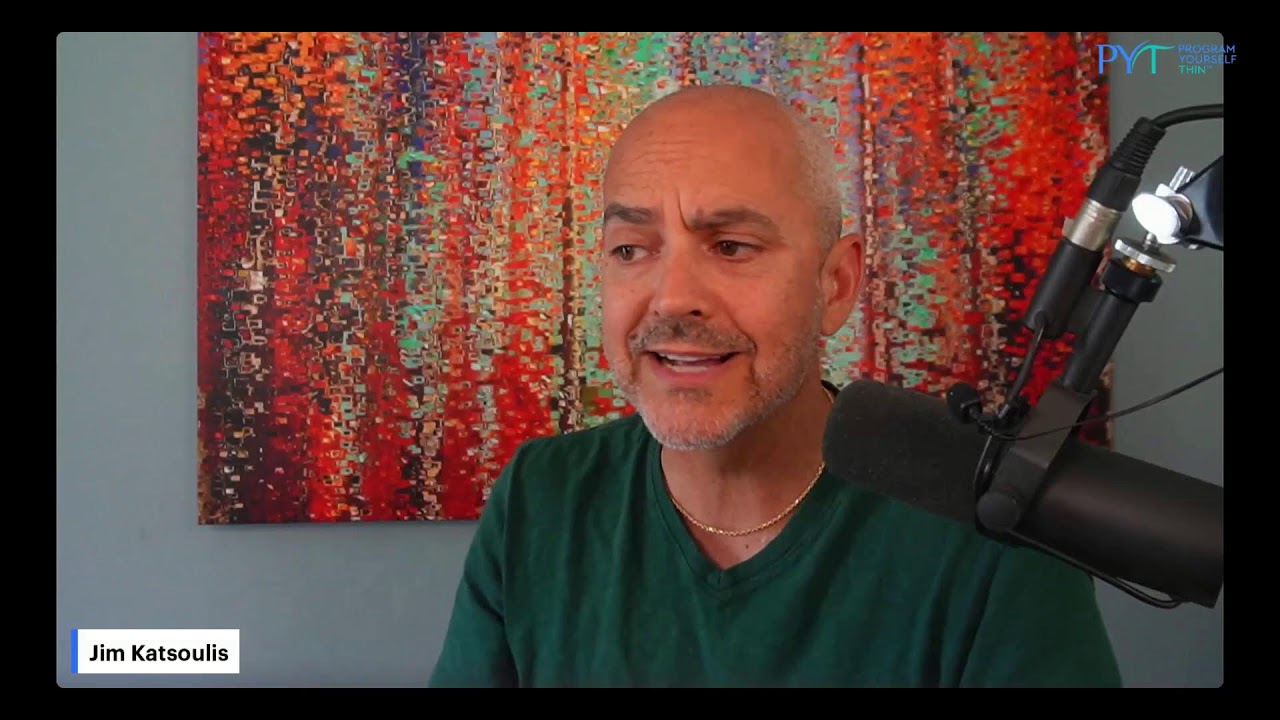
Jim Katsoulis walks through the Program Yourself Thin system, arguing that sustainable weight loss starts with internal goals, not impressing others. He covers mindset shifts, the "redo" technique for behavioral change, and answers questions about fasting, GLP-1 drugs, and teaching kids healthier eating habits.
Chapters
Everyone, welcome to today's program, Yourself Thin podcast. Today we're talking about who are you trying to impress with your weight loss? This is a question you really need to ask and answer because a lot of times we're kind of subconsciously trying to impress everyone and most of all strangers, people we'll never, ever meet or speak to in our lives. And this is a really important thing to get a handle on because you've got to match your goals with the motivation that you have. And I think a lot of people, because of the constant conditioning we're receiving, we think we've got to look a certain way for society or the world. And the truth is that when you lose weight, very few people are really going to care. There's going to be the people that you're close to in your life who are going to be happy for you because you're probably healthier and feel better. But very few people are going to genuinely care how you look. And I know this is something you probably don't want to hear, but it's just true because strangers don't give a shit. And most of the time, the people that you don't know, what they think about your weight really is going to make no difference because you're never going to hear about it. So a lot of times people have this weight loss goal that really is Boy, it's just like a fairy tale almost. There's no reality to it. What exactly do you want to lose the weight for? Well, you want to look better. Who exactly do you want to look better for? Because if it's for the people that love you, the people that you're closest to in your life, guess what? They already love you. And I'm sure they'll be happy for you to lose weight and look more the way you want to. But how you look is going to impact how they feel or act or behave towards you. Very little. And so if you have this goal of getting to a certain weight to look better, who's it for? That's what I want to know. And very quickly, when you start asking this question, you're going to get very interesting answers. What you're first going to start to notice is you're going to notice, oh, I want to look better for that bitch over at the counter at the place I go to. I'm joking. But you know what I mean? Sometimes it's all that that person said something. Wants, or that person, whatever. And now I'm going to lose weight, and now they're going to be sorry. You know, a lot of it's that energy. Other energy is that it's, um, all I want, you know, these people I've never talked to in my life to all of a sudden look at me and say, oh my God. And then they come over and they start talking to me, so I can't believe how amazing you look. Well, guess what? That's not going to happen that often. So the reason this is so important is you're going to realize a lot of your motivation to lose weight was not real motivation. Because if a lot of your motivation to lose weight is to look better for strangers and people you'll never talk to or people you don't like that you want to rub their face in it. That's not real motivation. That's fairytale motivation. And the people that are actually in your life, yes, they want you to feel better, look better, be better. But your weight loss goal usually does not need to be as extreme as what you're thinking to get to that level. Because when we think about the level of strangers and people we're never going to talk to and people we don't like to rub their face in it, Now what we're doing is we're jumping up to a real outlier level of what we expect to look like, which is usually fitness models or fitness influencers whose entire life revolves around what they look like. And most likely that's not really your goal. That's probably not really your goal. And so as you start to ground your goal in reality, in your reality specifically, you're going to see most of the time that's a lot easier to achieve and you have a lot more genuine motivation that you're bringing into this because now your goal is much more real to you and not to strangers and people you might potentially meet and people you don't like, which is where I find a lot of people's subconscious motivation to lose weight is really revolving around. So you've got to ask this question because the motivation you have dictates the whole experience. It's the fuel that gets you from point A to point B. And if you don't have enough fuel, you can't get to where you want to go. And a lot of that fuel, that motivation comes from a clear goal that is compelling and meaningful to you. And a lot of times people's weight loss goal is not meaningful to them because it's about impressing someone that they don't know, speak to, or, you know, like. So if that's the case for you, reflect on that and start getting clear about the goals that matter most to you and see how it feels different. If you want some support in helping that happen, click the link in my bio or go to programyourselfthin.com and go get the free hypnosis session I made you. Um, on top of that, it's also that, um, you get a training called Reprogrammed: How to Live at Your Goal Weight Without the Fight, uh, completely free. So go check that out. If you're over on Facebook or YouTube, I'll put the link in the description. If I can see it, there it is. And, uh, yeah, go check that out if you have not done that yet. And if you have any questions, feel free to ask them. I'm on here every weekday— whoops— usually at noon, except for Tuesdays, I'm here around 1. And I'm happy to answer any questions. Rose says, look better for me and my health. All right, very good. But looking better for me, be careful of that, right? Because just be careful. And that's fine, that's a fine goal, but just make sure it's accurate and true. Um, I get it, I like But I don't— I will tell— I mean, certainly how I look factors in. I don't want to pretend it doesn't. How I feel factors in a lot more. I have noticed that when I put weight on, I don't feel as good. I feel heavier. Things are— I'm just more lethargic, more tired. So a lot of times for me, wanting to be at my goal weight is based more around how I feel than how I look. I care about how I look too. Okay, so I make clear that that's a motivation for me. Absolutely. But it's a lower motivation than how I feel. I want to feel the way I want to feel. I want to feel like the best version of me. And I think that that's, that's the right place to go. But just make sure that's really true, because sometimes that sounds good, but it's not actually what's really motivating us. Just make sure it's true. And again, if anyone has any questions, feel free to ask them. Any weight loss questions are welcome. I've been doing this for over 20 years professionally. I've dealt with all different diets and people and I can usually kind of send you in a direction that might support you better. Sassy says, hi, Jim, may I ask you if you believe in fasting? I successfully lost 2.5 stone through fasting. I mean, I believe in all of it. You know, I certainly— there's people that lose weight through fasting. So do I believe it? Yeah, definitely. You know, do I think it's a good strategy to live at your goal weight? Well, not for most people, but my number one golden rule of Program Yourself Thin is that there's no right or wrong. There's only what works for you. So if you're someone who started fasting and you just fell in love with it and you love it and you look forward to it and you really could see yourself living this way forever because it just fits who you are psychologically, biologically, then I say fast. But most people, that's not their experience. Most people do not enjoy fasting. They find it stressful and difficult and hard. And in that case, my message to you is you do not need to fast to lose weight. So Sassy here has fasted in order to lose 2.5 stone. Obviously, that's what happened and that worked for you. But my bigger question is, how do you feel about it? How do you feel about the fasting? Do you get excited when you imagine fasting for the rest of your life, or do you feel, oh, you know, that's the big question because there's no question. Listen, all the diets work on paper. Right? Literally any diet that you do, if you follow it to the letter, you're going to get results. And this is part of the problem with dieting is they parade these people, these outliers that have stuck to the diet perfectly and gotten amazing results. So there's no question. I mean, if you follow the Weight Watchers plan perfectly, a keto plan perfectly, vegan plan perfectly, if you follow plans perfectly, you'll get results. The question is, can you follow it long term? That's the big question. And again, I don't know what type of fasting you're doing, but, you know, if the fasting resonates with you and works for you, then I think then you're on a good path. If you find yourself struggling with it, if you find yourself when you screw up your fast, if you find it hard to then continue with it, then I say it's probably not a great strategy moving forward, you know. But again, that's the bigger question is how you feel about it. And if you love it, great. And even if you love it, you know, listen, sometimes we still got to adjust. Sometimes we can love something that's working for us now, and then there's a shift in, in life. I'll give you an example, and this is specific to fasting, is I remember speaking with someone who had really lost a bunch of weight fasting, but then they lost their job and got a new job with a different schedule, and they couldn't— they couldn't do the fasting as easily. It just didn't work with their new schedule, and so they put the weight back on. So again, even if fasting is really resonating with you and you love it, things can also change. You know, schedule can change, you're just— your preferences can change, whatever. Things can change, and all of a sudden you might find it's not as easy anymore, you know. And so then you got to go, go to the drawing board a little bit and say, okay, you know, what can I continue with, you know. But again, the big distinction I want to make is that in the diet world, everyone's talking about losing weight here in Program Yourself Thin World, we're talking about living at your goal weight. So it's less about how much weight you can lose and how fast and much more about what can you live with long term. So again, that's why the question of how you feel about fasting is really the most important one, because certainly if I put someone in jail, if I put them in gym jail and I make them fast, they're going to lose weight, you know. So yeah, I believe that works.. But it's because I have control over their food, right? So if I force them, I know they're going to lose weight doing it. The question is, out in the real world, does that plan resonate with you? For example, me, I got off my plan last week. I went away on vacation. I come back, I can't wait to fold right back into my normal way of being, my normal eating patterns, my normal sleeping routine, my lifestyles, all of these things. I can't wait to get right back to it because I love it. I have customized how I think, live, and eat for me. So it's my favorite way to be. So even when I get off track because of vacation or because just different stuff happens, I can't wait to get back because I've built my entire plan around me. I hope that makes sense, right? Oh yeah, Felix says, I've kept like 65 pounds off for like 3 to 4 years, but I'm like, does this ever get easier? It doesn't. You know, how you lose the weight is how you keep it off. And so if you fought tooth and nail to lose the weight, you're probably going to have to fight tooth to nail to keep it off. And there you go. There's a diet in a nutshell. It never stops. It's so funny. I just did a lesson on this yesterday. It was so good about the 4 stages of competence. And we're talking about the 3rd stage is where most dieters end up, where they're consciously just controlling everything, but it never feels natural. So again, in Program Yourself, then we start on day 1 asking, what's the easiest, most enjoyable, comfortable way I can manage my weight? That's what we're— that's always the question behind every strategy that we come up with and use. So that by the end of it, you have a collection of strategies that are the easiest, most comfortable for you. And that's a key thing, because what's comfortable for me may not be comfortable for you. That's why you need to take the time to figure out what works for you. And diets never teach you this. Diets just give you a plan and say, you know, force yourself to follow it, where it feels like you're trying to fit a square peg into a round hole. Just doesn't fit right. But very few people take a step back and say, what works best for me? So congrats, Felix, on taking action and getting results you want. But now— and you can do it now too, by the way. Please understand you're in a better spot, right? I'd rather be 65 pounds down and then start thinking, well, how can I do this more comfortably, more easily than, you know, have to lose and do it? But, you know, that's the question to start asking is how can I make it easier? See, you're just expecting you're going to do the same thing that's been really hard. All of a sudden it gets easier. You know, that happens sometimes as we get more and more understanding of things, but Not necessarily, you know. So again, don't expect that just someday it's magically going to get easier. Start asking, how can I make this easier? How can I make this more comfortable to do the things that keep me at my goal weight? And if you keep asking that question, you keep uncovering better and better strategies for you. Because again, a strategy cannot only be evaluated by how much weight you lose with it. Do you get that? See, this is a very important thing to understand because dieting conditioned you to think that the only metric that you measure a diet on is how much weight you lose, how quickly. But the other side of that is how do you feel doing it? Because if you're miserable doing the diet, you might lose a bunch of weight, but you're gonna put it back on because you're not gonna do something that makes you miserable for long. You're just not gonna do that. At the end of the day, you're always gonna go back to what's easiest, most comfortable for you. And so you better take your time to figure out what works best for you., for, for that weight. Sassy says, yes, I didn't enjoy it, but I don't like calorie restriction also. Um, yeah. And Sassy says, I agree, most people can't sustain their weight loss, and I haven't managed to. Yeah, well, I get it, Sassy, but again, it's the same thing for you. It's, it's asking a better question, you know. And so here's the big thing, Sassy. Calorie restriction and fasting— and fasting is just a way to restrict calories, by the way, that's all it is. Um, and by the way, I mean calorie restriction. It's so funny because in Program Yourself Then, we just even just— we use different language because restriction has meaning. When you restrict something, there's an implication that you want it, but you have to restrict yourself. It's an active process of restriction, and that feels hard. That feels difficult. So in Program Yourself Then, we talk about reducing our average calorie consumption. So the languaging is different. And so, yeah, obviously you're going to lower your calories in order to lose weight. We all know that. But even right from the language, we're not saying about how can I restrict my calories to lose weight? That sounds like a fight. It sounds like you're going to go to battle with yourself. We want to ask questions like, how can I comfortably reduce my average calorie consumption in a way that feels normal and natural and I could keep up forever? Now, you— I know you've never asked that, Sassy. You've never asked that question. And when you start asking that question, you're not gonna have an answer for it. But if you keep asking that question, you're gonna start to develop one. And it's the most important answer that you'll probably ever create in your life, you know, certainly in terms of your weight and your health and your happiness. So again, if you start looking for the most comfortable, easiest, enjoyable way to manage your weight, you will start to find those strategies. Again, your subconscious mind's a servo mechanism. It just answers the questions that you ask.. But unfortunately, most people are asking the wrong questions. They're saying, how can I lose weight as quick as possible? What's the fastest way to lose weight? I just want to lose the weight and get it off me. These are all the wrong questions because they're all just focused on the short term of losing weight and not the long term of living at your goal weight. And you'll all realize that that is the thing you don't know. So you're not alone, Sassy. I would say most people here that aren't, you know, in Program Yourself Thin are really lacking the answer to the question, how do I live at my goal weight comfortably? You don't got an answer, right? There's nothing even pops up in your head. And we need to get an answer if it's ever going to happen, because it's not enough to just, you know, put the screws to yourself forever. You're never going to do that. That's why diets don't last, because they're unpleasant, hard, and difficult, and your brain rejects that long term. It's that simple. And the point is, managing your weight doesn't have to be miserable. It doesn't have to be hard. It doesn't have to be difficult. It really doesn't. I'm not saying it's easy either, please. Any, any change you make in your behavior and in your life is going to take work and extra effort, okay? But it doesn't have to be this overwhelming, miserable process that you all kind of assume it has to be because of the dieting that you've done your whole life. Uh, what's up, Susan? Susan says, I recently went to a restaurant and had an eating plan. The service was so slow, I ate all the bread and butter. How can I control myself? I did have a plan. It went out the window. I get that, Susan. And I forget if you're in the program or not. Oh, and Susan says, by the way, I got back in the saddle and lost some weight, but I wasn't at the weight I started out with. I got it, Susan. So great job. I think that's the most important piece of the second part. We got back on track and you're here to tell the tale. And I don't know if you're in the program or not, but what we would do in that situation is we would redo it. We would replay it in our mind and look at it from a different angle and just kind of think, what else could I have done? Comfortably, enjoyably. That's the key, right? What else could I have done? Now, I'll let you know that I wouldn't, I wouldn't beat myself too much about that because sometimes situations don't support us, right? So if the food came out at normal speed, you probably would have skipped the whole extra bread thing. Okay. So don't beat yourself up about this. It was just the situation kind of nudged you in the wrong direction. So first off, you know, recognize that. And then second off, you can ask yourself, If I could go back in time knowing what I know now, what would I do differently in that situation? Again, this is the core technique of Program Yourself Thin, the redo technique. If you don't know about this, again, click the link in my bio, go to programyourselfthin.com, go get the free hypnosis session I give you, but more importantly, go watch the training I made. I literally show you how to use the redo and rehearsal technique. So if you don't even know about it, it's the core technique of the whole program, but you go back and you redo it in your mind knowing what you know now as the person you want to be. This literally rewires your brain and it starts to answer the exact question you're asking. You know, you did have a plan, but it went out the window. But it didn't go out the window because you're a bad person, Susan. It went out the window because all of a sudden the food was slow and you had extra exposure to the bread while you were hungry and in eating mode now. And so that'll get a lot of people. So again, go back. What could you do? Maybe when you finish the bread you're going to eat, you push it to the side of the table. They tell the waiter to take it away. Um, maybe you would have sat with it and just ignored it. I don't know, like, there's a lot of different options you could have done. You haven't practiced any of them yet, so go practice some. Yeah, Susan says it's tough when you have a lot of great choices food-wise. Yeah, but that wasn't the problem there, Susan. The problem in that moment wasn't that there was lots of choices food-wise. The problem was that you're hungry, you're ready to eat, and the food's not coming out, and there's bread in front of you. Do you know what I mean? That's the specific problem in that situation. We've got to be very granular about what the problems are. Dieters have a tendency to kind of like go the opposite direction. I'm a bad person. Look at me. I'm in a restaurant. I can't choose. And now there's bread and I ate it all. What did I— why did I do that? I had a plan. I was only going to eat a roll and I ate all of it. Well, yeah, because you went in, the plan you went in with assumed that the food would come out at a normal speed, that you'd be in control. The rest of it turned out you weren't. So again, we want to go back in time, say, what could I have done differently? And practice it. That's another thing too, folks. Y'all, I don't know what in life you can get good at that you don't practice. And dieting really seeks to just skip that process, right? Dieting is under the delusion that you can just read a dieting book and then the next day you totally act different. Where else would that work? If you read a book about how to play the piano, could you just play the piano tomorrow? If you read a book about how to swing a golf club and you've never done it before, you just swing a club perfectly tomorrow. And so people confuse— well, it's just knowledge. If I know what to eat, what not to eat, I should just be able to do it. Wrong, wrong. There's a knowledge level, but it's by behavior. Behavior doesn't change through knowledge alone. Again, I could give you a book about how to play the piano. Does that mean you'll be able to play the piano? No. The only way to play that piano is to practice. Well, it's no different with your behaviors. Ah, Susan, yes, yes, yes, yes. There's it. That— then now you're thinking. Susan says maybe drink a lot of water. Yeah, because even I've noticed I did this in social situations. That was my solution for beer back in the day. I had trouble. I drink too much beer. I didn't want to. I had a plan. I'm only going to drink this many beers. And, uh, you know, next thing you know, I drank way more than that. What happened? Well, I went back in time and I said, what's going on here? I started realizing I get kind of anxious. I'm kind of anxious. I'm drinking because I'm anxious. I want to do something with my hand and just something to do. Then second thing I realized, I had taken huge sips. Once I realized that, then I was able to create a strategy and a solution that worked for me. What was the strategy? When I order the beer, I order a water too. So now I got— I can drink the beer when I'm kind of anxious and nervous, and I can also grab the water. I do both. Second thing is I started training myself to take smaller sips. I can take more sips of beer, but just take small ones. And when I put both of those together, that was a huge turning point for me to finally actually have control over the beer. So yeah, it's the exact same thing. Hey, since I'd rather have a tequila. Yeah, fair enough. Fair enough. But even that, you know what I mean? Again, whatever the right solution is for you, think about it right now. You are thinking about solutions and not just replaying your mistake over and over again. Notice that difference because that's the difference that makes all the difference. Susan screwed up in her mind and ate the bread. And since she's done that, she probably keeps going back. Scott, why'd you do that? You had a plan. What's wrong with you, Susan? Susan, you always do this. You say you're going to do this and then you do that. You always screw up. What's wrong with you? You don't— you deserve this. You don't even deserve to lose weight because you can't even stick to your plan. Tell me that's not some of what you've been thinking since then. Now you got back in the saddle, and so maybe you've been able to manage it pretty well, but That's a pretty common thing for people. They make a mistake and next thing you know, they just start piling on top of themselves and beating themselves up and reliving the mistake, redoing it in their mind. You know? So again, we want to change our mindset when we make mistakes and learn from it. Go back in time, understand it a bit more. You're not making bad decisions, folks, because you're a bad person. You make bad decisions usually because of the environment, um, the, the way you got yourself into the situation, where you're at emotionally, mentally. Hunger-wise, there's factors that are leading you to behave the way you do. And the least of the factors is whether you're a good or bad person, whether you have enough willpower or not. Those are really extraneous factors. The main thing is when you step into a situation, what is your mood? What are you thinking about? What's your hunger level? What are your strategies? You know, these are the more important— what's your programming? Probably number one. Um, those are the more important ones. Yeah, Susan, thanks for your help. You're welcome, Susan. Again, if you've not watched that reprogram training, please watch it. It'll definitely give you more context what I'm talking about. Um, oh, okay, yeah, the Vegas smile, that's also a technique Neville Goddard taught, which he called revision. Cool stuff. Yeah, Neville Goddard, I always— I've been hearing about him for years. I got a book of his not long ago. I didn't really like it too much. I gotta try a different one, but Yeah, the revision. I think that's great. That's a, that's a well-worn strategy that has a lot of scientific proof behind it that it really is so powerful. It's very powerful because of the way your mind works, the way your imagination works. Um, basic— basically your mind can't tell the difference between vivid imagination and reality. So, um, you know, when, uh, when you learn how to use your mind appropriately, things become a lot easier. So yeah, I'll have to check that out though. Um, Sarah says, how to stop food noises is my question. I sweat sometimes. I'm just bored, not really hungry. Um, yeah, but, but you're just bored. The food has nothing to do with your boredom. We've been conditioned to think it does because food's a really easy way to relieve boredom, but it's not the most effective and it's not the only one. So the bigger question, Sarah, is how to entertain or stimulate yourself when you get bored. And you gotta pre-plan that. You're not just gonna spontaneously figure it out when you get bored. So take a little bit of time, notice times you get bored and start asking yourself, what can I do in those situations that doesn't involve food that would be entertaining, stimulating, interesting to me? It might be calling a friend and going somewhere with them. It might be going to a movie. It might be reading a book. It might be taking a pottery class. It could be anything. Everyone's different, you know? But if you're bored, the food's never going to resolve that. And as well, for all of you boredom eaters, the answer is not to eat either, because then you're just a thin bored person and that's not really your goal either. So again, I would say that your food noise isn't really the main issue. The bigger issue is that you don't really have many strategies for what to do to entertain yourself when you're bored. And if you had better strategies that you really enjoyed, you might have a better time. Um, User 746 says, starting, starting the weight I want to be versus the pounds I want to lose has been a game changer. Thank you. You're welcome, you're welcome. Yes, stating the weight I want to be versus the pounds I want to lose has been a game changer. Um, again, a big, big suggestion I give people: stop talking about how much weight you want to lose and start focusing on weight you want to live at. Um, what weight you want to lose is really about what you're not going to get. And what you're not going to have. And then I think that, um, I think it's important that you realize what you want and what you're going to be is a much more compelling idea for your mind. All right. And so it starts right by the articulation of the goal. It's not about how many pounds you want to lose. It's about what pounds you want to live at, what weight you want to live at, who you want to be. That's a much more compelling goal for your mind. Um, Moni says, is that learned when you're an infant? Um, I'm not sure which, which thing you're referring to, but lots of things are learned when we're infants. Really, before the age of 13 is when we really are basically programmed. That's when a majority of the programming is happening. So, um, regardless of whether it happens as an infant or as a 5-year-old, to me it's irrelevant. Um, it's just programming. Pretty much everything we're doing is programming, um, that runs on autopilot now. And so we're not even aware of it. This is why, again, you fight— you fight to lose weight as much as you possibly can, yet you still, um, stay there. Oh, regarding boredom, um, potentially. Sure, sure. You know what I mean? Like, again, people have all different histories and we all learn and are programmed in different ways. Um, the good news is that regardless of whatever went on back there, we can change it now. And in the future. And so, um, yeah. And I would also say too, like, understanding where something originated from really is, is unnecessary in order to change it. I just want to make that clear too. Um, you know, sometimes it's satisfying to understand like where something started, but it's absolutely not necessary because we can take a behavior, um, that we're doing, not understand where it came from, and change it. And I think that that's a very freeing thing to understand. You know, I gotta do something here real quick. My son is— oh, I guess I won't be able to do that. Oh no, I will be able to do that. Oh, I guess not. Anyways, um Yeah, Felix says, I lost it by counting calories and increasing protein and exercising. Um, yeah, well, okay, nothing extreme. Okay, that's great, Felix. And so that— what that tells me is that— I'm gonna turn the mirroring off here so I can show you something. So in Program Yourself Thin, and it's just the core of the program philosophy, is that I believe you need a holistic— you need a comprehensive holistic strategy to manage your weight because it's a lot of stuff. It's not just calories in, calories out. It is on a very technical, physical level. Okay. So again, if I put you in gym jail and I control your calories, you know, I can control your weight. But in the real world, you got autonomy, you know, and so it's a different scenario.. And so in that context, yes, we're looking at calories. Calories matter, but there's a whole kind of universe around that calorie consumption that's dictating how many calories you consume. And so I would say for you, Felix, one of the big things that you're probably— your weight has changed, but your mindset hasn't. And in Program Yourself Thin, one of the ways we refer to that is your self-image. And so I'm going to assume you haven't done a lot of self-image work. You've done a lot of external work. You've focused on calories, you focused on protein, you focused on exercising. All these external things, assuming that as the body changes, what I look like changes, what I feel like changes, that how I think of myself will change. And this is a big reason why sometimes we feel we're always fighting with ourselves, because in your mind you might think of yourself as the old Felix. Okay, so in Program Yourself Thin, right from the very first day, we're not just focusing on losing weight, we're also focusing on who we want to be, because Program Yourself Thin's an inside-out approach to change. And so we're looking not just to lose weight, but to become the person we want to be. And it's an inside-out process that starts with our thoughts. And so I would suggest, Felix, that when you say it doesn't feel easier, I would definitely look into your identity. How do you think of yourself? Do you think of yourself as a thin, healthy, happy person who consumes the right amount of protein, exercises, and eats right? Or do you still think of yourself as the person who struggles with food and exercising and weight? And all the rest of it, because there's a good chance that you're still thinking of yourself as the old Felix. And if you are, that creates kind of the subconscious incongruencies, this subconscious kind of push and pull, um, because here now you have this new body but you're still thinking yourself as the old one. So again, that'd be my first suggestion to notice if that's at play here. Um, that Vegas Smile says, I recommend Neville's book called Power of Awareness. I only learned of Neville via Wayne Dyer, who said this book inspired his work. Just sharing, as a lot of your work reminds me of Neville and Wayne. Yeah, that's cool. Yeah, the awareness book, I'm gonna get that, um, because so many people have mentioned, um, uh, Neville to me that, uh, uh, yeah, I will check it out, you know. So thank you for that. Um, Hiba says, what causes blowing— bloating of the tummy? Um, I mean, you know, everyone's different, and so I don't know, like, what causes bloating in the tummy. I suppose it could be anything, you know, to some, to some degree. Um, without knowing specifics of your situation, I couldn't answer that, and I probably couldn't answer if I knew the specifics because I don't— I'm not really an expert in bloating of the stomach. Um, but they followed up by asking, how can we change our thought? Well, that I am an expert in. Um, and I would suggest that the way you change your thought is real simple. You change your environment, okay? Um, because You know, if you think about learning something, right, think about— imagine you just want to learn whatever. Just say you want to become an accountant. Let's just say to learn how to be an accountant, you're going to have to change your environment and expose yourself to a lot more accounting, right? You can't just read a book on accounting and know it. You can't do that. So to change your thoughts, you need to change your environment. And so I believe that when you— this podcast is an example of that. I have people on here that have been listening for years. And so that starts to change their thoughts because they're hearing new ideas. And I, coming through the podcast, become a way to change your environment, right? Same, the same shit happened to me. Tony Robbins, you know, through his Personal Power program, changed my environment. All of a sudden I had new ideas going in my head that I'd never heard before. And so I think the best way to change your, your thoughts is to change your environment. Um, and that's not just a physical environment, it's a mental environment. And this is an example of that, right? Physically, you can be sitting in the same room you always do, but now you're listening to this message and it may put new thoughts and ideas in your mind. And certainly Program Yourself Then is built around that idea because a lot of it's built around hypnosis sessions, trainings, things like that. Yeah, Felix says, thank you. I'm trying to experiment now with like, what can I do to make it more sustainable? And I'm adding small snacks for lunch. Yeah, that's great, Felix. I think you're on the right You're right, Path. Absolutely. And I would strongly recommend, Felix, if you haven't, is make sure, um, go get the hypnosis session I made for you. Just click the link in my bio on TikTok. There you can get it. Um, and watch the training I just did, Reprogrammed. I just made this training. It's completely free. I think it's the best training I've done. Um, Felix says, I think I'm realizing I have to train my brain that I'll never be able to eat the quality, the quantities I want, but I can be satisfied with smaller quantities than I think. Okay, I love what you say here. I'm a big I'm a big fan of words and your words reveal all, right? So right now, Felix, your subconscious programming is that eating a lot of food is what I want. That's what you believe. And so that's what you're fighting against. There it is. Okay. So now we know exactly what it is that Felix has this subconscious association, the subconscious belief that eating a lot of food is what I really want to do. Okay. But is it? Right, so let me give you an example. If I said, um, I'll give you a million dollars if you only eat half that food, now we have to ask the question, well, maybe you want to eat all the food, sure, but if I say I'll give you a million bucks to eat half of it, what do you want more? Do you want to eat all the food, or do you want to eat half of it and get the million bucks? Well, most people are going to say, oh no, I want the million bucks, I want the million bucks. Right. So in that sense, now we've traded one want for a higher want. This is the secret. Okay. Because most dieters are saying, I want to eat all the food, but I can't because I have to lose weight. No, you want to lose weight. And so now we put a want against a want. All right. So here you are, Felix. It's, um, yes, you have to train your brain. Not that you'll never be able to eat the quantities I want. But you're going to train your brain to realize the quantities I want to eat are less than what I thought they were. I want to eat less because I love feeling 65 pounds lighter. I want to eat less because I feel more alive, more free, more happy, more confident, more successful, more healthy. Do you see what I'm saying? So, so that's how you retrain your brain, not to convince yourself to because you're not gonna lie to yourself in this context. You're gonna say, oh, I don't want to eat, I don't want to eat a lot of food. Yeah, you do, right? But the only way around that is to have a higher want. Again, if I give you the million bucks, now that one supersedes the want to eat all the food, and you're happy to make that, right? Happy to switch that in 2 seconds, right? Well, I'm not giving you a million bucks, but what you are getting is the want to live the reality you're living. And again, this goes into the mindset— is please watch Reprogram. It's 20 minutes, and I think for you it's really important because you're at the key part. I'm here for people people like you. I want you to know this. The people that I'm most committed to on this podcast are the people that have lost weight because you're willing to put the work and you've done the work, but you don't have the mindset and the strategy to maintain it. Usually. I mean, again, don't, don't blame me. 85 to 95% of dieters that get to their goal weight put it back on. So this is a big issue. The issue, honestly, and I was going to sound strange to some of you that are struggling with weight loss, but the real issue isn't the weight loss. The real issue that no one seems to have figured out is how to live at that weight. And that's what I've been obsessed with for over 30 years. So again, the goal is that, yeah, I want to eat all the food. You can acknowledge that and accept that, but if you have a higher want, that will supersede it. But you do not want to be training your brain to try and not want what it wants. That doesn't work, right? Because you're bullshitting yourself, and you know that you are. Uh, Fit Quick Coach says, never go hungry, 2 apples on the way, eat, run for flavor, not to fill up. Yeah, I, I agree, agree, agree. Agree 1,000%. Never go hungry. I, I can't agree with that enough. That, that's smart wisdom right there. Um, what's up, Pia? Pia says, I want to be 58 kilograms, or yeah, 58 kilos. Um, you're doing great work. Sound waves in this place where I live make me eat too much. All right, I have to calm nerves by crunching food. All right, interesting. So there you go though, but you're, you're right You've identified kind of your biggest challenge, which really isn't the food, it's the sound waves. And so what I would do is I would ask myself the question, what are some other ways I can deal with the sound waves where I live that don't involve food? Because if you have that answer, if you come up with that answer, well, you got a new solution and strategy at your disposal that you don't have right now that food's filling in, right? So, um, focus on that. What's up, Lois? Lois says, my life weight will be a range of 121 to 129, still will be considered overweight, but that is my normal and good for me. Today I weighed 131. My life is so much happier and fulfilling as my health has improved. I found out that I will be a great nana in February and I will be able to do things with him and her. Um, yeah, that's great, Lois. I'm proud of you. Again, Lois in the program here. I am, I'm proud of you for how you're changing your mindset. Again, folks, having a range, I think, is one of the greatest things in the world because you're a human being who fluctuates. So, you know, I was thinking to myself, trying to keep yourself at the exact same number is like trying to keep your gas tank at the exact same level. You know what I mean? Like, it starts— you make yourself neurotic. And so it just relax, you know, it's natural to have ups and downs. We get to pick the range. Me personally, I live within a 5-pound range. Which I'm above right now. I mean, I just went above it after last week. I don't like it, I'll bring it back down, you know. I'm not freaking out. I have a range, I understand it. And, um, yeah, and again, the main point that Lois is making is that her quality of life has improved, right? And I think that's really important. Uh, what's up, Jane? Jane says, how am I missing all the time you coming on here live? I don't know. I do not know, Jane. But I saw— I can't fix that, Jane. I just want you to know, like, if I could, I would, but I have no control over how Facebook sends notifications and there's just nothing I can do. I don't know. Um, I told you though, the time— set a timer. Set a timer for Monday, Wednesday, Thursday, and Friday. Set a timer for noon Eastern and I'll be on. And on Tuesday, set a timer for 1:10 and I'll be on. And then you'll never be late again. But yeah, I don't know. I don't know. Facebook has got weird. I don't know how that works, honestly. Um, so yeah. Um, start Ozempic on Thursday and I'm looking forward to your support as I do this. Uh, yeah, great, great. Like I said, this is a GLP-1, um, accepting space, you know. Um, although I will say I had a really interesting conversation today and I loved it. Um, it was with a client of mine and she went out to lunch with a friend of hers who's on a GLP-1. And, um, basically long story short is they both ordered, uh, kind of a fried fish sandwich and they both ate half of it. Because they didn't want to finish it. So one of them did it with GLP-1 and one of them did it with Program Yourself Thin. And, uh, so yeah, but again, obviously what we're doing here is, um, is, uh, you know, this way, right? Um, Pia says, how tall are you? What is your weight? I don't really get into that because, you know, it's like, it doesn't matter what— how tall I am and what I weigh means nothing for anyone else, you know what I mean? Like, this is, this is my weight that I picked. I didn't pick it from a BMI chart. I didn't pick it from a doctor telling me. I experienced different weights and decided which weight I'm happiest at and I feel best at, you know. Um, Lynn says, what time zone are you in? Uh, Eastern. Yeah, I'm right, uh, Boston time, New York time. Um, Jane says, I do have a timer and I get on here, but I can't find you. Oh, okay. Well, Jane, yeah, then you just have to, um, I mean, you can just bookmark I mean, again, there's multiple ways to watch me. I know you're on Facebook, so just bookmark the Program Yourself Thin, uh, page and then just refresh it at 12 and it'll pop. It's always on there. The replays are on there too, by the way. So if you want to watch it, you can go back and rewatch it. But, um, yeah, Program Yourself Thin page. And so I'm assuming you're already like following that page, but you can literally just set up a bookmark of that page and then click it and there I am. Waiting for you. Um, uh, The Vegas Smile says, do you recommend being on a weight loss journey and also doing program yourself then, or do you recommend losing weight first and then starting your program? Oh, I definitely recommend losing the weight with the program, you know. But if you already lost the weight, this program is even more valuable to you because I know if you've lost the weight, you're freaking out. I already know it. I already know it. Again, please understand there's, there's a reality behind the number that 85 to 95% of dieters put the weight back on. There's a real reality for why that happens. And so I already know dieters always flip. They— the one mantra when they want to lose weight, I just want to lose the weight, I just want to lose the weight, I just want to lose the weight, I just want to lose the weight. And then as soon as they lose the weight, then it flips into, I hope I don't put the weight on, I hope I don't put the weight on, I hope I don't put the weight on, you know. So again, folks, it's because you've never learned how to live at your goal weight. You've never learned how to maintain. You're— your whole sole focus of weight has been how to lose it as quick as possible, and you're woefully unprepared for how to live it. You've never studied it. You've never thought about it, really. You've never learned how to do it and program yourself. Then, as I say, we start day one with maintenance because, again, the whole point of it is to live at your goal weight, not just to get there for a day, but to live there comfortably, easily, enjoyably. So that's key. Um, so yeah, but I would definitely recommend, uh, yeah, I mean, if you, if you want to lose weight, yeah, getting with Program Yourself, because Program Yourself is gonna be the easiest comfortable way anyways. So instead of making it two processes, make it one. See, all you dieters have to lose the weight and then you have to figure out how to maintain it, which no one ever figures out. Again, 85 to 95% put the weight back on. Which means dieting has a 5 to 15% success rate, which means 5 to 15% of the people figure out how to maintain it, which statistically is virtually no one. Program Yourself Thin is all about living at your goal weight. So instead of this two-step process, most dieters, this is their average calorie consumption and they drastically cut it down so they lose the weight. And then the idea is they're going to bring it up to some magical maintenance level, which no one figures out. Program yourself. Then we slowly bring the calories down, and then the weight comes down. You want to lose some more? Okay, bring the calories down, then the weight comes down. But whatever, by the time you finally get to your goal weight, you've been practicing that way of living, thinking, eating. So there's nothing left to learn. I mean, you've been focusing on maintaining the whole time. You've developed the skills to think, live, and eat like a thin, healthy, happy person. So the time you get to your goal weight, these are skills that you've identified, figured out, and practiced. It puts you in a completely different position than a dieter who hasn't thought about that shit at all. And it's really a two-stage process for them. And honestly, no one ever teaches them how to maintain it anyways. What program teaches you how to maintain your weight? What program? Give me the program that teaches you how to maintain it. It's all about weight loss. It's all about losing weight. And there's a whole psychology behind that. Mony says, how can we start teaching these insights to our kids so they don't fight this when they are adults? Um, yeah, that's a great question. Uh, you know, I think the big things are to put healthy whole foods in front of them, educate them, let them understand the food that we're surrounded by and what it does and how it works. Read books like The Dorito Effect, Ultra-Processed People, The End of Overeating, and understand the reality we live in now and educate them and let them know that we're constantly being surrounded by trickery. You know, the, the people that own the food companies now are the cigarette companies. So when you think about cigarettes, you would have a much clearer idea of how to educate your kids about that, but you don't think about food the same way, and you have to because the whole food— all the food surrounding us is completely alien foods that are hyperpalatable and hyperaddictive and hypermarketed. And so most people are just walking through life with blinders on, don't even realize, you know. So again, I think educating them is good, putting good foods in front of them so they get a taste for natural flavors and the, the experience of eating natural foods is probably a good starting point, I would say. Miss Claire Armstrong says, I started yesterday walking and calorie counting, nothing fits me anymore. Oh, great job. All right, so again, um, you know, I'm just gonna say— I'm just gonna say this because, because again, I take the no bullshit oath, so I'm not— I'm not here to sound negative, please. But at the same time, I can't hear people just say the same strategies that never work and just be like, oh, great, hope you do great, you're gonna— you're gonna do it this time, you're gonna knock it out of the park. I'm not doing that, okay? Now please understand, I'm here to support you more than anyone on the planet. I'm here every day, Claire. You can pop in here every day, Claire, and talk to me about how it's going, and I will help you out. So I want to preface what I'm about to say with the, the, I'm here to help you and I'm not being negative, but I just want to clarify, how many times have you tried starting to walk and count calories in your life? And if it's more than 5, 10, 15, 20, 30, then I hate to tell you that the chances of this working are very slim. Why would it work this time when it hasn't worked before? Now, if you've never tried walking and calorie counting, then ignore what I just said and see how it feels. And if, if just, if you take like a duck to water to it and it just really works for you, great. But if you find yourself resisting it, struggling, straining, unhappy about it, worried about the weekend, then here we are. Okay. And again, what I'd strongly suggest is you go, um, watch the, go listen to the hypnosis session I made. Go watch the training I made, Reprogrammed: How to Live at Your Goal Weight Without the the fight. Um, because that nothing fits me anymore is just going to be temporary motivation. I hate to say it. What do you want from me? You don't have to believe me, but I'm here to help you all. I'm not here to blow smoke up your asses. And you know, I'm not going to do that. Am I wrong? I could be. I could be wrong, you know. But, but again, um, one of my main goals— I just want to— and this isn't hard to do, but I want to give you a different perspective on things than what you always hear. Because every time you hear someone start something, it's like, oh, rah-rah, go, you're gonna— you got it. But if you tried walking calorie count and this is your 30th time trying it, what happened the first 29? I know this sounds negative. I don't care. I gotta speak my truth. You don't have to believe me, folks, but if you try something the 20th time, you gotta take it just a quick second and say, well, what happened the first 19 times? Am I at risk of that happening again? Yeah, you are. I know I sound like a jerk. I'm sorry. Uh, the Vegas Smile says, thank you. I've been on GLP-1 since end of April and I have 40 kilograms more to lose, but I'm already thinking long-term rest of my life success. Yeah, that's great. Um, and again, I'm not against the GLP-1s. Um, I think, I think there's a better way to do it that doesn't involve any of that stuff personally, right? Again, what I was saying yesterday this person has naturally got a handle on their food noise. They've naturally been able to get themselves to eat differently without that, you know. And I would say that they've gotten way more benefits as well out of it, you know. But I think the second best thing, if you're going to be on GLP-1, is you've got to be doing mindset work because you're not going to want to be on that thing forever, I promise you. You know, you might think it, but because you're losing weight now, you're all excited. But once the weight loss stops, and it always stops around 16 months out, every GLP-1 at this point stops around 16 months out. The weight loss stops and you're at whatever weight you are. Even if you're at your goal weight, once the weight loss stops, a lot of the dopamine stops, the excitement about the process stops, and now you're left with the realization that I'm injecting myself with this thing that makes me not really care about food. Then it starts dawning on you, well, am I ever going to enjoy, you know, Nana's lasagna again? Am I ever going to enjoy the donut place that we go to in the summer on vacation? Am I going to eat like that again? And that's where we gotta understand that that's coming too. So very few people, I think, are going to want to stay on GLP-1s long term. That's that hot take. Print it and show me where we're at in 5 years. But I, I think it's exciting that people are losing weight when it feels like nothing else has worked and it doesn't take anything more than, you know, injecting yourself to work. Um, but I think that what I'm always looking at is the long term. And so I think even if you're on a GLP-1, I think you owe it to yourself, um, to prepare and plan to come off of it. In order to do that, you've got to have some mindset stuff going on. I think lifestyle— again, in my opinion, whether you're on GLP-1 or not, at the end of the day you're gonna need all this if you're not gonna be on the, the GLP-1, or, or, you know, shrink your stomach with surgery. But I think you're gonna need this holistic, comprehensive approach, you know, if you're gonna be able to, uh, manage your weight long term. That's what I think. Um, Hiba says, how do we practice our mind when it is very stressful conditions to calm down to help lose weight? Um, yeah, I mean, you know, like even when it's stressful conditions, I know it can feel like you want to wait till the stressful conditions are over to practice it, but now's the perfect time to practice it because no matter anything you practice in life consistently, you're going to get better at. And relaxing even in stressful environments, you can do as well. It's harder, you know what I mean? Like everyone's got their challenges. I get it's harder if you're in a stressful situation to be able to practice feeling relaxed. I get that. But you can still do it. And it's important that you know that, because if you start practicing it now, you can start feeling a lot better immediately. Maybe not perfect, okay, but better. And so if you start aiming at better— how can I feel a bit more relaxed? Not perfectly relaxed, but if I can— how— what can I do to feel more relaxed? If you start asking that question, I know you can do it. All right, uh, Max says, I can't find the hypnosis session. Well, I'll put it right in the link for— I see you over on Instagram, so let me pop that link. Oh, did that go in? Yeah, there it is. So yeah, go check it out. I just put the link in the chat window over on Instagram, and I'll put it over on Facebook and YouTube here as well. So if you want to get that hypnosis session, go get that. And again, more importantly, I think, I think the hypnosis session is great. I think the training is even greater. I think Reprogrammed is really good, and I think you deserve to watch it, um, if you struggle with your weight at all, want to get a handle on it. I think It's, um, it's kind of profound and new stuff that you probably have never heard and could make a huge difference for you. Um, Jane says, before I started Ozempic, I had 3 days of pigging out and eating too much junk. So dumb. Um, yeah, you know, it happens. Uh, but again, I mean, that's the classic diet move anyways, right? It's like, you know you're gonna go Ozempic, so you have the binge now. It's the last binge, last binge I'm gonna have, right? Again, I get it though. Just human nature. I, who cares? I don't think it's dumb. I think it's normal and I think it's what most people do, you know, when they anticipate that everything's going to change on Monday. So I might as well pig out now. We all know that one, right? We all know that move. But again, you know, the thing is, you know, again, it's not a guaranteed thing. So you'll see how your body responds because a lot of people's bodies does not respond well to those medicines. But if you're like the majority, your hunger will go down and you'll eat less while you're on it. You know, that's what I would expect. Uh, Pia says, where did you learn all that? Uh, that's a good question. I've been obsessed with this for over 30 years. I've dropped over 50 pounds and kept it off for over 30 years as well. Uh, I'm just obsessed with this. Over the last 20 years, I've done this professionally. I've been teaching Program Yourself Thin for over 20 years. I've done over 6,000 private weight loss sessions. I'm just obsessed. I read— this year I'm a little off, but on average I read 50 books a year. I just— I'm always consuming this stuff, and I'm just obsessed with it. For me, it's a mission. My father died of a heart attack when he was 54. So for me, um, my urge to help you with your weight goes far beyond what you look like, um, right to how long you're gonna live and what your quality of life is while you're here. So yes, uh, Jane says, so did you eat a lot of ice cream while on vacation? I hope so. Uh, yeah, absolutely. I had ice cream. I didn't have ice cream. I had ice cream like one night, but I had frozen custard. They're technically different. I don't exactly understand what the difference is. Um, but I had a frozen custard every night except for then I had ice cream. So yeah, I, uh, again, when I go on vacation, you know, I enjoy myself and I eat foods and all the rest of it. Um, and then I come back and I slide right back to my normal routine, enjoyably, comfortably, because I love it. So yes, both can be true. All right everyone, I'm gonna get out of here. Again, if you're not my world, please click the link in my bio, go get the free hypnosis session. I just posted the link in a bunch of different places, go check that out. Again, you owe it to yourself to get on my email list. I got so many cool things coming. I am so excited about the future. I just can't even contain myself. I'm still kind of regrounding myself from vacation. But yeah, so go check that out. I got a bunch of stuff for you for free there. If you like this, I'm here every Monday through Friday around noon Eastern. So pop on here. I'm happy to help you in any way I can. That's what I'm doing here. If you can't make the live, it's also a podcast. Search Program Yourself Then on the podcast platforms. And, um, yeah, check it out. All right everyone, have a super duper day and we will talk soon. Bye everyone.
More from Jim



Weight Loss Visualization: Wake Up in Your Dream Size #programyourselfthin #weightlosshypnosis



What If You Pretended to Be Thin for One Hour? #programyourselfthin #weightlosshypnosis




