Program Yourself Thin Live 8-25-26
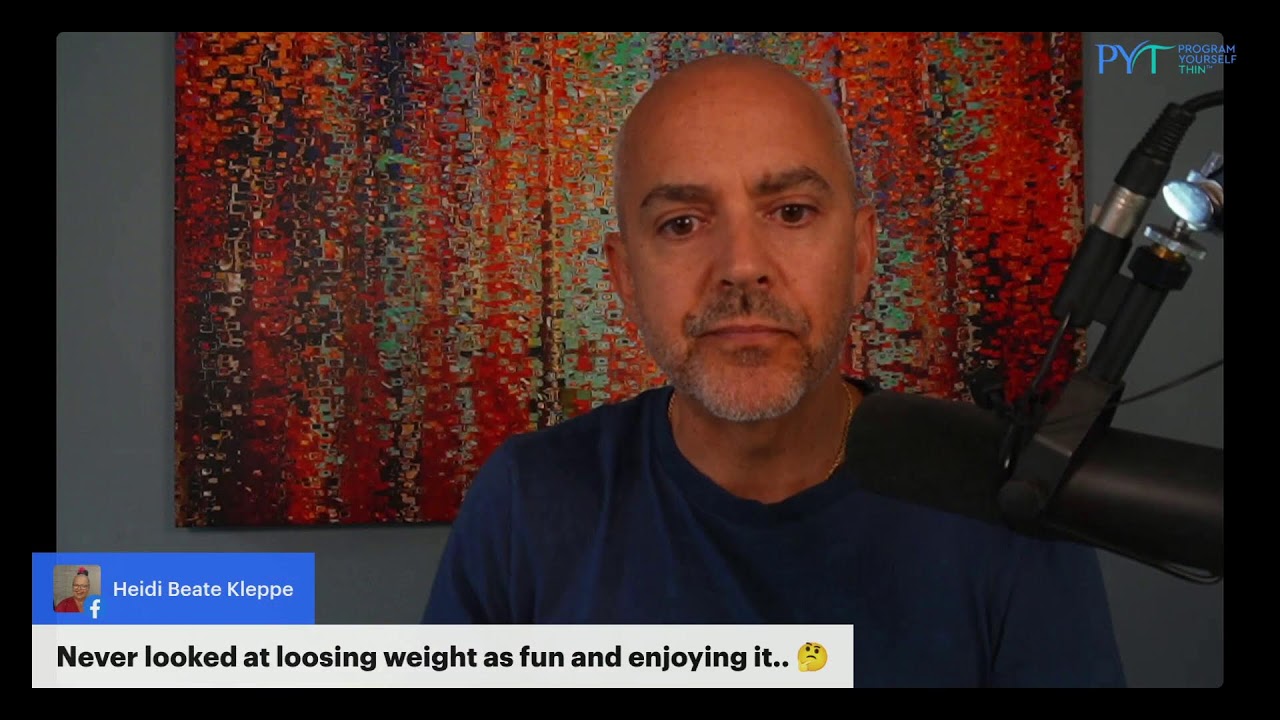
Jim Katsoulis argues stress eating stems from stress itself, not lack of willpower. His Program Yourself Thin system uses daily hypnosis, an app, and a Goal Weight Blueprint to reprogram habits and reduce cortisol, shifting from all-or-nothing dieting to sustainable, automatic choices.
Chapters
Hey everyone, welcome to today's Program Yourself Thin podcast. Today we're talking about The answer to stress eating, right? A lot of people struggle with stress eating, and so it's affecting their weight, right? If you're stressed and you're using food to manage the stress, then you're going to eat more than you need, and you're gonna put extra weight on most likely. Okay, so a lot of people are familiar with this. They recognize it, and what they try and do to fix it is they try and fight. Against the stress eating, so they get stressed. They want to eat something, and they try and use their willpower to say no, don't eat that thing. And this is what they try to do as long as they can until they finally can't control themselves anymore and end up eating the food, and then usually overeat a lot of it because they've kind of built up that that pressure, that energy. So what's the real solution to stress eating? Well, you're never gonna believe this, but it's relaxation. Because the issue isn't the eating. The issue is the stress. The eating is just a symptom of the deeper problem. The eating, the stress eating, is just an attempt to deal with the stress. And it's relatively effective in the short term, in the moment, because whatever's stressing you out, all of a sudden you stop thinking about that and you focus instead on the food. So you shift your attention. And so now all of a sudden, the thing that was stressing you out You're not focusing on— you're focusing on the food. So the stress begins to relieve. And then the other side is that a lot of the times the foods we're eating have a pleasure— they activate our pleasure centers. And so there's a pain-relieving property to eating as well. And so the stress goes down for that reason as well. But the problem with stress eating is that as soon as you finish eating, pretty much the second you finish eating, the stress starts going back up. Because you never dealt with this stress in a genuine way from the beginning. You only tried to distract yourself from it with the food. And so that never really dealt with the core issue, which was the stress in the first place. So when I say relaxation is the answer, I mean it very literally. And we want to get to a place where you're able to reduce the stress naturally by being more relaxed and then expecting and anticipating that if you can dial down the stress, Dial up the relaxation that in that place, you will be able to make better, healthier food choices for yourself. But what we want to do is we want to go right to the core problem and deal with that. And a lot of times people kind of overlook that and instead they're just focusing on the eating. But again, your goal is not to become a thin, stressed person. Your goal is to become a thin, healthy, happy person. And if you ever have any chance of really making that a reality for yourself, you have got to deal with the core issues. And of course, this applies to all emotional eating, but stress especially, because if you're stressed out, it's very difficult to make good food choices. If you're stressed out, you're literally burning through your willpower. Willpower is a finite resource. And when you're stressed, a lot of times you burn through that willpower so you don't have as much of it available to you. And on top of that, the stress activates cortisol, which makes you even hungrier. So if we don't deal with that core issue, the best-case scenario is that you're constantly fighting and keeping yourself from stress eating for as long as you can. And not only is that not effective and doesn't work very well, it's very unpleasant. So again, the goal is to go back to the core issue, which is the stress, and start to manage it at that level. And as I said, it's the same for all emotional eating. If you're a lonely— when you get lonely, you eat. The secret isn't to not eat when you're lonely, it's to become more connected. If you, you know, eat when you get angry, the answer is not to stop yourself eating when you're angry, it's to start to feel more calm and happier. And if you start thinking this way, it's really powerful because it's getting to the core issue. And again, dieting never teaches you to focus on this, it just focuses you on the food and controlling your behavior. But that's a forever process where you're always fighting against yourself, as opposed to coming up with better relaxation techniques and strategies and lifestyle and routines so that you just feel more calm and relaxed in general. And when you feel more calm and relaxed in general, you tend to make better food choices. When you're more calm and relaxed, you can start to trust yourself. That's the path you actually want, not just to fight against yourself and stop yourself from eating even though you're ready to freak out and you're up to here with stress. That's not the real answer. The real answer is to bring our stress down, relax more, and then expect when we get to that more calm, grounded, relaxed space that we're going to be able to make better food choices naturally. And to help you practice this or to test it out yourself, Click the link in my bio or go to programyourselfthin.com and go get the hypnosis session I made for you, because there's probably no better way to relax than to use hypnosis. This session will not only put lots of good ideas in your mind that get you fixated and focused on getting to your goal weight, but you're also going to relax and calm down, and that feels really nice too. So go check that session out. It's completely free. Uh, click the link in my bio or go to programyourselfthin.com. Uh, if you're over in Facebook or YouTube land, I will put the link in the chat window and you can go there. And again, this session is completely, completely free and you can get it instantly once you opt in here. There you go. If you have any questions, feel free to ask them. Any weight loss questions are welcome. I'm here every day to help you all, uh, with your weight, whatever plan you might be trying, whatever method you may be following. Uh, if you're having any struggles or questions or issues with it, feel free to ask them, and maybe I can give you some suggestions that might make it easier for you. This is what I've done professionally for over 20 years. I see over on Instagram I'm still blurry. I guess I will forever be blurry. I gotta look that up. That's it, I'm writing myself a note. I'm sick of looking at me being blurry on Instagram, which means I'm probably blurry on Facebook. I don't know. Instagram. But yeah, if you have any questions, feel free to ask them. There we go. That looks like it says bunny but blurry. All right, now we got it. Uh, yeah, what's up? Uh, Connie, how's it going over in Alabama? Boy, must be hot now. Is it hot in Alabama? not that hot here, but I always think Alabama's just hot 24/365 days a year. But, uh, yes, hope you're doing good, Connie. Um, yeah, what are we doing here? What is it? I thought it was Wednesday for a second. I am off my days. Um, Carolyn says no today on Facebook. Okay, so it's not, it's not blurry. Okay, good. So just on, just on Instagram. Yeah, it's so weird. Yeah, it looks like it's like, I don't even know, you couldn't even read the text on Instagram is what I'm seeing. So I don't know, it's so weird. But, uh, that's just how it goes. That's how it goes. Um, yeah, Connie says you're not blurry. Yeah, I believe— yeah, Connie, what are you on? Oh, you're on YouTube. Yeah, YouTube and Facebook I guess are clear. The other ones not so much. Um, what's up, Debbie? Debbie says, my daughter told me today I don't seem to be thriving. All she sees in me is stress mode. Um, yeah, I mean, you know, it's It's a sign of the times to some degree as well. I— ironically, you know, we live in the most technologically advanced age in history, and yet stress is running rampant. And, uh, it's a— it's a thing, right? But, um, this to me again goes to a— a bigger discussion. And I always say this, but in Program Yourself Thin, we take your weight loss and we wrap it in personal development. And part of the personal development is again going beyond just what your weight is because Um, it's not enough just to lose weight. It really isn't. I mean, Jesus Christ, do you know that? You gotta know that, folks, right? Um, and so if you're stressed out, you know, you can be at your goal weight and be in stress mode, not thriving. So I think it's important if you're going to put the work in to manage your weight, you might as well set a higher goal than just your weight, you know, and start to set a goal that you become the person you want to be. And I think that that's a much more compelling goal than just the number on a scale or the size of your clothes, you know, is to show up and be in thrive mode with your daughter, for her to see, um, you know, you at— again, not necessarily even at your best, but just operating at a higher level. And I will tell you, I will tell you this too, you know, again, there's obviously, you know, steps to improvement. But I would say in my experience, I've done over 6,000 private weight loss sessions, that I believe becoming more relaxed, calm, and grounded is probably the number one easiest way to improve the quality of your life tremendously. And it's simply because when you're more calm and grounded, you're just more of yourself. You have more access to all of your resources. You think more clearly. You feel more calm. You just see things more accurately, and you tend to make better choices and decisions. You see your options. You see things in it just from a different angle. It gives you more perspective, more choice, more awareness. So again, this is why in Program Yourself Then, the program is really built around hypnosis because hypnosis not only puts good ideas in your mind, but it calms you down. You got to understand hypnosis is experientially very similar to meditating. So if you've ever meditated or wanted to meditate, why? Because you think it's calming. It's relaxing. It's grounding. Yes. But so is hypnosis. They're virtually— they're very, very similar brainwave patterns. And so when you use hypnosis, you're not just mentally getting the benefit of the suggestions, you're simultaneously getting the benefit of the physiological calm, the breathing, the relaxation, all of those things, you know. And I think that's really, really key because once you calm down and relax, I think you become a better version of yourself. You just operate at a higher level. It's that simple, and that's without question. Physiologically, cognitively, emotionally, biochemically—every way when you're calm and relaxed, you tend to you tend to become a better version of yourself. You operate at a higher level. So, so Lois Lois says today in my strength and balance class, several classmates called me a warrior. Made my day. That's awesome, Lois. Yes. And, um, you know, Lois in the program. So I, I point that out because, you know, the weight is one part of it, and weight's fun, right? It's obviously fun losing weight. Obviously, we all know that. But there's so much more, you know. That's the thing. I think the diet industry conditions us to really just fixate on the weight when the reality is that you can achieve so many more benefits. And the more benefits you can achieve, the more goals you're kind of aimed at The more motivation you hook yourself up to, and the more motivation you have, the easier the process is. And I find a lot of people that want to lose weight, their first core challenge to deal with is motivation. And I'll prove it to you because in Program Yourself Thin, um, we follow the goal weight pyramid here, which is, uh, right here: mindset, lifestyle, and eating. But if you look at the subcategories of mindset, what's the very first one? What do we start with? Motivation. Right, motivation. Because most people aren't motivated enough to lose weight, and that's the core problem, right? Because if you're not motivated enough, you're never going to give it enough effort. You're never going to try up to your full potential. And so for a lot of people, the limiting factor is their motivation. They're not motivated as as much as they could be, and that becomes a big problem. You can think of the motivation. The motivation you feel to lose weight, you can think of it like the engine of your car, and you could imagine you got kind of a lawnmower engine in your car. It ain't going to go very fast or very far, and a lot of people that want to lose weight unfortunately have that little lawnmower engine in there. It's not up to the task. You'd like to lose weight; it'd be cool, but you don't really really want it. It's not a judgment. You know, it's just an awareness of what is. And if you realize that, wow, yeah, actually I'm not really motivated to lose weight, great. Now we can focus on motivation and get you motivated. And once you're truly motivated, boy, the process seems a lot different, a lot different. Debbie says there were 2 different links in the email. One was a voiceover. What is the difference between both? The hypnosis session I give you all for free. Again, you can click the link in my bio or go to programyourselfthen to get it. Uh, it is— there's 2 versions. One has— is just my voice, and one has a binaural beat behind it. And some people like binaural beats. It helps them kind of get into a hypnotic state. Um, so it's just a preference, but they're, they're the same session. It's just a different— uh, it just depends on, um, which one you like more. So they're both effective. They're both, you know, the same session, like I said, but one just has a binaural beat behind it. So yeah, listen on both and see which one you like. And in Program Yourself, then yeah, there's so many hypnosis sessions. I some I do with binaural beats, some I don't. You know, I don't know. Debbie says, is the beat audible? Yeah, you'll hear it. It's just a that's a binaural beat. I don't really know exactly what a binaural beat even is, but it's um something like woo woo woo woo woo woo woo woo woo woo. But supposedly kind of gets your brain into a certain brainwave pattern. I don't know. Is that true? I guess it could be. So that's why I say it's just preference. You know, don't force yourself to like it if it's not really resonating with you. Don't even worry about it. Connie says people generally feel stressed these days. This morning, 4 AM, I watched a Steve Jobs speech from 1983. He actually introduced AI in his view of the future. Wow, that's crazy. You're the Jobs of healthy eating. Well, thank you, Connie. I appreciate that. That's interesting. Wow. Yeah, yeah, he's a smart guy, that's for sure. Um, yeah, Debbie said, I listened to that one but I didn't hear anything but voice. Oh, that's weird. That's interesting. Yeah, you should hear it. I mean, so it's not an inaudible thing. Um, I know sometimes people do that, uh, subliminal, subliminal hypnosis sessions. I don't— I, I personally don't believe that there's a lot of evidence that subliminal hypnosis sessions work. Um, I suppose if you believe they do work, you know, that in and of itself might be beneficial. But, um, yeah, I just don't know. Um, Lois says mindset's so important, it has been a life change, life game changer for me. Oh, that's funny, Lois, you just wrote mindset and so it's gonna send you a message now. So if you're on Facebook and you write mind in a comment, it'll send you a message. So there you go, Facebook, if you, if Anyone on Facebook wants to get the hypnosis session, all you got to do is write mind in the comments and it'll automatically send it to you. You guys in TikTok land, you have to go to my profile picture and then hit the link in there. But everyone else in Facebook anyways, right, can go do that. YouTube, yeah, there's no such thing in YouTube or Instagram. But yeah, Facebook's got kind of a cool thing where you can just write mind and it'll pop up there. But yeah, any questions you have, feel free to ask them. If you're thinking about weight loss, if you're trying to lose weight, if you're struggling, This is the place to kind of get some a different perspective on it. You know, because as Lois says here, mindset is so important. It has been a life changer for me. Yeah, I mean, everyone that goes through the program that's impacted by it discovers the same thing: that your mindset is crucial. Your mindset is the crucial piece of getting your weight under control because at the end of the day. I mean, how are you going to change your weight long term if you don't change what you typically think? Is that— that's like, I know I live in this world, so it's kind of a given and a taken for granted for me now at this point. But it's, um, how in the world would you ever change anything in your life if you didn't change how you thought about it? I, I, you know, I wouldn't know. Uh, there you go, Carolyn. Yeah, so again, yeah, it's pretty cool actually. No, that's kind of neat. I could do that, um I should do that. Like Facebook. Yeah, Facebook's kind of cool, um, where you can kind of have different words do different stuff. But yeah, Mind is the one now. So yeah, if you're on Facebook and you want to get the hypnosis sessions, right, type Mind into the comment, um, and it'll automatically set it up for you. And I wish everyone else could do that too, but not in that world yet. But maybe, maybe someday. So it'll, it'll send you right up there. That hypnosis session is great. I love that hypnosis session. It's called The New Thin Me. It's a kickstart session, so it's designed for people who have never used hypnosis before. Listen to that session, and what it's meant to do is connect you to your goal weight self, your goal weight body. Because a lot of programming yourself in is built around the idea of kind of stepping into the reality you want to experience, and every time you step into it, you kind of connect to that, right? So if you step into— if you act as if You are at your goal weight. If you act as if you're a relaxed, calm, healthy, happy person, you're going to start to train your brain literally to start to become that person. Let me put it this way. Let me put it in the simplest way possible. When you imagine yourself as the person you want to be, it's practicing it, right? So if you say you wanted to be a golfer, you want to take up golf. Well, what are you gonna do, right? Obviously you get the clubs and you read a book or watch a video about how to play. And then what are you gonna do? You're gonna practice. And how are you gonna practice? Well, you're gonna think about the right way to do it or what your goal is, where you want to hit it, how you want to hit it. And then you're gonna, you know, do all the things you do to set it up. And then you're gonna swing the club and see how it goes. Maybe it goes right, maybe it doesn't. If it doesn't go right, what are you gonna do? Oh, well, my shoulder was too tight, or this was too low, I hit it sideways, or whatever. You hit it right. Oh, how'd I hit it right? What'd that feel like? Oh, I was doing this, this, this. You're practicing. Whatever happens, you're learning from, and then moving forward practicing some more. But when it comes to weight, when it comes to your mindset, there's no concept of practicing. With dieting, it's expected that, okay, here's your plan, and now just be a totally different person starting tomorrow, right? I mean, every Monday you just turn into what, the keto version of yourself? You know, and I'm the intermittent fasting version of myself, and I'm just gonna be an intermittent faster now. And you think there's no need for practicing who you want to be? There's no need to practice being, you know, in ketosis or being on a keto plan, thinking like a keto person? You know, Debbie says the New Thin Me. Yes, New Thin Me. That's the one you probably got, Debbie, if you signed up for the hypnosis session. That's what it's called. It's called the New Thin Me. Again, it's designed to be a kickstart session where relax, calm you down, clarify what your goal is for you because everyone's got a slightly different goal. Oh, I just want to lose weight. We always want to lose weight. Yeah, I know you want to lose weight, but how weight loss shows up for you, what you anticipate weight loss to be, is kind of unique to you. So it's important that you imagine your success, your weight loss success, in a way that really resonates with you. And I think most people don't do that. They do not do that. They just imagine, I just want to lose weight. I want to look like this actress. I want to look like that person. And that's not a detailed goal. That's not really how it works. So it's important to kind of set it up for yourself. But yeah, that's what the hypnosis session is. So again, if you're on TikTok, you can click the link in my bio. If you're on Facebook, you can write Mind and it'll send you a message and get you in there. But Either way, the point is that what hypnosis— the way I think about hypnosis anyways— is that it's a very powerful way to practice being the person you want to be. So instead of just starting a diet and saying, okay, from now I'm going to follow this plan, what if you simultaneously spent a little bit of time each day and imagined yourself following the plan easily, comfortably, in a way that really resonated with you? What if you internalized that plan and imagined yourself being the person you wanted to be? And what if you imagine yourself being that version of you tomorrow, moving through your day at the weight you want to be at, moving through your day thinking, feeling, living, responding the way that you want to? How many people do that? Not many. And he says, thank you for sharing this. You're welcome, Heidi. Yeah, and that's what it is. I don't know, you know, I get on here every day. My goal in life is to help as many people as possible live at their goal weight. And I think one of the biggest ways to make that happen is to realize that just having a plan and trying to follow it is not enough. There's got to be a little extra to it. That's what I think anyways. But what do you all think? What do you all— what are you all struggling with? What's— what's— what's your challenges with weight? I love to hear them because I love to take a swing at it. I think one thing that I've found out in my life is that by approaching weight differently than you typically do, you can have new realizations. And new realizations reveal new strategies. And new strategies are really what are going to get you the results you want, not dialing down on the old strategies that haven't worked. I mean, how many of you have tried a diet more than 5, 10 times? How many times you all tried Weight Watchers? How many times have you tried starting your keto plan, your intermittent fasting, your South Beach? You know, if you tried it 5, 10 times and it hasn't worked, why do you think the 11th time is going to work? It doesn't. And unfortunately, they just feel stuck. You know, most, most dieters feel stuck, um, when it doesn't work, and it feels like, Jesus, it must be me. I've tried it. Keto didn't work. Intermittent fasting didn't work. This didn't work. It must be me. I must be broken. It's the opposite of that. The diets are broken, and specifically the diet mindset is broken because the diet mindset says, here, here's your plan, just follow it, do it perfectly, and, uh, you know, you'll get the results you want. But then you look around and who's getting those results? Who do you know that has been at their goal weight, uh, for 5 years on a keto plan? Probably not too many people. How many people you know that have been at their goal weight for five years doing intermittent fasting, doing Weight Watchers? Not a lot of people. It's not a lot. Lois says I'm in a small stall weight-wise, but I'm seeing other benefits: more energy, better balance, smaller size clothes, etc. That's great, Lois. And again, you know because Lois is in the program, she understands that we don't want to just focus on weight. Yeah, I know you want to lose weight. I get it. But ironically, focusing only on weight is actually counterproductive. If it wasn't, you'd be at your goal weight. Yeah, Amy says I always gain it back. Yeah, but Amy again, why wouldn't you gain it back? You've never focused on maintenance. You know. See, here's what I'm saying. Listen, folks, your goal is not even to lose weight. You think your only goal in life is to lose weight. It's not even your main goal because you don't want to lose weight. You want to live at your goal weight, and those two things are completely different because you can lose weight for a month and then put it back on. And the diet industry's conditioned you to focus on losing weight, but the reality is that you want to live at your goal weight. You want to live there. You want to lose the weight and then keep it off. You want to stay at your goal weight for the rest of your life on near autopilot. And so most diets treat maintenance as an afterthought. In Program Yourself Thin, we treat it on day one. We start talking about maintenance because in Program Yourself Thin, you're developing the skill of maintenance, the ability to live at your goal weight for the rest of your life so that when you get to your goal weight and program yourself thin, You're now well prepared to stay there. Whereas dieting is a 2-phase process where the first phase is doing something drastic so you lose weight as quick as you can, and the second phase is that I'll figure out how to stay there. But unfortunately, 85 to 95% of dieters that lose weight and get to their goal weight put the weight back on. How's that possible? Well, it's possible because dieters never focus on maintenance. They drop the weight drastically and then expect they're gonna figure out how to— oh, I'll figure it out once I get there. No, you won't. No, you won't. No one does. So what that means is none of you have ever learned how to live at your goal weight. You've learned how to do this drastic diet shit so you lose weight quickly, and you know how to live your normal life where you're overweight, but never have you learned how to live at a lower weight long-term. And the difference is this: that dieting is an all-hands-on-deck, conscious-based program where you have to consciously focus on everything you do and fight against all of your natural urges. You want any ice cream? No. I want another helping. No. I want to drink this. No. You're constantly trying to know and stop yourself. You can do it for a little while as long as the scale's moving down, but as soon as the scale stops moving, even if you're at your goal weight, it's hard to live a life of constantly fighting against yourself. So in Program Yourself, then instead of just always saying no to ourselves, we're programming ourselves to think, live, and eat differently. And once the programming takes hold, Now we do the thing on autopilot. You all programmed in your toothbrushing habit, right? At first, it took a lot of energy, but now you just brush your teeth automatically when you brush your teeth, and you don't even have to think about it because it's a subconscious program that you installed, and so now it runs automatically. But have you ever approached your weight loss with that mindset that you're looking to install the thoughts? Life and eating behaviors of your thin, healthy, happy self. Because once you do that, now you're developing skills. And look at anything in your life that you develop skills with— reading and writing, really hard. Now you do it automatically, so automatically that if I show you a word, you can't even not understand it because you do it so quick. So we want to work on developing skills, or put it a different way, the subconscious programming that runs automatically. And almost none of you as dieters have ever focused on the subconscious programming, the skills of being at your goal weight comfortably, easily, enjoyably. You've never even considered it. And so what you've focused on your whole life is, what can I drastically do tomorrow to lose weight as quick as possible? But that's not a plan for life. That is a plan to change things for a little while and then go back to the norm when you get tired of it. You know, Amy says, yes, I want to live at my goal weight. I felt so good, and also I felt free. Yeah, and again, but that just reinforces the point that even if you get to your goal weight and feel great, that's not enough for you to maintain the cognitive load it takes to diet for the rest of your life. Dieting is extremely difficult because the cognitive load is so high. You have to consciously think about every little thing you're doing. It would be like if all of a sudden I said, okay, from now on You got to remember to breathe. Well, breathing feels great too, but you'd probably almost die a lot because you'd forget to breathe. You'd forget to think about it. You get distracted. Your brain's not built to micromanage every little thing. That's built to be on autopilot. You make over 200 food decisions a day, and now you go on a diet and you're going to make each one of those decisions consciously. That's a huge uptick in your cognitive load. So even if getting to your goal weight feels amazing and I feel free and I feel better than I've ever felt, That's not enough to continue that high cognitive load. It's just tiring. It's exhausting. You can't keep it up. It's like trying to sprint a marathon. It might feel great to sprint a marathon. I'm running. I'm giving it my all. I'm way ahead, everyone, but I can't keep it up. What's wrong with me? I love sprinting. I was way ahead. It was great. Why? Why did I stop? Why did I stop sprinting? What's wrong with me? How come I keep— how come I keep collapsing halfway through the marathon? I want to win it more than anything in the world. It feels so good to win a race. It feels so good to be ahead of everyone. How come I can't sprint the whole thing? Because sprinting is the wrong strategy for a marathon. That's why you can't. You got limits to what you can do physically, mentally, emotionally. And dieting puts you at the top of those limits, and it's almost impossible to keep it up for the rest of your life. So even though the weight loss feels amazing, I felt freer, I felt great, all the rest of it. The cognitive load of constantly thinking and math. I would love to know what you did, Amy, to lose weight. I bet keto, counting calories. I bet it was something stricter. And what do I mean by stricter? Stricter is something that all of a sudden, you know, yesterday you weren't even thinking about what you're eating and now today you're tracking every single calorie. That's something strict. That's a huge thing to take on and it's tiring. And most of our brains are going to opt out of that and say, uh, I love being at my goal weight, but oh my God, I can't keep this up. It's too tiring. That's how I see it. Um, Hiba says, do you practice sports to lose weight? Um, no, I actually lost my weight. I stopped doing sports. I stopped exercising. I stopped doing sports and I stopped lifting weights and I lost the weight. So you do not need to exercise at all to lose weight. You don't need to do sports. You don't need to do anything. Um, To do that, you know. Again, it can support and help in certain ways, but you do not need to do any more activity to lose weight. You need to manage the calories coming in. As Chica says, in an age of GLP-1s and Ozempic, what are your thoughts? It seems everyone is on it. I am trying to reprogram my thinking to get motivated to work out. My issue is in food because I consume for health. Well, I mean, my thoughts on on the GLP-1s. I, um, yeah, my thoughts on the GLP-1s— this is a welcoming place for them. There's a lot of people in the program that are on them, you know, while they learn how to manage their mind more effectively and their lifestyle and their eating. Um, but I don't think the GLP-1s are a solution. I think they're a band-aid to a problem, and I think a very effective band-aid for a lot of people in terms of the weight. But again, in Program Yourself Thin World here, I'm thinking on a whole different level. To me, this really isn't just about weight; it's about becoming the person you want to be. And so again, with the program yourself thin, we're taking a more holistic, comprehensive approach of what we're doing here. So there's a mindset component, lifestyle, and eating component. And so I always say this: that program yourself thin success stories versus GLP-1 success stories, program yourself thin smokes them. Why? You don't have to inject yourself with anything. You haven't thrown your whole biochemistry off. And you've learned how to take control. You've got a real system here now, whereas with the Ozempic and the GLP-1s, you need to be on them forever because you haven't changed anything. You've just kind of masked it. You haven't changed your program with GLP-1s. You've just kind of masked it. That's what they do when they're effective. And so program yourself in is really this inside-out transformation. So I think that's the first thing. The other thing you said that I would push back on is I'm trying to reprogram my thinking to get motivated to work out. My issue isn't food because I consume for health. Um, I, I would suggest that's very wrong, and I say this with care and with love, um, but I think it's wrong. Um, I think, A, you don't need to work out to lose weight. A, working out's got a lot of benefits though. I'm not saying don't work out. I think working out's great. I don't think it's great for working— for losing weight. Exercise is not associated with weight loss. It's true. It is associated with maintaining, which is a very interesting kind of paradox. But, but the main thing you're saying here, and I want to point this out, and this is an example of programming that can sabotage us. When you say my issue isn't food because I consume for health, that's one of the most common forms of the licensing effect where you're eating healthy food. And so now your brain is blind to the amount of calories you're consuming, though. So I promise you, if you— and again, I don't know what your weight is, but if you're overweight and you want to lose weight, your main issue is absolutely food. It's absolutely calories. And while you may be eating for health, great job, okay? Because that's a big step forward. There's a big advantage if you eat healthier foods. Great. You're gonna have an easier time, most likely. But your weight is primarily driven by the calories you're consuming. The healthy calories you're consuming. And a lot of those calories you're blind to because they've got the halo effect. You can think of like sometimes healthy food is almost like an invisibility cloak to your subconscious mind where it's like, it's healthy food, so that can't be the problem with my weight. Well, absolutely, you can overeat healthy food and put weight on. Hope that makes sense. And that's what I would bet, S Cheek, if I had to guess. I would bet that is your number one issue, is that you're consuming more calories than you realize because the health halo over it is blinding you to those calories. And so if I were you, I would stop trying to reprogram myself to work out, and I would start focusing more on what I was eating and the amount of calories I was consuming. And, um, what you'll find is you're probably consuming more than you thought you were. And healthy calories put weight on just as much as unhealthy calories. True. Um, what's up, Heidi? Heidi says, you showed an elephant, you showed me something, and you are so right. Yes, yes, the elephant that we talk about. Again, that's in the, the training I give you all for free. If, um, if you're not in my world, please click the link in my bio and go get the free hypnosis session I give you. Uh, if you're on Facebook, you can just type MIND in the comments and I automatically send you a DM and it'll get you set up there. Um, go check that out. If you're on TikTok, you got to click my bio and then go to get the link. But you ought to do it. Again, that hypnosis session is my gift to you, and I do it for a couple reasons. One of the big ones is a lot of people have never experienced hypnosis, and it's important that you realize it's not like the movies. You're not going to lose control. Um, it's really just a form of meditation, um, I think is the most accurate description. Um, but the other side is that if you have experienced hypnosis, you didn't probably experience it from me. I'm one of the highest paid hypnotists on the planet. So I think when you hear a hypnotist who's got the background and the skill and the experience, that it can be a completely different experience than you may have had in the past. So again, I give that to you for free. I'll give you a bunch of other free stuff too, by the way. So once you sign in there, you get all that. Yeah, Debbie says live at your goal weight, different concept for me. Yeah, it's a different concept for everyone. That's why I wrote a book on it. I literally wrote a book called The Tao of Living at Your Goal Weight. Because the main goal I'm talking about is living at your goal weight. Dieting has conditioned you all to think, I just want to get to my goal weight. I just want to get there. Once I get there, then I'll figure out the rest. I just want to get there. Well, shit, 85 to 95% of dieters that get there put the weight back on. So that's not enough. You got to set a higher goal. And I would suggest you start by setting that goal now, that losing weight is not your goal. Your real goal is that you want to live at your goal weight. You want to live the rest of your life at your goal weight in the easiest, most comfortable, natural way possible. You've never said that goal. And because you haven't set that goal, you really don't have much of a chance to achieve it. In NLP, we have a concept called well-formed outcomes, and I think that, uh, that idea is real important. So as Chica says, my weight gain was caused by hormonal medications. I've stopped taking them and now implementing natural cures. Goal is to now reset the body to remove excess water retention. Yep. Um, and I get it, but again, I, I would, you know, because I heard you say, you know, I want to— I'm trying to reprogram my mind to get more motivated to work out. Um, I— that takes a lot of work. And again, I'm not saying it's not worthwhile. I think there's a time and a place for that. But I think right now, you know, as you kind of normalize back after getting off the medications, um, I would look at the eating. I would look at the, the lifestyle pieces. I would dial those in first, and then once those are dialed back in That's when I would focus on working out, but that's me, you know. But I wish you the best with that. I hope, I hope you get all that stress stuff settled out. Uh, what's up, Dottie? Dottie said you make so much sense, appreciate your input. Thank you, thank you. Yes, I've been fortunate enough to be able to do this for over 20 years, and it is really a mission for me to kind of share this as much as I can, um, with you all. Um, Amy says I followed Dave Asprey Bulletproof Diet, then I had a few normal foods, moved house, and gained weight. Yeah, exactly. And Dave Asprey again is another Um, kind of ridiculous, um, approach to managing your weight, in my opinion. I, I don't— and now again, please understand the golden rule of programming yourself: then there's no right or wrong, there's only what works for you. Okay, so if you've done Dave Asprey's Bulletproof Diet and you've just like hit it out of the park and it's easy and it's natural and it's automatic and I could live this way forever, I feel amazing, it just resonates so deeply with me, you follow that plan. But most people find themselves stuck because they're trying to follow a plan that doesn't really fit for them. Most dieters are metaphorically trying to put a square peg into a round hole their whole lives. And so, if a diet doesn't work for you, stop trying to force yourself to do it. Dave Asprey's is not the only way to manage your weight, I promise you. And again, the big problem that happens with diets is the second something changes, everything's just gone. So right, you were— and again, this comes back to the core issue for you dieters. Is that you all are stuck in an all-or-nothing mindset. You've been conditioned to think about your weight and your weight loss approaches all or nothing. I'm either all in or I'm not doing it at all. And so Dave Asprey, as long as you were all in, everything was going fine. The second things changed a little bit, right? Again, moving a house is a big thing. But as soon as you got off the normal, you had a few normal foods. And this is the classic with dieters, right? It's called the what the hell effect. It's specific to dieters. But you're all or nothing. When you were all, you were losing weight and everything was going fine. The second things changed a bit, you were completely off. Which is why in Program Yourself Thin, we live in an all or something mindset. All or something. Yeah, we want to be all. Sure, who the hell doesn't want to be all perfect, great, fastest results, most amazing results? We all want that. But life has different plans. And so sometimes you get sick, you got to move, you got to switch jobs, you're getting relationship issues, whatever. So we need to have a something category, and most dieters don't even understand what that means. And so you're at the mercy of being perfectly on track, perfectly everything going perfect, or I'm not on at all, waiting to get back to perfect. And next thing you know— and I, I'd ask you, Amy, how long has it been since you put the weight back on? And how long have you been intending to get back on the Bulletproof Diet? How long you've been planning to get back on it? I say metaphorically most diets, and especially Bulletproof's right up there, it's metaphorically— it's like your diet is a tightrope way up in the air, and you decide to get on your diet, but you don't just get on it. You gotta climb up the little rope ladder all the way to the top. You get way up there. Now you gotta start walking the tightrope. The tightrope is, you know, a mile long, and it's like— it's daunting. And then the second you slip, you fall all the way back down into the net. And now you're laying in the net and it's probably been 3, 4 months and you're like, I gotta get back up there, I gotta get back up there, I gotta get back up there, I gotta get back up there. But you can't find the energy, the motivation, the time, the will to do that whole thing again. That's where most of my clients come from. They get to a point of apathy. They've, they've lost weight and gained it so many times they don't even believe it's going to work even if they're successful. And that's usually the last straw for most people before they get into Program Yourself Thin. Because again, Program Yourself Thin It doesn't feel like that at all. Metaphorically, it's like, fine, you want to say it's a tightrope, it's not. It's a tightrope that's this wide, right? So it's more like a balance beam and it's an inch off the floor. So if you end up falling off that, you know, balance beam an inch off the floor, getting back on, it's easy. And so you're always able to be engaged. And I can't even tell you how powerful it is when you do an all-or-something year. Imagine a whole year where sometimes you're just dialed in doing everything perfect, But every day you're doing something. That's what gives you the results, you know. And the diet industry never conditions you to understand that or to know that. And so you're trying to be perfect, and you're approaching your diet— what it really feels like is an endurance test, you know. If you know about endurance tests, you can't beat an endurance test. An endurance test isn't beatable. It's always just a measurement of how long you can go, and there's always an end. And it's the same with dieting. There's always an end in your mind. I'll do this as long as I can, but in your mind there's always this point where I'm going to stop. With Program Yourself Thin, we get rid of that. Program Yourself Thin is constant. This is why I changed the whole shape of the program. It's a membership now. You can't get behind, oh, I didn't listen to my sessions yesterday. Who gives a shit? Here's a new day, here's your new sessions. And so it psychologically keeps you in the game. Yeah, you're gonna miss some days, of course. It's okay. You're going to keep going, and it is the accumulated effect of small changes that will trump a week, a month of giant changes every single time. But again, dieting has conditioned you to go all in with the intensity formula, and what I have found work for people that lose weight and keep it off is the consistency formula. Being consistent, but dieting is the opposite of consistency. It's very much about intensity, I would say. But yeah, if you have any questions, feel free to ask them. Um, as Chica says, when you sign up for the program, is there an app or are you emailed the sessions? Um, all— there is an app, right? So the Program Yourself Thin is delivered through an app, right? So it's kind of like 2 parts. There's a membership area And there's an app, and so the app goes right on your phone, and you get messages through there. So the sessions are sent to you; they're also emailed to you, and that's a key part because most programs, most programs, you're on your own. There's no support system, and shit, even Weight Watchers—you don't show up for the meeting; you don't show up. So I have been doing this. I've been obsessed with this for over thirty years. I've been doing this professionally over twenty years. And I really have figured out the real subtleties that seem to make the biggest difference. And one of the biggest ones of all is that you need to be supported. Think about where you've learned the most stuff— school. You can like school or don't like school, but you have to understand you were there every day in a, in a, in an environment that supported your learning. And so Program Yourself Then set up the same way. So Program Yourself Then, yes, there's an app where you can get to everything through. Um, and you'll get messages through that each day. Here's your session. Um, but also it's emailed to you. Here's your session. Because I know that like every day you want to get that, whether you do it or not even. It's there. It's in your mind. It starts to become a routine. And the sessions are right there. You click the link, go listen to session. Click the link, go listen to session. And so I always think of like, I think of Program Yourself Then as like a hypnotic cocoon because the way it's set up. And again, this is profound. No one, there's nothing like this. I promise you, I know all the hypnosis programs out there for weight loss, and what you're going to find is a collection of some random sessions. Program Yourself Then is unique because every day you get a new 5-minute hypnosis session, because I want you to start your day with that 5 minutes. It's some of the most important day— time of the day. So you start your day relaxed, calm, grounded, hearing good messages. Every session is built around a mantra, and so every morning you get one of those. And then every week you get a 10-minute session with a deep core mantra in it, weight loss mantra. That one you listen to at night. Ideally, listen to it every night for the week repetitively. But if you listen to it once, that's fine too. And so what happens is you kind of bookend your day with hypnosis. There's nothing like this. There's nothing like this. And the secret is it's always different sessions coming through. That's the key. Because if you try to listen to the same session over and over and over, even it's effective in the beginning, it loses effectiveness. You become familiar with it. It loses its impact. That's what the the famous hypnosis sessions never tell you this. Okay, so program yourself then once you get involved with that, you're you're the the sessions are always getting rotated. You're you're not getting the same sessions, and that keeps your mind interested. But every time you're getting positive messages put in your mind, I want you to think about this because this is the the mindset piece I'm talking about, and that's just the hypnosis part of the program. Please understand, there's three key parts of program yourself then. I just talked about the goal weight hypnosis system. By the way, I got the random hypnosis sessions too. You get access to a library. There's over 30 sessions in there. Okay? That's why I said it's the number one hypnosis program on the planet for weight loss. There's nothing even close to it. That's just one part of it. The other part is I teach you how to hypnotize yourself with a 60-second technique. I call it Program Yourself Then technique. This is you programming your own mind. This is the most important piece because you are your best or worst hypnotist because you're in your head talking to yourself 24 hours a day. What you are saying is really the main factor controlling your weight. And then finally is the Goal Weight Blueprint, which is this, right? You get the PDF version of this instantly. The Goal Weight Blueprint, 144 pages. Now listen, does it sound like a lot? Yeah, okay, fine, right? Boom. You download this and you work on it. But what this is, it takes you through the Goal Weight Pyramid, and we specifically go through all the questions that allow you to think, live, and eat like a thin, healthy, happy person. Customized to you. So you tell me what other program you've seen anything like that. And that's just— that's not even all the bonus. That's not the, the live Q&A we do. That's not the live Monday class we have. It's not the Jim AI that you can talk to my AI version like it's like talking to me all day long, you know. So anyways, yeah, go to Program Yourself Then, check that out if you're interested. Um, Yeah, yeah, yep. As Chica says, yeah, emails, emails tend to get lost or unread. Yeah, that's why I send both. I— it's exactly right. So yeah, with Program Yourself, then you get a little message on your phone every morning, um, and then you get an email every morning, you know, and then you get an email at night. I send another one out just to reinforce, um, what we're doing there. But again, there's no program on the planet like that. And like I said, it's a membership now, so, um, the barrier entry is way lower and, um, it's a lot more accessible to people. Uh, what's up, Sarah? Sarah says, I've been able to stay the same weight for 7 months, having trouble losing. Lost 25 pounds and I'm stuck. Well, let me just say, Sarah, congratulations. And I think being at, uh, 25-pound weight loss for 7 months is quite an accomplishment. Because again, for me, I flip it around. Well, I'm more interested in your maintenance more than your weight loss. We know people can lose weight. I'm sure you've lost weight before. I would bet 7 months of maintaining your weight loss is pretty close to a record, if not the longest, I would bet. So I would change the word stuck and I would flip it around and say, I've really gotten good at maintaining my 25-pound weight loss. And now you've normalized to it, you've gotten used to it. And so maybe now, you know, might be a time to kind of dial the calories down a little bit more if you want to lose some more. But I would reframe that a bit, you know, that you really have gotten really good at maintaining apparently because you've been able to stay at the same weight for 7 months. So nice job. Yeah, Heidi says you do it upside down to other programs. Yeah, absolutely. Um, Program Yourself Thin is diff— it's absolutely upside down to other programs. We refer to as inside out because most diets are saying, okay, change your behavior, right? Change what you eat, track every calorie, track everything you do, and then you'll lose weight, and then you'll become a different person in here. You've all lost weight. Is that what happened to you? Did you transform into a different person when you lost the weight? I know the answer because again, statistics say 85 to 95% of people that get to their goal weight put it back on. So if losing the weight turned you into this other person, then why do people put the weight back on? And I hate to say this inconvenient, uncomfortable truth: if getting to your goal weight is so incredible and such a cure-all for everything, then how come people are putting the weight back on? To that point, why did you ever put the weight back on? Because you've been at your goal weight. So if it was so incredible and so amazing, why'd you put the weight back on? And unfortunately, the answer is that just losing weight, that just changing what you look like, doesn't change how you think, how you live, how you eat, which is what you're really looking for. And so instead of just hoping that that's what happens, why not approach it intentionally to make that happen? Stop hoping and start putting the work in and just do the work that's required one more time. Learn how to think, live, and eat like a thin, healthy, happy person in a way that works for you. Learn how to run your own mind. Install a mindset that supports you living at your goal weight so that it runs automatically. Find the easiest way possible you can find to do it. Have you ever approached it that way? I already know the answer, but I say this to you to inspire some hope more than anything else. Because I know most people— I've tried it all. I tried it all, Jim. Nothing works. I said, well, you tried what you tried. I tried keto. I tried intermittent fasting. I tried Bulletproof. I tried Weight Watchers again. I've tried that 10 times. I tried— I said, guess what? You tried the exact same thing, just in different outfits. Because every one of those is a diet. How do I know? Because every one of those, you start on Monday 100%, 100%. There was no room for growth. There is no room for transformation. There was no room for customizing it to who you are. There was no room for customizing it to your lifestyle, your preferences. You just took someone's plan and tried to follow it. And that's what most people have done, and they wonder why they can't stick to it. Well, it was never built for you. You know, I sit here and tell you, you know what, actually dress like this, watch these types of movies, and listen to this type of music. Are you going to resist that? Why? Because you're losing your autonomy. What I tell you to listen to, that's not the music I like. Okay, well, that's a real issue then. And it's the same thing with the weight loss. I tell you what to do, I tell you what to eat, how to eat, it doesn't resonate with you. How long you keep that up for? Not long is the answer, but not because you're a bad person. Uh, what's up, Chris? Chris says, good topic today. Thank you for giving us your time to teach us and motivate us. I'm not at goal weight but learning to live at maintenance and following your PYT program. Nice job, Chris. And again, I mean, sometimes it takes a little while to get your goal weight. That's okay too, right? Again, because what we want is we want to, um, we, we want to not just lose weight but also develop the skills and the ability to be the person we want to be. So that's why, again, we don't just focus on weight. We focus on mindset, lifestyle, and eating so that as you're progressing to your goal weight You're feeling more calm mentally. You're thinking more positively. Your emotions are more balanced. Lifestyle—you feel more flexible, more energized, more comfortable. Eating—it starts to become easier and more natural for you. You know, and so if you approach it that way, the journey becomes fun because it's a journey forever, right, folks? If you want to live at your goal way for the rest of your life, you're going to have to follow a path. That allows that to happen for the rest of your life. So you better get used to the journey. There's a thing called journey-based, uh, journey-based motivation versus destination-based motivation. Dieting is destination-based motivation. I want to get to my goal weight. It's very one-dimensional. I just want to get to my goal weight. I just want to get my goal weight. That's destination-based. That's all about getting there. Journey-based motivation is about the process. of being the person you want to be forever. I think it's way better myself. Yeah, keep it up, Chris. Uh, yeah, Debbie says, yeah, example, walnuts or pistachios, healthy, but too many aren't good. Yes, absolutely. Yeah, yeah. My weight's definitely driven by the calories I'm consuming. Yes, yes, exactly. Of course. Okay, and it's not, it's not a shame thing, it's just an accuracy thing. If we're not clear about what's going on, it's gonna be hard to fix things. So yes, absolutely. All right, Carolyn Kennedy says yes, great book. Yes, this is the book she's referring to. I know she's got— this is my book. And yeah, I'd say it's a great book. I think it's the best book on the planet about how to live at your goal weight, but might be one of the only ones too. Um, Cindy says so happy to be dialed back in. Super great intense summer helping special needs children, so demanding. Thanks to PYT, still living at my goal weight within 5 pounds. Yes, genuinely getting back to calmer energy. Thank you. Wow, 2 years. Nice job. Nice job, Cindy. Super proud of you. Right? That's what I mean, though. But that's what I'm talking about. It's not just the weight. It's the mindset you have in life. You understand what I'm saying? That's why I say program yourself then. We take weight loss and wrap it in personal development because, yeah, if you're dealing with special needs kids all day, let's just use that for example. Say your job's dealing with special needs kids. The weight is one piece of that, but so is your ability to manage it mentally, energetically, your lifestyle, the eating. All of that stuff's important too. So great job, good job. Proud of you, Cindy. Keep it up. Um, yeah, Heidi says never looked at weight as, as, uh, as fun and enjoying it. Exactly. And that's the problem, folks. If like, okay, let me, let me just frame it so you understand what I'm saying as clearly as I can make it. I lost over 50 pounds more than 30 years ago now, but I am as fired up and motivated and excited and focused in on my goal weight. But it's not, it's not about going by my goal weight anymore, right? I've lost the weight. It's not like I'm just used to being here. But what I'm— I love is I'm always focused on improving my strategies, right? This is an example of some of them. But I'm always improving, improving my mindset, my lifestyle, my eating. I find it to be a never-ending process, and it's fun. It's not much different than guitar to me. Like, guitar doesn't have some ceiling where it's, oh, I guess I've learned everything. It's just never-ending, and I find that very appealing. So I get rid of the stress of having to do everything real quick, and I focus on the enjoyment of the journey. And if you start thinking about it that way, I promise you, I promise you Managing your weight can be fun and enjoyable. I see it every day in Program Yourself Thin. It's not even—that's not even a hard thing. You have been conditioned to think about weight as miserable and stressful and difficult by the diet industry, not because it's real. And Amy follows it up by saying yes, the bulletproof diet is extremely restrictive. Yes, Amy, I'm gonna—I'm gonna say that you're never going to. But folks, do you understand every diet? Right? So every diet starts your weights here, your calorie consumption's here, and the diet says I want you to lose weight as fast as possible. Let's drop the calories. Drastically, and then when you get to your goal weight, then you can bring them up to some maintenance level. So you're you're used to when you think about weight loss, you think of this drastic first phase because you just want to lose weight quickly. In program yourself, then we start with the same thing. Okay, my weight, my calorie consumption. Let's comfortably cut calories down a little bit, ten percent of them, and then we lose some weight. And you say, okay, I want to lose a little more. Let's cut another ten percent out. Okay. Let's lose a bit more, and we do this until you get to your goal weight. That's way more comfortable and easy than trying to change everything all at once, which is what dieting has trained you to do. I think that's important. Um, what's up, Jay? Jay says, what happens over time when you get tired of all your favorite whole foods? Um, yeah, just mix them up, you know. Mix them up, prepare prepare them in different ways. You know, so you can take the same whole foods and give them completely different flavor profiles. That's what I would suggest. So get a little more kind of creative in the flavor profiles you're using to prepare them. Amy says, "How do you know when your mindset is changing?" I well, I think you start to notice because you you start to naturally. Doing things that are better for you, doing things that help you get to your goal weight, start to feel more comfortable and natural. Eventually, start to become automatic, and that's really what we're aiming at. And program yourself then is we're looking for our new healthier habits, whether it's thoughts, lifestyle behaviors, or eating patterns. We're looking for them to be automatic. So I used to eat, you know, I used to eat two donuts every time I went to get a donut, and now when I go, I just automatic. I just order one. You know what I mean? It's just normal now. That's just— that's my new normal, okay? And so we're looking for that automaticity. That's how we're judging things. We're not just judging everything by the weight loss, we're judging things by the automaticity. How automatic has it become? That's what we want, because once something becomes automatic, now we can leave it alone and move on to something else, you know? And I think that's a much better way to approach it because it brings you to a much better place where you're really relying on Like right now, I've been doing this for a long time, but it's like all of the, the things I do, I do pretty much on autopilot at this point. Now there's new things I'm working on that I'm put more cognitive load into that I'm looking to turn into habits or behaviors that run automatically. But those ones that I'm working on now sit on a pile of behaviors that I do on autopilot. My Monday through Friday breakfast, autopilot. My lunch, autopilot. My dinner, autopilot. My meditation, autopilot. My water consumption, autopilot. My fruit consumption, autopilot. My greens and whole food consumption, autopilot. My happy, healthy pleasure foods, autopilot. My alcohol, autopilot at the level I want. So a lot of those things have turned into automatic behaviors. Like brushing your teeth is the clearest example I can give you. You, you're aware of it somewhat, but it's mostly running automatically. And so this is the subconscious program. So Amy, if you have not seen the training I did, please do it. You can— anyone who's not in my, my world, click the link in my bio. If you're on TikTok, click the link in my bio. Um, if you're on Facebook, just type mind in the comments and it'll automatically do it. The rest of you can go to programyourselfthin.com or go to my bio and get there. But go get the hypnosis session I give and then watch the training I made. It's called Reprogrammed: How to Live at Your Goal Weight Without the Fight. I, I can't— I literally teach you the entire Program Yourself Thin technique. I don't know more I can do. You know, you got to go watch it though. Um, go check it out. Okay. And then again, Program Yourself Thin is now offered as a membership. So the barrier to entry is lower for you. And, um, it's the— I mean, oh, well, whatever. What can I say? You know, how many testimonials can I show? How many people can I work with? It's up to you to kind of see if it resonates with you. It doesn't resonate with everyone. I wouldn't say that it does. Um, but I think you'll quickly realize this is a different approach. And it makes a lot of sense, a lot of sense, a lot more sense, a lot more sense than dieting does, I will tell you that. Right. Uh, what's up, Karen? Karen says, I just started to follow you. What would be the first step I should take today to be in charge of thoughts so that I can remember to make good choices in order to lose weight? Thanks. Um, yeah, well, you've joined right at the right time. Go get the hypnosis session. I'm gonna put the link right in the comment window, Karen. So please, I can't, I can't tell you a secret. If I could tell you a secret that would just make that work for you, I would tell you. Like, if there's one little weight loss secret that would make you live at your goal weight, folks, I would tell you, I promise you. But there isn't. It would be like going up to a carpenter and saying, how do I become a carpenter? Well, they would tell you sign up to be an apprentice. Okay, what I'm telling you is get the hypnosis session I made for you, watch the training I made for you. That's the step. That's the first step if you're even remotely serious, but at least open your mind up to the possibility that there is another way to manage your your weight because we live in a culture that constantly tells you that it's either dieting, surgery, or injections, and they don't tell you ever about this more holistic approach that works. Again, I I don't. I'm gonna leave it alone here. It works. I'll leave it at that. Um, I gotta get out of here, everyone. Thank you so much for being here. Again, if you're not in my world, go get that hypnosis session, Right Mind. If you're on Facebook, um, click my bio, the link in my bio. If you're on TikTok or any other, uh, social media sites, uh, and I'm here every Monday through Friday. So if you ever have any questions, pop in here. I do this as a service. So you come in here, ask me questions, um, let me know what you're dealing with, and I am happy to help you out directly. That that is what I'm here for. I'm happy to do it. I'm here every day, usually around noon Eastern, to do it. If you can't get here, that if you can't if you can't get here for the live, it's also a podcast. You'll see anytime you want. Fusia says I've been following your advice last three years and I can't thank you enough. Now I'm on my goal weight. Nice job, Fusia. Yes, that's what I mean. Again, it really works. You know, I'm not gonna sit here and brag and you know talk about how amazing my my program is, but it is. It just is. Okay. And so if you're kind of at the wall and you're stuck, just look into it. That's all I'm saying. Just look into it, please. What I will tell you is there are better ways. There are better ways, okay? It's really important that you realize that and not buy into the bullshit that the only way you have to lose weight is dieting, injections, or surgery. That's bullshit. Not true. All right. So everyone have a super duper day and we'll talk soon. Bye, everyone.
More from Jim



Weight Loss Visualization: Wake Up in Your Dream Size #programyourselfthin #weightlosshypnosis



What If You Pretended to Be Thin for One Hour? #programyourselfthin #weightlosshypnosis




