Program Yourself Thin Live 9-1-26
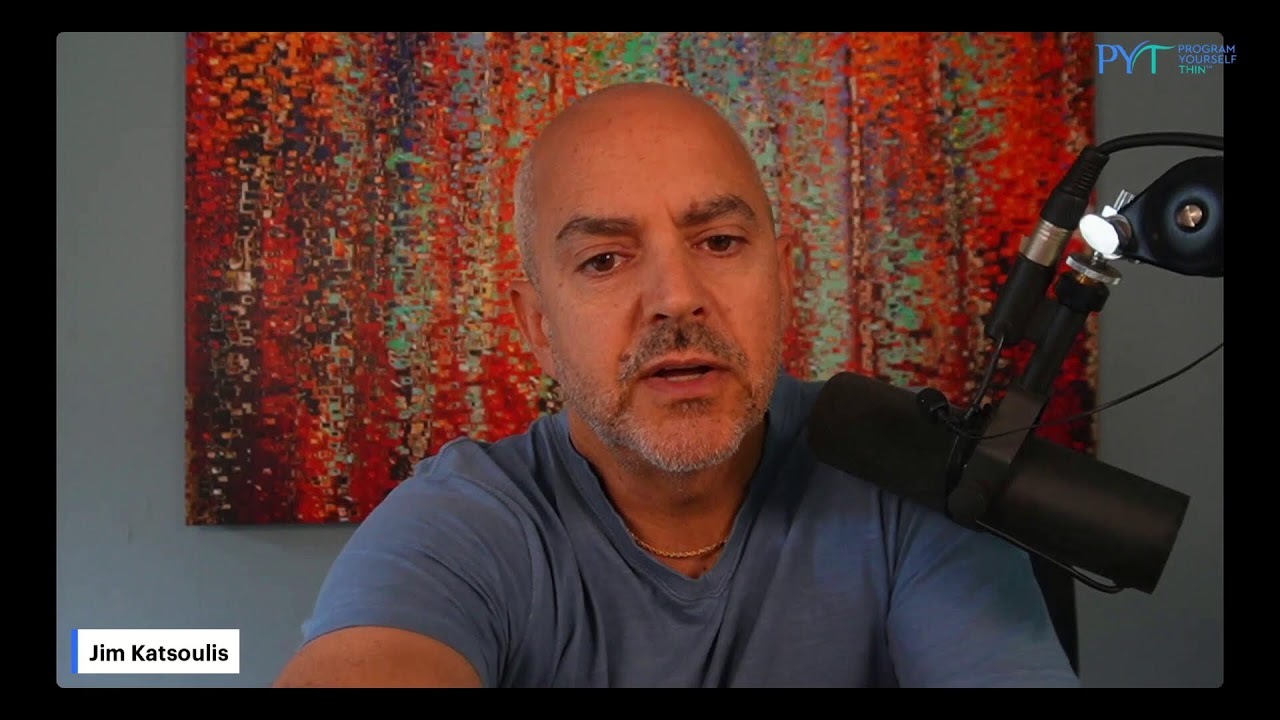
Jim Katsoulis describes his mindset approach to weight loss, using a personal pizza binge in New Haven as an example. The key is to fully feel the physical and emotional consequences right after eating, not distract from them, so your brain learns to associate the food with discomfort. His Program Yourself Thin system combines mindset work, lifestyle design, and optional medical tools as an alternative to traditional diets.
Chapters
Hey everyone, welcome to today's Program Yourself Thin podcast. Today we're talking about what I did after I binged on pizza. I want to talk about this because Everyone's gonna go through this no matter what. There's always gonna be times when you overeat or binge on foods, and whether you're at your goal weight or want to get there, being able to manage this is one of the most important things because you're gonna make mistakes. And the secret is, what do you do after you overeat? When you binge on something, what do you do after it? Because that's actually some of the most useful time in the entire journey. And so to give you a little bit of backstory, I love pizza, and I went down to New Haven this weekend to go and eat pizza. That was literally the main reason I went down there. And at one point I was expecting to go to 3 pizzerias, and I was getting a little nervous. How am I gonna do this? I'm gonna enjoy it, um, after the first 2. Uh, so we did end up going only to 2 of them, um, but ate way too much pizza. And it was really interesting because I felt like shit. Driving home the rest of the night, and honestly, even the next morning and day, um, didn't feel the greatest. And I wasn't alone with that. The people I went with kind of felt similar as well. Uh, but it's how I utilize that that I think really makes the difference, and it's something you can really learn from and use in your own experience. Because what it does is it allows you to use the mistake as A tool to move yourself towards your goal. And I know that sounds weird, right? Because we usually think as soon as we're doing great and as soon as we make a mistake, it feels like we blew it all. But I don't think that way at all. I think when we make the mistake, that is some of the most fertile, useful time right there in order to reprogram ourselves and how we think about foods that can help us move towards our goals more effectively. So the first thing about this, and I want to get into the specifics of it, is really just the general mindset. You know, when you look at your mistakes as an opportunity to learn, grow, evolve into a better version of yourself, an opportunity to kind of program yourself to move yourself in the right direction, it takes a lot of the pressure off of your mistakes. Because that's one of the biggest things, is that a lot of times dieters are so subconsciously worried and anxious and fixated on the mistake they may make that they build it way up into a big thing. You know, remember, managing your weight is a forever process. It's a— managing your weight is a forever marathon, a lifetime marathon, right? Because if you want to live at your goal weight, you're always going to have to kind of interface with it and figure it out, and there's going to be ups and downs forever. Uh, so once we realize that, we take ourselves out of that diet mindset where we think, you know, we've got 1 month to lose 10 pounds. Take that pressure off of yourself and Realize that when the mistakes happen, and they're going to happen, it's not a big deal if you learn from them. Okay, so that's kind of the first kind of 10,000-foot view that mistakes really don't have to be the end of the world. It's not a guarantee that you're going to fail now because you make a mistake. That's wrong thinking. You're going to make mistakes. It's unquestionable. It's impossible not to on a long enough timescale. So how do you get back on track and how do you utilize it? So the next step is that when you overeat, especially this is really helpful when you overeat, is as soon as you are done eating, now connect to that consequence. There are 3 phases of eating: anticipation, consumption, and consequence. And 5 seconds after you take the last bite, the consequence phase begins. And a lot of times what happens is people, when they get into the consequence phase of their overeating, They actually disassociate. They might distract themselves with a screen, phone, TV, computer. They may beat themselves up, which is actually a disassociation technique. So what ends up happening, though, is they basically disconnect themselves, ignore how they feel. And so, no, you want to do the opposite. You want to recognize how you feel physically, mentally, emotionally, and honestly. Mentally and emotionally is typically one of the more powerful parts. Now, when you really overeat, the physical one can be powerful too because you feel so full. You feel so, um, kind of tired from it because, again, remember, all the blood in your body goes down to your stomach. It takes a lot of energy to digest food. And when you overeat, you're always gonna feel that aftereffect of low energy, um, kind of lethargic, don't wanna move a lot, feel heavy, brain's moving a little bit slow. There's kind of a fog going on there. That's pretty typical. So the secret is instead of beating yourself up, oh my God, why'd I do that? I'm always doing the wrong things. What that does is psychologically actually disconnects us. It disassociates us from the experience of being in that body and mind that just overate. So you wanna connect to that because to put it another way, when you overeat, when you binge, there is a hangover. And ironically, that hangover starts almost the second you stop eating. When you really overeat, and you can feel your stomach stretched. You could feel the fullness. You could feel the heaviness, and that's the initial physical piece of it. The next piece might be the mental piece. What do you say to yourself? Right, and usually you're pretty mean to yourself. Right? You're thinking about how you screwed up, how you always screw up, how it's never going to work, and you're beating yourself up and saying mean things to yourself. So that's important to recognize too. And then finally is the emotional piece, which is how do you feel? Do you feel successful, confident, happy, motivated, or do you feel frustrated, sad, irritable, hopeless, depressed? And again, it usually trends towards the latter. So it's important to just sit in the consequence, in the experience of actually being overeaten and being in that overeating body, because what it does is it associates a different Association to the food, because again, if we only think of food and the anticipation and consequence of it, that's the part that drives us to eat it. If we disassociate and ignore the consequence piece, other than the weight gain, right? But the weight gain's too far away; doesn't matter. But if we steep ourselves in the actual consequence that follows poor food choices, it has a huge impact on our nervous system. And eventually, what ends up happening is when the next time because oh, I want to eat a bunch of pizza. Ah, no, I don't. Last time I did, oh my God, I felt like shit. And that's what I felt like. I felt like shit. I felt like shit for a good solid 24 hours afterwards. And I was very aware of it though. Wasn't beating myself up. Now again, this is something I had planned, so it wasn't like a spontaneous thing. But even if it just happened spontaneously, it's the exact same process of connecting to the consequence and realizing, oh my goodness, this really feels like shit. Oh my, I don't want to move. I don't feel like doing anything. My brain's working at half speed. When you start noticing all those things, you associate them to that behavior. And it is that association that really drives your behavior in the future because you have never messed with the association. You've eaten all the food, focusing on the anticipation and consumption. You've enjoyed it. And then as soon as the consequence phase starts, you disassociate by either ignoring it or by beating yourself up. And neither of those change the association you have. And that is the secret to changing your eating long term, is to change the associations that you subconsciously have with the different foods and behaviors that go with them. And as you learn from that, as you grow and evolve from that, and you come out of the mistakes with more reinforced programming that drives in the direction you want, this is what makes the changes. So I hope this helps you out. If you want to go deeper into this way of thinking, this way of approaching your weight, click the link in my bio and go get the free hypnosis session I made for you. It's called The New Thin Me, and you can get it at programyourselfthin.com and/or click the link in my bio if you're on social media. And if you're on Facebook, you can actually just type mind, M-I-N-D, into the comment, and it'll automatically kind of get you going with that whole process. So you don't have to go anywhere or do anything. It'll kind of set you up with that whole thing. And if you have any questions, feel free to ask them. Any weight loss questions are welcome. I have been If you don't know, I've been working with people to manage their weight for over 20 years. So whatever challenges you may be having, I have probably worked with someone on that. What's up, Jody? Jody says, Jim, were you doing a challenge that you went to multiple places? What did you think about the New Haven pizza while you were eating it? Oh, I loved it. I thought it was so good. Where'd I go? I went to— I had been to Pepe's before. um, Frank Pepe's, which is my favorite pizza. It has been my favorite pizza for a long time, um, and continues to be. So I'm really glad that I went there first. Um, it was super good, uh, and we got to eat at the original and it was so good. And then, um, I've had Sally's Pizza before and I like that a lot. We didn't go there and I kind of wish I went there, but I'd never been to Modern and I went there, uh, and I— it's not really my favorite pizza Uh, it was good for sure. It's really good. But ultimately, my favorite pizza, me personally, is Pepe's. And I am looking forward to giving Sally's a fair shot. So I'm looking forward to at some point, um, just really focusing on Sally's. But boy, Pepe's really is my favorite. Oh my God, their white clam pizza, uh, is just phenomenal. And I am kind of a, uh, What would you call it? I'm interested. I make pizzas as well. I make a lot of sourdough bread, which I've come a long way with, but now I'm working on the pizza. So I wanted to model how they did the pizza. So I was excited to, uh, make my own version of Pepe's, uh, at my house, which I'll be working on. But yes, it was, it was, um, oh my God, boy, the pizza there, it is amazing. If you live on the East Coast, that's the first time I've been there. It's the first time I've been to New Haven. So yeah, while I was eating, it was amazing. The first pizza, I gotta be honest. The second pizza, I tried pacing myself. The second pizza, you know, I— this might sound messed up, but it's kind of like— yeah, this is stupid, but it's like pizza Ozempic, you know? I ate so much pizza at lunch that I didn't really have much food noise for pizza for dinner, but I was there and I promised myself I would do it. So I don't feel like I'm giving modern— Pizza. A real fair shake because I was pretty full from the first pizza 3 hours earlier. Uh, they ate too much of that one. But, uh, but even still, it just— it wasn't— some of the things of that pizza weren't just what I like as much as Pepe's, and I love Sally's. So yes, I, uh, it was kind of funny. But yeah, it was super good. So if you've never been to New Haven, it is worth the trip. I would say it lived up to all the, the hype. Um, it was really good. And yeah, old school too. Old school. So yeah, that was a lot of fun. We had a fun time. But yeah, if anyone has any questions, feel free to ask them. We talk about weight loss here and we talk about it in a different way. Program Yourself Thin is really an approach to managing your weight that doesn't rely on diets. Okay, diets without question are proven to not be effective long term. There's not a single diet that Rises to the top when it becomes long-term. So you know, that's what we're talking about here is ways to manage your weight that don't involve dieting. And this is very applicable. You know, I know obviously GLP-1s are the big story in weight loss. You know right now, but as effective as they are in turning down the food noise and decreasing people's hunger and appetite. There are other approaches too, you know. And again, with Program Yourself Thin, I always say let me just show it to me. Flip this screen around real quick. There we go. With Program Yourself Thin, we really kind of follow the goal weight pyramid, and so you can kind of see what that entails here. But the big point is that this is a more comprehensive, holistic strategy to manage your weight, and most likely you've never been exposed to something like that. I, I can't think of a lot of holistic— whoop— I can't think of a lot of holistic, comprehensive approaches to managing your weight that I know of. So this is, uh, that. And, uh, again, there are other ways to turn down food noise beyond just GLP-1s. And so if you're on a GLP-1, you know, this to me is the path to avoiding the rebound if you decide to come off of them. And if you're not on GLP-1, this is how you avoid it, you know, the entire time. You know, if you get your mindset right, if you get your lifestyle right, if you get your eating right in a way that works for you, that to me is the kind of golden road, you know, to getting to the weight that you want to live at and being able to stay there. And that's the other key piece, is that dieting really conditions you to lose the weight temporarily, but it's not a plan for long-term success. And unfortunately, a lot of people internalize that as it's the their fault. There's something wrong with them that they can't stick to the diet, when the reality is that diets aren't meant to be stuck to. Diets really are kind of an over-response, a short-term over-response to a chronic problem. Your chronic problem stems from how you think. Again, your weight is really a reflection of your mindset. You take my brain and pop it in your head, I promise you, you're going to start losing weight. If you're overweight, guaranteed. The way I think about it is totally different, and I used to be 50 pounds heavier, so I know what it's like to think totally different. And so yeah, the weight's different, but the weight's different because the mind's different. And this is what I've been able to work on over the last 20 years professionally, um, with thousands of people. It's consistent because when you change how you think, when you change how you live, and when you change how you eat in a way that really resonates with you, You get different results. Um, Jody says, yeah, Modern has been off and on recently for my kids. Did you hit Libby's for dessert? Yeah, of course, of course I hit Libby's for dessert. So not only did I overeat too much Pepe's, but then we go and go to the bakery and, uh, got a bunch of shit there. Yeah, so Modern, I didn't really get a fair shot, but like I said, Modern just— I, I— it just, it's not my— compared to the other 2, I like that style more. And Pepe's is just the The main one. Yeah, it's been off and on, huh? Yeah, never eat at Modern. So yeah, I'm glad I did it. Um, and you know, I didn't know what I didn't know, but knowing what I know now, I would go— I would have gone to Sally's, which I wish I'd done. But that's okay, you live and you learn. And it's not even that far. I don't know. Anyways, but on top of that, anyways, I, I actually am lucky because where I live there's actually a Pepe's and a Sally's probably an hour south of me. So I don't even have to go to New Haven. I can go to those. I don't know if there's much difference between those 2, um, places. I do know— my God, the Sally's at the mall— I forget what the name of the mall is, but it's got a TV screen that is like 6 stories high. It's, it's kind of weird. So it's so funny because on one hand you have the Sally's in New Haven looks like, you know, it's just a pizza place from 1950 or something. That's— it looks like a really old building in place. And then you have the other version of the mall, and they went and they got like a literal— like an IMAX screen on the wall. Then you sit this far away from eating your pizza. It's kind of weird, but the pizza is really good. So anyways, but enough about pizza. Uh, yeah, any weight loss questions are welcome. If you're struggling with anything, feel free to ask some questions. Um, I get on every day because again, for me, my mission in life is to help as many people as possible live at their goal weight. So Um, this I take very seriously. If you don't know, my father died of a heart attack at 54, and I believe his weight and his eating were a big part of that. And so for me, helping people manage their weight is way bigger than, um, just looking good in your jeans. It's also helping you to live longer and have the best quality of life possible, um, while you're here, you know. And so I've worked with a lot of different people on a lot of different diets, a lot of different challenges. And usually I'm able to offer some perspective that you don't normally hear. You know, you usually— I think with dieting, you kind of just hear, just do it. You know, with dieting, like, the answer is always the same. It's usually a willpower one, right? Just come on, just, just do the right thing. Just make yourself do it. Just say no. Just— I don't know. It's this idea of relying on willpower exclusively, to me, does not seem like a good strategy. Now I can't answer that for you. I mean, has it worked well for you? I mean, if anyone's here and the willpower hasn't worked well, maybe it's not you. Maybe the answer isn't to just have even more willpower, right? Like the idea of tracking like every calorie— are you really gonna do that forever? You know, is that really the plan? That's a tough plan, you know. And again, I think dieting reveals itself very quickly as a short-term strategy when you consider doing whatever diet you may have tried for the rest of your life. And if you like flinch from that idea, that, that could be a sign that that's not a very good plan. Because the question behind that is how long you want to live at your goal weight for? How long y'all want to live at your goal weight? I'm assuming we'll be here forever. I'll live my goal weight forever. Okay, well, if you want to live at your goal weight forever, then how are you going to do it with a plan that you can only follow for a little while? And that's the part, you know, I don't know. I don't think dieters think about because I know what dieters. I know. I know what you're thinking. Well, Jim, I got to get there first. Yeah, well, I get that. But the way you get there is the way you're going to stay there to some degree, right? If you fight to get there, you're going to have to fight to stay there. But what if you don't fight to get there? What if you approach your weight with a more strategic, calm mindset and you ask questions like, how can I lose weight in the easiest, most enjoyable, comfortable way possible? Now I know you don't have the answer to that question. I know that. But the bigger point is, when's the last time you asked that question? And I know the answer is never, because dieting has conditioned us to look for the hardest way possible. Subconsciously, most people, most dieters especially, they associate they associate the harder the plan is, the more intense and rigid and strict it is. The better, right? Because the harder the plan is, the faster you're going to get results. That's the thinking in the background. And so most dieters are walking around thinking that the answer to losing weight is to do something extreme. And listen, these are all extreme things that we have in front of us. Intermittent fasting is an extreme way for most people to jump right into. Weight Watchers is extreme. Yeah, you're gonna— every single thing you eat now? I mean, are you not already up to here with life? I mean, do you just have an abundance of mental energy and, you know, focus to spend on tracking every calorie, whether you write it down or whether you call it a point and gamify it? It's extreme in that sense. Um, keto is obviously extreme. Keto's goofy. Um, GLP-1's extreme, you know. Again, I'm happy that it's working for some people. But again, as a long-term solution, we will see. We will see if people are willing to spend that money, inject themselves, never really enjoy food the way they used to again. We will see. You know, so in the meantime, Program Yourself Thin is an approach that is comprehensive and holistic, that addresses what I believe really are all the main factors that are going to dictate your weight ultimately. And the key thing about Program Yourself Thin is that it was really created and designed by studying people that successfully lost weight and kept it off. That's the big thing. I am an NLP trainer. NLP is neuro-linguistic programming, and NLP is all about role modeling. And so this is where my journey started over 30 years ago when I was 50 pounds heavier and just, just stuck in my head with how to change up what I was doing. This is what I start— kind of kickstarted me, is I learned about NLP and role modeling, right? The idea that if someone's getting the results you want, then you can get those results too. But it's not just about copying what they do, it's about copying how they think, right? How do they think about these things? And, uh, the easiest way to figure that out is to speak to people that have successfully lost weight and kept it off. And not just ask, oh, what do you eat? What do you do? You know, tell me what you did. Not just that stuff, but honestly, what's going on in your mind, right? What's going on in your mind? How do you think about food? What do you do when you screw up? How do you get yourself back on track? How do you get yourself to do these, these new habits you've been doing? How do you, how do you get them to yourself to do them? How do you stick with them? You know, how do you do this? And I think that the more You ask those questions to people that have the results you want, the more it becomes pretty obvious. You know where where the answers are. But dieting is not built like that. Dieting is really again it's it's a strategy. The diets are owned by the big food companies anyways, by the way. The diets aren't your friends. You know you know a lot of people know this. Weight Watchers was owned by Heinz. Jenny Craig was owned by Nestlé. SlimFast is owned by the same company that owns Ben Jerry's ice cream. So, you know, these companies, I don't think they really want you to lose weight and stop eating their products. So a lot of dieters and people that want to lose weight just feel mystified. They're just confused. They're not sure what to do. And, uh, I think it's very intentional because I, I don't know, I'm one person who's put together an entire system that I've put people through and watch them get great results. So I don't know why we don't get this information more in our society, but that's why I'm here every day to talk about it and hopefully move you all along. So yes, if you do have any questions, if there's anything you're struggling with, any weight loss, you know, challenges you're having, let me take a swing at it. Let me see if I can give you a perspective on it or any semi-advice or a new way to think about it that may put you on a different path. Because this has been the last 20 years of my professional life, is smart, successful people that feel stuck with their weight. And, you know, let's be honest, I mean, before someone works with me, they're pretty apathetic. I mean, that my typical client is usually 45 plus, you know, usually a woman, um, smart, successful, driven, action-oriented, Usually a perfectionist, usually an overthinker, and they have tried for decades to manage their weight. And usually they've had some successes, but they can't maintain it. And eventually what happens is those people get to a point where they just get apathetic and they say, well, geez, what's the point? What's the— because that's how you know you're in trouble when you start a plan and you start losing weight and you still feel discouraged. Right, so have you ever felt that way? You may have. If you have felt— if you've started a plan, you actually got yourself to do it and you actually lost some weight, and then you have this weird feeling in you of like fear or indifference or disappointment, and you say, what the shit, how come I'm not excited about losing weight? Well, because you, you've lost weight before and put it back on. Is there anything as devastating as when you lose weight and then put it back on? You do that enough times and the brain says, "Oh shit! Stop! What are you doing? Hey, it's the point." And so a lot of people that start with me are at that point. I don't even know what the point is anymore. I just I can't do it. Must be something wrong with me. And that's what a lot of people I think end up kind of at is they say, "There's something wrong with me." Other people can succeed with keto, but I can't. I don't know what's wrong with me. And then you come up with whatever story, you know, you may tell yourself. But I believe, from my experience, what I see the bigger reason, way bigger than your willpower, there being something wrong with you, is that you don't have a real strategy to manage your weight. Again, let me just show you in Program Yourself Thin the kind of general plan we follow. And I would just want to point out that That most likely you've been focusing on your weight for decades, and you have never focused on any of these things—not in any systematic way. Yeah, you've said, "Oh, I know I don't need a diet. I need to change my lifestyle." You've said that. You said, "I don't need a—you know what I really need to do is change my mindset." You might have said that, but you've never had like a strategic, structured plan to actually do it. And even the eating, you know, most likely you've never really done this kind of eating where you figure out what works best for you. You kind of do what I always say, like this is a diet right here. It's about that much of the pyramid. You see that tiny little little bit at the top? That's me saying, okay, don't eat carbs. That's me saying, okay, count every point and restrict. Don't eat for sixteen hours, right? And you never do any of this work, you know. And in my experience, that's one of the main reasons people struggle with their weight. Is because they don't have a real plan. And I think once you have a real plan and an understanding of how your mind works, how your behaviors work, how your cravings work, how your eating works, uh, you can set yourself up for success. Yeah. So yeah, you have any questions, feel free to ask them. If not, I'll wrap it up. Sometimes things are quiet. I know this is a funny week. This is one of those weeks where, uh, people are kind of getting ready. Getting ready for next week when the when the year officially starts right after Labor Day. That is a big thing for people. Very good. All right, let's wrap it up again. If you're not my world, click the link in my bio and go get the free hypnosis session that I made called the New Thin Me, and it's completely free hypnosis session ready for you. All you need to do is click the link in my bio, go to programyourselfthin.com, type mind into Facebook comments if you want, and it'll send it to you automatically. And if you like this, I'm here every Monday through Friday at noon Eastern, and if you can't make the live, it's also
More from Jim



Weight Loss Visualization: Wake Up in Your Dream Size #programyourselfthin #weightlosshypnosis



What If You Pretended to Be Thin for One Hour? #programyourselfthin #weightlosshypnosis




