Rest To Lose Weight
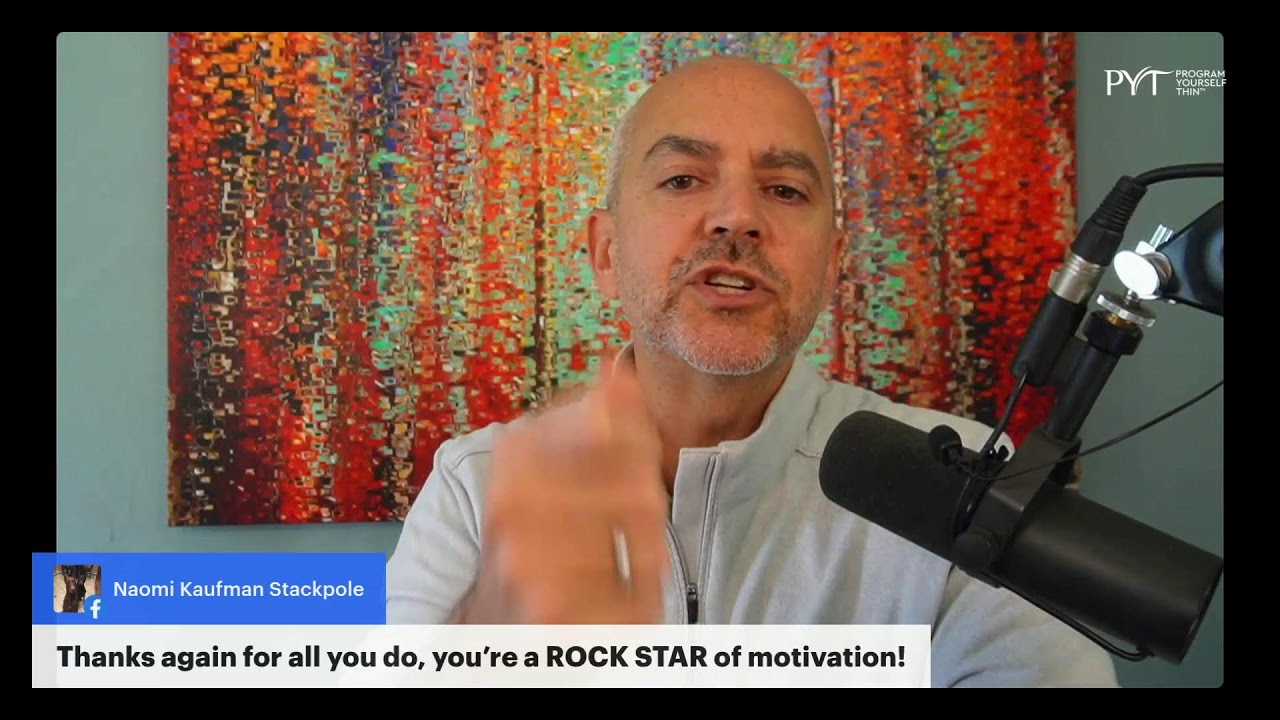
In this extensive live session, Jim Katsoulis argues that true, lasting weight loss stems not from relentless exertion or restrictive diets, but from intentional rest and recovery. He explains how chronic stress, elevated cortisol, and mental fatigue sabotage eating choices and drive overeating. By reducing stress, grounding oneself, and practicing quick relaxation techniques, individuals can naturally make healthier food decisions and lower their average calorie intake. Katsoulis critiques the diet industry’s focus on calorie restriction and short‑term struggle, emphasizing that an "overweight mindset"—a set of habitual thoughts and behaviors—must be replaced with a "thin, healthy, happy" mindset. He outlines his "Program Yourself Thin" framework, which integrates mindset work, lifestyle habits (sleep, hydration, stress management), and eating strategies into a skill pyramid that runs on autopilot. Throughout the session he engages with community members, offering personalized advice, hypnosis sessions, and free training resources, while addressing common challenges such as menopause, intermittent fasting, night snacking, motivation loss, and post‑weight‑loss anxiety. The overarching message is that sustainable weight management is achieved by shifting from a struggle‑based diet mentality to a restorative, mindset‑driven approach.
Chapters
Rest to lose weight. That's not something you usually hear. Typically, when you think about losing weight, you think about the opposite of rest. You think about exerting a lot of effort and energy, whether it's just mental energy of controlling all your eating or physical energy of working out really hard. We tend to think about an exert— exertion of energy when we're going to lose weight, when ironically, the thing that usually supports weight loss certainly long-term and usually short-term too, is when you get some rest, because there's a good chance that you are at your limits, let's say, if not beyond them. Exhausted, tired, stressed out. If you're one of these people who's kind of just like up to here with everything, to add a whole bunch more on top of it is not a great strategy because you have less energy, physical, mental, and emotional, to create the changes that you're looking to create to get the results you want to get. And so while it may seem appealing to go all in on a plan and force yourself to follow it so you get the results, when you zoom out just a hair, it becomes real obvious that that's a good short-term strategy perhaps, but it certainly is not a good long-term strategy. And this is what tends to lead to people burning out before they ever get results. And even if they get results, this is what creates the stage, sets the stage for not being able to stick with it. So the alternative is something that a lot of people never consider, that when you want to lose weight, you actually start to rest. You start to take your foot off the gas. You start to slow down. You start to look for more opportunities to say no and to recover, rejuvenate. Um, and then when you approach it this way, you find that a lot of times the stress and the kind of up-to-here nature of reality was a huge part of what was causing you to make unhealthy food choices. So now when you rest and recover, a lot of times you're naturally making better food choices. You may be eating a bit slower. You may be able to have more ability to stop yourself, you know, when it's the right time. And you may have more control ultimately over your behaviors without doing anything else. Just having some more rest, and this operates on so many levels. You know, when we're stressed out, it's not just that we're kind of you know the obviously there's cognitive effects, right? When we're stressed out, we're not thinking as clearly. We're not as grounded. We get more swept up emotionally. We're we're more reactive. We're more unbalanced biologically, physiologically, biochemically. We've got higher cortisol levels. And there's things going on that are nudging us to overeat, to eat more, to crave unhealthy foods, and have less ability to direct that process. So if that's what you're dealing with, to add more stress to it to try and control all that stress that's currently there, again, it's just a matter of time, you know, until you run out of steam, you run out of energy. So the alternative is to really focus on relaxing, calming down, resting, rejuvenating. And doing the simple things that start to calm the whole system down in the opposite direction— physically, mentally, emotionally, biochemically. We want to walk a path that starts to make us feel more grounded and calm. And we do this with the expectation that over a week, 2 weeks, a month, 2 months, we're going to start to feel different. We're going to start to think different. We're going to see things differently. We're going to behave differently. This is the idea, and the beauty here is that while it may take a little bit longer, it's a lot easier and more comfortable. And when you are able to make better food choices and ultimately lose some weight in a comfortable, grounded way, one of the coolest parts about it is it starts to dawn on you that I could keep this up. This hasn't been that hard. This actually is kind of easy. And once that happens, it is like a light bulb goes off because you start to open up to the possibility that weight loss doesn't have to be this difficult, stressful, miserable process. Instead, it can be something that you weave into your life comfortably, enjoyably, in a way that not only helps you lose weight but makes you feel better, in a way that makes you become a better version of yourself. And becoming more rested and calm and grounded helps you in every area of your life in addition to your weight. And this is what sets you up for long-term success. And again, a lot of people just kind of brush right over this part in order to get to the difficult plan, the one meal a day, the intermittent fasting, the keto plan. We add more stress on because we think we're going to get the faster results that way. But it's an illusion, and the fastest, longest-lasting results tend to come from focusing on rest and recovering and getting yourself back to a more powerful state where you naturally make better choices and have the ability to influence yourself at higher levels. So let's just take a second and do that. And I want to point out that it really, within a couple seconds to a couple minutes, You can rest in a profound way, and I want to make that that really clear because I think a lot of people overlook the the fact that you can relax and rest very very quickly. There's levels to it. Obviously, you know, there's taking a week or two off from work and just totally sleeping and relaxing and recovering. That's an extreme version of rest, but we need to have everything in between there. And what's most practical and useful for most people is when you're able to rest quickly. Many times, right? I'm going to show you how quick it can be because if you follow along, if you take a second right now and you can do this with your eyes open, your eyes closed, doesn't matter. Um, and whatever situation you're in right now, if you bring your attention inwards and you pay attention to relaxing the muscles in your face, your jaw, your shoulders, your chest, your stomach, relax those muscles as deeply as you can. Now connect to your breath. You don't have to take deep, deep breaths, but take deeper breaths than you were taking. And when you exhale, slowly exhale the air out. And just kind of stay in this place for a moment where you physically relax your body and you connect to your breath and you just breathe more deeply. Okay, and exhale more slowly. Now what I want you to do is I want you to imagine, let's just say today, whatever you've got planned for today, whatever you expect to do today, I want you to imagine doing those exact same things. So nothing's going to change in terms of what you need to do, but I want you to take a moment and imagine doing those things from this relaxed, grounded place. So maybe you're going to a restaurant. Imagine going to the restaurant With you being relaxed and calm and grounded, connected to inside of you and overlooking it and keeping relaxed and calm in there. So you can do these responsibilities, you can do these different things, but you can do them in a different way. You can certainly imagine yourself doing them in a different way for sure. So take a moment and play your day out in your mind, but imagine yourself feeling relaxed and calm. Imagine there's a dial and as you turn it up, you feel more relaxed and calm. Imagine cranking it up and now see yourself moving through your day, being more grounded, more calm, breathing into yourself comfortably. And notice how you imagine yourself acting and experiencing those different situations. Notice how it feels to imagine yourself being rested and relaxed in those scenarios. How do you imagine yourself thinking, feeling? Behaving, eating, responding, speaking, all the little subtleties. And again, the longer you spend in this, the more subtle and granular you get, the more powerful it becomes. But again, just take a moment now and just imagine that you crank up the relaxation for the rest of the day. How would your day go if you did that? And now you're getting a sense of really what we do in Program Yourself Then, which is to ground ourselves within ourselves to have that ability so that we can do it at any moment in time. We can do it while we're in the car driving in traffic. We can do it while we're waiting in line at the grocery store. We can do it while we're, you know, at work working on a computer. Anytime we choose, we can bring our attention in and ground and relax ourselves. When you start doing this more regularly, it increases your rest. It helps you sleep better. It helps you eat better, helps you hydrate and do the things that keep you feeling good. And then on top of that, we use our mind to imagine ourselves being this version of ourselves in our life. All the different scenarios that we kind of subconsciously and automatically freak out and worry about, we intentionally take a moment and imagine ourselves in that scenario being relaxed and calm and grounded, naturally, easily making the right choices. Now, at first it exists in our imagination, but eventually what happens is it starts to become reality. All of a sudden, imagining ourselves being relaxed and calm in the scenario turns into being relaxed and calm in the scenario. That takes a little bit of time, but it gets there. And eventually what happens is you start to think of yourself as this person. And so you're transforming yourself from the inside out. It's not just forcing yourself to eat different. It's about imagining yourself being a better version of yourself, a more powerful resourceful version of yourself. And the more you imagine yourself that way, and the more you practice being that person, the more you become it. And this is what gives you a solid foundation to build your new goal weight on. And this is how it lasts. So I hope this makes sense to you. And if you want to go deeper into this process, click the link in my bio, uh, or go to programyourselfthin.com. Or if you're on Facebook, you can type mind, M-I-N-D, Into the comments, and I'll send you the session. I'll send you a link immediately, and you can get going with that. But again, there is a better way to approach your weight than dieting. I promise you, and it revolves around the idea of kind of going inside yourself and connecting to your best qualities and really building on top of them, and beginning to imagine yourself as the person you want to be. So go check that out. It's free, and it's going to help you out. If you have any questions, feel free to ask them again. I'm here every Monday through Friday. So if you ever have questions about weight, I am happy to help you. It is. is part of kind of my mission in life, I would say. And so I love to get on here and talk to people about weight. And I hope you're all having a nice Friday. Um, boy, it feels like the first Friday of the— feels like the first Friday of the fall. So I hope you have a nice time. Uh, I've been struggling with weight loss for 5 years. I'm 25. All right, so since you were 20. Um, Dream life when I lose all of this BS. Yeah, well, you know, you're, you're younger, so, so that's— I think it's more helpful, I guess. I don't know, there's the, the exuberance of youth and the energy of youth versus the wisdom of being older, so I can't say that one's necessarily better. Well, yes I can, you know. I think it's harder. I think, I think when you're younger it's harder. It's just more tempting to go with the diet bullshit because you just got more energy, got less Wisdom, you know, and wisdom really is just experience. You know, somebody just frame reframe it. But I say this because most of my clients are probably 45 plus, and I think most of my clients get to that point because at that point they've got 25 years of failed dieting attempts behind them. And so, you know, they're finally more open to an alternative, you know, approach. But yeah, when you're 20, although I did, I started when I was 19, so it's certainly not impossible. But you really do have to shift your mindset. Because I do think that, you know, when you are younger, it's just easier and more appealing to just go the diet mode. And when I say diet road, I mean workout too. Whether it's a strict diet or whether it's a strict workout, you know, they're one and the same. They're both set up for the short term. So again, I think as you get older, you start to realize that if you're going to do something, it better be something you'll be able to stick with, or otherwise, what's the point of putting the energy and time into it? So, um, yeah, but again, I've been struggling with weight loss for 5 years. Uh, for me to help you, Spader, you'd need to get a little bit more specific. What specifically have you been struggling with? Because most likely you haven't been struggling with weight loss, you've been struggling with eating and behaviors. And this is a huge difference, folks. And I hope you recognize that I'm just— I'm not just getting stuck on semantics for no reason. Uh, words matter, concepts matter. And when we say things like, I've been struggling with, with weight loss, It's so vague and so unhelpful that there's almost no escape from it. You know, it gives no information there, you know, about what the specific struggle is. And when we say I've been struggling with weight loss, it's very unclear what exactly is the struggle. Is it that you've been eating perfectly and the weight's not coming off? I know it's not that, but you may think it. Is it something, you know, is it some other, you know, situation that's going on? Um, it's probably that you're— you want to behave a certain way and you're unable to get yourself to behave that way. That's probably the more specific description of the struggle, if I had to guess, you know. Um, but yeah, this is what a lot of people, um, are dealing with. Um, says, in menopause and HRT, struggling to lose weight and 59. Again, um, the struggling to lose weight, folks, We've got to get more specific. You know, struggling to lose weight is so vague, your brain has no way to resolve that. Okay. And when we put such a big description of I'm struggling to lose weight now, again, when you precede it by saying in menopause and HRT, now what we're subconsciously saying is that I'm struggling to lose weight. I'm doing everything right. I'm doing all those things, but my body's not letting the weight go. That's why struggling to lose weight a lot of times is a direct line to Well, I'm doing everything right, but my body just won't let it go. And I have never seen that happen. I've— I personally, and I've done over 6,000 private weight loss sessions, I've been doing those over 21 years, I've never seen someone that makes a shift in their calorie consumption that doesn't lose weight. It may take a little bit longer than it took in the past, I won't argue that, but I've never seen someone lower their calorie consumption, their average calorie consumption, and not lose weight. So every time I've worked with someone and they come with the struggling to lose weight, when we really drill down into it, it's really, I'm struggling to influence my behaviors effectively— eating, lifestyle behaviors, things like that. And now all of a sudden, we're— now we can work with something. But struggling to lose weight is so big and vague. That's like saying, I, I'm struggling with money. Well, what does that mean? I mean, do you spend too much? Do you have too much debt? Do you not make enough money? Do you not like to go to work? I mean, there are just so many possible reasons why that's happening that you're giving your brain such a vague problem that it just can't figure out the solution. So we need to get more specific. What specifically are you struggling with? And I would like to hear a behavior as opposed to, I'm doing everything perfect and I've been doing everything perfect for 5 years, Jim, and the weight's not moving. I've never heard anyone say that to me. So when we drill down into it, it's almost always, you know, I start off strong and then, uh, and I'm doing good, and then nighttime comes. Or, you know, it's usually something like that. What's up, Pamela? How's it going? I see you over there in Facebook land. Uh, and I am on Facebook a lot now, so if you do, if you do kind of check out the show and are, you know, watching my reels or any of the rest of it Facebook is definitely kind of the main social media location for me moving forward. I do a lot of TikToks too, but on Facebook I have the opportunity to kind of post lots of different types of stuff. So if you do follow me on anything, I would say Facebook is a good one to check out. Yeah, user 592 says intermittent fasting. Okay, so there we go. So they start by saying, you know, I'm on menopause and HRT, struggling to lose weight at 59, and then they go down and say intermittent fasting. And so more specifically, you're probably struggling to stick to your intermittent fasting routine. So those are 2 different things though. I hope that makes sense to you all, right? It's not just picking— it's— I'm not just picking at words. If I come and say I'm struggling to lose weight, well, that, that implies, oh, I'm a menopausal, I'm HRT, and I'm struggling to lose weight. It really just sets you up to believe it's because something's going on here that I have no control over. When we say, "I'm having, I'm struggling to stick to my intermittent fasting protocol," well, that's a totally different thing to say, right? And now we can. There's a lot more detail there. We can get specific, and now it's a much more interesting conversation because what are you struggling with intermittent fasting? Because don't tell me. I am. I can almost guarantee user five nine two will not say, "I've been intermittent fasting perfectly for last five years." And I'm struggling to lose weight. We're probably not gonna hear that. We're most likely gonna hear, my goal is to do the intermittent fasting protocol and I'm struggling with it. Sometimes I do it, sometimes I can't. I'm overeating when I'm doing it. I'm having a hard time getting till noon, whatever. Now that's a whole different conversation with a lot of detail and specifics. I'm struggling to lose weight is so big and vague that it's just— it's a big minefield and, and, uh, a bunch of trapdoors for your mind. So, if you get into specifics about intermittent fasting, you may find that, okay, that's, um— I'm having a hard time sticking with it. Now, if you're a woman in her 50s or, you know, late 40s going through menopause, and you're trying to intermittent fast and you're struggling with it, it's the kiss of death because now, there's nothing special about intermittent fasting. It's just a way to influence consumption of calories designed to reduce average calorie consumption. So, okay, if we compress your eating, you're You're gonna lose weight. There's no magic autophagy bullshit. There's no magic about the last two hours of not eating that intermittent fasting. It's all bullshit. It all comes down to how many calories a day are you consuming, and for some people, intermittent fasting is the magical answer, and it works for them. Great. In program yourself, then we have the philosophy: there's no right or wrong; there's only what works for you. So if you've done intermittent fasting and you're just like, holy shit, this is the perfect fit for me. Stick with it. But if you've been struggling with intermittent fasting for years now, and when you try and do it, you can do it for a little while and then you can't do it, then you try and do it again and it's stressful and it's hard, and every time you do it you're thinking about food, you're obsessed about food, you're getting really hungry, you're struggling to eat the right foods when the window opens— if that's your experience, I'd suggest you get the fuck out of there as quick as possible, because once you start getting menopausal You are more susceptible to the fluctuations of stress hormones, specifically cortisol, and intermittent fasting is stressing a lot of you right out of your weight loss. So you know again, I find intermittent fasting if it works for you great, but if it doesn't, stop trying to make it work. So many dieters trying to fit a square peg into a round hole. Intermittent fasting just ain't working for you, and you just won't stop until it does. And so you get in this, this battle forever to try and make it work, you know. Yeah, User 592 says, have stuck to intermittent fasting and it's not working. How long have you stuck to it? Did you stick to it for a long time? Did you stick to it properly? I, you know, that's the bigger question. Maybe you have. Again, if you— so 2 years, 2 years you've been intermittent fasting, you'd say 90% of the time you're doing exactly as you planned? Is that what you're telling me? For 2 years you've been intermittent fasting the same way you were, 90% on track when you're reading, you're right in your ranges, and you're not losing weight? Because that's what I want to know. It could be, but if that's the case, then that just points us in another direction. Still, okay, yes. So User592 says for the last 2 years they've been, um, intermittent fasting Right according to protocol. So how many hours a day? 16 hours a day not eating, 8 hours of eating. And you've been doing that consistently, following the intermittent fasting protocol for 2 years and haven't lost weight. And 90% of the time you're following it perfectly. That's, that's the story right now. The good news here— well, the bad news is you say, okay, well, it's not working. The good news is it's absolutely working. Yeah, okay, well, for the most part. Well, unfortunately The most part. Um, again, people are very, very bad at estimating what they're doing unless they're very, very specific and strict with it. So for the most part is a huge red flag. Just honestly, it just is, because a little bit of nudging and whatever. What would you say is your biggest challenge? Is it not being able to get through the 16 hours? Is it being too hungry when it's time to eat and you overeat a little bit? What would you say for the most part? What does that mean? I'd want to know when it's not the most part, right? So for the most part, I'm following it. Well, when the parts you're not following it, what's going on there? I would love to know that because I think you'll start to realize it's probably more than you thought, most likely. But either way, let me just bring it, bring it to another level. I would put a lot of money that you're not evaluating as clearly as you are. And for the most part, it's a lot more than you think. That's where I put my money after 21 years of doing this and 6,000 private weight loss sessions. But let's also walk down the path that you're absolutely doing exactly what you expect. You're, you're doing your 16 hours of not eating, 8 hours of eating. Um, you've been doing that for 2 years almost perfectly and you're not losing weight. Well, I say great because now you have structured your eating so well that you're very routine and specific about what you're eating and you're not losing weight. Which in a weird way is great here because now we know that what you're doing consistently is what's going to give you this weight. So now you've got a real clear cause and effect. The way you've been living and intermittent fasting is keeping your weight right here. So now to lose weight, what you would do is you would look at your 8-hour window and what you typically eat in that 8-hour window, and you would dial the calories down a little bit, and you will start to lose weight. Yeah, Shay says give up the struggle, find your peace. That's what I'm learning. Yes, yes, yes, yes. Yes, I agree. Give up the struggle, find your peace. Yes, yes, that's what we're talking about here in Program Yourself. Then I would say in a nutshell, that's it, is that we're looking to stop the struggle of dieting simply because it doesn't work. I love struggling in life. I love Taking action and doing hard things, I love it when it works, right? There's nothing worse though than taking lots of effort and energy to do something and it doesn't work, and that's what dieting is. So I'm not saying don't take a lot of action and put a lot of effort into something. I'm saying stop struggling. And struggling is when you're forcing yourself to do something. If you're forcing yourself to do something, it's probably the wrong path. Now again, it's a fine line. Sometimes we're doing new things and we're working to get ourselves to act in new ways, and it takes focus and energy. We got to keep nudging ourselves in the right direction. But there's a difference between that and struggling with something that we've done 100 times and it doesn't work. And I think if you start to follow that, I think it leads you to a much better place. If you follow your peace, I think you're going to end up in a better place. Now, just following your peace isn't enough either, in my opinion. This is why intuitive eating as a concept for weight loss isn't very effective. Intuitive eating as a philosophy is really about eating in a certain way and finding peace. It's not really about weight loss. So, the people I work with, myself included, we want to be able to manage our weight. So, yeah, we want peace too. We want to let go of the struggle. We want to eat in a way that really resonates with us, and we want to do it so that we're able to weigh what we want to weigh. Yeah. And that's where I think, yes, let your North Star that you're following be, I want to be peaceful, I want to be relaxed, I don't want to struggle, and I want to live at my goal weight. And that's why in Program Yourself Thin, it's all those things, but it's a very, very robust, comprehensive strategy and solution as well. Okay, so where we very, very systematically change our mindset, our lifestyle, and our eating so that we think, live, and eat like a thin, healthy, happy person ultimately. And that is how you're able to change your weight long term in a way that really resonates and works for you. Right. But yes, the quicker we give up the struggle, the better. I would say the struggle is not working. I mean, you all, you all have struggled as much as humanly possible, haven't you? It's not working and it's never going to work again. There's short-term struggle that like when you learn to read and write, it was a struggle. Then we got to a place where now you don't have to think about it anymore. Riding a bike, it was a struggle, but then you got to a place where you have to think about anymore. Using your computer mouse the first time was a struggle, and then you got to a place where you have to think about it anymore. Do you see what I mean? So that sort of struggle is what program yourself then is all about. We want to learn new thoughts, feelings, and behaviors and install them, but then we want to get to a place where we have to think about them anymore. That's the difference between program yourself then and a diet, because with a diet you have to 100% be on track. All the time, you have to you have to be focused thinking about it all the time. It's always a struggle. Dieting never doesn't feel like a struggle for people, and so that's why it doesn't work long term. You know, I just want to point that user 592 that was saying I've done everything perfect pretty much for two years. You know again, they kind of they fade away. That's fine. But I just want to point out when you hear yourself or someone else saying I've been doing everything right, I'm not losing weight. Please don't believe. Believe that. Don't believe that person, and don't believe yourself. It's not a judgment; it's just how our brains work. We're very unaware of what we're doing most of the time. We live in our narratives, and one of the biggest narratives of dieting is that I'm doing everything right, but I'm not. The weight's not coming off like it used to. You got to watch out for that because if you start to believe I'm doing everything right, but the weight's not coming off, it leads you into a powerless state where. There's nothing I can do. My body's changed, so no matter what I do with the weight, it won't come off. The second you think that you're never going to lose weight, you're never going to do the things it takes to lose weight because you don't think it's possible. So, and I've never seen that happen. I mean, that's what the GLP-1s are proving, is that all of these people that would have been considered, oh, my metabolism is broken— I mean, listen, GLP-1s have been used primarily on people that have metabolic disorders. They're at the top of the hill when it comes to unable to lose weight, broken metabolisms, um, metabolic disorders, all this different stuff. And they take the GLP-1 and they lose weight. Why? Not because the GLP-1 fixes their metabolism, because the GLP-1 causes them to consume less calories. So you're taking this giant population of people with metabolic disorders and you're reducing their calories, and guess what's happening? Guess what's happening to them? Their weight's going down. So a lot of times it's easier to say, oh yeah, it's my metabolism that's not working, than it is to say, oh yeah, I'm trying to do intermittent fasting, I do it okay for a month, and then I'm off track for 3 months, and then I get back on track and I'm good for a couple weeks, and then I can't keep with that. That's a more accurate description. And while it may sting a little bit, it leads you to a place where at least there's— you still live in cause and effect world. At least what you're doing is the reason why you're getting the result you're getting. So I'd rather live in the reality of cause and effect than this fantasy land that no matter what I do, my weight won't change. And a lot of people end up there because they're just apathetic, um, you know, from all the diets. What's up, Jane? Jane says, I'm very focused on improving my sleep and my hydration. I've definitely seen improvement and I'm losing weight. Nice job. Yes, yes, Jane. And Jane is a perfect example of that. Knowing Jane as I do, um, focusing on sleep and hydration would be probably 2 of the biggest levers. That's why And program yourself then in the lifestyle piece of it. The 8 lifestyle habits we really focus in on in order of importance are sleep and hydration are number 1 and 2. And so if you're a stressful person, um, sleep and hydration are 2 of the biggest things you could focus on. They really legitimately move the dial in so many ways. So nice job, Jane. Um, Carolyn says, is it really bad food choices because so hungry? Yeah, probably, you know. And again, I get people on here all the time that say, well, I'm doing everything, Jim, and nothing's happening. And I always come back that way. And some people don't want to go into the details of it. Listen, it's hard. I think it's hard sometimes to deal with our own bullshit. We all create narratives in our own mind that kind of protect us from reality to some degree. So if you've struggled to lose weight for 20 years, 5 years, and it's not happening but you're working hard, it is a lot easier for your brain to say, well, I'm doing everything right and just not My body's broken, then it is to say, "Well, actually, actually there was that. No, actually there's this." That's harder. I I don't disagree with that. But if you want to get better results, I think the first step is listen. I'm not just making this up. I just come up with this just now. This is why in program yourself then when we talk about eating, the very first step is awareness. It's not meal plan. It's not you know what I mean? It's not track calories. Although that could be part of awareness, but it's about developing your overall awareness because humans in general are very unaware of what we do regularly. And ironically, the things we do regularly are the things we're least aware of. My favorite example of that: if you close your eyes and look at your nose, close one eye and look at your nose, you see it. Close the other eye, look at your nose, you see it. Open both eyes, your brain deletes your nose. Why? It's there, it sees it, it's just it deletes it because it's not valuable. It doesn't offer value to seeing that nose. So A lot of times the things we do the most are the things we're most blind to. So again, awareness is really step number one to changing your your eating and ultimately your weight because most people are unaware of the things they're doing that are causing their weight to be what it is. So, all right. Pamela says that's why I joined. I refuse to fight now. Good for you, Pamela. Yeah, we don't need to fight. You know, we're gonna take the I mean, we're fighting in our own way. So it's like, in a sense, there is a— I don't like, like, the fight. I, I like, um, I don't know what the word would be. It's like when we take action, you know, and, and— but it's not the fight against ourselves. We're looking to work with ourselves, you know. So it certainly takes effort, but it's a different type of effort. It's the effort, um, you know, it's the effort of learning a new skill. That's— I guess that's the difference, right? So the examples I use, it's the effort you put into riding a bike or reading or writing or learning a new skill versus the repetitive fight of trying to lose weight, right? And there, that in a nutshell describes it. Because with one, when you're learning a new skill, there's an expectation that you're going to go to a phase that it's going to be difficult and hard, but if you stick with it, you're going to automate it. But when it comes to weight loss, it's just perceived as a never-ending battle against yourself. And that's the big difference. And Program Yourself Thin We're looking to break down all the skills that make you thin, healthy, and happy on near autopilot, and we break them down strategically. Again, that's what this, this pyramid represents. This pyramid is all the skills you're developing listed out. And when you have all these skills under your belt running on near autopilot, that's when your weight really genuinely changes and stays changed. Because instead of fighting against ourselves, We're reprogramming ourselves. We're developing new skills and new behaviors and habits that run automatically that keep us at our goal weight. And I don't know, like no one thinks about that or does it when it comes to weight loss. They're always trying to fight against themselves. Yeah, Carolyn says dieting had me always thinking about food, next meal and next, and making me think about all the things I could eat. Yeah, well Carolyn, you Hit the nail on the head. And Carolyn's here all the time, but it's absolutely true. Dieting is not your friend. Dieting is a psychological operation that was put in your brain by the food industry. You know that all the big diets were owned by all the big food companies. Weight Watchers was owned by Heinz. Jenny Craig was owned by Nestlé. Uh, SlimFast, owned by the same company owns Ben& Jerry's ice cream. So they— these companies are not going to give you some really effective way to eat less of their food and manage your weight. That's why they buy them, because they don't work. And ironically— and I'm not gonna go into all the details of it now— but ironically, diets subconsciously, as a hypnotist, diets are literally the most effective way to get you obsessed with the exact food you're trying to eat less of. Okay, fine, I'll give you a little taste of it. Um, your subconscious mind, one, one kind of rule of your subconscious mind, it does not understand negatives. So, for example, if I tell you don't think about—I want you to get your willpower and don't think about what I'm about to say. Okay, ready? Don't think about a banana. Don't think about a yellow banana. Now you probably weren't thinking about a banana, and now you probably are. I told you not to think about it. So why are you thinking about it? Well, this is an example. You can't not think about the banana without thinking about the banana first. So what do you think happens every diet? Every day, oh, don't think about carbs. Oh, don't think about eating until noon. Don't think about it. Don't think about it. Well, guess what? You're thinking about it. And not only think about it, you're starting to obsess on it. There's no better way to obsess on carbs than to start your keto plan. So again, it's a backwards approach that gets you shitty results, but that's not the problem. The problem that the diets don't work is not the main problem, ironically. The biggest problem is the diets don't work, but you blame yourself for them not working. They give you a shitty plan that doesn't work for anyone. I mean, it's estimated that 85 to 95% of dieters that the diets work for— 85 to 95% of dieters that get to their goal weight put the weight back on. Diets don't work for anyone statistically, and yet most people will blame themselves for the diet not working. Oh, I didn't follow it right, or I can't stay, I'm too weak-willed, or I'm too much of a food addict, or whatever. Bullshit. You know, dieting doesn't work as a strategy. It is— put, put a fork in it. It's done. It's done. Over and done. I mean, we've had 100 years of diets. There's not one diet— think about this— there's not a single diet that rises to the top of the list of being effective for long-term weight loss. There's not one. There's not one. Think about that. There's not a single diet— there's been thousands of diets over the last 100 years— there's not a single diet that rises to the top of the list of being effective. That's a crazy thing to think about, isn't it? So remember that next time you blame yourself for not being able to succeed on whatever dumb fucking diet you try. And they're all dumb, I hate to tell you. I hate to say it. Maybe Weight Watchers might be the best out of the group. because it has the social piece. Take that social piece away, it's as stupid as all the rest of them. It's just calorie counting gamified, you know. It's just— it's not a good strategy. It's not a holistic, comprehensive approach to truly mastering your weight. It's like going to college to become an accountant and all you do is study accounts payable, you know, if you know anything about accounting. It's just— it's just— it's like going to music school to play guitar And all you learn is to play the top E string. It's just it's one note. It's never going to do the job. That's why with program yourself, then it's holistic, comprehensive approach where we're specifically and intentionally focusing on mindset, lifestyle, and eating, and breaking them down, understanding those pieces, and then learning how to run your own mind. Without those things, I don't know how you're going to change your behavior long term. So anyways, please don't blame yourself. It's the the dieting plan is. Is cooked from the beginning. What's up, Pat? Pat says, "Don't you have to eat a thousand calories less in a week that you don't burn off in order to lose a pound a week?" I mean, you know, maybe technically. I I just I always hesitate with these types of hard and fast numbers, you know, because those numbers so often are just like in the context of extremely like. Specific situation laid out, you know what I mean? And so, so yeah, sure. I mean, at the end of the day though, and yes, you obviously need to reduce the calories, right? The simplest way to think about it is your, your weight is a reflection of your average calorie consumption. Let's just keep it there. Okay. Now that being said, yes, we need to reduce the calorie consumption is the main lever we're pulling. But to do that, You pull a lot of different levers, and again, this I would say is is my approach to helping people reduce the average calorie consumption. This is this is the big piece of it. This is the the plan, if you will, and it involves mindset, lifestyle, and eating. All of this is used to get the average calorie consumption down. Okay, that being said, there's a lot of things that go into your calorie consumption. You know, so again, whether it's you know a thousand calories in a week to burn off a pound, again, and I say that because there's there's resting metabolic rate that can change. You know, there's cortisol levels that can affect things. There's what you're eating kind of impact your blood sugar and your metabolism, your microbiome. I mean, there's just there's so many factors that I don't like like cut and dry. Like, well, just cut a thousand you know calories and. Listen, let me put it this way. Let me let me reframe this in a way that all of you have experienced. A calorie calculator. A lot of you have used calorie calculators before. A calorie calculator is basically a cut and dry formula for figuring out your weight loss. But has that ever worked for you exactly the way it says? And most likely no. Calorie calculators are really just calorie guesstimators, weight loss guesstimators. And again, there is a science there that's legit, but it's going to show up a lot differently for you because there's a lot more variables that are also going on. But again, overall, the truth is, yes, reducing your average calories is going to reduce your weight. But if you drop 1,000 calories this week, you may or may not be a pound down is what I guess I'm trying to say. And that goes along with another thing that I'm always telling my clients, is that weight loss is inconsistent and unpredictable in the short term and very consistent and predictable in the long term. All right, so don't get too caught up in the short-term numbers of what's happening. Um, really keep an eye on towards the long-term, um, reflection of your behavioral shifts. All right. Snacking at night is my issue. Get started and cannot stop. As a diabetic, this is not good. Um, yeah, okay, Pam. So, um, so what you want to do— or Pamela, I don't want to shorten your name on you. Um, yeah, what you want to do is that becomes your main focus, right? So in the program, um, that becomes your number one calorie habit that you're gonna focus on, and you might focus on it for the rest of the year. Pamela, snacking at night was my number one issue when I started this 30— over 30 years ago when I was 50 pounds heavier, and I spent, I mean, 6 months to a year working on that. And so for you, Pamela, that becomes real grist for the mill when you're doing the redo rehearsal for the next few months. 85% of the time, it's probably going to be based primarily built around snacking at night and figuring that out. So you really, again, you go into the eating blueprint as a to go right there. You go to the eating blueprint and you start to get a clear idea of kind of breaking that habit down and what's going on there. Because the first step is let's gain some awareness to why you're snacking. And I said, oh, I know I'm snacking because I'm hungry and I want to eat and I got to stop myself. No, let's understand it. What time does it happen? What do you eat for dinner? How do you eat during the day? Are you tired? Are you moody? Are you lonely? Are you happy? What's going on? Are you emotionally eating? Um, what snacks cause you to really overeat? And what snacks have you eaten in the past that have helped you be more moderate? You know, so all of these different things are going on and it's up to you to kind of pay attention To what's showing up here. Because again, the first step to snacking at night and fixing is not to just stop snacking at night. I know it's what a lot of people want to do. The first step is to understand what the hell is going on here. What am I using this for? Oh, because I'm hungry, Jim. I doubt it. I bet there's more to it than just being hungry. I'm not saying you're not hungry either. That might be part of it, but I promise you there's more to it. And so there's probably an emotional component to it. There's probably a hunger component to it. Both of those things we can manage, but first we need to understand how hungry are you. If you're starving at night because you didn't eat all day, then yeah, you're gonna have a real hard time controlling your snacking. If you start to nourish yourself through the day, you might find it's a lot easier to manage your snacking at night. And if it's, um, okay, Pam says it's a cortisol rush, so that implies something stressing you out. Is some acute thing happening at night that stresses you out? I've had that. Women, everything's fine, then my husband comes home at 7 and all of a sudden I just snack everything. Oh, I'm joking, but that's not unusual. Um, or it's a crash, right? All day long you're just going, going, going, going, and then all of a sudden 9 o'clock comes, you just crash, and the snacking is part of that routine. But my point is that I promise you there's more than just the physiological snacking. Oh, it tastes good and I want to eat it. I promise you there's some emotional piece to it, component to it. And as you start to understand that, that's what starts to move you towards figuring it out. And remember, Pam, get on the Tuesday Q&A calls and we can go through this even in more detail. But what I want you to do right now is not try and stop yourself from snacking at night. Give yourself a week. You can keep snacking at night, but start to pay attention. How hungry am I? Is there some emotional reason or component to what's going on here? You mentioned cortisol rush. What specifically does that mean and how is that related? Um, and then start paying attention to how it makes you feel afterwards. So the second you're done eating, 5 seconds after you take the last bite, that's the consequence phase kind of starting. And start to notice the consequences physically, mentally, and emotionally. What do you say to yourself when you're done snacking? What do you feel emotionally when you're finished snacking? Um, physiologically, how do you feel energetically, physically after you're done snacking? Yeah. How does it affect your sleep? And then when you wake up the next morning, how is it impacting you? Pay attention to all those things this next week, and you'll have a whole lot of stuff that we can talk about and work on. And that's how you move forward through a snacking habit, not just stopping it. Do you see what I mean? Because what, what we're talking about here is resolving it, not just trying to contain it. We don't want to contain it. See, containing it, it's like you got the snacking habit and then you're trying to use your willpower to say, no, no more snacking, no more snacking. The problem is the habit runs on autopilot and the willpower takes conscious effort. And so it's an unfair advantage, you know. And so you keep doing this and eventually you can do it while you're really focused and motivated, but then, um, you get bored, you get sick, your work sucks, you're getting in a fight with your partner, and all of a sudden it goes over here and this just goes off again. And that's what all of you have experienced with your diet, is you can do this for a little while, but eventually this willpower and focus and energy Has to go other places. You got a life to live. You can't just spend 100% of your time fixated on fucking eating. What a terrible quality of life that's going to be. And you know that. That's why you let it go and you focus on the things that really matter— your work, your relationships, your personal development, whatever it is going on, your finances, whatever. There's always things that are more important than just eating and weight. And so as soon as that happens, you go and do those things, and this thing just goes back to doing what it always does. But if we resolve this, if we figure— if we go to the source and resolve this issue, it fades, and now we don't need the willpower to stop it. I hope that makes sense. I'm simplifying it, but, but I hope this makes some sense. Uh, Jane says, one of my new habits is to grab a big glass of water when I start to listen to you on here. A good way to start my day. Jane, yes, yes, Jane, I'm so excited for you, Jane, because you're really— I can hear you, and this is just what happens. Jane's been with the program for a little while now, and I can hear this is always what happens. I mean, you know, again, everyone's got different timelines with things, you know what I mean? But it's like, it doesn't matter if you stick with things, you get better. And I can hear you, Jane, you're getting better with this because I can hear the way you're speaking, the way you're focusing on habits now. You're really making some of the right progress. And understand, 2 things happen when you start going about it this way. Yes, you'll start to add water and that gets better. Yes, you're starting to focus on your sleep and that's getting better. But simultaneously, what's also happening is it's starting to dawn on you. Holy shit, I can actually make changes in my behavior pretty comfortably. And that's a big one because you're going to build on that. Yeah, Pamela says, yeah, losing weight as fast as you can is not wise. It's not. It's not for a lot of reasons. What's up, Naomi? Naomi says, I'm down 81 pounds over a period of 2 years. It finally really shows now. Went from 231 to 150, gave away all the plus-size clothes. Now I'm constantly afraid of going back. I lose sleep over this worry. Okay, this is— we were talking about this yesterday, and again, this is back to the point that no one ever thinks about. Because again, dieters are always saying, once I get there, I just want to get there, once I get there. But what they don't realize is dieters always start with the mantra, I just want to lose the weight, I just want to lose the weight, I just want to lose the weight. I don't want to hear about that, I just want to lose the weight. And then somewhere along the way, if they stick with it long enough and actually get results, it always transforms. I hope I don't get it back. I just don't want to get it back. I just don't want to get it back. And they live in these these flip sides of anxieties. Two sides of the same anxiety coin. Whether you're just obsessed, I just want to lose it, or you're obsessed, I'm going to gain it back. They're both not the best quality of life. Do you understand? This is what I mean. Like the weight loss in and of itself doesn't guarantee success because here you have someone. Who's dropped 80 pounds and is living in constant anxiety where it's so deep it's affecting their sleep. And this is because dieting doesn't address the core issue, folks. Listen, if you're overweight, you've got an overweight mindset. It's that simple. It's that simple, okay? Our mindset is what creates our habitual results. So if you've been at this weight for this however long, no matter what your weight is, it's a reflection of your mindset. And so dieting is not a mindset. Please understand. So if you're overweight, you got an overweight mindset. What you do naturally, the way you think about food, how you live your life keeps you overweight. Okay? When you're not thinking about food, you're not thinking about weight, you're just living your life, you're overweight. You have an overweight mindset. Okay. So now you diet. Diet's not a mindset. Diet's an anti-mindset. All it does is it takes your overweight mindset and says, okay, now we're just gonna say no. Let's eat that. No. Let's do this. No. Let's have that. No, no, no, no, no, no, no, no, no. You know yourself down to your goal weight, let's say. But now we got another problem. You can't keep knowing yourself down. You can't keep dieting. That's a temporary thing to get you down to your goal weight. And now you're left with the exact same problem. The problem that is keeping Naomi up at night is that she still has an overweight mindset. She still thinks of herself as an overweight person, still identifies that way. Doesn't really believe this is true. Doesn't really have faith that they're gonna be able to keep it up, and that's what needs to change. This is why dieting doesn't work. It's one of the core reasons. It's not giving you a new mindset. It's just knowing your regular mindset down to your goal weight, and you're left with the same problem. The only way forward to live at your goal weight long term is to create a thin, healthy, happy mindset, and ultimately, you need that mindset. On top of it, you need a lifestyle and eating. So you need to be able to think, live, and eat like a thin, healthy, happy person in a way that really resonates with you, in a way that just happens naturally. So Naomi, you say thank you for your posts and videos. I feel motivated listening to you. Naomi, please listen to me here because you are exactly the person I'm here for more than anyone else. People that put all the time and effort and, um, focus on losing weight and succeed I'm so here for you because I know you're willing to do the work. I know you're serious. I know you're motivated. And I know the one thing missing from your whole approach is that you don't have a real good plan. You had a plan to lose weight and you knew how to work it. And now that you've kind of— you're coming to the end of the weight loss phase, because your goal, folks, is not to lose weight. Naomi's lost weight and she's so anxious now that she's gonna put on, she can't sleep. That's not the goal she expected when she imagined losing weight. And this is because dieting is about losing weight. Losing weight is just a phase of your ultimate goal. Your ultimate goal is to live at your goal weight. You don't want to just get there. You don't want to get there and be a nervous wreck that you're going to put it on. You want to be able to live at your goal weight for the rest of your life on near autopilot in the easiest, most enjoyable, comfortable way possible. This is why. This is why I wrote a book called The Tao of Living at Your Goal Weight. But you see the difference there? Living, living at your goal weight, not getting to your goal. The Tao of Getting to Your Goal Weight. Nope. And dieting is about getting to your goal weight. It's not about living there. This is why I'm programming yourself. Then we start day one with maintenance. It's right there because program yourself in is all about living at your goal weight, maintaining it, being there, becoming that version of you. So Naomi, if you have not yet, please get the hypnosis session I give you. All you have to do— I see you're on Facebook— all you have to do if you're on Facebook is type mind, M-I-N-D, into the comments section and it will automatically shoot you a link to go get the hypnosis session. If you are in, um, TikTok, you have to go to my You gotta go to my, uh, my bio, and then you can go to Program Yourself and get it there as well. I give you a bunch of free shit. But Naomi, please, please do this, okay? Because what I'm gonna do is I give you a hypnosis session, that's gonna be great, but I want you to watch the training I give you. It's gonna really clarify a lot of what I'm talking about here, okay? Um, because it starts with a mindset shift right off the bat with the goal, folks. Again, my clients are very smart. I will tell you that Program Yourself Thin— very— I'll tell you this blatantly— Program Yourself Thin is for overthinkers. So if you're someone who's constantly spinning your head enough to keep yourself up at night, you're probably an overthinker. Problem is you don't know what to overthink. Overthinking is not the problem. Oh, being an overthinker is like having a supercomputer for a brain, but you just don't know how to use it. Being an overthinker is one of the greatest gifts in life. When you know what to overthink, I'm overthinking constantly. But you know what I'm overthinking? This stuff. I'm overthinking this stuff constantly and have been for over 30 years. So now living at my goal weight, which I've been at for over 30 years now at my goal weight, I had one blip at 25 pounds that I was able to correct from relatively quick. But it's because I'm obsessed with it. Like I love it. I love it. I love thinking about it. I love. I keep getting because here's the thing too. And this is something a lot of people don't understand. There's a thing called hedonic adaptation, and what it means is that when you get something new, right? So you've done this, right? You, you've got a new car at some point in your life. You got a new car, new to you. It doesn't matter if it's brand new, just new to you. And for the first couple months, it was so exciting. Yeah, oh my God, new car, new car. Eventually that new car turns into your car and it just becomes whatever. And this is just the, the curse of being a human, that something that's this exciting in the beginning Ends up just being normal, and weight is no different. Okay, so the big problem with motivation when it comes to weight is that all the motivation is built around losing weight. Think about it, folks. You all know this, that you usually get your excitement and pleasure from food, and now when you go on a diet, you're getting your excitement and pleasure— you're trading it for the weight loss. So you used to get your, your pleasure and excitement from the food, and now you get it from losing weight. What happens when you get to your goal weight though? Now people are so— well, I'll just be so— I mean, so fucking happy, I'll never overeat again. Huh? Folks, everyone here has been at their goal weight before. If being at your goal weight was this magical, mystical, perfect situation, then why did you put the weight on? I'm not trying to burst your bubble. We've got to start looking at things more accurately, though, because I want you to live at your goal weight. So I'm not here to just, you know, destroy your whole motivation and mindset. I'm here to help you show how your diet mindset's broken at the core. Broken. And so in Program Yourself Thin, we take the weight loss but we wrap it in personal development. This is why I'm as excited about all of this shit 30 years later. I haven't lost any. I haven't lost any weight in thirty years, and I'm as excited and fired up about it as if I were losing five pounds a week. That's what you need, right? It's not hard to do. It's not hard to do, and it's exciting because for me, the weight's staying the same, but I keep getting better and improving. I keep feeling healthier. I keep being more hydrated. I keep being more rested. I keep making cleaner, healthier choices. I keep feeling more flexible and stronger and happier and. Sleeping better, more energized, and it's fun. And I think that's the key part that most people have lost when it comes to managing your weight, is that dieting has made it absolutely not fun. It's made it the opposite. It's miserable. Dieting makes people miserable, and it's very intentional. Lisa T says, I've lost 90 pounds over 2 and a half years, met goal weight a while ago, gained 10 pounds in the last month. Um, yeah, you're reading my mind. Yeah, please, Lisa. Please, Lisa. Lisa, congrats. Okay, no, it's not a big deal. Okay, just relax. I want you to relax. I want you to congratulate yourself. That's quite an accomplishment, and you, you've done that. 2 and a half years, you've got a lot of these skills. Okay, please, Lisa, go to my bio, click the link, and get the hypnosis session. Again, if you're on Facebook, you just type mind, M-I-N-D, into the comments and they'll take care of it. But for you, Lisa, you got to go to my bio, then click the link, and then go get that. Please get it, okay? Because I know exactly where you're at. I've done over 6,000 private weight loss sessions. Please understand, it is like I'm reading your mind. It feels like I'm reading your mind because the pattern is the same for everyone. The problem is no one ever explains it to you. That's why I'm here every day, Monday through Friday. Okay, so again, if you like this, I'm here. I will help you every day. Lisa, pop on here. I will literally— I'll coach you through this live podcast. Same with you, Naomi. This is my mission in life, is help as many people as possible live at their goal weight. And I'm always extra committed to the people that have successfully stuck with things and gotten results. And, and I'm so focused on you because I want you to keep those results and I want you to get even better results. How about that? That's what I'm trying to say. See, a lot of people, they lose the weight. I lost 90 pounds. Okay, great. That's one great goal, but you can't live the rest of your life just, oh, I lost 90 pounds. I lost 90 pounds. It's just, you get bored of it. It gets— it just becomes normal. We need things to look forward to. We need, we need more. We need progress. We need excitement. We need to reach new levels. Dieting doesn't allow you to do that. It doesn't train you to do that. So you— the whole goal of dieting is to get to your goal weight, but then what? What do you do then? Let's follow my plan. No, you won't, because you're not gonna be as motivated. You're not as motivated anymore because the weight loss isn't there. And then the second your weight starts to plateau, or God forbid it goes up a little bit, you just turn into an absolute nervous wreck. So we've got to halt that quickly. So, okay, we start halting that Um, 10-pound gain by relaxing, because I know you're stressing out like crazy right now. I already know that. That's why I want you to go listen to the hypnosis session. Please understand, hypnosis— yes, you're getting lots of good ideas in your mind, and that's very important. But the bigger piece, I swear, is that every time you— See, it's so funny because we think about meditation as this concept of meditating and the experience of it, but we think of hypnosis really as like this— people putting ideas in your mind. But hypnosis and meditation are very similar brainwave patterns and very physiological similar states. And so when you're listening to a hypnosis session, it's very much like meditating in the sense that you're relaxing, calming down, breathing differently, centering yourself, different biochemistry. And that's really important, especially for you, Lisa, right now, because I know you're freaking out about the 10 pounds. And so the first step to, to kind of reverse the flow and get yourself back on track Is to relax. You're going to be fine, okay? You're going to be okay. A little blip is no big deal. You've got good habits. Two and a half years. You've got good habits, good routines, good thought patterns. But I believe that you're missing a lot of pieces of the puzzle to stay at that weight if that's where you want to be in a way that feels comfortable and that you feel confident about. Same same for you, Naomi, and for any else of you out there that have lost a considerable amount of weight. And are worried. Okay, once you watch that training I give you, that's gonna— I think is gonna give you a lot more context to how much more there is to managing your weight. And I think it's going to inspire you to feel more confident that you can do this, because right now you're really dealing with things that you've never learned about. You have never— you— yeah, you can follow an eating plan. I know you can do that. Okay, but what you're dealing with now is you're dealing mostly with mindset stuff. Stuff. So I'll let you— Naomi and Lisa, the biggest thing you're dealing with of all is right there: self-image. You're also dealing with motivation. As I said, your initial motivation was losing weight and the excitement of getting to your new body, and that's starting to fade a little bit. So there's other ways to motivate yourself. I want you to know that. As I said, I'm more motivated now than I was when I was losing weight. So please understand, your motivation is not directly tied to losing weight. We can use motivation artfully and motivate ourselves at higher levels with other ways. I'll just leave it at that. But the biggest thing you're dealing with is your self-image, and this is the identity piece, because you've probably identified most of your life as being an overweight person, and now you're this slimmer person. And as much as you want it, it's also very disorienting and weird. And so it's a whole piece of the puzzle, but I talk about this in the training, so go watch that. Um, I think it's gonna be very important for you. Lisa said, yep, nervous wreck. Yeah, again, so Lisa, first thing is let's calm down and relax, okay? Because when you're a nervous wreck, you have access to less of your resources, you know what I mean? Like, a lot of people overlook this, you know? You're not the same person when you're relaxed, calm, and grounded versus when you're a stressed mental case, you know what I mean? Like, you're 2 different versions of yourself, and one version is smarter, more creative, has more perspective, more solution-oriented, able to get better results. And the other one, not so much, right? Oh no, Lisa. Lisa said, I like you better than my doctor. He told me I better lose a few, scheduled a follow-up in one month. Yeah, yikes. And I, I— let me tell you this too, and I want— I wanted to just— I, I know you probably realize the way I'm speaking that I didn't just pop out of bed and start talking about this today, um, but I have worked a lot with women who have done like some really strict plan, medically supervised, okay, built around shakes a lot of times, okay, meal replacements, and they will lose dramatic amounts of weight. And it's a combo, you know, you go in there, it's accountability, and it's, it's all this. And then what happens though is the transition's terrible. And what they use is they really use this kind of punitive, tough love sort of approach because doctors don't know shit about weight loss most of the time. Even the doctors whose whole career is about weight loss. That's the fascinating thing to me. The doctors that are, are, you know, in charge of medical supervised weight loss or, um, surgeries, uh, GLP-1s are not really, you know, that just does its own thing. But the other ones, they don't really support you emotionally, mentally. And so what you're getting is you are getting accountability. I'll give it that. You're getting accountability, and that's about it. You're not learning how to deal with your mindset. You're certainly not learning how to deal with your self-image, right? Because it's like, oh man, Doctor, I'm feeling kind of weird. I lost all this weight now. I don't know. I just feel—I don't—I don't know. Like I feel kind of sad that I'm not—I don't know. It's weird. And they go, "Oh, well, just lose a couple more pounds. You'll be fine." You know, and that's what you get. That's the weight loss world. It's just—it's just bullshit. I—I man, I can't wait. I got a book just brewing. I can't wait to write this book. It's the book I was meant to write, but it's all—all about this stuff. Well, instead, I feel very morbid every time I look myself in the mirror. I dieted for the past 20 years and I fail. Um, at least— okay, so Lisa followed up, says advice was not to eat so much. Oh my God, that's how you know, folks. If you want a litmus test for who's full of shit and don't listen to them and who to listen to, anyone that tells you, well, just eat less or just exercise more, anyone that gives you some big vague fucking Answer, just ignore them. Please run away from them. I get people on here all the time. I haven't got them in a little while, but people oh, I don't know what's so hard to lose weight. Just eat less food. Oh no fucking shit! I mean, you know, I work with extremely smart and successful people. It's twenty five thousand dollars to work with me for a coaching package. So people that are paying twenty five thousand dollars are very successful, very smart, very action oriented, and they're struggling with their weight. So. There's got to be something more to it than just, just eat less, you know? And that's the shit that drives me insane because people use that to beat themselves up with. Oh yeah, why don't I just eat less? Oh, I can't eat less. I tried to eat less. I couldn't eat less. Oh my God, what's wrong with me? I should just eat less. Doctor told me to eat less, right? And you get this never-ending loop because there's a bunch of things that are causing you to overeat. Of course you don't want to overeat, but there's other things going on. A lot of things, and I couldn't even sit here and tell you what they are, but I can give you a vague, you know, general description of it's you know again when we start to figure it out usually it's mindset based that's why mindset's on the bottom it's the foundation everything else I wish this camera would fucking focus mindset why won't it focus there we go mindset's on the bottom it's the thing that tracks everything but usually this is the thing that sabotages the eating. And again, usually it's right around here, this top 2 levels. Now don't get me wrong, it's this stuff too. Don't get me wrong, it's emotions. It's maintenance is really big. One of the biggest things we learn in maintenance is how to get back on track when we mess up. That's probably strategically, strategy-wise, that's one of the biggest challenges people have lost a lot of weight struggle with, is because when you were losing weight, you were really on point and on track because you were so fixated on the weight. And then you, you stop looking at the weight. You don't have your metric system because now your weight just stays. So you did good, you did good this week and your weight's the same. It's your goal weight, so it should be great, but it's the same. And then you did good this week and you go to look for some positive reinforcement, which used to be the scale going down, and now you go step on the scale, it's the same goal weight, still the same. Can you see how that might mess with your motivation? You know, um, but then the maintenance rate comes in, so you make a mistake. We're all gonna make mistakes. Long enough timeline, everyone's going to make mistakes. But you didn't make as many mistakes when you were losing weight. And when you did make a mistake, you just wanted to lose weight again some more, so you got back on track. But now you're at your goal weight, and now you make a mistake, and now you find it harder to get back on track. And then you get off track a little bit. Now you see the scale go up. Now you haven't seen the scale go up in 2 years. Now you're freaking out. I saw— shit, it was a good run, but now it's over. And I know, I get it. But you see how that's mindset? You see how And you can feel it, Lisa and Naomi. You can feel your mindset like a switch, like a switch when you're in active weight loss mode. Okay, but you struggle to maintain it and live at your goal weight. It feels like completely uncharted territory. It is. You've never learned how to think, live, or eat like a thin, healthy, happy person. You've learned how to think, live, and eat like an overweight person who wants to lose weight. They're two totally different things, and I explain all this in the training, so go check it out. Yeah, exercise more too. Yep, of course, of course. Um, I can't read that name, but it says, I tried everything yet I always fail. Doctor told me I'm lazy and a quitter. Yeah, doctors, man. I know I, I love doctors for a lot of things. I do not love doctors for weight loss. I hate to say it. Um, doctors are really some of the most toxic, unhelpful harmful people when it comes to weight loss. They don't know shit. Most of them don't know anything about nutrition. Most doctors have studied about as much nutrition as you have, believe it. They don't study nutrition in medical school unless there's a specialty or interest in it. It's not part of the core curriculum for, for most doctors. They're cranking it up a little bit, but it's still woefully inadequate. And knowing— even if you know nutrition doesn't matter. You go see a nutritionist, they're going to help you lose weight either, because knowing what to do and being able to do it are 2 totally different things. But doctors, um, on top of not having much nutritional information most of the time, they really don't know much about weight loss. So yeah, they, they usually say the same shit to you that your friends say to you, but they have a lab coat on so they seem like they're more— you know, they wear their doctor's coats, they seem more knowledgeable, but they're not a lot of times. Yeah, what's up, Vicki? How's it going? All right. Yes, Pamela says Jim AI has helped. Nice. And Jim AI is getting— I know I've talked about this over the last couple months, but it's, uh, I had to do a lot of work on the back end, but there's going to be a Jim AI, um, reboot coming, and I can't wait. I can't wait for that to be out there. Um, but yeah, Jim AI is awesome. Um, Naomi says, thankfully I work at night. It was being off during COVID that threw me off and causing the huge weight gain. I work in a sports arena, so the food are there, but I have to stay away from it. Oh yeah, sure, sure. Yeah, you got an eye on me again. Just relax, ground yourself, and you can, um, you know, you'll be okay. Yeah, being able to get back on track is the key thing. Key thing. Uh, yeah, yeah. Now he says, can't agree more. My knees and hips are so much better. I'm a very petite person, so all that weight really showed. With seven pounds to go to goal weight, I'm almost there, but have to stay present with food to not lose my edge. I do still think and see myself as a chubby girl. Yeah, that takes a while too. Again, I'm not saying just because you study self-image and go through you know the process we go through doesn't like just fix it. I mean, something you know over time, you know, but but it needs to be a focus, I think, because I think a lot of us think that well, if the external, if my weight changes, I'm going to change as a person. I'm going to be a different version of myself. Not necessarily. Our self-image can is almost independent of what's going on, you know. So Lori Lori says when I'm really tired, I make the most mistakes. Yes, being jet lagged, I eat to stay awake mindlessly. Now that is more in my mindset. Get sleep. Yes, yes, exactly, Lori. That's exactly right. Yes, and once you start to recognize the the correlation between being tired, stressed, anxious, depleted, and making mistakes, whatever that may mean to you, um, it's gonna become very obvious. That goes right back to the beginning when I was talking in the beginning that focusing on rest is really one of the greatest, um, weight loss strategies that exists. So yeah, this person who's struggling is, uh I eat less. I do intermittent fasting. If I, I get hungry and angry and I eat. Well, there you go in a nutshell. There it is, right? I eat less. I do intermittent fasting. I get hungry and angry and I eat. Um, and that, that in a nutshell sums it up. You know, if what you're doing makes you hungry and angry, it's never going to work for you long term. So, uh, what's up, Digital? How's it going? I told the therapist I felt odd, sad, confused having lost 100+ pounds. She basically told me it was ridiculous for not being happy. There we go. That's what I'm talking about. And that's a fucking therapist. Therapists should know better than that. Therapists shouldn't— should have responded a lot differently to that one. But again, what I'm trying to tell you, this is what makes what I'm doing a lot— what I've been so fortunate, because I have spent 30 years personally and over 21 years professionally working with smart, successful people who have struggled with their weight. And I didn't just give them a plan and tell them to check in next week. I would work on their mindset. Certainly how they were living, their behaviors, how they're eating comes up too. But I got to work on their mindset. And one of the things that I've gotten to do that very few people have is week to week, I got to work with people that were motivated and then their motivation started to flag and then they were doing well, then they made mistakes. And I watched their motivation and their mindset shift and we would work to get it back up. So one of the few things that I— that one of the things that I've done that very few people have is I've worked with people on their motivation and mindset to stay in the game. And that's what you're gonna realize is so different, because most weight loss strategies revolve around you following the plan perfectly, right? Most weight loss, whether it's an exercise plan, an eating plan, or whatever else, is gonna say, here's your plan, follow it, and I'll see you later. And what I've done is I've worked with people to follow the plan, and that's very— there's very little of that out there. And I think that's what makes Program Yourself Then so unique and so effective for people, you know. But yeah, what a shitty thing. But odd, sad, confused having lost 100 pounds. I want you all to hear that part for a second. I've heard this so many times that it's almost— I expect it now. Why? Because when you lose 100 pounds, you identified and went through the world and existed in the world one way And now all of a sudden it changes. Change is always stressful to humans, even if it's a positive change. It's a new reality. Humans are built to conserve energy and live in the status quo. So when all of a sudden you shift that status quo, even if you shift it upwards positively, it still can wreak havoc with us. And again, even a therapist— unfortunately, I think a lot of therapists would have handled that differently, but the one you had, that's a ridiculous Um, response, and I'm sorry you had to deal with that, but I'm glad you're here. Okay, and again, make sure you go get that training as well. All right everyone, I gotta get out of here. Uh, thank you so much. You all are awesome. Thank you so much for sharing this. Um, I love hearing your stories. Uh, it's— hopefully I was able to offer you some help, and, um, I really want you to be able to, um, learn from each other as well, you know, because a lot of times what I want to talk about here is not just getting into the calories of things But the deeper aspects of weight, the mindset piece, the feeling sad and confused when you lose 100 pounds, you know, the losing 80 pounds and being so anxious that you can't sleep at night—that's the stuff I like to talk about because that's the stuff no one ever talks about. And whether or not you've lost 80 pounds or 100 pounds, the same process that's affecting them is affecting you right now. It's that mindset piece, and we've got to get a handle on the mindset piece if we're going to get a handle on the weight ultimately. What's up, Yvette? Yvette says, hi Jim, not sure if you remember me. Since 6/1 till today, lost 13 pounds. I'll be 62 in October. Nice job, Yvette, super proud of you. And I love, I love that rate of speed. I love that. That's a perfect weight loss rate. I think that's great. And I know I do remember you, and so I know that what you're doing is probably more balanced than what you've done ever before because you just keep getting better. You keep learning from mistakes. Optimizing, improving, and you do better the next time. And I'm sure that's a big part of what's allowed you, um, to be on the path you're walking now. So nice job, keep that up. I appreciate it. Yeah, Naomi says, thanks again for all you do, you're a rock star of motivation. I appreciate you saying that. I, I like that, and I, I agree. I, I think that again, I have literally dedicated my— I'm obsessed. I don't want to say I've dedicated, um, I feel like I was chosen for that. I don't feel like I have a choice. I'm just obsessed with motivation. I'm obsessed with mindset and helping people get the results. You know, I say this all the time, but for me, my— this is a mission for me. And the reason it's so important to me, um, beyond a lot of people that help with weight, is that for me, this is life and death. My father died when he was 54 of a heart attack, so— and his weight was absolutely a factor. And so for me, this is so meaningful. So it's like, yeah, I want you all to look good in your skinny jeans or whatever it is you want to wear, and then Wear your bathing suit to the beach. I want all that for you too. But more importantly, I want you to live as long as you can. I want you to have the best quality of life while you're here. All right. So I appreciate you saying that. Thank you. And so if you like this, I'm here every Monday through Friday at noon. You can pop on here, ask whatever questions you have. I'm happy to talk to you, happy to, you know, hopefully help you out a little bit. If you can't make the live, it's also a podcast. You can search Program Yourself on any podcast platform. It'll pop up and you can listen to it. And if you are not in my world, click the link in my bio if you're on TikTok or YouTube. If you are on Facebook, just type mind, M-I-N-D, into the comments section and it will automatically send you a free hypnosis session. In addition, I also send you a great training to watch. It's like 20 minutes, but it really— it's free. All of it's free. Go check that out. Go check it out. Um, because that's really helpful. All right. Um, yeah, that says, I like when you told me that Asian women have hormones, menopause, and they aren't all overweight. Yes, specifically Japanese women, um, maintain the same BMI throughout their entire life, so they go through menopause. So I'm not saying there's not challenges. Please understand, there's challenges with menopause. 90% of my women clients, 90% of my clients most of them are women anyways, um, have been in some form of menopause. So please understand, I know there's factors there, but even though there's factors there, it doesn't mean you can't still control your weight. So, all right everyone, have a super duper weekend and we'll talk soon. Bye everyone.
More from Jim



Weight Loss Visualization: Wake Up in Your Dream Size #programyourselfthin #weightlosshypnosis



What If You Pretended to Be Thin for One Hour? #programyourselfthin #weightlosshypnosis




