Shifting Your Perspective On Weight Loss
Jim Katsoulis argues the goal isn't losing weight fast but living at your goal weight long-term. He presents a Goal Weight Pyramid built on mindset, lifestyle supports like sleep and stress management, and structured intuitive eating instead of lifetime calorie counting.
Chapters
It.
Everyone, welcome to today's program yourself Thin Podcast. Today we're talking about shifting your perspective on weight loss. One of my favorite subjects in the world, because I think the first step in actually losing weight is shifting the way that you think about it. And the easiest way to do that is to shift where you're looking at it from, which is your perspective. Now, the first thing I want you to shift is what the actual goal is. There's two big shifts. We're going to make a perspective. The first one is what your actual goal is. And so the big mistake a lot of dieters make is they think that their goal is to lose weight, to get to your goal weight, but that's not really your goal because you don't just want to lose weight and then put it back on, right? So the first thing you want to do is get perspective on your goal and realize that's not actually my goal. I've been misstating my goal this whole time, which is probably a big reason why you haven't succeeded with your weight the way that you want to. And so your goal is not to lose weight and get to your goal weight. Your real goal is to live at your goal weight for the rest of your life. That's your real goal. And they're not the same, right? Getting to your goal weight is a moment in time and you've, most of you have already experienced that before. You've lost a bunch of weight, you've gotten to your goal weight, perhaps, and then you put the weight back on because all you focused on was losing weight. You never focused on actually living at that goal weight the way you would think, the way you would live, the way you would eat long term for the rest of your life in order to maintain that success. You've never focused on it that way. You treat it as an afterthought, right? Your maintenance is really an afterthought. Once I get to my goal weight, well, then I'll think about that. But no one ever does again. 95% of dieters that lose weight put it back on. So that's one of the core shifts you need to make in terms of your perspective, is that this is not a short term game we're playing. This isn't about just losing weight as fast as you can. It's about creating the weight loss in a way that's sustainable so that you can live at your goal weight for the rest of your life. And ideally, you figured out so thoroughly that you're not only able to live at your goal weight, but you're able to live at your goal weight on near autopilot so that it's relatively easy and comfortable and enjoyable. Now, the other huge shift in perspective follows this, right? Because we can't have the second big shift in perspective unless we have the first one. So once you realize the goal is not just to lose weight, it's to live at your goal weight. Now all of a sudden the goal changes and the strategy changes. Because it's a completely different strategy to live at our goal weight than to just get there. If all we care about is losing weight as fast as possible and getting to our goal weight, we. Well, the strategy that naturally flows from that is one of the most extreme shift you can make in your reading so that you lose weight as quick as possible and get this weight loss over with. But as soon as the goal is living at your goal weight, the strategy has to shift. Because the extreme diets, the extreme fasting and cutting out macros, and these extreme approaches to changing up what we're doing are not good for long term success because you're not going to maintain them. So when we start focusing on living at your goal weight, the perspective shifts that it's not about how fast, right? So we shift the focus from as fast as possible to as long as possible. That's the shift in perspective that follows the shift in goal. And as soon as we start focusing on as long as possible, we start focusing on completely different strategies, ones that may not get us the fastest results, but get us the results that we're able to maintain because we can keep it up, because it's not overwhelming. And this is the second big perspective shift you need to create for yourself if you've got any chance at all of living at your goal weight, is that it's got to go from being as fast as possible to as long as possible. You need to extend that time frame and you need to dial down some of the strategies and tactics you're using to lose weight so that they're not so overwhelming and so they don't freak you out so much. And once you do this, you start building a real genuine strategy to not only get to your goal weight, but then ultimately live there and stay there. That's the shift. But you need to make this perpetual, this perspective shift now before you start losing the weight. Because which way you're thinking about this is going to dictate which path you step on. And of course this, the path you want, I don't want to imagine, is to live at Your goal weight to just be there so you don't ever have to lose weight again, never have to start another diet again. And that begins by shifting your mindset in what you're focusing on. So I hope this helps you out. And if you want some support going deeper into this way of thinking about your weight, click the link in my bio or go to program yourself then and go get the free hypnosis session I made for. It's called the New Thin Me. It is a kickstart session and yeah, all you need to do is enter a little bit of information and you instantly get it. I also may do a training as well that's over there. So go check that out. And if you do have any questions, feel free to ask them. I am here to answer any questions I can for your weight loss struggles. I have been doing this for a long time and sometimes I'm able to give you insights and perspectives that can help move you forward. And I know we're in a weird kind of spot, right. A lot of people get stuck here, right. There's a lot of gravitational pull for eating bad right from this moment forward. Right. Because I think it kind of kicks off with Halloween if you get into the candy and then, you know, right on the edge of your awareness is Thanksgiving. And then, you know, Christmas and the holidays come after that. So I think sometimes this moment in the year can be one of the most challenging ones for dieters who are all or nothing thinkers because they are struggling. You know, again, depends on which path you're on now if you're doing great, you know what I mean? You might, they might be all right. But if you being eating a lot of candy at Halloween, it might feel like you got off track. And now getting on track at this point can feel hard, you know. So I hope, I hope none of you are having to deal with that. But, but that is a common thing.
That I hear from people. But yeah. Any questions? Weight loss questions, eating questions, lifestyle questions. Again, program yourself. Then we follow the goal weight pyramid. And so it includes your mindset, lifestyle and eating. And it's about strategically shifting those things up. Oh, look at that. There was, I, you know, it's right there. Used to have the old thrive success planners. I forgot that I put there. I cleaned my whole desk up and now I'm seeing, I'm seeing things I haven't seen in a while. So funny.
I love when my desk is clean. I don't want to clean it more.
Ever do that. You finally clean something like do that I wait so long. That's kind of where I'm at. Yeah. If any, any weight loss questions, feel free to ask them. I have a quiet day. That'd be fine too, actually.
Doing a lot of, a lot of behind the scenes work. Got the book coming out, covers picked, covers chosen.
Interior designer is almost.
Picked. So it's all, it's all coming up. What's up, Sanjita? How's it going? Zol says, should we count calories? You know, the way I look at counting calories is I think of it as kind of a calibration exercise. Right. Meaning that I don't think counting calories for the rest of your life is a good strategy. I find most people burn out on that right now. Again, there's always some people that love doing it. They'll do it forever. Okay. But they're usually outliers. The average person I've seen burns out on counting calories because it's a lot of effort and energy to count every calorie. It's a weird thing to do. Right? We weren't, we didn't evolve counting calories. It's a weird thing to do. So I'm not a big fan of like thinking like, I'm gonna count calories for rest of my life. However, I do think and program yourself. Then we structure our reading. So it's. I don't want to say it's intuitive eating, because it's not, but there's. It's a more intuitive approach. And so I'm not a big fan of counting calories. I've never counted calories. However, I do think that if you count calories for a week or two, it can be useful as a calibration exercise. And what I mean by that is that you may think like that cookie you eat is, you know, 80 calories and then you go and look at the thing and it's a 200. Right. So in that sense, it's good to kind of calibrate. Are you accurate or are you not? Most people are not very accurate when it comes to the amount of calories in the food. So I am a big fan of maybe being more aware of the calories and the foods that you typically eat so that you just have a more accurate sense of where they're at calorically. That, that, that. Absolutely. Because again, my whole, my whole journey, so much of it really was.
Letting the ignorance go. Right? Like, I thought one thing and I was completely wrong. You know what I mean? And I had to learn that. So so much of My journey has been waking up to incorrect assumptions. And one of the core incorrect assumptions most people with weight loss make is their, their numbers of what they. How much calories they think is in the food and what actually is are two totally different things. So again, I do like counting calories in the sense that it, it calibrates how accurate you are to what you typically eat. And we use that in service of structuring our reading with the foods that support our weight loss journey. But I'm not a big fan of counting every calorie for the rest of your life. So I have not seen that do well for most people. Most people burn out on that is what I've seen. And I don't think there's anything wrong with that. You do not need to count calories to lose weight long term. You just have to structure your reading. ZZ says how to stop obsessing over food. Okay, so how do you stop obsessing over food? Now again, I come back to the goal weight pyramid because I believe that to stop obsessing over food, to reduce your food noise, to reduce cravings, reduce your appetite, all of those things. In order to do that, it's going to take a more holistic, comprehensive strategy than what dieting typically gives us. So there's not like one simple thing you can do to stop obsessing over food, right? So if I, and the focus of mine is to stop obsessing over food because I was obsessed with food I used to think about when I was 50 pounds heavier, I thought about food, I thought about TV shows I was going to watch, and I thought about drinking, okay? And so a big part of being able to live thin and healthy is changing my mindset. So I'm less, I less think about food, right? I turn the indifference up for food and I turn the, the craving down for it. Now I follow a kind of a three part plan here though, okay? So it's not just one thing. I work on my mindset. So my mindset's rock solid and I'm connected to my real goals and I'm feeling empowered and I know how to run my mind and my habits and my emotions. So I work on all that. That's one level of it. And the next level to deal with my cravings and the obsession with food is my lifestyle because. And so what's lifestyle? Sleeping, hydration, relaxation, breathing, nourishment, movement, meditation, gratitude. That's what it is in this program. And so all of those things directly impact how much you obsess over Food, right? Get a shitty night of sleep and notice how much you're thinking about food tomorrow, right? Get dehydrated. Watch how you start thinking about foods. Get yourself stressed out, you're thinking about food. Okay, so again, I think we need a comprehensive plan here that involves mindset, lifestyle and then eating, right? Because again, if you're eating a lot of fast food and junk food, you're going to start obsessing over a lot more as opposed to if you're eating a lot more. Salads and fruits and vegetables, they just, they're totally different substances, one's food and one's food stuff. So that's another way to reduce the obsessing over food is to start cleaning up your diet. Because whole natural foods don't have that same same addictive, obsessive quality to them. They don't elicit that same thing in people. Okay, so that's another strategy. But again, it's all three of them combined. You know, it's not just one thing, it's. It's all three of them. And once you do that, you've got kind of a complete system where all of a sudden you realize, oh, I don't really think about food as much anymore. So I hope that helps you. Again, the specifics are the fun part.
But you didn't have to count calories, clearly, because you're naturally slim, right? I don't know what naturally slim means. I mean, I do. Like in the sense I know there's people out there that are just never have to worry about their weight, okay.
I don't feel that way. Like I was 50 pounds heavier and I had to completely transform my mindset, lifestyle and eat. So I mean, I've been at this for 30 years, right? So 30 years ago, I was 50 pounds heavier when I was a, you know, teenager, 19 years old. And so changing all of this here is what I've been doing for 30 years and will continue to do. So I don't know. Yeah, there seem to be some people that just don't give a shit about food. I was not one of them. I thought about food constantly, I ate constantly. And. And my weight reflected that. And so I did not count calories is not how I changed my weight. I changed everything. Instead of counting calories, I structured my eating and I started to optimize it. And I know it doesn't mean a whole lot of sense because you don't think in those terms typically, but it's a more intuitive approach, but it's also structured. And I think Counting calories is just too structured. It's just too. It's too mathematical. It's missing so much context with this, with the cause. Again, I don't give a shit. First of all, when you count calories, you're not even accurate. So just right off the bat, when you're counting calories, you're already got an error. There's already a discrepancy in accuracy there. That's number one. But number two is that calories.
Boy. It's just, again, I think it's important. Calories are important. Like, I think they're very important. I think how we approach them though, really matters. And I think when you start counting every calorie, it's the wrong mindset. I think I've just seen it fail over and over and over again. And it's just, I understand why you're not built to micromanage every calorie you eat. You're just not. That's not how you make food decisions, right? You don't sit there. So, oh, it's morning time and I'm feeling about a thousand calories down. I'm gonna eat a thousand calories. So I fill up like, you don't. You're not thinking in calories. Calories is just a concept that was invented 70 years ago. No one talked about calories before that you subconsciously have no sense of value to a calorie. It doesn't mean anything to you, you know, so when you try and make your entire weight loss thing about calories, it feels. It doesn't feel human. It's very like you're trying to micromanage it. It's not normal, it's not the way your brain's designed to work, or body, you know, they don't work. They don't work that way. Now, understanding a calorie and how it impacts your weight and all the rest of it, obviously it's important because it's a mathematical way to understand the process. But in order to actually change your calorie consumption, you've got to bring more in than just knowing what your calorie level has to be and what your calorie level is. Because if that was it, no one would have a weight issue because it's either, oh, okay, I need this many calories, so I'm just gonna eat so many calories. Oh, problem solved. Problem solved. You know, and that's the lie of dieting, that it's just a mathematical thing that you just need to know the math and then you're all set it's absolutely not a mathematical thing. It's partly a mathematical thing, but it's primarily an emotional thing. Tell me it's not. If I could, you know what I mean, Just give you the dynamics of that, right. If I turned you into a totally logical being, I make you, you know, Dr. Spock, or I turn into a robot, and you could just type in what you're gonna eat all day, and then you just ate it, because that's what you're a robot and programmed to do. You wouldn't have any problem with your weight. The issue with your weight is not primarily one of you don't know what to eat or not eat. It's primarily that you know what to eat and not eat, but you can't get yourself to do it consistently. And I did. I was talking about this the other day, and I was referring to as kind of like the soft skills of weight loss. You know what I mean? Whereas, like counting calories, it's the hard skills of weight loss. The meal plan. Hard skills of weight loss. Cutting macros. Hard skills of weight loss. Okay. And to be honest, that's the easy part to explain. Could say, oh, yeah, just eat a thousand calories, you lose weight. Okay. Rolls off the tongue. So simple. Oh, just cut all your carbs out. Just stop eating sugar. Just stop eating for 16 hours a day. We get all these prescriptive mathematical things thrown at us, and then you're supposed to just do it. And so the diets always ignore the main part of the problem, which is how do you get yourself to do this new thing consistently? That's where everyone's having the problem. And yet the diets never address this. So, yeah, I never counted calories, but I, I structured my eating. And so, you know, it's two ways up the same moun. One, I think, set you up for long term success, and one burns out. That's my thoughts on that.
Yeah. The naturally thin thing, though, be careful of that.
He says, can you naturally. Can you naturally achieve the same effect in your head as you do? I'm on Juro. Oh. Can you naturally achieve the same effect in your head as you do on Manjaro? No. No. I mean, not, not. Not exactly. You know what I mean? Like, like, no way. That's some powerful medicine. You know what I mean? Like, it's some powerful. And understand. I mean, you gotta understand this, folks. I don't think a lot of people know about the GLP1s, but, like, when you go in the GLP1s, they're very powerful. And you are going to be when it works, if it works for you, you know, quarter people that do this, it doesn't work for them for one reason or another, but for the people it does work for, it works because you feel right, right below the edge of nauseous. You know what I mean? Like, you know, like when you've eaten a lot of food or, you know, like when you're just feeling nauseous, you don't want to eat anything. That's. That's your. That's where you're at when it's working. That's why you don't eat. So, yeah, I don't, I don't know. Like, like I wouldn't know how to create some aversion, you know, aversive hypnosis session that would consistently make you feel sick.
But what I do think is, I think that, you know, program yourself then. I've been dealing with food noise for over 30 years, and I think it takes a holistic, comprehensive strategy to deal with food noise, to deal with your food behaviors, to deal your weight. I think you've got to shift your mindset, lifestyle and eating, and I don't know anything else that. Listen, everything I'm teaching you here, this, this book here, by the way, is, it comes in the program, the goal weight blueprint, right? So everything that's in this book, everything that's in the program, everything I'm sharing with you are things that I have learned from people that have lost weight and kept it off. And I think that's what makes my message a little bit different, is I'm not just talking about how to lose weight quickly and then put it back on. I'm talking about how have people who have lost weight and kept it off for at least two years, what have they done? Because I'll tell you what, the second you begin speaking to people that have lost weight and kept it off for a couple years, you instantly start hearing completely different point of view, a completely different perspective on weight than you get from the dieting thing. And what you'll notice and what I learned from speaking with these people over and over again is I started to realize there's always a mindset shift. Always a mindset shift. There was always a lifestyle shift, and there was obviously always an eating shift. Now, the interesting thing is that it, the specifics were different from person to person. You know what I mean? Like the mindset, specifically, they had different thoughts and ideas. Whatever. Same with lifestyle and eating, okay? But what was similar is that these three Categories always came up. Always came up. There was some big belief they had some awareness they had that shifted their mindset. There was some big lifestyle changes they did that really kind of set them up to succeed. And then obviously there was big eating changes that they made in their habits, in their thought processes about eating and their routines and all this. And so, you know, program yourself then is really an effort to kind of codify all that into a system, you know. But again, you never hear any of this stuff from diets. They never talk about this. So.
I believe you absolutely can create similar.
Results as Manjaro or if not better. But again, the. The effect of feeling nauseous all the time. No, I wouldn't know how to achieve that. But. But I do know how to help people, you know, get better control of their eating and ultimately their weight in a way that's sustainable.
Sanjita says please suggest which hypnosis method of yours should I follow? Would appreciate if you send the link. Oh, yeah, let me put that link in for you Facebook and YouTube people. And for anyone else, you can just click the link in my bio and go get the free hypnosis session I made for you. And I would strongly suggest you do it because I am right in the process of creating a bunch of free stuff, a whole free area of my new free community. So again.
I got this book. I'm putting the final finishing touches on this. I'm so excited. But that's freeing me up to be able to start to work on some other things I want to do. And one of those things is going to be a lot more free stuff. So make sure you get on my email list so that you can get all that.
Rebecca says same. Diagnosed with psoriatic arthritis since menopause and trying to kick its butt. Gained 70 pounds in four years. Have to get back. Yeah, I'm sorry to hear that, Rebecca. Right. And again, you know, like, this is life. And this is why diets. Another reason why diets don't work is they're so inflexible, you know, and so life just, you know, life's coming at us. Sometimes you got energy, sometimes you don't. Sometimes you got time, sometimes you don't. Right? I mean, this is life. And I think we need to have an approach to our weight that is able to help us deal with that. I mean, that's what I. I've done over 6,000 private weight loss sessions, okay. And with smart, successful people. And no matter what, life just goes up and down. And that's going to impact your eating. You're not a robot. You're not just going to eat. That's the big problem with the diets, right, because you have to be so strict. And the second you're not strict, you feel like you completely fell off the wagon. And so we always talk about dieters, have an all or nothing mindset, right? And program yourself. Then we really work on creating an all or something mindset because you can't be all. You can't be perfect all the time. Life doesn't allow for that, okay? And so we need to have an ability to be something to, to still be in the game, even if we're not being perfect with it. The missing piece of pretty much every dieter, right? Because dieters can only be perfect or they're not doing it at all. And the reality is, you know, it always makes me crazy when people say all or nothing mindset, because I think it's usually more accurate to say you got a nothing or all mindset, right? Because most of the time you're doing nothing. And statistically that majority of time you're doing a nothing is preventing you from getting any real results, you know, because you're spending months doing nothing, and then you're getting, you know, fired up, focused, and motivated for a couple weeks. And the math just doesn't. Math, you know, so you need to be able to ride the storms and still stay engaged and be okay. That, that sometimes you're better than other times, but you're always doing something. That, to me, is one of the biggest secrets of really getting better results. And so I feel, I feel I, I get you, Rebecca, dealing with, with the psoriatic arthritis in the menopause, and, and it kind of led to more eating. And so now you've, you kind of grounded that. You kind of normalize to that. Now again, we approach it, okay, and go listen to hypnosis session, because the hypnosis session's so wonderful because it just relaxes you. And so if you have, you know, arthritis, any kind of physical issues, just relaxing, calming down usually creates some relief, you know, and then obviously there's the good stuff you hear as well. But hopefully that'll help you out, Rebecca. But keep going, keep going. Um, Mary Jane says calories are something you should be aware of, but being aware of your body's reaction before and after food is important. Yeah, absolutely. I agree, Mary Jane, so much. Have you noticed a weight loss, have you noticed a muscle loss after your weight loss?
You know, I, I didn't really notice much. Well, No, I did, I, I lost a lot of muscle, my saying, but nothing, it was fine, you know, because there was also less to carry around and I felt so much better. But I would say for Most the last 30 years, I've not focused on muscle building at all. I'm an active person, but I have not lifted weights or worked out in any consistent way. I do do yoga and like, I'm, like I said, I do a lot of stuff, I'm active, but it hasn't been until basically this year. And it's because of my shoulder too. I had a bum shoulder, but so this year I've really focused more on muscle building. But yeah, I mean, when you lose weight, you're going to lose muscle too, right? Everyone should know that. So, you know, that's why, again, don't wait. You know, it's important, I think, to take this on as quick as you can so that you can get yourself set up to age as gracefully and successfully as you can. And that's a reality of weight loss. That's a reality of your body. You know, I don't go into this enough. I gotta, like, I don't know, I don't want to freak people out here, you know what I mean? But it's like, Jesus, we live in this culture where they're always minimizing the damage of the, the overeating. You know, I, I say, I say this yesterday, that in America. And it changes day to day, it seems like, but it's between, it's between smoking and, and weight related issues. But weight related issues are again, depending on what day are the number one cause of preventable death. Weight related issues. And we live in a culture, you know, it's the same thing with the cigarettes. Cigarettes are that, that's what goes back and forth, right? Weight related issues and smoking, two number one, two top causes of preventable death. And what's interesting about the cigarette, you know, piece of that is that the food. Well, first of all, the food companies are literally the cigarette companies. Do you know that? Do you know Nabisco and RJR Reynolds are literally merged together, the same company. Do you know the parent company of General Foods and Craft is Philip Morris? So you, you know, these cigarette companies went into the food business and they brought the same philosophy of creating the most addictive product possible, use the most aggressive marketing that you could possibly come up with and sit on the evidence of how damaging as much as you can. And what that leads to is we live in this cultural reality where we're killing ourselves with the food, but we don't really see it that way. We kind of do a little bit, but not really. And what ends up happening is a lot of times we internalize it, that a lot of these weight related issues are just part of getting older. Right? Type 2, type 2, diabetic. Well, that's just part of getting older. You know, high blood pressure, you know, all these different issues that are weight related just part of getting older. No, it's not. No, it's not. It's a direct impact from how you're reading. I always say, like, the way you eat, the way you eat in your life is probably statistically going to be the number one factor that dictates how long you're alive and how good the quality of your life is while you're here. It's so fundamental to everything that you're going to experience on earth as a human being in your lifetime. And yet we don't think of it that way. Most of the time we've been conditioned to just, you know, be obsessively think about shit food and want it and eat it. And then the way we think about it, we minimize the damage of it. It just gets crazy. And yet, and I say this to you because I'm on the front lines of that, my father died at 54 of a heart attack. It was directly weight related. And so, like, for me, my motivations are so much deeper than just like wanting you to look good in a bathing suit at the beach or to be able to wear your skinny jeans. I want you to do that stuff too, by the way. Okay, but my motivation is so much deeper because to me it's about life and death. It's about the people that you care about in your life and how much of them are you going to see for how long? What quality of view are you going to show up as with them? Like, to me, it's literally the whole center of your life revolves around your weight. And not because of how you look, but because what you're consistently putting into your body, it's going to impact every area of your life that matters to you, all the way up to the one which is going to dictate most likely how long you're alive and the quality of those years.
And so it's like, it's so serious and yet somehow it's just, it's become like, oh, it's time for me, time for me to get my summer bod. And it's like, I get it, I get it. Like, I get that Stuff, right? And I like that stuff, too. Of course. You look great. I love that stuff, too. But most dieters are missing that. That depth of motivation, you know, that depth of meaning, of how important this is, you know, how serious this is. It's life and death, right? But most people walking around, treating it like, oh, where are my skinny jeans that I haven't worn in 30 years? Who gives a. You know, again, it's fun to wear them. It's fun to wear them. Don't you want to be alive? Get on the floor with your grandkids. Should go on some adventures. Get out of bed, feel good in the morning, do some interesting.
I don't know. Anyways.
I don't know how I got there for muscle loss, but there it is.
Nice. She says, love seeing this live, growing. Yeah, we get a lot of people from Facebook these days. Facebook's kind of popping off. These social media things are funny. I've been doing it for a while now. I was thinking that, like, I've done it for, like.
I've been doing this. I've been doing, like, this live and, like, videos for, like, tick tock and in reels and stuff for, like, three years. But it's funny, like, as I put them on, everything, right? So sometimes, like, something, you know, starts blowing up. Some things, other things start blowing up, you know, it's so funny. But, yeah, it's fun. It's fun. It's. And again, especially the book comes out. I cannot wait for this book to come out, folks. Just got the COVID Oh, boy, we're getting so close. So I gotta talk to the guy, get that interior designed. I gotta do a couple more little things. Oh, I can't wait. I can't wait for you all to get this book. Melee says, what if you binge because you are addicted to it and I kind of feel bored without food. Well, interesting.
Yeah. Addicted to. It's just an interesting phrase, though, you know, because, like, on an obvious level, I'm not being a wise guy, but on obvious level, of course you're addicted to it, right? We're all addicted to food. Like, like, literally. I know you mean something else, and I get it, right? There's different types of addiction, right? There's being addicted to nourishment and life and sustenance, and then there's being addicted to fast food and junk food, right? And that whole thing. And it's a. It's a pretty interesting dynamic to compare because you'll learn a lot from it. You'll start to understand that There are two totally different cravings, but both real. But unfortunately, the junk food, fast food craving a lot of times gets layered over the other one, you know, and prevents the other one from really showing up.
But, yeah, feel bored without food. Let me talk to that a little bit. And I had someone kind of push back me the other day, said, well, boredom eating is disordered eating, and you're. You're just reducing everything. Because a lot of times what I'll say with boredom eating, now you understand I don't work now. They said, well, boredom eating is disordered eating. You know, people can make whatever claims they want. I. I think that there's a threshold that you have to cross to start to get into disordered eating. And I think people that are 25 pounds overweight that, you know, eat out of boredom. I don't know if I'd bring them in that category. Okay, that's my take on it. Maybe I'm wrong. I don't know. But. So when I talk about boredom eating, I'm usually talking about within the context of people that wouldn't define themselves as having disordered eating. They're just boredom eaters. Okay. So I'm speaking on a more casual level is how I would put it. That being said, what I like to say to boredom eaters that are of a more casual nature is that they're really. There's no boredom eating. There's boring people. And a lot of times the reason you're eating when you're bored is because you don't have other things that are truly interesting or inspiring to you. I've seen that all the time. Now. This person said, what are you gonna do? Just tell me. Go get a hobby, and I'm not gonna have this addiction anymore. Yeah, to some degree. Yeah. You know, if you go talk to addicts who have successfully overcome their addictions or managed them, however you want to describe it, a lot of times they come up with another hobby that they put a lot of their focus and energy into. You know, they said it real flip. Oh, I'm gonna start sewing and just be dumb. No, you know, I could be flipping about it. However, I think, absolutely. Part of an overall strategy of managing addiction or moving out of whatever word you want to use is having another thing you can really dive into that fulfills you, that makes you feel good. So I absolutely believe that if you're a boredom eater, that you're probably bored. And that's good news, because once you realize that instead of putting your energy into trying to stop yourself from Eating when you're bored. I would take that energy and I would put it into finding and doing more interesting things that you like to do.
I know that. I know it may sound so simple, but I've watched this work over and over. So again, does it work for everyone? Probably not, you know, but does it work for a lot of people? Absolutely. So I would say to you, Amelia, is what things do you like to do? You know, I don't like to do anything. Okay, well, there's your problem. Let's. Let's come up with a list. Start. Start thinking about it, you know, obsess on that question for the next week. What do I like to do? What. What's interesting to me? What's fulfilling to me? What do I want to do? What's something I used to do that kind of drifted off? What do I want to do? What do I want to do? And once you start filling your life up with things you want to do that helps you lose weight, I am. I used to spend my time watching tv. I used to watch tv. Over eight hours a day, I watched tv. I knew exactly what was going to be on. I was thinking about what I was going to watch, what I was going to eat. And that was so much of my mindset. And now here I am now. Now I play guitar, I read, I do yoga, I do puzzles and play with my kid, play basketball. There's so many other things that I do that I can fill up my time with. That's a fundamental part, in my opinion, of how I'm able to manage my weight. So don't just try and stop eating when you're bored. Find more interesting things to do. Two would be my suggestion.
Sorry.
I'm trying to get. I'm scrolling through Tick Tock to get to the comments. It's always hard. How would you. Hi, how would you plan a case for weight loss? Please.
How would I plan a case for weight loss? I mean, if I want to lose weight. Weight loss is simple. Theoretically, conceptually, it's just reducing your average calorie consumption.
Dialing it down. And so when you reduce your average calorie consumption, your weight's going to go down. So that's how I would approach it in a big, vague general description. And then I dive into it with specifics, basically through this Weight Mastery Pyramid mindset lifestyle eating. So I very specifically changed my mindset lifestyle and eating down to the level where I live at my goal weight now comfortably and. And relatively easily. So that's kind of how I planned it.
More than just like trying to follow a diet, because diets aren't yours. Diets aren't yours, folks. You know what I mean? Like, you're just trying to force yourself to do it. MMS says. Do you know how to stop a sugar addiction? A little bit off topic.
Yeah, I wouldn't say I'm a sugar addiction specialist. I, I certainly deal with sugar. I don't tend to work with people that would define themselves hardcore as like, sugar addicts. So that's always interesting. But what I would say is pretty much with any addiction. So here, here's kind of a concept is there's kind of three phases of addiction, right? There's the anticipation, the consumption, and the consequence. So with, with all of them, right, whether it's food addiction, any type of addiction, this is pretty helpful. So when you're actively addicted, you tend to fixate on the anticipation and consumption phases. That tends to be the whole of your thinking. And when you study people that have successfully. Again, either people use different phrases, right? They've successfully learned to manage their addiction, or they've cured themselves, their addiction, whatever language you want to use. The big thing I've always noticed is they start really fixating on the consequences of that behavior, right? So they pull the attention they used to put on anticipation and consumption and now bring it over to consequence. And so when it comes to sugar, instead of focusing on how good it is to eat it, how much you enjoy it, you start focusing on the effects of it. And the truth is, you probably aren't even aware of the effects of it. So I would suggest go watch a video about how sugar is made. That'll be eye opening to you because it's not nearly as natural as you think it is. It's very, very processed. Then go watch a video about how sugar affects your body and what it does to you in the first 15 minutes. And it'll be all new information, I promise you, you're not thinking about. And then the next time you go and eat sugar, pay attention to how you feel with that new information and knowledge in your mind and really start focusing on the consequences, short and long term, of that sugar addiction. How it affects your energy, how it affects your moods, how it affects your thinking, how it affects your weight, how it affects your health. That's the process I would use to kind of kick that off.
What's up, Megan? Megan says I'm on Manjuro. I don't feel nauseous at all. Some people just don't. It has taken away food Noise and cravings. I now have the headspace to change my mindset, beliefs and habits, my lifestyle, nutrition choices. I've done a lot of nutrition study, but I have not been able to lose fat without losing muscle for years. I absolutely applaud your approach, but beg you please to emphasize strength training for postmenopausal women as well as eating well. Thank you for your brilliant practice. Thanks, Megan. Yeah. And I appreciate that feedback. I want to make clear these medicines, they're not. They don't make. They're not supposed to make you nauseous. I just want to make that crystal clear, is when I say that, you know, that's the initial phase, they're looking to dial it in so that you're not nauseous, but they're looking to keep you right below nauseous, you know? So, again, I just want to make that clear. I don't want to misrepresent things. And yes, I agree 1,000%. Megan. Yes, doing strength training is very, very important and helpful as you get older. I don't talk about it a lot, and I don't. I don't know, probably because that's not really been a focus of mine most of my career. I've been doing this for over 30 years, and the focus for me has been weight loss. That's what I specialize in. So I am the person you come to if you don't want to go to the gym. You don't want to build muscle, right? Because we all know we should build muscle, okay? So. So knock yourselves out. We all know that. And I don't want you to do it, okay? But I know there's a lot of people that are not going to start building muscle right now. And so I leave the door open that I'm kind of. I like to think of myself as that first step that I can help you lose weight without going to the gym. Now, if you want to go to the gym, great. You know what I mean? I think there's a lot of benefits to that. But I also want to be a person who is here for people that don't want to go to the gym, because that's what drives me crazy, is I think that a lot of times people think they have to do everything, you know, so it's a fine line with it. So I totally get what you're saying, Megan. But at the same time, I. I think exercising and strength training is very important. Okay? But when I'm talking to people that are 50 to 100 pounds overweight, that haven't worked out in 20 years. I'm not. You don't have to work out, you don't have to build any muscle right now, so. Oh, you're gonna lose muscle. Yeah, great. But you know what I mean, if you lose £75 and you lose some muscle with that, I think you're still better off. You're better off losing the 75 pounds and the muscle that goes with it and not building any new muscle than you are staying 70 pounds overweight with the muscle. Most cases there's always exceptions and so, you know, but, but yeah, ideally, yeah, you're going to lose the weight and build the muscle. I get that. But I like to speak in all or something terms. And so again, I don't speak a lot about strength training because it's not a specialty of mine. The last eight months have been the longest. I've consistently been focused on resistance training for myself. Maybe the bigger it becomes in my life, maybe the more I'll talk about it. But the truth is for me that I have maintained a 50 plus 50 pound weight loss for over 30 years with zero strength training. Have I lost muscle? Have I? Whatever, I don't know. Again, I'm not an expert at that. So you can't be expert at everything. But I just want to make that clear. You do not need to build muscle in order to lose weight either. And I think that stops a lot of people. I think, I think a lot of people don't want to lose weight because they're not going to go to the gym and build muscle either. So anyways, I see both sides, but I appreciate, I appreciate that comment. What's up? Jenny Jay says over here in Wales. All right. It's definitely international. Yeah, it's pretty cool. It's definitely cool. You get people all over the world. It's so fun. It is so fun. You know, that's why I can't wait. Y' all get my book too. Book will be international too, so I can't wait. Karen says right now I need daily reminders, hypnosis sessions to keep on track. Have to find new hobbies. Yeah, sure, Karen, I totally get it, right?
Yeah. Karen, you in the program? I can't remember. Your name seems so familiar. I forget if you're in the program because you get all that in the program. You know that though. Probably. But yeah, we all need new hobbies pretty much. You know, I would say hobbies really one of the, the secret weapons of managing your weight, in my opinion. I really believe that Priscilla says how do you control the urge to eat at bedtime? That's a great question. And it allows me to talk about kind of holistic thinking that a lot of times where the problem shows up is not where the problem was created. So in programming self, then we really think holistically, right. So we don't just look at the problem being at bedtime, we kind of zoom out and say, okay, how does this problem, what's contributing to it? Because a lot of times, you know the saying that an ounce of prevention is worth a pound of cure and program yourself. Then we say announce the prevention is worth a pound of willpower. So the fact that you're having urges to eat at bedtime, what I'd want to look to do is I'd want to know the previous. I want to know you're eating all day, typically. Cause usually there's a pattern to it, but I'd want to know what you were eating during the day and I would start to look. So if bedtime I'm really feeling hungry and urged to eat, what I'm looking to do maybe is maybe at. Let's just. I'm just throwing out numbers here, but you'll get the idea what I'm saying. Let's just say you usually go to bed at 11 o' clock at night and right around 10:30 you get an urge to eat. Okay, so again, what most dieters are going to do, so I'm going to stop eating there, right? What I'm going to do is I'm going to look back and say, okay, what did you eat? Certainly last four hours. But I would look over the whole day too. But let's just say that the previous four hours you didn't eat anything. And so maybe there I'd say, okay, two hours before I go to bed, I'm gonna eat an apple, see how that feels. So again, I'm going to deconstruct it a bit and I'm going to zoom out a little bit, look at the bigger picture and then I'm going to strategically look for ways to improve that moment in the easiest, most comfortable way possible. So hope that helps. Mary Jane says a good hobby instead of eating or watching TV is learning or relearning a language. Yep, there are great free apps. Then traveling is more fun. Yeah.
Yeah, that's exactly. I mean, again, that's why in program yourself then we take the weight loss and rapid and personal development and we do that very intentionally for a lot of reasons. But one of the big things is that we want to become a better version of ourselves, not just to become thinner. And part of that, you know, embedded in that idea really, is if you're gonna become a better version of yourself, you got to do new. Okay, you gotta again, learn a language or learn about other countries or read a book or go for a walk or take a dancing class. Again, it doesn't matter what it is. It's just do some different. We listen. We're all in the same boat. Come on, America in 2025 or just in the world in 2025. It's so easy to waste so much time in front of a screen, and I do it too, so I'm not judging anyone, but it's like we. We've got to claw some of that time back and invest it into something that truly fulfills us. And, you know, again. You know, you know, but it literally doesn't matter what it is, you know, but you've got to claw some of that time back and invest it more wisely into things that. That fulfill you. And one of the most important things you could do.
Yeah. Priscilla says. Oh, they should follow it up a little bit. I. I don't eat breakfast, and I have more control during the day.
Yeah, but, you know, again, hunger starts its lowest when you wake up, typically. Right. You're going to start with your hunger at the lowest moment, your willpower at the highest. Okay. And then as the day goes on, they start switching. So if you don't eat, what happens? Your hunger starts going up and your willpower starts going down. And so if we don't eat enough during the day, a lot of times we get to a point where we're really hungry and our willpower has gone down and we can't control our eating anymore. So a lot of times it's not about having more willpower at night as much as having a better strategy through the day. That brings us into the evening challenge. More ready for it.
What's up, Lois? Lois says I love to crochet, and it's great for keeping me being bored. I've learned that if I crochet for long periods of time, I have to take breaks and go for a walk or something. Well, that's perfect then. Yeah, that's a perfect type of. Perfect type of strategy. And that's a nice one. Right. Again, when you can have a strategy that encourages other strategies. Right. That's. That's some of the best ones. What's up, Jen? I see you there. Hi, Jim. I truly believe that being at McGoal weight eating well, and moving more has added years to my life. I'm grateful. Yeah, it's awesome. Jen, I'm super proud of you. And I believe it too. I mean, how could you not? You know what I mean? Like, again, this food we're putting our body consistently, it's gonna have an impact, you know, So I agree a thousand percent.
Oh, right, yes, Jen. And I got that. The Thrive. I'm gonna let you know about that. I only. I just, I've been. Oh my goodness, I'm spinning 50 plates right now. But I promise I'm gonna get back to you and.
And even a Thrive program, that's another thing. I won't talk too much about that, but that's another one. And that's one's just coming in a couple weeks here, but that's some cool stuff happening there too, so. A lot of cool things happening. I'm telling you. It's just fun times to program yourself then. I am telling you that. Carry those books out.
Priscilla says intermittent fasting. Your thoughts, Intermittent fasting. You know, listen, first off, there's a program yourself, then the golden rule is that there's no right or wrong, there's only what works for you. So I never, you know, intermittent fasting for me may or may not work. Who gives a. I'm me, you're you. So whatever. That being said, my impression is that intermittent fasting. Now I use a form of intermittent fasting I came up with over 30 years ago. So before intermittent fasting was even a thing, I started basically intermittent fasting. But not technically, because it's not 16 hours, it's 13 to 14 hours. I call it nighttime fasting. Doesn't matter. But the way I did it is I slowly increased the time. I started an hour before bed. I didn't eat two hours before bed, three hours, and eventually got to. I stopped eating around six, seven. I eat usually around seven, eight in the morning. And that just felt natural normal to me. But I created that time thing slowly, you know, systematically and based on how I felt about things. And so I find that one of the big problems I have with intermittent fasting is that people just jump into it 16 hours right away. And once again, there's the problem with dieting. Dieting. The core problem of dieting is it's a mindset. Because again, it doesn't matter what diet you do. You could pick literally any diet, give me any diet. And it's always the same because you're going to jump into it 100% on day one. So I don't mind a lot of the philosophy of intermittent fasting and creating a break for my body from eating has been one of the best decisions I've ever made in my life. It's amazing. Okay, So I love it on that sense. What I don't like about intermittent fasting is people jumping into 16 hours. It's overwhelming. And now once again, you've associated stress to losing weight. And for a lot of people, the 16 hours is too much. So that by the time they're getting to the end of those 16 hours, they're really hungry, they're obsessed with food. And once they can start eating, they overeat. And that is literally a way to train yourself to be a binge eater. So to me, it's all the wrong stuff for most people, the way they're approaching it. Okay, do you see what I'm saying? So I don't mind the specifics of taking a break from food for your body. I think 10 thumbs up the approach of like, tomorrow I'm going to start my intermittent fasting where I don't eat for 16 hours and do this for the rest of my life. I think that's stupid and it's not going to work for the majority of people. You'll do it for a little while, hate it, and then you'll quit, and then you'll feel like you're right back to zero again. So that's kind of my. My thoughts on that.
So I don't like the strict things. And intermittent fasters are like rules rulers because I get. They bust my chops. Like, if I say like, I do it for 13 hours, let's have my fasting. You missed the most important hours. I'm not. So anyways, anywho. And plus, I never think anything's like, I don't think you're one thing away from controlling your weight. So I don't think, like, you're just gonna start intermittent fasting and you're gonna just be thin and healthy forever. I don't think you're gonna cut carbs out and just be thin and healthy forever. I don't think you're gonna go carnivore and just be done healthy forever. I don't think there's any one thing you're gonna do. I again, in my experience, it takes a holistic, comprehensive system to, to really change your weight long term. You've got to deal with your mind, you've got to deal with your lifestyle, and you got to deal with your eating. And I think most diets Only just give you, like, a real base, you know, eating philosophy. And it's not, not enough, you know, it's just not enough.
You need more. Not a bad thing.
Nancy says I want to lose these last 15 freaking pounds. Lost 65. Go figure. Yeah, but Nancy, just enjoy where you're at, okay? Relax. I don't know how long you've been at this for, but holy you are. You're 80% of the way to your goal.
You're 80% of the Way to all the happiness and joy you're going to get out at your goal weight. You're already got 80% of it. 80% of the joy and the happiness of being at your goal weight you've already achieved. Do you feel that way, though?
Because I find a lot of people don't feel that way. I can't tell you the number of people that are right in your ballpark, too. Right around 75. 80%. And they feel as frustrated because you're so focused on that 15 freaking pounds. You're so focused on that, you feel almost no different than you felt 65 pounds ago. It's crazy, isn't it? I think it's crazy and I think it's very important because again, the number that keeps me up at night, not you, too, is that it's estimated 95% of dieters that lose weight put it back on. And I think this is part of the reason for it. We're always so stuck in having to beat ourselves up to lose weight. Right? Because what happens, like, once you get to that goal weight? I always say this every day, because I have to say it every day, that dieters typically trade the excitement and the pleasure of the food for the excitement of the pleasure of the scale going down.
And when the scale stops going down, either hitting a plateau or you finally get to your goal weight, it becomes a real big problem. Because now what are you looking forward to? Where is your excitement and enjoyment and pleasure coming from? Now, I know you're going to say being on my goal weight, but you're already 80% of the way there. Do you feel 80% happier, more fired up, pleasured, excited, or you fixate on how you're not still not happy because you still got 50 more pounds to lose? You know, it's very interesting. And again, it's a mindset piece because for. This is what I mean, too. Like, you can be 80% of the way to your goal and not feel that at all. You can feel like you might be 80% of the way to your Goal and feel just as frustrated with yourself as you felt £65 ago. You know, and again, this is why the mindset piece is so important. If you don't change the mindset, nothing changes. You're. You're 65 pounds down, and I bet you've got a similar mindset as you had £65 ago. You're successful now, right? You're happy with your success, but you're mostly obsessed with how you're still overweight. And that's how you define it and think about it. I bet.
Healthy Vita, what's going on? Nice to see you back. I'm always here. I'm here every day.
You're welcome. You're looking for that answer.
Is it good to build muscle? Yeah, definitely. Muscle's great.
I love muscle. I. I think muscle is great. But I'm not gonna sit here. I'm not gonna. You folks. I'm not a big muscle person. I have not been a big muscle person in my life. So I'm not gonna get up here. Oh, no. You got a month. I'm not gonna say that I don't do it. I mean, I do now. Like, I started doing push ups and for like, you know, eight months. I don't even know if people consider that my life. It's amazing for me, I feel great, so I love it, but it's not my specialty. So I'm gonna say, I mean, there's lots of things you should do. I know. Obviously, I get it, you know, weight loss and muscles more related. But the truth is, again, I'm more about getting the weight off, you know, and then I've had a ton of clients, you know, like, like, they get the weight down and then they go and focus more on the muscle. But you can only focus on so much at a time. And I have found beyond that, for most people, if you've not exercised, you haven't been exercising for a while and you want to lose weight, I find it counterproductive to start exercising right away. So let it be known. I think muscle is very important, but I also think we have to take things in phases. And I think for most people, if they try and build muscle while they're going to lose weight, they're not going to do either. Because if you start working out a lot, you start working on building muscle while you're trying to lose weight, they. They counteract each other a lot of times.
I know. Theoretically, more muscle helps you burn. I. I know you're. Don't even, don't even start with Me, I'm not talking about that. I'm talking about, you go work. You never work out. You got to get yourself to go to the gym. That's a lot of willpower. Now you go to the gym and you work out. Now you've depre. Decreased your energy. You've used a lot of energy to work out. You're going to use a lot of energy to recover. And so now your energy is decreasing. So now your body feels hungry. Now there's a licensing effect that says, oh, I just burned a bunch of calories, so I can eat this calories. And so, you know, I. I think muscle's great, but it's a different. It's a different topic, you know, I mean, to me, anyways, might not be for you. And that's great because everyone has to figure out their own plan, by the way, you know, so may say, well, I like what Jim says over here, but he needs to add more muscle stuff. No, you would need to add more muscle stuff. You add more muscle stuff to your plan. Because if. If 30 years ago, someone said, no, Jim, you want to lose weight, you got to build muscle while you do it. I don't want to do it. I don't want to do it. I don't want to lift weights. I don't like it. I was so happy. I remember. I remember the day it was over 30 years ago. I remember the moment I. I literally had this conversation myself, because I'm like, okay, I really want to lose the weight. And the thought comes in and says, you're going to go to the gym all the time, work out. And I remember this moment like it was yesterday, because all of a sudden this other voice came in and said, no, you don't. The gym. Let's just focus on our eating, and we'll lose the weight. And that was one of the most freeing moments of my life. And so that's the path I have followed to master my weight. And so he said, well, no, you need to work out, too. Listen, I did a whole. I did a whole interview series with over 35 of the top fitness trainers and nutritionists on the planet. It was called the Elite Body. And so I learned all this stuff. They told me this stuff, whatever. I didn't give a. I wasn't gonna. I didn't want to work out lifting weights that time. I do now. Like, I have more motivation to do it now because I am getting older and I feel the muscle. I feel myself needing to work out to stay as strong. Okay, but that's me recognizing my situation, adjusting it now. And like I said, as I do it more, maybe I'll talk about it more. But my last 30 years, my focus has been on how can I help you lose weight in the easiest, simplest way possible. And that for most people involves not having to work out. Should you work out? Sure. There's lots of things you should do. Okay. I just want to make that clear because I know, I know. I get that sometimes. And I think muscle's great, you know.
Muscle'S wonderful, but I'm not a muscle expert.
Kobe Son says, how do you help us release weight? Mr. Jim? I think the way that I help people lose weight more than anything else is I help them to practice being a thin, healthy person. And I think that's the missing piece, the missing ingredient for most people. I think most people have a pretty good idea of what they should do and what they shouldn't do to lose weight. I think most people don't have an opportunity to practice becoming that person because dieting has taught you that you're just going to be that person Monday, that you're just all of a sudden magically going to wake up as a whole different version of you. And I think that's the disconnect, in my opinion, is that I don't understand how it works. I don't know how you just wake up and all of a sudden you're just a totally different person.
Because you want to be?
I don't think so. You know, and I think if you approached your weight like you'd approach learning like piano. You can't just learn the piano in one day, one week, one month. It's, it's a long term thing. And I think if you approach your weight that way you, you'd be much more successful. And so I think ultimately you need to practice. You need to practice thinking like a thin healthy person, living like a thin healthy person and eating like a thin healthy person. And I think it takes practice. And so in program yourself then it's all built around the program yourself then technique. It's a 60 second mental rehearsal technique you use at night. Part of it's redoing the day and part of it's rehearsing tomorrow. And every night you're doing that though. And so every night you're giving yourself the opportunity to imagine yourself the way you want to be, what the thin healthy you looks like, thinks like, acts like, eats like.
So I think that's a missing piece for a lot of people too because most people never get that Anywhere else. Right. There's no practicing. You either do it or don't. Right. That's kind of weird.
Sandy says after seven or eight is the only way I lost weight. But the eight hours I'm unconscious helps me from eating. Yeah, sure.
After seven or eight is the only way. Yeah.
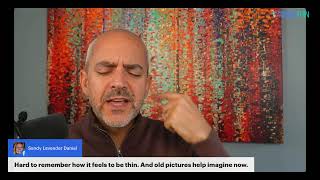
Eight hours of sleeping, sir. Hard to remember how it feels to be thin. And old pictures help. Imagine now. Yeah. You know, here's the thing though, Sandy, what I would say, and this is. I'm glad you mentioned that because I want to just say this for a second, that I think a big issue for a lot of people if you haven't been at your goal weight for 30 years, I think the big mistake a lot of people make is they. They think, oh, I don't even know. It's hard to imagine myself then. I haven't looked that way in forever. And I think that's a big mistake because you're trying to imagine yourself thin by, like, what you look like. But that's not really how your brain thinks. Your brain doesn't think about how you look. It doesn't have a good sense of what you look like. Think about it. We evolved in an environment where there was no mirrors, no pictures. You know what I mean? We don't have a good sense of what we look like, even when we were at our goal weight. And even if you saw a picture of yourself. And so the way to connect to your ideal self is. Is a lot easier to go in through how you feel. And so this is where you start to use your imagination so you can begin to say, sandy, how would it feel if I woke up at my goal weight tomorrow morning? How would I feel? And you could. Literally, just a lot of my hypnosis sessions, I put on TikTok and on reels and stuff. But if you close your eyes for a moment, imagine waking up tomorrow morning and you're lying in bed before you've even opened your eyes. And you just imagine you're at your goal weight. You see, it's not visual yet. We're not thinking about what you look like. We're thinking about what it would feel like to be at your goal weight. And if you can really allow yourself to imagine that, what would you notice? Would you be able to breathe easier? Would you feel lighter laying there knowing you were at your goal weight? How would it feel to lay in bed knowing you were about to go through your day at your goal weight? So I want you to notice how you would think about yourself, how you would anticipate and what you would expect throughout the day. Now, I want you to imagine hopping out of bed. If you were at your goal weight, how'd you get out of bed? What's the energy level you want to have, the way you're able to move? Now imagine yourself getting dressed in the exact clothes you'd like to wear at your goal weight. And don't just worry about how they look. Notice how it feels to get dressed in the clothes you wear at your goal weight. When you feel good about yourself, when you're able to move, when you feel comfortable. Then imagine looking yourself in the mirror, how it feels to wear the things you want to wear.
Notice how you breathe, how you hold yourself in this body, in this situation.
Now imagine yourself moving through tomorrow. Whatever you expect to have happen tomorrow, you get some sense of how tomorrow is going to go. But now just imagine yourself you at your goal weight. Because it's not just about what you look like. It's about how you feel, how you think, how you move, how you behave. And the more you put yourself into this version of you, the more you start to understand who this version is and the qualities of it. So it's not about just what you. What you look like, though, you see, I'm saying it's not just about pictures. Dieting has conditioned us to think about our goal weight visually, superficially, aesthetically. Because our whole lives, we've seen before and after pictures. But the real secret of being at your goal weight is to be the best version of you. The version of you who can think about other things other than food and weight. The version of you that feels free, happy, healthy, calm, grounded, centered, successful. It's all these feelings. Those are what you're tapping into more than what you look like. And what you look like is fine, too, but it's what you feel that's more important. So I hope that helps you. Prince Phil says. How do you. How does a person get willpower? It's really not about willpower. You got as much willpower as you're going to have. Pretty much. Willpower is a prefrontal cortex process, and it's limited. You only get so much willpower a day, and you're not gonna get a lot more of it. You're not gonna build up a lot more of it. The real secret is to optimize the system so it doesn't require so much willpower. Okay? And a good example of that is brushing your teeth. Most likely, you have automated your tooth brushing, right? So that now you brush your teeth multiple times a day, just on autopilot without even thinking about it. That's the secret, right? Because that doesn't require a lot of willpower. So that's why we approach and program yourself. Then we approach our behaviors very strategically so that we can live at our goal weight on near autopilot. That's part of the process. So we don't need a lot of willpower. Let me put it a different way. In dieting, you use willpower to control your behaviors and program yourself. Then we use willpower to install habits that run on their own. So if that makes sense.
Sandy says 64 just needs some endurance. Sure. All right. Yes, thank you. All right, good. That's helpful. Good. Yes. And by the way, if you want to go deeper into your goal weight and who you want to be, make sure that you click the link in my bio and go get that free hypnosis session I give. It's called the New Thin Me. It's literally the kickstart session that kickstarts the whole thing. So again, it's free. It's a 10 minute session. Go check it out. I'm one of the highest paid hypnotists on the planet, folks. It's free. Get this thing. And then I also give you a training as well. So go check that out. And if you like this, I'm here every day, Monday through Friday, usually around noon Eastern. I'm here to answer any questions you have, help you in any way that I can. This is a mission for me. So I'm here every day, Monday through Friday. Check it out if you like this and if you want to listen to it. But you can make the lives. It's also a podcast. Go any podcast platform, search program yourself then and up it pops. So you can listen to me anytime you want. So, all right, everyone, have a super duper day and we'll talk soon. Bye.
More from Jim



Weight Loss Visualization: Wake Up in Your Dream Size #programyourselfthin #weightlosshypnosis



What If You Pretended to Be Thin for One Hour? #programyourselfthin #weightlosshypnosis




