The Easiest Way To Lose Weight
In this live, podcast‑style session Jim Katsoulis argues that the most effective path to weight loss is not the fastest, extreme diet but an "easiest" approach that can be sustained for a lifetime. He explains how the diet industry conditions people to chase rapid results through hard, unsustainable methods, and why this mindset leads to short‑term success followed by rebound. Katsoulis shifts the goal from merely reaching a target weight to learning how to live at that weight permanently. He advocates breaking weight‑loss changes into small, automatable habits, using a "Goal Weight Pyramid" that integrates mindset, lifestyle, and eating. He critiques conventional diets, willpower‑driven restriction, and GLP‑1 drugs as non‑long‑term solutions, emphasizing that lasting change comes from reprogramming subconscious patterns rather than constant conscious effort. To support this, he offers a free hypnosis session (“The New Thin Me”) and a 20‑minute training (“Reprogrammed: How to Live at Your Goal Weight”), and he answers live audience questions about thyroid removal, menopause, and calorie testing, reinforcing the idea that personalized experimentation and mindset work trump any single diet plan.
Chapters
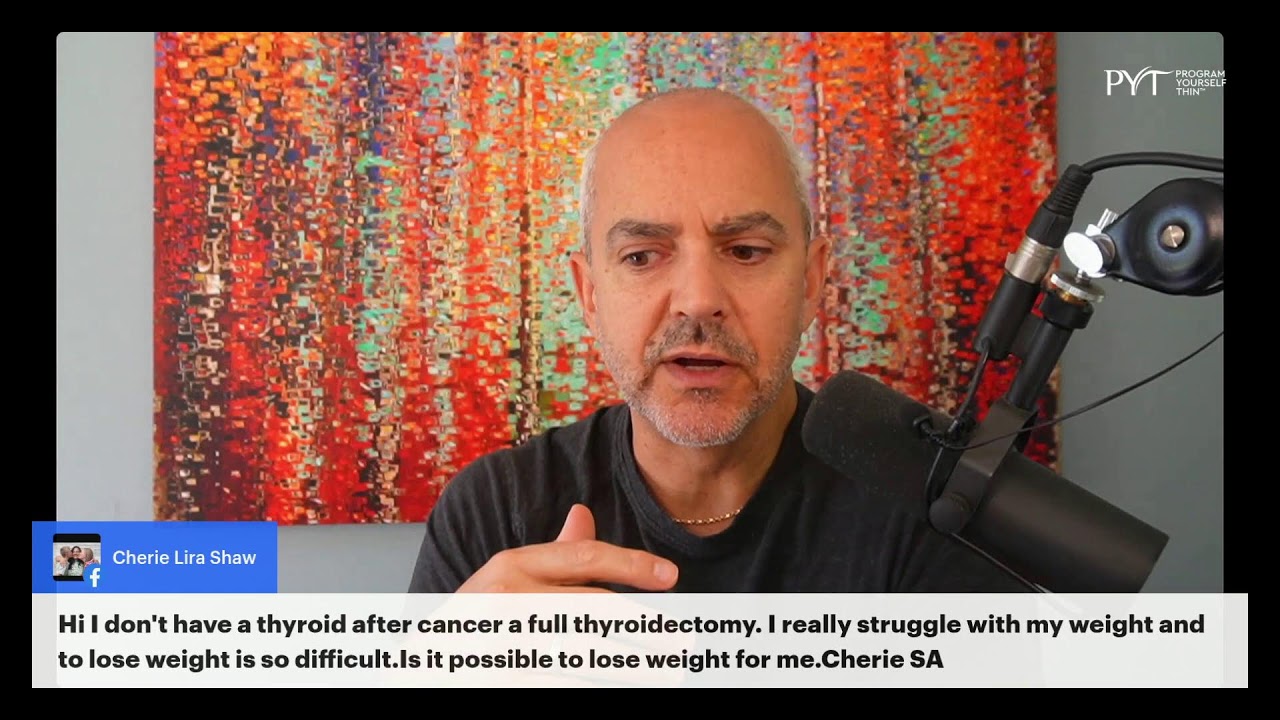
The easiest way to lose weight is the most important way for you to lose weight, because usually when you go and start focusing on your weight loss, you're actually looking for the hardest way. And this is really important to understand because dieting is really about the hardest way, because the hardest way is typically the fastest way. I'll give it that. The more extreme thing you do to lose weight, typically the faster the results you're going to get are. And the diet industry has really conditioned us to only consider plans that give us fast results, and anything else we don't even consider, because the only mode we have when it comes to weight loss is fast. But the only way to lose weight fast is to do something extreme, to do something hard. So to start looking for an easier way to lose weight really is fundamental to the whole process and requires a lot of focus and energy to figure out. Because your entire life you've been steeped in the hard way so deeply that it gets to the point that you only consider the hard way because that's the only way to do it fast. And that's all you've ever thought about when it comes to your weight. But when we start to look at the truth of what you want, you start to realize that it's not just about getting to your goal weight. It's not about how fast you can lose the weight and get there. It's about how long you can stay there. So we shift the goal from I want to get to my goal weight to I want to live at my goal weight. And then we start to build off of that. I want to be able to get to my goal weight and live there in the easiest way possible. And that's the beginning question that you start to ask. And you prime yourself with that question to find those answers out in the world. Now, I don't know what those answers are going to be for you. It's different for each person because what I find hard and what I find easy is different probably from what you find hard and what you find easy, right? Everyone's got different preferences, lifestyle, genetics, all different factors. So it's up to you to ask the question, how can I manage my weight in the easiest way possible? That's the big one. And then we start to drill down. How can I eat breakfast in a better way, easier? How can my lunch become healthier, easier? How can I control my portions more effectively at dinner, Easier? What can I do to make it easy, automatic, natural, so I don't have to think about it? How can I lose weight easily now and for the rest of my life? How can I maintain it for the rest of my life? This question opens you up to a whole different reality, a whole nother world, because deep down in the back, you've always been looking for the hardest plan. Because again, you associate the hardest plan with the fastest plan. So what we're trading here, we may not get the weight loss as fast as a diet. What we're trading the fast for is sustainability, longevity. So we trade that. Yeah, it might take a little bit longer to get there, but when I get there, I'm going to have developed the skills that allow me to stay there. That's the difference in the mindset. And I think this shift is so profound because most likely you've gotten to a point where you're just apathetic. You can't even get yourself to start another plan. Not really. Because you don't believe you're going to stick with it long term. Even if you get some results, even if you get to your goal weight, you don't believe you're going to be able to maintain it. So this is the core problem that is really sabotaging so much of your effort. And when you begin to ask a better question, how can I manage my weight easily? Easily, something you most likely have never even considered possible. Even still, as I say it, you're probably rolling your eyes. Oh, easily? It can't be easy. Well, it can be easy. It absolutely can be. If you start breaking down your changes that you need to make, then you start breaking them down to bite-sized pieces and working on them strategically and automating them and building your skills up so that you're able to do these things naturally and easily. Yeah, there is an easy path. And that's the path I want you to take because that's the path that works for people. So if you want to go deeper into this process, I put together a hypnosis session to help you do that. It's called The New Thin Me. All you need to do is click the link in my bio, go to programyourselfin.com, or if you're on Facebook, you can just type mind, M-I-N-D, into the chat and it'll automatically send you the link to go get there. And not only that, once I send you the hypnosis session, I also give you a training called Reprogrammed: How to Limit Your Goal Weight Without the Fight. And this is a 20-minute training that reveals the entire process that I talk about and use to help clients gain control of their weight. Uh, and be able to live at their goal weight for the rest of their lives. So go check that out. Uh, if you have any questions, feel free to ask them. You're all having a nice day? Kind of dealing with a little, little head cold, I guess. I guess a little fall head cold, but I'll take it. There's worse things in the world, so I will take it. But it is there. So I hope you're all having a nice day. And yeah, any questions are welcome. We, uh, I, I Do get on here every Monday through Friday, usually around noon Eastern, talk about way with different people. Um, and you know, it always— it's always— it never gets old for me. I mean, literally every person I get to speak with, um, is another challenge we get to kind of tackle together. And, and I, I love that sort of work so much. Uh, and I'm reminded that the biggest— I know I say this a lot, but I'm gonna just talk about this for a second because I was reminded of this yesterday in such detail. That the biggest challenge I believe that most people have, like day to day, is that what they think the problem is with their weight or their inability to control it, they're thinking about it in too big or vague of a level. So they'll say things like, well, I just, I can't get myself to eat right, or I'm an overeater, or I can't stop eating sugar. These big, giant, vague descriptions of what the problem is. And That leads to all kinds of issues. You know, first of all, when we kind of— well, I, I don't know how to eat well— that's such a big comment that there's no way you're going to fix that, right? Again, I always think of it as like, I don't know how to play the piano. Well, I may not know how to play the piano, but if I'm ever going to learn how to play the piano, if I'm actually going to learn how to play the piano, what's going to happen, whether I hire someone, whether I watch videos, whether I get books, Whether I even just do it myself, however I go about learning the piano, what's going to happen is I'm going to break down— I don't know how to play the piano. I'm going to break that down into parts. And I'm going to start to break the piano down into pieces. And maybe I'll work on my finger placement. Maybe I'll work on scales. Maybe I'll work on what the notes are. Maybe I'll work on chords. I will break it down into its component parts and I will work on those things. And as I work on those things, I will start to build on top of my skills that I'm developing. I'll get better and better and better and better in ways I don't even understand. Most of me getting better at the piano is going to happen back here in ways I don't really even know. I, I couldn't play this song last week. I've been kind of playing it all week, struggling with it. All of a sudden this week I can kind of play it. I don't, I don't know how that happened, you know. And that is really how change ends up Showing up in our lives, and with dieting we tend to try and micromanage kind of one thing. Well, we say one thing. We say you're well, you're going to change your eating, but changing your eating is changing three to six behavior patterns that you have every single day of your life. It's a lot. It's a lot of work to micromanage that because most of your eating is happening on autopilot. You're not thinking about your eating, and you're eating the same patterns week after week. And it's happening automatically. And when you go on the diet, what you're doing is you're trying to fight against that. You're trying to fight against your eating patterns by being consciously aware all the time and forcing yourself to make the right choice. But what ends up happening is you run out of steam because your willpower, which comes out of your prefrontal cortex, is finite. You only have so much of that energy. And most people will get to a point, you know, for some people it's a couple days, some people it's a couple weeks, they'll Once in a while you get to a couple months, but it always the same event happens that you run out of steam to control everything and you revert back to your old behaviors, your old habits and routines show back up and your weight returns back to where it was at the beginning. Because again, your weight's always a reflection of your what your habitual behaviors are, and those habitual behaviors are run by your subconscious mind on autopilot. You don't have to think to overeat the chips or the ice cream; you just do it. You don't have to think to get the ice cream or the chips into your house. You just do it when you're in the store. So you have all these automated behaviors that are leading you to be at the weight that you're at. And what dieting does is it tries to fight against these automated behaviors that you've learned and developed and installed over the years. Dieting says, oh well, we're a fast eater. Well, now we're a slow eater. Oh, I, I love sugar and carbs, and now I'm keto and I'm sugar-free. And so dieting takes this giant, like, whack at change, but it's so overwhelming that you can't stick with it. Again, if I go back to the piano metaphor, if I try to learn the whole piano as fast as possible, so I say, well, I'm going to practice 10 hours a day, I want to learn as quick as I can. Well, if I try and take that route, I may get through a day or two But eventually my body's killing me. I hate the piano. I'm overwhelmed. I'm tired of it. I don't want to do it. And that's what happens with dieting. You overwhelm yourself so much by trying to change everything all at once in a non-strategic way that you end up just quitting or fading and you go back to your old behaviors. And this is dieting in a nutshell. That's why dieting doesn't work. Dieting is not about living at your goal weight. Dieting is about doing some extreme crazy shit for a little while so you can lose weight and get to your goal weight. It was never a long-term plan. By the way, the GLP-1s for most people aren't really a long-term plan. Most people, it seems to me, are saying, I'll take GLP-1 so I get my weight under control. Well, that's not a good strategy because the companies themselves, the pharmaceutical companies themselves, will tell you that GLP-1 doesn't work once you get off of it, as much as you may think it's going to, because you get used to it. So again, these aren't built for long-term success. You know, again, GLP-1s, unless you stay on it forever. But a lot of people I find don't really intend to stay on it forever. So that's a whole nother story. But yeah, anyways, at the end of the day, I think the only way forward in terms of a real genuine solution and what I consider a real genuine solution is when you have a real plan, ability, skill set to live at your goal weight comfortably. Nearly on autopilot. I think that is the goal. That's what we'll be aiming at. And I think, you know, Program Yourself Then, we kind of break the big piece down, right? Because weight, weight is a big thing. You know, we try to simplify it into, oh, calories in, calories out, but weight is actually a lot of different factors all kind of working together. And so in Program Yourself Then, we break it down into the Goal Weight Pyramid. And we have mindset, lifestyle, and eating. And again, we break it down, and then we break it down some more here. But that's how you learn anything big. You break it down and then break it down into smaller pieces until it feels manageable. And with with weight loss and dieting, you've never done that. You've never done that. It's always been kind of the grand slam approach that you're gonna change everything all at once instantaneously. And anything else is going to be too slow and not worth it. And unfortunately, that's why the results people get are what they are typically. But anyways, if you have any questions, feel free to ask them. Any weight loss questions are welcome. I work with people that are doing every kind of plan possible. So regardless of what plan you may be attempting to follow or trying to use, I have helped people with it. And again, the reason why is I don't have to be an expert in every diet because at the end of the day, no matter what diet you're gonna do, there's a mindset component. No matter what diet you step into, there you are, right? You've brought yourself. You've brought your mindset. And a lot of the things that showed up and kinda sabotaged your last diet, guess what? They're gonna show up again and sabotage the next diet regardless of what it is. 'Cause the— the core problem is not the diet itself. It really, it doesn't matter. Pick vegan, pick cardio, pick, uh, high carb, pick, uh, high fat. Whatever your plan is to manage your weight, it has way less— your, your chances of success have way less to do with what the plan is and way more to do with what your mindset is. What are you thinking? What's your approach? What are your routines? What's your strategy? Do you have any ability at all to manage your mind, your internal dialogue, how you talk to yourself, what you say to yourself? If you've never learned those things— and you probably never learn those things because dieting never teaches them to you. Dieting is kind of like the idea is, oh, here's the plan, see you later, as if the only thing missing from your life That would allow you to control your weight forever is is a diet plan. As if the only missing piece is that you don't have a plan for what to eat. That cannot you cannot believe that because I know you've been attempting to lose weight for decades at this point. You cannot imagine you cannot believe that that one sheet of paper with you know some you know diet philosophy whether it's to you know limit or remove a macronutrient or whether it's some you know, take on how to structure your reading, uh, whatever it may be. You cannot think that that is the thing between you now and you living at your goal weight. I, I hope you don't think that. Um, and that's part of my, my, um, mission when I get on these lives every day is to talk about this because I think a lot of people make the mistake of Doing their best. I mean, they're trying. You know, I work with a lot of people that are very action-oriented, high-achieving people that are struggling managing their weight. And so it's plain as day that it's not—it's not a capacity problem. It's not—it's not that you can't do it. It's that you've never been given a real plan. Most of you have never been given a real accurate map for how to get to and live at your goal weight. You've been given diets, and diets don't. Work for the long term. They're not built for the long term. No. Yeah, Sharice says, I don't, I don't have a thyroid after cancer, a full thyroidectomy. I really struggle with my weight, and to lose it is so difficult. It is possible. Oh, is it possible to lose weight for me? Um, yeah, I mean, I'm gonna assume so simply based on my experience. My experience, I've been doing this for over 21 years professionally. I've never seen— have I worked with anyone that didn't have a thyroid though? I've worked with a lot of people that have had thyroid issues. I'm pulling up a blank here. I, you know, I may never have worked with someone who had a full thyroidectomy. I feel like I would have remembered that, but it's been a long time. I've done over 6,000 private weight loss sessions, but I cannot remember that one. What I will say is this, that I think More often than not, and which is every single time in my life that I've worked with someone, when they have reduced calories over time, they have lost weight. So I would say yes. But here's how I would do. Here's what I would do, Sheree, is I would test it. I would Eat, and I'm assuming maybe you have tested this, so you may know this answer already. But I would take a couple weeks and lower my calorie consumption and see what happens to my weight. So I would experiment. I would experiment with if you can reduce your calories, does your weight go down? I think you're going to find your weight goes down. Maybe you need to give a little more time too. That's what I would start with, you know. So again, but, but notice what I just said. It kind of builds right on the back of what I just said before that. See, like, again, you want me to say, oh, you can lose weight, you can't lose weight. Well, what the shit do I know? What does anyone know? You could go see a bunch of doctors, you know, you might get different stuff. So I think we need to test our own thing going on. All right, we need to test our own thing. And I think because you don't know what the answer is going to be— well, maybe you do. Maybe you've restricted calories. So yeah, but I will say, I mean, that's a very common thing. And I mean, you have a fairly extreme situation here in some degree, but Most people are walking around with some kind of belief that there's something wrong with their body that's going to prevent them from losing weight. That's the majority of people that are struggling with their weight usually end up in a place where they say, I don't know, I've tried everything. You know, I've done everything I can to lose weight and it hasn't worked. There must be something wrong here. And it could be literally, it could be menopausal, it could be my thyroid issue, it could be Hashimoto's, it could be insulin resistant, it could be. People, a million, there's a million possibilities, you know. So, um, again, that's been my whole history is working with people with some something like that and believing that that was the reason they couldn't lose weight. But we know, again, if we look at GLP-1, the, the biggest thing about GLP-1 in my opinion is that it proves that you take this whole population of people that have all the issues I was just talking about that usually believe that's why they can't lose weight. Right? Because when we take originally GLP-1s were for people, you know, insulin resistant, type 2 diabetics. You know, that was the primary one. And so obviously now lots of people are using GLP-1s, but all these different people are using GLP-1s for All these different people using GLP-1s for weight loss. Oh my goodness, hold on a second. Uh, just gotta answer something here. Yep. So there it is. What's up, Shereen? How's it going? Long time no see. Hope you're doing well. There we go. Shell just says, I take thyroid replacement and I lose weight listening to you and monitoring my intake. Yeah, there you go. So I appreciate that, Shell. And, uh, let's screenshot that. There can't be enough. And I say to you, one of my favorite things to say to those of you in some phase of menopause Is to remember that in Japan, women there go through menopause too, and their BMI stays pretty stable throughout their lifetimes. So again, you know, I'm not saying there aren't factors that can happen physiologically that can slow our weight loss down or make it harder or whatever. Obviously, that's true. But now, I think that it's important to remember that most of the time. You can still lose weight, and that's really important because if you don't, if you deep down, and then this is a lot of people. So I talk about a mindset thing for me. A lot of people deep down don't believe that they'll lose weight no matter what they do, and if you don't believe it, you're never going to get the results you want because you're never going to truly commit to the level you can. You know, so it's important that you all hear that. That again, I mean, it's just been a whole career for me of seeing people these things. Um, still lose weight because again, it really does come down to calorie consumption. And if you cut the calories down— um, nice, Sheree's doing good. Yeah, nice seeing you. Uh, that's awesome. Yeah, one of my local, local people. It's so funny. I, I, it's so such a funny world. I remember I first started my first hypnosis office was up in Keene, New Hampshire, and, uh, you know, did that for a couple years and then Um, began to move more online. And now, you know, it's just funny because, you know, 99% of my customers and clients come from outside of Massachusetts. And so it's always funny though to find, you know, certain clients that live right near me, you know. But, uh, yeah, that's awesome. Glad you're doing well. Um, yeah, all right, I gotta get out of here. I got some stuff I gotta take care of. Um, but again, if you're not in my world, please click the link in my bio, uh, and/or go to programyourselfthin.com. Go get that free hypnosis session I give you and listen to it. It's called The New Thin Me. It's completely free. Go check it out. Uh, and if you do that, you're also gonna get a training called Reprogrammed: How to Live at Your Goal Weight. Uh, and I send you daily emails just to teach all this stuff for free. So I don't know how much more I can give you for free, but go check that out and it'll help you. Uh, and, um, yeah, and you can pop on here and ask some questions about it if you want. I'm here every Monday through Friday. Usually here around noon Eastern. And if you can't make the live, it is also a podcast. So you can search any podcast platform, search Program Yourself, then it'll pop up. You can listen anytime you want. So, all right, everyone, have a super duper day and we'll talk soon. Bye.
More from Jim



Weight Loss Visualization: Wake Up in Your Dream Size #programyourselfthin #weightlosshypnosis



What If You Pretended to Be Thin for One Hour? #programyourselfthin #weightlosshypnosis




