Waking Up From Food Buying Trances
Transcript of a Jim Katsoulis podcast episode discussing “food buying trances” and broader weight-loss mindset and habit strategies. He advises reducing unwanted foods in the home (prevent purchases), identifying habitual buying situations (grocery, apps, convenience stores), and building mindset/habit systems (Program Yourself Thin) that address emotions, habits, motivation, self-image and maintenance for sustainable weight control.
Chapters
Foreign.
Welcome to today's program yourself Thin podcast. Today we're talking about waking up from food buying trances.
Something most people kind of overlook. Even though you know it's there, but you don't really pay attention to it enough. And a lot of people tell me, you know, geez, I can't stop myself from eating the, the ice cream in the freezer, the chips in the cupboard, or the cookies in the pantry. And yeah, that's going to be harder, but the easier place to avoid that is to not get them in the house in the first place. And so a lot of times what happens now, even before I get into food buying trances, let's just talk about transfers for a second. Because most of our behavior as human beings is done on autopilot. So a lot of what we do think feel is just on autopilot. And when a lot of times people are buying food, they're very much entranced. Let me give you an example. You're entranced when you're driving, when you got an hour drive ahead of you, right? And you take that drive out of that hour, you're zoned out most of that time, right? You're not there consciously, you know, looking at your hands, looking at, paying, totally mindful in the moment. You're kind of zoned out, just doing stuff on autopilot. So a lot of times getting buying food becomes like this. And so what we're looking to do is to make it as easy as possible for you to succeed. So it's not the easiest way possible to succeed. If you got a pint of Ben and Jerry's ice cream in the freezer, that's going to make everything a lot harder because your mind knows that it's in there, okay? And starts thinking about it becomes a cue. It becomes a subconscious cue that increases food noise, okay? It increases cravings, hunger, appetite, all the rest of it. When you have these foods in your house because you know they're there, you bought them, and if you didn't buy them, you know, the other person bought them, they're there. And so when you know they're there, they hook into your brain more. That simple. And so one of the easiest ways to change your eating is to zoom out a little bit and don't worry about not eating the food in the house. Let's focus on not getting the food into the house in the first place. Because a lot of times it's easier in that moment to say, no, I'm not going to get that at the supermarket than it is to say, no, I'm not going to eat it when it's right in front of you at your house. Okay? And a lot of times the buying trances are literally happening almost outside of your awareness. You know, you might start the morning, say, I'm eat good today. And you stop at the supermarket on the way home, and just on autopilot, grab a bag of chips, grab the cookies, grab the ice cream, all right? And so what you want to start doing is first off, looking at when you typically buy food. Okay? And so we're looking at grocery stores, we're looking at buying stuff online or through apps, things like that. You want to start to notice the patterns, the routines you have for when you're buying food, and then you want to figure out, where am I buying the most calories? Right? Because again, our behaviors have patterns to it. And you might find that when you go shopping on Thursday, you buy more unhealthy foods than when you go shopping on Monday, perhaps. Okay? So we want to focus on that day, and we want to start getting good at going into these situations out of trance, right? And it's relatively easy to do once you have awareness. Right. And you use the right strategy. So, you know, especially when you go to the grocery. Grocery stores is obviously a smart place to start. And when you go to the grocery store, you want to set yourself up for success, okay? So the first thing you want to do is make sure that you're not hungry and you're not thirsty, okay? So ideally, when we go grocery shopping, we want to have eaten something ahead of time and we're hydrated, right? And ideally, then we're rested, too. That would be the ultimate three things. But you want to walk into the supermarket physiologically in a good place to make good decisions. Psychologically, you want to remind yourself, I want to get good foods here because my goal weight is really important to me. I want to take control of my health, my happiness. I want to feel better, I want to look better. Blah, blah, blah, blah, blah. Say all the things you want to say. Now, if you use a food tracking app, right, it can be really helpful sometimes to consider foods that you might buy in the supermarket and just really quick remind yourself of the calorie contents, the nutrients in it that are there or they're not. Also, while you're grocery shopping, you can make it a habit of starting to look more at the nutritional labels that will help pull you out of trance. Okay? So when you're buying food in the supermarket, get in the habit of looking at the labels before you make the decision. Because a lot of times you're going to notice is your hand just does it automatically. And next thing you know, all that stuff's in your cart. Next thing you know, all that stuff's in your house. Okay? So that's one of the easiest ways to start making statistical improvements to your eating in a way that's relatively comfortable. Right? So focus on your food buying trances. Now, again, in the program, we talk a lot of times about the eating trances, right? And that's a whole nother thing. But for today, let's just focus on the food buying trances. Notice the situations where you buy the most food that's kind of keeping you overweight. And again, grocery stores are the most obvious starting point. But then you can start to focus in on online buying and delivery you're doing. When are you doing this? How can you work on that? Wake yourself up so you don't do it mindlessly. You know, stopping at convenience stores, different little snacky things you might have kind of weaved into your patterns. Pay attention to those and again, wake yourself up from them. All right? And I think this will help you out. And if you want to go deeper into this whole concept, click the link in my bio or go to program yourself then.com and go to get that free hypnosis session I made for you. Okay? It's called the new thin me. And it's going to dramatically help you. Right? It's going to help calm you down, relax you and get you all motivated because it puts good ideas in your head. And there's also a training I give you as well. Three steps to master your weight. It's all free. Go check it out. And if you have any questions, feel free to ask them. Any questions are welcome. Any weight loss questions? So, yes, Natalie says, agree, cannot eat what is not there. Of course. Right. And I think that's something we know, but sometimes we don't give enough focus. I think sometimes we're so fixated on our willpower in the moment of eating or right before that, we forget that if we zoom out a little bit and start focusing on the buying part of it, a lot of times there's a lot less momentum there. You know, that's how I think of it. I think of it as behavioral momentum. So it's like when you know you've got let's, for example, and you can substitute anything else in here, but when you know you've got a pint of ice cream in the freezer, your Brain knows this. And so what's going to happen now is you're going to have this loop. Your brain's going to say, oh, about the ice cream. The ice cream. Now it's up to you to keep saying no, no, no, no, every time you think about it. And over two hours of watching TV on the sofa, you might have to say no to yourself 20 times. You know what I mean? If the ice cream's in the freezer, if it's not in the freezer, you might think about ice cream, you might think about getting ice cream. But that'll happen maybe two times, three times, you know, so statistically, it lowers it down and you put a barrier between you and the ice cream. So this is a strategy I've used where. Where it's like, I don't get pints of ice cream. I don't have ice cream in the house. If I want ice cream, I can have it, but I'll eat it in the small Ben and Jerry's cups, and I have to go get it. And most of the time, again, banking on my laziness, I'm not going to go get it, you know. So, again, it's a strategy I absolutely use, and I think all of you could use to. Relatively easy. Again, that's the strategy. Relatively easy. I'm not saying it's the easiest thing in the world to not buy it when you're at the grocery store, if you're used to buying it. What I am saying is it takes a lot less energy to stop yourself from buying something than it does to stop yourself from eating it when it's right there. Does that make sense? Because when it's right there, you've got all this kind of mental, emotional, physiological momentum that builds towards eating it. And now you got to stop yourself. That's a lot harder than saying no, you know, in the store, you know, so. Yeah, good. Good. Good suggestion. What's a. Lori, Laurie says you are a godsend. I appreciate you. Well, thank you, Lori. I appreciate that. It's very nicey to say. I see. E. Pickett says have made special trips to the store just to buy junk food. I guess it's like being an alcoholic. Well, no, of course. Of course. Any. We have all done that. We've all gone out of our way to go get the food. So I wouldn't say it's just like an alcoholic. Although there can be some parallels, obviously. But the point isn't that you're never going to go to the store and get it. Of course we make special trips to just get junk food. Of course that happens. What I'm saying is, statistically, statistically, if you set yourself up and you make, you still make special trips to go get junk food, but if it reduces it by 20, 30, 40, 50%, well, that's going to show up in your weight. So again, we're not looking for perfect perfection here. We're looking for statistically, you know, improving our success. So again, I would work on reframing that a little bit. You pick it because it's not a big deal that you actually drive to the store. That doesn't. I wouldn't say that puts you necessarily in the category of being an alcoholic with it. Sometimes we just have cravings that are just firing off and we go and do that stuff, you know. But again, I wouldn't want to define myself that way. And again, it's not about being perfect. It's about improving.
So Rosa, Rosa says, I always eat healthy for a day, and then the next day I just overeat everything. What to do? Well, okay, Rose, that's a great question. That's very common. And so what you do is you start to reflect on this and start to approach a little differently. You know, I think a lot of people do this where they either eat healthy for the day or they restrict for the day, and the next day they're just right back off on track. Okay. And so I think this really, to me, is kind of a reflection of that all or nothing mentality. Most dieters are very all or nothing. They're either doing everything perfect or they're not doing anything. Okay. So what I would look to do, Rosa, is stop looking at. You're measuring things. Like in days and weeks here, I would start to look at things as habits. So for. If I were you, Rosa, something I would do differently is I would. Instead of thinking like, I'm gonna have a healthy day, I would start focusing on having healthy breakfast Monday through Friday, assuming you work like a Monday through Friday type of schedule. So again, you have to adjust this, whatever your schedule is, but let's just say you work a typical Monday through Friday. If that was the case, I would stop trying to have a perfect day and then a perfect week and a perfect month, and instead I would work to optimize my breakfast and make them healthier Monday through Friday, ideally. Oh, what's this? Did I hit a wrong button here? I don't know. There we go. That was weird.
I never. I didn't really have. You know, sometimes on tick tock, you can have multiple people on here. But I will tell you, when I've done that, it is not. It's not worked out well. I've not enjoyed that experience too much because anyone can get online. So that was an accident. But anyways, yeah, so that's what I would say, Rosa, is stop doing what you've always done, right? Because again, and by the way, this goes to all of you because you all do this to some degree, right? You all eat healthy for a day or a couple days or a couple weeks, and then you completely go off track, right? That's the number one diet pattern. And so the suggestion I would give you is to stop approaching it the same. Stop doing the same thing, Rosa. That's the main message to you. And again, the easiest way and most successful way is I would start focusing on breakfast or whatever your first meal of the day is. I would look to optimize that, and I would look to optimize that Monday through Friday every week. And once you get a handle on that and you start getting that in place, then I would start adding lunch to that, then I would start adding dinner, you know, so I would systematically and strategically approach it rather than just hoping one day I'll wake up and I'll be healthy from now on, you know, not gonna happen.
What's up, Jen? Jen says I've always planned out meals for the week. I always have a shopping list and try to stick to it. Definitely harder. When my college age daughter is home, I spend way less money without the processed crap. Here, here, here, here. My daughter comes home, although she's got a lot better, I will say. But yeah, it's. I. I don't eat. I really eat. Almost no process. I don't eat a lot of processed food. Certainly I don't eat like a lot of junk food. And.
So having kids, though, I let them eat, you know, that stuff moderately. And I am shocked at how expensive it is, I will say. And so I don't know if people are still saying it's. It's too expensive to eat healthy, but they better not be because, yeah, times have changed and it's really expensive to eat processed bullshit. And it's way cheaper to still eat. I'll tell you what, you know, I know there's a lot of food inflation. My beans and my rice and stuff is still the same price. So I'm still paying less than a dollar a can for beans. All right? So don't tell me that eating healthy is. Is cheap too expensive. It is not. Processed food's gone bonkers. I mean, geez Louise, I remember, you know, a bag of chips used to be 75 cents. Now it's like 250. It's crazy. And, and again, you're getting no satisfaction, no nutrients. You're getting cravings and hunger and weight and all sorts of issues with it too. Again, I have no problems with processed food occasionally, but yeah, it very quickly adds up financially, you know, real expensive to eat now. The funny girl. Yeah, it says breakfast is my hardest meal. I can't do eggs. Well, don't let that be a limiting factor. Yeah, yeah, I, I don't eat eggs. I do on the weekends. I'll have like an egg based breakfast. But five days a week, I don't need any eggs either. So.
Don'T let, don't, don't fall into the trap of the belief that, the belief only that breakfast is my hardest meal. We can start with that realization that breakfast is my most challenging meal. That's fine. But then make sure yaya, that you go into solution oriented mode. What can I eat for breakfast that I enjoy, is easy to make and is in my nutrient calorie ranges that I want to stick with? Okay. And if you do that, then I think you'd have a much better chance of figuring that out. Okay. So, you know, sometimes we can create the belief, oh my God, breakfast is my hardest meal because I can't do eggs. And then we just shut it down. You know, he said I can't eat eggs, so breakfast is just really so hard. You know, don't, don't let that happen. Fine. You can't eat eggs. Right? So what can you eat? What would satisfy you? What would be enjoyable? What would support you, what would be easy to make? You know, what would you enjoy? Start asking those questions and you'll start coming up with, with new, new ideas and solutions. All right.
See here, let's pop my tick tock for a second.
Yeah. Rosa says thank you. You're welcome, Rosa. Yeah, that's what I'm here for. Again, please, people, feel, share, feel free to share whatever you're kind of struggling with because so often the things you're struggling with and have been struggling with for decades. I'm not saying this in a conceited way, it's just, it's what I do. But you can share your struggle. And a lot of times I can give you strategies or a mindset shift that can profoundly help you. You know, I, I, I'm not trying to be conceited here, but this is literally what I do all day. So, you know, again, test it out. Maybe I'm wrong, right? Maybe what I'll say is total. You won't care. But we got nothing to lose here. That's why I'm here. Judd says, had my first athletic injury from working out. Torn hip, labrum. Start PT Monday. Missing the exercise and afraid it will affect my weight. Yeah, Jen, that's hard. That's always, always the challenge. You know what I mean? When we get hurt, it can really feel like it knocks us off track. What I would suggest is you is to dedicate that energy that used to put into exercise. Okay? So what I like to do is I like to keep habit containers because life changes, right? And so when, before you had the injury, you were in a better place than where you're at now, in a sense. Okay, but so what what's going on is that you exercised at a certain time, right? So you. You had your exercise routine. What I would want to do is I would want to maintain that routine now. But you can't exercise like you were. Okay, but now I would use that routine to do the PT work. Okay? Because what I want to do is I want to keep that association for that time period that you usually exercised before the injury. I want to keep that. But now I want to use it, and I'll use it for pt and so, yeah, maybe. Maybe you'll burn less calories, maybe your weight will go up a little bit for while you're recovering, but you still are kind of keeping yourself primed and ready for when you recover that you can go right back into your exercising more effectively than if you just stop exercising during that time completely. Now you got to redo that whole thing again. Okay? So. Oops. Good Lord. So, yeah, so keep an eye on that, Jen. And I'm sorry to hear you got. You got hurt there. So hopefully you have a speedy recovery. But again, don't. Don't just, like, stop exercising during that time. Use. Maintain the same routine. Just adjust what you're doing during that time. Okay. Tess Carroll says I want to get rid of my health anxiety. Whenever I experience even the smallest thing, I get stressed out and think about the worst case scenario. I will turn 20 years this month. Yeah. I mean, again, this is why in program yourself, then we. We follow the weight Mastery pyramid. Right? So again, you're not going to hear me just giving you food advice or exercise advice. I'm never going to do that because I think you need kind of a holistic, comprehensive approach to make changes and mindsets right on the bottom of this pyramid because I think it's the most important and it's the thing that all the other things are built on top of. And so if the foundation piece isn't solid and well structured, then. Then the rest of this isn't going to be solid and well structured. Okay. So I think getting rid of health anxiety, one of the first things I would look at without knowing a lot of details. Obviously we'd go into detail with it if we were coaching. But first thing I would do is because I'm hearing, I get stressed and anxious and even the smallest things when I hear those things. In worst case, thinking, what I want to do is I want to practice relaxation, calm and being grounded. And so I would absolutely start to look into maybe meditation, little simple yoga.
Stretches, little simple things you can do. I'm talking like a couple minutes too. You don't want to overwhelm yourself. But even a minute of relaxation. Oh. So what I will say, let me put this in there. Well, you're on YouTube, but this, this should show up for you. Let me put this link in here.
For the free hypnosis session. And if you're on, if you're on tick tock, you can just go to my bio and get it. But I want you all over in YouTube land and Facebook to be able to get. I gotta just type this up and copy it in. So I have to type this every day.
Boop. All right, there you go. So, so that's for you. Okay, Go listen to that hypnosis session because that's another way to start to common ground yourself. But that's the first step for you, Tess. Carol, you're not. I can't just sit here and tell you some magical thing that's magically going to make you a not stressed out person. You've got to work at it. It's like I could tell you to brush your teeth, but you've got to brush the teeth. You know what I mean? And so you need to have some routine in your life. It doesn't have to be a huge undertaking. It doesn't have to be you meditating for an hour a day or yoga classes, you know, six times a week. It doesn't have to be that or start from just zero. Right? You sound like you're really stressed, intense a lot of the time. So let's start with that hypnosis session. Ten minutes of just relaxing, calming down, breathing, getting good ideas, put in your head, do a one minute relaxation, set a timer and just relax. Your body for a minute and breathe right. Just as simple as you can make it. And if you start to develop that and cultivate that ability, that'll go a far way towards helping you deal with what you're dealing with, you know, and then you can get to the health stuff and all the rest of it. But I think at first you need to create a ground floor foundational ability to relax and calm yourself down. All right.
What'S up, Christina? Christina says, I bought two candy bars. One for me and one for my husband. Gave him his. Ate half of mine and gave him my other half. Very proud of myself, patting myself on the back. Thank you. Program yourself then. That's awesome. Christina's in the program. So again, we hear this stuff all the time, but that's so awesome. I'm proud of you. And this is what I mean, this is, this is the difference, you know, is that with dieting, it's all or nothing. You tell me the last time you were on your diet and you bought a candy bar and ate half of it and gave the other half away. You let me know what diet you've ever been on where you just did that. Go ahead. You know, and it doesn't happen because dieting is all or nothing. And it's like this, this frantic mindset. And it's just the second you have a one bite of a candy bar, not only are you eating your whole candy bar, but you probably would eat in your husband's too. I didn't get any candy bars. No, they were out, you know, so come on, you know what I mean? Like, this is what I'm talking about. This is why we need this comprehensive, holistic approach. Approach. Because again, I could say to you, hey, you know, when you get a candy bar, just eat half of it, right? There's your, there's your food plan. It's the half candy bar diet, right? And I, I'm sure there's a diet that exists. It's the half diet, right? Just eat half of what you eat, right? That sounds so easy. And just do it. And I could sit here and tell you, just eat half the food you get and you'll lose weight. Yeah, okay, great. But can you actually do that? Can I give you a candy bar and you eat half of it and give the other half away? I dare you. I dare you. And you won't be able to do it. Why? Because you don't have these other pieces in place. You think you're going to be able to eat half a candy bar and give you other half away if you don't have your mindset in place. Come on. You know, and as a matter of fact, dieting, they. They literally have the. What the hell effect is literally for dieters. And it's something, it's unique to dieters where when a dieter makes a mistake on their diet, they just go way overboard. Right? Because dieters are always walking that tightrope that as long as they're perfect, they have a chance of staying on it. And the second they make the mistake, they're. They're off. Okay? And so what I'm trying to say when I. When I talk about living at your goal weight, this is the stuff I'm talking about the ability to eat half a candy bar and give the other one away because you're so grounded and calm and relaxed, your mindset's so bulletproof that you enjoy the half of the candy bar and. And then you're good with it. Like. Like that's what I'm talking about. And so it's more than just being told what to eat. You've got to work on the mindset piece of it. Christina, great job. Super proud of you. And again, Christina works the program, though, you know, so not only is she in the program, but she works it, too. So that's awesome. That's fun to have that happen. Jen says I often eat chicken for breakfast. Eggs aren't the only thing you can eat for breakfast. Sometimes I'll eat lunch and dinner stuff at breakfast time. Yes, Jen, thank you for reminding us of this. Right. It's so easy to forget this because we've been so conditioned that that's breakfast food, that's lunch food. That doesn't. That doesn't even exist in the world. You know what I mean? I know we think it does now, we've been conditioned, but that's a good opportunity to reflect on the power of conditioning. You know, of course, there's no food that you can only eat at breakfast, but it feels that way, doesn't it? It does to me too. You know, but again, that's just how it is being a human. We associate things together and it starts to structure our reality and how we think of it. So thank you, Jen, for sharing that. And yes.
Elena, you. You can have other things than eggs, obviously, and you can expand out and just breakfast foods, you know, and that's such a powerful thing. So I'm glad you reminded me of that, Jen. That's a great strategy. Jen says, great idea. I'll do some stretching, PT and meditation in that space. Thank you, Jim. Yeah, you're welcome. You're welcome, Jen. And that's what I mean, like, because I do this all the time. Like if I get injured, I will always maintain the habit container because I always want to keep that association. Because Jen, I know, I know you fought hard to create the association that these are the times of my exercise. Right. And that's part of your anxiety is that now you feel like you're going to lose it. And people lose it all the time because they get hurt and they just. The time where they used to exercise, now it's just filled in with scrolling TV watching and eating. You know, so we have to be very intentional that, okay, I may not be able to do the same exercises, but I can still use the same time and you know, keep it in the ballpark of exercising so that when my body does heal, it's going to be a lot easier to get back into the exercising. All right. Brenda says took all summer to lose 21 pounds. Goal 10 more. A weight I can live with and not starving. Tried every diet, but I try to eat and think like a thin person. Your quote. I stopped red sugar pop and yes, may have the piece of birthday cake, but go back thinking like a thin person, also eating lots of fruits. Thank you for your great advice, Brenda. Super proud of you. That is so awesome. And it makes me so happy to hear this stuff because first of all, took all summer to lose 21 pounds. That, that to me is not even slow weight loss. You know, if we assume the summer is four months, to lose 20 pounds in four months is is, that's perfect. Five pounds a month, I think is, is. I think that's beautiful because it's not about how fast you lose it. Like you said, you know, you're losing it in a way that's, that's set up for long term success because you're not completely cutting all flour and sugar and cake out. You know what I mean? Like, you have lost it a little bit slower. But more importantly, you, you're learning how to live as a thin healthy person. And thin healthy people have birthday cake and then get back on track. You go out for pizza, then get back on track. You know, I mean that's how, that's how we're, we're thinking over here. Okay? It's not this all or nothing black or white thing. And that's the big problem dieters make. And because when you think black or white, it's so intense and it's such an unpleasant quality of life. I know all of you have probably at some time or another tried keto esque diet. Whether it was Atkins or keto or Paleo or whatever, you tried to cut the carbs out. And every time you try to cut the carbs out, you cut all the carbs out. And you know, as soon as you go to a birthday party or something, you feel like a weirdo. It's a. It lowers your quality of life. So again, fast weight loss is not the only thing that matters. Comfortable, sustainable weight losses. That's. That's the secret. All right, so great job, Brenda. Proud of you. Thanks for sharing that. Lindsay. What's going on? Lindsay? Haven't seen you in a while. Hey, Jim. Are you familiar with Abraham Hicks? They often teach that if you believe a food is bad for you, it will affect you more than someone who feels neutral about the food. For example, bread.
They haven't teached that if you. I am familiar with Abraham Hicks. They often teach that if you believe a food is bad for you, it will affect you more than someone who feels neutral about food. Oh yeah, sure, yeah, of course I believe that. I think that's absolutely absolute, you know, no doubt about it. And that's so much what we do in program Yourself then is what do you associate and think about the food? You know, because you have all these associations to food in your subconscious mind and that's what's driving most of your eating behavior, you know, and in a real simplistic way, you know, you should stop eating the ice cream and the cookies, but subconsciously you associate lots of pleasure to them. Right. And so, you know, again, I'm sure if I exactly understand the question, they often teach that if you believe a food is bad for you, it will affect you more than someone who feels neutral about the food. I mean, clearly if someone has a negative association to a food, they're going to be more affected about that food than someone's completely neutral to it, you know, obviously. But I think in, in practical terms, you know, what's going on with people is that they've got these subconscious. Let me back it up. We always make the best choice possible for us. We always do things for a positive intention. Which means that when you're eating the ice cream, a lot of times you're beating yourself up for doing it. But what a lot of people are missing is the positive intention behind it. That a lot of times the people are eating the ice cream because not only do they associate with pleasure, they associate eating the ice cream at night with reward for A hard day of work, relaxation, connection with a partner that you're splitting ice cream or something or sharing ice cream with them. So there's a lot of subconscious associations that we have to food that are responsible for our behaviors. Okay? And so, yes, absolutely, the subconscious associations we have with food are dictating our food choices, in my opinion. And, and they're malleable. This is why there's food commercials, folks. They don't spend billions of dollars on food commercials because they don't work. They spend billions of dollars on food commercials because they do work. And what they do is they change your subconscious associations and that influences you to consume more of that product. So in Program yourself, then a big part of what we do is we're changing the associations we have with foods. So again, with most of you dieters, this is what you're doing. You're okay, today's my diet. I'm starting my diet now. I really want to have ice cream. I love eating ice cream, but I'm going to stop myself. And so when you approach it that way, you're always creating this subconscious pressure that you're trying to fight with your conscious mind or your willpower. And so it's a very unsustainable way to do it. Okay? So in Program Yourself, then we change the subconscious associations so that when you think about ice cream, your craving and desire are way lower. And so now you don't need as much willpower to. To fight off the urges and the cravings. So, yeah. But yeah, if anyone has any questions, feel free to ask them. I see Tik Tok. I'm not. I'm missing you here. I just caught up in some other spots.
I never want to miss the questions, and I find it so hard sometimes on Tik Tok to find these. Sometimes I think I should just stream to Tick Tock too. It'd be cool having everything in one spot. It'd be so easy. But then I think on TikTok, I'd show up real small like I do on Instagram. I don't like that part. Her bubble says, I've been struggling with emotional eating since five years. What can I do to stick to my diet plan? That's a great question. I love that question so much because it reveals.
Like, diet thinking. And it also explains why you've been struggling with this since you were five years old. Okay. A lot of you are in the same boat. You've been struggling with the same dumb shit for 30, 40, 50 years. And I say dumb because, you know, you're smart. You know what I mean? Like, again, I know if you're listening, if you're here right now, I know you're. I know you're an intelligent person. I know you're an overthinker. I know you're probably a perfectionist. I know you're probably an action taker. You probably read a lot, listen a lot of podcasts, and intake a lot of information, because I know. I know the people that listen to this. Okay? So when you're smart in most areas of your life and then you struggle with something like emotional eating, a lot of times you look at it and you say, what's wrong with me? What's wrong? I'm smarter than this. I'm better than this. I know I shouldn't emotionally eat, but I keep doing it. What's wrong with me? And you could spend literally the rest of your life wondering what's wrong with you. Okay, and so why can't I stick to a diet? Well, I'm going to ask a different question. And so if we're going to start with emotional eating, I'm going to look at it completely different. I'm going to say, okay, I know you're eating emotionally because it's serving a purpose right? Now. If we want to look at a certain way, the emotional eating is a symptom of a deeper problem. And the deeper problem is that you don't know how to manage your emotions genuinely without food. And that's not your fault. Because we live in a culture where we have been conditioned since birth to use food as our main emotional management strategy. Whether we're celebrating and happy or whether we feel down, we're using food pretty much. And we've been trained to do that. Okay. And so what that does is it creates a vacuum of, well, how do I manage my emotions naturally, genuinely, without food? And a lot of people, if they're being honest, I don't really know. I don't really know how to manage my emotions. Right. This is why I'm programming yourself. Then when it comes to the mindset section, there's a whole part on emotions, because I believe if you have any chance, if you're gonna have any chance at all of living at your goal weight, you have got to learn how to manage your emotions, how to feel the emotions you want to feel in life, and how to deal with the shitty emotions you don't want to feel in a way that does not need food. That's been my, I would say for me personally, I dropped over 50 pounds the biggest shift for me is that I learned how to deal with the emotions. My story just in a nutshell, the high points or the low points, whatever, is my dad died when I was 9 and 54. He was 54. He died of a heart attack. I was 9 years old. And so for the next 10 years, mentally and emotionally, I was just a wreck. Anger and stress and frustration and sadness and depression and all this different shit. I had no idea how to deal with it. No idea. I had great people around me. They were loving, nice people. They didn't know how to deal with it. And so you just deal with it. How do you deal with it? Tv, food. And eventually it was alcohol too, okay? And so it wasn't until I really learned how to deal with the emotions on a genuine level that I had any chance in hell of ever being able to influence my eating and really a lot of my life. Okay, so back to the emotional eating. A lot of you are trying to stop the emotional eating. I think that's the complete wrong way to go about it. I think you should not stop emotional eating because let's just say you're a stress eater, okay? And so you eat and it is how you deal with stress. And so now you say, I'm not going to stress eat anymore. Okay, sounds good so far. But the first day you try not to stress eat, you're super stressed, right? Because not only are you stressed just to start off with anyways, that's why you were eating, you know, stress eating, but now you don't have your stress eating to kind of minimize it for a little bit. And so now your stress starts cranking up and then you get the stress of trying to control your eating and not give in to what you want to do. So what happens is even if you were able to stop stress eating, let's just say magically you're able to stop stress eating. I put a, I, I, I put a new contraption on your face, right? So it locks your mouth up. You can't stress eat. Okay, great. Now you're going to be a thin, stressed person. Is that what you want? I know it's not. And so we have to look at this. Not that you're going to stop stress eating, but what you're going to do is you're going to start to figure out how you can manage your emotions genuinely. And this is why we need to go from describing emotional eating, the vague term of, oh, I'm an emotional leader, to I'm a stress eater. I'm a Boredom eater. I'm a lonely eater. Whatever the specific emotions are that trigger you, and there's probably a number of them, okay? But we want to look at the big ones. And so let's just talk about boredom eating, because that's one of the easier ones. But let's say you're a boredom eater. Okay? I don't want you to just stop boredom eating because now you're just gonna be a bored, thin person. That's not what you want. Okay, what we want to do is we will start asking the magical question, what do I want to feel? Okay, I know you're an emotional leader. Let's get specific. I'm a stress eater. I'm a bored meter. Okay, what do you want to feel? I'd like to feel relaxed. I like to feel calm. Okay, I'm bored. I'd like to feel entertained, curious, interested, connected. I'm lonely. I'd like to feel loved, connected, you know, with someone, rapport. So we want to start figuring out what we want to feel, and then we start asking the question, how can I feel that? So I'm a stress eater, but I want to feel more relaxed. How can I feel more relaxed? This is the magical question. Okay? Because if you can start to do things that make you feel more relaxed, naturally, by definition, you've started to reduce your stress eating. If you're a boredom eater and you start finding ways to entertain yourself and keep yourself interested that you're genuinely interested in, you've reduced your boredom. And by definition, you've reduced your boredom eating. But you've done it in a way that feels good. I hope you get this because this is fundamental to transforming your reading. Because everyone's an emotional leader. I'm a big believer that emotional eating is the. That's the cause of weight issues. Because if you only. If you only ate when you were genuinely hungry and stopped when you were genuinely nourished, you wouldn't have a weight issue. The weight issue is always this emotional component. And the core of it is not that you can't stop yourself from emotional eating. It's that you don't know how to manage your emotions genuinely. And once you do, it all changes. It's just. It's absolutely night and day transformative. Because now instead of saying, oh, I'm an emotional leader. I gotta stop myself emotional eating, you put your mindset into figuring out what emotions am I dealing with here and what are the best ways that I can deal with them. And so now we're not just dealing with the symptom of emotional eating. We're dealing with the core issue of feeling the emotions you want to feel and dealing with the emotions you don't want to feel. So I hope that makes sense. Very powerful. You know, when you. When you get that.
Lisa says, I would have ate both candy bars before I got home. Again, granted, I get it. Right? Because that's what I'm saying. That's why, again, I know that's why Christina wrote it, because you should feel proud of yourself. Right? That's a big accomplishment, you know, but again, my point to you is that I want to put it beyond dieting, because this is. I think that's such a great way to explain that this is not dieting, you know, and again, because you tell me the diet you went on where you could eat half a candy bar, you tell me the diet you could be on where there's two candy bars, you eat half of it. You know, I don't know. So again, what I'm saying, what that aims at is that there's a mindset shift here. You know, there's a fundamental transformation of thought that is the foundational piece. Again, the foundational piece of weighing what you want. It can't just be eating advice. How. How helpful is it going to be for me to say to you all, oh, you know what? This Halloween, just eat half the candy bar and give the rest away? It could sound great. It could be a great plan. But just because I said it doesn't mean you're gonna be able to do it. That. That's what you got to remember about dieting. It's just because you're. You're given a golden plan from up on high, and it's an amazing plan. Doesn't mean you're gonna be able to follow it. Doesn't mean you're just gonna be able to change your thinking and your lifestyle and your behavior. So you just do it. That's why you need to have a full, holistic, complete system that involves and includes your mindset and lifestyle as well. You know, Brenda says when I try a new diet, if I get weight off, I would put it back on. Was like you say, a life change and eat like a thin person. I know a lot of people getting weight off, but hard keeping it off because they go back to old ways. You have to help my mindset. Thank you. Yeah, you're welcome, Brenda. Yeah. I mean, that's the big thing with weight loss. And I'm ready to just punch holes in walls when I.
And I'm reading The book now, and it's so good. It's so much good stuff. But the general tone makes me so irritated. And it's a lot. It's called Diet. Diets, Drugs and Dopamine. No. Yeah, Diet, Drugs and Dopamine. It's a good book. But anyways, it's this. This idea that people can lose weight but they can't keep it off, right? And so all these scientists go to work on explaining it and they only look at it physically. So they look at, you know, the metabolic changes, metabolic adaptation, the hedonic system changes of your body, the homeostatic system changes of your body that happen when you become obese. And all of these are real factors, obviously. But in my mind, the number one reason people can't stick to their diet is because the diet was never meant to be stuck to the diet was there. To get to your goal weight, are you going to be. Are you really going to be keto for the rest of your life? Are you really going to track every calorie you eat for the rest of your life? Right? Are you really? Is that what you're going to do? No, you're not. You're only doing it because you're losing weight. I say this every day because you really need to understand this is a very profound concept to get internalize, is that most dieters trade the excitement and the pleasure of the food for the excitement and pleasure of the scale going down, right? So talk about dopamine. I hope this guy gets this in the book because I'm freaking out. It just makes me nuts. So anyways, what happens is, you know, most of you're getting your dopamine from the food eating, and then at some point you say, oh, I'm gonna lose weight. And then you start getting your dopamine from the weight loss. But what do you do once you get to your goal weight? Because now you can't get your dopamine from the food and you can't get your dopamine from the weight loss anymore because you're not losing any more weight. And now I know you're thinking, you're saying, well, I'll just be happy because I'm at my goal weight. Well, no, you won't, because you'll normalize to it. What's exciting about losing weight for most people is the excitement of this. This idea that getting to your goal, it is this magical thing where everything's gonna be amazing. You have been sold your entire life that losing weight and getting to your goal weight is just like this Camelot, this Shangri La where Utopia where everything's perfect. And when you finally get there, you realize, no, it's not perfect. Oh, I still don't like my body. Oh, I still am fighting with my partner. Oh, I still can't stand my boss. You know, not to sound negative, but you know what I mean? Like, it's, it's. We have to understand you need more motivation than just losing weight, than just looking a certain way. That's not enough motivation. So when people are always struggling to stay on the diet, it's because, yeah, the diet was miserable from the get go. You hated it the whole time. And the only way you're able to get yourself to do it is because you were so excited and motivated by the weight loss. That's why in Program Yourself then the goal for us is not to lose weight. The goal is to live at our goal weight for the rest of our lives on near autopilot. It's a whole system built to do that. And so I would never do anything that was unsustainable. I don't give a if I lose a bunch of weight. If it's not sustainable, I don't even consider it. And a lot of you are choosing diet strategies that are unsustainable. You don't want to do them, and on top of that, you don't know how to motivate yourself. Your motivation is purely just weight loss. This is why in Program Yourself then when we go through, we start with the mindset section because it's the most important piece. And the very first thing we do in the mindset section is go through your motivation.
Because you don't know how to motivate yourself. How about that? How about you're not even properly motivated? How could you be? You think conditional motivation is the highest form of motivation? Because that's what it is. Conditional motivation means. Well, as long as the scale keeps going down, then I'll keep doing what I'm doing. That's why when you hit a plateau, it knocks you off track. It's certainly why when your weight goes up, you're done. Because your, your motivation is conditional. Now compare that to the motivation you have in other areas of your life. Unconditional motivation. If you have a kid, doesn't matter if you're sick or tired, you're still going to take care of them. If you got a job that's important to you, doesn't matter if you're tired in the morning, you like to sleep in bed, you get up and do it because it's important to you on a deeper level. If you're in college, you don't want to go to class, but you do it because you're committed to it at a much higher level. Even if you get a bad grade, you're still committed to it, right? And so the motivation you all bring into weight loss, most of you, it's completely not enough, completely inadequate. And the reason why is because most of you, your only motivation is to look better and to lose weight. And it's in the science. There is a science of motivation, just so you all know. And if you don't know, there's a science motivation that should be worrying for you if you want to lose weight. You know, that's my point to you, is that a lot of dieters think they know everything and just, you know, just can't do it. I'm here to tell you, you have no idea what you're doing. You are winging it. Winging it, winging it. You know, you're like, you're like the type of person, I just saw a post of some of this. You're like the type of person that's picking up a musical instrument, you're picking up a guitar and just trying to learn it. Good luck. You know, this is why I say, just to prove the point, I'm not, I'm not trying to be an here either, by the way, but this is what I'm saying, like in program yourself, then we follow this whole goway pyramid. Look what's going on here, okay? Because we've got a whole system where we go through six categories, which are mindset, lifestyle, there's eight habits and then eating, we go through a three part system. And what you usually do to try and lose weight is you get your handy dandy willpower. And then you say, give me an eating plan. So you have done and will probably always do. Unless, you know, you get into this thing, you'll probably always do about this much of this period pyramid. Now again, maybe you think this matters, maybe you don't. That's up to you, okay? But what you will do is you'll do about this much of this particular pyramid. And what this represents is, hey, don't eat any more carbs. Oh, okay. Don't eat for 16 hours. Track every calorie. This is about what you're doing here, when you could be doing all of this. And when you do all this stuff, you have a much more robust plan to get to your goal than what you're currently doing. Because what you're doing right now is just winging it. You've got some vague idea like I'm going to stop eating for 16 hours, I'm going to eat better, I'm going to exercise more. It's so vagueity. Vague, vague, vague doesn't mean anything. And you'll try and do it. It's not even a good plan and you won't be able to do it. And even if you write out a meal plan every meal for the week, you're probably not going to do it because it's overwhelming. So again, my point to you is that if you've struggled with weight loss, please understand that it's not your fault.
Because you don't have enough willpower or self control. It's your fault because you don't know any of this. You know what I mean? Like, you're just winging it because you're doing what diets have taught you to do. And diets are not on your side. Diets are not your friend. The diet industry is not there to help you lose weight, folks. The diet industry is a branch of the food processing industry. Weight Watchers was owned by Heinz so they could sell their shitty food. Jenny Craig was owned by Nestle Atkins Food Products, owned by the same company, owns onions, pretzels and Cinnabon. Slim Fast, owned by the same company, owns Ben and Jerry's ice cream. You really think these companies want to give you a strategy to stop eating their foods forever and lose weight and be happy and healthy? What world does that make sense? So they're not. Their goal is to keep you stuck on this treadmill and profit off you in multiple ways off of when you buy the food, off when you buy the diets, and ultimately when you have to buy the medicine. It's all the same people. And so you're never getting good information for how to lose weight. That's why you're so flummoxed, because you're constantly just given these, you know, super simple, ineffective strategies of oh, just eat grapefruits, oh, just eat Mediterranean food. Oh, just lower your fat. Oh, just stop eating sugar. Oh, just count your calories. You know what I mean? Like, give me a break. You don't think all those things are valuable too? But I'm not saying those aren't good ideas. I'm saying like, there's never going to be. There's one thing you're going to change that's going to allow you to live at your goal weight forever. This isn't a one thing you change problem. This is a big holistic issue. It's literally. I think maybe you don't think that, and I would love to know, but do you not think your mindset and what you think, do you not think that that impacts your weight and your food decisions? Are you telling me you're the only person on the planet who's ever tried to lose weight, who has an idea of what they should do, and then when it comes time to actually do it, can't get yourself to do it? Is that not your core problem? To prove the point, if you were a cyborg, if you were just a robot, you could program something into yourself and you just did it because you were a robot and you just did what you were programmed to do. If you were a robot, a human robot, would you struggle with your weight? Would you struggle with your weight if you could just type in what you were going to eat during the day and then you would just eat it automatically? Would you struggle with your weight? No, because it's. Your main problem is that you don't know what to eat and what not to eat. Your core problem is you have no idea how to get yourself to do that consistently. And so do you not think that that might have something to do with mindset? Now, what are we talking about with mindset specifically? Because again, that's a whole other thing. But what's mindset? So in program yourself, then mindset is motivation. Do you know how to motivate yourself or not? You tell me. Because if you knew how to motivate yourself, do it. Because if you are really motivated, it's going to make the whole process a lot easier. But do you know how to motivate yourself? Or do you have to wait till motivation visits you spontaneously and randomly and unpredictably? Or do you know how to crank up your motivation intentionally? I'll let you answer that. Your self image, right? How you think about yourself. So if you've been overweight for a while, do you define yourself as an overweight person who struggles with eating? Do you think of yourself as an overeater? Do you define yourself as a sugar addict, a cookie addict, a cupcake addict? How do you define yourself? How do you think about yourself? Because if you define yourself and believe yourself that you're an overweight overeater, how exactly are you going to live as a thin, healthy person forever? Because it seems to me that if you think, if you believe you're an overeater, that you're forever going to struggle to. To control your weight. And so if you want to become a thin, healthy person, don't you think somewhere along the way your identity and your self image is going to have to shift what you believe about yourself?
Okay, and we'll go on the next thing. Habits. Habits, right? Your weight is basically a reflection of your eating habits and the most simplistic explanation we could have. So habits, we all know habits are important, right? I don't have to, you know, convince you of that. But let me ask you this. As important as you may think habits are, what do you know about habits? I mean this genuinely. What do you know about habits? Do you understand the neuroscience of habits? Do you understand how to strategically transform your habits? Do you know how habits work, what the hell they are? Or do you just kind of have a sense, you got bad habits, you gotta fight against them? Again, it's a vague idea, so no wonder you have no control and program yourself. Then you, you learn what a habit is. You learn how to strategically deal with it. And by the way, here's a little information for you. You can never get rid of a bad habit because you can't get rid of neural wiring. So we don't get rid of old habits, we replace them with new ones. We transform them systematically, strategically. Okay, Emotions, right? We kind of talked about that. But again, emotions. Do you know how to deal with your emotions when you start to feel sad and lonely and stressed and bored? Do you have ways to deal with that that don't involve food that can make you feel better.
If you don't? How are you going to do this? How are you going to do this if you don't have any better way to feel better other than food? How are you ever going to do this? Because. What are you telling me? You're going to lose weight even though you feel absolutely terrible? You feel stressed, tired, lonely, bored? And you're just going to stick to your plan, though? No, you're not. No, you're not. This is why you've stopped every time. The reason you've stopped every diet you've ever done is you got into a mood. You say it, I can't do this anymore. I don't want to do it anymore. I. I'm miserable. My weight's going down and I'm miserable. Every one of you have been there because every one of you have lost weight or gotten your goal weight and then put the weight back on. So what I'm telling you is that just because you get to your goal weight doesn't mean emotionally you're, you're feeling amazing. You've all lost weight, and, yeah, it's exciting. It's exciting to lose weight. And that exciting, you know, can last a little while, but eventually, the emotions you're dealing with right now, they're right there, too, because they never left. It's just the excitement covered them up a little bit. So until you're able to genuinely deal with your emotions, I don't know how you're gonna deal with the weight. Okay, and then the next one. Thinking. Literally thinking. Do you know how to think like a thin, healthy person? Do you know how thin p. Thin healthy people think? You know, questions they ask? Do you know the language patterns they use? Do you know what. What kind of mindsets they have?
And I already know the answer, okay? So wouldn't it be valuable to know that? Because otherwise, it's like you're trying to learn a language by yourself. That's what it's like. What do you want to think like a thin lD person? You think it doesn't matter? Okay. It matters. Okay, well, how are you gonna learn it?
I don't know. Because you're not thinking about that, that's why. Right. And then finally, maintenance. Yes, maintenance. Because that's what program yourself then starts with maintenance on day one. It's. It's about maintaining. I don't give a. The last thing in the world I want you to do is lose a bunch of weight and put it back on. So right from the beginning, the time to focus on maintenance is right from the beginning. Because, by the way, not only are we talking about the maintenance, obviously, of living at your goal weight, but more importantly. And how dare you for this, okay? How dare you Just think about maintenance as. Once you get to your goal weight. That's. And I want you to realize this because I know you did that. That's fine. We're all trained the same way. But how can you not want to know about maintenance now? And what do I mean by maintenance? I mean maintaining. How do you maintain your plan from day one to day two? How do you maintain from week one to week two, month one to month two, never mind. When you get to your goal weight. Come on. What, do you just take it for granted? You're going to get to your goal weight.
95 of the time. You diet, you never even get close to your goal weight. So you need to understand maintenance right from the beginning. What's maintenance? Maintenance is. Maintenance is when life brings me a bunch of stress. How do I deal with it? When I. When I have results, I'm not happy with how do I deal with it? How do I get myself back on track quickly? Maintenance.
And I bet you have no idea how to maintain. And if you have no idea about any of these things, I'm not, I'm not judging you, but I'm saying, how are you just going to say, oh, I know what to do, I just can't get myself to do it when you don't know any of those things, you know. So again, when you, when you learn these things, it just, it makes the process so much more obvious. And I'm just trying to point out because the big lie that most dieters say to themselves is that, oh, I know what to do, I just got to get myself to do it. Well, as we just found out. No, you don't, you don't know what to do. You don't do any of the mindset stuff. You probably don't know any of the lifestyle stuff. And honestly, you don't know any of the eating stuff in a way that actually works for you long term. You know how to do crazy restrictive for a little while. And so no, you don't know what to do. And once you know what to do, it's a lot easier. You get way better results. You won't have to get yourself to do, you'll be able to get yourself to do stuff.
What's up, Lois? Lois says I've lost 18 pounds since June and 44 pounds since my all time high. I still might still see myself as the biggest me today I pulled out some of my smaller sized clothes and they fit. How else can I improve, seeing me as I am, not the person I was.
Yeah, yeah. Again, that's the whole self image piece, you know, right in here and we spend a lot of time with that and program yourself then it's just one of those things. It's a process though. It's not, there's nothing I can tell you and just change your self image. It's a process that, that starts to take root over time, you know, because it is partly what you're thinking, what you're feeling, what you're doing, but then it also mostly starts becoming your results. And so as you start to realize I've lost weight, I, I'm eating different, I'm living different, I'm feeling different, you know, I'm acting different. That stuff starts to sink in and so. Yeah, and I forget again. And program yourself thin. Yeah, Lois, I, I, you know, I know, I know you're in that, that weekly program and it's that program's really. I don't even offer it that much anymore. I do believe I'm gonna shoot you an email, but I believe you should get the. The full program. That's what I think. But it helps you with that stuff. It's hard to sit here. How do you. How do you influence your self image? I will say, just it's not going to mean a whole lot to you, but here's how. Basically, one of the best ways to influence your self image is to imagine yourself as the person who you want to be and who you're becoming for your situation. Lois. That you start to imagine yourself in your life and again in program yourself. Then we do the reader rehearsal technique. So you imagine yourself today and tomorrow as the person you want to be. The way you think, the way you see yourself, the way you feel, the way you behave, all of these things, you start programming those in. So I know it doesn't mean a whole lot when I say it, but. But that's the. That's the way Jen says, I buy Halloween candy I don't like. Just like, I only buy ice cream flavors I don't like for my husband. That's a great strategy. That's a good strategy. Yeah, you don't want any Halloween candy. Get the stuff you don't like. Right. That's a. That's a pretty good one, Jen. I'd say that's right up there pretty much with almost. I mean, it's the level above when you eat half the candy bar and give the other half away. But yeah, getting candy flavors you don't like, that's a challenge too, you know. That's a good one though. That's a great strategy. Cecile says Bible says, be transformed by the renewal of your thinking. It helped me to lose 70 kilos. Holy. Great job, Cecile. That's awesome. Yeah, one step at a time, right? Listen to cecile. She lost 70 kilos. That's a ton of weight. Great job. And yes, transformed by the renewal of your thinking. Couldn't agree more. So that's great, Cecil. Thanks for sharing. That or Cecile. Yeah, probably. Jeannie says I'm giving it a year to lose £150. Living one day at a time. That's great, Genie, but that's a. That's a terrible call. Hold on, hold on. Wait. Don't leave yet. I love the year part in one way, kind of, but not really. Let me explain. Let me just step back. Giving yourself a year to lose 150 pounds. Please don't make that your goal. Because even if you were able to do that, it would be the most extreme, unsustainable that I could think of. So please don't let that be your goal. Unless you just want to lose weight quickly and put it all back on. All right? That's the first thing. So I would. I would change that goal to. I would give myself the goal that I'm gonna. I want to lose 50 pounds a year for the next three years to get to my goal weight. I know you don't like that. Okay, But. And again, I'm not here to tell you what you all want to hear. I'm here to tell you what I believe is true. Okay? So. So please understand. I care for you all. I want you all to succeed. That's my motivation. But is my goal to be here to help you identify the mistakes you continually make? Because I can almost guarantee you, Jeanne, that you have made a promise to yourself like this before. I would guess so. Okay, so let's just pick it apart a little bit, and I'm proud of you for writing that in. Thank you so much. Okay, I'm giving it a year. First of all, folks, why give yourself a time period, right? And I go back one of my favorite Tony Robbins, he used to always ask this question to prove this point, that if you had a child and you were going to teach them to walk, how long would you give them to learn how to walk before you cut them off and said, you're done, right? You give them a week, and they don't get in a week, you're done. You're done. You don't know how to. You're never going to learn how to walk. You haven't learned it in a week. You're never going to get this right. Now, it's a silly thing in that context, right? Because you're like, well, I'm just going to keep. They're going to keep practicing until they can walk, until. Okay, so do not give yourself these arbitrary time limits. They will set you up for failure. Right? Just right off the bat. So why would you give it a year if this is really important to you? Genie, if losing this weight is really genuinely important to you, then why would you give yourself a year? If something's really important to us, we can't say, well, okay, I'm gonna give myself three months to learn guitar, and if I don't learn it by then, I'm quitting. It's almost guaranteed failure. Okay, so don't give yourself a year. I mean, you can certainly think In a year time frame, which I love, and I would set a goal of £50, but that's me. Okay? So even if you start off by saying, my goal is to lose 150 pounds over the next year, that that's even better than, say, I'm giving myself a year. Okay. Second of all, 150 pounds is a lot of weight. And as I said, you know, we're talking about, you know, 13, 14 pounds every single month consistently, and that's going to be almost impossible. A, and B, even if you were able to do it, it would be so extreme that you would never be able to keep it up, and you're just gonna put the weight back on. So, again, Jeannie, what I would strongly recommend if you scroll up is please go get my hypnosis session. Watch the training I made how to master your weight. It'll change your mindset a bit, and I think it'll help you set goals that are going to help you be more successful. All right, so again, thanks for sharing that, though. Victoria says I have to maintain the new lifestyle. Okay. But I'm just going to nitpick a little bit more. You don't have to do. You don't need to maintain the new lifestyle. You don't have to. You know, you don't. You don't have to. Because if that's how you meant it. And so, again, we do what we want to do. So sometimes when we force ourselves or use language, that implies that it kind of screws us up a little bit. So, again, I would like to reframe that, Victoria, and saying, if that's how you meant it, I would like to maintain the new lifestyle because I'll feel a lot better. I will have more energy. I'll be more calm. I'll be more grounded. I'll feel more balanced. I'll be happier. Blah, blah, blah, blah. Okay? So instead of saying, I need to, I have to, I like to say, I want to, and then because. And then fill that up with lots of reasons why. And you're going to find that that is usually much more motivating. All right.
Son. Son says, I watched a woman for three days while on holiday with her, and she was not focused on food the whole time and didn't need to eat everything she saw at the buffet or even the need to finish her plate. I feel that she was engaged in her mindset. Yeah, I would agree, son. Now, again, you know, some people just naturally like this. Okay, I wasn't. I learned it, you know, so you can Learn it too, you know what I mean? And I think that's really, really important. And so, you know, I think that, yeah, the mindset, though, ultimately is crucial. And program yourself. Then we call that developing indifference, you know, being able to feel indifferent to foods. Powerful strategy, right? Wouldn't you love to all be able to crank up indifference to your. The most challenging food, you know, so again, you all dieting really constrains and imprisons your mindset. It makes you think, you know, very simplistically, very ineffectively.
And, you know, you get caught in that and you think it's your fault, but it's the diet fault. It's. And it's not just the specific diet, it's the diet philosophy. So it doesn't matter what diet is, by the way. It could be literally, you could tell me any diet you can think of. And what makes them all the same is the mindset you approach them with. So we can take the two complete opposite extremes. We can take veganism and paleo or carnivore, right? And we say, okay, they're two different diets, two different strategies to lose weight. And you say, they're completely different, Jim. These have nothing to do with each other. Yes, they do, because what the dieter is going to do is you're going to approach both of them and tomorrow on Monday, going to be 100% vegan or 100% carnivore. That, that's the core problem. So, you know, very. I'm not complaining about the diet's nutritional philosophies. I'm saying it's the diet mindset that we approach it with. And yes, mindset is ultimately, in my opinion, again, this foundational piece that's always at the base of your success or failure. So if you've been unsuccessful with weight loss, I think it's primarily because of mindset. I think these other things are really important too, by the way. I'll make that clear. But I think primarily it always starts and ends with mindset. And I think your results are directly reflecting your mindset. And I think until you go to work on this, you're going to have almost zero chance of ever being able to change your weight long term. You know.
See here, Bubble says, I've been struggling with emotional eating. Oh, yep, we talked about that. Oh, oh, what's that?
Like I said, damn you. Tick tock.
Tick tock. Why are you so hard to see? The questions on let's Get Locked up, the other ones are so much easier. I am going to try. I'm going to stream in because the other cool thing, if I could stream into Tick Tock and everything was running through.
If any, everything was running through my restream, then I can do lots of cool stuff. I can show like pictures and graphics and I can show videos and I could just do lots of cool stuff that might be cool.
Vicky received a candy bar.
Ah, look at you. Yeah. Vicki gave it away, gave it to a neighbor and it was empowering, great for good for you. And again, folks, this doesn't mean that you just never eat the stuff, you know what I mean? Like sometimes you will eat the candy bar, you know. So again, I want to make that crystal clear. This isn't dieting where you have to be so rigid and strict with yourself all the time. It's about being able to, you know, adjust and be flexible with situations, you know, so that's super. Vicki, I'm proud of you and I'm glad that that felt good for you. Sandra says, lost my little 12 year old Yorkie Saturday and I barely had an appetite since. I'm sorry, Sandra. That, that's the worst. That's the worst. I'm sorry to hear that.
Yeah. I mean, again, but it does prove the point that situations happen and change things, you know, and, and so someone might lose their dog at 12 years and have no appetite. Someone else might lose a dog at 12 years and be eating every night and day since then, you know, so that's why again, dieting, another big issue is that it's just very rigid and it's always the same for everyone. That's a huge problem with dieting is it's like, you know, it's the same plan for every single person. As if we're not all unique, different people, and we are, you know, and so we need to have the ability to customize something for ourselves because we're all so unique and we need to have the ability to adjust to things. So again, sorry to hear about your dog and hopefully, you know, you kind of feel better as the time moves forward. Rosa says, sometimes when I'm locked in and then bam, I ate something unhealthy, so I end up eating everything. Yeah, Rosa, again, back to the all or nothing thinking. And that's the core problem you have because again, mindset wise, the core problem every dieter has is that they're an all or nothing thinker. So again, I know dieters more than you all know yourself. And at the core foundational piece of your mindset is that you're all or nothing thinkers. You're either doing perfect or you're doing nothing. And that explains that, Rosa. That's why I say for you, Rosa, what I would strongly suggest is stop the shit. You're trying to what, what dieters do is they try and create streaks. Dieters. You think of your weight loss like an endurance test. You're going to start on Monday with your plan perfectly. Eating, healthy eating, whatever your plan is, says you're going to do it perfectly, and then you're going to try and keep that up for as long as you can. And the second you make a mistake, it feels like, ah, well, I, I, wow, three days, six months, whatever, it doesn't matter. And now I'm off track. Okay, program yourself then. We're all or something. Very big difference. So, yeah, sometimes we're doing all, you know, I mean, sometimes we get real fired up, motivated, life's working with us, Boom, let's do it all. Let's track and count and everything's great. Okay? But what makes us different. And program yourself then, is we know we're not gonna be all forever. You can't. Sometimes your, your pet that you love passes away. Sometimes you have to start a new job or move or something happens. And now you can't do all. You don't have the energy for it, the focus for it. And so this is the big difference, is that now we go to something mode, whereas your dieters go into nothing mode. And so when you go to something mode, this is the magical thing, because now we're in this all or something mode. And when you stay in all or something mode, you keep improving. You know, you do your all thing and you improve. You do your something and you keep improving. And this is how you get better over time, you all or nothing people. And by the way, all or nothing's very misleading. They really got to flip it around because really, what's more accurate is, is you are nothing or all. You're mostly nothing. You're mostly not doing anything to lose weight. And occasionally you will go all out and be all, okay. And so, yeah, you've got to flip that. You'll never succeed with all or nothing. You'll just stay in the same space or continue to get worse. Which is why I suggested you, Rosa, to focus on breakfast instead of focusing on the days. And that supports that kind of mindset shift. But you should certainly as well, if you are even remotely serious, go get the hypnosis session I give you by clicking the link in my bio and going to get that. It takes two seconds. You're in my world. There's going to be a free community that you're all going to get access to soon. So if you're on my email list, you will get information on that, but that will be happening probably next week, I think. So that's really exciting. So I've cleared up some, some issues that were going on. It's working solid and that's just another free thing I'm giving you. Again, I take pride in the fact that I don't think anyone gives you more free stuff than I do. This, for me, is a mission in life. And, and so I do everything I can here to help you all out, which is why I'm here right now, because again, for me, this is a mission. What's up, Angie? Yep. All or something. Absolutely, absolutely.
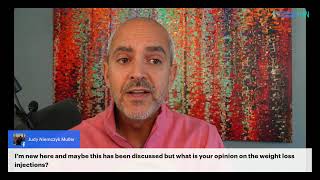
Judy says I'm new here and maybe this has been discussed, but what is your opinion on the weight loss injections? I, I don't really like to be negative about the injections because I'm not here to be judgmental and make people feel bad. So I think to each their own. You know, I think that people are going to do what they're going to do and I think, you know, diets don't work at all. Okay. We all know that there's not a diet that's been created in the last hundred years it's effective for long term weight loss. So I think in that context, the injections are the best thing so far in terms of diets don't work, so they don't even count then basically, when we talk about things that actually are effective, we're talking about gastric bypass surgery.
At the top of the list.
Lap band type stuff. Is it less effective than that? But that's another one. And then we have injections. And I think injections are the best out of those three because they're effective and there's typically less downsides with them. Okay. Now, that being said, you have to understand that I will all day long take the, the best, you know, the success stories of GLP1s versus the success stories of program yourself then. And there's not a comparison. That there's no comparison. Right. Because with GLP1s, what's happening is you're injecting yourself and you feel full all the time now. So now you're not hungry, so you don't eat. Okay. And you lose weight. Cool. Great. But program yourself then. You're figuring out how to transform your mindset, your lifestyle and your eating and you're creating an eating Plan for yourself. And so you get a couple things that you don't get with the weight loss injections. Number one is you know that you did it and you've internalized it and you understand that, you understand how to do this. It's something you mastered. So you feel that confidence and that certainty. Whereas with the medicine, you're always worried to some degree because you know that medicine could disappear at any moment. It could just get more expensive, it just run out of it, who knows? And as soon as that medicine goes away, your weight goes back up. So you, you haven't done it yourself. You're relying on this medicine. And so there's a big difference. The next thing is that you don't have to inject yourself and pay that money forever, right? So obviously, wouldn't you rather just be able to transform your mindset and your lifestyle and come up with a plan that genuinely works with you, than you can live at your goal weight forever that doesn't involve any injections. These injections are, they're a big deal. I think they're relatively safe, but they're a big deal. And so, you know, Program Yourself isn't natural, right? Obviously. And you don't have to pay anything, you know, I mean, there's no thousand dollar injections forever. Okay? You internalize and you get it. But to me, the biggest thing, the biggest thing is then Program yourself. Then we take the weight loss and we wrap it in personal development. So Program Yourself then. Technically, it's really not so much a weight loss program as it is a personal development program. So it's about becoming the best version of you. And that's a core part of the program. And so becoming the best version of you is bigger than just what your scale says. So this is about transforming from the inside out into the person you want to be. One piece of that is the weight that you're living at. But so much of Program Yourself Then is about becoming the person you want to be, doing the things you want to do, feeling the feelings you want to feel. So there's so much more to it as well. And so again, I will take the success stories of Program Yourself Then all day long and they, they smoke the GLP ones for a million different reasons. Now that being said, I know there's a lot of people out there that don't want to put the time, effort or energy into Program Yourself Then. Program Yourself Then at the end of the day is really not for most people. It's for people that are overthinker action Taker. It's for a specific type of person. And so I know there's a lot of people don't want to do that. Fine. You know, you best bet's probably GLP1s, but for the type of person that it is for. Holy. I mean, this is Jon. I mean, like, when you have all this mastered again, not only are you at your weight, but in. You've transformed yourself in so many ways. So that's kind of long. And the short of that, Leticia says, any chance we can see this replay? I'm at work and on a meeting. Yeah, great, Great question. Great point. Because, yes, you can. So the. The quick answer is that this is a podcast, so if you go to any podcast platform and search.
Program yourself, then.
You will find the podcast. And so I put it up every day. So, like, the second this is done, it pretty much goes up within an hour. And you can listen to all of them, I think. Geez, we got over 600. 600 episodes, huh? That's crazy that. Almost three years I've been doing these. A lot of fun. I love doing them. So, yeah, you can. You can listen to them. But the other thing. And I'm gonna wrap it up here anyways. And then real quick, Angie. I see that. Yeah, she did the. How do you say that? Trisepatide. Yeah, Very expensive. Yeah, that stuff's very expensive. And again, we'll see. We'll see what happens with all that stuff. You know, it's in its honeymoon period, I think. But anyways, beyond that, I am going to get out of here. So if you're not in my world, make sure you click the link in my bio and go get the hypnosis session I give you for free. It's kind of your starting point to just check this method out. Right. Maybe it makes sense, maybe it doesn't. You got nothing to lose. Okay? And so go get that. Get in my world. And then the other thing again. Yes. Is that if you like to listen to this, I'm here live every day, Monday through Friday, usually around noon Eastern time, between noon and 12:30, usually. And I'm happy to answer your questions. I'm happy to coach you along. Okay. I. I do this again. This is my mission in life. So I'm literally here to help you, and happy to do it. And if you like listening to these and can't get to the lives, you. You can go listen to the podcast and, you know, check. Check that out, and you can listen to the whole replay. All right, So I appreciate that Incognito says, listen to your podcast every day when I go walking, I try to make your lives, too. Love it. Well, thank you, Incognito. Yeah. Again, a lot of people listen to these while they're walking or doing something. And again, one of the little things I'd say is sometimes. But I am a hypnotist, so when I am speaking to you, I'm not just saying information or saying words. I am also very intentionally speaking in a way to influence your subconscious mind to start making healthier choices. So I regularly hear people that listen to the podcast regularly losing weight just from that. So, again, it's a smart move, you know, because again, I'm sharing with you a lot of things you just never get to hear. And I know that, and I know that you'll find it helpful, most likely. And if you don't, you got nothing to lose. All right, so. All right, everyone, thank you so much. I really appreciate it, and we'll talk soon. Bye.
More from Jim



Weight Loss Visualization: Wake Up in Your Dream Size #programyourselfthin #weightlosshypnosis



What If You Pretended to Be Thin for One Hour? #programyourselfthin #weightlosshypnosis




