Why You're Afraid of Reaching Your Goal Weight
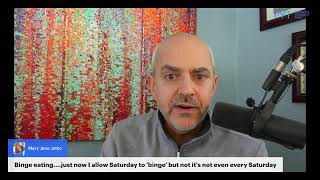
In this live‑stream, Jim Katsoulis explains why many dieters subconsciously fear actually reaching their goal weight. He argues that traditional dieting trains people to chase the scale’s numbers, not to learn how to live at their target weight. The fear stems from hedonic adaptation—once the novelty of weight loss fades, there is no longer a clear source of excitement, and the mind worries about regaining weight because it lacks a sustainable plan for life at the goal weight. Katsoulis introduces his "Program Yourself Thin" framework, which includes a free hypnosis session, a goal‑weight quiz, the Goal Weight Pyramid (mindset, lifestyle, eating), a 60‑second nightly mental rehearsal, and access to a Gym AI clone. He stresses habit automation—comparing healthy habits to automatic tooth‑brushing—to re‑program the subconscious for thin‑healthy living. The session also addresses binge and emotional eating by urging listeners to identify specific patterns and triggers rather than using broad labels. Throughout, participants ask questions and share experiences, and Katsoulis promotes his newly released book, "The Goal Weight Blueprint," and other free resources. He invites listeners to join his daily live Q&A, email list, and podcast for ongoing support.
Chapters
It. Foreign. Welcome to today's program yourself Thin Podcast. Today we're talking about why you're afraid of reaching your goal weight. And I know this may sound strange at first. You say, I'm not afraid to reach my goal weight. Yes, you are. If you have gotten your goal weight recently or close to it, or you're getting close to it, then this will be more obvious to you, okay? But if you really take a step back, I promise you, you're scared of getting to your goal weight. And the reason is simple. It's because your entire life you have been trained how to lose weight like a dieter, which is to say that you. Your entire focus and goal is on getting to your goal weight. I know you say, well, what's the problem, Jim? I don't. You lost me. Hold on. Because the problem is that your real goal is not to get to your goal weight. It's very important to understand this. Your real goal is to live at your goal weight. And if you're like most dieters, what's going on is that you have traded the excitement and the pleasure of the food for the excitement and the pleasure of the scale going down. And there is a difference between the scale going down and approaching your ultimate goal than being and arriving at your ultimate goal. And so this idea of trading the excitement of the pleasure from the food for the excitement pleasure of the scale going down is fine while you're losing weight, but once you get to your goal weight, where is the excitement and the pleasure coming from? Now, I know you're saying it's from being thin and healthy every day, but there is a problem, because there's a concept called hedonic adaptation that, that all humans experience. And it basically is this. That what is new and exciting to us today, we normalize to over time. And the classic example, you get a new car, it's all you can think and focus on for a couple months, but eventually it just turns into your car. Your new home, same thing, new sweater, you got new clothes. Every time you buy something online and you think it's going to be the most amazing thing ever, and you get it. It's. And you're. Huh? All right, you know, it's the search, it's the thrill of the hunt. That's really where the passion and the energy is. And so as a dieter, it's more motivating to be able to move towards your goal weight and to. In your mind. Now, again, the diet industry is conditioned to think this way, to look forward to that goal weight as if it's the most amazing thing that ever happened, a lot of dieters are approaching their goal. Once I get to my goal weight, I'm going to get a raise, my relationship's going to improve, I'm going to have more money, I'm going to take up more hobbies. And it's very easy to project onto this future goal that everything's going to be perfect. And then we get to that goal and everything's not perfect. Everything's kind of like it was, but now we're just at our goal weight. And don't get me wrong, there's a lot of things that are better, but it doesn't fix everything. And I know this may sound obvious when you think about it, but when you take a step back and reflect on how you've been conditioned to think about your weight as a dieter, it really becomes this idea that getting to your goal weight is the answer to everything. It is not. And so you are going to get to your goal weight and find that out. If you don't already know that. But I already think you know that. And that is one of the reasons why getting to your goal weight, you could be scared of it subconsciously, right? That's one of the reasons it doesn't fix everything. But the biggest reason that you're scared to get to your goal weight is you don't know what you're going to do once you get there. You've got a plan for how you're going to lose weight, right? Crystal clear in your mind, right? You got your diet, which is a plan of getting to your goal weight. Remember, weight loss is a phase of your big goal. It's just the initial phase, it's not the whole thing. Okay? The whole thing is you want to limit your goal weight. And the truth is that in your life, you've never, not even one time, learned how to live at your goal weight. Everything is about taking drastic, extreme actions to lose the weight. And so somewhere deep in your mind, you know this already. You know that how you diet and lose weight is not sustainable. You don't want to do this forever. You know this. And once the weight loss and the scale and the looking forward to it disappears from the equation, and now you're just left at your goal weight. But now you're just left at what? What are you looking forward to if you're a dieter? How are you sticking to your intermittent fasting? How are you sticking to your points? How are you doing it if you don't have anything to look forward to. And again, what are you looking forward to once you get to your goal weight? Most people don't have much to look forward to. Again, just being in my goal weight, I don't need to look forward to anything. It's just amazing. But if that was so true, why did you ever leave your goal weight in the first place? You know? So again, there's this subconscious fear for most dieters that getting to their goal weight is actually bad because now they can't keep dieting and they're just going to put the weight back on. And that's the punchline that the reason you're scared to get to your goal weight is because you don't know what you're going to do then and you're terrified that you're going to go back to what you were doing and put the weight back on. And why wouldn't you be terrified of that? Because with your weight your entire life, it's always been this off and on switch. You're either on tracking every little thing, managing every little thing to lose the weight, or you're not thinking about it and you're putting weight on. And so you know this on some deep level. And this is why, almost guaranteed, you have a fear of getting to your goal weight, a fear of being, being at your goal weight, because you associate being at your goal weight with putting weight on. Notice, it's an odd, odd things psychologically, that oddly, when you think of your goal weight, you think about putting weight on, because once you're at your goal weight, you can't keep dieting and you have no concept in your mind of how to live at your goal weight for the rest of your life. On your autopilot, that idea doesn't even exist. There's no concept, there's no information there. And this is one of the reasons why you're scared to get to your goal weight, because it's the end of the dieting and the beginning of what I don't know what to do exactly. And most likely what you think in your mind is, I'm going to get to my goal weight and then I'll enjoy it until I put the weight back on. That's probably what you think deep down, and that's why you're scared to get to your goal weight. So the answer to this is to start focusing on living at your goal weight. And one of the easiest ways to do that is to go get the free hypnosis session that I made for you. If you're on TikTok, you can click the little picture of me up on the left there. There's a link right in the bio. Go click it and you can go get the free hypnosis session I give you. I also give you a goal weight quiz to make sure you're chasing the right goal weight. Three steps to living at your goal weight training that I put together for you. The program yourself thin method, which is a breakdown of the 60 second mental rehearsal technique we use at night to program your mind and access to Gym AI, which is my virtual AI clone trained on over 10 millions of my words. And I give you access to that at least for a little while for free. So go check that out. If you're over in Facebook or YouTube land. I'm going to put the link right in the comments. Boop. There it is. And you can go get that again. It's free. No one gives you more free stuff than me. What's up, Nina? How's it going? Nina says, I've been listening to you for about a week and it makes so much sense. Thank you, thank you. I've lost £4 already, but I feel like I'm at my goal weight. I'm happier, I'm enjoying my food and my friends. It's true about the fear, but I'm not scared anymore. All right, Nina. Yes, yes, yes. Nina hit the nail on the head. And I appreciate, appreciate what you wrote because you kind of highlighted a whole other thing that I just want to point out that when you get good at living at your goal weight, the fear disappears. Right now, if you're overweight, there's a great chance that you're not very good at living at your goal. You don't have the skills, you don't have the strategies, you don't have the thought patterns, you don't have the muscle memory. You want to call it that to live at your goal weight. And so to live at your goal weight, you feel scared because you don't have the skill sets, you know, but if you develop the skills of living at your goal weight, you don't get so scared, right? Because you trust yourself. You believe in yourself. So again, a completely different approach than what you typically get from diets, but I think an important one because if you're trying to lose weight in your dieter, most likely it ain't working for you. And it's not your, it's not your hormones primarily. It's not your metabolism, it's your mindset, you know, that's the big thing. What's up, Mary Jane? Mary Jane? Says never had a goal weight, more a body relationship to food. It was troubling when I started seeing my ribs, wondering what my goal weight should be. Now it's stable, but your sessions help with not only weight, but lifestyle. Thank you, Mary. Yeah, exactly. And program yourself then. Absolutely. We, we kind of go at it almost backwards because in, in my opinion, we want to keep the weight secondary. Weight in and of itself is not a great motivator. And I know that may sound strange to you all because you think about it all the time, you think it is, but it's not. Weight's not a great motivator. So the way to think about weight is weight is a means to an end. Kind of like money. Money in and of itself is not very valuable, okay? But what you can do with money is. So money is a conduit, it's a means to an end, and your weight is the same thing. The weight in and of itself does not make you happy. If it did, no one would have weight issues. But what happens is, it depends. It depends on how you're achieving the weight loss. And if you're able to do it in a comfortable way, then your quality of life goes up. But if it's a miserable way to lose weight, if you have to track every point, restrict yourself, you're hungry all the time, then your quality of life's going down, even though your weight might be going to where you thought you wanted to go. So we can't just look at weight as the only factor that matters, because clearly it doesn't. You can't be much more obsessed with your weight than you already are. I'm going to guess most dieters are absolutely obsessed with their weight. But the obsession on the weight, ironically, it's a paradox. It actually creates less motivation a lot of the time. And so we want to look at other things. We want to look at the quality of life you're living, your mindset, your lifestyle, your energy levels, your health, how you feel, your mobility, all these other things. Again, whatever is important to you in your life, and then weave the weight around it. But, but that's awesome, Mary Jane. Yes, that does happen, that as you walk this path, you know, you start to resolve more and more challenges and issues that you'd had. You know that that's the goal. Toasted bagel, cream cheese. How's it going? Yeah. I haven't seen you in a while. I haven't seen you a little bit. Hope you've been well. I've been great. Yeah. Yeah. You're Making that bank, doing all right, you know, big news. I don't know if you've been around. I guess the big thing recently has been my book. So I'll show you that. I think I said this yesterday. I'm in the process of organizing my office, and I made pretty big strides, I would say. But one of those strides has led to a big old pile next to my desk that I gotta fix. But anyways, yes, this is the book. Let me switch this mirroring over. So, yeah, this has been kind of the big news. This. This went live at the beginning of January. So this is my. My first kind of official book. Of course, I do have the blueprint, but that's for people in the program. But this is. Yeah, you can just go get this. Yeah, I gotta be careful what I say. Tick tock. Will. Will remain. Restrict me. So. But anyways, yes, this book is out, out and out and about now. So that's been really exciting. And so I hope you've been doing well. What's it called? The Dow of living at your goal weight. Yes. So I love this book because this book is written very intentionally to kind of take you through the program yourself, then the system in a very accessible way. So it's 40 chapters, but each chapter is a page or two, and each one's kind of a hypnotic story. So the goal is that as you read this, it actually transforms and changes you as you read it. And I think that makes it kind of unique. It's not just more information, more of what you should do. It is, again, an experience, I would like to say. And I don't know, you know, last. I haven't looked in a couple days here, but last I looked, we'd had 70 reviews, 75 star reviews. That was pretty exciting. Let's see what we're up to. Going up at all. 75. All right, five more 75. Five star reviews. So people are loving it. Super exciting. So anyways, where am I at? Leanne says just found you last week. I love the mind shift that's happening. Can't believe the difference. Thank you. Thank you. Well, you're welcome, Leanne. Wow, this is really nice. Got a lot of new people, so that's always fun. Again, if you're new here, please go get in my world. Go get that free hypnosis session I give you. Get Opt in. Opt in. Because once you're on my email list, I give you a bunch of stuff, but I'm always giving you more. I'm always doing new things, and I got A lot of cool things coming up, so make sure you're on that list. As I always say, no one gives you more for free than me, you know. Again, my mission in life is to help as many people as possible live at their goal weight. And I give a lot away to help that happen, including being here. I'm here every Monday through Friday, usually around noon Eastern. A little late today, but. But here nonetheless. And I am here to literally answer your questions and any weight loss questions or challenges or you're feeling stuck or whatever, let me take a swing at it. You know, this is what I do. I've been doing this professionally for over 20 years and I'm pretty certain that I can help you. I'm pretty certain that no matter what your weight loss challenge is, that I can help you move through it and help you move through it in a way you never would have thought of. That's what I like. And that's what I like to do is to give you a different perspective on this whole thing, a different approach. And I think that's necessary. Right? It's just another way to say we need a different mindset. Different mindset to get the results you want. Most likely it's a. Veronica Rock says keep posting please. Yes, I will keep posting. And I got, just, I got, I'm so excited. You know, I always, I know I get on these podcasts and I talk about what I'm going to be doing and it may take a little bit sometimes to finally get there, but we always get there, right? But I got, man, why. I have some cool stuff coming the next couple of months. I'm so excited, you know, it's really exciting to me. So make sure you get on my email list again. It's free. I give you a bunch of stuff, you know, whatever. If it's dumb, you don't like it and it's just stupid to you. Just unsubscribe. Doesn't even cost you anything. But for the people does help. Holy. It's life changing for them. You know, it's a brand new approach to kind of age old problem of weight. Although, you know, weight really wasn't an age old problem. It's about a hundred year old problem. You know, don't get me wrong, I mean there's always been some people that weight issues but for it to be this, this mass epidemic issue, it's really, we're talking, you know, I mean Honestly, we're talking 50 years but, but you know, I'm fine pushing out to 100 years. But the secret to managing your weight in this environment, I believe, is to. Again, we reference the Goal Weight Pyramid a lot here, is to get control of your mindset, your lifestyle and your reading. Learn how to think, live and eat like a thin, healthy person. That, in my opinion, is the. The path to achieving the goal that you want to achieve, which, again, is not just losing weight. You don't just want to lose weight. I can't stress this enough. You want to live at your goal weight. Okay? And there's a huge difference there, okay? Huge difference. So don't think they're the same. Don't just say, oh, it's just semantics, Jim. No, Nina says, I have 30 pounds to go, but I'm not focused on the number. My thoughts are changing. No more excuses. Thank you for truly helping people. This is the only way to change your life. That's great, Nina. Yeah. I'm proud of you. Yeah. And £30 to go. I say this all the time, but I'll say it once more. Make sure that you're not just focused on the weight loss piece of it, right? Because it's hard to motivate ourselves as strongly with what we're going to lose versus what we're going to get. And so you can do both. You can say, I want to drop 30 more pounds so that I can get that. Now, again, you have to say this out loud to everyone, but in your mind, you should practice thinking this. That I want to lose 30 pounds so I can get to X amount of pounds, and I want to live at X amount of pounds. Because when I'm at X amount of pounds, I'm the best Nina I can imagine. I've got more energy, I've got more focus, I got more clarity, I feel better about myself, blah, blah, blah, blah, blah, okay? But we don't want to just focus on the weight we're going to lose. Please, please understand this. It's not enough. It's not enough. I know you said, oh, it's enough for me, Jim. I really want to lose the weight. Okay? But if you've been trying to lose that weight for 30 years and you haven't lost it, it's not enough motiv motivation. Okay? You know, and you need to think of it differently. And a lot of times I can always say with the. The goal Weight pyramid, the very first thing we start with here in mindset, we always start with mindset. And the first thing we start with is motivation. You know, how do you get yourself truly motivated? Because most dieters are surprised to find out that they're not really motivated. There's a difference between. There's a difference between truly, genuinely motivated and thinking you're motivated. That makes sense. Be healthy says metabolic health is the goal. Well, again, metabolic health is your goal, I suppose. Yes, I would agree. I do agree with that. But I do also think it's an opportunity to say that all goals are individual, too, and someone else's goal may not be metabolic health. I don't think that's a great goal necessarily. I think metabolic health is a. Is a great thing to aim at, you know, because it's gonna support your weight and all the other great stuff that you want, I think, in the best way possible. But anyways, Linda says, how do I stop binge eating? Okay, great question. The way I look at this is I think one mistake dieters make is they tend to generalize at too big a level. Okay, so it'll be, say something, oh, I'm an emotional eater. I'm a binge eater. Okay, but these categorizations are so big that they're practically useless, right? To say, you're a binge eater, good luck, you know, because specifically, what I mean by that is that you probably have different binge eating patterns. Very rarely does a person have one binge eating pattern. I hope this makes sense. And this is really important. It's the same thing with emotional eating, right? You're not an emotional leader. You have emotional eating patterns, and you need to know what those specific patterns are. Because if you just say, I'm an emotional leader, then you think the answer is, well, I just want emotional eat anymore. And that's. That's it? That's your plan? I'm not gonna emotionally eat anymore? That's it. But you have no real understanding of the issue. You have no real strategic solution or strategy to this. Okay, so let me give you my version of how I would approach either of these. I have binge eating issues. I have emotional eating issues and challenges, and I say, okay, let's dive into those. When do you typically binge eat? Because when you say you're a binge eater, that implies in your mind that every time you eat, you binge eat. And that's never true. And so we want to start to understand the binge eating pattern in more granular understanding. And so when we ask, well, okay, well, when do you typically. Well, I don't. I don't binge eat breakfast typically. I usually binge eat when I go to the restaurant, you know, especially that restaurant, when I'm in social situations, when I get pizza on Friday nights, I'll binge eat it, whatever. But you start to notice there's patterns. And it's the same thing with emotional eating. You say, I'm an emotional eater. Well, what emotions are triggering the, the eating? We need to know which emotions it is because we can't just say emotional eating because then that just says, oh, well, my willpower is going to stop me from emotional eating. That's the answer every time. And that's not going to help you because your emotional eating actually is. Oh, I eat when I get stressed. When I get depressed, I start reaching for the food. When I feel lonely, I start eating. Now all of a sudden we have specific emotions and the patterns that go with them. And now the solution for dealing with emotional eating that's based out of loneliness is going to be different than the emotional eating based out of stress. Does that make sense? You can't have the same solution for both of them. And I know you dieters think you can. Well, I just willpower. I just want emotional e. But here's the problem. The binge eating and the emotional eating are symptoms of a deeper problem. They're not the problems themselves, in my opinion, especially with emotional eating. And so if we go to emotional eating and you say, well, I'm a person who's, when I get stressed, I, I overeat. Well, with your willpower model, you're just going to stop doing that. And that's going to lead you to be a thinner, stressed out person. That's not really what you want. What you want is to lose the weight and be thinner and healthier, but to also be more relaxed and calm. So we need to know the specific emotions that trigger the behavior so that we can come up with specific strategy to deal with it. I hope that makes sense. And so for you, Linda, how do I stop the binge eating is such a giant generalization that you're not going to get anyone there. Because again, the answer is just stop binge eating. When we ask a giant big question like that, we get a big, giant answer. I'm an emotional eater. Oh, we'll stop emotional eating. I'm a binge eater. What do I do? Stop binge eating. But that doesn't help. Okay, so again, Linda, you want to break down the binge eating. You're not binge eating 24 hours a day. Your binge eating probably follows pretty regular cycles and patterns. Now, what are some of the big triggers of binge eating patterns, emotionally patterns, time of day, Time of week, time of month, location, Right. Places that you find yourself at. Right. It might be again like when you go out to restaurants, could be a specific restaurant especially, okay. Could be at home when you sit in your sofa watching tv. People, or lack thereof, certain people trigger to overeat. When everyone's gone, that might trigger to overeat. Right? And then finally is mood. Whatever mood you're in, that might be a trigger. But again, as you start to pay attention to the different things that trigger you to binge eat, different things that trigger to emotionally eat, then you can come up with a much more refined strategy to deal with it as opposed to this generalized idea that you're just going to stop doing this big giant thing that doesn't work for any of you. It's never going to work. And I think the better, the better path forward is to get more specific and how you articulate the problem and then the specific strategies you use to resolve it. Moira says, I'm confused over what time in the UK you're live. Your email said three and when I changed that to GMT it says 8pm but it's only 6pm here at the moment. Moira, that is, those are two separate things. Okay, so the, the email you got is for the live Q and A we do on Tuesdays. So you're in the program. So every Tuesday we do a live Q and A where you can get on, ask questions, listen to other people's questions, whatever you want to do that, that's your time to ask me whatever you want. And these lives I do every day usually happen between 12 and 12:30 Eastern Time, which I guess would be 6, 5:36 your time p.m. i go on live like this. Okay, but the email you got was for today. Tuesday's 3:00pm college is 8:00 clock your time. So if you go to that link at 8pm Your time, you will, you'll be there for the live Q A. Yes. Mary Jane says, oh, you're in Sweden. Okay, I didn't know that. Mary Jane. Yeah, so yeah, like I said, my daily things that I get on here for usually 1212-1230 somewhere in that ballpark. So for you it would be 5 to 5:30 somewhere around there. Jane says binge eating. Just now I allow Saturday to binge, but not, it's not even every Saturday. Yeah, again I do the same thing now again I don't use the word binge because I never want to binge eat. It feels gross. But I do have pleasure days where I allow Myself to eat more palatable foods, eat more of them, you know, so I have all the foods. I don't think it's a good strategy most of the time to completely eliminate foods from your diet, especially your favorite foods. So I think a much better strategy is to learn how to moderate them, you know, and dial down the calories you eat from the food you typically eat. But to do it in a way that is strategic. And I do believe in program yourself. Then we use Clean and pleasure days and we structure those out very intentionally. So that's kind of how we deal with that. Yeah. If anyone's got any questions, feel free to ask them. Moira says. Ah, thank you. You're welcome, Moira. Yes. Glad that's, that's cleared up for you. But yeah, pop on the Tuesday calls, the Q and A calls. I love those calls. Again, I'll show you whatever question you may have about the program, how to navigate it, where something is, how to use a certain technique, a specific challenge you have. I'm a big fan of the Tuesday live Q&As and happy to help you all. And plus, I, I need them now. I actually, I, I did eliminate my group coaching. My, my coaching group. I, I did close down one of them. I had to free some time up for some other things I want to do. But now I have my, I have more coaching energy. So I, I need those Tuesday calls. You know what I mean? Like, I've been, yeah. Dialing down the coaching a little bit, you know, over the years, but that was a big one. And it's weird. It's weird. I love coaching so much, but sometimes in life you got to make strategic decisions. So kind of where I'm at, Adrian says 10 weeks in the program. I love how things are starting to be automatic deep breaths when upset. Adrian, that is so awesome. And you know, I was just talking. I'm really excited for you, Adrian, and I'm gonna share something with you and talk about a time frame that most dieters never, ever thinking. And I literally just got to do a coaching call earlier where I got to talk about this with someone who's kind of hitting about a year. I've been working with them. And it's. When it comes to weight loss, the diet industry has really installed such short term timeframes in our mind so that most of us think about weight loss in very short time time frames, days, weeks and months, typically. But the real magic is when you start thinking about your weight in longer timeframes, really when you start thinking of your life in longer timeframes. I think it supports you, but certainly your weight. And one of the things I want you to notice, Adrian, again, you're 10 weeks in, so great job, congrats. But you're going to find next year at this time, you're going to get so much more out of this, right? Because the way Program Yourself is built and what makes it so unique is that we really are focused on automaticity. And that's just a fancy way of saying that we want to be able to live at our goal weight. In order to live at your goal weight, you need to have more, let's just say, habits, habitual behaviors, right? So most of you, the best healthiest habit you've ever installed in your life is your toothbrushing habit, right? At some point when you were a kid, you spent a lot of time, your parents had to brush your teeth, brush your teeth. You did the same times every day. Now you're an adult, and you probably do it the same times every day on near autopilot. That near autopilot piece is. Is the magic. That's the secret. Because your teeth and the health of them is directly related primarily to your toothbrushing habit, your flossing habit, depending how far you gone with it. And there's a lot of wisdom and strengthen that realization. And that's what program Yourself is kind of built around. Because the idea is that we're looking to add more things like that. You know, the thing that makes me so sad in this culture is we're trained to have one healthy habit. Brushing our teeth. Basically, that's it. What else, what else are you trained to do? You know? But what if a year from now you not only have your toothbrushing habit, but now you got a habit where you get enough quality sleep Most nights you drink enough water so that you're optimally hydrated. Most days you naturally kind of relax and do breathing exercises that make you feel more grounded and calm. You just kind of naturally do it. You have strategies and habits of nourishing yourself. So you're putting high quality nourishment to your body regularly. It just kind of happens. Just like you brush your teeth, you move your body more because you have movement habits weaved into your life. You meditate, you take a little bit of time here and there, and you quiet your mind down. Even it's just for 30 seconds to a minute. You ground yourself mentally and you practice gratitude just almost on autopilot. If you did these things naturally, imagine this. Where do you think you would be. See a lot of people with their weight loss, what you've been trained to do. Here's the goal weight pyramid, right? We got mindset, lifestyle, and eating. You've been trained to focus on just this part, and that's basically saying, I'm going to control how I eat, I'm going to control what I eat. But you've never focused on all the pieces underneath it that are influencing it. And when you get your mindset habits locked in so that you naturally think like a thin, healthy person, when you get your lifestyle habits in so that you're living like a thin, healthy person, and when you get your eating dialed in in a way that really works for you, that keeps you at your goal weight, and you start to automate it, you start to eat like a thin, healthy person. This is how you become a thin, healthy person and stay there forever. Dieting doesn't do any of this. Dieting doesn't do any of this at all. It just says, I'm gonna. I'm gonna eat different. I'm gonna eat different. That's about that much of the pyramid. You're using willpower to come down and force yourself to eat a certain way. You're never fundamentally changing your mindset, your lifestyle, or your eating in any sort of way. So does any wonder that you're able to fight? Because that's what a diet is, right? A diet is you saying, okay, from now on, the willpower, I'm gonna. I'm going to force myself to eat. But what you don't realize, and you've never seen it this way, is that every diet, you're basically using your willpower to fight against your eating habits, your lifestyle habits, and your mindset habits. And in your experience, which ones? 1. Because they're run by different parts of your brain, your willpower is run by your prefrontal cortex. Your habits are run by your subconscious mind. Your subconscious mind handles way more information than your conscious mind can. Think about it. Think about all the things that you didn't know how to do and you learned how to do and now can do automatically. Back to kind of the toothbrushing habit idea. Writing, reading, using a computer mouse, using your phone, driving a car, riding a bike, washing dishes, taking a shower. These are all things you didn't know how to do. And now you've got programs for each of them. And you can do them all pretty much on autopilot. You don't have to read a book every time you want to ride your bike. You just know how to do it, even if you don't do it for 40 years, just get on. You know how to do it. That's the power of your subconscious mind. That's the power of habits. You've never once focused on programming your habits, your thought habits, your lifestyle habits, your eating habits. I'm not just talking about your habitual behaviors. I'm talking about more than that. And when you start to program your subconscious mind to naturally and automatically do the things that keep you thin and healthy, what do you think happens? Again, I'm not making wild promises here. This isn't rocket science. It's not that hard. Again, the diet industry's condition is to think so broken about weight that this seems unusual. But if you want to improve on anything else in life, what do you do? You want to become a basketball player? What do you do? You break it down. You get good at dribbling, shooting, passing, playing defense. You get all the skills, and you practice them until they're pretty much automatic. You want to play guitar or piano, you practice the chords, the rhythm, the scales, the. The melodies until they become automatic. And then you. You get good at it. Everything in your life, everything in your life that you want to get good at, it's the same approach. You break down the skills and you get good at them until they become fairly automatic. And then you're good at that thing, or at least better. But when it comes to weight loss, there's none of that. You're not practicing any skills. You're just forcing yourself or you're trying to force yourself. It doesn't work, you know? So again, I mean, at least it makes sense why it doesn't work. I hope so. Great job, Adrian. Yeah. Adrian says look at all those things as victories, not just weight loss. Yeah, exactly, exactly. Thank you for saying that, Adrian. Again. And program yourself. Then the. The success we experience, the weight loss is really just one piece of it oftentimes. And I know dieters have a hard time believing this, but people in program yourself, then a lot of times what they're most excited about. I'm sure. Obviously, everyone's always going to be excited about losing weight. It's like you're always getting excited if you find 100 bucks on the ground. I mean, you don't have to worry about that. But we need to have more motivation, more excitement, and more fun with this process. And the weight doesn't give you enough. So we need to realize that when you start making. When you start thinking different, you start living different, when you start eating differently, and behaving differently. So many other areas of your life improve too. You start feeling more successful, your self esteem goes up, you start feeling proud of yourself, you start having more energy, you start thinking more clearly, your work improves, your relationships improve, your health improves, your energy improves, your moods improve. And all these things are improving almost instantaneously. And program yourself then so that the entire process feels really good and exciting because for most dieters it's just straight misery, right? You're just, you're miserable, but the only thing keeping you going is that weight loss at the end of the tunnel. That's not a good way to move through the process, you know. Yes. Adrian says, I feel like I can sustain this. Exactly. And that's what ends up happening when you, when you go about it this way we're talking about. That's exactly what happens, is you start to feel it's sustainable. You start to feel like this is, this is for real, this is, I'm going to be able to keep this up. And that's an amazing piece of the puzzle that most dieters have been missing because most dieters are terrified of getting their goal weight because then they know they can't keep it up. As we started the whole thing from which seemed like the perfect place to wrap it up. So again we're going to wrap it up here for now. If you're not in my world, make sure you click the link in my bio or if you're in Facebook land, go scroll up to the comments section, go get the free hypnosis session I give you. Watch the training I made you. I give you a goal weight quiz, I give you a report on how to use the program yourself, then technique. I give you access to gym AI. I give you all this stuff for free. It's all free. Okay, go check it out. You have nothing to lose here. And if you like this, I'm here every Monday through Friday to answer your questions and guide you along as best I can. Usually here between noon and 12:30 eastern time. And if you can't make the live and you like listening to this, you can go and you can go listen to podcast. It's a podcast too. So you can go search any podcast platform, search program yourself, then it pops up and you can listen to this anytime you want. All right? Mary Jane says excellent session today brought up a lot of great things. Which book is the pyramid in? The Pyramids in the Goal Weight Blueprint. Mary Jane, it's right, right? Page six of this here. So you have access to this, right? In the program. You have the pd, the PDF of it. Okay? If you do decide you want to get a physical version, you can get one through the Circle app. They're there. So. All right, everyone have a super duper day, and we'll talk soon. Bye.
More from Jim



Weight Loss Visualization: Wake Up in Your Dream Size #programyourselfthin #weightlosshypnosis



What If You Pretended to Be Thin for One Hour? #programyourselfthin #weightlosshypnosis




