You Don't Have To Give Up Sweet
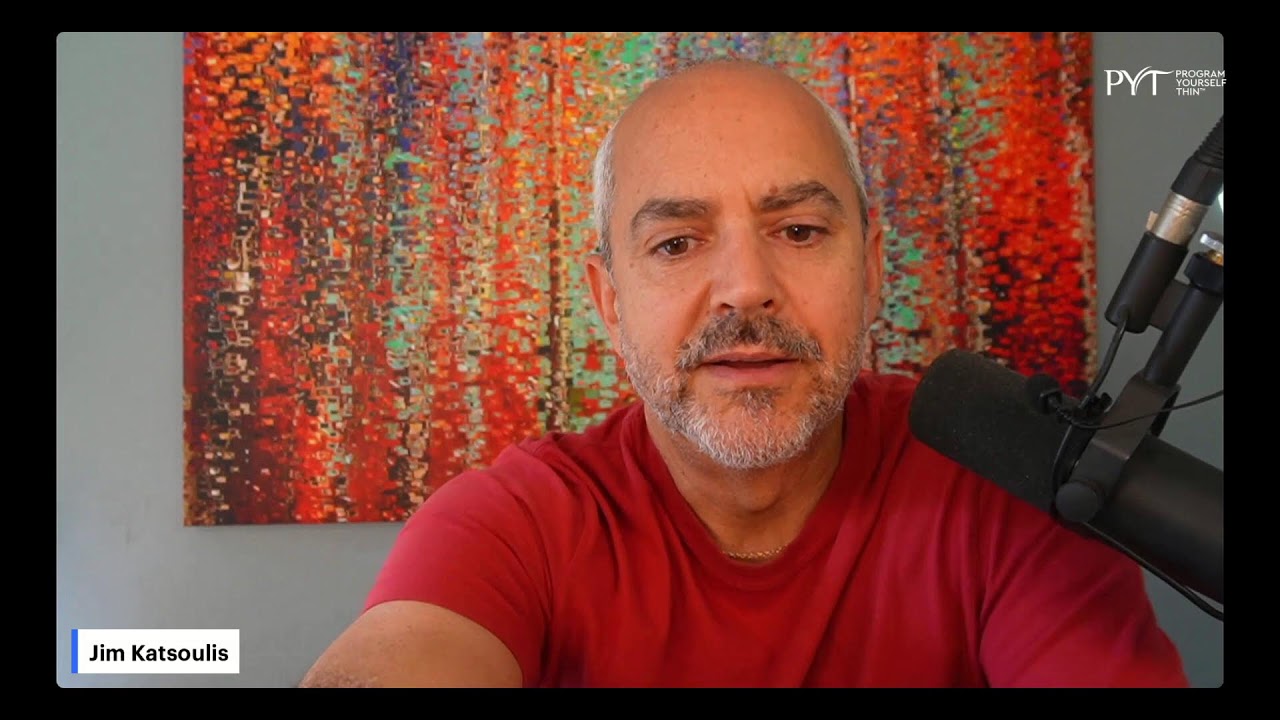
In this livestream, Jim Katsoulis explains that losing weight does not require eliminating sweetness. He argues that sweetness is a natural human craving that can be satisfied with fruit, whose natural sugars are healthier than added sugars. He describes how taste buds are adaptable, and by gradually reducing added sugar while increasing fruit intake, one can re‑program the palate to enjoy sweetness without excess calories. Jim emphasizes a mindset shift from an all‑or‑nothing diet to an "all‑or‑something" approach, focusing on consistent daily habits rather than extreme challenges. He shares personal anecdotes about walking 15,000 steps, past fitness challenges, and a fair‑food experience to illustrate the power of small first‑choice changes. Throughout, he promotes his "Program Yourself Thin" system, offering free hypnosis sessions, the "Reprogrammed" training, daily emails, and a podcast, and invites viewers to access these resources via links in his bio or by typing "MIND" on Facebook. He answers live questions from viewers (Tobias, Carolyn, Debbie, Pat, Pamela) about steps, weight‑loss mindset, and program logistics, reinforcing the core message that sustainable weight loss comes from a balanced lifestyle pyramid (mindset, lifestyle, eating) and personal choice.
Chapters
You don't have to give up sweet in order to lose weight, and I think a lot of people think you do. But the secret is to reestablish and reprogram yourself to exactly what sweet is. Okay, you can still have sweet, and you probably already know the answer. It's in the form of fruit. You have access to almost all the fruits in the world anytime you want them. You're probably not utilizing it properly, though. And at first, when you start to eat fruit, you have to recognize that the sweetness of something is relative to how much sweetness you consume. So if you consume a lot of sugar in your diet, it's likely that when you eat fruit, it doesn't taste that sweet to you, right? But if you realize kind of right from the beginning that as you go into this process, my taste buds are a relative thing. They can shift and change. They calibrate to the level of sweetness that you typically eat. So if you begin to reduce your sugar intake, refined sugar intake, added sugar intake, and you begin to explore different fruits, then maybe start with sweet ones, really sweet ones right off the bat. And you know, and go into it knowing that your taste buds can change, that your sense of what's sweet or what's not is malleable, changeable. And that you can program yourself to lower the added sugar you consume, reduce your sense— I should say increase your sensitivity to sweetness, start eating sweeter fruit. And this becomes a nice trade-off, right? Because the sugar in fruit is a lot better for you than added sugar. Okay. It processes much different in your body. It's a different thing. But fruit can start to become the thing you look forward to in terms of sweetness. Sweetness is a natural human desire and craving. Most people, even babies, one of the very first things it seems like they come out of the womb with is a preference for sweetness. So again, instead of trying to fight the sweetness, which is what a lot of dieters do, they'll try and stop themselves from eating sweet. Instead, we want to exploit that. We want to utilize it, and we want to strategically move in a direction where our sweetness, which we still look forward to, which we still enjoy, Is still part of our lives, but it's a different form. It's a form that serves you. It's a form that nourishes you, and it's a form of sweetness that helps you manage your weight more effectively. And it's a process, so it's not starting today you only eat fruit, no sugar. Okay, it's a gradual shifting, a gradual shifting. And so you begin to dial down the added sugar and begin to increase the sweeter fruits. You begin to dial down the sugar some more and then start to eat some less sweet fruits. You dial down the sugar some more and then you can eat some less sweet fruits, but they taste sweet to you because sweetness and how we experience is a relative thing. It's a relative thing that we can influence. And when you go about it this way, it feels so much nicer because now your brain and body don't freak out that we never get to have anything sweet. We never get to look anything forward to anything sweet. What happens is we're transferring what we imagine and expect to get as sweetness from added sugar sweetness, baked goods, cookies, ice cream, those types of things to the fruit. And it's a gradual shift. But if you make it gradually, it's comfortable, it's manageable. But we're aiming at a place where if you get to this place where you really look at primarily fruit as your form of sweetness and you have fruits you like and you've kind of worked into your pattern and you look forward to eating the fruits and that's how you think, Your ability to manage your weight goes way up. It's a huge, helpful part of the process. So I hope you give this some consideration. If you want to go deeper into this way of thinking about fruit, click the link in my bio or go to programyourselfthin.com. If you're on Facebook, you can literally just type mind, M-I-N-D, into the chat and it will automatically send you the link to get to your hypnosis session. And on top of the hypnosis session, I also give you a training called Reprogrammed. It is a training to help you live at your goal weight without the fight, and it's completely free. And on top of that, I send you a daily email program that I used to charge for. Again, I give this to you completely free. You can use it as long as you like on me, and I think if you do, you're gonna find that it dramatically helps you to be able to manage your weight. And again, that's the real goal here is to be able to get to your weight that you want to be at and then live there. So it's not enough just to get there for a day and then start backsliding. We want to be able to live at our goal weight in the most comfortable way possible. I believe these free things I give you is the first step to making that happen. So go check that out. Uh, if you have any questions, feel free to ask them. Oh, here we are on a Friday. Hope you all got a nice weekend plan. I'll tell you, it is weird. I'm sitting in here and I am Getting low-key mad because I get mad when it gets hot and it's kind of humid. It's kind of humid here today and I was a little out of nowhere. It's been a little chillier and then it started to get warmer, but so I'm not in the habit to put my air conditioner on. It's like I was starting to get irritable and I'm starting to realize, oh yeah, it's because I'm getting warm. I don't know if y'all are like that, but yeah, if you have any questions, feel free to ask them. And if you don't, that's fine too because it is Friday, a lot of stuff I'm working on. And, uh, if we don't have too many questions, I might just, uh, pop Pop on out of here. But again, I want y'all to know I did post the lose weight in October hypnosis session. I post that on TikTok, YouTube, Facebook, so you should see that if you're looking for it. Go check it out. Tobias says, been crushing my steps lately, trying to get 15,000 a day. I notice I'm not as hungry from it. Great job, Tobias. Nice job. Again, I just want to separate, you know, walking goals like that really ought to be separate from your weight loss goals in a sense, because again, hitting 15,000 steps a day is quite an accomplishment in terms of what you're capable of doing. But for most people, hitting 15,000 steps is something that's going to be hard to sustain long term. So it's great that you're doing it. I'm sure there's some benefits that you're getting out of it. But also be aware that that's not enough to control your weight. And, you know, ultimately it's your eating that controls it. But again, 15,000 steps probably takes a pretty considerable amount of energy To make sure you're doing it, to have the time to do it, to focus on doing it. Other things you're not doing because you're doing that. So again, great job, you know, kind of pushing yourself and seeing what you're capable of. And also keep an eye towards the long term. I say that from completely from experience. I am the challenge guy. I have done so many challenges in my life. And speaking of the one walking one, I will always remember. My wife and I did this one. This is 20 years ago. It had to be. You know what? It might have been 25 years ago. Oh my God, getting older every day. But um, anyway, so we made this 30-day challenge. We had a big board and everything. We're crossing it out, right? But what we were doing is we were walking this huge loop, and we lived at that time. We lived in a very, very hilly area. I mean, it's beyond hills. It was practically mountains, and so it was an intense walk. But we did every single day. And we were so proud of ourselves. I mean, it was like an hour, at least an hour walk every day. And, um, it was so funny because I remember we got to the 30-day— we did every day— got to the 30 days, we literally never walked it again. Never walked it again after that. Now, in fairness, we did move like, you know, the next year. But, um, I have done that so many times where I've challenged myself and done something like really intense and very proud of myself. I've done that with P90X. I remember doing a run of that for a while. I remember doing Insanity, which I think is aptly named. Shaun T, right? Again, a lot of fun back in the day. I would not do that now, but I did it then. But again, same type of thing, you know, but that taught me a lesson. My challenges where I went so deep into something and then never did it again really taught me an important lesson. Maybe the most important lesson of all. That what I really focus on when it comes to managing my weight is the things I'm doing when I'm not on a challenge, the things I'm doing when I'm not pushing myself to the kind of extreme. Uh, and that has been the biggest thing— thankful, um, best thing I've ever done is I really focus on the consistent things I do day after day after day after day after day, whether I'm in a challenge mode or not. And that gets to the point, you know, Program yourself then. We we use a mindset that stands in contrast to the dieting mindset. It's always all or nothing, and program yourself then we're all or something. And so we're always engaged on some level. So walking fifteen thousand steps a day again up here great amazing perfect. But when you're not able to do that, what are you aiming at? And when you're not able to do that, what are you aiming at? Right? We want to have plan A, B, and C. Nice job though. Anyways, again, don't don't uh. Don't let me lose the lead there. What's up, Carolyn? How's it going? Yes, happy Friday, happy Friday. Hope everyone's having a nice week. Um, I am. Went to the fair last night, ate a bunch of bullshit, um, but not too bad. You know, it's, it's funny, every year— and I say this a lot, and I want to just— because this kind of proves another point, I think, is that, yeah, this builds on what I was just saying. I really focus on the day-to-day things that impact my weight, not the outlier things. So One of the last things I ever got a handle on eating-wise in my life was Thanksgiving, right? Here in America, Thanksgiving is an eating holiday, and that was the last holiday, the last kind of like consistent thing that I really got a handle on. And why? Well, because it's once a year. And so I go to this fair, and it's actually— it's funny because it's a fair I grew up in the town, and it's like, you know, about an hour away or so. But, um, went there last night, and it's just funny, there's another thing because I don't get to practice a lot with Thanksgiving, I don't get to practice a lot with the Big E or the fair, it's a slower improvement arc, okay? But it's improving. And it's funny to go there and just change things up in a way that actually feels better. So that was really interesting, you know? But again, I say that to you because if you start thinking longer term, I think you get better results, right? Just looking at my health rather than weight loss at the moment with whole foods, et cetera. I think that's great, Tobias. I love that too. And I'm happy to hear that because again, we don't want to just put— because listen, everything takes energy. And so in that kind of context, there's a thing called opportunity cost, right? So if we put the energy into walking 15,000 steps a day, that's energy that we can't put into other things. Okay. And this is— we're always doing this, right? Like the nature of life is that we choose to do some things and that Simultaneously, we're choosing not to do other things. Okay. But dieting a lot of times really conditions us to think of one thing at a time. So we will, you know, focus on walking as many steps as we can or not eating for 16 hours or not eating carbs or whatever it may be. We kind of focus on one thing. And your weight, in my opinion, does not come down to one thing. It comes down to a lot of things that are consistently going on. Yeah. And so I'm happy to hear that. Yes, the 15,000 steps and whole foods and hopefully some lifestyle stuff too. Again, in programming, I'm not gonna bring it out right now because I'm not gonna be on too long. But program yourself. Then we have the goal weight pyramid: mindset, lifestyle, eating. And lifestyle is a huge focus for us. And so in order of importance, other things to focus on in addition to the movement piece of it that I'll mention are, in order of importance, sleep, hydration, relaxation, breathing, nourishment, movement, meditation, gratitude. Yeah. So you don't have to work on all of those at once, that would be overwhelming, but to work on a few of those things comfortably is really helpful, very beneficial. Uh, what's up, Debbie? Debbie says, hello, my daughter arrived last night, she just finished work and we're heading to Disney. I need to breathe through this and make good choices. Um, now again, Debbie, you do not need to breathe through this and you do not need to make good choices. You don't need to. You want to, right? You want to. You don't need to. And I just want to make this crystal clear. You don't need to. There's no need. There's no force over you that's gonna dictate your fate whether you do or don't. You know what I mean? Like, it's completely up to you. So there's no need to— I don't— you don't have to make good choices. You don't need to make good choices. You shouldn't make good choices. You either want to make good choices or you don't. It's very binary in that sense. And if you say to yourself, I want to breathe through this, I want to feel more relaxed, I want to be able to communicate more effectively. Because when Debbie goes to Disney with her daughter, she feels pressure to eat the foods her daughter eats, and her daughter puts this pressure on her very directly. And so Debbie is working through that. But again, this is something you want to do. You want to be able to go to Disney with your daughter and eat the way that you want to. You want to be relaxed and breathing in order to be in a more mindful, grounded space to be able to do that. But you want to, right? And want feels different than need to. Need feels like someone's forcing us to do it, and want is something we want to do. And at the end of the day, we always do what we want to do, you know, short of taxes. Um, you know, I don't know, a few others. A few other things in life that are like legitimately we have tos, you know. But there are very few of them. You know, virtually everything we do in life is a want. We want to do it. We've chosen to do this. Now, we may have chosen ourselves down into a situation where we no longer, you know, are connected to the choice that we made to get into it. Fair enough. Um, but it's always a choice. We always have a choice of what we're going to do. Uh, Carolyn says, have you been changing it up, uh, year after year at the choices at fair? Uh, yeah, I have. And, um, last night was the biggest change in the fair, right? Now, not completely. So, so I'll tell you what I did different is we usually kind of start in one area of the fair and we start there and we kind of get similar types of foods. Um, last night I said, ah, forget it, I want to go to this part, I'm gonna start here. And it was funny. And so that kind of shifted it up. And, and that— and this is a lesson too, that if you want to change the whole thing, the first thing to focus on is the first thing. Right. So if you change the first thing you do The chances that the rest of it are different go way up. So by me going there and making a different first choice decision at the fair than I typically do put me on a different path. And it really did. It automatically set me on a different path because by the time we got to the place where we typically start, I'd already eaten a decent amount of food and I wasn't even that hungry. So now all of a sudden, where I usually start and kind of mow down the same stuff, it was different. And, um, still got fried dough at the end even though I didn't really even want it. But part of me, I just felt like I needed to get it. But I was proud. I didn't have— I didn't feel like I had to finish it, and I didn't. And, um, it's the best I've ever felt. It's the best I've felt. And it's so funny because I go with my son, and this guy was almost, you know, in a coma on the way home. I said, I remember those days. But I felt really good. Again, not as good as I normally do because I'm eating fried dough and bullshit and ice cream and stuff, but that I don't normally eat. Um, at times I don't normally eat it. I got eating a lot later than I typically do, um, but I did it moderately. And that's what I'm trying to say. It's, it's not, not all or nothing. Not, oh, I want to watch my weight, so I'm going to go to the fair and I'm not going to eat anything I enjoy. And the whole time you're miserable. What is the point of that? Right? So I want my quality of life to be up. But honestly, the, the sweetest quality of life— and you can argue with me if you want— but I think the sweetest quality of life comes from moderate. moderately living, because then I can go to the fair and I can eat the shit I want, but I'm not gonna overeat it like I've done in the past. I don't want to do that. Yeah, it tastes good and I feel like shit for hours. It tastes good for minutes, I feel like shit for hours. It's not a good deal. And I'm finally getting to a point where I really genuinely think from that space most of the time. And going there, it makes me enjoy everything more. It was just more enjoyable, honestly, you know. So I really do believe that, uh, That all-or-something mindset is really a gift. I don't know, just it's such a nice way to think. Truly believe that. What's up, Pat? Pat says, listen to the Lap-Band hypnosis this AM and helped me visualize a smaller capacity stomach. That's great. Yeah, I love that session. The Lap-Band session is so good. And, um, the Lap-Band session— I'm gonna tell you a little trick, everyone. I give that session away for free. Most people are gonna charge you $50 to $200 for a Lap-Band session. Not me. I give it away for free. You gotta earn it though through action, but I just give mine away. I give it away. I don't know, maybe someday I should just charge for my hypnosis session. There's so much hypnosis and program yourself then. Um, but I, I always say, at least at this point in time, I always want people to be in the whole program. I don't want to just sell the hypnosis piece alone. I don't know, maybe someday I'll change my mind. But anyways, anyways, lap band session. Um, is so good. It's so good. So I'm happy to hear, Pat. And, uh, yeah, again, listen to that one a couple times. It'll reinforce it. And, um, yeah, you're right on the right path there. Yep. Debbie said, all right, yeah, we haven't even left yet and she's talking food. Off I go. Have a great day. Yeah, you too, Debbie. Have a fun time and enjoy yourself. That's the most important thing. Um, going and having fun is more important than eating perfectly. All right, so go enjoy yourself, but at the same time, um, keep an eye on where you feel the best. You know, that's key too. Um, Tobias said, I realized when I was slim I wasn't afraid to eat and just ate when I needed. Um, yeah, agreed. And I think that's, that's very accurate. Uh, again, one thing that sets Program Yourself Thin apart from most diets is that Program Yourself Thin was built by studying people that had lost weight and kept it off. And I think that's what makes it very different, because most diets are studied by focusing on people who lose weight quickly. I focused on people that lost weight quick or slow. I didn't really give a shit. I was interested in people that had been living at their goal weight, had lost weight, and then were living at their goal weight for at least 2 years. I was obsessed with these people, continue to be. And so I went and I began speaking with those people, um, and I really began to kind of download their mindset. I certainly paid attention to what they ate, what they did. I paid attention to that stuff too. But the big thing that I was focused on was the mindset they all had, how they approached this, what shifted in their mind, what spurred them forward. And you start to notice patterns. And yes, one of the patterns is that when you have a healthier relationship with food, there's not that fear, that anxiety, that stress, that focus on food that really diminishes the value of it, the enjoyment of it. And so I think, yes, ideally we don't want to just restrict calories. We want to be able to have a comfortable relationship with food where we naturally eat it in a way that keeps us at our goal weight. And so I agree a thousand, Tobias. I'm so happy you recognize that because now that can become part of a better criteria system. So you're not just going to tell me what to do to lose weight. I don't care what it is, even if I'm miserable. No, that ain't enough. You know, we, we want to be able to manage our weight comfortably, enjoyably. We want to have a nice relationship with food. And if we set that out as the goal right out, right in the beginning, we're much more likely to achieve it. So yeah, great, great realization, Tobias. Uh, Tobias says, do you have podcasts on YouTube I can listen to? Feel it helps a lot. Um, oh yeah, I've got— I mean, I'm closing on 1,000 podcast episodes. I've only been doing this for almost 4 years, so that's kind of crazy now I think about it. A lot of talking. People tell me that all the time. So I don't know how the hell you talk about this every day. And I tell you, I tell people this is my mission. I tell people I am just obsessed with this. I don't know why. I mean, I mean, I could sit there and say, oh, my dad died when he was 54 of a heart attack and I was 9, and that was the start of it for sure. Um, but it's also the, the, the way my life has gone. I don't know how it's even gone this way that I get to do this, but Um, it is just— it's what I'm meant to do. But yeah, so anyways, yeah, I'm going into almost 4 years of doing this podcast now, almost got 1,000 podcast episodes. So you can go to any podcast platform and search Program Yourself Then, it'll pop up. You can listen to any or all of them. Um, and also I think the best place to kind of catch Program Yourself Then is on Facebook, um, because again, we stream there every day. The replays are available there right immediately. Um, I post other stuff there, other content there. I got some other cool things I'm gonna be doing. Uh, so that, that I think is probably the best place. Um, but I'm also on YouTube. I stream there as well, so you can watch the replays there. The podcast, you can go follow that, and, and the audio version of that is uploaded every day. Um, and then I'm here every Monday through Friday at noon, uh, Eastern, uh, to talk to you live. Yeah, it does help a lot though too. Yes, I, uh I've been doing this for a long time. I mean, again, I feel very fortunate that I get to do this, and I feel very grateful that I get to help so many people, um, here every day, you know, in addition to my clients, my customers who are in the program. So, and I'm here every day for you all. So again, you don't have to be part of the program at all, uh, for me to help you. I'm happy to do it. So any weight issues you're having or questions you might have or struggles or concerns, throw them out here. Let me see, maybe I can give you a different perspective on it. And maybe I can help move you forward. There are better ways forward, that's all I can say. Yeah. Yes. What's up, Pamela? Pamela's stinking thinking is not good. Pamela, you got great thinking because you, I realized yesterday, have gone through the program in a way that has not been set up proper from the beginning. So I apologize for that, Pamela. I really— I found that out yesterday and it should all be set up now, but I hope you're completely getting everything That you should be at this point. If you're not, set up a support ticket. All right. Well, I'm gonna get out of here today though. I knew I was gonna do a quick one today. I'm gonna pop out of here. Thanks so much for listening. If you're not in my world, please click the link in my bio. If you're on TikTok, a little picture of me there in the right over here. Click that. Go get the link. It takes two seconds. You're in there. I got a bunch of free stuff I send you. If you're on Facebook, you can just type mind M I N D, and it'll automatically send you a link. Get you in in um. of in my world. I got a training I give you, all sorts of stuff. Uh, if you like this, I'm here every Monday through Friday at noon Eastern. Uh, so pop on here, ask any questions you have. Happy to talk to you. And yeah, if you, uh, can't make the live, it's available, uh, on all the places I just mentioned, but especially the podcast. You can search Program Yourself then anywhere, and they're popped up immediately as soon as they're done. So, all right everyone, have a super day, and we'll talk soon. Bye.
More from Jim



Weight Loss Visualization: Wake Up in Your Dream Size #programyourselfthin #weightlosshypnosis



What If You Pretended to Be Thin for One Hour? #programyourselfthin #weightlosshypnosis




