
Cancer Threatened Their Income. Storage Made It Bulletproof.
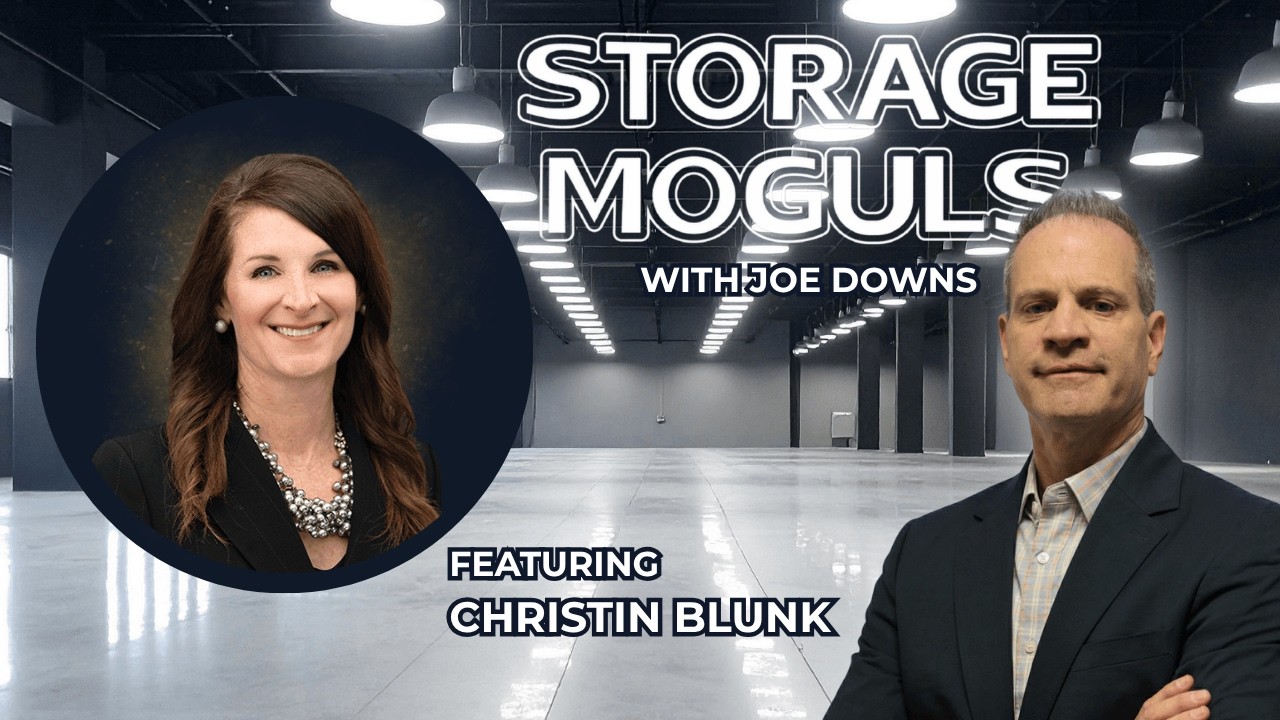
This content was created by Joe Downs. This content was uploaded by Joe Downs. This is a YouTube-hosted podcast interview (Storage Moguls Podcast episode titled "Cancer Threatened Their Income. Storage Made It Bulletproof.", published 2026-04-28) in which host Joe Downs interviews Kristen Blunk about how a family medical crisis (her husband Rod's stage‑4 cancer and the ensuing loss of income) prompted them to pivot from residential real estate into self‑storage. The conversation covers their background (well‑educated, W‑2 careers), the mindset shift after the 2008 crash, the decision to pursue commercial real estate, and practical deal details: Kristen cold‑called a 66‑unit facility in Radcliffe, KY (bought for ~$320K, ~37% below market rents, conventional local bank financing with ~20% down, cash‑flowing from day one and now ~ $4K/month), then acquired a nearby 117‑unit asset with significant rent roll issues (40 occupied but not paying) and roof needs, resolved via a creative addendum that allowed her to collect back rent and auction only three units. The episode is instructional—focusing on deal sourcing (cold calls), underwriting, conventional financing, operations, value‑add tactics, and the emotional/financial motivation behind building recurring income streams.
Chapters
I want to ask you something before we get started. What happens to your income if you can't work tomorrow? Not what if the market dips, or what if I lose my job? I mean, literally, what happens to your household if you can't show up starting tomorrow? Most people, if they're being honest, don't have a great answer to that question. And for most people, it never becomes urgent enough to do something about it until something forces the issue. My guest today had something force her issue. Her husband, Rod, who most of you who follow us already know, was diagnosed with stage 4 cancer 3 days before Christmas. He went from 205 pounds to 135 pounds in a matter of weeks. He lost his ability to talk, lost his ability to swallow. At one point, a priest walked into the hospital room. And while all that was happening, the income stopped because Kristen was his full-time caretaker. And you can't fill a sales funnel and take care of a man who's fighting for his life at the same time. That moment, not the cancer, but the income stopping, is what changed everything for them. Today, Kristen and Rod own 2 self-storage facilities in Kentucky and are completing a ground-up build. And their portfolio is on track to be worth somewhere between $3.75 and $4 million when they exit. Their current cash flow right now without new construction is between $8,000 and $10,000 a month. Rod couldn't be here today, and we'll get him on a future episode. But honestly, Kristen is the one who cold-called the seller, Found both deals, sat in an office for 4 hours photographing leases during due diligence, and negotiated the addendum that got her paid on 40 units the previous owner wasn't even collecting. She's the one you need to hear from anyway. Here's what we're covering today. Where Kristen and Rod started, and I mean really started, not the polished version. How they got into storage, and specifically how they found and financed their first 2 deals using a local bank and conventional financing. Not even SBA, not private equity, what it actually takes to operate a storage business, how many hours a week that looks like. And at the end, what she would say to the person watching or listening who's been sitting on the fence. I'm Joe Downs, and this is the Storage Moguls Podcast. Every week on the Storage Moguls Podcast, we'll sit down with operators, dealmakers, and capital partners who are actively building wealth across 6 storage verticals, because the best education comes from people in the game, not on the sidelines. And I'm excited to have Kristen Blunk here with us today. Kristen, welcome to the show.
Hi, Joe. Thanks for having me on.
Oh, it's a pleasure. Your story is, is an awesome one. That's— and I really want our, our listeners and, and our viewer to, to understand it, to, to really hear it from the beginning, if that's okay with you. And, and apologize in advance if if this, this is a little painful for you, because I honestly, I want to, I want to go back to before the storage, because I think understanding where someone started tells you more than any deal number ever could. It tells you whether this is someone who had an unfair advantage or someone who was starting from roughly the same place most of, most of you are. So, Kristen, you know, people look at you and Rod now and your portfolio, the exit strategy. You know, the mentorship you're providing in our community, and, and they see the finish line, which is awesome. But what they don't see is the starting line. So take me back before any of this. Who were you two?
How far back do you want to go, Joe?
I, I, I want to go back to before Rod got sick. What was your life like? Who, who were Chris and Rod Blount, and what were you doing, and what was your trajectory?
Sure. So we'll go back to the early 2000s. Rod and I both had master's degrees. His was nuclear engineering. I was in business. And we both had great jobs. He was a submariner in the Navy, an officer, and I was the vice president in an insurance company. And we thought we were doing everything right. We were making great money and just enjoying life. And then in 2008, the market crashed, as we all know, and we had lost a lot of money. We had, you know, we bought into the mindset early on that we believed in the system, we believed in getting a good education, and I still do, but that we continue to put money into our 401, our IRAs, and our mutual funds, and that's how we're going to grow wealth. And we thought we were on the right path for years. Bring you back up to speed. 2008, market crashed. We were still young at the time. Our girls were still young. We, we still thought we were doing the right thing, and we both agreed that we were going to continue on that path. So we continued to work hard for, you know, our employers and continue to put money into our 401 and IRAs. And then finally, in 2012, I had enough courage to open up our financial statements that I had been avoiding for the last 4 years. And I completely did not like what I saw. I was shocked, honestly, because we still were not where we were before the market crashed in 2008. And we were, over the last 4 years, contributing a significant amount of our income into our 401s, IRAs, and mutual funds still. So it made us realize that maybe we aren't on the right track. Maybe what, what we were taught and what we thought was right isn't. There are very wealthy people out there and We, we didn't know what we needed to do at the time, but we knew we needed to do something different. And so we just started educating ourselves. And I started reading books like Rich Dad Poor Dad, The Millionaire Real Estate Investor Next Door, Think and Grow Rich, all of that. And I know many people on this podcast probably have read those books and many more, but they helped us change our mindset and made us realize that there's other ways. And so Rob and I had made a conscious decision, decision to go into residential real estate. So we opened up a residential real estate company, investment company. He was was still working his W-2 job. I was running the business. We were— we did over 450 transactions probably in a 6-year period. We were fixing and flipping, buying and holding, wholesaling, doing private money lending. You name it, we probably did it. Life was crazy. It was fun, but we were, we were busy. And then, gosh, I can't remember the year. A few years later, 2016, 2017, Rod was diagnosed with stage 4 cancer.
So hold up, let me— I want to 100% want to get to that. I mean, it's a major part of this story, but yeah, I, I want to, I want to recap what I just heard for everybody. So here's, here's what I hope you all just heard that I just heard. You have 2 well-educated, high-earning people, a nuclear engineer and a VP, doing everything they were told to do. that they, you know, learned to do, was society expected them to do to be above average people, right? And still finding out in 2012 that they were behind, not because they were lazy though, but because they were smart. Or not because they were smart, because— That's not an insult to you. It's— my point is it wasn't just because you were smart, right? Because the path you were on wasn't designed to build wealth. That, that's what I want people to hear. It was designed to keep them, keep you comfortable until you ran out of time. That's what I think a lot of people don't realize. So I think it's fair to say Kristen and Rod saw that. That's what I just heard. And they decided to do something about it. And that decision, the willingness to, let's say, look at the statement and say, this isn't working. I feel, I think that's what I just heard you say.
Yeah.
Is the first step. So, like, kudos to you. A lot of people aren't even doing that because they feel like they're on the right track because they're checking all the right boxes or the boxes they think are the right boxes. So, if you're listening or watching right now, you mean— it should mean that you've— you're already having those thoughts, those same Kristen and Rod thoughts of, hey, this— If you're listening and watching, I'm I'm certain you're having those thoughts, actually, that, hey, maybe like Chris and Rod had, this, this isn't really the path we thought it was to ultimate financial freedom. And there's usually a moment, a specific moment that turns, I should do something different, into, I'm going to do something different. And I think, Kristen, you just started to allude to that moment came in the form of a diagnosis. Is that fair to say?
Yeah.
So you were building a real estate business, you had momentum, and then Rod got diagnosed with stage 4 cancer. I'm just gonna cut right to the chase because I know the story. I know how it ends. 3 days before Christmas. I mean, you talk about an absolute gut punch in general, but timing, my goodness, just to add to it. And I'm guessing everything stopped for you. And I wanna ask you about that period, not just because it's a powerful story, but because it changed the way you thought about money. That's what I heard. And income in a very specific way. So can you walk us through that?
Yeah, absolutely. And it did. And I, I believe we, uh, go through these journeys and, and obstacles for a reason, and we grew from them, and I'm grateful for them. You know, doing the residential real estate, we thought we were on the right path again, creating wealth, creating the life that we wanted to, even though we were, we were trading so much of our time in the residential real estate to do that. We were still enjoying it. But when Rob got diagnosed, he quickly, quickly became very ill and he wasn't able to work. So he didn't have any income. And he was so ill during this time that he needed 24-hour care. Somebody needed to be around him 24 hours a day. And so, as you mentioned, that person was me, Joe, and it was an honor to take care of him, and I wanted to do that. But we now have 2 people that don't have incomes coming in and 3 daughters, right? So, um, my focus at this time was just to get through this, to keep my daughters alive, keep my husband alive, and we'll muddle through this just like we always do. We were fortunate enough to have had enough money in our savings account.
Yeah.
To be able to carry us through for, for a while until he was able to get back up on his feet. And what really, what really made me start thinking is that, you know, there was a point in time during this journey, several times actually, where we did not think Rod was going to make it and that he was going to pull through. And after, after we passed that point and he was, you know, we knew that he was going to survive and that he was gaining his strength and our lives were resuming as normal. There was always something in the back of my head, and this is going to sound really harsh, and you know how I think, and I'm direct. So my worry wasn't, what if Rod died? What am I going to do? Because at that time, he was able to have life insurance, and from a financial perspective, we would've been fine. My worry was, oh my gosh, we could very well end up in this situation again where he can't work, and now what are we going to do? Because there's no life insurance coming in. There's no income coming in from his perspective at that point in time. And if I had to take care of him, there would be no income coming in from my side either. And so that, that really was eye-opening to me. And again, thought we were on the right path with the residential, but realized that we needed to shift what we were doing because we needed to put ourselves in a position that God forbid we ever go down this road again, from a financial perspective, we would be okay. That we would have income coming in regardless of whether we were trading our time for money. And so that's when things started to shift for us. And Rod and I went to the drawing board again and loved real estate. We thought we were going to continue down the path of residential real estate because that's what we knew. But after, you know, putting together the numbers and our goals, we realized that that was going to be a significant amount of residential properties that we were going to need to buy. And truth be told, I do not like being a landlord. I didn't want anything to do with owning properties and having passive income coming in that way, owning residential properties and having passive income coming in that way. So we quickly abandoned that idea of going, continuing to go down the path of residential real estate and started looking more into commercial asset classes.
So how did, how did storage come into the picture?
Great question. So we wanted something that was going to work with the lifestyle that we wanted to create, and we looked at several classes. Several asset classes, whether it was mobile home parks, self-storage, you know, office buildings, commercial buildings, whatever it was, multifamily. I knew I didn't want to go multifamily just because of it's still a residential piece to it, right? More income coming in off of it potentially. But there were still tenants that I didn't want to deal with. So just dug into self-storage, went to Self Storage Academy, learned a little bit more about it, and really realized that This asset class really aligned with the lifestyle that Rob and I were trying to create. And so that's where we landed.
Okay. And, you know, again, like I said in the opening, folks that, that know us know we work together. Um, and so this is a little self-serving as a first podcast, but it's also, I, I specifically chose you for, for the first Storage Monkeys podcast because your story, I think, is the story that res— that should resonate with the most people. So just for those that don't— didn't know that, you know, full disclosure. But that's why I selected Kristen. So I've known Kristen for years now. And so I know when you joined the academy, in the Self Storage Academy in 2020, during COVID you had 20 years of real estate experience. And you still spent a year just educating yourself and making offers before you bought anything. In self-storage?
100%.
Why? What were you learning that your experience didn't cover?
Well, a lot. You know, we did have real estate experience, but it was residential. I knew how to evaluate, buy, find, evaluate, and sell residential properties, right? And fix them up. I didn't know anything about commercial. It's— I don't want to say it's a different beast, but it is. It's— there's different terminology, different lingo. It's Different. And so I wanted to truly understand the business. I wanted to make sure that we knew how to buy. I didn't know how to find them. I didn't know how to evaluate them. I didn't know how to go to a bank and ask for a loan for— I mean, I can walk in, but you have to do a little bit more preparing for a bank interview to try to get terms out of them for them to agree to finance your commercial asset, right?
Mm-hmm.
So it's, While there's some similarities, there's a lot of differences. And just wanted to make sure that Rod and I knew what those differences were and that we were educated enough so that we could make good, sound decisions.
And what was that year like for you?
Well, the learning was exciting because I always love to learn. Being patient about finding my first deal was a little bit challenging for me. We kind of got in our own way. We thought You know, we live in Maryland and thought that we needed to have a storage in our own backyard. I wanted to be close to it, wanted to be able to drive to it. So most of the self-storage facilities in Maryland are Class A, and that is not what we're looking for. We're looking for Class B, Class C in the secondary and tertiary markets. So I couldn't find anything and just made sure I surrounded myself with the right people who could help me get out of my own way sometimes. And they showed me a path to how to find storage and own and operate storage that isn't necessarily in my own backyard. So.
Let me ask you a kind of a simple question. Is it hard?
No. What's hard is being consistent and not quitting on yourself.
Yeah.
That's what's hard. That's what's hard with life in general, right?
And that's what I tell people all the time, whether I'm standing on stage talking about storage or teaching it. I, look, I can do it. If I can do it, you could do it. The difference between me and you is just I immersed myself in it.
Yeah.
And I, and I, I drank the proverbial Kool-Aid because it tastes good, folks. And, and I applied myself, uh, with a little grit. And you did the same.
Yeah.
Because that, that year submitting offers, Kristen, getting rejected, driving deals, learning to underwrite storage specifically, that's not failure. And by the way, it doesn't take everybody a year. Um, that's the foundation. Every offer that didn't work was data. And when the right deal came through, which we'll talk about in a little bit, you guys were ready to move. You were ready to move on it, right? Because you had that foundation. One of the most expensive mistakes in this business is buying a deal you don't understand because you got impatient.
Yeah.
And Kristen and Rod didn't make that mistake. They were patient, they were disciplined, and then when they found it, they knew it. You cold-called a deal, a seller in Kentucky, and a year later you had your first facility.
Yeah, I did. Yeah, it was exciting.
Kristen, I want to talk about the first deal.
Okay.
Because nothing in this business is more important and nothing is more, I think, misunderstood than what a first deal actually looks like. Not the version where everything goes perfectly, the real version. So you found your first deal through a cold call, 66 units in Radcliffe, Kentucky, a town you don't live in.
Mm-hmm.
You're in Maryland, as you said. Walk me through how that happened and then let's talk about how you actually got it done.
Sure. So that year that Joe was talking about, wasn't wasted. I learned so much and I became better at finding the deals, negotiating the deals, evaluating them, right? And so my skills were getting stronger every step of the way. And so when the right opportunity came at the right time, I was ready to jump on it, right?
Well, let's, let's, if you don't mind, sorry to interrupt you. Sure. But let's start with the, maybe the thing that might scare most folks, cold calling. Most people think, Most people think you need a broker or a marketplace to find deals, and that's one way to find them. But you literally just called a seller. How did the conversation go? What'd you say? Was it hard? Did he yell at you, scream at you, bite you, kick you in the face?
Yeah, I think we create so much fear and anxiety in our own heads that, that isn't real, right? So you have to get out of your own way. And cold calling's scary. I, I don't like it. I get nervous, I get anxious. But as soon as I—
Well, hold on. Is it scary or is it just something you don't like?
You perceive it to be scary, but it is not scary. Does that answer your question? Does that answer your question?
It does. And I want people to hear that because in our minds it sounds scary. It's maybe the easiest thing you can do, but in, in our minds it sounds scary. Now I'm someone who, whose 4-digit PIN code for my ATM or any password or anything to get whatever are 4 digits I probably dialed, I don't know how many thousands of times when I was 22 and 23. Cold calling from American Express Financial Advisors. Sorry if I cold called you. I had to dial that 4 digits to get the dial tone out of the building. That's how many times I dialed it. It's the number I've dialed the most times in my life. I've cold called pretty, I mean, it was like 200, 300 cold calls a day, 6 days a week for the better part of a year. So, I'm here to tell you it's not scary. It's not fun either, but it's not scary.
So some people like it.
I don't, I don't want to meet that person.
But me either.
So, so walk me through that cold call.
Yeah. So what's interesting is the storage— not all of them, but the majority of the storage owners that I've ever talked to In my life, and there's been thousands, probably. They're all nice. They're all nice. It's not like residential. And it was shocking to me. And it was— I think I loved it, actually, the cold call. And you could actually connect with somebody who will talk to you and build a relationship with you. And that's what I love, right?
They want to help you. If you just ask for help, they help you. It's crazy. Yeah.
You get off the phone, you're like, what just happened here? This would never happen in residential. So I called and they— this lovely Southern lady who was from Kentucky answered the phone with her nice Southern drawl. And, you know, I, you know, was telling her who I was and what I was trying to do. I'm interested if she was— wanted to know if she was interested in possibly selling her facility.
Yeah.
And she said, sure, yes, I am. And we started to build a rapport. And she just bought her facility a year ago to show her daughter how to own and operate storage. But She was ready to sell it again because what I was getting ready to pay for it, they were making a decent amount of money off of it within a year. And I still had a lot of room to improve value.
So hold up. That, that is interesting because they must have stolen the place because, because I already know, because my next question to you is when you bought it, rents were 37% below market.
Mm-hmm.
That's, that's significant upside right there. But it also means you had to execute and capture it, of course. But, um, that's incredible. So she made a lot of money a year after buying it. I think she just— that's lightning in a bottle.
Yeah.
You still bought something, which is why you bought it. You, you were taught this is what you look for, right? 37% below market. That is— I mean, we look for 20%. You're 37%. I mean, you're You're playing with house money at that point.
What did that—
what did that first 90 days look like? First of all, how excited were you when you found a place that was 37% below market?
Well, Joe, listen to this. So it's a small facility. Obviously it wasn't— we were looking for something bigger, but this was a great opportunity. The returns worked. And I thought, I'm like, this is great. My first deal, I can get in the game, I can learn, make sure this really works. And if, if I lose it all, we'll still be able to recover. It's not going to wipe us out because in Maryland, residential real estate is pretty high, right? The cost to acquire a house is pretty high. But I bought this one for $320,000.
So why would the, why would the thought, if we lose it all, enter your mind?
I don't know. Oh, the fear, right? I'm always I'm always talking to myself and talking through the fear and worst-case scenario. And what does that look like for us and can we survive it? Right?
Yeah.
Did I think that would happen? No. Did I think there— I mean, you still have the land, you still have the building, you're never going to lose it all.
So, so you're— the purchase price, I'm just going to introduce it. You paid $320,000, which is incredible, right? And you put $64,000 down plus closing. So what did that end up being? $90,000-ish?
Not even that. No, because in Kentucky, Taxes, all that stuff, closing costs.
So $80,000, $85,000, somewhere in there.
Yeah.
So at risk was $80,000 to $90,000.
Mm-hmm.
Um, you were buying it way under market. It had to be at 37% below market. So were you— was this just the ultra-conservative Kristin Blunk, if I lose it all, thought?
Yeah.
That wasn't really— looking back, it was kind of a silly Thought, yes?
100%. 100%. I was testing the waters, always analyzing things worst-case scenario.
Okay.
And that's really not worst-case scenario, right?
But the— I'm harping on your thought process just because to me it's crazy. But, but the— back to the reality of the situation, you had $85-ish grand at risk. So you're right, even if you lost some of it, uh, you know, didn't work out and you sold it for what you paid, you lost your closing costs or whatever, right? You weren't— you wasn't really— the point I'm trying to make is you got into self-storage for probably less than you were getting into residential flips in Maryland.
Yeah, well, first-time home buyers in the state of Maryland are purchasing between $500,000 or $700,000 homes, right? So those price points don't exist. Really here. So yes, I got into storage for a lot less than what I was into in residential.
And how did you finance this?
It was conventional financing, a local bank, 20% down.
So 20% down on your $320,000 purchase. Talk to me about cash flow.
I was worried in the beginning that we weren't going to cash flow.
Of course you were.
That we were gonna have to carry this for a little bit, but we were cash flowing day one. At how much? Day one, I don't know, probably $2,000 a month day one.
Net of debt service?
Yes, yeah. And I quickly—
I'm just doing quick math here. So day one you were cash flowing 28% cash-on-cash return?
Yeah, yeah. And I was worried and I had it. I was just going up from here, right? Because I was filling up the vacant units and I was raising the street rates to market rates. So I was creating value. And so quickly that $2,000 cash flow accelerated. Right. And while we were there transitioning our first facility after we just bought it, right, we're in there, we're getting dirty, we're figuring out what units need to be cleaned out, prepped So on and so forth. We drew of the market and ended up meeting another seller and ended up getting another property under contract.
You're, you're getting ahead. I'm not, I'm not done. I'll go back.
I'm sorry.
No, you're— you don't have to go back. I'm going to ask you that in a second.
I was leading you.
I want to, I want to, I want to make sure we tease everything out of this first facility because there's— we're kind of missing— the cash flow is amazing. We haven't finished that yet. Where is that cash flow today?
On that one, since it's a small facility, we are probably cash flowing around $4,000 a month, and that's after debt.
So now we're $48,000 on our $85,000 initial investment. So now we're up to a 56% cash-on-cash return net of debt service.
Yeah. And $4,000 is not life-changing, but it is nice to be consistently coming in on a monthly basis.
Look, you can't, you can't spend 56% Uh, cash-on-cash return, but you can spend $4,000 a month.
Yes.
That doesn't suck.
No.
Um, Kristen, the elephant in the room now for— hopefully, uh, our listeners is, is wondering, well, what's this thing worth now? If you paid $320,000 and you doubled your— just if we just take the one Uh, net of, net of debt service, cash on cash, you doubled that, which means your NOI had to double as well. What is this worth today?
Great question. If I were to sell it by itself, it would probably be worth over $750,000. So more than doubled.
And remind me again what you paid?
Uh, $320,000. So there was really minimal CapEx. We probably put $5,000 of capital expenditures into this building, into this facility.
So $5,000, and your closing costs were only $20,000. So let's just say you're into the thing for $350,000 and it's worth $750,000.
Yeah.
And that's obviously not including all the cash flow you've received along the way. That's incredible. That, that— this is one of the reasons I wanted to have you on. There's story after story Of folks that we're either coaching and mentoring or running into or meeting in our masterminds we belong to who have this story. My first deal was $400 grand, $600 grand, $500 grand, and it's almost always worth twice as much today. And today isn't 20 years later, it's 3, 4, 5 years later. It's incredible.
Well, if I can add to that, I Did make some good returns in residential real estate, 6 figures, but never at those margins.
Right. Nor would you want to on a single-family rental or flip.
Right.
You don't double the value of a single-family flip in Maryland, do you?
Not normally, no.
And certainly not if you are, you probably have into it what you paid for it.
Yeah.
Right. I could see buying something for $320 grand and putting $300 into it.
Mm-hmm.
And yielding 7, 800, you know, but that all that's to make 100, not to make 400.
Right. And the cash flow. Right.
Plus the cash flow. I mean, it's—
And keep in mind, Rod and I got into this because we wanted consistent monthly income coming in.
Understood. So you're not, you're not trying to sell it. It just happens to be worth that. And by the way, there's other things you could do with that. I'm not saying you have to, but you could refi it, pull money out, go buy more deals. There's all kinds of stuff. I just want, I want people to hear this story because I want to make it— I want them to understand it's tangible. It's real. It's not pie in the sky. We're not talking about $10 million deals. So in summary, your first deal, 30, 37% below market rents is what I'm hearing. Use conventional financing at a local bank, which by the way, Bellrose Group, most of our deals are local credit unions, local banks. that finance them if they're not seller financed. Found through a cold call, nothing exotic about this deal. 66 units, no insider connection, no private equity fund, no 10-year track record in storage. Just someone who did their homework, asked the right questions, showed up credibly at the bank with a business, not a gamble. And that's what I want people to take away from this. The, the first deal doesn't have to be complicated. Just has to be right. Doesn't have to be a $10 million deal. It's just got to be the right size. And when you find the right one and you know how to evaluate it, the bank will tell you yes because you're not asking them to bet on you. You're showing them a business model. All right. Here's here's the thing about deal number two. That I think is more instructive than any underwriting spreadsheet I could— we could talk about here. It involves a guy who drove a school bus, repaired lawnmowers, and had never been in his office long enough to actually collect rent. And Kristen turned that into a lesson that applies to every single deal you'll ever look at. So Kristen, your second deal was 5 miles from the first. You already alluded to the fact that while you were at the first—
Yeah.
You found it, 117 units in Vine Grove, Kentucky. You bought this for $430,000. Rod found it by literally driving up to the neighboring facility owner and introducing himself. Is that correct?
Yes.
But when you got into due diligence, you found out that 40 of those units were occupied but not paying.
Oh yeah.
Talk me through that.
We were getting ready to close, actually. He, he didn't have a system. He rented units manually and had a whiteboard that he would write down. So we had to go all the way through due diligence without really collecting a rent roll.
I want to pause you there. So you're telling me his management system. So, so obviously no software. Not even a spreadsheet. Not even a notebook. It was on a whiteboard.
With magnets and markers.
Magnets and magnets, magnets and markers.
Yeah.
That, I don't know if it gets more mom and pop than that.
And you actually, he took cash or checks and you actually had to go into his office and pay him. So guess he was driving buses and running a lawnmower business. So guess what was happening?
Sophie wasn't there. You couldn't pay him.
That's right.
Oh my goodness. All right.
It was an opportunity for us. So, um, how did you handle that?
What— so you have 40 units occupied but not paying. What did you— first of all, what did that do to your evaluation of the deal? Did you, did you renegotiate?
Tried to. It significantly lowered the value. But keep in mind, you know, I think you said we bought the previous facility at 37% below market value. This was less than— this was more than that below market value.
This is more than 37% below.
Yes. So there was significant ability to create value here, and we knew that. And so we tried to renegotiate because We were buying it based on the fact that it was stabilized, probably 80, 85% occupancy, knowing that the rates were significantly undervalued, but that our physical occupancy was still stabilized. Come to find out, when we were getting ready to close, when we got the true rent roll, when I was going through all of his— I had to physically go in the office and read all of his contracts and go through everything to make sure who's paid, who's up to date, who's behind, so on and so forth. And that was very revealing. There was 40 units that were behind. And I'm not talking just a couple of months behind. They were significantly behind where they should have been auctioned 6 months, 8 months, a year ago. Right. So taking over this facility, I knew that we were going to have to come in and auction off all of these units and that would destabilize us. Right. Our occupancy would significantly decrease.
Let me, let me pause you there. How long after you closed on Radcliffe are you Closing on this second deal?
8 months. We were on— we had a long contract period. It took a while to negotiate it and get it under contract.
You're still new.
Yeah.
I want you to be honest. During this 8-month—
It's— hold on. August through February, September, October, November, December, January, 6 months. There you go. I have to count on my fingers. Don't mind me.
Folks, if I can do this, and Kristen can do this, you can do this. So 6 months after you close on the first one, you close on the second one.
Yeah.
You're still green. You're still wet behind the ears. You're still brand new, whatever. expression you wanna use. I know you know what you know now about the second facility, but in that moment, in that 6-month window, was there fear?
Yes.
Were you concerned about these unknowns of these 40 units and what would this look like and how will it get financed? And is this a deal? Are we being stupid? Was that going on in your head?
Yeah, it was going on in my head. I was thinking, oh my gosh, the cash flow isn't what it says, and we're going to have to spend 6 months to 8 months just stabilizing this facility and getting it up and running. And I didn't want to do that. That was fearful.
How did you cope? How did you get through that? What gave you peace of mind, or what were your guardrails?
Yeah, great question. I needed to add into this because during our due diligence period too, we also found out that we needed to replace 8 roofs.
So, and you're—
we have 8 roofs and 40 tenants.
That's brand new. You got— you're juggling one facility right now.
Yeah.
You're learning the ropes and you're getting curveballs with 8 roofs and 40 units not paying.
Fortunately, the numbers still worked because we got it under contract for a phenomenal price and we knew that. So what I did was with, with the units, we tried renegotiating with the seller and he wouldn't budge. But Rod and I knew that we were still going to make a good amount of money on this facility and that it was still a good deal regardless. So I got the seller to agree that, okay, we won't renegotiate the deal, but you need to sign an addendum that if I collect on these units, I get to keep it.
So what you did was you got creative.
Yes.
And this was a point I made recently, and I— and Have, and I implore people. I think I made it. I think I made it in the Storage 100 series I'm doing on YouTube. Just if it's a deal, you got to find a way to make it work. If it's a deal, you got creative, and I love that. So the owner wouldn't renegotiate. He represented 40 occupied units, but it was really 40 occupied units that weren't paying. It was like. 40 units that you're looking at potential auctions, which isn't doing you any favors from a cash flow standpoint.
I have to bear the expense of auctioning them and cleaning all that out.
But more importantly, you were counting on that NOI, I'm sure.
Yes.
And now it's not there, that revenue that leads to the NOI.
I thought it wouldn't be there.
You got creative. And what was the result?
Amazing. He signed it and then realized he wasn't happy about it when all I had to do was pick up the phone and call these people that hadn't paid in months. And guess what they did? They paid me.
Hmm.
And they paid me the back debt that they owed the old seller. And they were so happy that they could pay with a credit card and that I was going to send them an invoice every month via text and email. It was amazing. I only— out of all that, I only had to auction 3 units.
That's incredible.
Do you remember— I collected 14 grand that I didn't know that was, I didn't account for that in the deal.
So, so you paid $430,000, used again a 20% conventional loan or 20% down payment conventional loan, which had you put $107-ish down. You, closing costs takes you to where? 120?
Yeah, yeah.
And you basically had your closing costs paid for by collecting back rent.
It helped, yeah.
Incredible. Let me talk about the operations, 'cause now you're 6 months into the self-storage business and you're now managing 100 and, I don't know, 80-something units. 6 months prior, you were managing 0 units. What was that like? How many hours a month does this actually take? 'Cause you're managing them yourself, right? From Maryland, you're managing now 2 facilities in Kentucky.
Yeah.
Are you— how are you doing this, Kristin? How is Scotty beaming you to Kentucky once a week, or how's this working?
Very easily. At the beginning, the transition pieces and getting your facility up and running right is obviously more time-consuming than anything. But once everything's stabilized, once you have your systems in place, once the transition's complete, it really is not much work at all. So on these 2 facilities, I probably spend less than 15 hours a month managing them, and they're doing very well. And the occupancy's high, the money's coming in, and I can't complain. It's very different from my residential real estate investing lifestyle, that's for sure.
What was, um, oh, actually, I love that. Let's compare and contrast. So, oh, what's the, what's your cash flow coming from this now?
$8,000 after, after debt. $8,000 a month after debt.
So we're, we're looking at, geez, I think in the opener I said $8,000 to $10,000, but you're really at $12,000 a month after debt service, cash on cash. Well, just cash, cash flow to you. So $100,000, so you and Rod, sorry to air out your financial business here, but you and Rod make $144,000 a year.
Off of these 2, yes.
On 15 hours a week of work. That's what you're telling us. How much were you making, if you don't mind divulging, when you were running the show in your residential business and how many hours a week?
Well, if you count the hours and what I was making, it was probably equivalent to like $17 to $20 an hour, just how much was involved in it all. We, we were probably making consistently on a monthly basis, not this when we were flipping homes, Because once we flipped a home, guess what we had? We constantly had to pour the money back, right? You're— and you take a little bit to survive, but you're constantly reinvesting that and putting it into other deals.
All right. So because you just said 17 hours or $17 an hour, which—
I'm lying, but you know what I mean? The time involved with the returns is Not like it is today.
Well, I did a quick calculation.
Of course you did.
How much do you think you're making?
Let me count on my hands.
How much do you— I used the calculator. How much do you think you're making an hour now managing 2 storage facilities? And that's just 2 storage facilities.
Well, I know you calculated it, so you tell me.
Well, take a guess.
I don't know. You're putting me on the spot. Should I calculate it?
I'll calculate it just like you. About $185 an hour.
Still not where I want it to be, but I'll take it.
You're only working 15 hours a week, Preston. Oh my goodness, I said week, you're saying month.
Yes.
Hold on, I'm so wrong here. So 140— so 15 times 12, started to do this Folks, is, uh, sorry, you're making $800 an hour.
That's more like it.
More like— that's incredible. That's attorney territory.
Yeah, and I can't count. I have to use my fingers, so.
And, and think of all the quality of life you have as well, right? Uh, that surrounds that.
You're, you're, you're tough to get— Yeah, our lifestyle's changed.
You're tough to get ahold of in the morning between your coffee and your yoga or whatever you're doing. Folks, if you, if you heard what I just heard, so 15 hours a month to manage 180 units, 15 hours a month. It's incredible. Not because they got lucky with easy tenants either, because they put systems in place. They set rents right, which was a huge part of this. You did your homework, you understood the market, you knew where you could push rents to. I'm guessing you're still pushing them. You're probably not even all the way there. Is that— am I right?
That's right. Yeah.
I mean, it doesn't happen overnight. You do it methodically when you know you can, depends on market conditions. The previous, the previous, or you made it easy for them to pay. The previous owner of the second facility wasn't making money because he was never in an office long enough to take the money. But all he had to do, sounds like, was put in systems in place. If you, I think I heard you say they were thrilled they could pay by credit card.
Yeah.
Imagine making it hard for people to pay. It's incredible. But it— that those opportunities are out there everywhere. And they paid you almost immediately because you called them or sent them an invoice. You just made it easy. I mean, storage operations aren't complicated. They're just systems. And when the systems are right, the time is yours. I want to ask you, Kristen, one more question before we close, and I'm going to put you on the spot a little bit. 'Cause here's who's watching or listening right now, depending on if you're listening to the podcast or watching on YouTube, someone who spent the last 6 months, maybe longer, researching storage. They've done enough homework, probably if they've been doing it for 6 months to know it's real. They believe the numbers work. They've probably heard you or someone like you tell their story. And they still haven't done anything yet. Those people are out there. I know they are. I've met them. Something's holding them back. It could be fear. It could be doubt. It could be timing. It was timing for me for about a year. I need one more deal analysis. Whatever the reason is, that could be what they're thinking. And really, it's just excuses. At the end of the day, there's a mental block. There's an external and an internal fear. I would think through their homework, they've removed some of the external, but the internal fears still have to be there. That person, I think, was you before the cancer diagnosis, before it forced the question.
Yeah.
You didn't get here because everything was easy. You got here because something made the cost of not acting feel higher than the cost of acting. Does that make sense?
100%.
What do you say to that person, knowing what you know right now? Not, not the polished version, the real version. Like, what would you tell someone who has all the information they need and still hasn't pulled the trigger yet?
I start taking action, right? Everybody says that, but it's true. You have to take action. You don't have to be perfect. You don't have to know everything. You just have to start. And that's what we did. And—
What does that look like? What does starting look like?
Well, it could be starting by educating yourself, surrounding yourself by the right people who are gonna help guide you and help you see what you can't see, right? And then, Once you get comfortable enough with the education and know what to ask these storage owners, then start calling, right? Start making those phone calls. Start figuring out what market you want to be in. Just start moving forward. Right. But have your guardrails and make sure that you're surrounded by people who can help you along this journey. I, I wouldn't be here today with everything we have in our portfolio if I, if Rod and I were not intentional about surrounding ourselves by the right people.
That's really great advice. And the thing that I, unfortunately, I mean, Rod's doing great. Unfortunately, it took a really horrible, traumatic, near-death experience to move you. And I wish that on no one.
Yeah.
So, I'm hopeful that our viewer or listener realizes it doesn't need to take that event. And let's be honest, it won't be what the trigger is for most people. And I hope, obviously, we all sincerely hope it isn't. It happened to be yours, but it doesn't have to be. And, and I think what your interview, what our testimony, if you want, today says is it doesn't have to be. It just happened to be what got you to take the first step.
Yeah. Rod and I like to learn the hard way.
Yeah.
Every step of the way. And that's okay. We're grateful for all the lessons we've learned.
But— You know what I keep thinking about as we've been talking today is the math. When, when Kristen and Rob bought their first facility, they, they put $64,000 and some change into a deal that now generates $4,000 a month and is worth roughly $750,000.
Yeah.
The second deal, you put a little more than $107,000 into it. Well, actually probably about $107,000 when you net out what you were able to collect that the old owner should have. And that now cash flows $8,000 a month. And is where we didn't get to this, but, um, that's now worth, is it fair to say, $1.3 million?
Yeah, yeah.
Yeah, that's, I mean, for less than $200,000 of investment, you have created value of $2 million in just those 2 deals. Together, those 2 facilities are producing, as we learned, $12,000 a month in positive passive cash flow. Well, passive at 15 hours a month of your time. Folks, they didn't start with a $10 million fund. They started with a cold call on a local bank that said yes, and an education, some guardrails, a mentorship. And here's what I want you to do. I want you to go to storagemoguls.ai, not to buy anything. Just go to storagemoguls.ai and register and learn. We've got 106 episodes of free content there. It's called The Storage 100. It walks you through this entire asset class from zero, how to find deals, how to underwrite them, how to get to the bank to say, or how to get a bank to say yes, how to run operations. It's free. There's no credit card required. There's no trial period. You want to know if you can do this? That's where you're going to find out. And Kristen's your— Kristen and Rod are your proof. It doesn't take— and don't wait for some dramatic trigger event. Do it now. Let's get ahead of the curve here, especially with AI changing the entire landscape of how we're— the world's going to look different in a couple of years, folks. Get ahead of it now. For anyone watching or listening, the future isn't a chance, it's a choice. That's Rod's line, and it's a good one. Thanks for listening to the Storage Moguls podcast. We'll see you next week.
More from Joe





The tenant only paid for the first month! #selfstorage #horrorstory #realestateinvesting

What happens when a storage tenant stops paying? #selfstorage #realestateinvesting #storagemoguls



