
Day 12: Where Boat & RV Deals Actually Live: It s Not LoopNet
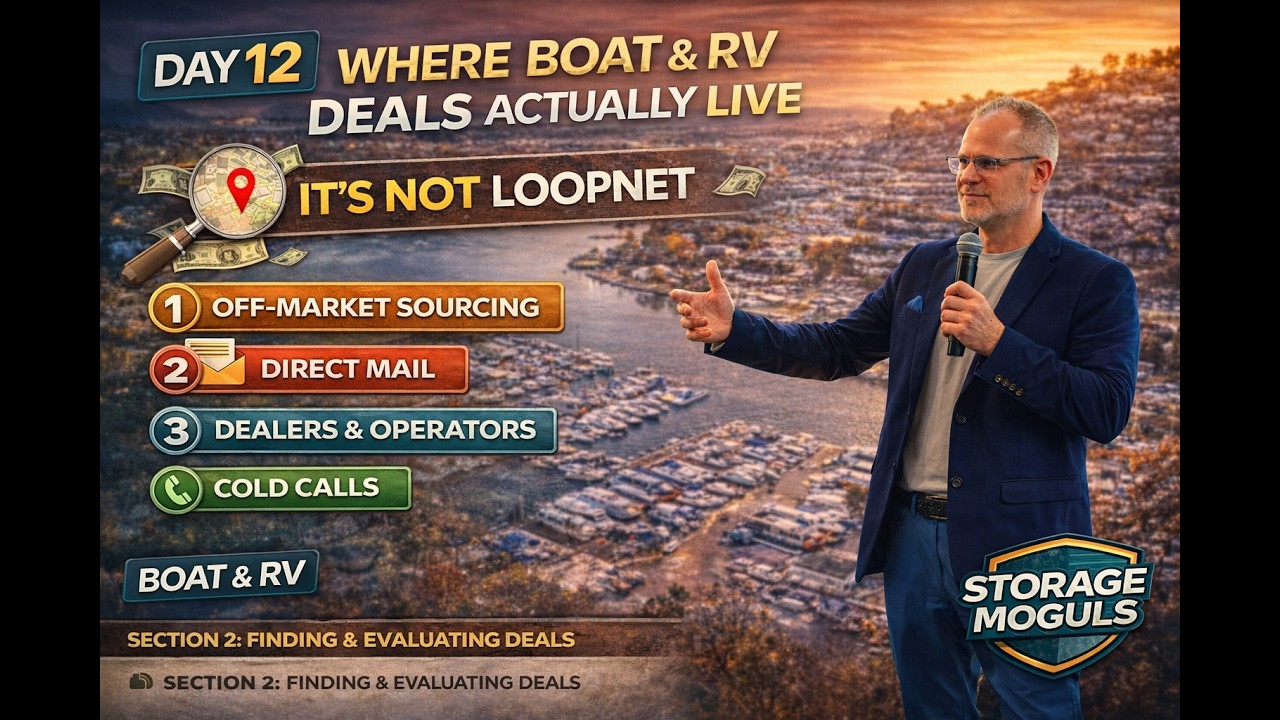
This content was created by Joe Downs. This content was uploaded by Joe Downs. This is a YouTube video titled "Day 12: Where Boat & RV Deals Actually Live: It s Not LoopNet" (published 2026-03-31) featuring Joe Downs of Storage Moguls presenting a solo instructional talk in a creator series on sourcing boat and RV storage deals. Joe explains why listings sites like LoopNet miss most deals for this vertical, then walks through practical, operationally focused sourcing channels (direct mail from county assessor records, dealer relationships, marina and RV-park contacts, cold outreach), a step-by-step research/CRM workflow, how to open respectful conversations with owners, and green/red flags to evaluate potential sellers. The video is aimed at investors and operators (W-2 earners, small teams, and independent buyers) and includes calls-to-action to join the Storage Moguls community and use their AI tools and deal-sourcing toolkit.
Chapters
And welcome to day 12 of the Boat and RV 100 series. I'm Joe Downs with Storage Moguls, and today I'm showing you where boat and RV deals actually come from. Because if you're searching LoopNet and waiting for something to show up, you're going to be waiting a long time. This isn't theory. This is how we source acquisitions at Bellrose. Uh, it's how we do it at Storage Moguls. It's how the best operators in, in this vertical find deals before they ever reach a broker. And if you want the full deal sourcing framework with AI-powered tools, head to storagemoguls.ai. storagemoguls.ai, our free community, free to start and level up at your own pace with— it's got loaded with GPT tools and multimodal learning opportunities and content across every storage niche. And that's exactly kind of why we built Storage Moguls, so we could provide all that. It's a community made up of real people who are actual operators just like you and me. Maybe it's a husband and wife team. That's like 2 of our founders. Maybe it's 2 neighbors who partnered up, the old brother-in-law's 2 neighbors sitting around the fire pit hatching the next great idea, right? Or the solopreneur who's got the W-2 and great income earner, maybe even loves what they do and not exactly trying to get out of that rat race, but wants to invest in real estate. This is the place for you. And we're not selling a fantasy here. There's no— nobody's You know, standing on a stage they haven't stood on in years and preaching to you. We're a network that actively evaluates real deals. We're talking about acquisitions under $2 million, you know, down to $500,000. We help people finance $400,000, $500,000, $600,000 deals up to $2 and $3 million. And it's all financeable, digestible, the kind of deal that someone with a W-2 and a serious mindset can actually close. So, and we're about real results. Members in our community are becoming storage moguls, not someday, now. So start for free. Advance at your own pace. Back to today, because section 2 here is where the education meets the execution. We know the landscape now. Now we find what to buy. So here's the fundamental difference between sourcing boat and RV deals and sourcing self-storage deals. In self-storage, brokers are active. LoopNet and CREXi, they've got listings, and the deal flow is relatively transparent. Institutional buyers, regional operators, and first-time investors are all competing in the same visible market. In boat and RV, most facilities are mom-and-pop operations that's never been listed with a broker. The owner built it, and they've owned and operated it for 10, 15, 20 years or more. And when they decide to sell, they don't automatically call a broker. They start by talking to people they know and trust. That creates an opportunity for operators who who do the relationship work before a deal is even available. The person who's already had a respectful conversation with a facility owner, who's expressed genuine interest in the vertical and in what they've built, they're the ones that are going to hear about a potential sale before any broker does. Institutional buyers waiting— wait for listings. You won't. That's the edge here. There's 4 main channels to find deals in order of control and effectiveness for most markets. So direct mail from county assessor records. You can find the facility owners. They're in the public property records. You could also buy them as leads from data aggregators. You can send a personal one-page letter, not a mass mailer, not some form letter you printed out with your logo or even the fake, you know, scripted handwritten ones. You don't want to do that. You want a letter that shows you understand the vertical, respect what they've built. And are interested in having a conversation. The conversation rate here is low, but the deals that come from it are off-market and uncontested. Dealer relationships— it's another way. Boat and RV dealers are on the front lines of the ownership community. They know which local storage facilities are always full, which ones are struggling, and critically, which operators are getting older and starting to think about what comes next. Day 13 covers dealer conversations in depth, so you don't want to miss that one. Now, marina operators. Marinas are often at capacity for dryers elsewhere, and they know exactly where. A marina operator who trusts— or who trusts you will tell you which nearby storage facilities have capacity problems, ownership issues, or are fielding calls from buyers. Then RV park operators. Same customer base, different asset. RV park operators often have close relationships with the storage facility operators in the area, and they hear things too. Direct mail works in this vertical because these owners are not used to being approached professionally. When they get a personal letter from someone who clearly understands what they built and isn't immediately asking for a number, that stands out. That stands out. The letter has one job. Get a conversation, not a sale, just a conversation, not a letter of intent, just a conversation. Lead with respect. Show them that you've done your homework on their facility. Mention something specific like the facility type, its location relative to a waterway, the fact that you drove by and it looked well-run and fantastic. These owners are proud of what they built. You should start by acknowledging it. They're not selling a piece of real estate. They're handing off something they built. Give them peace of mind about how you'll take care of their legacy. That matters to this type of seller. No urgency, no price, no timeline. Ask for a conversation. If you don't get a response in 90 days, send it again. If you get a soft no, call back in a quarter. These deals have long lead times. The relationships you build today surface as deals A year or 2 in the future. It's when they're ready. It's gonna be on their time. Cold calling works in boat and RV storage? Well, uh, more so in self-storage for simple reason: these owners aren't used to it. So self-storage operators get calls from brokers and buyers constantly. Boat and RV operators often hadn't had a single inquiry in years. So open with respect for what they've built, not flattery, and An observation. I drove by your facility on Route 9 last week. It looks well maintained. I could tell it's been well run. That's specific. That lands differently than a generic opener. Your purpose isn't to buy their facility today. It's to have a conversation about their experience in the, in the niche. Ask about how they got into the business, what they enjoy about it, what surprises them. People who built something from scratch love talking about it to someone who's genuinely interested. Listen more than you talk. The information you learn about— the information you learn about their motivations, their timeline, their concerns— that's what shapes the deal structure if they ever decide to sell. One thing that matters to a lot of sellers we talk to is knowing the facility continues to be well run after the sale. That's something we're able to provide. That's something you'll learn. Let them know you'll do that. Close by asking for a future conversation, not a sale. Would it be okay if I check back with you in a few months? That's a yes most people will give you, and that keeps the relationship alive. Every facility owner is in the public record. Here's the research process. Start with Google Maps satellite view. Identify every boat and RV storage facility in your target market. Note the address on each one. You'll typically find 5 to 15 facilities depending on market size. Go to the county assessor website for each property address. Owner name and mailing address are public record in virtually every county. If the property is held in an LLC entity, you'll see the entity name, and then you can cross-reference that with the Secretary of State business entity search to find the registered agent or manager. You can also probably use LinkedIn and Google search. To find the owner name? There's ways. You might find a personal LinkedIn profile, a prior business reference, a local news mention, or a Chamber of Commerce listing. This will give you context before you reach out. You know something about them before you even make that first call. Build a tracker or CRM with owner name, facility address, mailing address, and any contact information you found, outreach date, data response. This is a long-game activity. You're building a pipeline, not closing a deal today. Half a day's research builds your complete prospect list for a target market. Maintain it quarterly. Ownership changes, facilities change hands, new ones open. Refresh, refresh the list and continue the outreach. When a conversation starts to feel like it might lead somewhere, you're reading signals in real time, and here's what to look for. Green flags would be long ownership tenure, a waiting list, Retirement or health as motivation, strong peak season occupancy, and openness to seller financing. Any of these indicators, or any of these indicates a motivated seller with a real asset and a natural transition path. Red flags worth digging into, maybe reluctance to share even ballpark occupancy data usually means the numbers aren't very good, or high tenant turnover mentioned offhand. Always ask why, because the answer tells you something about the facility's operational quality. Quality or competitive position in the market. Deferred maintenance dismissed casually while you're there— oh, that's fine, it doesn't affect the operations— usually means it does affect the operations. Rate cuts to fill vacancies might suggest weakness or competitive issues. And multiple prior sale attempts that fell through almost always have a story behind them. Find out what it is before you go any further. Here's the frame for Section 2. Most investors in this vertical are passive about deal sourcing. They set up alerts on LoopNet, they check CREXi occasionally, and wait for something to show up. And occasionally something does, but the best deals, the undermanaged facilities in the strong markets with motivated sellers who haven't told a broker yet, they don't usually show up online. They show up in conversations that started months or even years before the owners even, even knew they wanted to sell. Process is simple. Identify every facility owner in your target market, reach out with respect and genuine interest in their experience, and maintain the relationship over time. It's not fast, it's not exciting, but it's how the operators who build real portfolios in this vertical source their best acquisitions. All right, next up, day 13, we'll dive into talking to boat and RV dealers before you buy anything. And tomorrow we're going to go into that deeper conversation, the dealer, the boat and RV dealer conversation, how to walk into a boat and RV dealership, what to ask, and how to turn a 30-minute conversation into your best market intelligence source. So please like this video if you've been waiting for boat and RV deals to show up on LoopNet, and subscribe so you never miss a sourcing channel that gives you access to deals before they're listed. And finally, share this with your network on Facebook, LinkedIn, and YouTube. These are videos that will set you apart. Your network is watching you. You might want to advertise a little to them for free. And remember, the deal flow in boat and RV storage doesn't come from listing, it comes from relationships. Build the prospect list, make the calls, maintain the cadence. The operators who do this consistently are the ones who find the best assets before anyone else knows they're available. Again, for the full deal sourcing toolkit, deal analyzer, join Storage Muggles. You can join for free, storagemuggles.ai. You can start for free, as I said, and level up at your own pace. And if you register soon, you'll get a free GPT that we built ourselves. We should still have some available. We're giving it away to the first 500. Remember, folks, self-storage may be what brought you here, but wait until you learn how to see for your own eyes and understand and evaluate all the other verticals and niches in storage that make it so much more exciting, just like boat and RV. And to do that, you should join us at Storage Moguls. We'll transform you from someone interested in boat and RV storage to a storage mogul. Tomorrow we cover the single best free market intelligence source in the vertical, and it's sitting at every boat and RV dealership in your target market. See you tomorrow.
More from Joe





The tenant only paid for the first month! #selfstorage #horrorstory #realestateinvesting

What happens when a storage tenant stops paying? #selfstorage #realestateinvesting #storagemoguls



