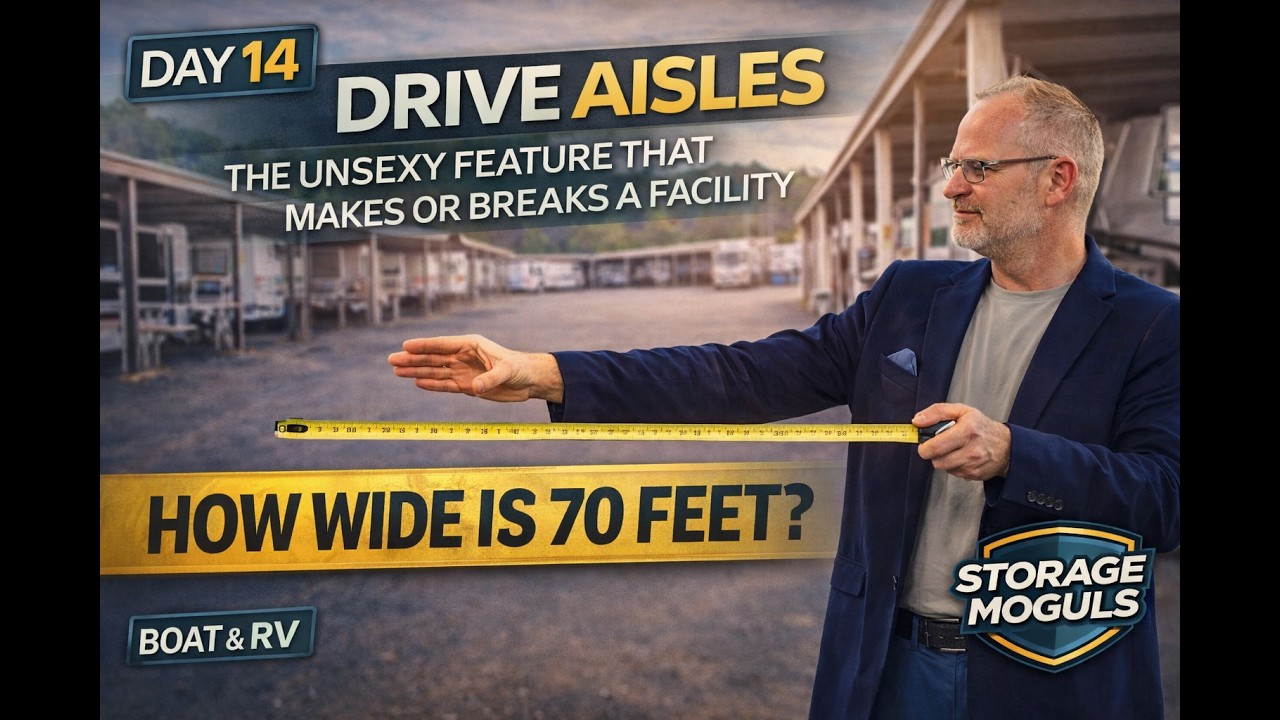
In this solo instructional video, Joe Downs of Storage Moguls explains why drive aisle width is the first and most critical on‑site measurement when evaluating boat and RV storage facilities. He outlines a three‑class system based on aisle width (Class C < 40 ft, Class B 40‑50 ft, Class A ≥ 50 ft) and shows how these dimensions dictate tenant mix, rent ceilings, and overall facility value. Downs provides a step‑by‑step field protocol for measuring the narrowest points of aisles, multiple aisles, gate staging areas, and surface condition, emphasizing documentation for due‑diligence and lender confidence. He quantifies revenue differences (e.g., $60‑$90 vs. $120‑$200 per space per month) and referral/retention advantages of wider aisles that accommodate premium Class A motorhomes and large boats. The video also discusses the high cost and feasibility of widening aisles after acquisition, the importance of a 70‑ft gate staging area for fifth‑wheel‑truck combos, and how to price such constraints into an acquisition model. Throughout, Downs promotes the StorageMoguls.ai community and AI‑powered tools for site evaluation, urging viewers to measure aisles before any financial analysis.
Chapters
And welcome to day 14 of the Boat and RV 100 Series. I'm Joe Downs with Storage Moguls, and today I'm showing you why drive aisle width is the first measurement you take on any boat and RV facility and why getting it wrong costs you the highest value tenants in the market before they ever move in. This isn't theory. We've walked enough facilities to know that drive aisles are the single most important common physical constraint that kills a deal or caps a facility's potential, and most investors don't even check until it's too late. And if you want the full site evaluation framework for boat and RV facilities and you want some AI-powered tools, head to storagemoguls.ai. Storagemoguls.ai. We're a community that's made up of real people, actual operators just like you, real people that look like husband and wife teams or 2 neighbors that partnered up, or the solopreneur who decided to stop playing small. That's who is in our network, in our community. Nobody there is selling you a fantasy from a stage they haven't stood on in years. We're a network that actively evaluates real deals. We're talking about acquisitions between $400,000 to $2, $3 million. It's all financeable. We'll show you how too. And digestible. It's the kind of deal that someone with a W-2 and a little grit can actually close on. Search, evaluate, close on a deal. And we're about real results. Members of this community are becoming storage moguls every day. Not someday, every day. So start free. All you have to do is register. Doesn't cost you anything. There isn't even a place for your credit card. Just register. It's actually going to launch brand new platform launching in, I don't know, 2 weeks maybe. And then you just level up at your own pace from there if you want. But all right, back to today, because before you evaluate the financials of any boat and RV facility, before you look at the rent roll, before you run a cap rate, You gotta measure the drive aisles. The drive aisle width is the first filter because it's the one constraint that determines everything downstream— your tenant mix, your rent ceiling, your class designation. If your drive aisles are under 40 feet, you are a Class C facility regardless of what else you have because your tenants will be smaller vessels, older trailers, or jet skis. Class A motorhome owners will look at your entrance, do the math, drive to the facility down the road. They're not, they're not parking with you. If your aisles are 40 to 50 feet, now you can serve mid-range boats and RVs, travel trailers, moderate-sized fifth wheels. You're in Class B territory. Again, regardless of amenities. You're leaving the highest value tenants on the table though, but you have a viable, profitable facility, I'm sure. If your aisles are 50 to 60 feet or better, you can serve Class A motorhomes, large fifth wheels, and oversized boats. That's where the highest rents are. That's where the tenants with the lowest price sensitivity are and the higher referral rate, the highest referral rate. And here's the painful part. Drive aisles are almost never fixable without a significant capital investment into the site reconfiguration. You can add amenities, you can resurface, you can upgrade the gate system. Can't easily make an aisle wider without moving structures, regrading, or losing spaces. The right fix is at acquisition, not after. Screenshot this table. It's the reference you, you should pull with you or keep with you when you're standing in a facility. And make sure you got a tape measure. Jet ski and small boat trailers, 30, 35 feet, adequate, comfortable. But that, again, that's your Class C floor. Midsize boats and travel trailers, you're going to need that 40 feet minimum. 45 is preferred. And these vehicles can navigate a 40-foot aisle, of course, but it's tight. Tenants will leave for a facility with more room if one becomes available. Large boats and fifth wheels, minimum 50 feet. Below 50, you're asking these tenants to make tight backup maneuvers that damage not only maybe their vehicle or a building, but trust in the facility. Class A motorhomes, 50-foot minimum, 60s preferred. These vehicles are 35 to 45 feet long themselves. The driver needs room to swing in and back around without a 3-point turn in a gravel lot. 5th wheel plus a truck combination. This is a critical one. The combination here could be 65 feet or longer. You need 60 feet of aisle width and a 70-foot staging area before the keypad just to enter the gate and reach the access point without blocking traffic in the street. If a facility doesn't have this, it can't serve this type of tenant, period. Not with patience, not with skill, not with a good attitude. The geometry doesn't work. Here's a scenario that plays out of facilities that don't have the staging room. Tenant shows up with a full-size truck towing a 30-foot fifth wheel, combined length 60 to 65 feet. They pull up to the gate, keypad is 20 feet off the road. They can't stage the rig before the keypad without blocking traffic. Then they gotta back out into the road, try another approach, or maybe even call for help. You need 70 feet of clear space from the road to the keypad, minimum. That gives the driver room to pull forward past the keypad, stop the rig without blocking traffic, and enter the code. Below 70 feet, this combination literally cannot enter your facility without a hazardous maneuver. This isn't about the tenant being inexperienced. It's geometry. A 65-foot rig needs 65+ feet to stage. The physics don't care how good your customer service is in this scenario. And the downstream effect is real. A tenant who has a bad entry experience, they talk. They talk to people at the RV park, the campground, the dealer. Don't go there. You can't get in with the fifth wheel. That's not a complaint that gets resolved with a rate discount or a waived fee. The geometry of the site is permanent. Here's the field protocol. 5 steps. 1, measure at the narrowest point. Aisles often taper, especially at corners where, or where structures were added over time. The worst point is the real operational spec. If the, if the wide section is 60 and the narrow section is 38, you're a 38-foot facility from a tenant's perspective. 2, measure multiple aisles. A facility where the front row is 55 feet and the back row is 35 feet Has a split tenant mix problem. Class A tenants, they're only going to accept spaces in the wide section, which is going to limit your inventory. 3, measure the gate staging area, road edge to keypad. This is the most commonly overlooked measurement and the one that determines whether fifth wheel combinations can use your facility at all. 4, document the photos with photos, tape measure in the frame, aisle visible behind it. You're going to use this. Sounds ridiculous, but you're going to use this in your due diligence file. And if you're building your lender package, it goes in there too. Lender who sees documented drive aisle measurements has more confidence in your underwriting. And then lastly, note the surface condition. Fully paved tells you the operator invested in the facility. Rutted gravel tells you maintenance has been deferred. Both inform your CapEx budget if you acquire. All right. Here's the revenue math comparison between narrow aisle facility and one with adequate Class A clearance. Average rent on a 38-foot aisle facility serving small boats and travel trailers is going to fall between $60 and $90 a month. A 50-foot aisle facility serving Class A RVs and premium boats at $120 to $200 or much, much more per month. On a 100-space facility, that's the difference between earning in revenue $6,000 to $9,000 per month. In gross revenue versus $12,000 to $20,000 a month or more in gross revenue. Same parcel, same number of spaces, radically different revenue. Referral rate. Class A motorhome owners and premium boat owners are highly networked. When they find a facility that works for their vehicle, they talk, they tell their community. Narrow aisle facilities primarily serve price-sensitive tenants. So you get lower referral activity. When we look at tenant retention, Class A tenants who have found a facility that fits their vehicle, meets their service standard, they're sticky. Moving a 40-foot motorhome is a real logistical event, so they typically stay. Price-sensitive tenants in a narrow aisle facility will leave for the less expensive option. The value-add story is also very different. A wide aisle facility has clear upgrade paths. You could add covered structures. You could invest in amenities. You can justify rate increases. The Class A tenant will understand. And narrow aisle facilities, value-add options are limited because you can't attract the premium tenant mix to begin with that usually doesn't have a problem with you justifying premium rents without reconfiguring the whole site. So can narrow aisles be fixed? The honest answer is Sometimes, and it's almost always more expensive and more time-consuming than you'd expect. If the lot is a gravel field with painted lines, reconfiguring the space layout is, you know, the most accessible fix. You're going to lose some spaces, very likely, to gain aisle width, but the revenue per remaining space goes up if you can serve a higher-value tenant mix. So price that into your underwriting. Might make sense. If there are covered structures on both sides of the aisle, reconfiguration gets hard. Structures that are Built to size aren't easily moved. So maybe looking at demolishing and rebuilding certain sections, which changes the capital equation significantly. And site constraints, irregular lot shape or setback requirements, adjacent property lines can make certain aisles permanently narrow. So before you write off a deal entirely, get a site engineer and look at it. But don't assume you can fix what the geometry won't allow. The gate staging area is worth a separate assessment. If there's land available on the approach side of the gate, extending the staging area may be feasible and relatively affordable. But if the road comes directly to the gate with no setback room, that's a permanent limitation. So the bottom line, if you find a narrow aisle facility in a strong market with addressable constraints, price the fix into your acquisition model and then negotiate the purchase price accordingly. A facility priced as a Class C asset that you can Realistically convert to a Class B capability with clear CapEx plan, that's a real value-add opportunity. A facility with permanent geometric constraints, though, that's a different investment thesis altogether. Here's the frame you carry into every facility visit from here. Measure first. Before you ask about financials, before you pull the rent roll, before you run a cap rate, walk the facility, measure the aisles. 2 or 3 measurements, narrowest points, also the gate staging area. Take you 10 minutes. Those 10 minutes will tell you more about what this facility can actually become than any document the seller gives you. So know the numbers cold: 50 to 60 feet for Class A, 40 feet minimum for mid-range, 70 feet of staging area before the keypad for fifth wheel and truck combinations. These are the specs. If a facility doesn't meet them, You know the tenant mix and rent ceiling before you run a single number. Price the reality in. A narrow aisle facility in a strong market is not a Class A facility waiting to be unlocked. It's a Class C or, or B facility in a good location. It has value, but only at the right price. The value-add thesis has to account for the capital required to widen the aisles, or it's not a value-add thesis. It's wishful thinking. All right. Next up, day 15, we'll dive into site access and egress, getting off the road and into the gate, which is the other physical constraint that gets overlooked, and almost as often as drive aisles, how you get off the road and into the gate matters more than most investors realize. So please like this video and subscribe so the algorithms keep telling me to keep producing this content, and share this with your social network so you can start seeding your potential investors. Not only does it bring awareness to them about these types of opportunities, but it demonstrates that you're putting in the work. And remember, narrow aisles are the most common physical constraint that caps a boat and RV facility's potential. Almost, almost never fixable without a major capital investment. The right time to find them is before you close, not after. So measure the aisles, know the specs, price the reality. If you would like full site evaluation framework and deal analyzer, you should probably join the Storage Moguls community at StorageMoguls.ai. StorageMoguls.ai. Join for free, level up at your own pace. And if you register soon, you'll probably get a free GPT we're giving away for the first 500 people that register. It's a deal analyzer. We build it and use it ourselves. And when you join us at Storage Moguls, a funny thing will happen. We'll help transform you from someone interested in boat and RV storage to storage mogul. Again, tomorrow we cover the approach to the facility. How site access and egress either supports your tenant mix or fights you every single day. See you tomorrow.