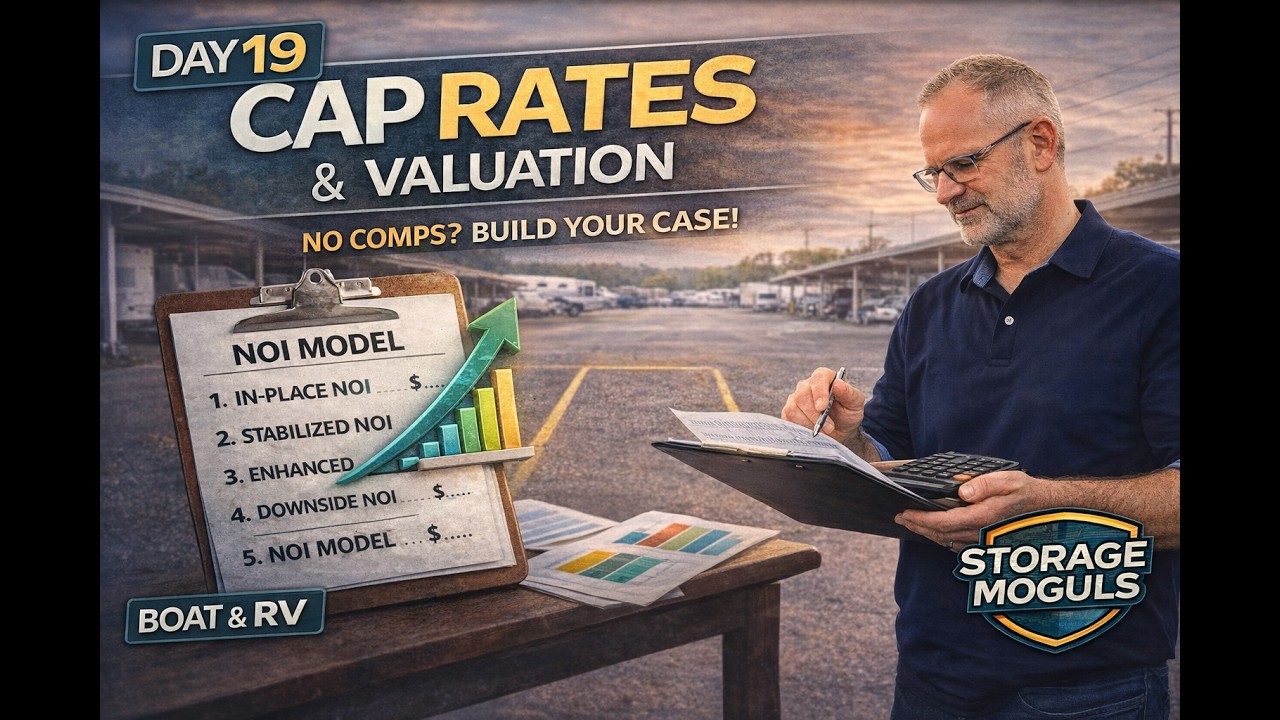
In this solo presentation, Joe Downs explains how to value boat and RV storage facilities when comparable transactions are scarce and lenders are unfamiliar with the asset class. He argues that valuation must be built on a detailed, narrative‑driven NOI model rather than a simple cap‑rate lookup. Downs outlines cap‑rate ranges tied to asset quality, then walks through a five‑step process for constructing a monthly NOI model (minimum 24‑36 months of revenue, stabilized NOI by calendar month, seasonality annotation, value‑add layer, and downside case). He describes the four NOI layers (in‑place, stabilized, enhanced, downside) that buyers should present to lenders, and how to reframe seasonal cash‑flow dips as evidence of engaged tenants. The video also covers how to assemble market and comparable evidence without public transaction data, using self‑storage comps, rent surveys, and supply‑gap metrics. Throughout, Downs emphasizes the importance of specificity, transparency, and a credible narrative to win lender approval. The session concludes with a preview of the next episode on zoning and permits and multiple calls to action for the StorageMoguls.ai community and tools.
Chapters
And welcome to day 19 of the Boat and RV 100 Series. I'm Joe Downs with Storage Muggles, and today we're getting into valuation. How do you value a boat and RV facility when the comps are thin, the seasonal cash flow looks confusing on paper, and most lenders haven't seen one of these deals before? The answer isn't a number you look up. It's a narrative you need to build from the NOI model up. Operators who can do this have a real edge, and that's exactly the kind of thing or thinking that we develop in our members at the Storage Moguls. So if you go to storagemoguls.ai, you can register for free. By the way, that's exactly why we built Storage Moguls, so we could have a community that's made up of real people, actual operators just like you. You know, it could be the husband and wife team, 2 brothers who partnered up, a solopreneur who decided it's time to invest in real estate. Nobody here at Storage Moguls is selling you a fantasy from a stage they haven't stood on in years. We're a network that actively evaluates real deals. I'm talking acquisitions under $2 million. They're all financeable, digestible, the kind of deal that someone with a W-2 and a serious mindset can actually close. We're about real results. Members in our community are becoming storage moguls every day, not someday, right now. And we'll help hold you accountable. You know, there's a saying, activity breeds results. And I like to put a word in front of that and append it a little bit. I think accountability breeds activity, which breeds results. And we'll hold you accountable. And you can start for free, advance at your own pace. But back to today, because in a thin comp market, the NOI argument has to carry the weight. So let's build it. The comp problem affects every stage of the transaction. In self-storage, comps are abundant. Lenders know the product cold. Cap rate benchmarks are widely published and valuation is largely comp-driven. In boat and RV transactions, they're fewer and further between and they're rarely public. Your lender may have never written one before or underwritten one. Excuse me. The appraiser may not understand seasonal NOI. There's no widely published benchmarks that really exist on this. So the buyer who presents a clean, well-annotated seasonal NOI model and explains the value-add thesis clearly is a fundamentally more credible buyer in the lender's eyes because they're doing the work that most buyers skip. Cap rates in a boat and RV, in the boat and RV range, they reflect what you're buying and the risk the market assigns to it. So stabilized Class A facilities with waiting lists, compressed towards the 6% to 7.5% cap rate range. The best assets, the better assets, they price accordingly. Value-add deals with below-market rents, they price on in-place NOI, probably 7.5% to 9.5%. And the gap in between the in-place stabilized NOI or— and the stabilized NOI is the return thesis. Undermanaged facilities trade 8.5 to 10.5 cap or more, or 8.5 to 10% more, which puts you in that 8.5 to 10.5% cap range. And capital and operational skills are the price of entry here. These ranges, they reflect operator-to-operator transactions though. So when institutional capital arrives in force, They will compress the cap rates significantly. And part of that window is the argument from day 6. So you might want to go back and refresh yourself on that one. All right. Here's 5 steps to build the NOI model that carries your valuation argument. So, 1, 24 months of monthly revenue. I prefer 36, at least 24. You don't— no annual totals. Each September gets its own average, each July gets its own, and so forth. 2, you need stabilized NOI using the 24-month average by calendar month. So when you do it that way, you're smoothing out any anomalies. This is your hold case. 3, you want to annotate the dip. June to August occupancy reflects vehicles in active recreational use. That's normal seasonal, seasonal pattern. You want to make sure that that's noted and discussed. That sentence transforms the summer trough from a red flag Into evidence of an engaged tenant base. So that's what we mean by annotate the debt. Make sure you explain why. 4, value-add layer. What is the NOI at current rents versus market rents? Show each improvement line by line, cost timeline, NOI impact. And then 5, downside case. What if the fall is 10 points softer? Does— what does that do to debt service? Lenders who see a prepared downside case trust the upside case more. All right. So 5 elements that together replace a missing transaction comp. All right. So we're going to give a market overview, supply gap data, HOA density, registration to spaces ratio, competing inventory. This establishes why the NOI is real and sustainable. Show whatever comparable transactions you can, though. So imperfect comps still help. 3 partial comps in adjacent markets or similar markets are better than an empty section. Comparable asset class, self-storage in the same market as a frame. If self-storage, for instance, is at 6.5%, boat and RV at 7% and 7.5% with a stronger demand growth is a defensible argument. Gather rent comps, supply or survey competing facilities. Independent evidence for your revenue assumptions that doesn't require a transaction. So you're going to build, build your comp case around the competing facilities. And then provide a value-add narrative. So each improvement on its own line item, line with cost, timeline, and NOI impact. Be specific. When you're specific, it's way more credible. Seasonality is the single biggest lender objection. And the one you have to be most prepared for. So you need to address the following: the summer dip, which we covered a second ago. You want to remember, annotate that. So vehicles are in active recreational use in the summer, which demonstrates engaged tenants doing exactly what they paid to store their vehicle there for. Revenue swings. A consistent repeating 2-year cycle is more predictable than a retail tenant whose sales depend on foot traffic. False spike. It's structural. Demonstrate it. HOA prohibited home storage is an annual regulatory reality. These tenants move in because they have no other option. And then reserves. Agree with the lender. Yes, seasonal cash flow requires reserves. We model the trough and hold 2 to 3 months of operating expenses. That's the operating plan. The performer that wins Lender approval shows 4 NOI layers. Make sure you deliver it this way. For your in-place NOI, don't dress it up. Lenders who feel like you're being straight with them trust the rest of your model more. For stabilized NOI, show 24-month average by calendar month, one-time events removed. Remember, that's your hold case. For enhanced NOI, show improvement on its own line with cost timeline and NOI delta. Specificity is what makes this layer credible. For downside NOI, show sensitivity by modeling the fall, for instance, 10 points softer. Present it before the lender asks. It signals that you've modeled through the risk and you understand what you're doing. In a thin comp market, the narrative is the valuation, full stop. So build the NOI model, Monthly, seasonal, 4 layers using 24 months minimum. Try to get 36. Write the comp argument, the market data, adjacent transactions, rent comps, comparable asset class analysis, and then reframe the seasonality. Remember, the summer trough is vehicles in use. The fall spike is structural. It's HOA demand. 2-year pattern— showing a 2-year pattern is consistent, predictable. predictable, and that for a lender is bankable. All right, next up, day 20, zoning and permits. Outdoor storage regulations vary dramatically, so we'll cover zoning and permits because before you get excited about any parcel or facility, you should spend maybe 30 minutes with the municipality. Could save you a 6-figure mistake. All right, if today shifted how you think about cap rates and valuation in this asset class, hit the like button for me. It helps more people find this series. And subscribing by ringing the bell so you don't miss the episode where a 30-minute call with the planning department could save you again a six-figure mistake. Share this on your socials as well right now on YouTube. Let everyone know you're doing the work it takes to become a storage mogul. And remember, the operators who succeed in this vertical aren't the ones with the best access to comps; they're the ones who build the most credible story from the data they have. The four NOI layers, a written comp argument, a seasonal narrative your lender can follow, and you can keep learning how to do all this and more and build your own storage mogul empire at storage moguls.ai. Storage moguls.ai. Remember, you can start for free. You level up at your own pace, and if you register soon, I believe we still have some free GPTs to give away that we built and use ourselves. The deal analyzer, the quick deal analyzer. The handy-dandy little tool. Also, evaluation and deal analysis is what drew you in today. Wait until you see these— the same frameworks apply across every storage vertical we cover. The more verticals you understand, by the way, the sharper every deal looks. Last reminder, join us at storagemuggles.ai. We'll take you from someone learning the math to someone doing the deals. Again, tomorrow, cover zoning because great facility on the wrong parcel is a problem. That could have been avoided with a 30-minute call you didn't make. See you tomorrow.