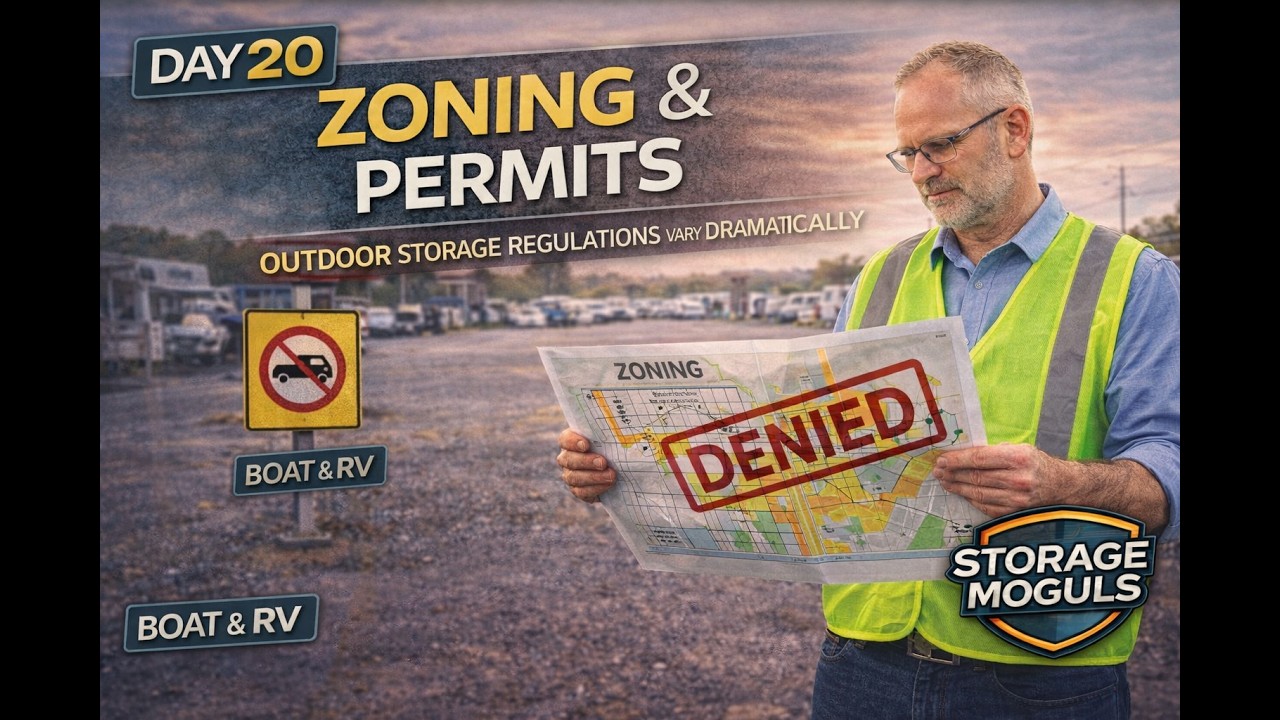
This content was created by Joe Downs. This content was uploaded by Joe Downs. This is a YouTube video titled "Day 20: Zoning and Permits - Outdoor Storage Regulations Vary Dramatically" (Storage Moguls Boat & RV 100 series), published April 8, 2026. It is a solo-presenter instructional episode featuring Joe Downs explaining zoning and permitting due diligence for boat/RV and outdoor vehicle storage investors and operators. The episode emphasizes a 30-minute call with municipal planning departments, gives three essential call questions and a seven-item zoning checklist, and covers zoning classifications (permitted, conditional/special use, variance, prohibited), overlay issues (floodplain, wetlands, shoreline buffers), Phase 2/covered-structure considerations, GIS screening tips, documentation practices for lender packages, and practical timelines and risks. The presenter also promotes the StorageMoguls community, related tools (a GPT for operators), and previews the next episode on environmental flags.
Chapters
And welcome to day 20 of the Boat and RV 100 series. I'm Joe Downs with Storage Moguls, and today I'm showing you why zoning is the due diligence step most investors skip and why a 30-minute phone call with a municipality planning department can save you from a 6-figure mistake on a deal that never should have gotten past the first look. This isn't theory, folks. We've seen deals that look great on paper get killed at the permit stage because nobody checked what was actually allowed on that parcel. If you want the full zoning evaluation framework, head to storagemoguls.ai. Community built around people who are actually in the market doing deals, not just talking about doing them. We're made up of real people, actual operators just like you. Husband and wife teams, uh, we got 2 neighbors who partner up, 2 brothers who partner up, solopreneurs who decided to stop playing small and start investing in real estate. That's who we are. Just everyday regular people, and nobody here selling you fantasy from a stage they haven't stood on in years or behind a mic where they don't actually do anything. We're we're actively evaluating real deals. I'm talking acquisitions between four hundred grand or two three million bucks. I mean, the the things you can take down, answerable. They're digestible, and we'll show you how. And the kind of deals that someone with a even if you have a W two and you you know a couple fifteen hours a week. We can find them. We'll teach you how to source them, evaluate them, negotiate them, due diligence them, close them. That's what we do at Storage Moguls, and we're about real results. Members in our community are becoming Storage Moguls every day. Not someday, now. So look, it's up to you. You can start for free. You can go to storagemoguls.ai and just register. There's no credit card required, and then you can advance at your own pace. But back to today, because zoning is the step that separates investors who move fast and get burned from operators who move deliberately and close clean deals. Here's a situation that happens more often than it should. An investor finds a parcel or facility, runs the numbers, gets excited, engages the attorney, starts talking to a lender, and then discovers that outdoor vehicle storage isn't even permitted in that zone. Months of work, real money in professional fees, a seller who may now be skeptical of a future buyer or doing that deal with you again. All of it preventable with a 30-minute call made before any of that started. The call's free. The planning department will tell you. All you need to know is whether outdoor vehicle storage is a permitted use, a special use, or prohibited outright. That one answer determines whether the deal is worth pursuing. The discipline is simple. You check zoning before you underwrite. It takes 30 minutes. It eliminates the deals that would waste months. Outdoor vehicle storage is classified differently in almost every municipality, and the classification determines your timeline, your risk, and whether the deal is worth pursuing at all. So let's go over them. Permitted use is the green light. You can build or operate without any additional approval beyond, or beyond standard, you know, building permits. This is the cleanest path. This is the one you want. Special use or conditional use. This is the most common scenario for boat and RV storage in suburban municipalities. It's allowed, but with conditions. Might have screening requirements, lighting standards, maybe setback minimums. Or limited hours of operation. A hearing is probably required here. So add 60 to 180 days to your timeline, and then you make sure you budget for that process. If you hear variance required, this means the use isn't standard for the zone and you're asking for an exception. Now, a public hearing is required and neighbor opposition is very possible. This is the highest risk, the longest timeline. And the least predictable. So avoid it when you have other options. And then prohibited, full stop, wrong parcel, move on, find a different site. Agricultural and unzoned areas are often more— most permissive for outdoor storage, but rural county rules can vary widely. So confirm explicitly, don't assume anything when you're talking to them. Okay, here's, uh, your 3 questions for your 30-minute call. Write them down before you dial. Question 1, is outdoor vehicle storage a permitted use in this zone? Ask for the specific code section so you can read the exact language. Permitted and conditional use are the answers you want. Variance required and prohibited, deal stoppers. Uh, question 2, If you get one of the 2 good answers. What setback screening or height restrictions apply? This is where conditions get specific. A municipality that requires a 6-foot solid wood fence along all road frontages is adding capital costs to your project, or height restriction on structures affects your covered storage design. These aren't showstoppers, but they need to be in your capital budget. Question 3, has anyone built a boat and RV storage facility in this municipality before? If yes, ask for the address. Drive out and look at it. That project may have established the entitlement precedent for your approval. You'll know what conditions were imposed, what the approval timeline looked like, and whether there was neighborhood opposition. Documentation matters too. Write down the name of the planning staff member you spoke with, the date of the call, And the answers you received. That's part of your due diligence record and potentially part of your lender package. All right. Boat and RV facilities near water, which is where much of the demand is, often sit on or adjacent to overlay zones that are— that add some regulatory complexity on top of your base zoning. So for shoreline and riparian buffers, most states, for instance, protect a minimum setback from the water's edge. Maybe 50 to 100 feet. It's common. Structures and impervious surfaces are usually restricted within that buffer zone, which can significantly reduce your usable footprint on a parcel that looks adequate from a satellite view. Floodplain overlay. If any portion of the parcel is in a FEMA special flood hazard area, ground-level construction may be restricted or structures may need to be elevated. So pull the FIRM map, which is flood insurance rate maps, before you get excited about the parcel. For wetlands jurisdiction, if the Army Corps has jurisdiction, you may need a Section 404 permit before you can disturb any wetland area, and that process can add 6 to 18 months and significant costs. Phase 1 environmental assessment will identify this. Then you got stormwater management. Gravel lot might look simple to build, but a large impervious surface near water may require engineered drainage. And stormwater retention. So check your county stormwater ordinance. Here's the quick screen. Most county GIS portals show floodplains, wetland delineations, and shoreline buffers for free. So spend 20 minutes on the county GIS before you spend money on professionals. Now, if your value-add thesis depends on adding coverage structures after acquisition, Phase 2 carports, enclosed spaces, paved aisles— you need to verify upfront that the zoning supports it. A value-add plan that requires a new permit hearing is a plan that takes 18 months longer and costs more than you budgeted. Can covered structures be added under the existing approval, or does a new hearing apply? This is the most important Phase 2 zoning question. If the original conditional use permit was for open-air storage only, Adding structures may require a new application. Are there height restrictions? A 14-foot height limit eliminates covered clearance for Class A RVs, which typically need 14 to 16 feet. You want to know this before you model the covered storage rent premium. What's the impervious surface coverage ratio? Adding paved aisles and concrete pads across a large lot can push you over the permitted impervious surface limit for the parcel. So check before you plan Phase 2 capital expenditures. And what are the original approval conditions? If the facility you're acquiring was approved through a conditional use process, get the original approval document. It may include conditions that limit future expansion or hours of operation or structure additions. Read it before you assume Phase 2 is a straightforward decision. All right, these 7 items are complete zoning due diligence checklists for both acquisitions and development sites. 1, confirm the classification: permitted, conditional, variance, or prohibited. That's the first answer you need. 2, get it in writing. A verbal confirmation from a planning staff member is a nice start. The actual code section goes a long way. 3, check overlay zones on county GIS sites. Floodplain, wetlands, shoreline buffer, stormwater management area. 20 minutes of desktop research before you spend money on professionals goes a long way. 4, setback, screening, height, pervious surface. These are the conditions that affect your site design and capital costs. 5, find the precedent project. If another boat and RV facility has been approved in this municipality, that approval tells you more about what to expect than any planning staff conversation. 6, for acquisitions, pull the original approval document. Every condition imposed on the prior owner is now your condition, so read it before you close. Might want to read it before you negotiate. 7, Phase 2 confirmation. Does adding covered structures require a new hearing? Know before you model the value-add. Zoning doesn't kill good deals, folks. It kills the wrong ones before you spend money, serious money, on them. That's not a problem though, it's a filter. The discipline is straightforward. Make the call before you fall in love with the deal. 30 minutes with the planning department answers the most important question. Can you actually operate here before spending money on any due diligence, engineers, attorneys, or lenders? Remember the 3 questions: Is it permitted? What conditions apply? Has anyone done it here before? Those 3 answers tell you whether the deal is worth pursuing, how long the approval process will take, and what precedent you're following. The full 7-item checklist takes about 2 hours of desktop research and a phone call. Build it into your pre-LOI process on every deal. All right, next up, day 21: environmental flags, what near waterway facilities require, and how to evaluate them before you spend money on phase 1. Okay, please like and subscribe so you don't miss the environmental episode. I know it doesn't sound that exciting, but it's important because a beautiful piece of land near a lake can come with wetlands, floodplains, and EPA requirements that might change your economics entirely. Also share this with someone who's evaluating about an RV deal right now and hasn't called the planning department yet. This episode is the 30-minute conversation that could save them months. Here's the thing about zoning. It doesn't discriminate between investors who do their homework and investors who don't. It just enforces the rules. The operators who build real portfolios in this vertical check zoning first every time. Without exception. And these are the types of things moguls in the making have access to at storage moguls.ai. You know, I'd find a way to get it back in there. And remember, you can start for free and level up at your own pace. Stick around long enough and you've got access to a GPT we built specifically for operators like you, trained on real deal scenarios, not textbook examples. By the way, zoning and regulatory due diligence is what came— or is what you came for here today. If it was what brought you here today, You're an interesting person. Now, that might mean you're doing your homework, and I'm super excited for you, but the rabbit hole goes deeper. Wait until you see how environmental review, lean law, and lender education all connect into one complete acquisition playbook across every storage vertical we cover, which is why you should join us at Storage Moguls, where we turn curious investors into operators who close. Tomorrow, environmental flags, what you need to know before the Phase 1 lands on your desk. Don't miss it. That's why you should subscribe. See you tomorrow.