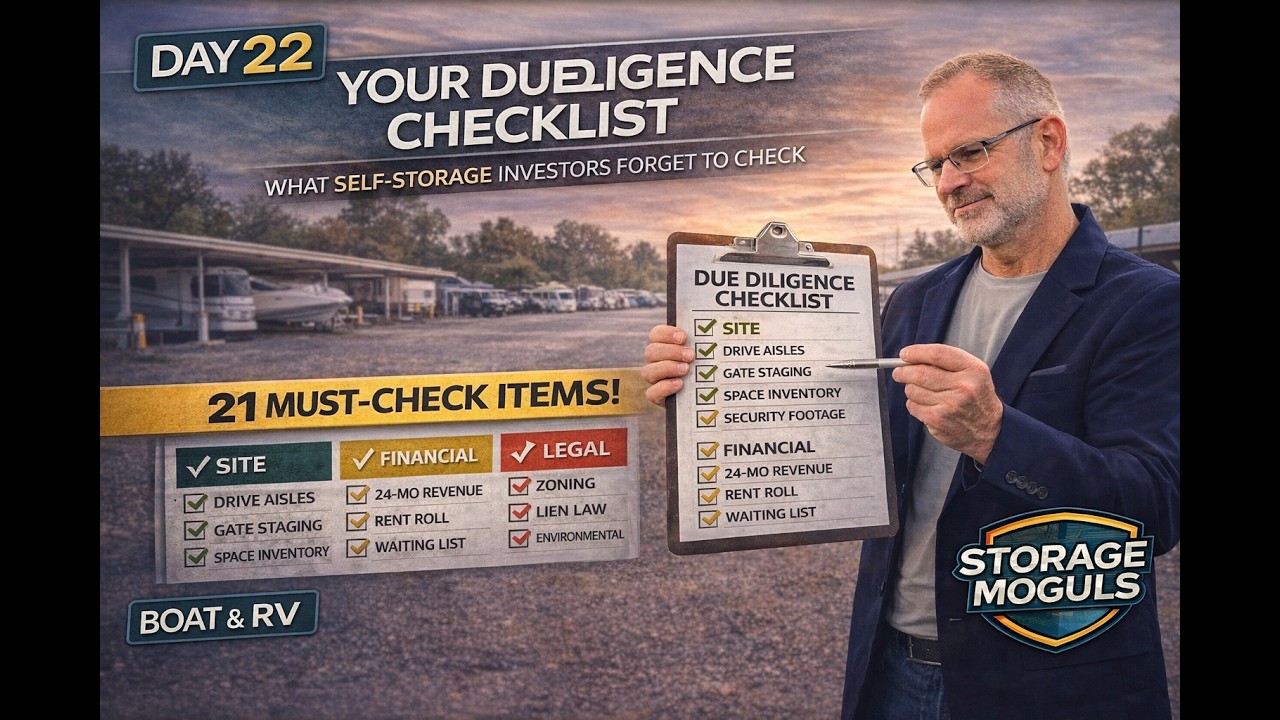
In this solo instructional episode of the Boat & RV 100 series, Joe Downs of Storage Muggles walks self‑storage investors through a comprehensive 21‑item due‑diligence checklist tailored for boat and RV storage facilities. He begins by framing the community of real‑world operators who close deals ranging from $400k to $2 million, emphasizing that the checklist is designed for determined individuals, even those with a W‑2 job. The checklist is organized into three categories: (1) Site Inspection – seven physical‑site items such as drive‑aisle width, gate staging area, space inventory, amenity condition, gate technology, security/camera coverage, and surface condition, each with measurement or documentation guidance; (2) Financial Records – seven financial documents including 24 months of month‑by‑month revenue, rent roll with move‑in dates, waiting‑list data, top‑tenant lease terms, itemized expenses, utility bills, and prior sale/appraisal history; (3) Legal & Regulatory – seven boat‑and‑RV‑specific legal items such as written zoning, vehicle‑lien law, Phase 1 environmental screening (including floodplain and wetland checks), original conditional‑use permit, title search, and Phase 2 addition confirmation. Downs then outlines six common deal‑killing findings (e.g., drive‑aisle under 30 ft, significant contamination, required zoning variance, missing seasonal data, low summer occupancy, lack of qualified lien‑law attorney) and provides decision rules for walking or renegotiating. He stresses embedding the checklist into LOI and contract contingencies to avoid post‑close surprises. The episode concludes with a call to action to join the free StorageMuggles.ai community, a preview of Day 23 on underwriting and seasonal pro‑forma modeling, and encouragement to like, subscribe, and share the video.
Chapters
Howdy folks, welcome to day 22 of the Boat and RV 100 series. I'm Joe Downs with Storage Muggles, and today I'm handing you the complete due diligence checklist— everything a self-storage investor needs to add when they're evaluating a boat and RV deal, and why missing even one of these items can cost you more than the deal is worth. And look, if you're serious about making this work, storagemuggles.ai is where you go next— not to learn theory But also to connect with people who are actually in the market doing deals right now. People in this community aren't waiting for the perfect moment. Maybe they're a husband and wife team who saved for 2 years and just closed their first facility, or the neighbors who pooled capital and went after a deal nobody else wanted. The person who was told they weren't ready and went and did it anyway. That's the energy we have in our, in our community. We focus on real deals, acquisitions between $400,000 and $2 million, deals that are financeable and digestible, and we'll walk you through exactly how. I'm talking about the kind of deals a determined person with a W-2 can actually get across the finish line. And we're about real results. Members here are building real portfolios, not planning to, not thinking about it, actually doing it. Remember, you can start for free, move along at your own pace, and build something real for a change. But back to today, because the gap between a self-storage due diligence process and a boat and RV due diligence process is exactly what I'm walking you through right now. Right now, a site inspection for a boat and RV has 7 items beyond what you'd expect or what you'd check on a self-storage visit, and all of them matter. Drive aisle widths first. Always remember, bring a tape measure. Measure at the narrowest point on multiple aisles. Take a photo with the tape measure in the frame. This goes in your due diligence file and your lender package. Gate staging area. Measure the distance from the road edge to the keypad. 70 feet minimum for a fifth wheel and a truck combination. Below that and Class A tenants cannot safely enter. Look at the space inventory. Count and categorize how many open air, how many covered, how many enclosed. Note the size of each category. This is your revenue inventory. Amenity conditions matter too. Is the air compressor station operational? Is there a rinse area? What condition is the gate system in? These are 4— these are the 4 items that appear most in Google reviews for boat and RV facilities. So document the condition. Operational or deferred maintenance matters as well. Gate and access. What technology is running? Is the gate remotely accessible? Take a photo of the entry and exit. This is a service standard question as much as a capital question. When it comes to security, camera placement and coverage matters. Fencing condition, lighting at night— these are all important. The tenant storing a $200,000 boat has expectations. Document whether the facility is meeting them. Surface condition is important as well. Is it paved, compacted gravel, or dirt? Note any rutting, pooling, or drainage issues. Take pictures. The surface condition tells you the operator's maintenance and standard And your CapEx timeline. Now you got 7 financial record requests and all of them need to go in your LOI and contract as due diligence contingency contingencies, or you ask for them before you sign. 24 months of revenue, monthly revenue, not an annual summary, minimum 24 months, month by month. This is the data that lets you build a proper seasonal NOI model. If the seller can or won't provide it, ask why. Rent roll with the move-in dates. This is important. Tenant tenure tells you a lot. Long-tenured concentration. Well, that's nice. That's a green flag. A rent roll full of tenants who moved in within the last year. That's worth investigating. Waiting list. If it exists, get it documented. Names, dates, vehicle type. This is your demand floor evidence and one of the strongest arguments you can make to a lender about occupancy stability. If it's real. You need to see the top tenant leases too. Look at the lease terms for your highest revenue tenants. Are they month-to-month? When do they expire? What's the rate history? Concentration risk in a 100-space facility is real. Get operating expenses itemized. The expense pattern tells you the maintenance standard. A facility with zero repair items for 3 years probably has deferred maintenance you'll inherit. You want to gather utility bills. Gate systems, lighting, and security run on power. Get 12 months of utility bills to baseline your expense model. Prior sale attempts or appraisals are important to know about too. If the seller has tried to sell before it fell through, find out why. Prior appraisals tell you what the asset was valued at and when. You also have 7 legal and regulatory items to consider. These are the boat and RV-specific ones that get missed by investors applying a self-storage checklist. You need zoning in writing. A verbal confirmation is a start. The code section is the record. Get the specific code reference so you can read the exact language of what's permitted. Vehicle lien law. This one catches operators every time. The process for handling an abandoned boat or RV is typically governed by state vehicle title law, not the self-storage lien statute. You need an attorney who knows the difference. Environmental Phase 1, covered in depth on Day 21, is non-negotiable on near-waterway deals. Make it an explicit DD contingency in your LOI and contract. Floodplain and wetlands— do the desktop screen first, FEMA firm maps and the NWI mapper, before you spend money on Phase 1. 10 minutes of free screening can tell you what Phase 1 will find. Get the original conditional use permit too. If the facility was approved through a conditional use process, that approval document is your operating rulebook. Every condition it imposes— screening, lighting, hours, limitations on expansion— is your obligation post-close. And the title search confirmed there are no deed restrictions that prohibit outdoor vehicle storage. It's rare, but it happens, particularly on parcels with complex prior ownership histories. For Phase 2 additions, confirm with the municipality that adding covered structures falls under the existing permit or if it requires new approval. Your value-add thesis may depend on the answer. Here's the complete checklist condensed into one view. Screenshot this and take it to every site visit. Site inspection, 7 items: drive aisle, gate staging, space inventory, amenity condition, gate technology, security coverage, surface condition, all of them documented with photos. With financial records, you get the 7 items: 24 months monthly revenue, 24 months monthly revenue, rent roll with move-in dates, waiting lists, top 10, top 10 at leases, itemized expenses, utility bills, prior appraisals or sale history. And then legal and regulatory, you got the 7 items: zoning and writing, vehicle lien law, phase 1 environmental floodplain and wetland screen, original conditional use permit, title search, phase 2 additional confirmation if needed. 21 items total. Standard self-storage due diligence handles most of the financial and legal category. The site inspection items and the boat and RV-specific regulatory items are the additions that matter most. So build this into your pre-LOI and contract process, and you won't get surprised by anything post-close that you could have found in due diligence. Know your walk criteria before you start spending money on due diligence too. Here's the 6 most common deal-altering findings and how to think about each one. If the drive aisle is under 30 feet with no fixable path, this is a hard constraint. If the site geometry can't support wider vehicle— or wider aisles, the facility is permanently limited to Class C tenants. Walk, unless the price reflects that reality completely. For Phase 2 contamination, walk or reprice depending on remediation cost estimate. The deal may still work at a lower purchase price if the seller accepts a reduction that accounts for cleanup costs and timeline. If the contamination is too significant, you probably need to walk. Is a variance— is a variance required for zoning? Not an automatic walk, but price it into the deal. Variance processes are slower, less predictable, and carry neighbor opposition risk. Get that risk priced into the acquisition. If they have no seasonal occupancy data, that's a red flag. A seller who can't or won't provide 24 months of monthly data is either disorganized or maybe hiding something. Negotiate harder and make that data a DD condition before you release your earnest money. If the summer occupancy is below 55%, investigate before you walk. Is this a market-wide issue or a facility-specific problem? Competing facilities performing better in the same market tells you it's operational. Competing facilities equally soft tell you it's a market problem. And then vehicle lien law without a qualified attorney. Don't, don't close without one. It's not a walk, it's a delay. Find the right attorney before the close date, not after. Here's the frame. Due diligence in boat and RV is not more difficult than self-storage. It's just different. And the investors who learn the specific differences, the drive aisle measurements, seasonal data requirements, vehicle lien law, environmental review, they close better deals than the ones who apply the wrong template. So you got 21 items across 3 categories: site inspection, financial records, legal and regulatory. Build it into your process and you won't be surprised, surprised by anything after you close. The 7 boat and RV-specific conditions are the ones that matter most. They're the items that self-storage investors skip and regret later. Now you know them. Know your walk criteria before you spend money on due diligence. It keeps you disciplined and keeps you from negotiating against yourself when you've already invested time and money in the deal. All right, next up, day 23, underwriting a boat and RV deal, building your pro forma the right way with a seasonal cash flow model that your lender can follow. Folks, if today gave you a clearer picture of what real boat and RV due diligence looks like, then hit the like button for me. It's the most useful thing you could do to help this series reach more people. And subscribe so you don't miss the pro forma episode where the seasonal cash flow model either works or doesn't, and we show you how to build one that does. And share this with someone who's been applying a self-storage checklist to a boat and RV deal and wondering why something still feels off. It's because it is. This is the episode that answers it. You've got the checklist now, 21 items. Use it. The operators who do their due diligence right don't just close more deals, they close deals they can actually make money with. And StorageMoguls.ai has the full framework and the tools to make you a smarter buyer and operator. It's free to join, work, work at your own pace, and if you're in early, you'll get access to a GPT we built for exactly this kind of operational analysis. Built by operators for operators, not generated from textbooks. Every vertical we cover connects to the next one. Boat and RV gives you the foundation. What comes after expands the playbook. So stay with us and join Storage Muggles. Do the work, close the deal. Tomorrow, the pro forma. We take everything you've built in DD— DD is due diligence— and put it into the model that tells you whether the deal works. See you tomorrow.