
Day 38: Insurance for Boat and RV Storage What Coverage You Actually Need
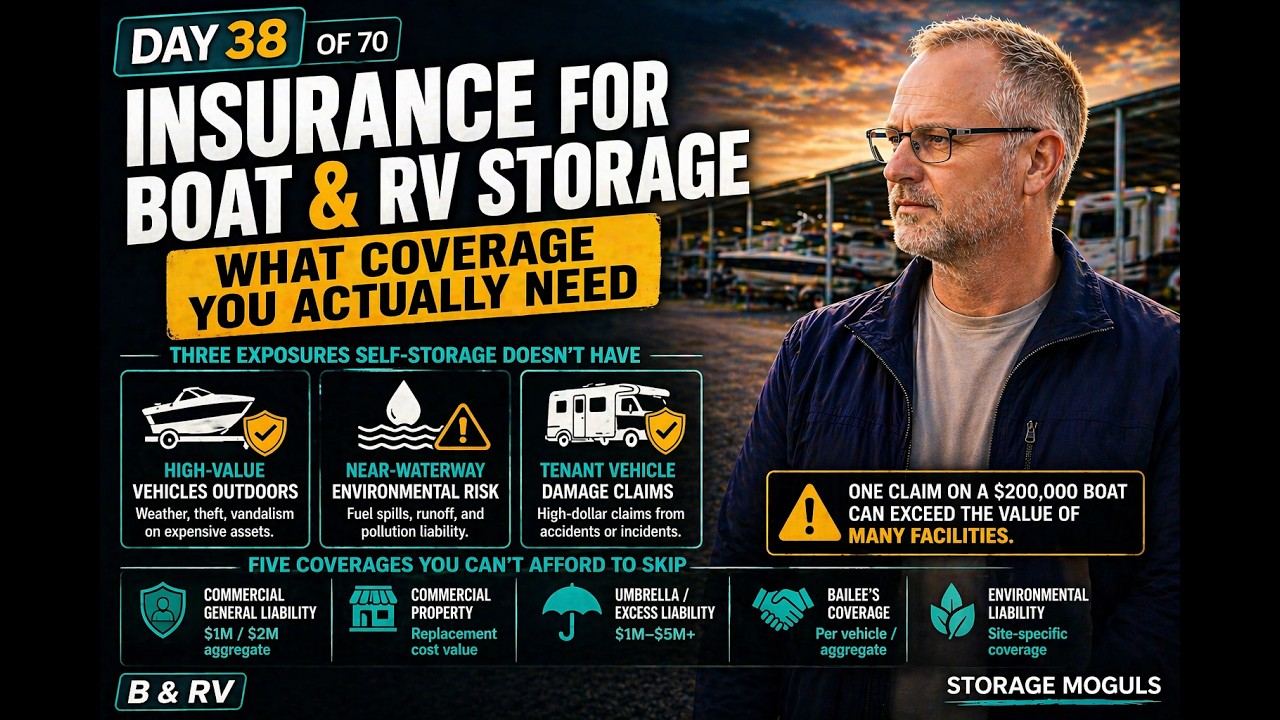
This content was created by Joe Downs. This content was uploaded by Joe Downs. This is a YouTube video (Day 38 of the Boat and RV 100 series) titled "Day 38: Insurance for Boat and RV Storage What Coverage You Actually Need," published April 26, 2026, produced by Storage Muggles and presented by Joe Downs. It's a solo instructional episode aimed at boat and RV storage operators (especially Class A/outdoor facilities) that explains insurance exposures unique to this asset class — notably (1) high-value vehicles stored outdoors, (2) near-waterway environmental liability, and (3) tenant vehicle damage claims — and prescribes five non-negotiable coverage types (Commercial General Liability, commercial property, umbrella/excess liability, bailees/bailee's coverage, and environmental liability). The video gives practical guidance on requiring tenant insurance, verifying coverage annually, finding specialty brokers, getting multiple quotes, reviewing policy exclusions with an attorney, and updating limits/replacement values before renewals. It also promotes storagemoguls.ai for checklists and broker referrals and previews a live recap (Day 39) of the operations section.
Chapters
Welcome to day 38 of the Boat and RV 100 series. I'm Joe Downs with the Storage Muggles, and today I'm covering insurance, specifically the exposures that are unique to boat and RV storage and that operators consistently underinsure until they have a claim. You've built a real foundation over the last 37 episodes. You understand the market now, you know how to find and structure deals, you know how to operate and retain tenants. Insurance is what protects everything you've built from And the events you didn't plan for. Getting it right isn't complicated once you know what you're looking for, and that's what today is about. The insurance intelligence at— comes from operators who have had claims and know firsthand what they wish they'd covered. A mogul, remember, isn't just someone who owns a storage facility. A mogul is a sophisticated operator of real estate, someone who understands the full arc for From finding a deal to running one. That's the standard we hold ourselves to, and that's what we're here to teach. We don't buy storage, we acquire and we optimize it. And that distinction might sound small, but it tends to show up as in, in the form of tens of thousands of dollars per deal, maybe more, and mistakes not made, which can be costly. And we're made up of real people— husband and wife, teens, 2 neighbors who hatch business plans together around a fire pit over a couple of beers. The 2 brother-in-laws or 2 brothers, W-2 employees looking to get out of the rat race. You name it, we got a community just like you. Not to mention all the real estate investors we have in our network who are looking for a better way out of residential and realize that storage is usually a lot easier to own and operate than residential. And we teach people how to find and evaluate real deals right now, acquisitions between $400,000 and $2 million. Some ask why that range. Well, because there's more financing options and we'll show you how and why. Can't give it all away here. If you want to be a part of it, join storagemoguls.ai. That's where we are. That's where you should be. You can start for free, advance at your own pace. But let's get into insurance because I'm telling you right now, it's not riveting. I get it. It's not riveting, but it's really important and you'll be really happy you learned it. Because finding out the other way, not fun. Look, there's 3 exposures that are specific to boat and RV storage and, and that change the insurance picture compared to self-storage. One, storing high-value vehicles outdoors. The average value of a boat and RV stored at a Class A facility is significantly higher than the average value of a self-storage unit's contents. A $200,000 Class A motorboat or a $350,000 Class A motorhome, for example, stored in an open-air lot is exposed to weather events, theft, and vandalism at a scale that creates claim potential far above the typical self-storage exposure. Number 2, near waterway environmental liability. Facilities near waterways have environmental exposure that inland facilities don't. Fuel spills from boat engines, bilge discharge, oil and chemical runoff from vehicle maintenance— all of these create potential environmental contamination liability near waterways. Standard commercial property insurance may not cover this adequately. So you have to ask your broker specifically about environmental liability coverage for near waterway facilities. And 3, tenant vehicle damage claims. A tenant who stores a $200,000 boat will have a very different reaction to damage and a very different claim threshold than a self-storage customer whose units cost— or contents are maybe $5,000. Gate malfunctions, fallen tree branches, surface damage caused by another tenant's vehicle. Weather events, all of these create claims scenarios at dollar values that self-storage operators rarely experience. Generally, you have 5 coverage types and all 5 are non-negotiable. Here's what each one does and what's specific about boat and RV. Commercial General Liability, CGL, is the foundation for any commercial property insurance program. It covers bodily injury and property damage claims arising from operations on your premises. $1 million per occurrence, $2 million aggregate is the starting point here. Near waterway facilities with higher exposure should discuss higher limits with their broker. Commercial property insurance covers your physical structures and improvements, the gate system, the lighting, covered structures, surface improvements. This policy does not cover tenant vehicles. That's a separate coverage type. Make sure you understand exactly what your property policy covers and what it excludes. Umbrella or excess liability coverage is important for a near-waterway facility storing high-value vehicles because it needs more liability cushion than a standard commercial property. A $1 million umbrella on top of the underlying CGL limit is a minimum. Facilities near navigable waterways with covered storage of high-value boats should discuss $2 million to $5 million umbrella policies with their broker. Bailees coverage is the boat and RV-specific coverage that self-storage operators don't think about. Bailees coverage protects against claims for damage to property in your care, custody, or control. When a tenant's $200,000 boat is damaged on your property by a gate malfunction, a weather event, a falling tree, the tenant may make a claim. Bailees coverage addresses that exposure. So ask your broker specifically about this. Environmental liability coverage is also important for near-waterway facilities. Ask your broker whether your CGL policy includes environmental coverage or excludes it. Many standard CGL policies exclude pollution and environmental liability. A fuel spill near a waterway that triggers a remediation requirement needs coverage. Environmental liability insurance can be added as a standalone policy or an endorsement. Bail lease coverage is the most overlooked policy type in outdoor vehicle storage and the one that creates the most unpleasant surprises when it's missing. Here's the language— here's the lease language trap that a lot of owners fall into. Most boat and RV storage leases include a provision stating that vehicles are stored at the tenant's risk and that the operator is not liable for damage, loss, or theft. Theft. Many operators believe this provision fully protects them. It does not. First, courts in some jurisdictions have found that broad exculpatory lease clauses are unenforceable in certain circumstances, particularly when the operator's negligence is contributed to— has contributed to the damage. A gate malfunction that damages a tenant's vehicle may be treated differently than a random theft the operator had no way to prevent. Second, Even when the lease language is enforceable, a tenant with a $200,000 boat that was damaged on your property is likely to pursue a claim before accepting that the lease protects you. The legal defense costs alone, even if you ultimately prevail, can be significant. Bailee's coverage addresses this directly. It covers claims for damage to property in your care, custody, or control, which is exactly what a stored vehicle is. When a tree falls on a stored RV, When a gate malfunction damages a boat, when another tenant's vehicle rolls into the boat next door, bailees coverage is the policy that responds correctly. Ask your broker, do I have bailees coverage or an endorsement that covers tenant vehicle damage? If the answer is no or they're uncertain, request a quote. It is typically not expensive relative to the exposure it protects against. Requiring tenants to carry insurance on their stored vehicle is a defensible and increasingly common practice in Class A boat and RV storage. Here's how to think about it. Require tenants to show proof that their boat or RV has coverage before storing it. This protects both parties. If the tenant's vehicle is damaged and their own insurance responds, the claim doesn't become your problem. If their insurer pays and then seeks subrogation against you, your bailee's coverage responds. The tenant's insurance is the first layer of protection. Specify a minimum liability amount in the lease. $50,000 to $100,000 is a reasonable threshold for vehicles typically stored in the, in the range of Facility, we're talking about that $400,000 to $2 million facility range. This screens out tenants who have no coverage on a vehicle worth hundreds of thousands of dollars. Some operators partner with an insurance— an insurer to offer tenant vehicle insurance at move-in as an add-on service. The tenant pays a modest monthly premium, their vehicle gets covered, and the operator, you, earn a small referral fee or revenue share. This creates a retention benefit. Tenants who purchase coverage through your facility have one more reason to stay, and you have a new revenue stream. Insurance policies lapse. A tenant who had coverage at move-in may not have it at year 2. So make sure you do annual verifications. Build an insurance verification into the renewal conversation or the annual outreach call, which we covered in day 34. Finding the right broker is the same discipline as finding the right lender or the right attorney. Experience with this specific asset class matters. Ask with the— ask within the industry first, either your self-storage contacts, the Storage Mobiles community, or your state self-storage association. The broker who has written 5 outdoor vehicle storage policies understands the bailees coverage question, knows how to structure the environmental liability discussion, and can get you a quote that actually fits the exposure. Here's some qualifying questions. Have you ever written a bailees coverage for an outdoor vehicle storage facility? And do you have experience with near waterway environmental liability? A broker can answer yes to both and give you specific examples is the one you want. A broker who needs to go research both questions, they're learning on your account. Get at least 2 quotes. The coverage difference between a broker who understands this asset class and one who doesn't can be significant, even when the premiums are similar. You may be paying the same amount for dramatically different coverage. So compare the policies line by line, not just the premium. Review the policy with your attorney. Once you have a coverage quote, have your commercial real estate attorney review the key exclusions. The exclusion language is where policies differ most significantly. Policy with a broad pollution exclusion on a near-waterway facility might be a coverage gap waiting to become an uninsured loss. Here's 6 review items. Build this review into your annual operating calendar, ideally 60 to 90 days before your policy renewal date. Property values. Every covered structure addition, every surface improvement, every capital expenditure changes the replacement cost of the property. A property policy that hasn't been updated since you added 10 covered carport structures, for example, is underinsuring the improvements you paid for. Review the replacement costs annually. Liability limits. The value of vehicles being stored at Class A facilities has increased significantly over the past decade. A $1 million per occurrence liability limit that was adequate 5 years ago may not be adequate for the vehicle values currently being stored. So ask your broker to run the numbers on current aggregate vehicle value in your facility. 3, balee's coverage. Confirm it's in force. Check the per vehicle limit against the highest value vehicles currently stored. If you've added covered spaces that attract higher value vehicles, the balee's coverage limit may need to be updated. 4, environmental exclusions. These exclusions are often written broadly and can evolve with the market changes. Review the exclusion language each year, particularly if you've added vehicle types that introduce new environmental exposure. And 5, tenant insurance status. How many of your current tenants have provided proof of insurance? Is the requirement being enforced at renewal? Gaps in tenant coverage increase your net exposure through the bailee's claims. Insurance is what protects you against everything you've built: the deal, the financing, the operations, the tenant relationships. Get it wrong, and a single event can unwind years of work. Find coverage types. 5 coverage types: CGL, commercial property, umbrella, bailees, and environmental liability for near waterway sites. All 5 are non-negotiable. Bailees coverage is the one most operators are missing. So ask your broker specifically. If they don't know what it is in the context of outdoor vehicle storage, find a different broker. Near waterway facilities need higher limits across the board. Umbrella, environmental, property values on improvements. The waterway exposure is real and the standard commercial package doesn't fully address it without specific attention. Find a specialty broker who has written this coverage before. 2 qualifying questions. One policy review, one check-in. That's the program. Tomorrow, day 39, is our live recap for Section 4, Operations and Management. Bring your operating questions, rate strategy, retention, amenity investment, marketing, vehicle liens, insurance. We'll close out this section live. Please like this video if Bailey's coverage was a gap in your insurance program that you didn't know you had. One policy addition, one broker conversation protects the exposure. I'm expecting no one to like this video because insurance is boring. But folks, it's so important. Subscribe so you don't miss tomorrow's live recap. Day 39 is where we're going to close this out, Section 4, and open Section 5. And share this with an operator. You could do that. Can you share it for me with an operator who's never had insurance review specific to outdoor vehicle storage? The 5 coverage types of and the bailees conversation alone are worth the share. And by the way, if you share a video about insurance, that definitely signals To everyone in your network, you are digging in and learning and leaning into this business. Nothing says I'm in this business like I wasted time— not wasted, I spent time watching a video on insurance. Insurance is not the most exciting topic in this series, but it's one of the most consequential. A coverage gap of $200,000 boat damage claim can cost more than facilities monthly NOI. Get the right coverage from the right broker and review it annually. StorageMuggles.ai. Has the insurance checklist and the broker referral network from operators who've gone through the claims and know what's up, know what to do. They know what's held up. Free to join. I don't know why you're not joining if you haven't yet. Protect what you build. Section 4's operating playbook is complete. Tomorrow we recap it live and open Section 5: growth, scaling, and what comes after the first facility. Join Storage Muggles. Cover the exposure. Operate with confidence. See you tomorrow.
More from Joe





The tenant only paid for the first month! #selfstorage #horrorstory #realestateinvesting

What happens when a storage tenant stops paying? #selfstorage #realestateinvesting #storagemoguls



