
Day 50: Managing Seasonal Demand Spring Move Out Summer Gap Fall Rush
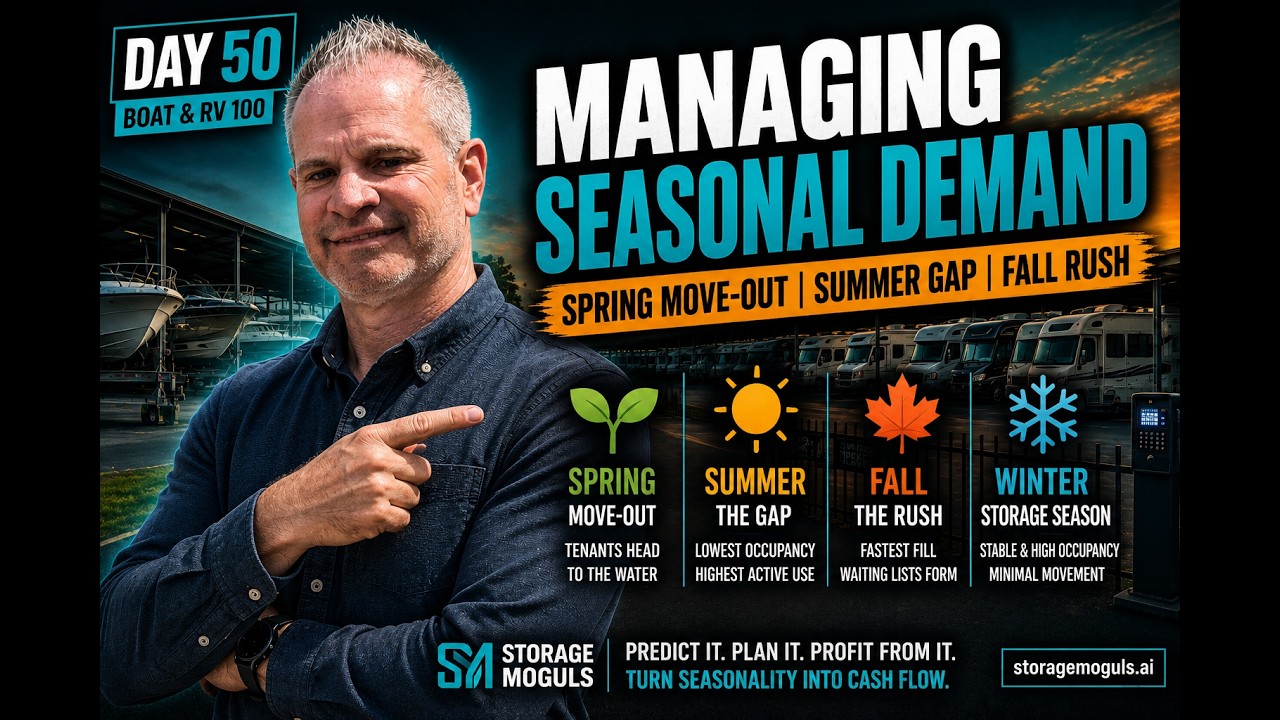
Joe Downs breaks down the four-phase seasonal cycle in boat and RV storage: spring move-outs, summer gaps with lowest occupancy, fall rush with peak demand, and winter high occupancy. Model occupancy month-by-month, not flat annually. Summer hits 60-70%, fall and winter 90-95%, spring 70-85%.
Chapters
And welcome to day 50 of the Boat and RV 100 series. I'm Joe Downs with Storage Moguls, and today I'm going to walk you through the seasonal demand cycle in boat and RV storage, all 4 phases, and the strategies that turn this predictable pattern from something you react to into something you plan around. If you're the type of person who wants to hang out in a community of people who share ideas and frameworks like this, you should probably join us over at storagemoguls.ai because a mogul Isn't just someone who owns a storage facility. A mogul is a sophisticated operator, someone who understands the full arc from finding a deal to running one. And that's the standard we hold ourselves to, and that's what we're here to teach. We don't buy storage, folks. That's— I'm not gonna say that's easy, but that's simple. We acquire it and we optimize it. And that distinction might sound small, but it tends to show up as tens of thousands of dollars per deal. When you get it right. And also not buying deals that are going to hurt you. And we see that too. We're made up of real people, couplepreneurs, solopreneurs, entrepreneurs, people that are actively in it, doing it every day. Nobody here, by the way, graduated from us or to a stage and stopped actually sourcing deals and doing the work and mentoring and teaching. We're actually evaluating real deals right now, acquisitions between $400,000 and $2 million that are financeable and digestible. And we'll walk you through how. Members in our community are becoming moguls every day. Not someday, not, not maybe. Now, if you want to be a part of that, join storagemoguls.ai. That's where we are. That's where you can be too. You can start for free and you can advance at your own pace. Let's get into today's episode because the operators who struggle in this vertical almost always struggle for the same reason. They're surprised by seasonality. And the ones who perform treat it as a cash flow pattern they already know is coming. And there we go. Before we get into strategies though, let's make sure the cycle is clear. This is not the same as self-storage demand. Self-storage demand is relatively flat across the calendar year. Boat and RV storage demand moves in predictable waves, and if you're modeling this asset With a flat annual occupancy assumption, your pro forma is going to be wrong. Spring is your move-out season. That's March through May. Your tenants are pulling boats out and RVs out to use them. So your occupancy is going to drop. And this is expected. Summer is your gap. June through August, your facility is at its lowest occupancy point. But the tenants who are there are actively using their vehicles, which means more gate traffic, more access requests, more facility wear. And then falls the rush, September through November. This is your highest demand window. Tenants come back, waiting list form, the phone volume spikes. This is your pricing leverage moment. Winter is your stable storage season, December through February. That's your occupancy is going to be high, movement in and out is going to be minimal, and your operational workload is going to drop significantly. So you got to know where you are in the cycle at all times. Every operational and pricing decision should be made with with the cycle in mind. The 4-season— excuse me— cycle is the operational and financial foundation of this asset class. Spring is your move-out window, again, March through May. Tenants pull vehicles out to use them. The summer gap, lowest occupancy, highest active use by remaining tenants. Fall, again, your rush, fastest to fill, waiting lists, pricing leverage, all at its peak. Winter is the stable storage season, highest occupancy, lowest operational workload. Every strategy in the next 4 slides is built around one of these 4 phases. Know which phase you're in at all times. Every decision— rates, marketing, staffing, maintenance— should be made with the current phase in mind. Spring strategy is retention, not acquisition. When your tenants are pulling vehicles out in March and April, your job is to make sure they're coming back in the fall. This— the mistake operators make in spring is treating departing tenants as lost revenue and scrambling to fill vacancies with new tenants at discounted rates. Don't do that. Your existing tenants, the ones heading to the lake or the campground, they're your highest value tenants. They know your facility. They've already made the trust decision. They're likely to refer friends and family. Your spring communication should be about holding the relationship. Thank them for the season. Confirm the fall return date. Ask if they need anything before they go. But resist the urge to drop rates for new tenants during the spring and summer gap. Discounted tenants acquired during the gap frequently don't renew at full rates in the fall, so you've trained them to expect lower prices. Price integrity through the gap is worth more than the marginal occupancy you'd gain by discounting. Summer gap is real. It's predictable and it's manageable if you plan for it. Your occupancy in June, July, and August, it's going to be lower than fall and winter. That's not a problem, it's a pattern. Problem is when operators treat it as if it's a surprise and make reactive decisions. Build the gap into your cash flow model. If your breakeven occupancy is 75% and your summer typically drops to 70%, that's a known shortfall you can plan around. It's not a crisis. Summer gap strategies that work Short-term storage for boats between trips. Some boat owners take their vessels out for a week, bring it back, and then take it out again. A month-to-month rate at Slate Premium captures this tenant without locking in a discounted long-term commitment. Target RV owners who use less frequently— use their vehicles less frequently than boat owners. An RV that's out there 3 weeks in the summer and is in storage for 9 months is a high-value tenant. And they're out there. Market to them in June and July. Personal watercraft and jet skis fill faster than large vessels during the summer because the usage cycle is shorter. If you have small spaces, market them specifically to this category during the gap. Fall, that's your Super Bowl. September is when the phones ring, the inquiries flood in, and your occupancy fills up fast. If you're not prepared for the fall rush, you will leave revenue on the table. And you won't get it back until next fall. So 3 things here to get right for the fall. First, be ready for September. Your marketing, your rates, your availability, communication, and your inquiry response process all need to be in place by August. Tenants who are looking for storage in September are already thinking about it in August. So be visible when they're thinking about it, not when they're desperate. Second, use this moment for rate increases. Fall move-in season is the strongest pricing leverage point in the boat and RV calendar. New tenants move in during September and October. New tenants who move in during September and October are unlikely to push back on the 10 to 15% rate premium relative to your spring rates. They need storage before the season ends. You have what they need, so price it accordingly. Third, build and maintain your waiting list. If you fill completely in the fall, which a well-run facility should document every inquiry you can't accommodate. That list is your fall marketing asset for next year. It's also negotiating leverage for late increases with existing tenants. Something— send a message like, we have a waiting list for tenants who want your space at a higher rate. I'd like to keep you at the current rate if we can confirm your renewal. That's pretty powerful. Winter operations are straightforward. But worth planning for. December through February, you're at the highest occupancy with your lowest operational workload, minimal move-in and move-out activity. Gate traffic is low. Your facility essentially runs itself during this period, which makes it the right time to do deferred maintenance, infrastructure improvements, and planning for the spring cycle. Tenant communication in the winter should be light and value-add. A winterization reminder if you haven't already sent one. Maybe a facility update if you made improvements, a renewal outreach if you have tenants whose leases expire in spring. The annual renewal conversation is much easier in January than in March. In January, the tenant's thinking about next summer. In March, they're in move-out mode and every conversation feels transactional. Here's one more winter note for you. For facilities in the northern markets, snow management is your primary operational task. Covered structures need to be monitored after significant snowfall. Drive aisles need to be passable. Tenants occasionally need access in winter for unexpected reasons. So maybe it's a family trip, an insurance inspection, a vehicle service. Be ready for those requests even during your lowest traffic months. Let me put it to you in practical terms here. When you're underwriting a boat and RV acquisition, your pro forma needs to model occupancy by month, not as annual— as an annual average. If you assume 85% annual occupancy across 12 months, you're not modeling this asset class. Model it as a 60 to 70% in summer, 90 to 95% in fall and winter, and 70 to 85% in spring. The cash flow pattern will look lumpy, and that's correct. That's what this asset actually does. Revenue concentration in fall and winter is a feature, not a bug, provided you plan Service around that pattern. Operators who get in trouble in boat and RV almost always made one of the 2 mistakes: they modeled flat annual occupancy and were surprised by the summer gap, or they discounted aggressively in the gap and damaged their rate structure for the following fall. Sometimes they do both. Understand the cycle, model the cycle, price around the cycle. That's the game in this vertical. Here's the frame. Seasonality is not a problem with this asset class. It is the asset class. The operators who plan around it outperform. The ones who react to it, they struggle. All right, next up, day 51, customer service and boat and RV, the peak-end experience principle. Look it up if you don't know what it is so you're ready for tomorrow, but I'll tell you about it. We are going into the Psychological framework that explains why, how you handle problems matters more than whether problems happen, and why boat and RV tenants are uniquely positioned to become your best marketing asset when you get it right. Please like this video if the Four Seasons Cycle framework gave you a clearer picture of how to model and manage this asset, because that's the foundation everything else in this section is built on. Subscribe so you don't miss day 51, the peak end. Episode has a specific framework that changes how you train your managers, and it's one of the most operationally valuable episodes in this section. And then share this with someone who's underwriting their first boat and RV acquisition with a flat annual occupancy assumption. That's the number one modeling mistake in this vertical. StorageMoguls.ai has a full seasonal cash flow model for boat and RV facilities, including the month-by-month occupancy framework and the pricing calendar. It's free to join, so join Storage Muggles. Model the cycle, price around it, build a facility that performs every phase of the season. See you tomorrow.
More from Joe





The tenant only paid for the first month! #selfstorage #horrorstory #realestateinvesting

What happens when a storage tenant stops paying? #selfstorage #realestateinvesting #storagemoguls



