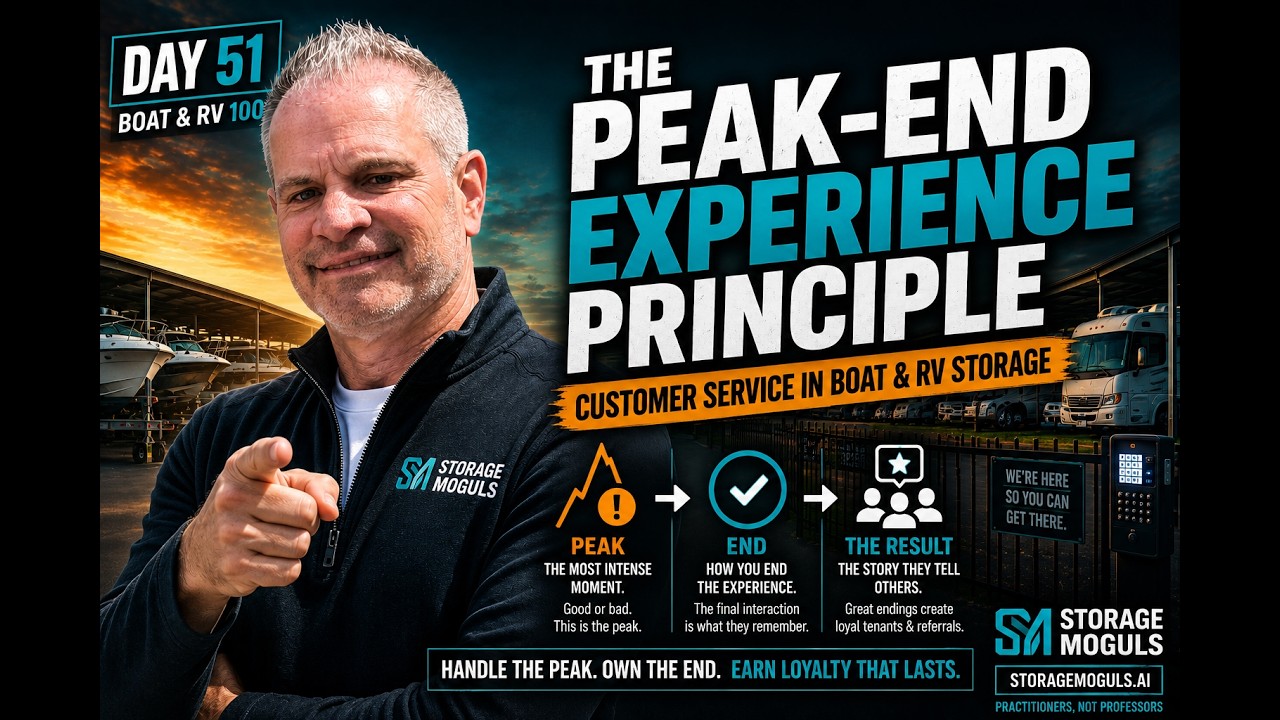
In this solo instructional video, Joe Downs of Storage Moguls introduces the Peak-End Experience Principle—a psychological concept that people remember only the most emotionally intense moment (the peak) and the final moment (the end) of an experience. He explains how this principle applies uniquely to boat and RV storage, where tenants have high emotional stakes tied to family outings and vacations. Downs illustrates the impact of a poorly handled peak (an expired access card and late fee) versus a well‑executed resolution that turns a negative peak into a positive end, leading to strong loyalty and referrals. He argues that traditional escalation chains are counter‑productive; instead, frontline staff must be equipped with authority (to waive one‑time fees), technology (remote gate access), and judgment to resolve issues in a single call. He outlines a three‑step system: (1) equip staff with tools and authority, (2) define a resolution‑by‑call standard, and (3) debrief exceptions to close gaps. He also notes that positive peaks (unexpectedly great interactions) are equally memorable. The video concludes with a call to join the StorageMoguls.ai community for deeper resources, a preview of Day 52 on one‑call resolution tactics, and encouragement to share the content.
Chapters
Welcome to day 51 of the Boat and RV 100 series. I'm Joe Downs with Storage Moguls, and today I'm introducing a framework that will change how you think about every customer service interaction in this vertical. It's called the Peak-End Experience Principle. And folks, there's a lot of people out there talking about storage, but not many of them are still doing it. We are, though. Every deal we teach, we've touched. Every framework we share came from something real, not a textbook, not a seminar from 5 years ago. We're a community of solopreneurs, entrepreneurs, husband and wife teams who are actively evaluating acquisitions right now between deals between $400,000 and $2 million. Why? Because they're, they're deals that are financeable, they're digestible, they're the kinds of deals that actually get done. The word mogul means something specific here. It means a sophisticated operator, someone who's learned the full arc. From finding the deal to running it and knows that acquiring and optimizing is a very different thing from just buying. That difference is usually worth tens to even hundreds of thousands of dollars per deal. So if you want a community that's actually in the field with you, then you should probably join storagemuggles.ai. You can start for free and you can level up at your own pace. But back to today, because in boat and RV storage, how you handle problems doesn't just determine whether a tenant stays. It determines whether or not they become your biggest marketing asset. You heard that right. The peak-end rule is a well-documented principle in psychology. People don't remember an experience in its entirety. They remember 2 moments: the peak, which is the most emotionally intense moment, whether that's positive or negative, and then the end, how the experience concluded. Everything in between gets averaged out and largely forgotten. This has enormous implications for how you run a boat and RV facility. Your tenant doesn't remember every smooth move-in, every functioning gate, every month where nothing went wrong. That's just the baseline. What they remember is the moment something went wrong and whether it got resolved. If the problem got resolved well and fast, The story they tell is about how great the facility is. If it didn't, the story they tell is about a disaster. The good news for boat and RV operators is this: your tenants have deep emotional investment in their vehicles. That emotional investment means the resolution of a problem lands harder than it would in self-storage. So a well-handled problem in this vertical creates deeper loyalty Then no problem at all. That's not risk to manage, that's an advantage to build a system around. Let's talk about what boat and RV tenants are actually feeling when they call. These are recrea— recreational vehicle owners, and they store their boats and RVs because using them is how they connect with family, decompress from work, and enjoy the life they've built. When they're calling you, it's because something is standing between them and that experience. The emotional stakes are not the same as a self-storage tenant who can't access a unit of furniture. The boat and RV tenant calling you at 7 AM on a Saturday is headed to the lake with their kids. The one calling you in September is preparing for their last camping trip of the season. The emotional temperature of these calls is higher. The resolution value is also higher. When you solve the problem quickly and completely, you've become part of a good memory. When you don't, you've become part of a bad one. Train every person who answers your phones to understand this context. It changes the entire tone of the interaction. You're not resolving an access issue, you're protecting a family Saturday. Here's the story that illustrates it. A tenant shows up to pick up his boat. He's heading to the lake. Family is waiting. He gets to the gate and his access card is expired. He calls the office. He has a late fee from the previous month. He's frustrated, possibly angry. This is the peak, the worst moment. Here's where most facilities lose the tenant. They put him on hold. They tell him someone will call him back. They say they can't waive the fee without manager approval. He misses his window. The day is ruined. He's out of there. Here's what the right facility does. Whoever answers the phone has the authority and the tools to resolve this immediately. They open the gate remotely. Maybe they waive the one-time fee as a goodwill gesture. They stay on the line until he's through. They say, you're good to go. Have a great day on the water. Peak was bad. The end was great. He stayed, and he likely told at least 3 people at the marina about how his storage facility handled it. That's the Peak-End Principle in action. The practical implication is that your customer service standards need to be built around resolution authority, not escalation chains. In most organizations, the instinct when a problem arises is to escalate. To someone with more authority, more information, or more approval power. In boat and RV storage, escalation is almost always the wrong move. Your tenants are operating on a timed schedule. They're heading to the lake or the mountains. They're picking up their RV for a camping trip that starts in 2 hours. They don't have time to wait for a callback. The person who answers the phone, whether that's you, A manager or call center needs 3 things: the authority to waive a one-time fee without approval, the technology to open the gate remotely, and the judgment to know when to use both. That's the entire customer service system. It's not complicated. It requires trusting the people you've trained and giving them the tools to execute. Here's how to build the system. Step 1: Equip everyone with the tools. Remote gate access on every manager's phone. Authority to waive a one-time fee. Define what one-time means and how often, but give frontline staff the authority. Access to tenant accounts so they can see payment history, note an issue, and update a record without putting anyone on hold. Step 2, define the resolution standard. Every access or payment issue that a tenant calls about during business hours gets resolved before the call ends. Not escalated, not called back, resolved. If it can't be resolved in that call, the tenant gets a clear timeline and a personal callback, not a ticket number. Step 3, debrief the expectations or the exceptions. When something doesn't get resolved on the first call, understand why. Was it a tools gap, an authority gap, a training gap? Fix it before it happens again. The goal is a facility where a tenant never hangs up the phone with their problems still open. One more thing worth naming: the Peak-End Principle applies to positive experiences too. The peak doesn't have to be a problem. It can be an unexpectedly great interaction. Maybe the manager who noticed the tenant's boat had a flat tire and left a note. The call where someone proactively reached out about a facility improvement before a tenant asked. These positive peaks also get remembered and told. The end still matters. Every interaction should close warmly and cleanly. Is there anything else I can help you with before you head out? It takes 4 seconds. It signals that you're present and that you care. In a vertical where the primary driver of referrals is how tenants feel about their storage experience, not the price, not the location, The operational investment in peak-end management pays back in retention and referral rates that self-storage facilities simply cannot match. Here's the frame: your tenants are heading somewhere meaningful every time they show up. How you handle the moments when something goes wrong determines whether they stay, whether they refer, and whether you built something worth owning. All right, next up, Day 52, Resolving Problems in One Call. The Boat and RV customer service standard. We're going deeper here. The specific tools, authority structures, and scripts that make the one-call resolution the standard operating procedure. Like this video if the Peak-End Framework changed how you think about customer service in this vertical. It's the foundation that Day 52 builds on. Uh, subscribe, by the way, so you don't miss day 52. It's the tactical execution of everything we just covered today— authority, tools, scripts, and the one failure mode that undoes all of it. And then share this with your network. You will thank me later when you understand why it's so important to start doing that today, if you haven't already. StorageMoguls.ai has the full customer service playbook for boat and RV facilities, including the Resolution Authority Framework. And the manager training guide. It's free to join, so join Storage Muggles. Build a facility your tenants brag about. Train your team to protect their Saturdays. See you tomorrow.