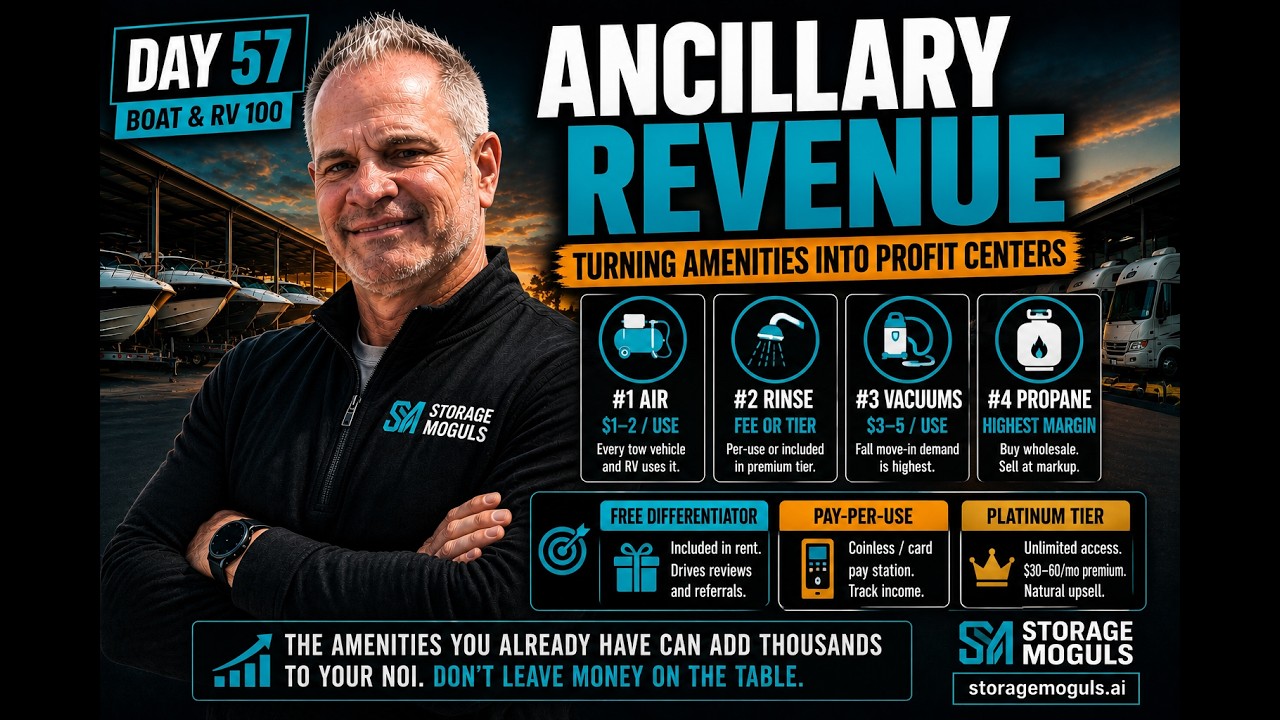
In this solo instructional episode, Joe Downs of StorageMoguls explains how boat and RV storage operators can transform four common on‑site amenities—air compressor, rinse station, vacuums, and propane—into significant ancillary revenue streams. He revisits the operational basics covered in earlier episodes and shifts focus to pricing strategies, outlining four models: (1) free inclusion as a marketing differentiator, (2) pay‑per‑use with coinless or credit‑card stations, (3) hybrid mixes, and (4) tiered/platinum bundles that bundle unlimited access for a premium monthly fee. Downs provides conservative revenue math for a 100‑space facility, highlighting propane as the highest‑margin item, and stresses the importance of consistency in the chosen model to avoid tenant confusion. He also delivers a concise maintenance checklist for each amenity, warning that broken equipment can turn a revenue asset into a cost center. The episode ends with a call to action to join StorageMoguls.ai for calculators, templates, and community support, and teases the next episode on Google My Business.
Chapters
Howdy folks, and welcome to day 57 of the Boat Interview 100. I am Joe Downs with Storage Moguls, and today we're talking about money that's already sitting on your property. The air compressor, the rinse station, the vacuums, the propane— most separators treat these like amenities, and that's fine, but the ones making real money treat them like revenue centers. And the people in our community get that distinction because we're made up of Entrepreneurs, solopreneurs, husband and wife teams who are actively working deals between $400,000 and $2 million. And we acquire and we optimize and we get that distinction because this is what we talk about. This is what we do. This is what we educate ourselves on. This is what we, we socialize around in the community. And that's the difference a lot of times between buying storage and running it well. StorageMoguls.ai is where you want to be if that sounds like you. You can start for free and you can advance at your own pace. But back to today, because the question isn't whether you have these amenities, it's whether you're charging for them. So here's the context for this episode. In day 44, we covered the 4 amenities from an operational standpoint, what to install and what priority order and what they do for the tenant experience. But today we're going to approach the same 4 amenities from a revenue standpoint. How do you price them? How do you structure them? What's the actual income potential, and what's the one mistake that undermines the whole system? The operators who treat amenities purely as operational features miss the income. The operators who try to monetize everything without a consistent model create tenant confusion and complaints. The right approach is to make a deliberate choice: free amenities as a competitive differentiator, or revenue-generating amenities with the clear pricing structure and then execute it consistently across every tenant interaction. The model you choose matters less than the consistency with which you apply it. So let's walk the 4 amenities and their revenue potential here. So we got air, which is the most used amenity in any boat and RV facility because every tow vehicle, every RV, every trailer needs air. You got the commercial-grade air compressor with a credit card pay station. Runs $1 to $2 per use and requires essentially no ongoing overhead once installed. At a 100-space facility, by the way, with regular usage, a season of air revenue is modest but entirely passive because you have no staff involvement, no inventory, no resupply. Then you got a rinse station, water only, remember, as we covered in day 45. And the rinse station can be monetized as a fee-per-use station with a pay terminal, or it can be included in a premium tier. Free rinse access is also a legitimate competitive differentiator in markets where competitors charge for it, of course. And then the revenue from a pay-per-use rinse station is meaningful during the spring and fall peaks when move-in and move-out volume is at its highest. Then you got vacuums, $3 to $5 per use via a coinless pay station is the standard, by the way. A boat owner who just came back from a weekend on the water with sand, fish debris, and lake mess in the hull definitely wants to clean up before storage. So a well-placed vacuum, commercial vacuum station with a coinless pay terminal generates consistent usage, particularly during the fall move-in. At 150 spaces with moderate usage, vacuum revenue over a full season is a pretty meaningful contribution to ancillary income. Then of course propane. This is the one with the real margin. You buy wholesale, you sell at a markup, and the volume compounds at a facility with significant RV mix in it. Propane is a consumable that tenants need regularly, so installing a compliant propane fill station with proper safety equipment and permitting is the most capital intensive of the 4 amenities. But the margin on propane, propane sales is the highest and most consistent. So the revenue model question, free amenities as a differentiator, or do you go pay-per-use revenue generation? Both are defensible. Here's how to think about the decision. The free model, all 4 amenities including included in the monthly rent. You price your spaces to reflect the amenity level and market. The difference here. Something like our rates include air, rinse station access, and vacuums. The argument for this model is simplicity and differentiation. You're not nickel and diming tenants who are paying premium rates. The free amenities becomes a marketing asset. They show up in Google reviews and marina conversations and referrals. The pay-per-use model, where you have amenities priced individually with a coinless or credit card pay station for each. Revenue is tracked per amenity. The argument for this model is that tenants who use the amenities heavily pay for that use, and the tenants who don't aren't subsidizing it. And then you got the hybrid model. And the most common failure is some amenities free, some paid, no clear logic to the distinction. A tenant who pays $3 for the vacuum but gets the air free can't figure out why. And that's a tenant who calls to complain. Mixed signals create confusion, and that's why it's more important to pick one model and apply it consistently. The platinum tier is the bundling approach that works, though. A growing number of boat RV operators are implementing a tiered rate structure where the top tier— call it platinum, premium, whatever fits your brand— includes the unlimited amenity access as part of the monthly rate. The structure: standard rate for, uh, standard rate for open air with no amenity access, mid-tier for open air with limited amenity access or covered storage access, and then platinum tier for the full bundle— covered space plus unlimited air, rinse, vacuum, and maybe propane at a fixed monthly premium. This model does 3 things. It simplifies the billing. So you have no per-use transactions and no pay stations to maintain. It creates a natural upsell from standard to platinum during the leasing conversation as well, and it prices your highest demand tenants, the ones who will use every amenity regularly, into a tier that captures their full revenue potential without creating friction at each use. The premium or platinum over standard should reflect the full value of unrestricted amenity access. So in most markets, $30 to $60 per month above the standard rate is reasonable and achievable. The revenue math at a 100-space facility. Conservative case here. Assume 40% of your tenants use the pay-per-use air station an average of twice per month at $1.50 per use. So 100 spaces, 40%, 2 uses at $1.50 is about $120 per month in air revenue. Not amazing. Assume 25% use the vacuum station twice per month at $4 per use. So 100 times 25%, 2 times the $4 a pop is $200 a month. Assume 20% use the rinse station once per month at $5 per use. So you got 100, 20%, 1 time at $5 is another $100 per month. That's And then propane at a facility with 40 RV tenants buying an average of 1 fill per month at a $15 markup. 40 times 15 is $600 a month. Told you that's a big one. So total conservative case is $1,000 a month in ancillary revenue, which is $12,240 annually. At a 7 cap, that's $100,000 and I'll call it $175,000 in additional asset value from Amenity revenue alone. The model that generates this is not complicated. It requires pay stations, pricing, and/or consistency of a monthly payment. One operational note worth naming here: the amenities that generate revenue are also the amenities that generate reviews and referrals when they're well maintained. A broken vacuum station is not neutral, it's negative. A propane station that's out of stock during a busy fall weekend is a tenant complaint that reaches the marina community by Saturday afternoon. And the revenue from these amenities is only sustainable if the maintenance is consistent. So add each amenity to your weekly walkthrough checklist. Air compressor, air compressor pressure, uh, and pay station function, rinse station hose and water pressure, vacuum station coin mechanism and suction quality, propane level and safety equipment check. These are 5-minute checks. The alternative, a broken amenity during peak season that costs you reviews, referrals, and tenant satisfaction far more than the maintenance investment. Here's your frame. Your amenities are either marketing assets, revenue streams, or silent cost killers. There's no 4th option. So decide which model you're running, execute it consistently, and maintain what you monetize. Go ahead and like this episode if the free versus pay framework gave you clarity on where your model is sending mixed signals. And subscribe because day 58 is GMB, Google My Business. The fall search window is August and September. If your profile isn't ready, you're not showing up when it counts. And share this with an operator whose amenities are a cost center, not a revenue center. The fix is simpler than they think. StorageMoguls.ai. We have the calculator templates, operators who've been through it to converse with, collaborate with. It's free to join. To join Storage Moguls, turn what you have into what it should be earning. See you tomorrow.