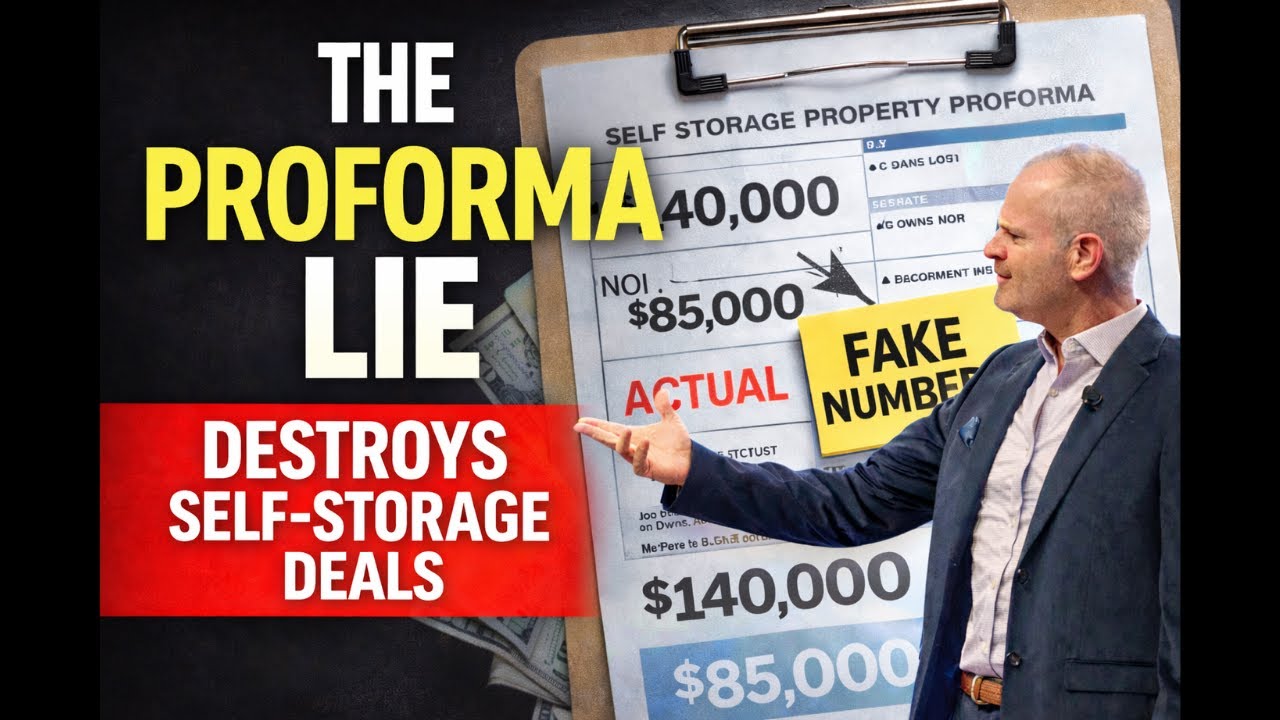
This content was created by Joe Downs. This content was uploaded by Joe Downs. This is a YouTube video (Storage 100 series, Day 57) titled "Day 57: Real vs Pro Forma Numbers in Self Storage: How to Spot the BS Before You Buy," published January 29, 2026 by Joe Downs / Storage Moguls Mastermind. It is a solo instructional presentation in which Joe Downs walks viewers through distinguishing real, verifiable financials (T12, Schedule E, bank statements) from seller pro formas, highlights common red flags (inflated NOI, unrealistically low expense ratios, 100% occupancy, perfectly round numbers), gives a $140,000 pro forma-trap example, recommends verification steps (secret-shop comps, check economic vs physical occupancy, apply a 40% expense rule), and explains using pro formas for upside while buying based on current reality. The video includes a closing call-to-action to like/subscribe.
Chapters
Hello, Storage Mogul Nation, and welcome to day 57 of the Storage 100 series. I'm Joe Downs with the Storage Moguls Mastermind, and today we're talking about what sometimes is the biggest fantasy in real estate— the pro forma numbers. If you can't spot the difference between real numbers and fantasy numbers, you're gonna lose money. The seller's job is to make their property look like a gold mine, even if it's just a pile of dirt, folks. Your job is to look past the shiny brochure and find the cold hard truth. So in this episode, I'm going to teach you how to spot the BS in any deal you look at. You have to learn to underwrite based on what is, not what could be. So let's start by defining what we mean by real numbers. So real numbers are verifiable facts, not hopeful projections. Real numbers are historical performance backed by paper trails you can audit. Trust but verify. We look at the trailing 12 months or T12, which is the profit and loss statement for their past year. This tells you exactly what the property has earned and spent. We also demand the tax returns, specifically Schedule E, which the owner filed with the IRS. And usually, usually people don't lie to the IRS, so those numbers are usually the most accurate. And finally, we verify everything against the bank statements showing actual deposit— deposits and withdrawals. And if a number isn't verified by one of those 3 sources, it's not likely real. Now let's look at the numbers the sellers want you to focus on. Pro forma numbers are where the seller's imagination runs wild. These are projected future numbers based on best-case scenario that rarely happens. They use market rates instead of the actual rates the current tenants are paying. They assume stabilized occupancy, meaning 90% full, even if the property's only 80% full today. And they always project expenses that are unrealistically low. Ignoring things maybe like marketing expenses or, you know, maintenance costs. Pro forma is essentially a fantasy land where every assumption works out perfectly. You can't underwrite a deal based on a fantasy because it forces you to pay upfront for the potential you haven't yet created. The seller is asking you to pay today for value that might take you 3 years to achieve. This creates a massive financing gap that's going to crush your deal. Banks are only going to lend money based on the property's current real income, not the seller's dreams. So if you agreed to pay a price based on pro forma, you have to cover the difference with your own cash. You also take on the execution risk. So if you miss those projected numbers, you're immediately underwater. Never let a broker or seller convince you to pay for their optimism. Let's look at a real-world example of how this trap can work. So this is the $140,000 pro forma trap, and it happens every single day. The broker shows you a pro forma with a projected net operating income, or NOI, of $140,000. They assume high income and low expenses, giving you that great number of $140,000. But when you look at the actual T12, the real NOI is only, let's say, $85,000. The income is lower. Expenses are much higher than they projected. That's a $55,000 difference in NOI. That's the trap. At a 6 cap, you're overpaying by over $900 grand if you use the pro forma numbers. You're essentially paying $1 million for a fantasy. That's why you have to start with the real numbers. But a pro forma isn't useless. It just needs to be used correctly. A pro forma is your roadmap for what you plan to do, not a guarantee of what the property will do on its own. It's most useful when you're buying a value-add project where the current numbers are irrelevant because you're fundamentally changing the business. So let's say if you're buying a facility that's only 40% occupied, the current P&L is useless. Your pro forma shows the path to stabilization at 85, 90%. Remember, pro forma shows potential, not promise. And you should never pay a premium for someone else's potential. So how do we make sure that potential is actually achievable? Well, the key to not getting burned is verifying every single assumption in that pro forma. Never trust the seller's offering memorandum. You need to secret shop the market yourself to confirm those rate assumptions. Call the 3 closest competitors and ask what they're charging for a 10 by 10 unit. That's your real market rate, not the seller's fantasy. You also need to verify occupancy. Specifically looking at economic versus physical occupancy. If they claim 90% physical occupancy but only 70% economic occupancy, that means 20% of their tenants aren't paying full rent, which is a massive red flag. Then finally, apply the 40% rule to the expenses. If the seller claims an expense ratio below 35%, they are lying to you or they're doing something illegal. So budget for 40% and work backward. We trust the seller's numbers only after we verify them. But what are the obvious signs that the numbers are completely fabricated? Well, you need to train your eye to spot the obvious financial red flags that scream walk away. This is the perfectly round numbers, like expenses listed exactly at $5,000 or $10,000. Real-world expenses are never that clean. Another huge warning sign is an expense ratio below 35%. Self-storage is not a 25% expense business, and anyone claiming that is probably hiding something big. Never trust a pro forma that assumes 100% occupancy either. This is— there's always vacancy loss, even in the best markets. And be very careful of aggressive rent growth projections. We see this a lot, especially those projecting a 10 to 20% revenue jump in year one. Madness. These red flags are the seller trying to inflate the valuation. If you see them, you need to re-underwrite the deal immediately. So how do you use the real numbers And the pro forma numbers together to make a smart decision? Well, the real numbers and the pro forma numbers have 2 completely different jobs in your underwriting, and you'll use the real historical numbers to determine your purchase price and secure your debt. You should never pay for potential. You pay for the current reality of the business. The pro forma, on the other hand, is what you use to determine your exit strategy and the upside you're creating. This is your profit. Your execution is the work you do to bridge the gap between the real numbers and the pro forma numbers. That's the renovation, the management, the rate increases, adding the value. Buy on reality and you profit on the potential you create. If you've learned anything about protecting your capital in this series, hit the like and subscribe button. We'd appreciate it. Covered a lot of the financial red flags that should make you walk away from a deal, from environmental issues to title problems, inflated pro formas. Pretty good section here. So if you don't mind liking and subscribing, appreciate it. Remember, your job is to be the most skeptical person in the room in underwriting. Don't let the excitement of a deal blind you to the deal breakers. And I highly suggest you share this video with someone who's about to close on a property without doing their full due diligence. They will definitely thank you later.