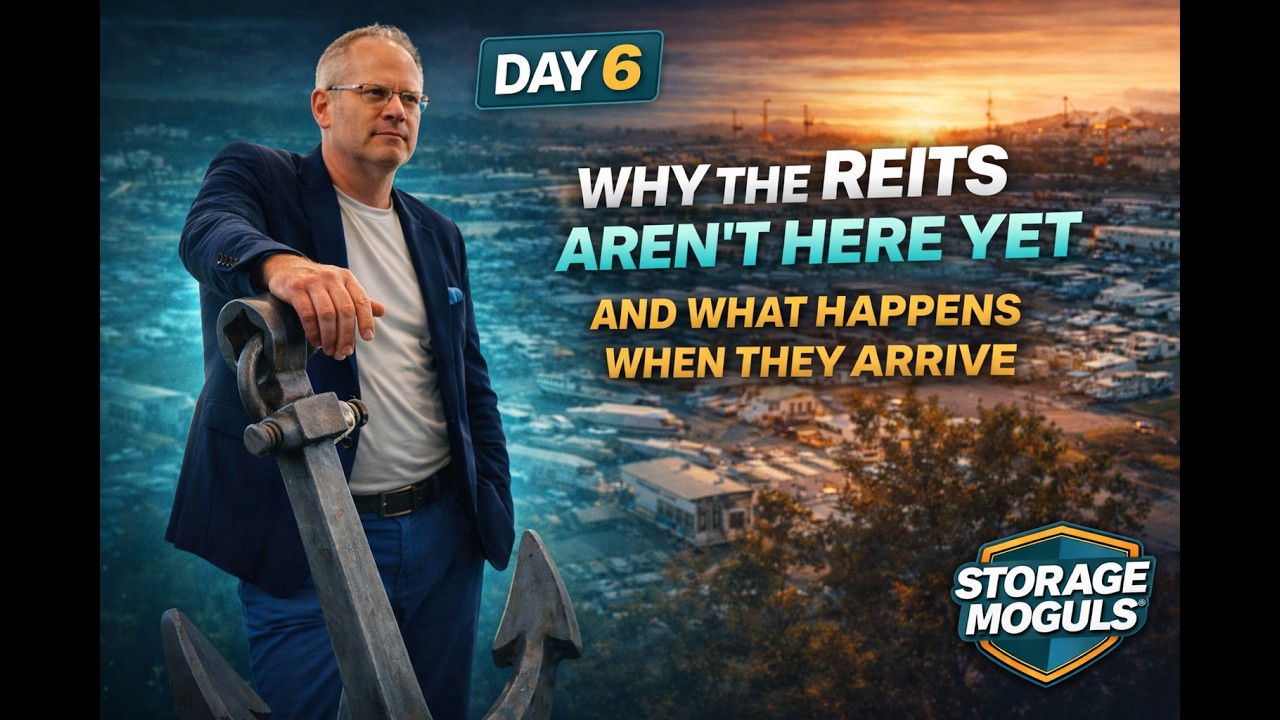
In this Day 6 episode of the Boat & RV 100 series, Joe Downs explains why institutional REIT capital has not yet taken over the boat and RV storage sector and outlines the limited window of opportunity for operators to capture outsized returns before that capital arrives. He draws a parallel to the self‑storage industry’s transformation when REITs entered, describing how early fragmented operators once enjoyed generous cap rates that later compressed as institutional players scaled. Downs identifies three structural barriers that keep REITs out of boat and RV storage: (1) operational complexity (seasonal demand, higher tenant service standards, varied drive‑aisle specs, and differing lien laws), (2) lack of a repeatable, cookie‑cutter facility template, and (3) thin, geographically scattered inventory that makes building a dense portfolio costly and time‑consuming. He notes that while REITs and private‑equity firms are now making selective, premium‑facility acquisitions and testing mixed‑use models, a full‑scale roll‑up is still years away. The “operator advantage window” exists while deals are priced on fundamentals rather than REIT multiples; operators who acquire, stabilize, and run facilities to institutional standards can capture the spread between their purchase price and the future institutional exit price. Downs estimates a 3‑5 year horizon for operators to position themselves before meaningful cap‑rate compression begins, with the window narrowing market‑by‑market, starting in high‑demand coastal and Sunbelt areas. He advises operators to (a) acquire now at operator‑level multiples, (b) document leases, rent rolls, maintenance, and occupancy rigorously, (c) build management systems that can run without the owner, and (d) position assets to be attractive to future institutional buyers. Throughout, he promotes the Storage Moguls community and the AI‑powered Operator Advantage framework on storagemoguls.ai as resources for learning, deal analysis, and networking. The episode concludes with a preview of Day 7, which will dive into the six types of boat and RV facilities, their costs, tenant profiles, and how to identify them on market research.
Chapters
And welcome to day 6 of the Boat and RV 100 series. I'm Joe Downs with the Storage Moguls, and today I'm going to show you why institutional capital hasn't taken over the boat and RV storage space yet, and exactly what that window looks like for operators who move before it does. This is in theory. We've watched that happen. We've watched what happened to the self-storage returns when the REITs arrived, and we're not going to make the same mistake twice here, folks. If you want the full Operator Advantage framework with AI-powered tools, you should head over to storagemoguls.ai. Storagemoguls.ai. It's free to join. You can level up at your own pace. We've got GPT tools there, multimodal learning and content across every storage niche. That's exactly why we built the Storage Moguls, actually. We're a community made up of real people, actual operators just like you. Think of the husband and wife team, the 2 brother-in-laws, the neighbors, the solopreneur who's got the 401 or the W-2 and is looking to get out of the rat race. That's what we built this for. We're a network that actively evaluates real deals. I'm talking deals you can actually buy. They're financeable, digestible. They're not $10 million. They're between $500 grand and $3 million. And the kind of deal that someone with a W-2 and a serious mindset can actually close on. So, and we're about real results. Members in our community are becoming storage moguls now, not someday, now. Again, you start for free, level up at your own pace. But back to today, because understanding the institutional capital picture in this vertical is the context that makes every other episode in this series make sense. All right. To understand why REIT, why the REIT picture in the boat and RV matters, you first need to understand what happened to self-storage when institutional capital arrived. Pre-REIT era, in the pre-REIT era, the self-storage was fragmented in mom-and-pop, and it still, by the way, largely is today at the lower, at the smaller band. And it was highly profitable for operators who understood it. Cap rates were generous. Local knowledge was a real competitive advantage. The asset class rewarded the people who were willing to learn it. Then the REITs arrived. Public Storage, Extra Space, CubeSmart, Life Storage. They began acquiring at scale. Capital flooded in, competition for assets intensified, prices went up, cap rates compressed, which is good if you own them. And the returns that were available to early operators who were looking for deals became harder and harder to replicate. Today, self-storage in most major markets is institutionally dominated. And that's true. We don't play there. It's not impossible to build wealth in self-storage. In fact, it's very possible. You just have to do it at the smaller facility level. But the easy operator advantage window is, is gone. That's why we built Storage Moguls, because we're still teaching people how to find, evaluate, close on, negotiate, close on, and manage awesome deals. The returns available to practitioners who moved early, though, the easy money Are not— it's not available anymore. Now you really got to know what you're doing. You got to be an operator. Again, that's why we build Storage Muggles. That's the story I don't want you to repeat with boat and RV, or at least I don't want you to miss the window. And it's the story you need to understand to appreciate why it matters now. So why haven't the REITs moved into boat and RV space then? Well, 3 reasons, and they're all structural. First, operational complexity. Boat and RV storage requires active management in a way that self-storage doesn't. You've got seasonal demand cycles, tenant relationship standards that are more demanding, drive aisle specifications that vary by tenant mix, amenity maintenance, lien laws that differ from self-storage in most states. REITs are built for scale, repeatable operations across hundreds of facilities, thousands of facilities. This vertical resists that model for now. Second, No cookie-cutter template. Every boat and RV facility, a lot of times very generally different. The site design, tenant mix, space types, local demand patterns vary dramatically from one market to the next. REITs need systems they can replicate at scale, and boat and RV doesn't exactly hand them one. And then third, scale. It's hard to assemble self-storage REITs. could enter a major market and acquire dozens of facilities to build density quickly in self-storage. Boat and RV inventory is thin and geographically scattered, so assembling a portfolio large enough to justify REIT-level overhead takes years and significant capital allocation. This is what self-storage was 20, 25, 30 years ago, so pay attention. The operator advantage window is is the period where practitioners like us who understand an asset class can outcompete passive capital. It exists because institutional investors haven't arrived yet in force, which means deals are priced on fundamentals rather than on REIT acquisition multiples. When the window's open, operators with local knowledge and operating expertise can find deals at reasonable prices, acquire them without competing against institutional capital, and earn returns that reflect the complexity discount of a less understood asset class. When the window closes, institutional buyers arrive, cap rates compress, acquisition prices rise, and the returns that were available to early operators get priced in. The multiple expansion is captured by the sellers and the early movers, not by people entering after the institutionalization takes place. The window is open in boat and RV Right now, not because the asset class is obscure, it isn't, but because the structural barriers to institutional participation haven't yet been solved. When they are solved, and they're working on it, folks, the window will close. The question is whether you're in before or after. Let's be precise about what institutional capital is actually doing in boat and RV right now, because it's not nothing. But it's also not a flood. REITs are making selective acquisitions of large premium facilities in proven markets. They're testing the model. They're not committing to a full-scale roll-up strategy the way they did with self-storage. Premium assets in major coastal markets are getting institutional attention. Everything else is largely untouched. Private equity is circling the wagons too, though. PE funds are exploring mixed-use and institutional-grade boat and RV developments. They see the supply-demand story. They're just trying to figure out how the operational model works. When they solve that problem, the capital's going to follow fast. Existing self-storage REITs are occasionally acquiring mixed-use facilities that have a boat and RV component, and this is the beachhead. Each one of those acquisitions teaches them a little something about how to operate that asset class. The learning curve is shortening and larger operators are beginning to systematize the operational model. When the operations become replicable enough for institutional buyers to underwrite confidently, the REIT thesis becomes viable. We're not there yet, but the pieces are moving in that direction. Here's the honest answer to the question investors always ask: how long does the window stay open? Probably longer than self-storage because the barriers to institutionalization are real. Operational complexity, thin inventory, developing lender familiarity, no dominant national operator. These aren't going away in 2 years, but not forever. Institutional interest is visibly increasing. Private equity is actively exploring the model. Self-storage REITs are watching from next door. The operational playbooks are being written, including this series. My honest read: operators who acquire, stabilize, and build operational expertise over the next 3 to 5 years will be well positioned ahead of meaningful institutional cap rate compression. Operators who wait until another 5 to 7 years may find that window meaningfully narrowed in the markets that matter most. The window doesn't close on a specific date. It narrows market by market, starting with the highest demand coastal and Sunbelt markets, then working inward. You don't need to be first. You need to be before the compression hits your targets— target markets, excuse me. So what does the institutional capture or capital picture mean for how you should be operating right now, even if you have no intention of selling? Build like you're going to sell to a REIT someday, not because you necessarily will, but because the standards that make a facility attractive to institutional capital are the same standards that will make it run well, retain tenants, and generate maximum, maximum NOI. Document everything from day one. Leases, rent rolls, seasonal occupancy history, maintenance records. Clean documentation is the foundation of any institutional exit. Stabilize before you expand. An operator who has demonstrated consistent 90+% occupancy over multiple seasons is far more valuable as an acquirer, as an, as an acquirer and an asset than one who just bought something and is still figuring it out. Build management systems that don't depend on you personally. If the facility can run without you present, it's worth more to everybody, including a future buyer. The institutional buyers are coming to this vertical. Whether they're coming to your facility in your market on your timeline is uncertain, but the operators who are building institutional-grade assets today will have the most options when that moment arrives. Here's the bottom line on the REIT picture. They're not here yet. That's the opportunity. Not because the asset class is, is a secret— is not, they're watching— but because the structural barriers to institutionalization— gosh, that's a word— are still in place, and they won't be solved tonight. The operators who move in the next 3 to 5 years, who acquire assets at operator multiples, stabilize them, and build institutional-grade operations, will eventually sell at institutional multiples. And that's going to be nice, very nice payday. The gap between the price you pay today and the price institutional capital will pay when it arrives is where the wealth gets built in this vertical. 3 things: acquire, operate, position. Acquire now while competition is fragmented and deals are priced on fundamentals. Operate at institutional standards from day one— the documentation, the systems, the performance metrics. And position your facility so that when the institutional buyers do arrive in your market, You have exactly what they want to buy. All right. Tomorrow, day 7, we shift from the macro landscape to the asset level. 6 types of boat and RV facilities. We're going to cover what each one looks like, what it costs to build or buy, what tenant profiles for each one serves. And that's the foundation for evaluating any deal in this vertical. All right. Please like and subscribe so you never miss the window that closes market by market. Starting with the ones you're probably already watching. And finally, share this with somebody who made real money in self-storage early and they're trying to figure out where the next version of that opportunity lives. It's here. They'll thank you later. And remember, the gap between the operators' play today and what institutional capital will pay when it arrives is where generational wealth gets built in this vertical. The window is open. The clock is running. For the full Operator Advantage framework and deal analyzer, if you join soon, join the Storage Moguls community. All you have to do is register. It's free. StorageMoguls.ai. StorageMoguls.ai. Tomorrow we'll get off the macro and onto the asset. As I said, 6 types of boat and RV facilities, what they are, what they cost, what tenants they serve, and how to tell which one you're looking at when you pull up Google Maps on a target market. See you tomorrow.