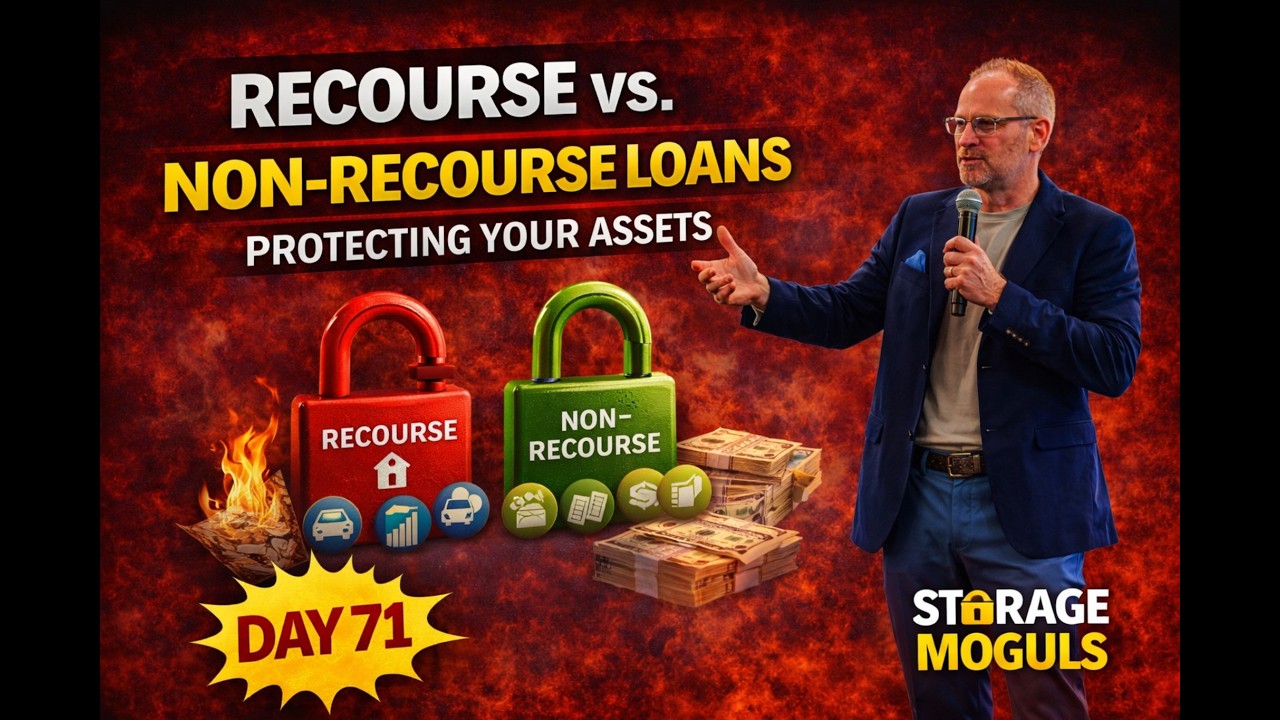
Joe Downs explains recourse loans, where you're personally liable if the deal fails, versus non-recourse loans that protect your personal assets but cost more and require stricter approval. Recourse loans offer lower rates and higher leverage for early deals; non-recourse loans suit large institutional deals and wealth protection, but "bad-boy" carve-outs can strip that protection.
Chapters
And welcome back to the Storage 100 series. Today is day 71 of the series, and I am Joe Downs with the Storage Moguls Mastermind. And today's episode is going to focus on the critical distinction between recourse and non-recourse debt, which fundamentally defines your personal risk exposure in real estate. Understanding this difference is not just about legal terms. It's about protecting your entire financial life because the choice between recourse and non-recourse dictates who bears the ultimate risk if a property fails. Recourse means the lender can pursue your personal assets. Non-recourse limits them only to the collateral. For sophisticated investors, structuring debt correctly is as important as finding the right asset. So we need to analyze the trade-offs because lower rates often come with higher personal liability, and the decision impacts your leverage, your cost of capital, and maybe even how you sleep at night. So let's start by defining Recourse loans and examining exactly what is at stake when you sign that personal guarantee. Because a recourse loan means you are personally liable for the debt, making the lender's claim extend far beyond the property itself to you. If the property sale doesn't cover the loan balance, then the lender can come after your personal wealth. Recourse loans require a personal guarantee, or a PG we say, from the borrower. This PG allows the lender to seize personal assets like your home, savings, and other investments. The lender is essentially betting on your personal balance sheet, not just the property's performance. This structure is common in smaller loans or for less experienced borrowers, and it shifts the downside risk almost entirely onto the borrower. The key takeaway is that your business debt can directly compromise your personal financial security. Now, let's contrast this with the structure that most professional investors prefer: Non-recourse debt. A non-recourse loan— excuse me, non-recourse loans are the gold standard for institutional real estate investors because they insulate your personal assets from the business debt. Here, property is the sole collateral for the loan. If the property fails, the lender's remedy is limited strictly to foreclosing on that asset. Your personal home, savings, other assets are explicitly protected from the lender's claims. This structure is the holy grail for scaling your portfolio without exponentially increasing your personal risk. The lender is relying solely on the property's cash flow and the value to repay the debt. And that's why non-recourse loans are often more expensive and have stricter underwriting criteria. However, even the non-recourse shield has limits, which we must understand before relying on it. Because there's the bad boy carve-outs, which are critical exceptions that instantly nullify the non-recourse protection, exposing the borrower to full personal liability. These provisions are designed to prevent the borrower from acting fraudulently or negligently. These carve-outs are standard in nearly all non-recourse loan documents. They trigger full recourse if the borrower commits fraud, such as lying on loan documents, or misappropriation, like stealing rents or insurance proceeds, That also voids the protection. Gross negligence related to environmental issues is another common trigger. And filing for voluntary bankruptcy to stall the lender is also a clear violation. The non-recourse status is a privilege, not a right. You must operate with integrity to maintain it. Understanding these exceptions is vital, but let's pivot to when a non— or when a recourse loan might actually be better, be the better strategic course. While non-recourse is preferred, there are specific strategic scenarios where opting for a recourse loan is the more rational financial decision. This often involves balancing risk and cost and leverage. Recourse loans are often necessary for your first few deals when you lack a track record. The personal guarantee acts as a substitute for the property's unproven performance history. They typically allow for higher loan-to-value ratios, meaning you can secure more Leverage. Because you assume more risk, the lender rewards you with a lower interest rate. For smaller loans, typically under $2 million, non-recourse options are often unavailable or impractical. The decision's a trade-off: lower cost and higher leverage versus increased personal risk. So let's look at scenarios where the higher cost of a non-recourse debt is justified. Non-recourse loans are primarily for larger institutional-grade transactions. The loan size is typically the first gate, usually requiring a minimum of $2 million to $5 million plus. At which point they're often sourced from CMBS or life companies. The most compelling reason for non-recourse is protecting personal wealth. High net worth individuals use this structure to protect their assets from a single project's failure. It's also essential when syndicating a larger deal with passive investors. Limited partners will simply not sign a personal guarantee, making non-recourse a requirement for raising outside capital. This protection, however, is not free. Comes with specific financial requirements we need to understand. Because while non-recourse lending offers protection, you pay for that safety net through stricter underwriting standards. The lender's taking on more risk, so they demand a stronger financial profile from you. Expect the lender to require your net worth to be greater than the loan amount itself. They also want to see significant liquidity, often demanding 9 to 12 months of post-closing cash reserves. This is a crucial buffer for debt service if the property underperforms initially. You'll also face a lower loan-to-value ratio, typically capped at 65 to 70%. This means you bring a larger down payment to the closing table. And then finally, there's often a slight rate premium compared to a full recourse bank loan. So how do these 2 approaches, recourse and non-recourse, affect your mindset as a sponsor? Well, the choice between recourse and non-recourse is about psychology. As it is about math. Recourse is the burn-the-ships mentality. Failure is simply not an option because your personal assets are on the line. This forces extreme focus, discipline, and a true all-in commitment to the project's success. Whereas non-recourse, conversely, is the safety net. It protects your downside and provides peace of mind for your family and other ventures. This structure allows you to take calculated risks on larger deals without betting the entire farm. Understanding this psychological difference is key to choosing the right structure for your current stage. No matter which loan you choose, you should always underwrite, buy, and manage like you're in a recourse loan. Okay, let's synthesize these into a final thought and how you should approach your first few deals, because the takeaway is simple. Key takeaways: don't fear recourse on your first few deals. It's a powerful closing mechanism. For your initial investments, accept the risk and use the personal guarantee as fuel. It forces you to underwrite conservatively and manage the asset aggressively to ensure success. This is where you build your track record and gain invaluable experience. Once you've established that track record and build up your net worth, you can graduate to non-recourse. At that point, you can upgrade to the asset protection structure to insulate your accumulated wealth. Start here, accept the risks, then graduate to Question for you. Did this discussion clarify the trade-offs between personal risk and asset protection? Leave a comment. Let us know. Also, if you're currently raising capital or will be in the future, share this episode with your potential investors to show your expertise in loan structures. All right. Next up, day 72, prepayment penalties, yield maintenance versus step-down. Please like this video if you found the distinction between recourse and non-recourse helpful. Subscribe so you don't miss the next 29+ days of the Storage 100 series. And please share this episode with someone who's afraid of signing a personal guarantee. They'll thank you later.