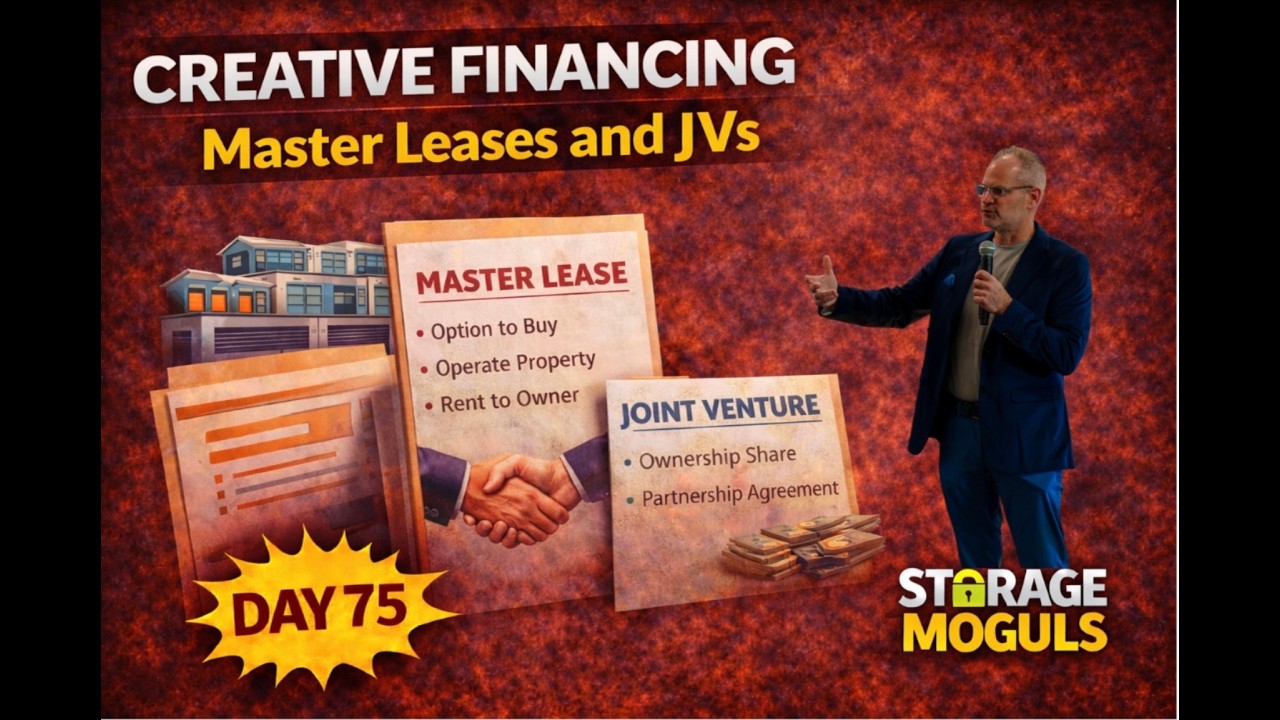
In this solo episode of the Storage 100 series, Joe Downs walks viewers through two advanced, non‑bank financing strategies for acquiring self‑storage facilities: Master Lease Options (MLOs) and Joint Ventures (JVs). He first explains why creative financing is needed—banks often reject deals with low occupancy, deferred maintenance, high interest rates, or insufficient down‑payment capital. He then details the two‑part MLO structure (a fixed‑rate lease plus a purchase option), highlighting its "try‑before‑you‑buy" advantage, cash‑flow upside, and an escape hatch if the property proves problematic. Next, Downs outlines JV partnerships, describing the operator’s sweat‑equity role versus the capital partner’s financing role, and walks through three common profit‑split models: a simple 50/50 split, a preferred‑return structure, and a waterfall tiered split tied to IRR targets. He warns of key risks—seller default in MLOs and partner disputes or legal complexities in JVs—emphasizing the need for competent legal counsel and custom agreements. Throughout, he promotes the free AI‑powered Storage Moguls community for deeper learning and previews a live recap with Ann Mino of Live Oak Bank, the nation’s largest SBA lender for self‑storage. The episode ends with a call to action to like, subscribe, and share the video with anyone currently seeking financing.
Chapters
And welcome back to day 75 of the Storage 100 series. I'm Joe Downs, and today's episode is one of my favorites because we're talking about creative financing through master leases and joint ventures. This is where deals that look dead come back to life. And speaking of next-level thinking, if you haven't joined the Storage Moguls community yet, head to storagemoguls.ai. That's storagemoguls.ai. Not .com, .ai. Why? Because it's free and it's AI-powered with GPT tools and multimodal learning. It's designed to help you learn and do across all the storage verticals. Start for free, level up at your own pace. But today we're diving into how to buy self-storage without ever talking to a bank. We're talking about creative financing here, and this is the advanced stuff. So we're going to focus on 2 powerful strategies. The master lease option, which we— I might refer to as MLO, and joint ventures or JVs. These methods allow you to control and profit from a property long before you ever take on traditional debt. So the goal is to show you how to acquire assets even when you don't have the 30% down payment or the property doesn't qualify for a loan yet. It's about finding ways to structure a deal that works for both you and the seller. So let's start by asking the fundamental question. Why do we even need to go creative in the first place? Because sure, creative financing is a powerful tool, but why go creative? Why not just use a bank? The reality is that the bank says no a lot. They say no when a property has low occupancy or needs significant deferred maintenance because it doesn't meet their lending criteria. Also, sometimes traditional debt is simply too expensive right now. High interest rates can kill a deal's cash flow, making it impossible to pencil out a profit. And finally, You maybe you have the skills and the deal, but you lack the 30% cash required for a down payment. Now, a lot of these situations sound like scenarios where I just go to the SBA, and that's true, you likely would. But what if you can't? Creative financing solves all these problems by bypassing the bank entirely. It's a way to get control of an asset without massive upfront capital. So let's look at our first strategy here, which is the MLO or the master lease option. Master lease option. Or MLO, as I just said, is a fantastic strategy because it gives you control without ownership. It's a 2-part structure. First, you have the lease. You lease the entire facility from the owner for a fixed monthly payment, and you operate it as if you own it. Second, you have the option. This secures your exclusive right to purchase the property at a set price for a specific period, usually 3 to 5 years. The upside's huge. You keep all the profit above that fixed lease payment. And you force appreciation before you ever have to buy the property. It's the ultimate way to de-risk a deal and prove the concept. So let's break down the mechanics of how this actually works on a day-to-day basis. We, we know the MLO is a lease plus an option. So how does this play out in practice? First, you pay a fixed monthly lease payment to the owner, just like rent. Second, you immediately take over the management. You raise rent, you cut costs, and you implement your systems to increase the net operating income. Third, you keep the spread, so you get to keep 100% of the cash flow that you generate above that fixed lease payment. So you're essentially getting paid to fix the property, to improve the property. Finally, once you've stabilized the property and forced the appreciation, you exercise your option to buy at the preset price, often using new equity or then a traditional bank loan that the property now qualifies for. So this leads us to the biggest benefit of the MLO. The greatest benefit of this structure is the try before you buy feature. This is your chance to verify reality. You don't have to rely on the seller's profit and loss statements. You get to run the business yourself, verify the actual income and expenses in real time. This also allows you to fix the property without the pressure of debt. You can implement your management software and rate increases without crushing— or without the crushing weight of a mortgage payment looming over you. And here's the best part. You have an escape hatch. If you find a major problem like a sinkhole or a market crash, you walk away. You only lost your option money at that point, not your credit or a massive down payment. All right. Now that we've covered the MLO, let's look at a second creative strategy, the joint venture or JV. These are the second major strategy for creative financing, and they're all about leveraging someone else's balance sheet and capital. This strategy is a true partnership where you, the operator, bring the sweat equity, find the deal-making skill, while your partner then brings the financial strength. Your role is to find the off-market opportunity, manage the renovation or, you know, the value-add improvements, and execute the business plan to drive value. Their role is to provide the down payment, sign on the loan, and fund any necessary capital improvements, essentially acting as the passive capital partner. This structure allows you to control and profit from assets you couldn't afford to buy on your own, making it a powerful tool for scaling quickly. But before you jump into a JV, you need to understand how the profits are split, which brings us to the typical structures. So once you decide on a JV, a joint venture, you have to choose the right structure to align incentives. And there are going to be 3 main ones that'll help you split the— or show you a way to split the profits. So the 50/50 split is the simplest model. You do the work, they bring the money, you split everything right down the middle. Then you had the preferred return model, which is common with passive investors who want a guaranteed return before you take any profit. So for example, they might take the first 8% of the cash flow before you see a dime. And then finally, there's the waterfall structure, is the most complex, where the profit splits change as the investment hits certain performance targets. So like Might start as a 70/30 split till a 15% IRR, internal rate of return, is hit and might shift to a 50/50. Remember the golden rule: everything in a JV is negotiable, but the structure you choose must fairly compensate both the work and the capital. Understanding these structures is key, but we also need to be clear-eyed about the risks that come with any creative financing strategy, because this creative financing opens doors, but it also introduces unique risks you must manage carefully. In the master lease option, the biggest risk is seller default. If the original owner stops paying the underlying mortgage, the bank can foreclose and wipe out your entire interest. With joint ventures, the risk shifts to the actual partner disputes. A disagreement on when to sell or who funds a capital call can freeze the asset and destroy the partnership's value. Because these deals are custom-made, you can't rely on standard forms, which means the legal agreements are a little complex. And require competent legal counsel for sure. You must budget for higher legal fees to accommodate this because you're going to be drafting custom master lease options or JV operating— joint venture JV operating agreements correctly. Bottom line is the creative deals require creative and competent legal counsel to mitigate these unique risks. But don't let the risks scare you away from the opportunity. This is the core message I want you to take from our discussion on creative financing today. Creativity solves problems that cash cannot. When the bank says no, when you don't have the capital, that doesn't mean the deal is dead. You have to shift your mindset from being a buyer to being more of a deal architect. If it's a deal, there's a way. Whether it's a master lease option or a joint venture using You're using structure and strategy in this case to acquire control and create value. Never let no bank mean no deal. Always look for the creative solution. All right. Hope you enjoy this today. So please like this video if you found the content valuable. The likes are free for you and I don't really get to spend them, but we appreciate them. Also, definitely subscribe to the channel so you don't miss the next session. Because next up tomorrow night, day 76, which is a live recap of the section that we just concluded today. So we're going to review all the key concepts on section 5, which is financing deals. Plus, and most importantly, I will have with me Ann Mino from Live Oak Bank. Live Oak is the nation's largest SBA lender for self-storage, the largest. So if you've been following the series and you, you are at the point where you want to really get a handle on financing, you don't want to miss tomorrow night. Anne Mino is one of the best in the business. It's your treat and mine to have her tomorrow night. So we will see you then, 8:00. All right. And since you've been following the series, you already know that financing is the biggest hurdle for most people. So I want to ask— I want you to ask yourself something. Do you know anyone right now Who's in the middle of trying to finance a deal? If you do, share this video with them. They will definitely thank you later because master leases and JVs aren't loopholes. They are legitimate structures that sophisticated operators use every day. And inside Storage Moguls community, we'll break these structures down with real deal examples. So join for free at storage moguls dot ai, storage moguls dot ai, because creative financing is how you do deals when the bank says no. Thanks, and we'll see you tomorrow night.