This content was created by Joe Downs. This content was uploaded by Joe Downs. This is a YouTube video titled "Day 89: Why Customer Service in Self Storage Is Different — And How to Get It Right" (created 2026-03-02) featuring Joe Downs of Storage Moguls delivering a solo presentation on customer service for self-storage operators. Downs explains why self-storage is a low-touch, transactional business and advocates a "friendly but firm" approach: enforce policies consistently, keep facilities clean and secure, be responsive, enable online payments/autopay, use clear and proactive communication, and de-escalate difficult tenant interactions by citing the lease. He contrasts good and bad service, gives practical tips (automated reminders, advance notices, maintenance communication), and promotes the Storage Moguls community (storagemoguls.ai) and a Deal Analyzer GPT giveaway; he also previews an upcoming live recap (Day 90) with guests Kristen and Rod Blunk.
Chapters
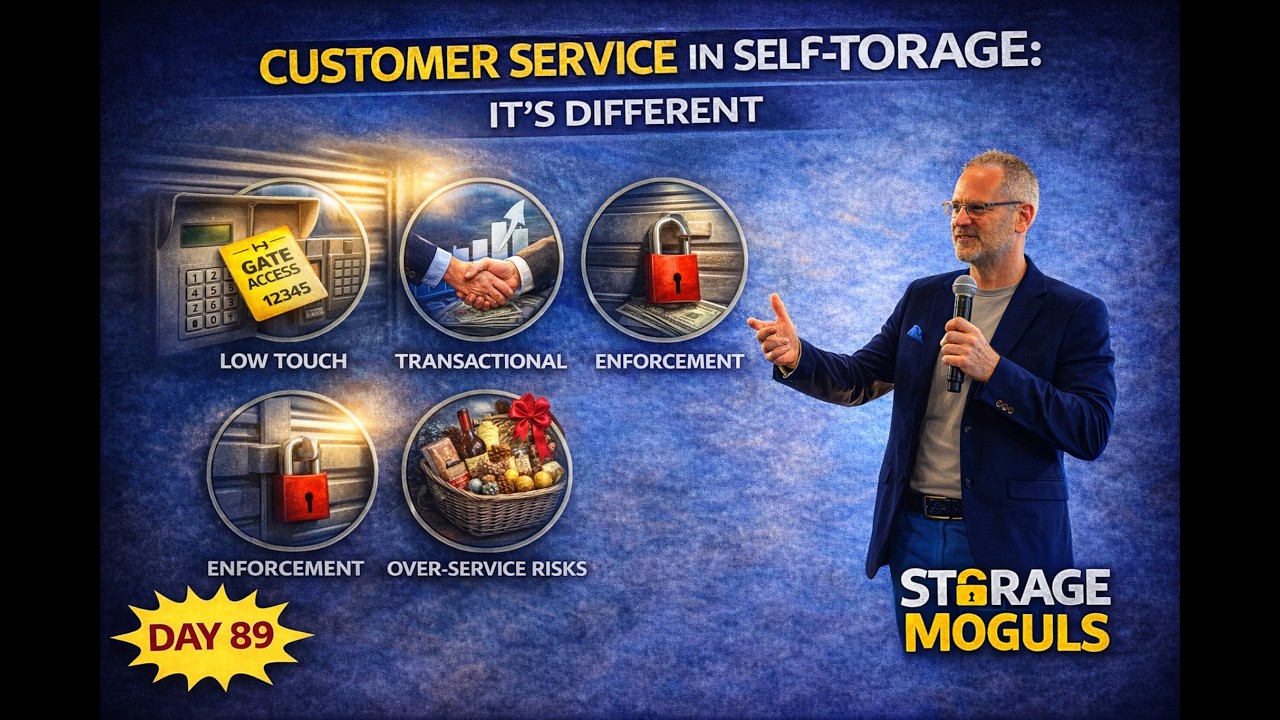
And welcome to day 89 of the Storage 100 series. I'm Joe Downs with the Storage Moguls, and today I want to talk about customer service. Now, before you go tuning out, you need to realize that customer service in storage is unlike any other real estate asset class, or maybe other business, and most operators get it completely wrong. So today I'm going to show you why, and at the end, if you're glad you stuck around, I'll also remind you that for more insights from operators who figure this out, You can join us and become a Storage Mogul. Join us in our community for free at storagemoguls.ai. storagemoguls.ai. We are an AI-powered multimodal learning platform across every storage vertical, and you can start for free and advance at your own pace. So customer service and self-storage, folks, it's completely different from any other business you've run. This isn't just about being nice. It's about running a profitable operation, and you'll need to know what good service means in our industry because it's different. It's a unique challenge that requires a very specific mindset. And today we're going to break down the friendly but firm philosophy. So let's start by understanding why storage is fundamentally different. The customer service model you used in retail or restaurants simply doesn't apply here. Storage is a low-touch business, and that changes everything. Your tenants are paying for space and security, not a relationship. Most of your operations are automated, so direct interaction is actually rare. This relationship is strictly transactional. You provide the space, they pay the rent. That's the contract. And here's the critical part. You must enforce your policies. Being too nice means you lose money on late fees and collections. Overservicing tenants actually creates entitlement, not loyalty. We need a clear, consistent approach, which brings us to our golden rule. If you take one thing away from today, Let it be this: friendly but firm. Being friendly means you are professional, courteous, and helpful when you do interact. You answer questions clearly and with a positive attitude. But being firm means you enforce every policy consistently, every single time. Don't make exceptions for anyone. Tenants actually respect consistency more than they appreciate a one-time favor. This approach protects your bottom line and sets clear expectations. So what does this actually look like in practice? Well, good customer service and storage starts with the physical asset itself. The best service you can provide is a clean, well-lit, and secure facility. That's the first impression in the core product. Responsiveness is key. Answer the phone or return calls promptly. Don't leave people hanging. Make payment easy with online options. And autopay. Remove friction from the transaction. And finally, good service means clear communication. No surprises on fees or policies. When problems do arise, like a gate issue, solve them quickly and efficiently. All right, now let's look at the flip side of this coin. Bad customer service in our industry is usually a failure of consistency or basic professionalism. Unreachable management is a killer. Ghosting tenants when they have legitimate issues— unacceptable. A dirty or unsafe facility is a direct failure of your core service promise. Think broken lights or overflowing trash or unplowed snow. Surprise fees— another huge mistake. Everything must be clear at lease signing. And of course, a rude or dismissive attitude will guarantee bad reviews. Bad service leads directly to higher vacancy and lower revenue. We need to avoid these pitfalls at all costs. Trust me, I've dealt with them. I've dealt with bad managers. They crush you. Now, let's talk about the hardest part of the friendly but firm philosophy, knowing when to say no. Saying no is not bad customer service. It's setting boundaries that protect your business and your other tenants. You have to be firm on the non-negotiables like living in units or storing hazardous materials. It's a no-go. These are legal and safety liabilities you cannot absorb. Be friendly when you deliver the no, but don't waver on the policy. Waiving late fees repeatedly is another trap. You're training your tenants that the due date is flexible. That destroys your cash flow predictability. The lease is your shield. Use it to keep your business running smoothly. But what happens when a tenant pushes back hard? So you've delivered the firm no, and now you have a difficult tenant on your hands. The key here is to de-escalate the situation without compromising your position. First, you stay calm. Your goal is to lower the emotional temperature in the room, not match their energy. Listen to them vent. Sometimes they just want to feel heard, and letting them get it all out is half the battle. Once they finish, stick strictly to the facts. Reference the lease agreement directly. When you say, the policy you signed states, you remove yourself from the argument, put the focus back on the agreed-upon rules. Finally, offer a solution if you can, or a firm final answer if you can't. End the conversation professionally and move on. We can prevent many of these confrontations entirely by being better communicators. Preventing problems is always cheaper than fixing them, and that's the power of proactive communication. Don't wait for a tenant to call you angry. Tell them what's happening before they even notice. Take rate increases, for example. The law might require you to give 30 days' notice. Send it in 60 days' notice. This gives them time to process the change and budget for it. Drastically reducing your pushback calls. Use automated reminders for payments. An automated simple text 3 days before the due date and on the due date cuts down on late payments better than any threat of a late fee ever will. And always communicate maintenance issues immediately. Silence breeds frustration. Updates, even if it's bad news, that helps build trust. Remember this, prevention is cheaper than damage control. This is how you run a professional operation. All right. Covered a lot of ground in customer service today, whether you wanted to or not. And I leave— and I want to leave you with this final thought. You're running a business, not a charity. This is the core principle that guides all of your decisions. Being friendly doesn't mean being a pushover. It means being fair and consistent with every single person. Consistency is the highest form of customer service because it creates a predictable professional environment. Protect your asset, protect your revenue, and most importantly, protect your sanity. That's the Storage Mogul way. All right, folks, believe it or not, that wraps up another section. Tomorrow night we are live again for day 90, where we'll be doing a full recap of section 6, which is transition and management. Make sure you are ready for that deep dive tomorrow night because I'm going to have 2 awesome guests with me, Kristen and Rod Blunk, who are not only owners and operators, but they help folks transition Facilities and set them up with management. You don't want to miss this husband and wife team. They are a hoot and full of information. Bring your questions. It's going to be a lot of fun. All right. If you found this session valuable, please support the channel with a like and a subscribe so you don't— so you get notified and don't miss tomorrow night when we go live with Rod and Kristen. And remember, folks, your tenants are often going through life transitions. Moves, divorces, deaths, downsizing. A little empathy goes a long way, and it shows up in your reviews, your referrals, and your retention. Also, as promised, we have a community you can join for free where we'll talk about all of these topics and so many more. So grab a seat now. And if I forgot to mention earlier, the first 500 storage investors to register will get a free Deal Analyzer GPT that we built and use ourselves. So register now at storagemuggles.ai, storagemuggles.ai. I will see you tomorrow for the recap.