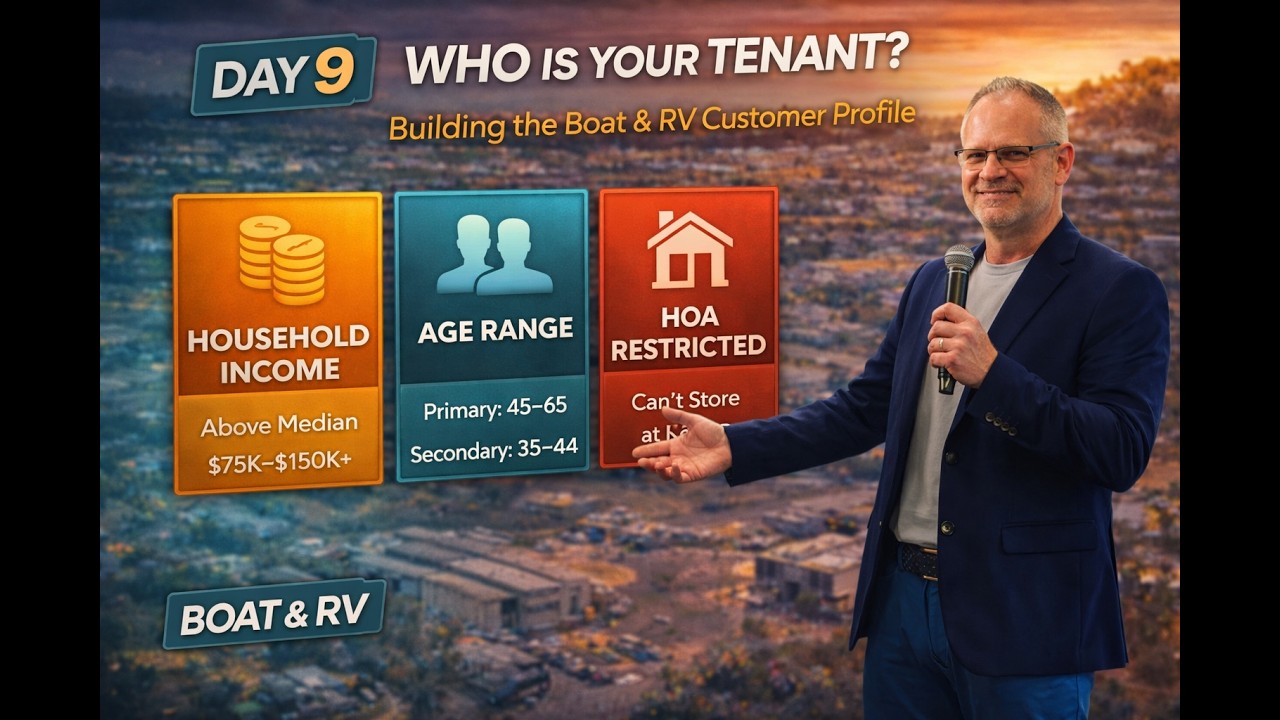
In this instructional video, Joe Downs of Storage Moguls explains why a detailed tenant profile is the cornerstone of a successful boat and RV storage business. He outlines the demographic and income characteristics of typical boat and RV owners (primarily ages 35‑65 with household incomes $75k‑$150k+, often much higher for premium assets) and describes their behavior patterns, such as frequent weekend visits, need for 24‑hour gate access, and high emotional investment in their vehicles. Downs emphasizes that these tenants are not price‑sensitive; they value reliable access, robust security, ease of use, and responsive, one‑call resolution. Retention, he argues, is the highest‑ROI strategy because satisfied tenants stay for years, have high switching costs, and generate strong word‑of‑mouth referrals, while churn is driven by unresolved problems, security incidents, or poor management. He presents a simple retention formula (fast problem resolution, continuous facility improvement, proactive communication, relationship building) and highlights the power of referral programs. The video also provides a practical five‑step process for building a market‑specific tenant profile: pulling county registration data, interviewing dealers, conducting mystery visits, analyzing online reviews, and checking HOA restrictions. Finally, Downs connects the tenant profile to operational decisions—facility design, amenity investment, pricing, service standards—and promotes the upcoming storagemoguls.ai community and the next episode on market selection and the “buy box.”
Chapters
All right, welcome to day 9 of the Boat and RV 100 Series. I'm Joe Downs with Storage Moguls, and today we're building out a complete customer profile, the foundation for everything that comes next in this business— in the boat and RV business anyway. This is in theory, folks. Knowing your tenant inside and out will inform your marketing, your facility design, your pricing, and your operations. And if you've been looking for a place, a one-stop shop if you will, where you can consume information like this Ask questions, engage with operators who might be husband and wife teams or 2 partners looking for a better way, or even a single person with a high-income W-2. Maybe they're a doctor, maybe they're just looking to get into real estate. But either way, they want to actually learn the way around it and consume it and understand what they're investing in, not just invest in it passively. Then you should join storagemoguls.ai. If that— if you're any one of those people, you should join storagemoguls.ai. When it launches in a few short weeks, it won't be a hollow network or an empty void of hope. We will already have hundreds of members and students in the community as soon as it launches because they're already— they exist already on a different platform. This is an upgrade for them and one big welcome to you. So storagemoguls.ai will give you the opportunity to learn, Self-storage, boat and RV storage, all the storage niches, and learn it your way through multimodal adult learning theory. That's exactly why we built Storage Moguls, to enhance a community made up of real people, actual operators, or people becoming operators just like you. We're a network that actively evaluates real deals, and I'm talking about acquisitions that are not $10 million, $500 grand to $2 million. They're, they're financeable. We'll show you how to do that. Find them, finance them, evaluate them, then finance them, negotiate them, close them, manage them. Everything is digestible, consumable. It's, it's real. It's the kinds of deals where someone with a W-2 and a serious mindset can actually close on. We're about real results in our community. People are becoming storage moguls, not someday, now. They're just doing it at their own pace though. And again, you can start for free and level up when you're ready. When either your time is ready or when you have the time, I mean, or when you, you know, a deal, you see a deal, you come across a deal and you have the capital and you want to invest. That's what we're there for. All right. But back to today's focus, understanding your ideal tenant in boat and RV is critical to this business. So let's dive into who these customers are and what they actually need. So let's start with who actually owns boats and RVs in this country, because the profile is not what most operators assume going in. Household income for boat and RV ownership skews significantly higher than the national median. Typical tenant is earning low-end $75,000 up to $150,000. Actually, probably a lot more in a lot of cases. At the Class A end of the market, tenants storing high-end boats and Class A motorhomes, you're often looking at households well into the 6 figures, well into them. These are not price-sensitive tenants. They have money and they spend it on things they care about. In terms of age, primary ownership bracket is 45 to 65, but the strong secondary bracket is that 35 to 44. So really 35 to 65. The COVID cohort brought younger first-time owners in, and the generational transfer is moving assets into the hands of those 30 to 45-year-olds as well. This tenant base is not aging out of the market. It's getting younger, actually. Homeownership is very high. But increasingly prohibited from home storage by HOA rules and municipal rules. So this is the tenant being pushed into commercial storage by regulation, which we covered in day 5. And the asset value picture, a tenant paying $150 a month to store a $200,000 boat is paying less than 1% of its asset value annually, 0.075%. It's less than, it's less than 1%. I mean, it's, it's nothing. It's a rounding error, right? Price is almost never the primary decision driver for this tenant unless you're at the lower end range and the gravel lot and the used vehicles. Yeah, okay, they might be price sensitive, but for most of the industry, it's not really price. It's service, security, and access. Demographics tell you who they are too. Behavior tells you how they, how to operate for them. So how often do they visit? Active season means weekly or more for many tenants, you know, maybe every weekend or, you know, once, twice a month. They're picking a boat on maybe Saturday morning, dropping it back off Sunday evening. Gate access outside business hours here is not a luxury feature. It's the basic operating requirement for this tenant. Their emotional investment is high. When something goes wrong at your facility, Let's say the gate won't open, a neighboring vehicle has leaked something, or there's some sort of security concern. It's not an inconvenience for them. It's a disruption to something they planned around and care about. You could ruin someone's weekend if you aren't responsive. That emotional weight is why the peak-end rule we covered in day 3 matters so much here. Switching behavior is— it depends on you. Low churn, once established, Right? Moving a 40-foot RV is not a casual decision. So tenants who are satisfied have a routine stay for years. The ones who leave, again, it comes back to you, almost always do because of a specific problem that wasn't resolved. Referral behavior is very high here. These tenants are part of a tight recreational community, whether it's marinas, campgrounds, RV parks, boat launch lines. A good experience generates referrals, Without making, without much of a marketing spend, right? Which is fantastic. A bad experience though spreads through the same channels, but way faster and way further. Response to rate increases, more tolerant than self-storage tenants, particularly when the increase is framed around a facility improvement. So, you know, they're not gonna, they're like, well, they're not price sensitive. So $5 here, $10 there, not a huge deal. So the math is simple. I mean, Think about it. A tenant protecting a $200,000 asset isn't going to leave over a $10 monthly rate increase for paved aisles, right? They might think that's a bargain. Here's where the tenant is actually buying when they sign a lease for it. Here's what they're buying when they sign a lease with you. It's not the space so much, it's the experience of having their vehicle accessible, safe, and ready when they need it. They need reliable access first. The gate has got to work every time. If it doesn't, You got to fix it in one call. Saturday morning at 6 a.m. is not an acceptable time to find out your code expired. Every operational decision around gate technology flows from this, this concept. Safety for a valuable— for a valuable asset. Got to be there. Fencing, lighting, cameras, a gate that actually deters unauthorized entry, not just slows it down. These tenants know what their vehicles are worth and they expect the facility to take that security seriously. Ease of use is important. Wide aisles, smooth surfaces, good lighting. Tenant showing up before dawn with a 35-foot RV does not want to navigate a tight lot in the dark. The facility should work without drama. Responsive management is important. One-call resolution. This is the operational standard that separates facilities with great reviews from facilities with vacancy problems. Whoever answers the phone has the tools and authority to solve the most common issues. They have to. Not just a log, you know, not, yeah, not just log a complaint. They got to be able to solve it. Amenities that match their use is important. So air, a rinse station, vacuums, propane where applicable. These are functional tools this tenant uses as part of their recreational routine. They're not asking for a resort. They're asking for the basics that support how they plan to use the facility. Retention is the revenue strategy in this vertical. We covered the space economics in the demand episodes. Fewer spaces means each vacancy is proportionately more expensive. So that math makes retention the highest ROI activity available to a boat and RV operator. So why they stay: established routine, high switching costs, relationship with management, a facility that keeps improving. That's why they're going to stay. When all 4 are working, you don't lose tenants. They stay until they sell the vehicle or they leave the area. Why they leave though, almost always one of 5 things: an unresolved problem, a better option opening nearby, maybe a rate increase with no visible improvement to justify it, a security event that shook their confidence, or a management team that doesn't care, doesn't respond. Notice that price was not on the leave list, and that's intentional. In most cases, the tenant is not shopping one month or not shopping a monthly rate. They're deciding based on experience, quality, and trust and convenience. The operator who tries to retain tenants by undercutting on price is solving the wrong problem. The retention formula: resolve problems fast, keep improving the facility, communicate proactively, and build the relationship. That's your retention formula. That's it. It's not complicated, but it requires consistent Execution. And here's one of the most underused advantages in this vertical. Boat and RV tenants are part of tight recreational communities that talk constantly. They're at the marina on Saturday, maybe they're at the campground on holidays, they're in line at boat ramps every summer weekend, they're in Facebook groups and forums for their specific boat or RV brand. And in all those settings, they talk about their storage facility. Tenant whose gate problem got solved in one call tells people at the marina they have a good facility. Someone in that conversation might already be looking for storage or have had a bad experience somewhere else. A tenant who left because of a security incident tells more people and tells it with more intensity. The negative referral spreads faster and further than the positive one, which is why resolving problems fast isn't just about retention. It's about the downstream marketing effect of every interaction. The practical implication? A simple referral program is one of the highest ROI marketing tools available to a boat and RV operator. One month free for a tenant who refers someone who signs a lease? That's smart. The acquisition cost is a fraction of what any paid marketing would cost, and the referred tenant arrives prequalified by someone who already trusts your facility. The national tenant profile we built today is a starting point. But the market's going to be your answer. So before you evaluate any specific deal, spend half a day building the tenant profile for that specific market. It shapes every decision downstream. Pull county registration data. This tells you the total addressable market, what types of vehicles dominate— boats versus RVs versus jet skis— and whether ownership has been growing or not. Growing registration numbers in a supply-constrained market is the cleanest demand signal available. Talk to dealers. 2 or 3 conversations with boat and RV dealers in your market will tell you more about tenant needs and preferences than any desk research you can do. They hear the complaints. They know what tenants are looking for and can't find. Visit existing facilities as a prospective tenant. Call them, ask about availability, show up and walk the lot. Read it through the tenant's eyes. What's the experience? What are the gaps? What would make you choose this facility or not? Read every review. Google reviews of every boat and RV facility in your target market is free voice of customer research. What do satisfied tenants praise? What do departing tenants complain about? That's your product spec. Do it before you visit the site. Check the HOA rules. As we covered in day 5, HOA density determines your occupancy floor. Know the percentage of the addressable market that has no choice but to use commercial storage. It's 5 steps, 4 or 5 hours of work. That's your market tenant profile. Here's the frame I want you to leave this episode with. Every facility decision flows from the tenant profile. This isn't a soft point. It's a direct line from understanding who you're serving to every hard decision you make. What class to build? The tenant profiles tell you. What amenities to invest in first? The tenant tells you. Air and rents before anything else because that's what they use. What rents can you charge and how far can you push them? The income and asset value profile tells you. Further than most operators realize. What does your service standard look like? The tenant's behavior tells you. One-call resolution, extended access hours, proactive communication. What's your retention strategy? The tenant switching cost tells you keep the relationship and keep improving the facility because they'll stay if you do. Tomorrow, day 10, we take the tenant profile and connect it to market selection. Your buy box, what to look for in a boat and RV market before you spend a dollar. The tenant profile you built today is the foundation for evaluating whether any specific market is worth entering. All right. Next up, day 10. As I just said, we'll dive into your buy box, what to look for in boat and RV market before spending a dollar. Please like this video if you've been thinking about boat and RV storage without a clear picture of exactly who you're building or buying for, and subscribe so you never make a facility investment without understanding the tenant profile that has to justify it. And finally, share this with someone who owns or operates a boat and RV facility and hasn't thought about their tenant profile as a strategic input. They'll definitely thank you later. And remember, the tenant is the business. Every decision you make as a boat and RV operator either matches what they need or doesn't. The operators who build for the actual tenant consistently outperform the ones who build for the asset. Know your tenant first. And remember, in a few short weeks, all of this and much, much more will be available 24/7 for you at storagemoguls.ai. Take 1 minute now and join the waitlist so you don't miss out. Tomorrow, we take what we built about the tenant and the market and turn it into a decision framework, your buy box. What signals tell you a market is worth entering and what tells you to move on? See you tomorrow.