
Nine Months to Evict One Tenant Who Paid Zero Rent
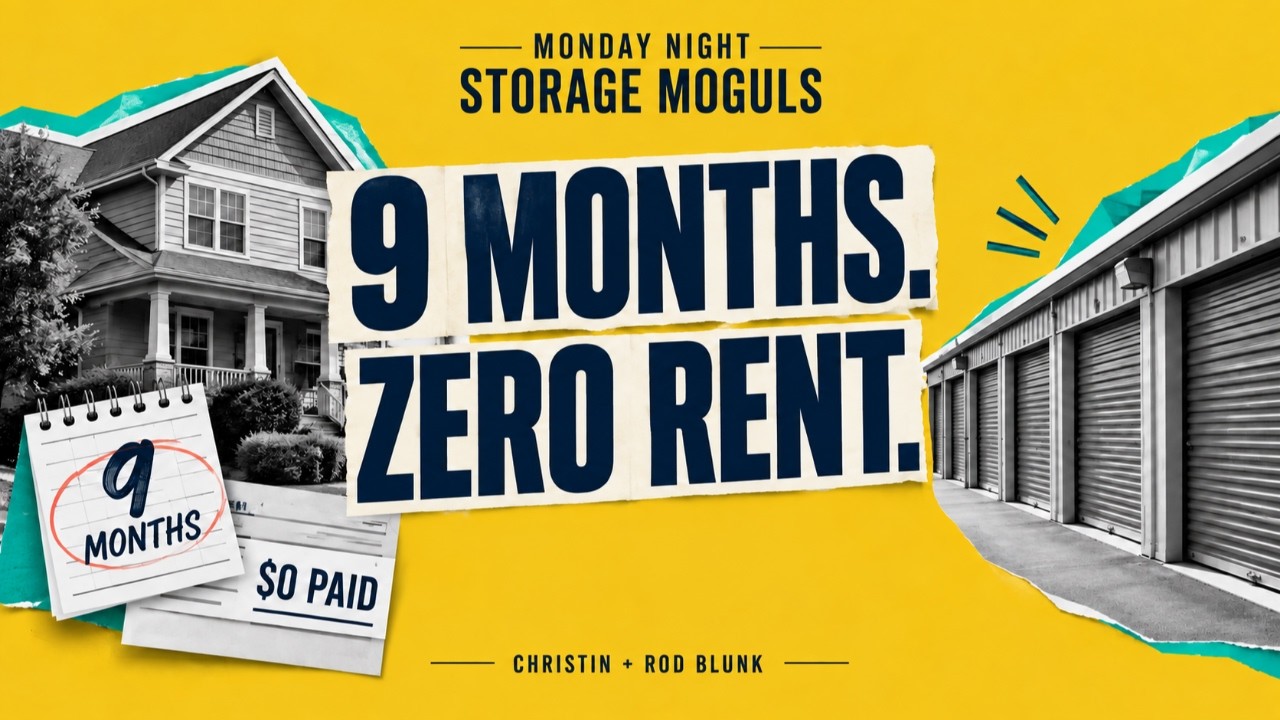
In this episode of the Monday Night Storage Mogul Show, host Kristen Blunk, filling in for Joe, is joined by her husband Rod Blunk. They recount a nine‑month, zero‑rent eviction they endured in residential real estate, describing how the tenant exploited legal loopholes, caused $30,000 in damage, and forced them to spend over a year without cash flow. The ordeal highlighted the fragility of a business that required their constant presence. Seeking a model that could generate income without daily hands‑on involvement, they pivoted to self‑storage. They explain why storage offers faster, landlord‑friendly lien/auction processes (45‑60 days), lower time commitment (10‑15 hours per month versus 60+ hours in residential), and easier financing (20‑30% down, SBA programs, strong bank appetite). They walk through two of their first storage deals: Radcliffe Mini Storage (bought for $320k, $64k down, now worth ~$750k, $50k NOI, $430k equity) and T&T Mini Storage (bought with ~$107k down, now worth $1.3‑1.4M, $90‑95k NOI, $1M+ equity). They discuss operational choices (self‑manage vs. third‑party), the importance of “driving for dollars” to locate underperforming facilities, and the mindset shift from hustling to designing a lifestyle with optional income. The episode ends with a call for listeners to share their own horror stories and to join their community at storagemobils.ai.
Chapters
9 months. That's how long it took to remove one tenant from one of our rental properties. It was a clean case, everything done right on paper. 9 months, and the tenant paid zero rent the entire time. Tonight, we're going to show you why that's not a landlord problem; it's a rules problem. And the rules changed underneath residential real estate, and no one sent out a memo. And if they did, I can assure you that we certainly did not receive it. And we're going to show you the exact numbers on the mechanism we switched to instead, because that same nine-month nightmare doesn't exist. I'm Kristen Blunk. Joe is not here tonight, unfortunately. He had to go to a funeral, and then he's on a flight out to Las Vegas for a live event starting tomorrow morning. So he handed me the keys with about 6 hours notice. This is the Monday Night Storage Mogul Show, and tonight it's just me and the guy I actually live— that actually lived that 9-month eviction with me, and it's my husband, Rod Blunk. One more thing before we get going. Last week we floated this may be turning into a general business show and not just storage. We scratched that. This is going to be storage, and it's going to be every vertical of it, full stop, moving forward. So tonight, before we talk about the numbers, since it's just me up here, I should tell you why you should listen to a word I say. Rod and I ran a full residential real estate business first. We did well over 450 transactions, which included flips, wholesales, buy-and-holds, private money lending, and we did it for years. Rod, you were in the room for basically all 450 of those. Why should anyone trust 2 people who spent that many years doing the thing we're about to tell them not to do?
Oh, look at this bald guy. Who can't trust a bald guy? Seriously, a lot of people. Exactly. Because we were living it, right? We, we lived it. We, we, we did a lot. We did a lot for a long time, and, uh, we ended up looking for a way out of it, right? We wanted something different. Yeah, if we'd only done a handful of deals, fine, we may not be here. But no, we did a lot— 450 plus— and we did enough times to know that, hey, this isn't for us.
Is that what made you bald, or is it the 3 daughters?
Uh, I will declare the fifth because I have to live in the same house.
Okay, well, you know, I guess, I guess we're talking about residential real estate, but that's the whole point of tonight. And there's nothing that we're going to share with you that's borrowed from a course. It's just what actually happened to us in the order that it happened to. And we just feel like we have a lot to share. And so that's what we're going to do. And Rod, I want to ask you something personal. When you got sick, what actually changed for you? And I'm not asking you what changed in our business or what changed with our business plan. I'm asking what changed for you personally?
Well, I remember, right? Well, that's sort of— I can remember things. Um, that if I'm gonna be down and out of the count for 6 or more weeks, that, uh, uh, or with our rehabs in progress and pipeline, the honest answer, nothing. Nothing was gonna get done with those residential properties or our pipeline. There was nothing unless, unless I was gonna sacrifice not only my sickness but driving you insane with having you run yourself to the ground to cover for both of us, which Me being sick was probably not going to be the best idea because I needed somebody to help me as well. So, um, yeah, nothing. That's the answer.
But that happened though. I mean, truthfully, that's what actually happened.
That was what happened.
You couldn't do anything. I was caring for you 24 hours a day, and I was still running the business, um, on a treadmill trying to keep up and still, and still taking care of our 3 young daughters at the time. So And really, that's the part that got to me too. And when we were in that situation, I realized that we built a machine that only ran if one of us was standing in the middle of it every single day. I said to Joe on our last show that I, I built my own prison without realizing it.
Yeah.
Until we were faced with some really, really difficult times. And then it became very apparent, um, that that's exactly what I— or should I say we did. Um, and so It was fine for us. It was, you know, we enjoyed it. We were doing really well. We were making good money. We were running on a treadmill. We were doing so much. Um, we were so busy, but it was fine. We were enjoying it, and we thought we were building and creating wealth and, and creating the life that we wanted. And we were to some extent, but it, it required us to trade our time for money.
Yep.
And that was fine. Right up until the day it wasn't, right? And so after your illness— yeah, go ahead. I'm sorry, I didn't mean to cut you off.
I was gonna say, you know, when you're sick like that, you get a time to think. And, uh, that was when my mind changed, right, on what we were looking for. Uh, it wasn't a better flip or some new cool rental deal, but, uh, I needed a business that didn't care if either of us were there to run it, right? It could run itself. And, uh, storage Storage is that business for us.
Yeah, yeah, it is. But it took us a while to get there, honestly, because, you know, when, when fortunately, when you had recovered and I was thinking, gosh, we— you had stage 4 cancer. So I was thinking we could definitely be in this position again in the future. And we were fortunate enough because we had enough money in the bank to keep us afloat. for that time, that year that we were struggling with this. But if that happened to you again, there would only be a matter of time before we would have to deplete all of our money, all of our savings.
Right.
And I didn't want that to happen again. I always told myself I could stick my head in the sand and pretend that like everything is good and nothing's going to happen again, or we can be prepared and hope that we never face that situation again. But from a financial perspective, we would be prepared the next Yeah. Um, we were very fortunate that it didn't impact us too much financially because we did have that business and we did have contractors and people who were helping us or helping me, um, while you weren't able to be there. But if it happened again, I would need to still take care of you and I would still need money coming in so that we could live the life without, you know, the lifestyle that we wanted for us and for our kids. And I realized that if we continue down this path, that wasn't going to be the case, right? I was going to have to work. I was going to have to trade my time for dollars. Um, and so we started— I started looking at multifamily. You know, that was the next path for me in my mind, that, you know, we did residential. Okay, multifamily is not, not much different than residential, but it's bigger. So maybe we can get to where I want to get to from a passive income standpoint. And when I say passive, I'm not really meaning passive. I'm just meaning the money's going to come in regardless of whether I show up that day or not, right? Um, and so that's what got us into storage. I realized that if we did multifamily, we were still having the same problems and challenges that we were having in single family, just on a greater scale.
Right.
And I didn't want that. I wanted whatever we did next to fit with our lifestyle that we wanted to create for ourselves. And That was storage for me, and you quickly came on board with that idea too.
Oh yeah, dude.
Yeah, and you know, I share this and we share this, and, and we don't tell people to quit their jobs. We just want your paycheck to become optional and not required. So if you want to keep working, that's totally your call. If you truly love what you're doing and you're passionate about it, do it by all means. We just don't want you to need to have to have that W-2 Uh, paycheck. And that's the position we were in, right? Because you, at the time of your illness, you were still a W-2 employee who could no longer work. And then I was running our residential real estate business, and you were helping me with that as well. So, um, yeah, so it kind of opened our eyes to what we created.
The other thing too is it paid for colleges, right?
Yeah, the residential— well, it paid for private schools. Our girls weren't in college yet.
Yeah, but I mean, the storage side of it, right? When we say you don't need to quit your job, I didn't quit my job.
No, no. And yes, the storage, the storage side did help us pay for the colleges.
Definitely.
And help create the life that we're trying to create. But yes, listen, before we get anywhere near a spreadsheet, um, because we're certainly going to go over some of the numbers, you know, of Rod and I's, for our first 2 deals. But Rod, what actually changed the day for you once We finally sold all of our properties and moved into storage.
My time. Absolutely my time. Uh, man, with residential, you know, uh, especially like with the flips that we were doing, or just, you know, prospecting, uh, with the flips, uh, and going to see some of these houses, I would finish my W-2 day job, you know, and then I would immediately be on the phone with a contractor Or to go verify work was done, or setting up the next job. Or I'd be on my way to Home Depot, my favorite place. They love me at Home Depot, and buy more stuff. I did get some nice tools. So, uh, but I went down. Yeah.
I don't like Home Depot, by the way, but I know you love it.
She loves it. She could like be a spokesman. But, uh, so I would do that, and then, um, Then I'd end up going there to work. I'd end up working either 3 or 4 hours, and that didn't even include the drive times. Like, some of these places we were going, they're 30, 40 minutes away one way, right? So I'm driving that. Now it's 10, 11 o'clock at night. And guys, for you, for those who know me, I'm a 9 o'clock kind of guy, right? I get up early, but that was not good.
And, uh, 9 o'clock's a stretch though. It's really 8 for you, honestly.
Okay, let's, let's slow the roll. Let's not tell away all my secrets here.
All right, all right.
I am a party animal.
You need your beauty sleep, I know.
Exactly. Look at this hair, right? So, uh, and that, that didn't include the week— I mean, that was all weekdays, so not the weekend. So, but, and then, so you go, okay, what about rentals? Okay, fine, let's talk about rentals. So with our rental prop— uh, properties we had, we'd spend majority of time chasing down the, uh, the property management company to find out what's going on in the rentals because they weren't communicating enough with us. So I'd call them, they would have to find out what's going on and call us back. That was just not another experience that I want to go through either. I just did not want to be that type of person who owned properties and had to always chase my rental management company to tell me what's going on. Now let's do a little bit of change on that. With storage, my phone rings in the evening when I'm relaxing, not driving to a Flip. I'll pick it up because somebody wants to pay me money, and that's a great day for us. Or somebody wants to rent their unit from us, which is a great day for us. So yes, absolutely worth it. Now, is it? It's not just less of my time and Kristen's time. It was really that freedom that gave us because when we were doing our flips, we were around, right? Hey, you have to make this decision. Hey, this we found this thing out. You have to make that decision. With owning storage, no, we did not have to do that. It, uh, it was not like that at all. So for the amount of calls most months, I would say maybe 10-15 months actually for the whole month, right? 15 hours, 10-15 hours overall. Majority of that Kristen would do. So yeah, not hard at all. Now let's, let's talk about what we were doing before that with residential. Again, Kristen, 100% in. So she's got 35, 40 hours. I'm going up there and doing the houses for sure, right? At least, right? And oh yeah, because you would get calls in the evening too on those house— on some of the, uh, on the, uh, wholesale deals. I'd be up there in the evenings. So by Friday, we probably have 60 hours combined between the two of us. So in one week, we have 60 hours And in 1 month with storage, we have 10 to 15. So we're doing 1/4 to 1/6 less hours in a week— or in a month— that we did in 1 week. I mean, it's insane the amount of freedom we got, right?
Yeah, and that really impacted me more than you because of, you know, I was the one doing most of the And I'm going to say hustling, but that's not really what it was. I was the one taking the phone calls. My phone was non-stop for the residential real estate, out and about finding the deal, selling the deals, getting the buyers for the wholesale. Um, and now I'm the one who takes the calls for the storage too. So the impact has been significant for sure.
And I'll definitely say, I'm not going to sit here and say storage isn't nothing, right? Uh, it's a business, right? And luckily for me, it works on our schedule. Uh, it works on Kristen's schedule. She gets to go to the gym. She can rent units, take payments at the gym or the beach or trips.
Yes, I, I hold my morning sacred nowadays intentionally, right? And, um, it didn't used to be like that. So I cherish, I cherish the time that I have and the life that I've created because storage has allowed me that.
That.
And I want us to hold on to that because everything with numbers we're about to show you only matters because of that. And not everyone is chasing a bigger percentage. We were originally when we got into residential real estate. We wanted money, um, more so than time. But as, as our life had unfolded and as the challenges that we faced, it made me realize that it was really the time that we were looking for and income coming in whether we showed up or not. So not everyone is chasing a bigger percentage, but I can assure you everyone is chasing their evening back and their evenings back and their time back so that they can do what they want to do. And I, I want to ask everyone a favor. For everyone who's watching tonight on this call, I want you to actually sit with something for a second, not our version, but yours. And I want you to think if money kept showing up whether you were reachable or not, so you didn't have any calls, no being the one who fixes it. That sounds so nice. What's the first thing your actual weekend— what's the first thing that you would actually change in that week is what I really want you to sit with. And I don't want you to answer that for us. I want you to hold on to it because we're going to come back to it before we're done tonight. Nothing else in this episode matters if it doesn't get you closer to that one thing that you're telling yourself right now. So, absolutely. Yeah. And, and we had to sit with it. I think we were so caught up in the moment that I didn't, I didn't know what that was for me until, until we went through some, some tough times and I sat with it and thought about it. And so that's what we want for everyone else to think about it and know what that is so that you can start creating that in your life. And I— so, Rod, I want you— I told people we're going to be sharing our numbers of our first 2 facilities, so let's get into that. I want you to walk everyone through the first facility we bought once we made the switch from residential real estate. What does that look like? Do you mind sharing that with us and everyone who's on the call?
I love sharing it.
So I know you do.
This actually was— come on, you know you love— um, this was actually Kristen's call. It was a callback she had done, uh, on the many calls that she had made. And, uh, delightfully old ladies, great ladies, actually. That, you know, funny story before you even get to our numbers, they bought it before us and they had found it as a worn-down place. Now it's important to know because we— that's what we tell you later on, is she found this worn-down place and they got it kind of fixed up, and then we bought it. So we bought it at $320,000, right?
They bought it for $160,000 less than a year Before I bought it.
Before us, right? So they've doubled their money in less than a year. So, but wait, there's more to this story. So we bought it, it's got 66 units. Uh, at the time, uh, it was 37% under the market rents. They had no website, nobody was marketing this thing at all. Okay, now it was right across the street from, uh, I think, uh, 3 apartment complexes, so we're not gonna understand why they weren't. But, uh, yeah, nobody does. So what do we do? Well, we rebranded it. We rebranded it Radcliffe because it was Stowaway Storage in Radcliffe, Kentucky. We branded it Radcliffe's Mini Storage. We, uh, raised the rents to market rates. We painted the doors. It had some mispainted doors. We painted the doors. We still need to really paint that, but, uh, painted the doors and we managed the whole thing ourselves. So today, that, that one facility— whoa, hold I always forget, our— we only had to put down $64,000 to own that facility, right? Because the purchase price of $320,000 and we only put down $64,000. Not too shabby.
Yeah, and this is what's crazy to me because we live in the Northeast. We live near, just outside of Washington, DC in Maryland, and to buy a residential property for that price Today you, you can't do it. You, you can't do it. And then you're gonna have to put in $75,000 to $150,000 worth of work to, to flip it. Um, so it's amazing to me that we could get into storage for less than what we were actually buying rundown single-family homes for in this area.
Oh yeah, absolutely.
And they were, they were putting off monthly cash flow from day one.
Absolutely. I mean, even, even though it's here, let me just— so that facility right now is worth about $750,000, $775,000. It's bringing in $50,000 a year of net operating income. So after expenses, it's paying $50,000. It has an equity of about $430,000. Uh, off of again putting down $64,000 of borrowed debt. So let's just take that. If I bought a flip house at $320,000, um, I'm probably still not high enough to double the money off of it or anything else like that. But if I'm buying at $320,000, I'm not getting $400,000, right? I'm probably getting maybe $100,000. I don't know, depends on the market, but Right now I put down $64,000 and I have an equity of $400,000 into this.
Yeah, and not to mention the annual cash flow that we're getting off of it, right? So yeah, so the returns on these are, are, are incredible, um, if you buy it right, right? If you're not buying it right, then there could be a problem. But the problem, you have to know, you have to know what you're doing. And so That's deal one. It worked so well that within a few— actually, when we were— when we bought deal one, we were transitioning it. The first week we bought it, we were there. Uh, what did we do?
We drove for dollars. Yeah, we did. We met Bob. Bob the bus driver.
Yeah. And we got— and we got our second property under contract.
Yes, we did. T&T Mini Storage.
And then a few months later, a few months later, we did— we closed on it and we rinsed and repeat. So you want to share that story? Sure.
$430,000, I think we put down on that one, $107,000-ish down payment. We had 40 of the units weren't, weren't even being collected on. And that kind of told us the story of Bob's availability to, uh, collect the rent. Like, he wasn't there. He had too many other jobs. That storage is like an afterthought. So, you know, that's what it was. So we, when we bought it, we fixed the collections. Actually, majority of those folks who hadn't paid paid up, which was nice. It was a nice little bonus. We raised the rents to market value. We ended up updating the roofs and we Manage it the same way we managed the first one, by ourselves. So it's quite the deal. Now, in terms of— let's get to the day where it's at today, right? Everybody wants it out today. This facility is now worth about $1.3 to $1.4 million. It's bringing in about $90,000, $95,000 plus or minus. It's probably closer to $100,000, but let's just say $90,000 to $95,000 in NOI.
Yeah, so off of these 2 facilities, we're bringing in about $150,000 net operating income, and they're small, small secondary markets here.
Yep.
And, and I have to share this with you because we were used to doing hard money lending or paying for cash for our residential real estate properties, but folks, Banks love storage, right? We find— how do we finance these deals, Rod? I would— we were a little bit nervous. How are we going to get a bank loan? What do we need to do?
We got a local bank. Yeah, absolutely local bank. I love Amanda, she's great.
20% down. Some of them require 20% down, some of them 25 to 30 depending on the deal. SBA loves storage facilities too, and SBA has a few programs that allow you to put 10% down. So these are easy to finance, um, as long as the numbers are there and they can see it. And they— obviously you have to have credibility to your name and you have to have some kind of experience to show them that you are going to be a successful owner-operator of these storage facilities. But banks love this asset class, which is fantastic. Um, so if, if we put these 2 together, Rod, what does it look like?
From a numbers perspective, it looks like heaven. That's all I'm gonna say.
It looks like rinse and repeat, rinse and repeat.
It looks like a guy, like, which is what we're doing here. Yeah, it looks like a guy who has a lot of hair or can buy hair plugs, I guess. Um, it, uh, it's $140,000. Let's say we have about $140,000 that we had to come out of pocket. Give or take, right?
And we had that, we had that cash. So that was— yeah, that cash, that was our equity piece, right?
But that wouldn't have kept us— like, we found something, we probably could have partnered with somebody to help us with cash, but that, that's a different topic we can come back to on another Monday. Um, so, uh, it brings in, let's say, $145,000 to $150,000 NOI, again after expenses. Yep. We have created over $1 million in equity. So if you go and look at like, well, what's my return on money? Well, if I sold it today, it's probably a 9 to 10x on my money in just, uh, 5 and a half years. So yeah, um, yeah, these are amazing deals, guys. But guess what? These, these, these are not the best ones that we've ever done. These are our deals. We've actually worked with some others who have done probably 6x in In a year. Yeah, they found the, they found the beat-down place and it was in the right market with the right people that needed it, needed the storage. The market was, is exactly what they did, and guess they took advantage of it. And, uh, yeah, we are just figuring this one out.
I wanna, I wanna point something out to this too, because our goal was to buy and hold. We weren't looking at flipping these because we wanted cash flow to come in. But we created all of this equity in year 1, right? So if we wanted to flip this asset or both of these assets, we totally could have within 6 months because that equity— 6 to 9 months. Because the equity creation by us coming in, buying an underperforming facility, fixing it up, adding value, we could have turned around and sold it within 6 to 9 months after we bought it for what we're telling you now. for the equity piece, but we're holding on to them for cash flow purposes and, and buying. We're adding to our portfolio. Um, so, and that was our goal. We wanted to buy and hold, buy and hold. There are some that we have to sell, um, just because it just makes the most sense for those facilities. But our goal is to flip the ones that need to be flipped and buy and hold the ones that, that we need to hold on to for passive income and just continue to grow. This portfolio. There's also one thing I want to point out, and you guys might have picked up on it already, maybe, maybe not, but Rod said these were in Kentucky, and earlier in this show I said we live just outside of DC. We have not moved to Kentucky. We own and operate these facilities, and they're not in our backyard. They're a flight away, and, um, we just have the systems in place that allow us to do that. And be successful at it.
Yeah. You take the calls. You could take the calls and breakfast, lunch, or dinner.
Yeah. And honestly, I could easily have a third-party manager manage these properties. So I didn't have to take any of the calls, but I don't want to because it doesn't require that much time for me right now for it to make sense to add that expense onto our books. So the larger facilities, we do have property management companies on there because I don't want to answer 20 calls a day for storage. But for these 2 that we're specifically talking about, it makes sense for me to continue to do that. But the money's there. If I ever decide that I don't want to operate them anymore, I could easily get a third-party manager there.
Absolutely.
And it would more than, you know, the profit off of these would more than, uh, cover that expense. So, um, yeah. And, and Rod mentioned this, this isn't truly passive, but It allows you to create the life that you want to create. I'm choosing to take those calls. I don't have to, right? If, if to be more passive, I would just manage a third-party management company if that's what I wanted. And we do that on some of our other facilities. Um, but, and this is the part that matters more than the numbers. And, and I think I just want to share this with you because if you think this only works for people who already know what they're doing, it It's the exact opposite. Rod and I were beginners, uh, for self-storage when we got in. We— I owned a commercial office, a couple commercial office buildings, but I didn't know anything about storage. And so—
Oh, you really didn't run the commercial either though. You were kind of—
No, I had somebody running it for me for sure. Um, and so we were beginners and this is what we did, right?
Yep, absolutely. As a— and, you know, and I'm gonna say, you know, it's not passive. I still work my full job. I kind of like it. Uh, and Kristen mentioned, hey, we could have sold it. Well, we used the income to, uh, like I already mentioned, help pay off colleges, right? And that's a great freedom to have. So we don't have to have college debt for our kids. They can go out and do all kinds of crazy stuff. Uh, and they did. They made some really great choices in life. But hey, for 15, 10 to 15 hours a month, right? And the income doesn't stop if we can't show up or if we miss a phone call, we call them right back. So it's pretty simple. I think the hardest thing was the learning the vocabulary, which took about, you know, for me, I'm a slow learner, one would say, so probably 2 weeks. But the math is simple.
Well, that's because you're a nuclear engineer. You're not an English major. Okay.
So it took Kristen 3 weeks. weeks to learn the math. Actually, she's still throwing up a little bit. Um, but all things fair. Have we ever— have we had to call and get a lawyer? Do we have to have a lawyer to get anybody out of this unit?
No, no. I just call the police when I need to get somebody out of the unit, or I just followed the lien process and auction. So completely different, completely different game of rules, um, which frees up a lot of our time.
Yes, it does. Absolutely.
So in our new permanent segment that we have added in, one real residential horror story every week, ours or yours. So Rod, you lived this one with us. I— would you mind telling it in full? I'm still traumatized by it. So would you mind sharing with everyone what actually happened with the 9-month eviction?
You're gonna have to get over that trauma, honey. It was just one renter. Okay, well, this renter was expensive. Okay, all right, so here we are. It's 9 months, and this is what— this is why— this is one of the things that put an ill thing into my owning a single-family home. Um, we did everything right, all the paperwork to evict this person, everything right. They get in, they pay the property, uh, property management company to Rent. They say get the first month of rent. So they got paid. Property manager got paid. Then we go through month one. We never got paid. As a matter of fact, we never ever got paid from this renter. They knew this system. They knew the laws, and that's the key thing. The problem wasn't us with getting the paperwork. The problem was the tenant knew how to manipulate the system, and we couldn't get the tenant out. There's all these little nuances, and again. This wasn't in our backyard, it was a different state, but there's all these little nuances of trying to get this tenant out. And it was the worst thing ever. Like, we would have all the documents from contractors, yes, this is being done by the tenant, this is what the tenant's doing, show all this documentation, still can't get them out. Finally, after 9 months, we got this person out. So 9 months, no payment. We never got the payment up front. Okay, now what else did they do? Well, they decided to take the garage door—
Let me stop you for a second. Did you say this? Did you say that we never got a payment because the first month's rent goes to the property management company?
Yeah, I said that.
Yeah, perfect. And they destroyed the inside of our house.
Well, actually, they started off by taking the garage doors.
Yep.
And then they decided to take some wiring from us.
Yes.
Right. I mean, that's what happens.
So they did about $30,000 worth of damage. So by the time we were able to get them out of the house, by the time they destroyed everything, we didn't have rent coming in for probably 13 months. 9 months they were occupying it, a couple months to fix, you know, for the contractors to go in and fix it, and then another month or two to get a tenant in there to do it. So they cost us a lot of money and It was, it was pretty, pretty tough, right? And, and that's not the only story we have. We have tons of other stories. So let's compare that to storage, Rod. When somebody stops paying on a unit, how long does it actually take to resolve?
A lot less. Yeah, uh, about, about 45 to 60 days. Uh, depends on the state, obviously, but about 45, 60 days start to finish, like literally They miss a payment, they have systems in your software that you're tracking. Like us, we're tracking in our software and you notify them and it's all automatic, which is nice. It gives you reminders. Uh, the states are so much friendlier to you regarding that because at the end of the day, they're not living— they don't live in this. They don't need the storage to survive, right? They don't even need this stuff, the junk or whatever they're storing in the storage to survive. Right? It's extra, right? So not paying for that, the laws are in your— tend to be in your favor because now it's like, I'm renting a space, uh, just because I have stuff and you don't need that stuff, so you don't need to rent the space. So the eviction process is smooth and you can actually, you know, it's not like those, uh, Storage Wars or anything like that. We just post them online and people come and Kristen takes the call and tells them what unit to go and clear out and they clear it out for us, which saves us a On that as well. It is literally beautiful in a way of legal for us.
So what you're saying, 9 months, actually 13 months for us, versus 45 to 60 days for the exact same problem— somebody who stops paying.
Exactly.
That's not Rod or I being bad at collections and good at storage. That is the mechanism If you've lived something like this in residential and multifamily and commercial or storage, send it to us. Our email's on the screen. We would love to hear your stories because we want to read the best one live every week. So please share, share your stories. I know there's a lot out there that are worse than, than what I just shared or what Rod just shared. So share them.
Absolutely.
So Rod, so if the numbers landed for somebody watching tonight, Can you share what the one real thing that you think if you were starting in storage or interested in storage, what you would actually do this week? What could you do this week not knowing anything?
I would go find that facility that I found last time, right? Driving in the area, it was being run badly. And, uh, that was my first step, right? I wouldn't be out there, uh, trying to find a $40,000 training or a 12-tab spreadsheet. I just—
oh, but you love those spreadsheets.
I am a spreadsheet kind of guy. I, uh, I will admit I am addicted to a spreadsheet. Uh, it's kind of nice, sort of, but, uh, let's not talk about that. We can talk about that later. Um, anyway, um, I would, uh, I would go drive. And, uh, you know, when you, when you do drive, you know, call, call around, drive around. If— call the number on the sign. If they're not picking up That's a place, that's a facility you want to find out who the owner is, right? Because that's a facility that's probably— somebody's probably going to sell it, forgotten about it. And also, when they pick up, ask to talk to the owner. Because, uh, guys, nowadays some of the owners of these original owners are looking to retire. The kids don't know the value of it, but, but you would, right? And then you call them, you get to understand what they want to do, and they'd be happy that a mom-and-pop wants to take over a mom-and-pop's place. Awesome, and it's funny, guys. Of all the people we've talked to or helped in storage, everybody's like, "Well, man, I can't do that. It's too hard." Guys, that's the easiest step. It's not scary, and it's not hard. It's just being able to pick on the phone, right? And a lot of us older people with a with a lot of hair like I got, we're not afraid to talk on the phone. But you just gotta get over that fear and communicate because when you do it. You'll, you'll be amazed at the opportunity you'll have when you talk to her. And it's— we say it's an actual first step, and it's actually the easiest step.
So, and to be open, I, you know, being in residential real estate, calling storage owners to see if they are interested in selling their facility or building that relationship or building that rapport with them was so much easier than dealing with homeowners who were in bad situations, right? Because when you're wholesaling, typically people are struggling through something. They can't afford it, or they've lost somebody, or they're hoarders and they can't get out. Like, there's always problems, and that's why, that's why they're selling their home off-market like that. Um, what I found with storage owners is that they are— most of them are super, super friendly, and it was night and day experience for me, um, cultivating and building those relationships and cold calling versus residential. So, Rod, If I am hearing you correctly, you're saying it's just one thing, and this one thing is really what we are known, uh, known in the industry as driving for dollars. It's not a syllabus, it's not a book of what needs to be done, it's just one thing— driving.
Oh yeah, guys, it, it is so easy. Let's say you're going to go visit your aunt or buddy, or you can go to Google Maps Put in his location, and then in the same Google Maps go under near me go self storage. And you know your buddy's like, hey, what are you doing tomorrow? I'm gonna just drive a couple self storages in your areas. What are you doing that for? I said, I'll tell you in six months after I bought this thing, and I'll tell you in another year when I sell it, and I'm even happier than I did, right? So again, I'm it's that easy. It really is. We did it. Right. And, and we actually did it out of state, which was even easier. Um, it really was easier.
So that's true. And folks, what we're— what we're not trying to teach you everything about storage under an hour. It's absolutely impossible. There's a lot more that goes into it, but it's not hard, right? It's just understanding the asset class, understanding how to find them, understanding how to evaluate them, understanding how to close them and operate them or get a third-party management. Nothing about it is hard. Um, what we're trying to show you tonight is it's real, and it's in— and give you the one thing to actually go out and do, um, which is knocking on doors or finding owners and talking to them, right? Um, so I want to go back to what I asked you to hold on to earlier, the question that I asked you. The first thing in your week that changes once income stops needing you to personally show up— that's tonight's actual destination, and it's not a number on the screen. You need to know what that is. We encourage you to, to soul search and figure out what that is. And if you want a real next step towards that, it's not a course, it's not a funnel, Just go to storagemobils.ai. It's free. That's where the real community lives, the real numbers, and the people who've actually done this. And then make sure you send your horror story while you're there— residential or storage or multifamily, it doesn't matter.
I always send the horror stories. I love horror stories. I, I'd love to compare horror stories.
Everybody does. Everybody does. So send them to us. We want to share them and talk through them.
Yeah, I mean, it's funny.
Yeah, sorry. So that's okay. So please do that. And Gina just sent me a note saying there are no questions for this evening, but that's okay. I know we're just getting this show up and running, and we're going to start having lots of questions coming in, which we will answer live on the calls.
Absolutely.
Yeah. So I am Fabio.
Well, I heard one came up. I just saw one come up. It said, are you Fabio's twin?
Oh, somebody said that to you?
Yeah.
Well, maybe more like Mr. Clean. Maybe Mr. Clean, not Fabio.
Uh, well, we can just decide later. But, uh, yes, I'm both Mr. Clean and Fabio's brother. So, uh, just so everybody knows.
Okay, we'll be sure to remember that, Rod. So I want to thank you, Rod, for filling in on short notice. I appreciate you jumping on. Um, and Joe, um, hopefully his travels go smoothly. I'm sure they will. And I am Kristen Blunk, and I am filling in for Joe, who we expect to be back next week And this has been the Monday Night Storage Mobile Show. It's been exciting. Thank you for your time, and we definitely look forward to seeing you next week. Thank you.
I won't.
You will.
Take care. We'll see you.
More from Joe





The tenant only paid for the first month! #selfstorage #horrorstory #realestateinvesting

What happens when a storage tenant stops paying? #selfstorage #realestateinvesting #storagemoguls



