
No Experience No Excuse Self Storage Beginner's Blueprint
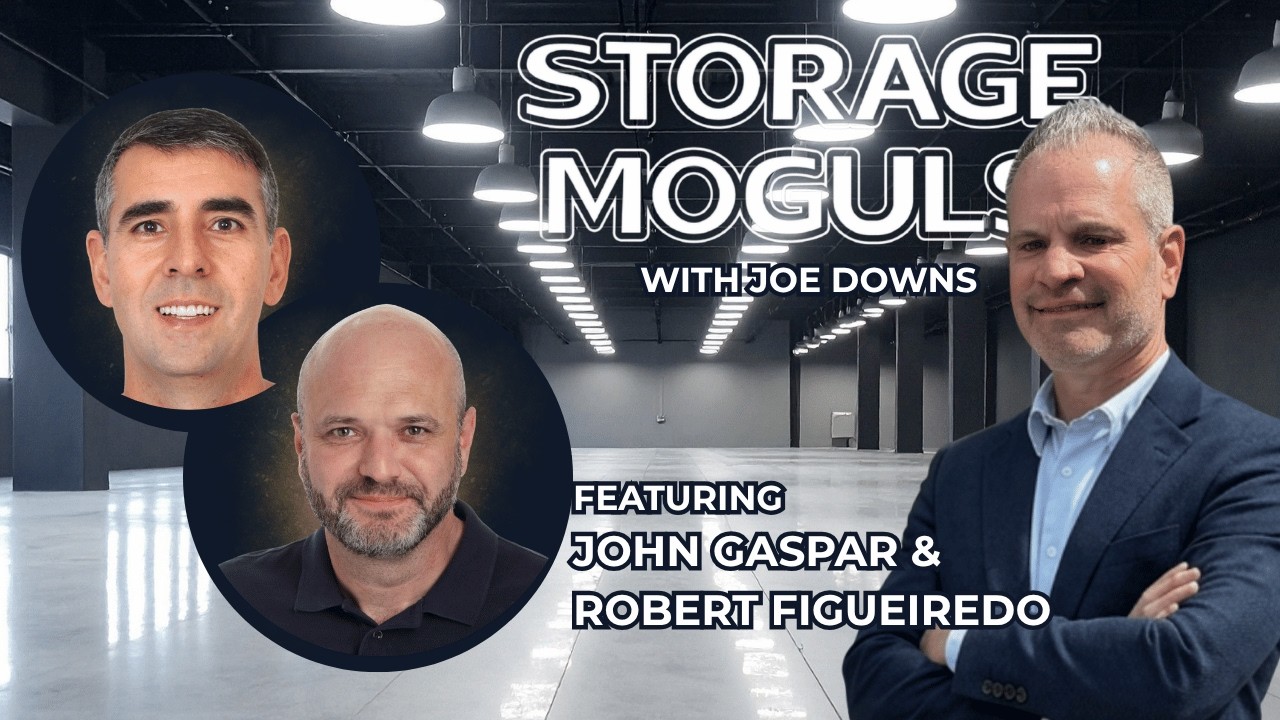
This content was created by Joe Downs. This content was uploaded by Joe Downs. This is a YouTube podcast episode titled "No Experience No Excuse — Self Storage Beginner's Blueprint" (published/recorded Aug 3, 2026) hosted by Joe Downs of the Storage Moguls Podcast. It's an English interview-style conversation with guests John Gaspar and Robert Figueiredo, Brazilian-born former IBM/tech professionals and co-owners of Cubed Up Self Storage in Morganton, North Carolina. The discussion covers their transition from third-party management to owner-operated (remote) management from Florida, practical tactics for improving occupancy and collections (auto-pay, delinquency focus), tools and processes they rely on (WhatsApp for field communication), key KPIs (occupancy, delinquency, leads), and their experience raising rates and stabilizing the asset.
Chapters
2 guys who never ran a storage facility a day in their lives, who don't live anywhere near their facility, fired their management company and started running the whole operation themselves from Florida on a facility in North Carolina. If you've ever told yourself you can't do this because you're not local and you don't have the background, today's episode is going to be a problem for that excuse. I'm Joe Downs. Welcome to the Storage Moguls Podcast. My company's acquired over 20 storage facilities and over $70 million in assets across multiple storage niches. I've seen this business from every angle, educated hundreds of students, and learned firsthand who succeeds and why. And that's actually what drove us to build StorageMoguls.ai, which is an AI-powered community With the tools, the structure, and the guardrails to teach people how to buy storage facilities and really how to buy their very first one. That's also why we launched this podcast, to bring you the operators, the lenders, the vendors, and the real people who've bought the deals so you can hear their stories and learn this business from the folks living it every day. Kind of like my guests. Folks, today's guests not only operate a facility in North Carolina from Florida, English is not their first language, and they're originally from Brazil. So please welcome John Gaspar and Robert Figueiredo. Who are co-owners of Cubed Up Self Storage in Morgantown, North Carolina. They're not related, they're not brothers, but they are longtime working partners, employees, I believe. Well, we'll unpack that. Both spent years in business development at IBM before making the jump into self-storage ownership in 2024. John and Roberto, welcome to Storage Moguls Podcast.
Thank you, Joel. Pleasure.
I'm super— I've known you guys, I've known you guys for a while now, and it's, it's, this has been a long time coming. I'm super excited to, cuz I followed your story, so I'm, I'm excited to unpack this for the, for the listeners. I, it just occurred to me though, in the intro I reminded myself you guys are from Brazil. Was Brazil in the World Cup this year?
Yes. I know.
I don't think so. No, no, never mind.
I thought that would make you a little angrier than it did. Yeah, that's not a good topic.
Because I believe they exited in the round of 16, which is the same round the United States exited in. And we only just started playing soccer like a couple years ago, I think, here in the US. So that was— that was—
I'm American, Joe. I don't know what you're talking about.
I love it. I love it. I'm a Patriot.
I'll get there. I'll get there.
Robert's still in denial, and John traded in his excellent soccer card for a very mediocre one. All right, well, we have other great sports here, as our producer Doug learned this year. We dominate things like hockey and basketball and football and baseball. Anyway, all right, before we get into the show, guys. As I had mentioned, I, I like doing true or false questions. They're fun. And it's a great way to, to just throw some, some nuggets out to the listeners. So here's your first one. I'm gonna read you a true/false statement. You guys answer how you want. True or false? Independent mom-and-pop operators like you guys, not the big public REITs, still own the majority of self-storage facilities in the US. True or false?
Absolutely true.
That is correct. And the major public REITs, for folks who don't know, so it'd be Public, uh, Extra Space, CubeSmart, uh, NSA, which is National Storage Affiliates— those are the names everybody knows. But independent and regional owners still make up the majority of the roughly 55,000+ storage facilities nationwide. So, uh, and that's exactly, uh, who, who my guests are here today, the independent operators. So Awesome to have you guys. Let's back up a second here before any of this happened, because I think people assume everyone who comes on the show came from a real estate background, and that's not true. And it's definitely not true for you guys. You were tech guys, right? Years of business development, I think, at IBM. You had no real estate— but correct me if I'm wrong— you had no real estate background between them. And you ended up buying self-storage facility together. How the heck did that happen?
Oh man, that's a good point. So yes, first about my background, and Robert is very similar. So we are tech guys. So from college, I joined IBM Corporation in Brazil, which is a big company there as well.
Until today.
And I, very boring story. So I stayed there for almost 30 years, right? So from Brazil, Latin America, and I came to the United States 10 years ago, invited by IBM to work as part of the global organization of IBM. So I was in an executive position. I met people from around the globe, traveled around. So It was nice, great story. So I'm proud of that. But 3 years ago, I started looking for something more that I could call my businesses to do, right? So I found self-storage as the most interesting asset class in real estate. And I said, hey, this is what I would like to do going forward.
Robert, I want to hear your story in one second, but I got to jump on that right there. Unpack that for us. What? Why was self storage the most interesting? What else did you look at? So how did you compare it, or what did you compare it to to determine it was the most interesting?
Do you really want another podcast now? Because I looked at like thirty different things, literally. Right? So Robert and I, we visited several laundromats. I started developing. houses, single-family residentials. So I've been doing different things as I started my new career. But self-storage, when you look at the kind of investment you need to make, the returns you get, and the benefits along the way, so it's just the best.
So you didn't just look at other asset classes, you actually tried some like flipping houses. That's interesting. Robert, who the heck are you? Why are you partners with John? Where'd you come from?
Yeah, I'm from Brazil as well. I met John at IBM where I worked for 7 years. So from college to IBM, and then I worked also on Lenovo, HP, Microsoft, and other Brazilian companies, all always in tech, right? And always tried to move to US through those companies, never happened. So I tried I made myself to get in here, and then I lost contact with John because I moved to other companies. So, but I met his brothers from other circumstances in Brazil. So, I mean, in 2023, I moved to you— 2022 to 2023, I moved to US. And then I got in contact with John. I said, look, you're here, I'm here, let's get in touch. And we decided to do things. And he was telling me the stories about his research about developing everything. So we got together and started to study those things and we got to self-storage and that's how we got here.
And so did John lead you to self-storage?
Yes. Yeah, basically, yes. Yeah, he brought the opportunity and said, do you want to hear more about developing And especially self-storage. And I said, yes, let's, let's go for it. And then we started to do everything together, but it was led by him. Yes, that's true.
Okay. All right. So if it goes well, you have him to thank. If it doesn't, you've got a scapegoat. I love it. It will go well. I obviously it will and it's going well and we're going to get into that. You know what I love about this is, is neither of you had a real estate resume. That got you here. You just, John, you had a curiosity, it sounds like, and a desire for more. And I don't know what that was. That was that— were you trying to get out of the corporate, the tech corporate life? Or were you just trying, looking for a part-time gig or another way to invest? Or what was the, what was the true impetus there?
No, no, Joe, it's, it's different. Since since college, I wanted to to be an entrepreneur, right?
Okay.
But then you you're hired by IBM as a trainee. After one year, you got a promotion. You got a salary rise, and then you get some travels. You get some good results. Everybody is happy with you. You get a promotion, and then you get a girlfriend. You get married. And so life happens because a company like this treats you really well.
Mm-hmm.
Right? And then 30 years goes by, but my original desire to become an entrepreneur one day was there. So when I had the opportunity, and by the way, I, this, Was crystallized with the self-storage weekend that Robert and I had together in Orlando in the end of 2024. Okay, nice time.
That sounds romantic. So, so you know, I never thought about. Thank you for sharing that. I never thought about the fact that because we. I hear from, talk to, and you know, even from a marketing standpoint, as we market Storage Moguls and try to spread the message, one of the folks, the avatars, the the niche, the people that we're the message we're trying to reach is people who work nine to five because there's a lot of people trying to get out of that that rat race. You know, the proverbial rat race, whatever. And and we know this because we we've met them. We've you know it's one of the Major, um, distinctive types of people that find us, right, is the 9-to-5. Then you've got the, the guy who's, who's a bunch of residential properties, so the tired landlord, we'll call it that, that avatar, that profile. And then you've got the doctor, the lawyer, the whatever, the high-income earner that is really just looking for, uh, they're not going to quit their job, they love what they do, they're really high-income earners, they're good at it. Um, but they want a better way to invest, or they want to diversify at least out of the market, you know, not have everything in the stock market, right? So those are generally the 3 types of people we see and meet. And, and, and you've, you've met these people as well through the, through the masterminds we've been members of together. And, uh, and that's what we, that's what we market to. That's who I'm trying to talk to. That's the message I'm trying to reach to get out there even through this podcast. But you just said something I didn't even realize. And I forgot, or I forgot about. And that's that, that 9 to 5, there's plenty of people that have that full-time 9 to 5 job who are only there as a means to something else. In other words, you, you just said those words, I wanted to be an entrepreneur. But what happened? Well, life got in the way. What kind of life? Well, I had to get a job to pay to eat and provide shelter for myself before the You found the girlfriend, right? So you have basic human needs— food, shelter, clothing. And unless you were born into some entrepreneurial job, that's— you got to get a job. We all started with a job somewhere, somehow, most of us anyway. And a lot of us just get— I'm going to use the word stuck, and I don't mean that in a negative way, because it sounds like it was a pretty good 30-year ride for you. You mean girlfriend turned into wife, which I'm sure You know, turned into family and, and you got to meet Robert and other business professionals along the way and have great experiences. And it led you to the US even. I don't even know if that was your original goal, but that's where you ended up.
Right.
So all of that's good. I'm not saying any of that in a negative way, but your, your original desire in life, it sounds like, was to do your own thing. And you just needed the right intersection of time and money and life situation Which in this case was, is 30 years later in the US and for whatever reason found the promised land of self-storage. So thank you for sharing that because I have, I have forgotten about the fact that a lot of, a lot of folks that are in that 9-to-5 job are kind of stuck there, some against their own will, some just, it's just part of the plan, part of the process. Like it sounded like it was part of your plan and process too. And frankly, it was mine at one point. And I think that describes a lot of us. So I just started to riff on that. I just lost sight of it. But I think it's important to highlight that, you know, especially if you're listening and you identify yourself as John right now, who wants to own your own business or franchise or really Control your own life and destiny, right? So it's just it's it's great to hear that.
And Joe, there is there's just a little story here. So my my name from Brazil is João since I was born, right? But João, I see your face. It's impossible to pronounce.
It's like my last name, Figueiredo.
Figueiredo.
Yeah, it's like my last name.
You know, you know, you know, you know, fellow Portuguese.
Almost. You're close.
You know, fellow Portuguese.
No? All right.
It's the best I can do.
So, but who is, who is our, who's our client? Who's our tenant? So our tenant, our typical, the stereotype of our tenant is a Older lady from North Carolina. That's 60% of our tenants, and we just want to treat them well. When we we just love them as tenants, right? And we speak to them every day. So I decided to to remove friction. So I got my. US citizenship, and I adopted John officially. So my US passport is John, truly. So I speak to the ladies as John, and they call us every day and say, hey, is it John or Robert? So this to me That's great.
And I love it. I want to harp on this again because there's a lot of folks out there that are stuck in the 9 to 5 or they fit into one of the other avatar or classifications that I described, where you're a tired landlord or you're making a lot of money and looking for other ways to invest. And they still have this fear. Maybe a lot of it is, is I think a self-inflicted fear of how do I get started? Or I, I can't do it, or no one's gonna lend me money, or, you know, all these, all these excuses we create for ourselves to make ourselves feel better about not taking that first step. And here you guys are from a different country with a language barrier, changing your name to fit in Not to fit in to be a cool kid, but to fit in so that your your customers so you're removing some friction. Something simple that your customer who's an elderly North Carolina Southern woman can pronounce your name easier. You're doing all of that without all these excuses, but you have the excuses. You have so much stacked against you, right? Just not even being from this country, and yet you've overcome all of that and you're enjoying success. I mean, what a what a true American story! And I say American story because that's that's what a lot of us would call the American dream. I mean, we were born here. I was born here. So my American dream is to not screw it up, right? And to take advantage of the opportunities I was born with. You actually came here and get it with, with a goal of it. I don't want to put words in your mouth, but it sounds like a goal of achieving that and you're doing it. And meanwhile, we got people in the US who are screwing it up. And, and, and I don't mean intentionally. I just mean they're screwing it up because they're, they're, they've got these self-inflicted fears and obstacles that they have created that you don't have. You're not even from here. And I just, I just wanted people to hear your story so badly because of that. So. Thank you for sharing it. Um, not that we're done, we're, we're just getting started. All right. True or false, it costs less per square foot to develop a self-storage facility than almost any other commercial real estate asset class.
Oh, absolutely.
A layup of a question. Of course it's true. Self-storage shells are simple structures with minimal interior finish compared to a multifamily or retail or office. Folks, we're building metal boxes. There's nothing in 'em, and it's a bigger Yeah. Another reason why it's, it's such an accessible entry point, even for people coming in from completely outside of real estate. All right. Let's talk about the thing most people are actually afraid of when they hear storage facility and losing control of something they can't physically check on, right? You two don't live anywhere near your asset. Neither of you had an operations background, at least in self-storage, on paper, that's the exact setup someone would say will fail, right? What do you think would happen if you brought management— or what did you think would happen when you brought management in-house versus what actually happened? Because you, you, your first— you bought the facility and you immediately went third party, which I think It's a very logical move if the facility can support it when you don't have a real estate background and you certainly have never managed an asset like this before. So what did you— you obviously— let's, for the sake of this podcast, let's not name the third-party management company because I don't want to— who knows what happened there, right? But Just talk about third-party management. What did you like about it? What didn't you like about it? What was your fear about bringing it in-house?
So, I mean, that's the reality. We brought the third-party management because we didn't know what to expect. And I mean, from one day to the other, we had to run the facility. So we said, okay, we need to learn several things. And if we just do the movement, without knowing exactly what we have to do, we might fail. So let's hire a third-party manager.
Yeah.
So after the— that's the obvious movement. So after the first month, we realized, I mean, based on when we speak about our work, previous work, there are several things that we gain, not only money, but also relationship that we had, that we created with John, for example, or management or how to to structure things to make it happen. So based on our experience, we start to see, well, we can do much better than this company's doing, right? So we have a lot of experience on that. So we could communicate better with the customer. I think they're losing calls. They're losing, not losing, I mean, losing potential customers. What about them? We don't have reports about the facility. So we were not really engaged on what was going on there. So after a while we realized that, okay, after 1 or 2 months, okay, I think we can jump in there and do a better job.
What was the moment, Robert, what was the moment you realized we at least have to try this ourselves? This isn't working.
To be honest, myself, after a month.
Well, but why? What was the trigger?
Uh, we used to have recurrent calls, uh, with the company and hearing what was being done and the control they had under the facility, we realized there was like missing several things, several pieces to connect, right?
So, but That there's, there's one, there's one very objective, uh, answer to that, Joe. We, we did the math. How many hours of the week the lady that was managing our facility would, would work? And we asked her, how many facilities you manage yourself? She said 23. So, okay, so we are spending 1 hour together every week. So that means you have another half hour to manage our facility per week.
And also we used to get in the system and see the communication with the customers and they were like very short with no— I mean, it was not personal, you know, you didn't try. For example, we had situations where the person was delinquent. So instead of, okay, what's going on? Can we help you? It was like, Pay 50 and leave. So what? That's not the way. I mean, we want them to understand the situation, what's going on. They might lose this job, they might have a specific situation, we don't know. So get in contact, talk to the customer, and try to understand. And we don't want you to leave. If you have a problem, let's try to find a way to solve that. We can wait a month, we can try to resolve, but we want you to stay here. We don't want you to leave. So that's where those kind of things that we were like, that's not the way we treat our customers in the corporations. And that's not the way we're gonna treat the customers in our own business.
That's so interesting. So your experience was your facility was being run in more of an impersonal fashion. And your vision for your facility was, no, these customers aren't numbers. They're not lines on a spreadsheet. They're not payments on a rent roll. They're people. People sometimes have hiccups in life, and we're trying to build relationships with our customers so they stay long-term and grow with us. So you felt the need to step in.
Yeah.
I totally get that. But there had to be some level of fear of if we take this thing back, what does this mean? Who's doing what? Do we even know how to do it? Because I get the, you can do the personal part better because it's yours and nobody's gonna care about your facility more than you. But what about all the other stuff that you don't know how to do yet?
Yeah, I mean, the other stuff we were stepping in and since, I mean, the first month we were stepping in and those things and try to understand. I think the biggest concern was really running the system.
Right. The system, the marketing, the collection, the raising rent. There's a lot involved.
Yeah.
None of it, none of it, for anyone listening, none of it is anywhere even remotely close or on the same planet as launching rockets into space. This is, this is not, this is not a shot at John or Robert either. If it is, it's a shot at me. This is not rocket science. However, there is a learning curve. And I'm wondering where you were in this learning curve when you took this over.
We were learning, to be honest.
You were learning?
Yeah. But when we decided like, okay, let's operate. So we did like a plan and okay, we have to study the system, understand how to operate. So we did like 45 days before really transitioning. And when we started, I mean, we like had a few days with fear. Yes, the transition was not so easy in the beginning, but there were no impacts for the customers overall because there were really a transition of system. So it was— operating normally when we did the transition. The biggest part was, okay, how are we going to answer the calls? Who's going to answer what? Who's going to do what? And in which moment, right? But I mean, we got connected then in those things that we operate together.
How many hours a week do you think you guys spend managing the facility now?
I think I spend like 1 hour, 2 hours probably.
Yeah, to get—
A week.
No, no, to be honest.
2 hours.
Maybe it's more honest to say the first week of the month.
Yeah.
Where people, when people still need to pay, some are not on auto payment, some others are not approving the credit card pull. We need— we have more calls. So the first week is more busy. So maybe 3 or 4 hours.
But sometimes average, average would be 2 to 3 hours, I would say, more to 2 hours, I would say.
So, so 8 to 10 hours a month. Maybe a better question is how many hours a month do you spend? Yeah.
Yeah.
And you're right, it would be front-loaded in the first week where there's payment activities and collection calls or whatever reminder Calls. Yeah. So, so folks, the lesson here is you don't need to live next to the facility or near it or have a background in how to run it. You just need the right systems, the right people around you. You need to learn how to do it, and you have to have the desire to do it well. And I think what prevailed here for you guys is, is the desire to run it well or better than anyone else could run it for you is, is really what What won the day here? True or false: The modern self-storage industry traces its roots back to Texas in the 1960s. Should I pick on one of you?
I don't know.
Fifty-fifty, you get it right.
1960s.
Yeah.
Good, good guess, I believe. Yeah. But it's, I think it's as simple as it would be in 1960, at least.
Yeah, it's true. Most, most industry historians point to the early facilities in Fort Worth and Odessa, Texas as the origin of the self-storage format we know today. All right, let's get, let's get tactical for a minute because we brought it in-house sounds simple until you actually have to build it. So for someone who has a facility today, that's underperforming, or they're about to buy their first one, what does actually standing up your own marketing and operations look like? Because it's one thing to say to fire the third party or never hire them, um, but now you got to do it, right? And it's easy to say it, but there's still— there's, there's some moving parts involved. So what does that look like if so? If If, if someone's facility is underperforming with third-party manager, like maybe yours was, what's the first thing you'd tell them to check? What is it? What does this look like?
Yeah, so you need to check everything. So that's the answer. But first, first things first, I would start by looking at the delinquency and understand the root cause. So We found many, many, many tenants not on auto payment. So that's what eats your time brutally. So we, so Robert and I, we just split Converse and we called every single tenant at that moment to understand the situation and to convince them. It cannot be mandatory, but you can convince them to go on auto payment. Either the credit card, ACH, debit card. So in such a way that they will be automatically being getting the payment without any action every first of the month. And by the way, every client that volunteers that they need a payment the first Friday, second Friday. the 15th of the month, that's okay. We accept, we change the billing system to accept that in such a way that these clients will pay.
Back to making it less or frictionless or as little removing friction. That's what you did there. Instead of forcing the first of the month, you'll take payment when it's convenient for them and from their budgetary cycle. Is that what you're saying?
Many people in there, in North Carolina, in Morganton, they are on healthcare or government, which pay on the first Friday of the month. So first of the month, they cannot pay, but first Friday they can. So that makes a ton of difference.
So I love that. So the first thing you would tell somebody is, The hours get eaten up in trying to collect and make phone calls to collect payments. And just because they didn't pay doesn't mean they're bad people or they're not going to pay. Sometimes they forget. Sometimes it's when their, when their, their income lines up with when they can pay. And what you're saying is, what I heard you say is, first thing you should do is get those payments under control.
Exactly. Perfect.
I totally agree with you. It's the first thing we do as well. Uh, not, not the least of which the result of that— you're— you mentioned time. I would say certainty of payment, right? It's a lot easier to manage your business when you know what you have coming in, when you have coming in, or when you have it coming in.
Um, are there—
speaking of managing remotely, Are there any tools or processes that you guys use or, or had to implement or, or like, thank God for this, we couldn't do this without it, that you want to share that made this all possible?
Oh man, there's, there's one thing that, that American people don't like.
What's that?
WhatsApp.
WhatsApp?
WhatsApp, the app WhatsApp.
Yeah, the app WhatsApp.
Yeah.
You don't like it?
No. So text message SMS sucks, but WhatsApp's amazing. And people from, people that are not from the US around the globe love WhatsApp.
And yeah, it's so good that you can't imagine how many tools were created around WhatsApp in other countries. Like, for example, Brazil. There's a lot of tools. A lot of tools.
I love the way you guys pronounce it. What's up? What's up?
What's up?
What's up? There used to be a Bud Light commercial where it was— you guys remember this? The what's up?
Sounds like you're saying it. That's a meta product. So is Facebook. It's the same.
Okay.
So it's not weird.
Believe it or not, we use it. My whole family communicates via WhatsApp. I had to turn off the notifications because I'm a big family because there's so many messages on it. But no, we use that. But you're right, not to the same penetration level that I've noticed folks from other countries use it.
But please, that's our communication with our boots on the ground.
So, so your boots on the ground communication is through WhatsApp?
Yeah.
Okay. Not with your customers. I thought you were gonna tell me your customers were on it.
No, no, because our system is, is not using WhatsApp. But anyway.
Okay. So WhatsApp is, was critical for you to be able to communicate with your boots on the ground. Give me an example other than, cuz you can send a text message or an email or make a phone call. What, why WhatsApp? What's so great about it?
NetViz is just super simple to use. You can add pictures, you can— so it's basically the same, but it's more easy to use. And you can add, for example, labels to the communication and organize with your guy in the field what he's supposed to do and what's in the queue, basically, without using a sophisticated messaging system or Anything else?
Oh, okay. So you're saying WhatsApp has a lot more bells and whistles than, than can be used in a regular text message, SMS message?
Yes. Right.
Okay. Oh, that's interesting.
Simple and super, super, uh, easy to use, effective.
All right. How about, um, what are, what are, let's say, your top couple KPIs that, that you're using for oversight since you're running remotely?
Occupancy, delinquency, and leads, leads generated. So the net positive tenants you get every month.
Okay.
Because we are in lease-up period. So we are stabilized now, but we were leasing up since the beginning of the year.
That's great. I didn't ask you that. When you took— when you bought the facility, what was the occupancy?
91.
That's what they told us. That's what they told us.
Physical. I didn't ask you economic. And then when you took it over from the management company, what was the physical occupancy?
70.
So it went from 91 to 70. Now, is that because— well, did it go from 91 to 70 physical or economic?
Physical.
So they lost customers for you?
Oh yes. Pay and vacate.
That's the most effective way to manage the facility.
What was that?
Pay and vacate.
It's less trouble for them.
Yeah, when they have a delinquent, it's just, please pay something and leave.
Go.
Okay, so you took it over at 70% physical Uh, and where does it— where is it now today? And, and when did you take it over, by the way?
Uh, oh, we met— the management was January, but we bought the facility in September of, uh, last year.
No, but you, you two started managing— you fired the third party in January?
Yes, early January.
Yep.
So in— since January, we're end of July here, 7 months, you took it from 70-something to 90—
what?
84, 84, uh, physical. 84. Okay. In a little more, uh, uh, economic occupancy because we increased prices back in May.
All right, nice work. And that's—
and Joe, that's, that's, that's one good nugget for everybody. So price increase is something that you are really afraid of doing.
Rate increases?
Yeah.
Yeah.
Rate increases, sorry. So I did my study here and said, hey, we must increase because there's a really real gap from physical to economical, and we must increase. And Robert said, hey, we're gonna lose a lot of people. It's dangerous. It's well, it's complicated.
And then I said, "Hey, we must do it." Brad Robert, you know, you let's unpack that for a second. You said rate increases are something you the way you say it was a declarative statement. Rate increases are something that everyone is afraid of. Why do you think everyone is afraid of it?
I was I was not I was not thinking I was not afraid of a I just thought that the moment were not appropriate to do that because of several circumstances that is going on around the world and, uh, also in the economical side. But, uh, so that's, that's, that was my, my concern only, you know.
But that's a valid concern. There's certainly times you need to use your head and say, hey, this is not a, not a good time in general. or for this person, right? This customer. But do you think everyone is afraid of rate increases?
No, I don't think— no, not really. But I was in that moment. But we kept like—
Are you now?
No.
What happened when you raised the rates?
Nothing.
Yeah, I would agree with you that most people would have some trepidation. And I think that's natural. I know I did. But if you can demonstrate why, like you bought it and 6, 9 months later, your customers can see that, you know, you've improved this process or either physically or from a management standpoint, it's justifiable, right? You're, you're for-profit business. And then there's also the supply and demand factors, right? And now at 84%, supply and demand is not really a factor, I don't think, for you in general, for your general occupancy. However, when you look at your unit occupancy as it relates to the market, you might find that it's time, right? And you understand what I mean by that. I know you do, because I know you have, John, at the very least, you've watched all the videos in StorageMoguls.ai. And have complimented them very graciously. We thank you for that. But I want to acknowledge that fear because it's a real one, and it's—I think it's perfectly natural. I just when I heard you say it, so it's such a declarative statement. I thought that was an opportunity for us to—I think we—I wanted to unpack that because and acknowledge it because that is a true fear among a lot of people, especially on their first. facility. Um, put yourself in those shoes though. I'm renting a unit from you in North Carolina, in Morganton, North Carolina. I got a 10 by 10. And what, what is a 10 by 10 going for right now?
$109.
$109?
$109.
And what is that, the street rate?
Yeah, that is.
Yeah. And so do you have customers paying $100?
We do $99.
So you have customers in there paying $99. The street rate for the new customer is $109. 6 months from now, you raise me from $99 to $104, $105, right? Am I going to— so let's, let's say it's $104, make the math simple. That's $5. That's $60 a year. You've just increased my rent, right?
Yep.
Your fear was I'm gonna get upset with you. Who who the hell do these Brazilian guys think they are raising my rate, right? That's your fear is that that's what's going through my head, and maybe it is. You don't know. There might you might have a customer thinking those exact same thoughts. I I doubt it, but you might. But even if they are, what are they gonna do? Am I Renting a truck, finding a weekend to rent a truck or a van to pack up all of my stuff that's in my 10 by 10 to move it down the street at maybe a better rate. I don't even know what my options are. But how much did it cost me to rent the truck or the van? Just stop right there. More than $60. And is my time worth anything? And can I find something that costs less than what you're offering? And is that as convenient to where I live? Because I clearly chose you for a reason. Maybe rate was part of it, but it was probably convenience. All right. So the fear exists, no doubt. But is it warranted? Not when you break it down logically.
This—
the industry stats are, I think, and I think it depends on how much you raise rates. And there's some yahoos out there that are insane with what they do. Believe me, we employed one at one point. But the industry stats on a normal 5 to 10% rate raise, 3%, 3% will leave. So if you have 100 units, maybe 3 people move out. And that might be because you've reminded them through the communication that they actually have a storage unit. Now, it might not even be because they're upset with you, right? They might, might just be, I can't believe we're paying for this thing still. Let's throw that stuff out. But, but do the math. Hold on, do the math. You got 100 units. You raise the rates by $5 on 100 units. That's $500 a month. But you lost 3, so you lost $15. Well, you lost, uh, let's say you were paying $100, so you lost $315. You lost $315 a month, but you picked up $500. That's a net positive, and you cleared out 3 units for someone who wants to now pay $105, not $100.
Well, Joe, it's, it's more dramatic than that because we raised on, on average 12%, some more.
Yeah, I just picked 5%.
And we've got zero out. So it's just mind-blowing.
Right. You raised it 10%, use my same math. Now you just picked up $700-some a month. You raise it 12%, I mean, the math just continues to go up. So yeah, look, I'm not I'm not highlighting this so that everyone listening goes out and willy-nilly raises the rates every month. You will, you will start to crater your— eventually your customers will get pissed off at you and leave. But appropriate rate raises commensurate with maybe things you're doing at the facility or just the cost of living and the cost of doing business. Your expenses go up every year. I'm pretty sure your utilities, your utilities and your taxes don't go down. Right. I'm pretty sure they go up every year, or at least in intervals. So part of it's just the cost of being a business owner. And, and, but a lot of it is, is, you know, the management you're bringing to the facility, right? They're paying for convenience and hopefully a well-run operation, a safe, secure place to store that's accessible when they need to access it, right? So that's the, that's the The service you're providing, really. And you shouldn't feel bad about being a for-profit business owner, especially with the way you guys are talking about how you treat your customers. You changed your name for them, John. Yeah.
And there's one thing that is interesting is that, I mean, when we got the facility, the first thing that we did was painting the whole facility. So putting our colors, right? Our brand and everything. So then with the number that, okay, we have a lot of women here, So they need to be safe to get into the facility, right? So, okay, cameras were not working. Cameras, let's put cameras. So lighting, if they want to go at night there, there's, I mean, we need to put lights in there, right? So for them to feel safer, right? When they're there. So we did a lot of things, you know, to like to be, To be better for our tenants, type of tenants that we have, mostly women, to be safe in there, right?
Yeah, 100%. And you nailed it. And I don't know what— I haven't seen a stat on what the percentage is of male versus female visiting the facility and actually doing the loading and unloading. But I do know it's 65% female-driven decision. And I think that number is growing. So you're 100% right. And we take the same philosophy when we take over an old mom-and-pop-run facility. Lighting, cameras, security. Does my female tenant feel safe and secure, particularly at night? Number one. Number two, do they feel like what they're storing is safe and secure? Right? And it's not one in a distant second, it's one in 1A, but it's very important. And that's the service you're providing. And I love that you guys know that. I, I see a lot of self-storage owners, operators who, who don't understand that. They, they think, they think the customers are lucky to have them. And, and they're some— they're almost like This is not all of them, but there's some of them. They're almost like slumlords of self-storage. And it's, well, that's why the opportunity exists. That's why we built StorageMoguls.ai, so folks can learn how to do this and go find them, source them, evaluate them, underwrite them, close them, and do what you guys are doing and living the dream.
And Joe, you know that our chosen color for the doors, for the brand, You know the color, right? It's purple. And the reason for that is that we did a thoughtful study on how to differentiate ourselves from the existing red, orange—
Green. Chartreuse is actually— chartreuse is the actual color that— yeah, yeah.
And yellow. So we looked for a different one and for color that the 65% woman would like and appreciate the most.
Purple. Love it.
And we have 1 acre of grass green in the facility in North Carolina. So, the color that gets a great contrast with the grass is purple.
That's— I love it. I love the foresight you guys have there as well. That's great. And there's no purples. So maybe, who knows, maybe Cubed Up will be your, the purple REIT someday. What's the— isn't there a company, the Purple Cow or something like that? Is it a company or is that their logo or something?
I'll do my research.
It stands out. But my point is, it's, people know it as that 'cause it stands out. So, you know, that's great. Cubed Up Purple. All right. Self-storage, true or false? Self-storage was one of the hardest hit real estate sectors during the 2020 COVID lockdowns.
False. Not at all.
That's right. It was actually one of the more resilient sectors. First of all, it was deemed a necessary business. Several public REITs reported rising occupancy rent growth through 2020, 2021, as people downsized, decluttered, staged homes to sell, or needed extra space while working from home. We all experienced that. That was the COVID— COVID was gasoline on the self-storage performance. All right, before we get to the last question, uh, that I ask every guest, um, I wanna leave the listener with something practical. So if someone was sitting on the fence right now, worried, I don't know, specifically about not being local to an asset or being able to find one near them if they're not in the business, uh, or, you know, they're thinking about getting into self-storage, but whatever, whatever self-inflicted fear they have is going through their head. What would you tell them? What's, what's the one piece of advice you'd give somebody who's on the fence or, or even on the other side of the fence wondering if they should hop the fence?
Well, I can, I can, I can say that. I mean, when I, when I, when we got together 2 years ago for the, the mastermind for the, for the self-storage, I didn't know anything about the market. So, so nothing gets easy if you jump in and then you go deep in it. So you need to study, you need to have people like you, Joe, and all storage moguls, you know, to give you the background and the experience you have in order to be able to understand the tools, how to analyze the market, how to analyze the facilities, how you make things You know, to get in there. And it's not easy. It's hard. Everything is hard until it becomes easy. And when it's easy, it's because you did your job, right? So it takes time. It's not easy, but you have to be close to people that have the experience and can like guide you you know, to jump steps easier to get in there, right? So what I would say is that it was not easy for us when we understood how, what we had to do to get our facility. It took 7 months to get our facility. And we know people that still trying after that, you know, So it's one year, almost two years that we studied together, and they're still trying. It's it's not easy. It's hard. You have to go for it. You have to look at the market. You have to study a lot. You have to put hours on it, right? Nothing falls from from the sky, right? So but yet it's possible. And once you are in the market like we are. We understand better the whole ecosystem. So we know how to operate. We know how to look for the second unit. We know a lot of people like you, Jack, and other, like Rob, a lot of people that know a lot about the industry. So it's much easier today than it was 7 months ago than it was 2 years ago, right? So, but it takes time and effort to have, you have to put in there.
Yeah. Right. And Joe, on your question about remote acquisition and management, right? There's one fact, you may or may not live in the right place. So I live in Miami, Florida. Miami, Florida is 100% REITs, big facilities, just impossible to acquire, right? They buy a 5-cap, happy. We want to buy value-add, right? So where is the market where you can effectively buy value-add? So it's remote. You really want that? So you had to look for a remote and then you acquire there and then you build your systems to manage remotely. Simple as that.
Yep. And you nailed it. And I'm in the same boat. I live outside of Philadelphia. I'm in a major metro, John. You're in a major metro. You and I don't have the capital stacks to buy and compete for any facility within probably an hour of us. Maybe, maybe more than an hour. Right? So you have to go remote. I've bought over 20. The closest one's an hour and a half away. And I would argue that's in a market that today we probably couldn't buy in. It's just the time we bought in it, we were able to get into it. But that's outside of Baltimore and that's probably too big of a market now. I mean, I'm glad I own it and we'll do well when we sell it, but we're even more secondary market and tertiary market because we have to be because that's where the value-add opportunities are. That's where the mom-and-pops have these facilities that the REITs and the institutions frankly can't compete with us to buy and turn around and manage. They're just not set up for it. So, you know, it's that we're the yin to their yang. And, and, um, and I— the reason we built storagemoguls.ai is to teach people how to go find those facilities, because that's where the real value and the opportunity is. All right, last question. I ask everybody this question: Have either of you read the book Be Your Future Self Now? No. It's by it's by Dr. Benjamin Hardy, one of the one of the co-authors of Who Not How, which is a book you probably have read. Have you heard of Mr. Beast? Oh yeah. Okay. Who hasn't? Right. The book is basically about MrBeast, or at least he's the inspiration for the book. And the beginning of the book talks about how MrBeast, who was a 17-year-old kid, Jimmy something, Jimmy Donaldson or something, I forget his name, how he became MrBeast. And by the way, he's only probably 27 years old now. This was only, this started about 10 years ago, maybe a little more than 10 years ago. He's the most followed man on the planet on YouTube. 10 years ago, he was nobody. He had 8,000 followers. He was just a kid in high school. And the way— what he did was one night he released— he recorded, I should say, and then published to be scheduled in the future, or scheduled to be published and released in the future, 4 videos. One 6 months from now, from that— from this night, uh, 10 years ago when he was 17. So one was to be released six months, one at a year, one at five years, and one at ten years. The ten year was just released last October of twenty-five. That's what I say is just a little more than ten years ago. And what he did in that moment was a lot like Cortez when he burned the ships. I'm sure you've heard that expression. Maybe not actually. Probably not in your history books growing up in Brazil. But when Cortez brought—I don't know what your background in that is—but when he brought The the the Europeans over here. He burned the ships. There was no chance of going back to Europe, and they said, "You're gonna make a life here because there's no ships." So that's effectively what Mr. Beast did that night. Jimmy did that night. He, by publishing these videos, he burned the ships, and what he did was he described who he wanted to become. So switching analogies here into Back to the Future or Hot Tub Time Machine, whatever. If you were to get into a time machine and go 5 years into the future, and from a third party, look at who's Jon Gaspar and who's Robert Figueredo, who have you become? What does your portfolio look like? What do you see and what are you doing today to make sure that's what you see in 5 years?
Yeah. So, I mean, when I look for 5 years, we are actually creating, I would say, an ecosystem right now to be able to be in 5 years in a very different situation, not only in terms of facility, but the self-storage ecosystem.
Describe it. Just describe to me what 5 years this system looks like. Self-storage portfolio in the system.
Yeah. So I mean, we are creating, we wanna, we saw that what we did in our facility, it can be extended to other facilities. So we have, for example, we created a tool where every facility can get in there and create our X of their facility to see all the gaps that we see, that we use for our facility. So they can use this tool to see what is the status of their facility right now. And then we can help to improve the management of the facility as we did in ours, right? So this is one thing that we are doing. We're seeing gaps as well in the software space, right? We are tech. So we are putting a lot of tech that we know in order to make things better. Not only because we are not very well served in terms of technology for the self-storage, but we can improve technology, we can improve management, we can improve a lot of the management using technology. So we are creating this ecosystem right now in order to use for ourselves. And then we probably got to go to market, not only for managing, but also acquiring new facilities.
All right. So you guys are great partners because Robert, you answered the, what are you doing today part of the question. John, what does it look like in 5 years because of what you're doing today?
So coincidence or not, Joe, today in the morning I presented to Robert and we agreed with our strategy. So strategy is something we need to execute today and see the results 5 years from now. So the answer is, in 5 years, we want to be the next— Amazon. Bellrose Group in some aspects. So we want to have at least 20 facilities. So that's the facilities part. We want to manage the 20 facilities and open to third parties. So a second business line to be property management. We are developing a self-storage software that will manage those facilities and hopefully sell the software to Bellrose at that point. And the fourth is the most recent. We are developing CubeDev Capital. So we would like to finance Acquisitions of facilities.
John, you have, I don't know how many, I think this is the 6th, 15th or 16th podcast. You are the first person to answer this question to my satisfaction.
Now, now I need to execute then. So it's only 5 years to execute, right? Right, right.
Because here's what I heard. In 5 years, you'll have at least 20 self-storage facilities. You'll be in third-party management using the software that you built. With your tech background to manage those facilities. And you'll have a, a lending company because that will either directly lend or I don't, you know, I don't know what those parameters look like. You didn't tell me, but that's okay. You'll have, you'll, in some form or fashion, you'll also have a lending company that will specialize in lending to other buyers in your network or folks in Storage Moguls community maybe to help them buy self-storage facilities. Is Is that a fair summation of where you are planning to be in 5 years?
Yes. And that's one more thing we are copying from you. So I'm going to be responsible for the facilities, Robert for the property management. We brought another partner, just you did, for the software, and we are going to find someone For the Cube Capital.
I love it. I love it. I love the plan. I love what you guys are doing. I love the whole story, folks. 2 guys with zero storage background running a facility they don't live near built better systems than an outsourced manager they replaced that I'm sure manages hundreds of facilities. If that's possible for them, it's possible for you. And this is, folks, the types of stories that we're covering every week on Storage Moguls, right? And the Full verticals. So far, we're talking a lot about self-storage, but soon we're going to start talking about boat and RV storage and pro-star storage and industrial outdoor storage. And I'm going to have the Truck Parking Club on soon. We'll talk about small bay flex, all of it right here on this podcast. So please share it, and sharing matters. Why? I tell you this every week because when you share this, you're you're letting people in your. Social media network through whatever channel you're sharing on know that you are in this business, and that goes a long way. And I guarantee you John and Roberto at least will nod their heads with along with me because when you go to raise capital for these deals, you don't want people thinking it's your first deal or you just got in the business yesterday. So start sharing this this these podcasts. Join Storage Moguls community. It's free. StorageMobiles.ai. There's tons of content in there for you. Folks, there's a seller out there right now who's ready to sell. So stop watching, start moving, drive for dollars, send the LOI. We'll see you next week.
More from Joe





The tenant only paid for the first month! #selfstorage #horrorstory #realestateinvesting

What happens when a storage tenant stops paying? #selfstorage #realestateinvesting #storagemoguls



