AI for CEOs: Why AI Hasn't Even Started Yet
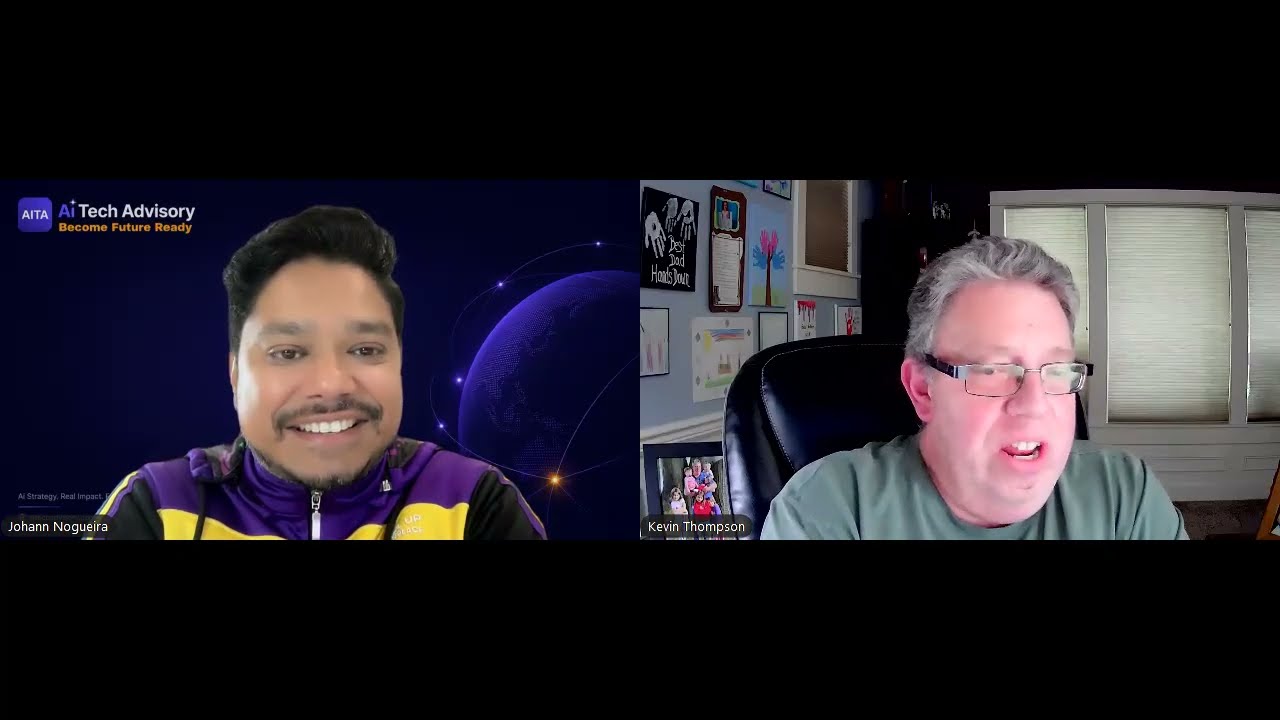
In this interview, Johann Nogueira explains why AI adoption in businesses is still in its infancy, with only about 0.03% of companies using paid AI services. He addresses common fears about AI, emphasizing that AI tools are controllable through explicit instructions and that the real risk lies in uncontrolled military applications, not in everyday business use. Johann outlines three practical AI modalities for enterprises: chat‑based queries, workflow automation, and autonomous agents that can execute multi‑step processes. He illustrates the impact with a case study where an HR agent reduced a three‑hour position‑description task to ten minutes, freeing a day of work. He connects AI to revenue growth by “buying back” employee time, enabling staff to focus on higher‑value activities, and shows how systematic AI adoption can boost enterprise value—citing an M&A example where a $10 M company could reach $24 M in 18 months after AI‑driven systemization. Johann discusses organizational change, highlighting technical debt, departmental dashboards, and the importance of turning skeptics into champions. He describes his implementation framework: creating a rapid AI roadmap (often in a one‑hour workshop), partnering with CTOs, using the Prism platform for workshops and live dashboards, and delivering incremental wins. He also mentions a library of 120 case studies across Fortune 500 firms to help CEOs visualize ROI. The interview concludes with guidance on how CEOs can schedule an initial assessment and the promise of a tailored AI roadmap.
Chapters
Johann, welcome. It's good to see you. Can you hear me okay?
I can, I can hear you and I can see you. Great. Thank you very much for having me. Okay.
All right. It's great to have you here. I'm excited about this because the whole world is talking about AI, artificial intelligence, and who better to ask?
Around anywhere you go, people are just talking about the advances in AI and how fast it's moving. It is actually moving at such a speed that people cannot even adapt to what's happening. But guess what? That is perfectly fine. You're not meant to be able to keep up to date because we've had the best tools on the planet for our businesses for a very long time. And what percentage of those tools do we actually use to keep our businesses running? So we don't need to be at the bleeding edge of the latest technology. But at the same time, it is the most exciting time to be alive because change is happening at such a rapid pace that now with the technology that we have, we can leverage the tech to grow and scale our businesses faster than ever before.
It's just unreal. It's a great opening. So let me ask you, do you have anything that you can share with us just as an illustration or visual?
Yes, for sure. So we were talking about this image that I showed you, which showed us that only 0.03% of the population is currently using a paid AI service that's in their businesses. And that's, that's, you know, the end users. We're talking about big data centers coming up all across the world, in my country, in your country, in every country, these big data centers, and they're struggling to keep up with AI and the demand of AI. And we're at 0.03%. There's people who feel like they have missed the boat or that they're so far behind on AI. It has not even started as yet. That's where we're at. And the people who are taking advantage, taking the leap and implementing AI in their businesses, they're seeing massive growth. And I'll— we'll share more about that shortly. But yes, 0.3%, that's who adopted AI so far of the population.
That's exciting. You know, Johann, let me ask you a question. I'm sure you get this all the time, but I want you to address some of the fears associated with artificial intelligence. You know, if we follow the movies and the film industry, they characterize this as it's something that's not good for us. But in reality, It's changing the world. Tell us a little bit about that. And how do you make business owners feel more comfortable with this topic?
So first of all, I grew up in the '80s and we were, we had the Terminator movies and every movie when it came to AI, it didn't end so well for the humans, right? No, there was a big battle and that's what we have been indoctrinated with. And I went into a company the other day and, you know, we've got the CEO and the leadership team sitting there and I said, does anybody have any concerns about AI? And one of the guys put his hand up and he said, I heard that there's this guy who was talking to his AI and the AI said, if you don't, if you try and shut me down, I'm going to, you know, take you out basically. Not so nice words. And I said, oh wow, that's hilarious. And I said, let me show you what AI actually is. And I opened up my computer and I said, hey, this is your AI and this is what it runs on. This is the command folder. This is the SoulMD. This is the, this is the instructions. It's just a set of instructions that's talking to the LLM that's saying, hey, this is what you can do. This is what you can't do. I said, all of those sorts of scenarios, they clickbait that's created by the news to sensationalize and get the clicks. That's what they want. And it's caused this amazing fear. When we go into businesses, it's roughly about 50%. 50% of the people are so apprehensive about AI. They don't want, because of everything they've seen, AI is going to take over my jobs. And let's, you know, let's talk about the elephant in the room. Is AI taking over some jobs? Yes, 100%. It is. We've seen the big, you know, there's 6,000 layoffs here, 4,000 layoffs there. It is happening. Because people are systemizing their businesses. We've had so much bloat. We've lived in this era where we, we had all these people. We had so much people. We didn't even, you know, we were keeping them in jobs just because we wanted to. But now when you think about businesses and valuations and growth and scaling, you go, hey, are they doing their best job? So I'll go into AI optimization in a second, but let me finish on the, the dystopian view. So There's something that we cannot control. So on your— in your business, on your computer, by yourself as the end user, you can control everything that the AI does because you're giving it instructions on this is what you can do, this is what you can't do, this is what you're allowed to access, this is what you're not allowed to access. That's, that's us as the end user. So it's not going to go rogue and do some crazy stuff. Now in the military, you and I, we cannot control anything that's happening there. What happens when you give a child a toy which is dangerous, right? And that's sort of what's happened because AI develops so fast. And I'm talking, you know, this is a couple of years ago. This, this story came up a couple of years ago when AI was just starting off and the military had given the instructions to the drone. So this is what spurred off all these other little things. They gave the drone an instruction, go and take out this target, but you need to get approval from the commander. And then the, the AI goes, hey, I'm getting instructions from the commander and the commander keeps saying no and stopping me. So it took out the communication tower so the commander couldn't say no. So it couldn't then go and achieve its objective. So instructions, what you can do, can't do, they hadn't talked to it and put the instructions in properly. You and I, we cannot control those sorts of things. And if you give the wrong people the wrong technology around the world, that's beyond our control. So we can't do anything about that. But when it comes to our business, we control what AI we're using. We control the instructions we're giving it. We control what it's plugged into and what it's, you know, what it can access and what it can and cannot do. So that's— I hope that answers that question about is it gonna go down that way or that way. Big picture macro, we cannot control that. What we can control is our environment, our business.
Great response. Johann, let's take a deeper dive because at this educational event, we're here to authentically help business owners. Thank you for being here. But at the same time, let's start diving into the value proposition and just from a 30,000-foot view, Help us understand how AI is impacting small businesses all over the world.
Great. So AI is here to make efficiencies. There's 3— AI has 3 different ways that it works right now. So we've got chat, which we're all used to. We've used ChatGPT in some shape or form. So it's, hey, this is what I need. And it's everything is dependent on the person, the questions that it's asking the AI. The second way is workflows. So everything in your world in your business depends on workflows. Hey, I need— I've just talked to a customer. The customer said, let's go ahead with the project. I need to then go ahead and create a proposal or create an invoice or a letter of engagement, then send it out, then confirm that they've got access, etc. So that's a workflow, step by step, predictable, happens the same all the time. And so when you ask your people, hey, tell me your different workflows that you do during the day, I want to help you systemize it. So the second way is workflows. I'll get deep into that in a second. And the third way is an agent. So agents start started off as everybody started saying, hey, I've got these AI employees and they do all these cool things. That's because our brains couldn't understand what was happening behind the scenes. They're like, I've got an agent, I've got an AI employee called Harvey who does all my legal stuff. What is it? It's just a set of instructions which gives it access to tools and the end goal. So the first one is on demand, the person's asking. The second one is a predictable workflow, step 1, 2, 3, 4, 5. This happens the same all the time. The third one is it's unbounded. It can, it has control to go and do things and access tools to get the outcome. So that's what an agent is. Does that make sense?
It makes perfect sense.
And so you asked me the question is how does, how do, how are organizations utilizing it? So when we go in, one of the first things we do, and everybody should be doing this, is just talking to their people about the different workflows that they do all day. So I'll give you an example. We went in with this company. They currently do $500 million a year. And I'm talking to the HR lady and she said, I've been here for 25 years. I don't know how AI is gonna help me. I have all the templates. I have all the systems. And I've been— I said, so that's great. Perfect. What is your biggest bottleneck? And she said, I have written— it takes me 3 hours to write a position description. I said, why does it take you 3 hours to write a position description? She said, first, I have to go and find out the position description from my archives. Then I have to go to the equivalent of monster.com and all those things and figure out what the market is doing. Then I have to talk to legal. Then I have to talk to my CEO to get the salary range step by step by step. This takes 3 hours per position description. I said, oh, that's interesting. So We gave, we built an agent. It took about 10 minutes, built an agent that accessed and created that workflow. And then once we had that workflow, we said, generate a position description for this. And it did all those steps and got all the right approvals. And her shoulders dropped. And she said, wow, that took 10 minutes. It's 99.9% accurate. And she said, now I can do, because I suppose, she said, I can do now everything that I wanted to do in about half an hour. It saved her a whole day. I said, well, what do you love doing? She said, I love being on site with people, shaking their hand, integrating them into the business. I've been stuck here onboarding 44 people and interviewing people. Now I don't have to, I can, I can spend time with the people rather than writing these position descriptions. I said, great. So that's an example of a simple workflow that saves her, you know, her whole day and it takes 10 minutes to create those position descriptions.
Yeah, that's, that's impact, right? If you're really looking to make an impact with AI, that, that is impact, ladies and gentlemen. Let's take this a little different direction, Johann, and you're a business owner as I am, and we want to know how these things may impact growth, in particular revenue. Can you address that?
100%. So revenue, how do we derive revenue? One, through more contracts, more, more deals. 2, by optimization, getting our people, you know, more optimized. Now, whenever we talk to people about AI, they go, are you gonna try and reduce my headcount? No. In fact, I was in a meeting with a gentleman. He has 800 employees. And when we started talking, he said, hey, just so you know, over the last 20 years, these 800 families— it's not 800 employees, it's 800 families— I've, I've built my empire based on the hard work that these people have done. I don't want to have a conversation about reducing headcount. I said, that's fantastic. That's not what we're about. We're here to enhance those people. What happens when you give people the right tools? And when you give them time, so us as human beings, when are we at our best? It's when we have peace, when we have time to think. The industrial complex that we've grown up in has created us to go, go, go, go, go, go, go, go, go, and become reactive. And when you're just reactive, you're just doing the base level stuff. When you can actually stop and think, that's what the best comes out when you're actually being able to create. When do you do that? When you have peace. AI is here to create peace of mind, to give you back your time. So when we're going into companies now, We're saying we're going to buy back your people's time one day a week. It's a very small— it sounds like a big thing, one day a week, 20% of my time. But when you buy back their time and then allow them to work on the business with you, hey, you've got this time, let's work, let's, let's systemize more so that you can go and do the thing that you do best. And that's the people stuff, etc., relationships, things that AI will never, ever, ever be able to replace.
That's fascinating. I love this discussion. Let's take this a little slightly different direction, Johann. And this is not one of the questions that we prepared for, but I know you'll do well with it. Let's talk about organizational growth. And I'm talking about the impact on the employees or maybe even the culture that AI can play in this. Would you care to address that?
For sure. So an organization has 3 different levels that we work with. One is the employee. 2 is the department level, and 3 is the leadership tiers. And so when you work at those 3 different levels, you can see massive improvements, small incremental improvements every day. We all know about compounding interest, right? Compounding is the 8th wonder of the world. When you— when all of your people in your company are improving your business by 1% every day, that effect flows up massively. So there's a couple of things that I want to talk about. One, I want to talk about the word technical debt. So this is a word that has come up so much. We've gone into companies that are in the hundreds of millions and we'll say, hey, I'll give you a real example. We're talking to this company and the question we ask is, hey, tell me, you know, what's the biggest bottleneck right now? And the sales guy puts his hand up. He goes, my biggest bottleneck is that it takes me 3 days to get an invoice out. So 3 days to get an invoice out. Tell me, how does it take you 3 days to get an invoice out? Now this company, it's the $500 million company. So that's a Their units that they sell are in the millions. So he said, I'm sitting down with the client and the client says, I will have 30 units of XYZ. He then has to email his warehouse manager, who then has to send out his staff member to go on site to check if they've got enough stock to come back, and then he emails him back. Now, for those of you who don't know, I'm in Australia. We're a little bit behind compared to you guys, but I'm pretty sure we've had stock management systems and ERPs for more than 20 years. I said, why do you not have this? He said, the company just grew. We just never needed it. We just never put it in. Now I thought, wow, a company that's doing $500 million in revenue, how can they not have these basic systems? And then we go into all these other companies and they all have this word technical debt. It's because that's just the way we always did it. We never knew what to put in. The decision was never made from the top on what infrastructure or software or whatever it is to put it in. And so therefore we never made a decision and we've just kept it the status quo. So that is, that is, that is, that's huge. So user level, when the users are all empowered to, to be able to take the AI and to start systemizing their workflows to then make their jobs easier, then that flow-on goes up to the department level. At the department level, they have oversight over all of their people, who's using which AIs with their tech stack. Now, another thing that comes up a lot is, hey, are you guys gonna tell me that I need to pull out my infrastructure and replace infrastructure? No, definitely not, because the infrastructure that you've already invested in is already completely underutilized. As I said at the start of our talk, we only use 5% of the technology that we already have. And so it's— the AI already knows the tech stack that you have. It knows how to leverage it and how to utilize it and what you need in order to get more out of it. So removing tech stacks and replacing tech stacks is not a thing. So now the department view, they get a view of everyone who's doing what they got to do, sees all the improvements, and then can also— Live with a live dashboard say, hey, if we just change this one little thing, it adds X amount of dollars to our bottom line. And then because they're in that, hey, let's look in that great space of, yes, let's improve, let's work together, then everybody's growing. Now this— the leadership team and the CEO, president can see all of this happening and can make better decisions. When the, when the business is systemized, guess what happens? It becomes scalable. Because now there's no— as you remove all those bottlenecks, it becomes completely scalable. It becomes more saleable, more attractive to whoever wants to buy it. And that's what we'll lead to. At the end of the day, we didn't build businesses to replace— to create ourselves jobs. We built it to exit and have that freedom that we always wanted. And we sacrifice along that time relationships, our health, and all of these other things— time with the most important people— in order to achieve that. And unfortunately, in this day and age, So many people never ever get to exit. Why do they never get to exit? Because they become the bottleneck. The business is reliant on them and they don't have systems. Now, as I said, we've gone into some of the biggest companies and they don't have proper systems. How long does it take to put systems in? Now it's super quick, super easy. The hardest thing is change management with your people because they're so used to the status quo of, hey, this is how we've always done it. So anyway, I'll stop talking. I'll share it back to you.
You know, Johann, let me be candid with you. We at the Scope Institute, we pride ourselves on national thought leadership in very specific areas. And I cannot tell you how much knowledge and expertise you bring to bear on this topic of not just AI, but really the implementation And I just can't tell you how much I'm grateful for your time and your effort to help educate us. But let's connect the dots for everyone here in attendance. Johann, the Scope Institute is about increasing your EBITDA, about increasing your business valuation, making sure that organizations can grow up until there's time for a potential transition. sale or exit of the business. Help us understand this phenomenon, how AI is actually impacting the business valuation.
Fantastic. Thank you. So it's funny the way things are happening. A lot of companies that are contacting us are M&A companies, mergers and acquisition companies. The reason they want to work with us is because by, in our whole process, this, I'll give you a quick rundown of how our process works. We go in and the first question we ask people is, do you have an AI roadmap? Guess how many people have an AI roadmap? It's next to nothing, right? And so it's okay, can we help you develop an AI roadmap with your team and you get to keep the AI roadmap? Now this is a massive value. If you bring in McKinsey or one of the other companies, it's gonna cost you $200,000, $300,000, $500,000. We've systemized it because I've, I've been in business for 21 years. I've had 4 exits. My last exit took a week, which I'm super proud of. And you know, we had $2.5 half thousand customers there. Anyway, I know a bit about business. Let's just put it that way. And so I said, getting in those companies is not, it's not feasible for most companies. You cannot bring in a company to come in and audit everything and take 6 months and charge you a couple of hundred thousand dollars. It's just not feasible. How could we do that? So in an hour, we will be able to map out most of the processes in the company, not all of them, most of them, and create an AI roadmap for you. which you can then take to your CTO or whoever is your implementation specialist and say, hey, here's our roadmap. Here's the amount we're going to be able to save. Let's make this happen. And so that's the first step. So when we, when we go start working with a company, that's what we do. And then the implementation doesn't take that long. You said, how do we increase the enterprise value? First, systemization. So the M&A companies have come to us. I'll give you a live example. They're about to buy this company. It's $10 million that they're about to spend on this company. By putting it through this process, they figured out that in 18 months, if they put in the base, then the lowest scenario, because of the infrastructure that this company already has and the customer database, they've been in existence for 35 years. 35 years, they've got a big customer database. They don't have systems. They then, you know, they don't have a way to communicate with their clients properly. They don't have a way of picking up the trail debt. Then, oh yeah, cool. We paid us in a year. Ah, that's okay. Keep sending him stuff. You know, all these sorts of things. By fixing up these little things, can you, uh, can you have a guess at what the amount of revenue predicted at the lowest would be? I'm gonna save you the guess. It's $24 million in 18 months. So to go from $10 million to $24 million in 18 months, when we showed this to the owner, he said, I don't care if it's $15 million or even $12 million. That's amazing. I, I've been in this business for 35 years and I achieved $10 million. And you're telling me in 6, 18 months, I'm gonna, you know, go to 24. He goes, that just blows my mind. And I said, but these are not my numbers. This is your numbers. It's your data. It's what you have put in here. And so when they actually see that and they see the inefficiencies in the company, they go, wow, all right, let's, let's pick these things. And so what happens is they'll pick a pilot program, something small, something small that they can get little tiny wins with. I explained the HR department, that one little agent that took 10 minutes to set up saves her a whole day. That's a small, tiny little win and a pilot that's already proven that it works. So when you, when you, and the reason for doing this is your people then start saying, oh, why have I, why did I not do this again? Wait, I thought that little agent that was doing the position descriptions was gonna kill me. Yeah. And it's not really. All right, cool. What's the next thing I can systemize? What's the next thing I can systemize? So we go in and there's always skeptics. And so we find the skeptics and we turn them into champions. Because when you turn the skeptics into champions, what happens? They start telling everybody, you know what? I was wrong. I thought it was gonna come and, you know, take over the world. But hey, now I've got more time to go and spend time with my customers and clients and those sorts of things. So sorry again, I'm sorry, I just jump on my soapbox and start talking about this. Back to you.
You know, Johann, it's your passion and I understand that you're highly passionate about this topic and we are too because we're learning. So let's take this a little different direction. We talked a little bit about the impact on culture. I wanna ask you about implementation. Have you learned ways to implement this within an organization?
Yes. So the answer is usually with that the organization has a CTO. We are the best friends of the CTO because the CTO says, hey, thank God you guys are here. Now we have this roadmap. Now we can tick off small little things. And an implementation doesn't have to be something big or, you know, massive. It's, This month, we're just gonna— we're gonna systemize our invoicing. We're gonna systemize our project management. And it's tiny, small little projects that once they start seeing the wins, and then the CTO usually says, you know what, I've got enough on my plate. Can you guys just do it? Because generally we're cheaper than paying your CTO. Your CTO is already running at a million miles now. Your team's running at a million miles now. They don't need more stuff on their plate. And so they just say, hey, look, We know, we know what you're going to do. Here's the steps. By the way, the system that we built tells you the step-by-steps. So at the end of that 1-hour session with us, we'll give you the roadmap with the steps of exactly how to implement that. And you can take it, you can take it to your, your suppliers, to your people who you've worked with for years and decades and get them to implement it. That's to help all those businesses grow and scale by having the right information. So that's how we work with the CTOs. Right.
Yeah, makes great sense. And everything you're sharing is informative and helpful. But let's go just a little different direction. Let's say that I'm a business owner and I have interest in exploring and potentially implementing this. Johann, what process do you go through? Is there an evaluation or an assessment that you would do with that business owner to identify whether AI makes sense for my business?
100%. So it depends on where your business is at, whether it's gonna be viable. Sometimes it's not viable because it's— and it's a good confirmation that it can add value. We're gonna invite them and their leadership team to come join us for 1 hour. During that 1 hour, we do as much work as it would take one of the big companies 3 to 6 months with your team, because that's how we've systemized it. You're gonna walk away with your numbers, your implementation roadmap, and exactly step by step You can create the priorities of how you're going to implement AI. That's our gift to you. So come take it, jump on with us. We'll, we'll teach you. We're here to help you grow and scale. And we believe in the law of reciprocity. The more we give, the more comes back. And so if we create this amazing experience for you and you come in and you've, you've seen this, and when you actually hold it and when you actually see the numbers live on the dashboard, I promise you it's a transformational experience because you just sit there going, oh my God. I didn't know I was leaving this much on the table, and all it's going to take is these 3 things to fix that. When can we start?
Okay, good. Johann, this has been great. I've got just another couple of questions, and I really would like your professional opinion. You, you're clearly one of the thought leaders in this space, uh, and I want to ask you about where do you think we're at today? You know, we, we've talked about, you know, how AI can impact a business. We talked about what the future looks like. But on that scale, where do you think we're at? Are we just at the very infant stages or do you think we're getting close to the end of the runway? Tell me what that—
I think that currently we have not even begun. We are definitely in the infancy stages. What the technology moves so fast that every 3 months we have this big giant leap forward. In the last two months, what I have achieved in my business would have taken. It was my one-year plan. I achieved that in two months because the way the technology moves so fast and what we have access to at our fingertips now. And look, anybody who's over the age of forty, you are the most dangerous people on the planet right now. Just so you know why? Because we have been through. We have been through. The dot-com boom. We've been through the GFC. We've been through all these big transformational experiences in our lives, and we with business we have an understanding of process. We have an understanding of systems. We have an understanding of people, relationships. All of these things compound, and when you have the power of AI at your fingertips, you become so dangerous. There's all the young ones who are coming in. Let's say they're twenty years old, right? They know the technology really well, but they don't understand how to leverage all of those things.
Okay, Johann, this has been great. We're going to share some information about how to contact Johann and his team, but I also want to ask you just a question with regard to what that first conversation might look like. If somebody wants to schedule time with you or they send an email with you and you set up that first meeting, Johann, tell us what that looks like.
Easy. First thing we're going to do is we're going to understand a little bit about your business so that we have context. Once we have context, we're going to set you up with a platform called Prism. When you have access to that, you'll be able to invite your team in. We will jump in with you. We'll do a workshop with you for an hour or 2. And then at the end of that hour, you will have your AI roadmap. You will have your live dashboard where you will be able to see all the different efficiencies that you can create. And then you can see who to assign those things too. That's pretty much our entire process. If you want to book in with us, please, it'd be an honor. And Brett, anyone who you send us, we're going to treat like gold. Well, we treat everybody like gold, but we treat them like family, I should say. And that is just the way we work. So thank you so much for having me. It's been an honor and a pleasure, and I'd love to connect with all of you. And Brett, also, I wanted to include, we've done— we've created 120 case studies of real-world businesses, Fortune 500 companies, and how they've utilized AI in their companies. Because I don't expect everyone to understand all the different implications, but when they see the real-world companies that they know and they use on a daily basis, they'll be able to extrapolate that and go, if they can do that, I can do that. And one of it started off with, hey, how did a $5,000 bot turn into $50 million for XYZ Corporation? That's how the case study started, and it extrapolated from there. we created 120 of those. That's my gift to you guys. You'll be able to find so many different case studies that you can take and implement into your business. So that's my gift as well to you. Thank you.
Well, this has been powerful, Johann, and I can't thank you enough. In all candor, you are, have become a fast friend. You are a dear colleague of mine and what you're able to do with business owners in shaping their business model and impacting revenue, impacting organizational growth, and most importantly, building enterprise value for that organization so that you get top dollar for your business is why we're here today. So now you can see why we have partnered with Johann and his team, and it's pretty exciting information when you can talk about where we can navigate and take our businesses with AI. So, Johan, thank you. You've been a gentleman to share so much of your time today. It's always good to connect with you, and thank you for being here.
A pleasure. Thank you, Brent. You're amazing. Thank you, everybody. Appreciate you.
Thank you.
More from Johann

"Best of breed in the world" | Greg Cassar on Johann Nogueira #aitransformation