#51: Readying an AI-augmented workforce with John Munsell, Bizzuka
John Munsell, CEO of Bizzuka, explains how to prepare teams for AI through Scalable Prompt Engineering, a spreadsheet method that treats prompts as modular variables. He's teaching these frameworks at LSU and releasing a book, Ingrain AI: Strategy Through Execution, to codify the methodology for reliable AI output across organizations.
Chapters
The Agile Brand.
Welcome to the B2B Agility Podcast, where we look at the factors that drive success in B2B marketing with a focus on the people, processes, data, and platforms that make B2B brands stand out and thrive in a competitive marketplace. I'm your host, Greg Kilstrom, advising Fortune 1000 brands on martech, marketing operations, and CX bestselling author and speaker. Now let's get on to the show.
Everyone listening to this show that's already in the workforce, from entry-level positions to leaders, has had to learn at least a little bit about AI over the last few years. But what are we teaching college students about how AI will impact their work? And more importantly, what should we be teaching them? Today we're going to talk about helping companies scale AI across sales, marketing, and operations, as well as how to make sure those about to enter the workforce are learning the right skills and mindsets from the start. To help me discuss this topic, I'd like to welcome John Munsel, CEO of Bazooka. John, welcome to the show.
Hey, Greg. Thanks for having me on.
Yeah, looking forward to talking about this with you. Before we dive in though, why don't we start with you giving a little background on yourself and what you're currently doing?
Sure. Yeah. So, a 1,000-mile-an-hour backstory. I spent 17 years in financial services, and then when the web started to come out, I ejected, started my own software company to to develop web applications in '97. And then we gradually grew into a web design shop, then a digital marketing agency, and we started to use AI in that. And 3 and a half years ago, actually closing in on 4 years ago now, I sold off the agency side to zero in on AI and try to help businesses learn how to use it more effectively and more efficiently, because I could kind of see the writing on the wall. And that's how I ended up building a company around upskilling employees and businesses.
Great, great. So yeah, let's dive in here. And as I mentioned at the top of the show, and as pretty much I assume most people listening out there are experiencing, you know, the last few years have been an education for, I would say, most people, if not all people, on how to better use AI in their work. That doesn't mean that a lot of people hadn't already been using some forms of AI, but certainly, you know, with the rise of generative AI tools like ChatGPT, Gemini, all of those, there's certainly been a lot more focus on AI in a number of different ways. So you've come up with some tools and frameworks to help with this education. So can you talk a little bit about why a framework is helpful for organizations as they need to, you know, grapple with things like upskilling and in some cases reskilling their workforces?
Yeah. Yeah, absolutely. So what I started to do was create— well, I'll back up. I've been in a bunch of AI masterminds for years, and I've just been kind of watching techniques and learning from them. And 3-some-odd years ago, I was in a mastermind, and I saw a guy named Darby Rollins create a prompt that had some really interesting characteristics to it. And I thought that was cool, but it was more for direct response copywriting. And I thought, Well, I'm in the B2B space. How would I take that and not just focus on a copywriting application, but expand it to be anything? And so I created this technique that I call scalable prompt engineering, which, if you know anything about spreadsheet design, it's similar in that you're creating variables that you can change the variable and everything else in the prompt stays the same., right? Or buckets of information we call prompt containers. And so I started to develop that so people could hot-swap information out and we could use it all over the organization. Everybody understood how the prompt was constructed. And so then I started to teach people how to do this so that ability to get the best out of AI became A, second nature, but B, shareable knowledge, right? Because anybody could look at the prompt and go, oh, I know what you're doing. If I change out this for this, I can get it to do that, right? So as I started to teach our first cohort in there, the first two sessions, I could see that things were clicking, but not very well. And so I thought, okay, how do I display this visually so people understand what needs to go into a prompt? So that they don't have to go back and forth and back and forth and back and forth all day. If they give it to the AI right up front, they get a vastly superior result a whole lot faster. And so that's when I developed this thing that I call the AI Strategy Canvas. It was based on, I don't know whether you're familiar with the Business Model Canvas, but it's based on that same structure. And then I presented it on the third session to the group and man, the light bulbs just went on for everybody. It just it clicked, and I thought, okay, cool, now we're really on to something. And then the provost at LSU heard what I was doing, and he asked if he could come over and tell me what was going on at LSU and AI, because they were doing some fantastic things over there. And so I said, sure. At the time, I didn't know what a provost was, but turns out there's the president and then there's a provost, and he's over all of academia. I didn't know that, but now I do. Anyway, so he asked me to show him what I was doing. He's like, whoa, that's next-level stuff. I haven't seen anything like that. And here they're building LLMs and they're doing all kind of stuff at the university level. And so then he asked me to teach their honors students. And I said, well, you know, I think we would have a better impact and a faster impact on the world and the workforce if we went through continuing education instead of, you know, undergrads, and we taught businesses and their employees how to use these things. Because the problem is that people, universities are teaching people how to build LLMs and train LLMs when 1,000 times more people are going to be using them. And I would rather be teaching those people because they're the ones that really need to know these skills. And so we started to develop a course for continuing ed.
Yeah, and so, you know, definitely just off the bat, I mean, it sounds like a lot of the spreadsheet analogy is helpful because, you know, there's definitely the concept of making it easier is pretty clear there. Can you talk a little bit about also, you know, consistency is another component there of, you know, if everybody's kind of sharing the same framework. But can you talk about, you know, what is the importance of consistency across the teams and, you know, why is that so important?
Okay, so think of it this way. I mean, right now, by most people's imagination, AI was invented 3 years ago. Right?
Right.
Right. But so that means that virtually everybody is self-taught, right? And inside of an organization, the bigger organizations that you got controls in place, the smaller organizations, they're all trying to figure it out. And if they've all learned it a different way, they're all getting different results. And there's this tendency to think that because you can ask an AI a question and get an instant response, that it's easy. But the problem is it's not easy to get an excellent output from an AI unless you know what you're doing. And so if I've got an organization with 20 people or 2,000 people, the more I have people using it in a different way, the harder it is for everybody to get the same output, the same consistency in, in the output. And so some, somebody might be, you know, working with a simple report for 2 minutes and the other person might be working with it for 2 hours. You know, granted it used to take 8., but it would be neat if the person who was able to get it out in 2 minutes could teach somebody else how to do it. But that person might not have the right structure to it. And so what they created was this, word vomit prompt that's, you know, monstrous, sentences long, and they don't even know how it worked. Uh, and so that's, that's the tricky part. But if you know how to structure it, so that everybody understands how to do it and everybody speaks what I call the same language, then now you have SOPs in an organization, whether it's the marketing department, the HR department, whatever, everybody knows it the same way. Anybody can come in and help somebody by looking at and dissecting the prompt and saying, okay, if you just adjust this, it'll work a whole lot better. And not only that, but it, it's the, it's the framework for creating really rich documents that you would use as a knowledge base. In AI is when you get into the agentic workflows and everything else. If you know how to do it right, you get amazing results. If you don't, you'll get average results. You know, it becomes a very fast typewriter. In other words, we want more than that.
Yeah. Yeah. Well, and so does that, um, just kind of seeing what good looks like, is that— I would imagine that's also part of the education process, right? So, you know, if, if, because if they're not using the, the, the spreadsheet, so to speak, they're seeing well-constructed prompts quite often, and is there learning in that part of it as well?
Yeah. Yeah. I mean, look, when you see how they're structured and you understand the makeup of it, then everything becomes far more logical. And again, in any organization, you have turnover. And what you want when you do have turnover you want the new person coming in to be able to see what the other person did and go, oh, okay, this is easy. I can take over. Right? And you also want to make sure that people are— well, let me back up. What you want in an organization is the last thing you want to do is replace somebody because you've got time invested in that person. That person knows your culture and your operations and knows your products and services. And they probably know what excellence looks like, what your standard for excellence is when you're delivering to customers or anything else. So if they know what excellence looks like, they're going to be the most likely ones to get it out of AI. But if you don't know what that is, then it's going to be very hard to get it out of AI. You have to first know what it is, and then you have to know how to construct the prompts to get that out of AI. So that's the real critical thing is getting people to getting the people in your organization who fully understand your vision for excellence to be able to drive that out of AI. And that's very easy in a structured approach. It's not so easy if you're literally doing stream of consciousness and prompting every time you go to AI.
Yeah. Yeah. So, you know, you mentioned, you know, people coming in and out of the workforce or, you know, people, you know, needing to onboard new people. Let's let's talk about the people that haven't quite entered the workforce yet. So how prepared would you say that the average, you know, whether it's undergrad or, you know, a grad student that maybe hasn't entered the workforce yet, how prepared are they to take on the current world of work where, you know, AI is, is, it's a requirement, but maybe to your point, it's, it's not as well structured as it could be in a lot of situations?
Yeah, the, the problem is that most of the universities are teaching what what we would call stream-of-consciousness prompting. So they're not very well constructed. They don't have a really solid framework for what should go into the AI. So consequently, when they leave, they've got bad habits. Some universities aren't teaching it at all. So unless you're in the computer science department and you're learning how to do, you know, some other kinds of training on an LLM, you're not going to get the executable skills when you graduate. The good news is the kids graduating these days know how to use a keyboard pretty fast, right? And they understand social media and they understand a lot of those aspects of it. But they will fall into bad habits with AI, and that's what we want to make sure that they understand it in a process as opposed to in just this back and forth and back and forth. Once they understand it in the process, if they graduate with that skill, then they bring that skill into the workforce with them. And that's another game changer. So for me, what I'm trying to do is approach it from both ends. I'm trying to get existing workforces to learn a new methodology that's scalable and shareable inside the enterprise. And I'm trying to teach students to leave and enter the workforce with that skill. And if their employer doesn't have it, they can bring that to the employer and they're vastly more employable and valuable at that point.
Yeah. And so, you know, your, your strategies are mandatory requirements for students at LSU. Is that an anomaly? I mean, you kind of touched on this, but, you know, are, are other universities, maybe not all of them, but are other universities kind of following suit and adopting things like this, or is, is this really an anomaly?
We're trying to make it more universal. And it's been interesting because right now we've just been kind of perfecting certain aspects of it. You know, the AI changes and progresses. Everybody keeps asking me like, hey, you know, pretty soon you're not going to need to prompt an AI. And I'm like, that's kind of like saying pretty soon you won't have to talk to an employee. You know, that's not true. You're always going to have to tell the employee what to do and how to do it and what excellence looks like. And you're going to have to give it context for it to execute at that level. So the way we structure prompts, as these models have gotten better, our approach is actually more valuable rather than less. And it's funny because some of these newer models that have come out, whether it's DeepSeq R1 or whether it's the newer version of ChatGPT or Claude Sonnet 3.7. I can go on and on and on. Grok. They— Grok loves our approach to prompting. All of them do. And I've been amazed at how better the output is when you use our formula approach. It's astounding. So that's kind of where I see it getting more and more valuable. And I think if universities will get on the bandwagon, we're going to have a better workforce. And so what I've been spending the last 6 months on, Greg, is writing a book. And so it literally is now available on Amazon as of last week. Oh, nice. Congrats. In fact, my print version is supposed to show up sometime today.
Oh, nice, nice. Well, congrats on that.
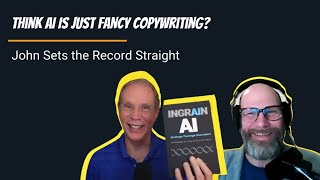
Thanks. It's called Ingrain AI: Strategy Through Execution. It's about how to scale an AI-first culture in your organization. But it walks you through this process. So it's structured for anybody. So a student could pick it up. There's going to be parts of it when we talk about AI governance that a student's going to go, but when you get into scalable prompt engineering, which is part 4 of the book, they'll start to understand how it operates. And that's kind of my focus for the next quarter is to get this in the hands of universities so they start teaching in this manner because it's so much more effective and so much more efficient.
Yeah, yeah. So with some of the other people I've interviewed, I've made the analogy, and most of them have seemed to agree as well, that there's— well, I guess just to take a step back, you know, there's lots of buzzwords. You know, I live in the world of marketing, so, you know, we've seen lots of buzzwords over the decades that I've been in this field or whatever. But, you know, so not taking into account things like the metaverse and blockchain and some other things, there are, there seem to be some similarities between the way that AI is, is growing and being adopted to kind of the early days of the web where, um, you know, there are, there, there are also some dissimilarities, I guess, as well. But universities adapting to, you know, whether it's the web, whether it's social media as a marketing, uh, you know, as a marketing channel, you know, are, do you think that universities are more able to adapt now to something like AI becoming more more prominent than they were in the '90s or the, you know, early 2000s and with social media, or is it still kind of the same sometimes uphill battle? Sorry, that was a long question.
Yeah.
But maybe a loaded question, but yeah.
It's, yeah, it's a bit of a loaded question. Mainly because I, I think universities by and large don't operate like a business. They don't think like a business. Yeah. Yeah. And that's a big challenge. You know, if you get a university that thinks like a business, they, they, they see their students as the product. Majority of, of universities don't see the students as the product. They see research as their product. And so their, their goal is to generate research grants, which ironically enough, I've taught, uh, 3 LSU professors how to apply for research, research grants a hell of a lot faster using AI. Um, But if more— I think you see this more in like community colleges where they see the student as the product. They're able to move a lot faster than a university. When— if universities would at least embrace more of a business mindset, and I think you're going to see that happen as, you know, the— what's going on with the Department of Education and everything else, as universities become more responsible for revenue creation they're going to have to learn to operate like a business. And the cost of tuition has just gone nuts up, right? And the return on that tuition has really gone south. So I feel like universities, if they would take the viewpoint that their primary purpose is to enhance a workforce and develop— let's just take the US, right? Develop a US workforce that's second to none, then they would be looking at how do we get them the right information so they're immediately employable and productive tomorrow. And I don't think many of them are ready for that. There are a couple that are leading this. I think it's either University of Arizona or Arizona State. I can't recall which. I think it's Arizona State is doing some really good stuff with AI and pushing the boundaries on that. But I think more need to hurry up and get on the bandwagon because we have a big problem headed our way. But there's an advantage that a university would have if they would first teach students Like I always say, if they would teach students what excellence looks like and then teach them how to get it out of AI, now we, we've solved some really good problems out there, you know? Yeah. I don't know. Are you artistic at all?
A little bit.
Yeah. Yeah. Okay. So my wife makes cakes professionally and she, she's like Cake Boss, right? So she, she builds these just amazing things that I, I'm like, God, that's amazing. And I'm like, she'll take fondant and she makes these figurines and she does all these things for weddings and. You know, all that stuff, cakes, just ornate. I can't even see that in my mind, let alone mold it into something. But she, in her mind, can picture this and make it, you know. I can look at it and evaluate it. That's as good as I get with art, right? I can't do anything else. I, on the other hand, am the same with copy. I can, I can see what the copy should look like, and I can work and write the copy. But don't— I'm really good with, you know, editing too. But if you don't know, like, for instance, if you're on the art side of marketing and you're trying to create images, if that's your superpower to where you know creatively what you want, and you learn how to drive that out of AI, you're going to be leagues ahead of anybody else. If you don't know what you want, then you're basically kind of letting AI figure that out. You know, it's the same with copywriting or anything else. If you really don't know what you want and you don't know what excellence looks like, you're gonna settle for what it puts out there. You know, AI is essentially, it, it has devoured the world's content and not all the world's content is excellent.
Right, right, right.
There's a lot of garbage out there. And so consequently, if you, if you are just using what I would call untethered AI and say, write a, write a blog post about topic X, it's gonna sound like AI. But if you really understand conversions, if you understand just the human psychology of motivation, then you'll know how to prompt AI and get it to write like that. And that's the key, you know, but you don't have to have superpowers in all those areas. But if you're really good at one, man, make that your zone of genius and learn how to get that out of AI. Yeah.
Yeah, I love that. That's great advice. Well, John, thanks so much for joining today. One last question for you before we wrap up here. I like to ask everybody, what do you do to stay agile in your role and how do you find a way to do it consistently?
I work 16 hours a day, 7 days a week. I mean, you know, the main thing is I'm just constantly reading. I drink from the fire hose so our students don't have to. I am ADD from the word go, so this makes my propeller spin, you know? So that's it. I read a lot. I do a lot. I'm constantly using it and it's fun. That's the answer, right?
I enjoy it. Yeah, I love it. Well, again, I'd like to thank John Munzel, CEO of Bazooka, for joining the show. You can learn more about John and Bazooka by following the links in the show notes. Thanks, Greg. Yeah, thank you so much.
Thanks again for listening to the B2B Agility Podcast. If you enjoyed the show, please take a minute to subscribe and leave us a rating so that others can find the show more easily. You can access more episodes of the show at www.b2bagility.com. That's b2bagility.com. While you're there, check out my series of bestselling Agile brand guides covering a wide variety of marketing technology topics. Or you can search for Greg Kilstrom on Amazon. Until next time, stay focused and stay agile.
The Agile Brand.
More from John

AI Strategy for Business: Build an AI-First Culture Faster - The John Munsell Interview