S5 Ep05 The Road to AI Mastery with John Munsell
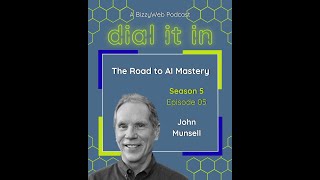
In this episode of the Dial It In podcast, hosts Dave Meyer and Trig B. Olson interview John Munsell, CEO of Bazooka and author of Ingrained AI: Strategy Through Execution. The conversation covers the practical side of AI adoption in organizations, introducing the Ingrained AI framework, a 10‑stage model of AI mastery, and a certification program for implementers. John explains how the framework draws on EOS/Traction concepts to give companies a common language, scalable prompt‑engineering process, and a roadmap from basic prompting to managing AI agents. They discuss tooling choices (ChatGPT, Claude, Gemini, Groq, Perplexity, Copilot, Boodlebox, GenSpark, Gamma, etc.), security and governance considerations (enterprise licensing, HIPAA/FEDPA compliance, AI Center of Excellence, AI Council), and real‑world workflows such as an end‑to‑end sales proposal pipeline that uses AI note‑taking, transcript analysis, personality emulation, and rapid proposal generation. The episode also highlights capstone projects that turn everyday pain points into AI‑built tools, the AI Strategy Canvas from the book, and upcoming updates to the book and certification. Throughout, John emphasizes starting with the ecosystem that fits the organization, the importance of structured training to accelerate adoption, and the balance between rapid AI capability growth and security lag.
Chapters
Welcome to Dial It In, a podcast where we talk with fascinating people about marketing, sales, process improvements, and tricks that they use to grow their businesses. Join me, Dave Meyer, and Trig B. Olson of BizzyWeb as we bring you interviews on how the best in their fields are dialing it in for their organizations. Let's ring up another episode.
I know I'm supposed to be like future-proofing when we do these, but on the day that we're recording this, it is -25 degrees Fahrenheit here in Minnesota. It is so cold that your garage door spring shattered this morning.
It sure did.
I'm just cold and grouchy. And so in order to make this feel better, especially that, 'cause we're gonna be talking about Talking to a guy from Louisiana, I thought it would be good to, to give some basics about what it's like to be in this weather.
Yeah.
Yeah.
At— we are so here in the Twin Cities where we are recording, it is -25 with the wind chill today. So that is cold enough that tossing boiling water up into the air turns into snow before it hits the ground.
Yeah. And you'll also see the TikTok or social meme where people freeze their pants.
Yep.
Leave them standing up in their, in their yards. So you leave a pair of wet jeans out and then you can stand it up like cardboard.
Yeah.
And it's very entertaining and you gotta embrace the chill. Otherwise it would, it's a different kind of, why would you live in a place that hurts your face when you walk outside?
Yep.
So at 20 degrees below zero, it physically hurts you to breathe outside. Lithium batteries tend to die faster in the cold. It can go from 80% to dead in 5 minutes if so it's not put in a pocket. Cars sound broken, basically, because rubber stiffens in extreme cold, so tires get flat overnight. And I think the hardest thing that I had trouble believing, but ChatGPT told me so, was touching bare metal in extreme cold can cause a burn similar to touching something hot.
Yes, frostbite.
So nature believes in symmetry. Yes.
All right.
I got that out of my system. We're in the midst of our AI season, so we've got a great guest on who's going to talk to us about monetization strategies for AI and how companies can take the next leap forward. So before that, do we have a sponsor for today, Dave?
We sure do. Is your HubSpot cluttered and inefficient? WeFixHubSpot, powered by BusyWeb, specializes in customizing and optimizing your HubSpot experience. Our team of certified experts offers tailored solutions, including training, re-onboarding, architecture reviews, and data restructuring, ensuring your portal aligns perfectly with your business needs. Don't let a disorganized HubSpot slow you down. Visit wefixhubspot.com to schedule your complimentary consultation and start transforming your HubSpot today.
Thanks, Dave. Our guest today is John Munsel. He's the CEO of Bazooka. With two Zs, and the author of Ingrained AI: Strategy Through Execution. He works with business leaders to help them move from AI experimentation to practical results-focused adaptation. Since 2022, John has advised leadership teams on aligning AI initiatives with real business needs, focusing on strategy, execution, and measurable impact rather than hype or tools alone. Welcome, John.
Thanks. Great to be on. I appreciate you having me.
So first question, how cold are you today?
Not as cold as you. Yeah, like right now it's 61 outside. I'm feeling good about myself. Better than you.
Another insider secret on Minnesota, John. When it gets into the 30s after a cold dip like this, you'll see people on motorcycles in their shorts driving around.
Yep.
Shorts. 61 is, I think, what you can get the sauna up to today. Karen?
Yeah.
I bet you're right.
John, we really are giving people the opportunity to have a naked self-promotion. So let's start with this. Tell us about the book.
So the book is called Ingrained AI: Strategy Through Execution. And the subtext is the blueprint to scale an AI-first culture. So I wrote that book and published it last March, and now I'm in the process of writing a new one and I'm doing some research for it for all the people who've read the old one, all the businesses we've consulted with over the past year and a half to try to get more updates to it. But the book, I don't know, are y'all familiar with EOS or Traction? Okay. Yeah. Good. All right. With Traction, Gino Wickman wrote that 15+ years ago and now he's created a group of implementers. One of my best friends is a EOS implementer, and they, they go to businesses and implement those frameworks, right? You could read the book and do it yourselves, which is what we did originally. We read the book, implemented those frameworks, started using it to manage the company. And then when my friend became an EOS implementer, I was like, oh, I didn't know there was such a thing. So we hired him to redo our implementation. So the same concept is true with our book. It is a set of frameworks for implementing AI across the board in your organization. It gives you the tools to do that. It gives you what we call a common language to speak throughout your departments. And it gives you a process for prompting that we call scalable prompt engineering. Theoretically, any business could implement these in their organization. But this month and next month, we'll be graduating our first group of ingrained AI certified implementers. And so that's their job is to work with businesses to implement these frameworks. And we're using, we're working right now with a lot of universities to implement it on the operations side. We've got literally implementers across the globe right now. So it's getting fun. And that's what the book is about, helping businesses scale AI. And the interesting thing is one of the things that the new book will probably go into is how do you define AI adoption? And most people, when you read it, when you read the stuff that's in the news or whatever you watch or whatever research papers, they'll say stuff like 86% or 90% of companies have adopted AI. That could mean that they got a license to Copilot with 4 people in the organization. They've adopted AI or they built some sort of chatbot. I define it differently. To me, adopting AI is putting it in the hands of every knowledge worker or every person who uses a computer more than 60% of the day in your organization, teaching them how to use it and teaching them how to build their own tools. That to me is adoption, and that's what we help businesses do. There's my 1,000-mile-an-hour tour.
I love it. And it's fascinating on AI adoption. And I love that you're doing the EOS model because I think it's hyper-scalable and there's a good track record there on how to reach out As you're working with organizations, is there an ideal size or an ideal kind of company that can take over or start an ingrained AI strategy?
Yeah, that's a really good question because we have had literally one-man operations do it. I would say that the average company is somewhere between 50 and 500 employees, but we've we've had, gosh, like we're working with a company with 12,000 employees right now. We have companies with literally over 100,000. I've had companies like Amazon read my book and call us on it, 1.25 million or 1.5 million employees. So it's literally all the, all over the place, but it's universal. That was the idea to write a book that wasn't going to be outdated the minute a new AI model got released. So it's a very universal type application.
That was where I wanted to start is with all the different AI models, where do companies start?
Man, I wish that was a one-size-fits-all question, but it's really not. It depends on your level of tolerance for security. It depends on what I would call the chemistry of your company. In other words, if you've got a company that is really innovative and moving fast, then the best model is 5. Okay. All right. It's not a model. It's being able to use ChatGPT, Claude, Gemini, Groq, Perplexity, all of those tools. And then as you start to get good with those, you got to remember you've got image generation capabilities inside those models. You got video generation capabilities inside those models. So you could stay in those ecosystems for a while. We're starting to look at Copilot a little more now because of its integration with the Microsoft 365 5 suites. You've gotta get more advanced licenses to really get anything out of Copilot, but that's why it wasn't in my top 5. So it would be in my top 6 or 7 maybe. But we're now starting to look more seriously at Copilot. I wish they would get their licensing figured out. It's clunky. Have you ever tried to build a custom Copilot inside of that?
Yeah.
If you're a small company, it's gonna cost you a lot of money. You're a bigger company, then maybe on a per-seat basis it's not so bad.
But I think with a lot of these models, especially at the corporate level or the large corporate level, it comes down to licensing and bundling as far as what you have. And that's probably the best option is if you're a Microsoft shop, you're probably going to want to start with Copilot at some level or ChatGPT probably. If you're a Google Workspace shop, you're going to want to start with Gemini because it's just included in the Pro versions. Not the super versions, but the decent, decent enough to work with versions. And so some of the outside in your top 5, like Perplexity and Groq, they don't really have an ecosystem to hang on to, so they just have to be really good.
Yeah. I tell you what's another good starter point, depending upon what kind of company you're in. Like, for instance, a lot of universities start here. And as we started to— full disclosure, we just established a partnership with this company because of the use case. And that's a company called Boodlebox. You ever heard of it? Boodlebox. Boodlebox. B-O-O-D-L-E-B-O-X. Boodlebox. B-O-O-D-L-E-B-O-X. It's really— it's a wrapper, okay? But it incorporates all the models. They're typically going to be a model behind for about a month and a half, so they have to integrate a new model. Like, for instance, I think they just gave people access to SONNET 4.5 in Claude, right? And Opus 4.5 as well. But it's HIPAA compliant, it's FERPA compliant, it's all of these things that you would need if you're in, if you're all about security. It allows people to build their equivalent of a custom GPT, but it's called a BoodleBot. You can upload and create your own knowledge base. So if you're worried about shadow AI and you're really wanting to give people power, but at least constrain it enough from a secure standpoint, that's a really good place to start. But we have this thing that we call the 10 The 10 stages of AI mastery. And the first stage is just you figured out how to ask a question and get a response, right? The 10th stage is when you're managing AI agents and people who manage AI agents. So you can see just how broad that spectrum is in terms of mastery. The way I look at it is BudaBox will take people up to say stage 3 or 4, and then people will split. They'll, they'll become power users and they'll realize, okay, I need the model itself. I don't need a wrapper around the model. And so that group will start to split and some people will stay in that zone of comfort where this is easy enough. And then there are other people that like, I need the full-on Claude because I want to build skills. I need the full-on Gemini because I want to do a lot of integrating with the G Suite of stuff. But I just found it really interesting as we were using it with a university in Louisiana. And I was like, okay, this is— originally I was like, oh man, this is just another wrapper. But then as I started to get into the use case of it, I started to realize, yeah, this is a great set of training wheels for the people that need training wheels. It'll take you pretty far, but then you got to split.
So I think that's really illuminating.
Illuminate. There you go.
But John, what— where are companies who come to you? Where are they falling down with AI to start with? How are they identifying themselves as problematic to you?
How are they identifying themselves as?
Yeah, probably, right?
Yeah. When somebody needs to say, I need help with AI. What does that typically look like?
So most people come to us are somewhere in the C-suite. Okay. So they're either chief executive officers or chief operations officers. And the biggest problem they have is they know there are people using AI in the organization, probably know it better than them, and they don't know how to lead that, but they know they need to herd those cats before they get out of control. They'll have a management layer that also isn't very familiar with AI, and some are power users and some are scared to death of it. So what they have started to realize is that they need a uniform approach to it, a uniform policy to it, and they need a way to get there fast. And what we tell them is, look, the, where you really want is you want your entire staff to be at stage 6 or 7. And if you leave them to their own devices, it'll take 19 to 24 months to get them there. If you train them in our training program, we can get them there in 3 months. Now all of a sudden you've really closed the gap, right? So instead of you waiting 18 months and then starting to test applications and all that stuff, you can get going pretty quickly. And I think that's the biggest problem. They're like, man, we have a handful of people using it. We need hundreds of people to use it or dozens of people, whatever the number may be. And we don't have a uniform way of doing it. In other words, everybody's doing it differently. No one is sharing their expertise. No one knows what the other person is doing. So there's probably a lot of redundancy. Everybody, if you let everybody teach themselves, then everybody has to make all the mistakes themselves, right? And so you don't get any benefit from those mistakes if they don't go to somebody else and say, you don't go down that path, go down this path. And that's the biggest problem in scaling AI use is they just let everybody figure it out for themselves. And the other issue I think is the security part of it. Right. They don't know how to establish AI governance. And so their go-to response is nobody can use it. You can't use it until we tell you. And that puts more problems out there. We work with them to establish their AI governance, and a big chunk of AI governance is just making sure people go through the training. We have them produce what we would call a capstone project, and the capstone project is them building a tool on their own that solves a 3 to 4 hour per week problem. And that's really cool when they actually put it together. Like we have a gal one time who built a tool to estimate the cost of building a home, and it was within 3% of what they were using. Wow. I don't know anything about estimating the cost of building a home, but we taught the process and she built it. I had another guy built a patent analyzer. And it analyzes patents and looks for conflicts in the patent that he's trying to apply for and tells him how to reconcile his own patent. That's pretty crazy. We've had professors build things to communicate with students. Everybody comes up with something cool as their capstone project. And that— I was on a conversation just yesterday with one of our students from Tulane University, and And I was a Tulane student, but she's a knowledge worker, if you will, on the operations side. And she built the most cool thing I'd ever seen. And, but she was one of those who bifurcated and got out of BoodleBox and started using the models directly. And she literally built an app. So she went off and I, I see she used Claude Code. She installed Claude Code and she built an app and it was impressive.
Right.
That's fun.
Got to appreciate a guy who can use bifurcate correctly. Right.
So I think one of the things that we're talking about, and I'm assuming this is probably one of the steps, if not outright called out as one of the 10 steps, is vibe coding. So coming out and doing something that achieves an ultimate goal that probably includes some level of code. To work that out. Is there a— like, and we— one of our most recent podcast guests was a VibeCoder, and he talked us through how he was doing it and installing code, um, on your computer in order to run local. And so you can basically use your entire computer content to learn from what you're doing. What— how do you start with that, or how do you start small on a project or as you're introducing a capstone project or getting people to start thinking about that, how do you identify those opportunities?
Hey, that's a really good question. We had to solve for that because that was one of the big things is people would go through the training. They're like, I don't even know what to build. We literally built a GPT that helps them think through that process. What is it?
Oh yeah. There's using your note.
And when we're going through, first of all, when I described the 10 stages of mastery, I typically, if I'm doing a workshop for a company and they're like 30, 40, 50 people in there, and I'll say, okay, I want everybody to stand up. And then as I describe a layer of mastery that you haven't reached yet, I want you to sit down. And we'll go stage 1. Of course, everybody's standing, right? Stage 2, stage 3, all of a sudden 90% of the people are sitting. And then you hit stage 4 and you might have 1 person standing after that. And the only thing that's at stage 4 is recognizing the need to create knowledge-based documents. Stage 3 is recognizing the need for structured prompting and you're actually saving your prompts and reusing them.
Right?
So these are just basic things, but you would be surprised how many people sit down and then they're, then you start getting into building step-by-step workflows, et cetera. But what's interesting is after we go through that exercise and everybody is looking around the room and they're realizing, wow, as a collective, we're only about stage 3 as a collective. That means the entire collective AI wisdom in the organization is at stage 3, and it's best if they're at stage 6 or 7. Okay. And so now we go through this other thing that an exercise we call the perfect day. And that's getting to your question where we say, look, I want you to look at the perfect day for yourself. First of all, on one side, it's kind of like the old Ben Franklin clothes where you say, don't want it, do want it, but think. So you're sitting there and saying, okay, what are the things that are just a gnat flying around my ear that drives me crazy every day that if I could hand it off, to some automated agent to handle and know that it was done with excellence. That would be great. And then all the stuff that I really do that adds value to the corporation, that adds value to my self-worth, that really I enjoy my— I'm tapping into my own aptitudes and strengths and creativity. What are those things that make you want to wake up in the morning and go, God, I love my job? All right, and so they make those two lists and then they start to realize, okay, all of these little robotic things are a pain, but I'm the only one that knows how to do them, therefore I must do them, right? And that's the big thing. I'm the only one that can do it. It would take me too long to explain it to somebody else. But with AI, you can explain it really quickly, right? If you know what you're doing, you're getting into these upper stages of mastery, you realize Okay, I can explain it to AI. AI will catch on. I know how to create the documentation to provide AI. And next thing I have a tool that will take that 3-hour process and compress it to 3 or 4 minutes. And that's buying bandwidth, right? That's buying capacity when you do that. Even if it takes you an hour or 2 hours to build the tool, Man, the mental relief is awesome.
In your experience, are companies seeing AI using— companies who are using AI on the higher stages, are they realizing more free time or are there other monetization and revenue that they're realizing as a result?
So here's what— and that's interesting you should ask because I'm actually doing a research project with a university in Sydney, Australia. To try to actually put numerics to this, right? To, to figure out what's the benchmark before training and what's the benchmark after training. So we're literally just starting that this week. I'll let you know when the results are ready. But what, here's what typically happens. You just think about it in your own life. You build the tool, it saves you time. So what ends up happening? You don't just say, okay, I had 8 hours allocated for today. I finished everything that was on my docket for the day, so I'm going to take the rest of the day off. You end up taking something that you would do tomorrow or the next day or the next day, and you pull it into today. So you've created some excess capacity, but that capacity quickly gets built up by you pulling in the future work into the present moment and getting it done. It's not until several months where that capacity gets recognized in the organization as something they can sell into or reallocate what you do. And it's in an organization that is moving slowly, you never actually recognize those gains to any mass extent. To an organization that moves quickly and trains everybody up, you do start to recognize those gains, then you then have the ability to sell into those areas of excess capacity much better than your competition. I look at it like, here's a simple way to look at it. What's the most valuable time of a salesperson? The most valuable time for a salesperson is being in front of a prospect. Right. Right. Not trying to get in front of a prospect. It's not doing the paperwork to present a proposal. It's not prospecting, looking for a list. Right? It's not doing the research. It's pitching, pitching and closing. And I think I forgot what the actual research is, but if we just go Pareto principle on it and say it's 80/20, that means 80% of a salesperson's time is spent doing the grunt work and only 20% is in front of somebody. We've developed a workflow for ourselves that takes a proposal that used to take us, when I had the agency, it used to take us anywhere from 5 to 7 days to build a proposal. And it was 90% boilerplate, right? And we would always have to schedule a closing meeting with a client somewhere between 5 and 10 days out. Now I can generate that proposal within 30 minutes of hanging up the call with that prospect, and it's 100% bespoke. And so now the salespeople aren't spending that enormous amount of time doing all of this. And so they don't really have much of an excuse other than to get in front of another prospect. But think about what that does to your sales cycle, right? I can meet with a client and say, okay, let's talk again tomorrow and we're going to walk you through the proposal. Whoa, that's pretty quick.
Yeah, super fast. And I think it's important to earmark those time savings and the time opportunities inside of that because you mentioned the Pareto, but as, as well, the Parkinson's Law. If you just give people an open calendar and say, just do whatever you can, Parkinson's Law is time used will expand to however much you give to it, right? So if you say, I've got a week to do this, it's going to take you a week. If you say, I've got a day, it's only going to take me a day to get this done. And so I would imagine inside of this, it's important to start edging or nudging ourselves to using these tools to save the time and actually start harnessing that time. So is that— is, is process part of the 10 steps? Like, you, you've got a system in place?
Yeah.
So let me— I'll give you an example of our workflow now for sales, and this is stuff that that probably 90% of your listeners aren't even thinking about. Okay. I don't know. Almost 98% of our sales presentations and sales calls are handled over Zoom. All right. Because we're all over the— all of those are recorded on Zoom. We also have an AI note-taker in there.
Okay. Love those. I don't know what I'd do without my note takers.
We're all doing that. Let's see if I've got— yeah, yeah, yeah. One of these.
Oh, the Plods.
Yeah.
What's that?
Yeah.
Hang on, man.
So there's a tool called the Plod Note, I believe.
Yeah. This is it. This is the Plod Note. Now this is one of the original ones. So the newer one has fancier lights and stuff, but it's literally the exact same dimensions of a credit card, except for it's about twice as thick. Okay. I take this with me. So if I'm not on Zoom, I'm gonna take this with me. I'm gonna say, you mind if I record the call? No. Right. Or this meeting. And then it records it, digitizes it, gives me a transcript, analyze the transcript. I can create my own transcript analysis prompt inside of Plaud, which is awesome, right? Because I've already got those things built inside of Claude and Gemini and all that. That's just if you're not doing your meetings over Zoom, you still have no excuse. To have an AI note-taker. Absolutely. So watch this workflow. So we record the meeting no matter where it is with a, with an AI note-taker. That note-taker takes the transcript, puts it into a document automatically through a Zapier connection. Okay. That document then is fed into, let's just, let's stick with ChatGPT for the time being, because we have these different custom GPTs built in ChatGPT. One of them analyzes the transcript and it pulls out the commitments that were made, but it also pulls out the fears and frustrations and the desires of the prospect. All of those things that really matter in the sales situation. But then it goes a step further and says, I think our prompt says something like, I want you to pull out from that conversation any of the unspoken or probably overlooked things that we should be paying attention to. What are the things that we potentially might have missed. And what it comes up with there is, whoa, I never even thought about that. Okay. So it pulls that out of the transcript. Then it turns around and we have a proposal generator GPT and it generates a proposal. Okay. But then we have a personality analysis GPT that analyzes anybody in the conversation that we want to. It'll analyze us, it'll analyze the other people on the call, and it'll give us the equivalent of a DISC profile. It's called an ocean profile, which is a little bit different, but it's a profile. All right. Then it will turn around and turn that into a document that we could use in the future. So we could literally roleplay by telling AI to assume that personality and we can roleplay with that personality. But then we have a personality emulator GPT that then takes that personality and emulates it and then reads the proposal. And it comes up with objections and questions to the proposal. And then it goes back up to the proposal writer, rewrites the proposal to address the questions and the concerns and the objections. And then it goes back to the personality emulator and it reads it again and it edits it again. And then it reads it again and then it edits again. And then we have finally a proposal that's rock solid and we're 90% sure that we're answering everything in a manner that makes sense to the prospect. How do they make decisions? What was really important? We make sure no stone is not overturned or whatever the phrase is. Not turned or— Yeah, yeah. We don't want it. We don't want any hidden things that all of a sudden we get into a proposal and they go, oh, you forgot about X. It's already baked into there a bunch of times. But now we have the proposal and literally that whole process You can guide it because it's always better if you're looking at it and going, eh, I'm not sure I want it to say this or that, but it can take anywhere from 7 or 8 minutes to an hour or two to propel or to do this proposal. So literally if I'm off the call with somebody, I can have my assistant go through it and produce that proposal. And then 30 minutes later, an hour later, I have the proposal. But like I said, on the call, I can schedule that meeting for the next day., right? Because the sooner you get back with a hot prospect, the better you are, right? Absolutely. That's the process. A lot of people aren't thinking of all of those steps. They're just like, oh, let me take the transcript and let me produce a proposal. There's a whole lot more to it. There's a whole lot more to it.
I love those steps. That's brilliant. And I don't know why we haven't done it before.
We have a lot of it. We don't have, we don't have it down to 8 minutes.
It's, I'm telling you, the more you tell AI to pull from a transcript those things that you might have overlooked, the more aha moments you'll have. In fact, aha moment is one of the other things that we have in our prompt. Give us those aha moments where there was a light bulb that went off in the prospect's mind. And it comes up with some really interesting things there. I remember one of the meetings that we had. When I had it go through AI and said, give me, give me some of those things that are opportunities that we may have overlooked in this thing. And it came up and said, you're missing a partnership opportunity. And then it starts to talk about the partnership opportunities. And they're like, whoa, I never actually thought about that. But yeah, you're right.
And is your proposal, the proposal generator, is it all branded? Is it, does it look spiffy and nice?
Yeah. So the next step is actually connecting it to Gamma and having Gamma doll it all up. Correct.
So yeah. Love Gamma. And I'm sure you have a set template where you have your logos and all that stuff. Correct.
That's cool. We're starting to use tools like GenSpark. I don't know if you're familiar with GenSpark, but GenSpark's amazing. It does really nice presentations. Claude will do some nice PowerPoint. Presentations, but I've found that with the right structured prompts, GenSpark has some templates that you can automatically call in, which are really nice, but I can also do some structured prompts with the hex colors and all the other fun doodles in there as well.
Have you had a chance, and I apologize for nerding out on actual tools, but have you had a chance to play with Gemini 3's integration with like slides?
On that? Um, I have not to a great extent. Yeah, because I've been so enamored with Claude's ability in that. I've also been using Claude quite a bit for spreadsheets. I don't know whether you've built any spreadsheets. Oh yeah, absolutely amazing what it'll do. Absolutely amazing. I was using primarily Grok for certain analyses on spreadsheets because it could do more of a semantic connection than the rest of them. So if I had a, in one case, for instance, we had, I don't know, 1,000 items in a dataset and one was a field that was an open-ended field. Okay. So people could say, how did you hear about us? We heard about you on A podcast, on the SME podcast, on the SME pod, on whatever pod, right? And it would have all these different words as opposed to a set of 7 options that they would've selected from, but they were all over the place. So I would go to ChatGPT and Claude and not Perplexity, but Gemini, all of them say, okay, give me a breakdown of how many people heard about us from a podcast. And how many people heard about us through Google search, blah, blah, blah. And none of them were better than 30% accurate except for Grok. Grok was 100% accurate. Cool. Read any variation and go, oh, that's a podcast. And it was crazy. And so I used to use it all the time for that kind of thing. Just 2 weeks ago, I had— I have to fill out expense reports. Okay. Being that I'm busy, I usually put it off for months, so I'll try to get 4 or 5 months done at a time. So I took 3 months worth of exports from my checking account that showed all the expenses, and then I gotta match it up and blah, blah, blah. But I thought, you know what, now this is a great time for me to look at all the recurring expenses that I'm paying for that I could probably eliminate. I know there's an app for that, but I really don't want it having access to all my banking information. So I'm going to just stick with what I got.
I took—
there are two ways to go about it. One would be to go to an Excel spreadsheet and stack all those together, run a pivot table, try to figure it out yourself. Yeah. You know, do something.
Brain hurts thinking about it.
Yeah. Yeah. That's the old school. The other way is to take all three of those spreadsheets and just upload them to an AI and go, tell me what recurring expenses I could potentially get rid of.. And I tried it in all of the major tools, which is why I love having 5 models to play with. I just wanna see who wins for what application I need. And when I tell you Claude mopped the floor with them, I'm not even exaggerating. It created the most incredible spreadsheet I've ever seen.
Multiple tabs, color-coded.
Holy moly. All this stuff. And it nailed every single one that was a recurring expense. Even there, there are other applications I've done with this, which are mind-boggling, but even if there were 4 different ways that I might have said the name of that vendor, because sometimes it just comes in differently and you're like, okay, I'm quick and you just take that. It knew they were all the same thing. Whereas ChatGPT was like, oh, you have this one and that one, and it counted them as 2 different expenses and they weren't. So it was amazing what it did. And then I've used it to say, look, I need to create a financial model that forecasts our revenue over the next 3 years, blah, blah, blah. I gave it a bunch of descriptions and stuff. And I said, but I want an assumptions page so I don't have to go in and find all those things. And it built out an assumptions page. It built out a page that explained the assumptions and then it built out 3 years of financial forecasts with a P&L, with a cost of goods sold, with a revenue, and with operating expenses. And it was, I was very, yeah, it's cool. It's really cool. Now it burned tokens like a big dog, but I bet. Yeah.
But it was cool. When you're using pro versions of all of those tools, obviously, cuz you wouldn't use like public, like Gemini free or ChatGPT free, which uses— which will take that data and kind of fluff it out into the ether for training.
We're using paid versions. Yeah, we have team versions internally for all of them. Sure. Because they're more secure by default. Your stuff is not used to train the model. If you use a paid version, you have to know how to unselect that piece unless you're in a team version.
So for security, John, do you recommend that people go through and set up, uh, do you have a checklist as part of the setup for most companies where you go through, okay, get the pro versions and make sure you turn off these settings, or how does that go?
Yeah, that's part of our training. The initial part of our training is security and ethics. And so we teach them where to go to turn these things off. Cool. When we're working with a company like we're working with a major university right now to establish their AI governance and we're creating initially what we call an AI center of excellence, that center of excellence reports to an AI council that we'll be creating. And some people flip that logic, but for some reason we felt like the council was all-knowing, all-telling, and the center of excellence underneath it. But the center of excellence job is to make sure that everybody knows, look, if you're going to use these things, this is where you're going to establish your settings. And because some of them are in the, in the team version or the enterprise version, but some people have some level of exclusive access to something that's not an enterprise access. So they just want to make sure, okay, we know some of you are cheating the system and bringing your own AI to work. If you do, will you please turn these things off and don't use a free model?
And that gets back to the governance idea that you were talking about earlier. Yeah, exactly. You can't— it's not productive for anybody to just download a program and go.
It has to be thoughtful and useful. Look, everybody, I don't care who they are, whether they're just using it at home or using it at work. You should know that what you put in there needs to be your data and yours alone, or you might want to be careful what you put in there, right? Like, I, I know that this whole idea of autonomous agents is starting to take off for 2026. My personal belief is that you will not see autonomous agents touching anything financially, like a bank account or anything like that, for probably 2 years at an enterprise level or a small to medium enterprise level because of the security side of it. I know for a fact AI is growing far faster than security is able to keep up. There's going to be a big blowup where somebody goes, okay, y'all, No more of this autonomous agent stuff. No more of these glorified keystroke loggers. We're not going to do that until we have a way to control this. And I don't know that a way is possible. That's the scary part, right? I don't know that it's kind of like the radar detector and the radar gun wars of old. This is a similar scenario. But I don't know how security can catch the speed of AI right now. And they were already saying that some of these encryption methodologies that they thought was going to take 20,000 years to break, they're thinking that by the end of the year, it might take 2 or 3 minutes. So that's scary. Yeah, that's scary.
John, where can people find your book and when is version 2 coming out?
Currently, the book is available on Amazon. And the new version of it, I am threatening to have it available in April. So that's the goal. And they can go to ingrain.ai/2026. If they go to that and they say, I heard it on your podcast, then we'll send them a digital copy for free when it's published. I just need to know they heard it on the Dial It In podcast. But otherwise you can go to Amazon and get the current one. The other one's going to be This is the debate, y'all. I don't know whether it's going to be updates to it, but it's going to be a companion because there's a new direction that we need to move people. Still need the foundation.
There's more stuff coming. It's one of those things where the tech keeps going so fast that there's going to be a constant update.
Yeah. So it's like an hourly thing, man. It used to be a weekly and a monthly thing, but now You're just like, what?
Have you thought about using ChatGPT to speed up your writing process?
How do you think I wrote the first one?
I'm told that AI can help with time issues.
There isn't any AI for that. Yeah, I used Claude for the first one to help me really write it fast. I thought it was going to take— everybody told me it would take 9 months. It took me 7. Claude or no Claude, it still takes a lot of time to do the research, to integrate your stories, to learn how to prompt it the right way. The cool thing is that since that last book, there have been several updates to Claude, right? I think I started writing the book when Sonnet 3.5 had just come out. I was like, oh, this is amazing. Oh, we're at Sonnet 4.5 and Opus 4.5, and no telling what's going to happen next week. But I don't know whether you've built Claude skills yet, but skills are amazing. I've already started to build skills to help me write the new part of the book and the skills are my new toy. And the cool thing about building a skill is first of all, Claude will help you write the skill. But second of all, they're all a series of Markdown files that you can pull into any other tool. So I can pull it into ChatGPT and run it in a project. I can pull the skills into Gemini and run it, all that. And because I have, I use all the tools. I have a ton of research in NotebookLM that I work with. I've got Perplexity and I've got Groq and I've got GenSpark doing research for me on a weekly basis, pulling that in. So I've got tools out the wazoo helping me write this book.
Awesome.
I love it.
Dave, do you want to bring it all home? Yeah. So John, this has been enlightening and super fun, and I can't wait to check out your book. The, and the update. As we look at these things, I think it's important to realize that it all starts by taking the first step. And for so many of our clients and our listeners, I know we have a lot of smaller organizations that, you know, sometimes just solos that don't know where to start and/or they're a little nervous about what to do. So I think the important message is that you need to start somewhere and start getting familiar with these tools. And to that end, for one last question to John, what would be the one spot that you would check first? Would you go to ChatGPT first, or what's your favorite just dipping your toe in the water tool?
I guess I'll answer it twofold. I would go to the one that has the ecosystem that suits you best. Oh yeah. For some people, it, it might be Gemini. You are already embedded in the Google ecosystem. Gemini is really coming on strong. It really, it's the dark horse that I, I had a feeling it would do this. ChatGPT is great because it allows you to do so much. And so I think most people would probably start with ChatGPT because there's so much available for ChatGPT. The one thing I would tell you that probably is, it has been the best for our clients was learning the AI strategy canvas, which is in the book, and you can download it for free on our website too, by the way, bizzuka.com, and just do a pull download for AI strategy canvas. But that explains to you what you need to prompt AI to get the best results. And it just kind of teaches you how, what an AI is going to need and not just from a prompting perspective, but what you're going to need if you're going to try to build tools. So that as a frame up for the entire process, I think is what has changed the game for all of our students when they saw the canvas and how that helps them understand everything a lot better. And then they can pick a tool and crank it from there.
Amazing.
Wow.
Thank you, John.
Yeah, you're welcome. Thank you, John. This has been another episode of Dial It In. I'm Trigvy. He was Dave, and we are produced by Nicole Fairclough and Andy Wachowski. And much like Tony Kornheiser, we will also try to do better the next time.
More from John

AI Strategy for Business: Build an AI-First Culture Faster - The John Munsell Interview