AI and Sales: Scaling Success with John Munsell of Bizzuka

In this episode of the Sales Development Podcast, host David interviews John Munsell, founder and CEO of Bizzuka (formerly Bazooka), about his journey from banking and financial services to building an AI consulting and training business. John recounts early career experiences, the pivot from a fractional CMO role to AI-driven consulting, and the creation of a $5,000 AI‑generated business report that generated over $100K in revenue. He explains the 9‑lever framework he uses to assess a company’s sales and marketing opportunities, and how AI automates the analysis via scalable prompting. The conversation then moves to Bizzuka’s core offerings: the AI Strategy Canvas, a methodology for developing, implementing, and executing AI strategy; scalable prompt engineering that lets any employee reuse structured prompts; and the AI Skills Builder program, built with LSU, which teaches security, strategy, and prompt engineering across functional roles. John shares practical examples—turning business cards into VCF files, calibrating chatbot tone, and a momentum‑analyzer that evaluates sales‑post effectiveness. He discusses organizational challenges of AI governance, the need for a common language, and the importance of risk‑aware AI usage. The episode closes with a preview of John’s upcoming book, Ingrained: The Blueprint for Scaling AI from Strategy to Execution, and details on how listeners can obtain an advance copy.
Chapters
Hello, hello, hello, everybody. Welcome to another edition of the Sales Development Podcast. I am honored to be joined today by John Montsell of Bazooka, the founder, CEO. How are you doing today, sir?
I'm great. How about yourself, David?
Oh, man, it's too good to be legal. We were joking before the show. Founder, CEO, you know, it sounds like such a cool job, but a lot of times you're the chief cook and bottle washer, right?
Yeah, it's like I say, I'm the first to show up, the last to leave, the first to get work handed to me and the last one to get paid. So, it's a great job.
You're not really selling it very well, John.
Yeah. It's easier to get a paycheck, you know, that's all I'm saying.
I know. I know, that's so funny. You are, anyways, we'll focus on Bazooka. How did you start the company and, you know, how'd you get into this?
Yeah, great question. So I, and forgive the, for those who are watching, the facial hair, there's this debate on whether I'm gonna do a beard. I'm writing a book on AI strategy and implementation and execution. And I said, I'm not gonna shave again until I finished writing the book. And it's taking me a lot longer than I thought it would. But anyway, so, so I started in financial services back, you know, in the dark ages, and I spent like 15, 16 years in financial services. And I spent the first 10 working for banks. I get held up at a bank as a branch manager. This was back before people would literally blow themselves up with bombs. But this guy put a contraption on the teller window, and I'd let somebody go early, so I was acting as a teller. And, and, uh, passed me a note, and I'm like, what's that supposed to be, a bomb? I mean, literally said that because it was the day after Halloween. I thought some of my friends got him up to this. And, uh, and I, I'd see this note, and it's like, you know, something about $7,000, no joke, uh, alarms. And I was like, huh? Uh, so anyway, bottom line is He got away. And I thought, you know, as a branch manager, you're supposed to sell the bank, create loans, generate revenue, manage people. And I thought, okay, if I have to sell, I would rather do it in an environment where people aren't going to come in, you know, hold you up and everything. And the thing that convinced me that it was time to exit the banking world was— and this is the sad part— but 3 weeks after I got robbed. A couple of guys went into a branch about 5 miles away and killed the branch manager. So I was like, okay, it's just not fun anymore. But then, so I got a job working for Northwestern Mutual Life so I could learn sales the right way. I spent 6 years with Northwestern Mutual, really learned the ins and outs of sales, and then helped other agents create take complicated processes and simplify them so they could sell more. And then all of a sudden, this thing called the World Wide Web started to come out, and I built an intranet for our regional office in Tampa. And I thought, well, this is a heck of a lot more fun than selling life insurance. And so, I ejected and started a software development company because I've always been a bit of a software nerd and a marketing nerd. And so, I started that company and it gradually grew into a web application company and a mobile application company and then a digital marketing company. And then 2 years ago, I decided to sell that off to do what I thought would be fun, and that would be a fractional chief marketing officer. And then after landing a couple of clients, I realized, I just traded the job I wanted to get rid of for the same job.
So it's not even your company.
But, you know, we had been messing around with artificial intelligence for a number of years, and it started to get pretty interesting. And the thing that really got me intrigued, because, you know, marketing and sales have converged to an insane level, right? And what I did was I got a guy's software. I think it was called Profit Accelerator. Great software, really cool. I was thinking this would be a great way to land consulting clients. And he had this software and you could offer it to people and you would go through this process. And his deal was offer it for free, give the value, and then land the client. And, and being the sales guy that I am, I was like, why would I offer it for free? And since I was really versed with AI, I'd built all these framework frameworks and stuff. I decided to use AI inside of that software and then sell the report that I was going to generate for $5,000 and then see if it would turn into a client. And so I pitched it to a couple of people. All of them, I said, here's the deal. I'm going to do this report for you. I'm going to analyze your company. I'm going to give you a blueprint on how you can scale your company using AI and using marketing principles. You know, the 9 levers that we have for scaling a company in marketing. I said, I don't want you to pay me. It's going to be $5,000, but I don't want you to pay me. Until I actually deliver the report. If you don't think it's a blueprint, you don't have to pay me. If you do, you pay me. Right? And so they're like, oh, that's fair. They did it. So anyway, bottom line is I ended up landing a little over $100,000 worth of business doing that on 2 clients. And I was like, oh, this is really cool. And they all love the report. And then I thought, okay, actually, I'm having a lot more fun with AI than I am acting as a marketing consultant. And so then I started to do this thing called the CXO AI Roundtable, where I would teach people in the C-suite how to use AI to grow their businesses, to communicate better on the marketing side. And I was trying to figure out what problem did they want solved, you know? And after about 6 or 7 episodes, I started to recognize what the problem was that they needed solved.. And so then that was how we started the, what we call Bazooka 2.0, which is all about consulting and coaching and training businesses on how to use AI. And now I'm, my training is part of a mandatory curriculum at LSU, which is kind of interesting because he liked it. The provost of LSU liked it so much. And so Here we are now. Okay, now I'm— I got a whole different business and, uh, a whole new crowd. It's fun.
That's crazy. Okay, so, so you, you would offer the report and you would say, you don't have to pay me anything up front, but if you find it valuable, this is how much it costs on the back end. And, and so what was in the report and what, what would they get to the other side and go, yes, I want to—
yeah, great question. So, there were 9 different levers that we would explore ranging from, do you have a unique selling proposition? Are you doing cross-selling? Are you doing upselling? Are you doing downselling? Are you bundling? You know, all of these things we would ask and then we would, you know, every time you'd ask them and they would like, and you'd explain what that was and then you would say, if we got this down right, what percentage increase do you think that might have on your revenue? And they would sometimes they go, man, if I got this down, I could probably increase revenue 5%, 10%, 15%. I'm like, let's go conservative and let's maybe say 1% or 2%. You know, and I would bring it way down and I would just go through that process with them. And so when they were finished and that was— that took about an hour to an hour and a half discussion walking them through all those questions. And, you know, at that point they're starting to go, well, this I know something I don't know. Right. But that was, that was pre-sold on the front end. They knew I was going to have this long discussion with them. But then after I had that discussion and, you know, being the AI guy and you're, you're in the same thing right now, this, this call is being recorded with Fathom. We were using Fathom, that AI note-taker transcribes everything. So I take that transcription. I have a bunch of AI prompts that I use and it then analyzes the company, analyzes their response. Creates all kinds of ideas and options because, again, it's a, I don't know, we have 10 or 12 prompts in this series that generate a 52-page book. And it's pretty extensive, but it was really cool. So when I, the first time it took me the better part of a day and a half to create all the prompts and master everything. And then the second time it took me 3 hours to produce the report, mainly because trying to format something in Word is a pain. But once I got that done, it was crushing it. And so, each one of them, when I presented it, they're like, "Whoa, this is amazing." So, it worked out.
[Speaker:STEVE] Okay. And so, this report would give them a blueprint for moving forward. And so, they could take it as almost like a big to-do list. And if we do these things, then we'll increase revenue or decrease expenses. You know, according to what it says in the report.
Yeah, essentially, if you think about it, it's, it's giving you the why and the what, but not necessarily the how, right? So if they said they've never done cross-selling or, or bundling, I would come back to them and say, okay, look, you haven't done cross-selling or bundling, but my— all of the stuff that I do with artificial intelligence actually gave me several potential options for bundling, came up with the names for the bundle, came up with the potential price for the bundle. And I said, what are these? Do these look like they could be useful? And they would look at them and they would go, well, this one not so much, but these two, these are really interesting, right? So now all of a sudden, I'm giving them literally good ideas. Now, how they execute on the bundle is what they would hire me for, right? Hire our company for.
Got it. Okay. And, and so, and do you still do that now, or is it just a completely do-it-yourself model with Bazooka 2.0?
Yeah, what we do now is, is because I had done all that and I started to gain a reputation for, uh, you know, I was teaching people how to do this, right? Yeah. Um, and so it, to me, with my propeller head, it became a whole lot more fun working with AI to get it to do extraordinary things with ordinary information. And so I created this framework that we call the AI Strategy Canvas, and we use that to help coach businesses through development of strategy, through the ideation and implementation of the strategy. And then we use the canvas also to show them how to execute and create really sophisticated prompts using the same blocks on this canvas. I could show you, but anyway, it's— we created a process that we call scalable prompt engineering or scalable prompting. And what that means is most of the training that's out there, and that's why LSU got so intrigued by this, most of the training out there just shows you how to have different types of prompts, one-shot, prompt, few-shot prompts, zero-shot prompts, chain-of-thought prompting, all this other fun stuff. But nobody really teaches you how to make that scalable. And so that's what our framework does. It makes it so that inside of an organization, anybody can come behind me and they can read my prompt structure and they know exactly what it is and they can swap out parts and use it in a completely different use. So if marketing is using it and they have They have an established series of prompts to write what we would call a News Jack post. So it's a post, a blog post. Well, there's more than a News Jack post, right? There's a how-to post. There's a— we have 9 different types of blog posts we write. But I want anybody in my organization to look at that structure and then like somebody in let's say somebody in HR could say, oh, if I look at that structure and I swap out the target audience, instead of it being the CEOs of large companies, the target audience is the accounting manager I'm trying to hire. They can swap out that information and now they can write a really sophisticated job description. I'm just giving a really high-level example. But the point is that you're not constantly writing paragraph prompts over and over and over again, and everybody in your organization is doing it a different way. Everybody's doing it using the same standards and the same processes. And if you have turnover or if somebody's sick, the next person can come in and they know exactly how to operate. Yeah. And it gets much better results and much faster. Yeah.
And so pretend like you're talking to like a 5th grader because maybe they're like, this is all very new for people. And if I don't even know how to spell prompt, right? So, let's just, and I'm just being funny, but take a step back in that there's organizations and there's individuals who work at the organizations. And within those organizations, there's all kinds of inefficiencies. It's just inherent to an organization. And so, what you've discovered is by using AI tools and scalable AI, you can identify some of those inefficiencies and increase productivity. Is that correct?
Yeah. So, AI inherently makes you more efficient if you know how to use it. The bigger your organization gets, the more chaotic that gets because everybody's been taught differently. Everybody uses it differently. Everybody's basically figured it out for themselves and they're all at different levels. Yeah. What we try to do is organize that and give everybody a common language, essentially, to speak, a common understanding and a common process. And that process is so simple and so logical and so efficient that now your AI efficiency gets even higher. We teach people how to share prompts, how to build a database where they can swap them in and out. And there's so many different uses that we try to teach people how to think of AI first. And, and say, how can I solve this with AI instead of bothering my boss or instead of bothering somebody else? Or, you know, how do I just do this with AI and maybe not tie up my assistant with that? Like, for instance, I was speaking at a conference in Clearwater, Florida, way back in February, and all these people came up to me and gave me their business cards, and one of them even wrote his contact information on a piece of paper. I went back to the hotel, and in the old days, I would bring all those cards back, hand it to my assistant. She'd run them through a scanner, and then maybe 3 days later, I would, I would contact those people. All I did was I took a picture of the business card with my phone, and I told ChatGPT to turn it into a VCF file that I could add to my address book. Boom.
Did it. Wow. Okay, I mean, and so are we talking organizations with like 5 to 10 people or are you thinking, you know, thousands of people in an organization?
All of the above. All of the above. Look, a one-man band can use this and be insanely efficient. And like, for instance, we're working with a company right now that has 8,000 employees and their big concern is they want everybody to understand safety and security when it comes to AI first. And they said, can you teach them that? And I'm like, sure, but here's the problem that you're going to have. As soon as they understand the rules, then you're letting them loose on the playground and they, there's no structure to what they're doing and everybody's going to learn it differently. And he's like, oh, well, we can just go, we have a big license to Coursera. We can give them access to Coursera. And I'm like, sure, you can do that. There are 3,000 different AI courses on there taught by potentially 3,000 different instructors with 3,000 different methodologies. Everybody's going to learn differently, and you don't have anything that really teaches them their, their job. And so what we created, this thing we call the AI Skills Builder, and we're doing that in conjunction with LSU. So everybody has to go through these three foundational layers: security, strategy, and then, uh, scalable prompt engineering. So we're teaching them all about the security layer, but then we're teaching them how to use the AI strategy canvas to develop strategy and to have interdepartmental discussions about strategy. And then at the executional layer, we're teaching them how to do scalable prompt engineering. And then we teach them practical applications that are specific to their role, right? So we have practical applications for HR, for legal, for customer service, for operations, for marketing, for sales, right? So you don't have somebody sitting in a robotics course when their job is HR. You know? Yeah. So that makes it a whole lot more efficient. So think of it as like we're providing the Coursera because they have access to all this training, but it's all conforming to the same logical standards and procedures and frameworks right across the organization.
Yeah, yeah, definitely.
And so uses the same framework. It makes a whole lot more sense.
It totally makes sense. I mean, you've got to look at it strategically because right now, and say you're taking it back to like an individual. They could sit there and get ChatGPT and Claude and 5 other things. They have all these tools and they're thinking of ways to use it themselves here, here and there, hit or miss. It's not like a strategic, you know, program that they have in place. It's just kind of this hit or miss thing. And so, take me back to the beginning. Like, when you start working with clients, do you have to map out the day in the life of the person and then start identifying where you can plug in AI, or do you sort of come at it from the top level and you have your program that you put over the top of the organization?
Great question. Right now, what we do is we're typically called in by somebody who's a C-suite, or, you know, it's either the CEO, CFO, CIO, or whatever. And they're like, okay, everybody's telling us we need to get our heads wrapped around AI. We got some people in marketing using it, but nobody else is using it. And I know that I need to get everybody using it. But the CEO typically is nervous because he or she doesn't really understand it enough to make sure that it is, that the gates are opened effectively and he's not risking too much. Right. Because people, if you don't know what you're doing, You could easily upload the company's financial statements or personal information to an AI and it'll train the model. And now all of your competitors know your financial information or know your customer list or know your transactions for the last 12 months. So you have to teach people that. But at the same time, you know, I want everybody at the C-suite to know, look, these are the controls that you need to have in place. But here's how people need to execute, because if it takes you, let's say you go through a process and you finally develop a process for writing a really good blog post that sounds like you, has good information on it, blah, blah, blah. And the next thing you know, you don't have to do it again for a couple of weeks, and now you got to do it again and you lost the conversation or you didn't record how you did it and you got to go through the process all over again. What we teach people to do is take that process, but we put it in a really unique framework, and then we're going to store it into a database. And then somebody else can come along and grab that prompt and literally just swap out pieces of it and use it somewhere else. And so now the first time, if it takes you, you know, an hour to master how AI is going to deliver something with excellence, the next time it'll take you about 2 or 3 seconds. That's where you can scale up. And that's a— you can do the same thing.
It's an organization-wide database of, of the scalable prompts. And is that what Bazooka does? Is that— that— that— so that stays with the organization?
Yeah, correct. Oh yeah, yeah. We just teach them how to build it. We teach everybody how to use it. Um, you know, if they've got an IT department, like, we typically build it in what's called Notion, software application called Notion, and they can get team versions and everything like— but if you've got a good IT department department, you could literally create a database using SQL and do the same thing and give people access to those things. Notion just makes it really visible and very, very usable. But there are other tools that you could use as well. But the key is just to know how to write the prompt so that you're not just writing paragraphs and paragraphs and paragraphs over and over again. And then the next time the circumstance comes up, you got to do it all over again. Yeah, there are so many repetitive processes in any organization. If you had the right structure to develop prompt, that process— like, I mean, just, just think in terms of HR writing a job description. Every time they want to recruit somebody, most of the time HR departments write a job description that fits a legal requirement for your internal books.. But if you go post that online, it tells the potential applicant basically describes the job they already have. It doesn't describe the job they want. And so you need somebody with, you know, some marketing chops to take the frameworks of what has to be in a job description, but then color it with the information about the company, the information about the culture, the information about the understanding of the person that you're trying to target, what their frustrations are and how working with your company is going to solve all those frustrations for them and make their life better. Right? You create the prompt that does that. And now anybody can come up and next time, even if they're recruiting a bookkeeper, they're going to make that job sound pretty damn sexy, you know? Yeah. But you could do it with AI. You can do it these days. You could do it better with Claude than you can with ChatGPT. But those are some of the other things that we teach. Like, like, for instance, Getting AI to sound like you, most people say they use little things like, oh, talk in a nice, casual, and friendly voice, but I want you to act like a credit analyst and talk in a nice, casual, friendly voice and sprinkle it with a little humor. Okay, those kinds of prompts don't work because when you've told the AI it's a credit analyst, it already makes assumptions on that person's level of humor, that person's style of writing and everything else. And so you try to modify it with other modifiers and it goes haywire. We worked with a company that was doing a chatbot, for instance, and she came to our mastermind group. She goes, John, I need your help. I said, what's up? And she said, I can't get my chatbot to stop talking like a pirate. I was like, like what? A literal pirate? She says, yeah. I said, okay, bring it up. Let me look at it and let's look at the prompt. And I looked at the prompt and she hadn't followed the framework because what we do is we teach people how to actually calibrate the level of humor or the level of a call to action that we have 57 variables. You don't use them all, but we have these variables and you literally calibrate them so that the AI can, you know, can tone up or down in however it wants to speak. And so all we did was we added a couple of variables, we toned it down a notch. Changed the— kicked out a couple of things that she had in her role description, and it started to talk exactly how she wanted it.
It was—
wow. Okay. And it's literally going, "Ahoy, matey," and it was hilarious.
So that is— that's weird. Okay. And I was thinking about this today because obviously one of the first use cases is writing with generative AI and it's almost like the writing comes out so generic and plain vanilla that even after you write something, you have to have a human look at it to just kind of make it sound human again. And so what you're saying is with that problem, for example, you would be able to train the AI to go through what the AI created and then make it sound customizing human for your organization.
Yeah, it'll sound a lot more like a natural conversation than like— like in the early days when we were using AI before, I think Jasper was Jarvis back in the early days, and CopyAI was one of the original ones we started with. And it kept doing what I would say, talking in circles. You know, I just say talk in circles, and it would just use big words when big words weren't necessary, and it would string on these massive sentences and ChatGPT will do the same thing untrained. But the more you can fine-tune it to how you want to speak, the better it is. But you have to give it a whole lot of context. Now, will AI out of the gates write a giant document exactly what— like you want? No, you're still going to need a human who knows. Like I always say, if you don't know what excellence looks like, you're going to get average out of AI. So you need to know what excellence looks like in order to make sure that somebody tweaks up the output. Yeah, but like last night we were working on some copy and, uh, I was showing one of the guys that, uh, is in our mastermind how to use Claude to write this specific headline and opening line, and it was amazing what it did. Now we had to kind of do some finessing on some of the interior lines But what it produced with a fairly simple prompt using our structure was really, really powerful. I was happy. But if you don't know what context to give it, then you're kind of stuck. So you have to have a concept. I mean, are you familiar with the buyer's journey? Yeah. In sales, right? Sure. So there's that kind of appears linear, even though they're either not aware they have a problem or they're somewhat aware or they're solution aware, product aware, etc. Right. So, there's this product, this we call the buyer's journey, but I expanded it to a lot more detail to where somebody has an awareness of a symptom and then it becomes a symptom and then it graduates from there. So, it's about a 14-step buyer's journey instead of a 6-step. I took that, I explained it to our team and created a little PowerPoint deck so they could understand the difference between forward momentum in a post and backward momentum in a post. And so I just presented it to them in like 5 minutes, recorded it with Fathom, took the transcript, and one of my guys took the transcript from that along with the PowerPoint slide deck, uploaded it into Claude because Claude now has custom GPTs, but they're called projects. You uploaded those documents in there and created a momentum analyzer project. And so we can take any, any reply to a post and it'll tell you whether or not you're moving the prospect forward in a momentum towards buying your product or you're moving them in the opposite direction. And I tested it on a few and the dang thing was right. And you can tell it to rewrite. Well, you don't even have to tell it to rewrite stuff. It will say it'll take your post, it'll look at it and go, you're kind of moving sideways or backwards in momentum, I would suggest you write it this way. And what it comes out with is pretty impressive. But it's amazing what you can do. That's crazy.
Yeah. I mean, yeah, because you just think like salespeople tend to wing it. They're just like, it's a very gut feeling type of profession. And so, it's always interesting to see how computers and science applied to this unveils, you know, these amazing advancements.
Well, look, in sales, the more you know about your prospect before you show up or even get on the phone with them, the more likely you are to be able to establish rapport quickly. And AI can do all that in a matter of seconds. You know, you got a phone call in 4 minutes, you can roll AI out and you can understand more about that particular business and who their customers are and what problems they solve and what the anticipations are of their customers, you can relate in a whole different way. And especially if you're an appointment setter, you know, there's so much that you can do with AI to break that ice.
Just in it, what used to take like a full day. I mean, you know, a full day of like just research and reading like 10-K reports and stuff like that. Instead, it's like just a push of a button these days.
Yeah. Well, I mean, most salespeople aren't calling on the Fortune 500. They're calling on a business that might do $3 to $50 million in revenue. How do you get that information? So you can use AI to do a whole lot. You would be surprised. I mean, it doesn't necessarily have to give you competitive intel, but it's easy to do that. But if you know who the competitors are, or you don't, you can go into Perplexity, for instance, and ask it to give you competitors. And then it'll analyze— you take that list and you analyze those competitors inside of ChatGPT. I know I'm talking 1,000 miles an hour, David.
I'm sorry. No, no. I love this stuff. And, you know, I tried on 10bound, we created a directory of sales technology tools because of this exact thing. I think in this podcast, you've mentioned at least like 5 or 6 tools that I've never heard of. And so, now, we got to go. We'll put them in the show notes. Yeah. The tools are, I mean, yeah, I mean, that's a whole other Pandora's box, all the different tools. But having the clarity of working with somebody like you is, okay, yes, there's 2,000 AI tools, but really for this particular thing, you need 5, you know, and here they are and stuff like that.
So that's actually the problem that we started solving for people in that CXOI AI roundtable. We realized, yes, that they just— there was so much coming at them and they liked coming to our thing because we said, look, there are 5 that we analyzed. I want to say 6 different AI note-takers. And I said, out of all these 6, this is the one that I think is the best right now, you know? Yeah. So everybody's like, cool, I don't have to do all that research. I don't have to think of it.
Yeah, right. I mean, exactly. And that's why it's funny because the RSA conference was in San Francisco about a month ago and it's one of the biggest, obviously, you know, the cybersecurity conference. And there was over 500 vendors, you know, that were— you took the escalator down Moscone Center, which is our biggest convention center, and it's just 500 vendors. Of cybersecurity. And as a CIO or a CTO, where do you start? So, the biggest booth as you come down the escalator is Gartner. And they're there because they've basically got their big square thing and it says there's 3 in the top right and that's all you should talk to. You know, like, okay, I can handle this now.
All the vendors in there that aren't in the top Right.
I know. They're all at the bottom fighting it out. Yeah. And that analyst model is interesting. But the point I'm trying to make is with all the overwhelm of solutions that are out there these days, it's great to have somebody point you in the right direction like what you're doing with, okay, you really can narrow it down to 2 or 3 main tools. Yeah.
Yeah. So, no, absolutely.
This is great. So, John, thank you so much for giving us this roadmap. I think if folks want to join the roundtable or just get in touch with you and potentially try out Bazooka, what's the best way to get in touch with you?
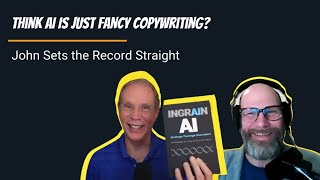
Oh, great question, because we stopped doing the roundtable because I just got too busy. That's a good problem. Yeah, it is just too much to do. So, what they could do, there are a couple of things they could do, and I wanted to do something kind of interesting for your followers and listeners. So I told you at the beginning, I'm writing this book. It's called Ingrained: The Blueprint for Scaling AI from Strategy to Execution. It basically explains to you how to use the AI strategy canvas in those 3 areas that I was talking about, how to use it to develop strategy, how to use it to implement strategy, and how to use it to execute. And I'm, as you can see, since I haven't shaved, I'm still writing it. I'm thinking it's going to be available in September, but We're going to probably put it on for about $49. But if anybody would like an advance copy when it's ready, I'll give it to your listeners for free. We're going to give away probably about 100 of them. All they would have to do is go to bizuka.com, B-I-Z-Z-U-K-A.com, and there should be a link called the End Grain in the AI tool section and they could get an advanced copy there, or they can just reach me on LinkedIn and just, you know, send me a message with the word ingrain, I-N-G-R-A-I-N. If they do that, then I'll know that's what this is and I'll set them up.
So, man, that is awesome, John. Thank you so much. I'm going to be the first one on there and I'll— when it comes out, I'll buy it too. But I want to see the advanced copy too, because I mean, I got a whole note page. It's not AI, it's a piece of paper with a pen, but I got a bunch of stuff I got to do now after this call. So, thank you for sharing the wisdom and the offer for the book, and we'll see you over on bazooka.com.
Awesome, David. Thanks so much for your time. Hey, it was great talking to you. Great meeting you.
More from John

AI Strategy for Business: Build an AI-First Culture Faster - The John Munsell Interview