John Munsell: AI Strategies in Business

In this Badass Direct Sales Mastery episode, host Jenny Bellinger interviews John Munsell, CEO of Bazooka and veteran of digital marketing, software development, and AI. John recounts his 40‑year career, from early spreadsheet tools in financial services to building web and mobile applications, and his pivot to AI after discovering ChatGPT in 2022. He explains Bazooka’s proprietary AI frameworks – the AI Strategy Canvas and Scalable Prompt Engineering – and introduces the "10 Stages of AI Mastery" model that helps organizations assess and grow their AI competence. The conversation dives deep into a concrete AI‑driven sales workflow: Zoom/AI note‑taking, transcript generation, AI‑powered transcript analysis, OCEAN personality profiling, proposal generation, persona emulation, and iterative refinement, all designed to free salespeople from paperwork and boost conversion rates (claimed 65‑70%). John also shares Bazooka’s core values (God first, family second, Bazooka third; learn, teach, grow, serve, innovate, execute) and his upcoming book Ingrain AI, a practical guide to building an AI‑first culture, with a free digital copy offer for listeners. The episode emphasizes practical AI adoption, upskilling teams, and leveraging AI to create capacity for salespeople to focus on human interaction.
Chapters
Welcome to the Badass Direct Sales Mastery podcast with your direct sales dom, Jenny Bellinger. Badass Direct Sales Mastery is a podcast for rockstar direct sales moms who are determined to make their business kick ass. Jenny will share her knowledge of effective sales and recruiting techniques, tips to get what you want from your business, and will interview direct sales professionals and leaders from various companies. The interviews will give insight to how these rock rock stars got to where they are and where they plan to grow in the future. And now, the direct sales dom, Jenny Bellinger.
Welcome back to another episode of Badass Direct Sales Mastery. I'm your host, your direct sales dom, Jenny Bellinger, helping you whip your business into shape. And today I have with me John Munsel. Now, John Munzel has been involved in digital marketing, software development, artificial intelligence for over 40 years.
Oh, stop.
I know, craziness. And now, as the CEO of Bazooka, John has led the company to multiple appearances on the Inc. 5000. In 2022, he rebuilt Bazooka from the ground up, shifting its focus to help business leaders understand and accelerate their adoption of AI. AI. John has dedicated thousands of hours to mastering AI technologies, and this has led to the creation of the AI Strategy Canvas and the Scalable Prompt Engineering, both of those registered and trademarked. So, John, welcome to the show.
Thanks, Jenny. Great to be here. Appreciate you having me on.
Absolutely. No, and I'm excited to have this conversation because I've had a few conversations in the past couple of years around AI in general. And it's really advanced so much since I first remember hearing about it, which was January of like 2023 when, right, you know, ChatGPT had really like— I swear every conversation I had, it was like every third word was ChatGPT and that, right? And now we have like so many AIs out there. So how did you get started into the world of digital marketing, software development? What brought you into this world and how'd you transition into AI now?
Yeah, great question. So I spent the first 17 years of my life in financial services, and in the latter segment of that— well, I mean, just to— since you shamefully said I've been in business for 40 years, uh, when, when I got out of college, that was the year IBM came out with the first PC and they dropped it on my desk and said, figure out how to use this thing and then teach us. And so, I was like, well—
Right. They're like, hey, youngster. Yeah, here we go.
And so, I went through literally every iteration of a spreadsheet from the first one, which was called VisiCalc to Lotus 1-2-3 to Symphony to Excel. And so, I, you know, I built a lot of spreadsheets. And at one point, I developed a spreadsheet that analyzed commercial financial statements so lenders could you know, look at the lending ratios and make financial decisions. I did more complicated things than that. But right when I moved to Florida— so this was in Baton Rouge, but I went to move to Florida, went to another bank, and I thought, you know, they didn't have the tools that I had built for the other bank. And so another friend of mine happened to also have moved to Florida. He moved to Orlando and I was in Tampa. And I called him up and I said, hey, do you still have that spreadsheet that we created? He goes, yeah. And I'm like, hey, what do you say we, we rebuild that thing and we sell it to other banks? Because I rebuilt it for our bank. So anyway, that introduced me to the world of direct response marketing. And so this is like, you know, in the late '80s, early '90s. So I had to learn how to write copy. And back then there was no email, there was no nothing. So you literally had to write some— write a sales letter, put it in an envelope, mail it out. And just hope a check showed up in the mail a few weeks later. That was the only way you knew the thing got delivered, right?
Oh, wow.
And so we got to be pretty good at that. It was kind of fun. You know, you just, you know, you'd package all this junk up, mail it out, and then you'd sit there and then all of a sudden, you know, literally checks would show up in the mail. It was hilarious. But I learned a lot about pricing. I learned a lot about copywriting, learned about headlines and all that stuff. And that, that got my propeller spinning, so to speak, you know, the marketing propeller, the computer propeller had already been whirring. But then in '97, in '96, when the web came out, I was, you know, working still in financial services. And but I thought, wow, this is where the future is. And it's a heck of a lot more fun than financial services. So I, so I ejected and started a company to build web applications for businesses. And back then you could sell them for multi-six figures, you know, because there was nothing that existed. There were no templates, no nothing. So, we gradually grew that company and then we relocated to Lafayette, Louisiana, 2003-ish and grew it from there. And then, of course, mobile phones came out. So, we had to build mobile applications. Then social media came out. So, we were doing that. So, you know, we just kind of morphed into a digital marketing agency that also did software development at the same time. And then 2022-ish, at the beginning of the year, we started to use tools like CopyAI and Jarvis, which is now Jasper. But we were using those to write copy. And it was interesting, you know, it would give you a head start, but I always said it just talks in circles, but at least I didn't have to start from a blank sheet of paper. But then November of '22 happened, and that's when ChatGPT became available to those of us, you know, who didn't have insider access.
Right.
And when I saw that, I was like, oh, this really changes everything. And so around that time, a little bit before that, one of the guys that used to work for me, he went on to start his own company, work for a competitor. They merged. And then, you know, he and I always were friendly. So we were having lunch one day and he, you know, we were talking about growth in the new year. He's like, how are you going to grow? And, um, I said, I don't, I don't really know that I want to. I said, um, how about you? And he goes, well, I'm thinking about growing via acquisition. I said, well, would you want to grow by acquiring a portfolio instead of a company? And he says, maybe. And so then he said, let me get my financing in order. And so he got his financing in order and then he called me up and he said, let's go have lunch again. That we did. And he goes, you still interested in selling? And I said, sure. He goes, how much you want? And I told him, and he comes back within 4% of that number. I'm like, okay. So, so, you know, I sold off the agency side and then just went headlong into AI. And well, let me— that's kind of oversimplifying it because what I did was I thought I'll just become a fractional CMO. And my wife and I, you know, are at that time had just become empty nesters. And so we're like, hey, we could travel, see the kids, blah, blah. So as I always tell people, I landed a couple of fractional CMO gigs and realized I just traded the job that I didn't want anymore for the same job. So, yeah, so I spent a year working with executives thinking I would teach them marketing. So every Friday I had this roundtable discussion and I would just teach them some marketing stuff. But since I went from 40 employees down to 2.5, I had to use AI to do a lot of workload, right?
Yeah.
And it was in that process of teaching people that I realized they were more interested in AI than anything else. And so I thought, okay, well, I'm going to use this opportunity to figure out what problems they wanted solved, and then I would develop a company around solving those problems. So, you know, there's a long-winded story to how I got into to AI.
No, and I think that's an important piece though, because it all— every single one of those things is an arrow pointing to where you ended up, right?
Yeah.
You know, because they're all interconnected in some way, shape, or form. So now with what you're doing with AI, how is it that you are helping people? I know you've got a book and some other stuff, but how are you helping companies, businesses? Like, what's the thing you're doing now with AI?
Well, so we teach people a specific process and framework. We have this thing that we call the 10 stages of AI mastery. And most people are at stage 1 or 2, but they think they're at stage 9. And they don't realize there's a whole lot more to it. And so when we look at an organization, we look at the collective expertise and we're like, whoa, that's way down there. And then they're trying to bring in an AI application that's a stage 9 application, but they don't have anybody in the organization that understands the other, you know, the mid-7 stages. And so that project goes off the rails, right? It doesn't work out because there's not enough collective expertise in the organization to make that work. And so depending upon the size of the organization, we're either trying to upskill the entire team, you know, everybody that uses a computer for more than 60% of the day, We're trying to upskill them to show them that AI is way more than just a fast copywriter. You know, you can use it for a lot of things. So we teach them how to think differently about how to interact with AI and how to use AI. And then we teach them how to structure prompts in a way that are reusable and shareable across the organization. And then we teach them how to build workflows, and then we teach them how to build agents. And so we move them up that ladder, so to speak. So they come, they become more, more and more efficient and effective. Now think about that, what it looks like in a salesman's life, right? Because that's your audience, right? Forget the HRs and the accountants and all that stuff, right? In sales, what time or what's the highest and best use of a salesperson's time? That's being in front of someone, not being in front of paper. It's being in front of people. Right? And so AI creates capacity. And if you know how to use AI, then you have this excess capacity that is then used to be in front of people because you're delegating the paperwork to AI and you're delegating more than that to AI. And I'll give you an example of one of the tools that we use internally, and we use it myriad of ways. But our old way of writing a proposal back when we were in the agency was we would meet with the client, we would take copious notes, you know, and if it was just me, my copious notes weren't so great. Okay.
Because you're busy having a conversation.
I'm having a conversation. It's hard for me to write. And if I'm writing, I'm not paying attention. And if I'm paying attention, I'm not writing. And so then I'm relying on memory. And then right after I leave that meeting, I'm in another meeting. And so I forget that meeting, right? And so I have chicken scratch and I'm just praying I can get it through. And I hand it off to an assistant. She goes, I can't read your writing, you know? And so anyway, I would have to go back and forth just to get the conversation into a document. And then we would take that document and we'd say, okay, now how— what do we propose to this person? And then we would go and grab a whole lot of boilerplate junk, match it up with, okay, here are your problems, here are your pains and frustrations, here how we're going to address them. Here's a whole ton of boilerplate and then here's the price, right? And then we'd make it look pretty. And that whole process took 3 to 4 days, you know, depending upon how long it was, because everybody else had another job. So you don't just stop what you're doing and put together a proposal, right? Right. Well, enter AI, and there's so many things that you can string together that make this process more efficient. And I'll describe for you our workflow and you'll see why I say this isn't just a fast copywriter. So most of our meetings are held over Zoom, and if they're not held over Zoom, we bring an AI note-taker, something like ApplaudNote. Are you familiar with ApplaudNote? Uh, maybe. Mine's in the family. I might have brought it here. It's literally the size of a credit card. I mean, the exact dimensions of a credit card. It's just about twice as thick.
Okay.
But it'll record the meeting and digitize it, give you a transcript.
Oh, wow.
And some other fun stuff. But in Zoom, we typically have Fathom as a note-taker. Zoom will give you a transcript. It doesn't really matter. But so you think about it, we have the meeting over Zoom. We have now a transcript. We take that transcript and we run it into an AI transcript analyzer. Typical transcript analyzers just give you a to-do list after the fact. Yeah, we have architected ours to go way beyond that. We have it looking for nuances in the conversation. We have it looking for unspoken needs or opportunities. We have it looking for a whole lot of things. So we do a transcript analysis, but at a minimum, it's pulling out the pains and the frustrations and the desires of the person that we were just talking to, right? So that's one GPT that we have. We finish that one and I roll that into a proposal generator. Now that proposal generator has all the description of our products and services and pricing and strategies and all that other stuff. But the system instructions on that are designed to look at that analysis of that call and then match up the right thing or make suggestions of it. Right. So it creates this proposal. The next step, though, this is where it gets really wild. We have another GPT that analyzes the transcript again, but it analyzes the prospects on the call for their decision-making process, their thinking processes, their communication style, their needs. Right. And so then it turns it into a persona profile of the person we were just talking to. Right? So think of it as it's kind of like a DISC profile, but, but in our case, it's called an ocean profile. But it has all of those nuances that you would normally not know about, right? It, it turns that into a document. We now have that document, so I can roleplay with it in the future. But my next step is to turn around, and I have a personality emulator GPT, which takes that personality we just created and now emulates the p— or that person, and it reads the proposal that we just wrote. And it reads the proposal, comes up with objections and questions, and then it loops back in and it rewrites the proposal to refine and address those questions or objections. And it goes through that loop 3 times, and then we have a completely 100% bespoke proposal, no boilerplate whatsoever. And it's, you know, form fit for that individual and their problems and their communication style and what they're looking for. Right. That's crazy. That whole process takes about 40 minutes because we teach people to be the human at the helm, not a human in the loop. So at the helm, you're guiding that process, but it's just literally seconds as it does it. And then you have this refined thing. But it's amazing. And so what we do now when we're having a call with somebody is we immediately— I mean, this is just good sales process, you know, we immediately set the closing appointment with them. So it's already booked on the calendar. So the email that we send to them does not include the proposal, but it does say, look, here's some of your pains and frustrations. We're looking forward to meeting you on Thursday. We've addressed them, and then there's this certain way that we address them to kind of hook them into saying, I want to see what this is on Thursday. Right? And all that is generated by AI and read again by the emulator to make sure we nail it and keep it intriguing. So all of that stuff is done by AI, and that's where you can really leverage up, you know, your sales force. Right?
Oh my gosh. I like— I am just sitting here like in love with this process because as a marketer and a salesperson, and especially one who's very people-centric on that, and the best salespeople are, as we know, they are— you've got to be people-centric, not dollar-centric.
Yeah.
You know, I love the fact that it's taking into account the, the person on the other side of the table in such a personal way to be able to say, Okay, based on how they showed up, here's what we see as their profile and, you know, etc. Like you mentioned DISC, that happens to be one of my favorite, favorite ones. I've not heard of the Ocean one. I can't wait to find out what that is. Like, is that a proprietary one or—
No, no, you just tell it you want an Ocean profile and it knows what the acronym is and it'll pull it all together for you.
Oh, okay, cool. I'm gonna go look that up now because now I'm curious. I love—
It's got more letters than DISC, so that's why I went with it.
Oh, okay. See, I I like DISC because it's simpler, right? I only have to remember 4, right? And, and just knowing that everybody has all, you know, some D, some I, some S, some C, right? But again, that idea of the AI being able to say, okay, based on the recording from your strategy call, discovery call, conversation, whatever, because it's not really a sales call yet because you're still trying to figure out— because you can't sell them until you know those things, till you ask the questions, till you find out The, I made sure that I mentally noted this, the pains, the frustrations, and the desires, as you talked about. I think that's a really important piece for people to pay attention to, because if you're not doing those in those conversations, your conversion rate is going to not be as good as other people. Right?
Well, you know, here's the other thing, right? What's the other thing that's really the hardest part for an, for a salesperson? And that, that is the getting in front of somebody in the first place. Right. The prospecting. And the minute you're in front of somebody, the last thing you want to do when they say, what do you know about us? And then you go, not much. What can you tell me about you? Okay, well, you just lost the deal. Right?
Right.
We have an entire process around analyzing the prospect before we even get there. But it's so detailed. It gives us everything they do. I don't know whether you're familiar with a business model canvas or not, but. Okay. We analyze everything about that business. I want to know what their departments are. I want to know what their customer segments are, who their potential partners are, what their cost structures are, what their revenue flows are. All of that stuff I can get AI to tell me, but I can get it to tell me in the context of the solutions that we provide. And it can tell me, you know what, here's how you can help them. Because in this division they need that and you've got this, right? And so I can go into a meeting now fully briefed, right? Because I get that, I get that briefing, you know, the minute we decide they're a good prospect. So that's a whole automated process in and of itself. But I get that briefing and then I really study it and understand what's going on. But the briefing is created by an AI assistant that knows everything about our products and our services and our advantages, right? All that stuff., and it matches it up with what's going on there. And so when I'm on that call, I can say, do you, do you, you have this problem? And they go, yeah. Okay, well, you know, have you thought about solving it this way? And no, you know, so there's so many things that, that I'm briefed in that there's no other salesperson that come in that could come in before me or after me that is as well briefed as I would be. Does that make sense?
Yeah, it does. It does. And again, that's the, that's the personal side, right? It's taking into account the actual human that you're talking to, the, like, where they are. And, you know, my experience with just having worked within the same industry for 15 years now is, you know, when you can say, well, is this what you're going through, right? Now, I haven't done my AI research with people, but just because of how they answered some questions on my Calendly form before they came in, I can generally gauge, okay, here's where they probably are in their business and here's probably what they're experiencing and that, you know. And so when I ask those questions and they're like, yeah, how did you, how did you know?
I don't even remember answering the question.
Right, exactly. Because exactly, they booked the appointment with me a few days ago, a few weeks ago, whatever. And so they We can't remember what we had for breakfast yesterday. Sometimes we can't even remember what we had for breakfast today, let alone answer some questions for somebody's calendar thing, right? But when people can feel so seen and understood that, that preparation that you went through, because again, your AI did a lot of that for you to look through who they are, what they're doing, and then said, here, here's some pain points that they're probably experiencing. Here's some of the solutions, have like, here's some ideas, blah, blah, blah. Like it can pre-tell you how to, or tell you how to go into the conversation. So you're, you're ready to go. And I think that little bit of preparation is something that a lot of salespeople miss.
Yeah, true. And, you know, and think about how much more effective you are with an inbound lead because you just described an inbound lead process where somebody filled out a form, right? Right. So with Calendly, you know, it's got an API, so I could take that, that Calendly form that they filled out, and then I can take that information plus their URL, do the analysis on the URL, match it up with the questions that they answered, and then, then come up with other issues that they probably haven't thought of. So we can have a really interesting discussion And the other thing that we develop is a really deep psychological persona of that person based on their role. So if they have a specific role, we've already kind of got a good idea of what their pains and frustrations and fears are. And sometimes, you know, it centers around recognition. Sometimes it centers around job security. Sometimes it centers around family. You know, there's a lot of things, but from all of that, it'll help us generate an interview kind of thing that pulls more of that out. But we also go into that very well briefed. And in some cases, it's really interesting. I don't know, Jenny, I get so excited about some of this stuff. I'll babble on incessantly, but I love the fact that I can take a transcript after having a conversation with somebody and I can match it up with, you know, future stuff, and then I can have better emails, better conversations, all of that stuff. You know, I had a conversation with somebody just, just this week, and we were just literally having a conversation, and it turned out that we might have a really good partnership opportunity. So I did my sales workflow, but in a very specific format to extract from that conversation what were some things that I may have overlooked? What were those hidden bits of communication that are opportunities that are hidden from view? And what it pulled out was amazing. I was like, whoa, I wouldn't have thought of that. And so then I had it craft an email to this person as a follow-up. And I was looping in another person to introduce this person to. And so I said, you know, I have this block that I call thoughts, you know, and I add that into the prompt. And the thoughts were, okay, I'm going to introduce him to Bob and I'm going to CC Kelly so she can help coordinate the meeting, all that other fun stuff. And then it spits out this email. And then I said, okay, now I want you to emulate the guy that we were talking to and read that email. And it says, Oh, this is really strong. This is really strong. This is really strong. And this is okay. This one needs to be tightened up because I think this way and that's not written that way. Oh, okay. And so we would tighten up the email anyway. It's, it's just, it, it's fast and it's fun and it works.
Right. Well, and I would imagine then that your conversion rate with people or companies that you're working with is pretty darn high because I mean, the average, average sales rate, I mean, from— I see statistics all over the place around this, but it's somewhere around 30, 33, 35% for most people, most salespeople. But when you're that dialed in to who you're talking to and the way that you are sending out follow-ups and conversations and emails and proposals, I mean, do you mind sharing? Do you know what your conversion rate is?
Yeah, ours is closer to maybe 65, 70%, but it's better than that because our average sale is significantly higher and our, and the duration of our relationship is significantly longer. Right. I mean, we've had some deals where I thought we were going to get a $1,500 sale and we ended up with a $400,000 sale over 2 years, you know, so that's a decent little growth. Yeah. But here's the more important thing, Jenny, the more important thing is that we're solving problems for the prospect. We're not selling a product to the prospect. And that's the mistake that we've seen a lot of salespeople go into. They go, hey, you know, they open up their coat and go, you want to buy one of these? Buy one of these? Nope. Okay. How about over here? Do you want to buy one of these on the other coat pocket?
You know?
Right. And we're like, we don't want to do that. Our whole thing is we're just asking questions. And we just want to know, does this hurt? Does this hurt? Does this hurt? Does this hurt? But the good news is we have a pretty good idea of what hurts going in. And so as we're probing for pain, we're more likely to get it. And like you said earlier, they feel heard, they feel understood. And we on the other end know that we can help, right? That's the whole idea. So we're passionate about what we do. We're passionate about helping people. We're passionate about helping employees keep their jobs because they're infinitely more valuable. And even if they contract it out, they now have skills they can take somewhere else. So that's really what we're all about. But it would be wholly different if all we said is, oh, we have this course. Do you want to buy it? Does that make sense?
Yeah, yeah, yeah. No, and I mean, that's something I've said for a long time. Like, the best salespeople are the people who are solving problems. Right. You know, I regularly tell people I have 100% sales conversion rate. It's just, I'm not always solving people's problems with my stuff, because if I find out that John doesn't need help with launching a podcast or doing sales or whatever, then I'm going to go, okay, so what is your biggest need right now? Like, what can I help you with? And I'm going to introduce them to the person. I'm going to introduce John to the person who, or the company that does do that thing. Right. Because it really is about problem solving. And so, you know, hopefully the person listening right now, the badass crew are listening right now and thinking to themselves, okay, what problem do I solve? Do I really feel the pain points of my ideal, my best client that I can help and help make sure they feel heard, understood? And that I've got the solution to their problem, to their pain, whatever that may be.
Yeah, completely. Yeah. You know, our— we have the 6 values, right? Our leading value statement is God first, family second, Bazooka third. Meaning, you know, we, we want our people to be engaged with their family, and I want them to worry about Bazooka after their personal lives are, you know, great, right? So, but then when we get down to being Bazooka, it's learn, teach, grow, serve, innovate, and execute. So we want them to learn, right? Because they're inquisitive and they want to learn new things. We want them, for whatever they learn, we want them to teach others, right? Teach others in the organization, teach others outside of the organization. We want them to grow personally. Spiritually, mentally, whatever it takes. But so we want them to grow. More importantly, we want them to serve. But when they serve, it's not just about service to our customer, it's service to the people they work with, right? So we want them to have that attitude of service no matter who we're addressing, right? So learn, teach, grow, serve, innovate. I want them to think differently. I don't want them to look at the status quo and say, well, that's how you taught me to do it. I'm always going to do it that way. I want them to look at, especially in the space we're in, AI changes seemingly hourly. I don't want anybody getting caught into complacency, so I want them to innovate. And then finally, we want them to execute right. I don't want them to do just dilly-dally all day long. They got to get the job done. And so that's, that's how we drive the company. And so it's not really how fast can we make a buck or, you know, how fast can we turn something over? It's really all of those things combined is kind of our focus. And you, and we, we interview against those values too. So if we have a feeling that you're not going to quite line up, it doesn't mean you're a bad person. It just means you're not going to be a good fit here. Right. So that's, that's how we roll.
I know. I, I I really do love that because again, going back to, you know, when I, when I'm working with my clients around coaching in their business and why should someone buy from this Mary Kay lady who's my client versus this Mary Kay lady, right? They have the same product. Why this gal versus this gal? And, you know, by having those core values that they know that they're sharing with people like you just talked about, by having a give back that they do. So you guys talk about serving. How are we serving? With my clients, I'm like, pick a nonprofit, any nonprofit that part of your revenue goes to. Because now the difference is, is I can buy this skincare cream from her or from you, but if I buy from you, a portion of it goes to help animals or children or whatever the, the, the The thing is, so I, that's, that your business can't just be business. There's got to be some heart to it, you know, behind that. And I love that you guys are also operating that from the standpoint of also taking care of your employees that way too. That's, that's really amazing. And so with all of this we've been talking about, you've also written a book about AI. Then tell, tell, tell me about the book.
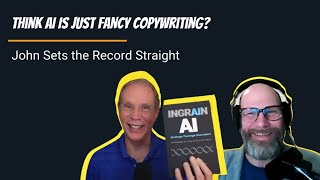
Sure. So the book's called Ingrain AI. And it's, it's called, it's about how do you build an AI-first culture in your organization from strategy all the way through execution. So some people learn from the book how to write, you know, better prompts, and other people are learning how to develop better strategy for their organization. And a lot of people will, you know, larger organization go, Oh, wow, this is what AI adoption looks like all across. If I can get everybody learning this with a common language and a common understanding of, of how AI operates, now I'm crushing it. And so it's, it's a pretty broad book, but it's a very detailed book. You know, it's not one of these books that says AI is important, you better do this, or, you know, the world's going to collapse. It's, it's a book that says AI is important, you better get on board, here's how you do it. It's, it's a very specific how-to manual. And then I'm, I'm in the process of writing, uh, a, a— I don't know whether to call it a sequel or companion book or an update book. I— it's, it's too soon to tell, I guess. Uh, but, um, that one theoretically will be coming out in April, so I am Oh, here's my M.O., Jenny. You might find this funny. My M.O. is I go hole up in a hotel for a week at a time. So it's almost like working on an oil rig, you know, where you're 2 weeks on, 2 weeks off. This is 1 week on, 3 weeks off, 1 week on, 3 weeks off. And so what I'm doing is I'm hiding out in a hotel and in a couple of weeks for a week, just blistering, writing the book. I'll come back, let it marinate while I keep doing work. And then 3 more weeks, I'll go hide out in a hotel again and blister out the book, and then I'll have it all done. But there's so much that has gone on in the last 12 months. I mean, the curve is exponential at this point. And so, it's not that any of the principles that we teach have changed. They're actually becoming more important. But after working with hundreds of companies, we've seen new paradigms, new patterns, new things that we that people need to be aware of as they implement and adopt AI. So that's, that's what— so this will probably be called Ingrain, Ingrain AI, but something else, some new subtitle.
Okay, gotcha. Now, and I, I, I love the process, by the way, because I've actually thought about doing the same thing when I write my book, is like go get an Airbnb where there's no other distractions, like out in the middle of nowhere and just type and just have it there, you know. Um, so that's fantastic. And so, um, one of the things you're offering for our audience then is if they're interested— so the Badass Crew— if they're interested in learning more about this and, and seeing what's coming down the pike from somebody who's been working with AI from the get-go. I mean, I, I think I know you and one other person now who are like, oh yeah, I was I was playing around with AI before ChatGPT became a thing. So I'm assuming you probably know Molly Mahoney.
I know of her. I don't know her.
Oh, oh my gosh. I did an episode with her and I've, I've had the opportunity to be on a couple of different marketing conferences with her. Oh, cool. She is fantastic. Yeah, absolutely. So hearing you say a lot of the same things is really neat there. So, but anyway, Moving on, because you're one of the people I know who's been doing this so much longer than everybody else, you're beginning to get to the point where you're seeing the things that are shifting and seeing the things that are coming. And so the gift you have is the opportunity for what now?
Well, yeah, great question. Um, yeah, no, uh, it's the same process that we went through last time, which is, look, if, if you go to ingrain.ai/2026, that way In 2027, if somebody is listening to it, they'll know the offer has expired. But yeah, but it's ingrained.ai/2026. They can get on the waiting list, right? They just have to tell me that they heard about it through your podcast. So if they tell me they heard about it through your podcast, then we'll give them a digital copy when it comes out for free. I would give a hard copy, but I last time I did that and I had to ship some to Sweden and to Australia and it cost me like $60 a book. And not including the cost of the book.
So that was a little bit challenging, but yeah, no, but I think the digital piece is important, right? Because, you know, the, the great thing about getting those digital copies is depending on your device, you can have it read it to you. So, you know, um, so that is fantastic. So again, badass crew, if this is something, if this conversation has really piqued your interest, or you are one of those people that John talked about at the very beginning, we're talking about those different stages of AI incorporation or mastery, and you're thinking you're like a 3, a 4, a 5, a 6, a 9, and you're realizing, oh no, I'm a 1 or a 2, you probably want to check this book out. So again, it's ingrained.ai/2026. And of course, my badass crew already knows the answer to this one. The link is in the show notes, so you guys don't even have to type it out. Just grab your phone, as long as you're not driving, click on today's episode, scroll under John's picture, and there you will see the link to grab your digital copy of the book or get on the waitlist, uh, for that. So, um, and make sure you let them know you heard it on Badass Direct Sales Mastery, so that way, uh, you get your free digital copy to learn what's coming up. In AI now. So, John, thank you so much for being here. This was such a fascinating conversation. I really loved it.
Yeah, it was a blast.
Oh my gosh. And so opportunity for a last thought in, in regards to AI and how it applies to a sales business.
Yeah, I mean, 2026 is going to be a really crazy year. So I wouldn't put off learning how to use AI. Okay. Last year was all, and the year before is more about how do you, how do you just kind of ask questions? This year is going to be how do you actually build authentic workflows where it takes off and does stuff for you? I mean, there's nothing better than waking up and rolling up to your desk on a Monday morning and having everything prepared for you, right? All your research and everything just sitting there waiting for you. AI can do all that if you know how to set all that stuff up. But as a salesperson, there's never been a better time to leverage your time and to be more productive, but also more effective and to give more back to the people that you serve. Hmm.
That is a wonderful thing to end on. So again, guys, if you want to connect with John, we do have all of his contact links down in the show notes.. So please feel free to check out what he's doing as well. So, John, thank you again for being here.
This was awesome.
Thank you. Absolutely. And of course, badass crew, you know how this goes. Stay tuned because there's another badass episode on its way.
Thanks for listening to the Badass Direct Sales Mastery Podcast with your direct sales dom, Jenny Bellinger. Why are you you waiting to go to badassdirectsalesmastery.com? Don't make the Dom get her whip. If you enjoyed this episode, make sure to share it with another rock star that you know in direct sales after you subscribe to the podcast so you won't miss any future episodes. You can also check out the show notes for links and any contact information mentioned in today's episode. We'll see you next time.
More from John
AI Strategy for Business: Build an AI-First Culture Faster - The John Munsell Interview