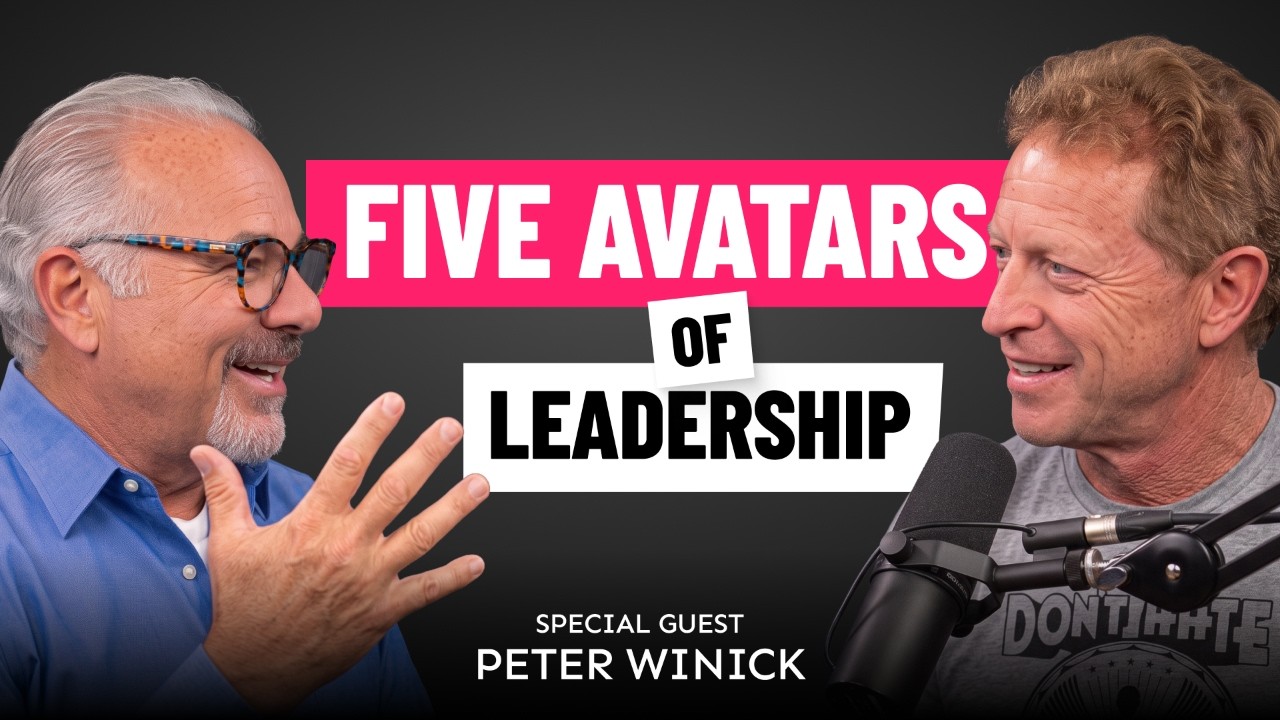
This content was created by John Murphy. This content was uploaded by John Murphy. This is a YouTube interview episode titled "5 Avatars of Thought Leadership | Peter Winick" (a Fearless production by Fuel) recorded/posted 2026-08-29. It features host John Murphy interviewing Peter Winick about thought leadership: defining it, the five avatars (growth-minded CEO; impact/legacy executive; thought leader on the run; in-house expert; Hall of Fame thinker), and practical guidance on strategy vs. mere activity, Lean thinking, emotional intelligence, cross‑pollination of ideas, publishing, and using GenAI to scale and role‑play ideas. The tone is an actionable, conversational podcast aimed at aspiring or practicing thought leaders.
Chapters
Well, hello everybody and welcome to Fearless, a production of Fuel. And if you're not yet familiar with Fuel, I got to tell you, you got to check it out. It's all about lifelong learning. And surrounding yourself with brilliant minds, thought leaders, which is what we're going to talk a lot about today with Peter Winnick. Peter's a fellow FUEL instructor. I highly recommend you check out his course on FUEL and some of his interviews with Todd Duncan, the co-founder of FUEL. And today I've got the privilege of having him on Fearless. So what's Fearless all about? Well, in a word, it's about fearlessness. It's about leadership. It's about taking an idea And actually doing something with it, acting on it. And as Peter's going to say, ideas don't speak for themselves. And I just love his line of work and how he'll speak about strategy and how that relates to tactical execution and things like that. And why the why is more important than the how. So you've got to be really clear on the why. And you've heard me say before that you figure out the how along the way. So when I started my practice 38 years ago, I had a big why. I really wanted to help the world with something that I had skills with and experience with. And back then, there's no AI. There's no Google back then, no YouTube, nothing like that. So you're actually reading books. I'm surrounded by books. Peter's the author of the leadership handbook, the Thought Leadership Handbook, which we will share with you a little bit more on later. He is the founder and CEO of Leveraging Thought Leadership. Actually, the host of Leveraging Thought Leadership podcast. All right. And so, this is going to be all about what is thought leadership? And I've heard Peter say, well, it's thought and it's leadership put together. And we'll have a little fun with that. So, with that, Peter, hello and welcome and say a few words about yourself. And then let's get right into thought leadership and these 5 avatars that you speak about. I want to hear a lot more about Sure.
Well, first, thanks for having me on. As you mentioned, I've got really 3 buckets that I focus on. The business, which is Thought Leadership Leverage, is my primary focus, where we work with all sorts of nonfiction authors, academics, keynote speakers, thought leaders, et cetera. Podcast, we're coming up on 750 episodes over the last 8 and a half years. So that's been a blast. And then the latest one is the book. The book just came out fairly recently. I'm the co-author of the book, which is The Thought Leadership Handbook. So that's been a lot of fun being On the other side, because I've been sort of the behind the scenes with hundreds of hundreds of clients and their books and finally have crossed over to the dark side of being a published author.
So. Yeah, well, you know, I've got 20 books published. So there's another example of taking an idea and actually doing something with it. And again, if you're— if our audience, if you're sitting there and you're thinking, well, I got it, I got a great idea, but I'm just afraid to do something with it. And this isn't just about a business idea. You might be in a relationship that you're unhappy with. but you are afraid to make a change. It could be a job that you are unhappy with and you are afraid to make a change. So, this, the whole mission of this podcast is to help you look at things just a little bit different and hear from thought leaders about how they have managed their way through Yep. a fear, you know, to get, or adversity, something like that, to get to where they are today. So, we are going to hear a lot about that from Peter and Can we start with just a quick summary of what you see thought leadership as, Peter? And then let's get into these 5 avatars a little bit and play with that.
Yeah, so thought leadership is a lot of things to a lot of people, right? But to me, if it's— A, it's a lot of fun, right? And it could be a great business. And it could change the world. And it could lead you to opportunities in places that you never thought before. So I might be slightly biased. The last 20-plus years, but I don't know anyone that is a thought leader, an active thought leader, that hates to get up on Monday morning and get with it or is dreading the next day. So to me, that's a good litmus test of, hmm, people making an impact, making a good living, enjoying what they do, and unleashing the power of the ideas that they've developed and deployed.
Yeah, well, I— you just hit the nail on the head with me. I, I can't wait for Monday morning. I can't wait for Tuesday morning. I, I really do feel that way. I love— and I didn't used to feel that way. You know, my first job out of college was in corporate finance. I was a finance degree out of Notre Dame. And after 2 years, I couldn't— I was pulling my hair out. I was like, I got to get out of here. This is— this is boring.
Right.
So anybody who's really struggling with a decision. But leaders make decisions. They don't— doesn't mean they always get it right. Isn't that right, Peter? You mean, but you, you act, you do something with it. Is that— what's your, what's your experience with that? That, you know, is it— is a person always going to get it right when they take an idea?
But I think the act thing is actually part of the problem, meaning my clients are really, really smart, right? I mean, literally, some of them are number 1 in the world at what they do. recognized as such, etc. However, there's one common thread that I see across many, many thought leaderships is they confuse activity with productivity, right? So they're hardworking. You know, they're willing to put in the reps. They're willing to do the work. But activity is not productivity, right? So to me, that speaks to the need for a strategy because it's not that you don't want to do the things, but you're doing the right things in the right sequence against a set of goals and objectives so that you know that you're Trying to get, you know, you're getting closer to where you want to be as a thought leader. Because we could spend all day on social media. We could spend all day speaking to clients. We can spend all day doing lots and lots and lots of things. But are they helping us? Are they helping get us to where we need to go? Not always, right? Because you're not— if you're not doing things, then you're just active. Active is cool. But, you know, I prefer productive.
Yeah, I've used the term activity trap for a long time.
Yeah, exactly right.
You get trapped and you're busier than crazy, and, uh, but you're not really getting anywhere. So you're just, you're just busy. And, uh, I play around with this term, I call it the closet space syndrome, where you just fill up your closet space with all kinds of stuff or activity, and then you start thinking you need more space, you need more time, you know, you need, you need more. When the real secret to productivity Is getting rid of stuff.
Yeah.
I really don't need these distractions, all this clutter. So, you know, and I teach Lean, as you know. So when I go into an organization and they're taking 50 steps to do something that should take 5, that's just clutter.
Yeah.
So you take out all that waste, all that non-value-added activity, and now you've got an orchestra. You're not playing like a garage band anymore. You've got harmony. You're playing as one, right? And that's huge. But I'll let you know, I love the idea and I want to hear your thoughts on this too, is the ideas I've been executing on for a long time now haven't all been mine, not by a long shot.
Sure.
So, I think it's critical for anyone to realize that I don't have to be a genius to, you know, be highly successful. But what I want to do is surround myself with as many geniuses, as bright people as I can, because a lot of the ideas I've executed on haven't been mine. They've been somebody else. The first book I wrote, somebody said, yeah, you want to— you got to write a book, John.
So let me, let me add to that. I think a lot of people, when they think about thought leadership, think they need to come up with, you know, something radical, something totally out there. And, and sometimes that's true, but usually what I see is it's not an issue of You know, everybody thinks the world is flat, but I know it's round. I'm going to prove them that it is round, right? OK. I think a lot of it is acknowledging and having the wisdom to acknowledge there are others that came before me in my space, whether that's leadership, whether that's management, whether that's communications, whatever it is. And a lot of what they say is true. Many of the things that they say is true. Sometimes it's adding just an incremental thought to it, a twist, a nuance, a little bit that changes it. It changes it a lot. So I think it's not necessarily about, you know, staring at that blank slate. But what is it that you're adding to the conversation of management, of leadership, of whatever the area is that you practice? And does it lead to a better outcome for those you're serving? And if the answer is yes, then that's thought leadership.
Yeah, exactly. And you use the term cross-pollination too. I've heard you use that where A lot of the best ideas come outside the box you're in, whatever box that happens to be.
I think that's right. Yeah. Yeah. I mean, I think what happens is some of it is organizational, some of it is human nature, is that things are siloed, right? If you're an accountant, you hang out with a lot of accountants and you go to accounting conferences and you know everything there is to know about accounting. But if you're an accountant, and when was the last time you talked to a marketing person? When was the last time you sat down with a creative person? When was the last time you sat down or or read poetry, whatever it is. So I think that this diversity of ideas that are best practice, like Lean came, you know, comes out of operations and productions, right? But then Lean moved over into software development and became Agile, right? It didn't start as a software development framework or methodology, but the software developers realized we could steal some principles from Lean. We can do some other stuff with it. And now we call it Agile software development, right? So that's, to me, that's an example of where do you—
Yeah, in fact, if you think about it, you know, back in, you know, Lean was coined in 1990 at MIT, the term, and James Womack, Daniel P. Jones wrote the book Lean. First, they wrote the book The Machine That Changed the World, which was about Toyota, the Toyota Production System, and then they came out with Lean Thinking. But for a long time, Lean was called Lean Manufacturing. So people would think, oh, that's just something you do in a factory somewhere.
Exactly.
And hospitals would be, that doesn't apply to us. We're a hospital or a university or a service retailer. No, wrong. Because Lean, if you have processes, you have an opportunity for Lean. In fact, I am, when I'm teaching black belts Lean, I'm teaching them to use it at home. take this root cause analysis tool home and try it on your own self, you know. And so it's, it's now that, you know, the lean thinking applies everywhere, which is, which is so important these days because, uh, if you're not thinking lean, uh, and AI is coming out stronger and stronger and stronger, you better watch it.
So stay, stay there for a minute, the, the take-it-home thing, right? So in my world, we, we focus on thought leaders that are B2B. So their work is most useful in a business environment. However, that being said, I would say over the last 20, 25 years, the stuff that's caught fire most are things that you can use at home. Think about emotional intelligence. Think about—
Absolutely.
—a growth mindset. Think about resilience. So it's not packaged in such a way where you need to tell people, hey, Peter, you can go home and talk about this over the dinner table with your loved ones. Right? But you don't need to tell people that, right? You don't need to tell, you know, if you're taking a program on empathy or social cues or whatever it is, it's pretty obvious that those are tools that you can use in other domains of your life. And if you're using it in other domains of your life, right, that's pretty cool.
Oh, yeah, absolutely. To me, that really takes it home. And I've heard you say, learn it, do it, teach it. Yeah, to really, you know, to really embody it, you know. And so you learn a tool, And then you have to swing the golf club if it's a golf club. You know, you got to do it and to the point where you can now teach it.
Correct.
And by teaching it, you're learning it at a deeper level even. So I think that's essential. You mentioned emotional intelligence. You know, the first competency of emotional intelligence is self-awareness and then social awareness. So I think ideas, if you want to be a thought leader, You better be aware. You better pay attention to what's going on around you because you're surrounded by ideas and opportunities. We all are. But you also have to be aware of what's going on in your own mind and your own heart. And if you're afraid, okay, you're almost paralyzed. Here's something that's interesting. The National Institutes of Health came out and said that, you know, roughly we have 60,000 thoughts a day.
Right.
And 80% of them are negative. Ouch. So, if you want to apply a little Lean to your own life, delete the negative. All right? Just start getting that out of your closet because thought leaders aren't negative. Right? Am I right?
That's right. That's right.
You know, you're going to get knocked down from time to time. You're going to run into some obstacles. But you're going to get over it, under it, around it somehow because Quitting isn't an option. Right?
Right. That's right.
So let's talk about these 5 avatars. You know, let's start with the first one. What is the growth mindset? Walk us through the 5.
Well, let me— yeah, before I get into the 5 avatars, let me just talk for a quick moment about where they came from. So Bill Sherman and I developed these over 20 years working with hundreds and hundreds of clients. So this didn't come from academia where we said, Here's a theory and we're going to research the hell out of the theory and then we're going to put it out in the universe. We noticed patterns because most thought leaders aren't hanging out with tons of other thought leaders often. There are places they congregate like Fuel or communities or whatever. But most of the time it's kind of a lonely world. You're out there writing, you're out there speaking, you're out there serving your clients, et cetera, et cetera. But we're fortunate enough that we sit in the middle of it. So we saw a pattern. And we realized that these patterns are helpful to share with people. So the first, you know, the other thing I'll say about the 5 Avatars is they're not, it's not like your blood type. It could change over time and you could be more than one. So like any model, it's designed to be helpful. It's not definitive, right? So you might start off as one and move into the other and say, you know, I'm kind of 80/20. So that's the point, to give you insight in where you are in your journey as a thought leader and where you want to be.
Exactly.
So the first one is the growth-minded CEO. So that is the CEO, could be of a small-cap, mid-cap, large-cap, that is strategically using thought leadership to grow the business, right? So think about the reality of the world that we live in today. And this has been happening since before AI, but AI certainly has accelerated, is we're all being commoditized. I don't care what business you're in. you're selling product or you're in professional services, high-tech financial services, et cetera, you're being commoditized. And by definition, commodities are not differentiated. If I'm selling a pound of wheat and you're selling a pound of wheat, the only thing I care about as the buyer is who's selling it for cheaper. And that's the end of it. Well, that's a pretty crappy place to be as a supplier. I don't want to sell for the— I've never been in a business where I've been the lowest cost provider, nor will I ever be. Right? So thought leadership is a great way to punch above your weight. Like, if you're a consulting firm, small, mid-sized consulting firm going up against the McKinseys or the Deloittes or the BCGs, whatever, there's a long list of things that you can't do. You can't be bigger than them. You can't be in business longer than them. You can't have 400,000 employees like they do or an office in every city around the corner. So, so what? Who cares? Can you be as smart or smarter than them? Can you bring insight into the marketplace that you're serving in a way that's effective? That's what a growth-minded CEO does. They're looking to strategically use that thought leadership to share how they think. And when I say they, the organization thinks to elevate the brand, to attract net new clients, to get invited into the right engagements, etc. So, any questions on that one?
Yeah, well, my comment there is, is that You might not be interacting directly and personally with thought leaders, but one of the clues to my journey over all these years is I've surrounded myself through books, back in the day, CDs and cassettes. I mean, I've got— I'm flooded with brilliant minds who I've never even met in many cases.
Correct.
But the difference between activity and productivity Is I'm spending hours a day learning, right? And learning from really smart people who've been been there done that. So a tip there is I'm not going to be as big or as old as McKinsey or okay or Deloitte or where I actually don't care. I can be smarter. I've actually had consultants from those firms come to my workshops. To me, that's sure an honor. I've had people from the CIA come to my workshops, people from the Air Force and the Army and the Navy. So people. I can be smart without being McKinsey. And I love that what you just said, that is—
And furthermore, furthermore, there's a self-selection piece, right? So if someone is out there that's been consuming the thought leadership that's put out by your CEO or your organization or your firm, maybe today's not the day. The problem and one of the problems in professional services is, you know, we sort of always have the supply, but the demand is beyond our control many times. But if I'm following a thought leader and now a problem comes up, whether it's remote work, whatever it is, I already know that's the one I'm calling, right? Because I've been following this person. Now I know they talk about those things. They have expertise in there. And they don't have to convince me that their way is the right way because I wouldn't be calling and reaching out to them if I wasn't, you know, if I wasn't thinking that the way they think could be helpful to me. Which is a great thing, right? Because if someone, you know, if you convince somebody that your way is the better way, you're not getting paid for that part of the sales process. And that extends a sales process, you know, which is not fun.
Yeah. Yeah. Yeah. You know, I had a fellow Fuel instructor, Brian Byrow, on just a couple of weeks ago. And Brian's actually been on the Fearless Show a couple 3 times now, but Brian, he talks about control the controllables.
Correct.
And so when you start thinking about it, I can't control Deloitte or McKinsey, or I can't control a client. I can't really control anything but my own mind. So focus on that. Control what you can control. Don't worry about the other stuff. And so I, again, I think a critical factor here to, if you're on your journey to becoming a thought leader, and really influencing the world with your ideas, then learn everything you possibly can. Surround yourself with bright people. This is why I'm such a fan of Fuel and you and our other instructors, because to help people live a better and be a more successful person in whatever it is they're doing. Why wouldn't a person who's hungry for success Do that. You know, I really believe that. And why do I believe that? Because that's the only way I got to where I was. I didn't know what to do. You know, Peter, when I started a consulting business, I was reading books about how to start a consulting business. What my first book—
Potentially for Dummies, right? Potentially, How to Start a Consulting Firm for Dummies, right?
Precisely. In fact, I, you know, somebody said, John, you got to write a book if you're going to be in this for the long run. And I'm like, okay, I guess you're right. I read a book about how to write a book.
Right.
I didn't know how to— I don't know how to write a book, get a book published. And, uh, and then, uh, my older brother who just retired as a professor from Notre Dame said, John, you should write an allegory. After the first book, he's like, you tell interesting stories in this book, you should write— I didn't know what an allegory was, Peter. So now I'm reading allegories to figure out how to write. Yeah, and the idea is though I was open-minded and aware. Talk about some EQ here, emotional intelligence.
Yeah.
I was hungry for ideas and I wasn't afraid to execute. That's— so I think those are critical components for anybody listening. You want to really grow, and whether it's yourself, your business, or both, your family, whatever, you got to be open-minded. You got to be willing to execute and confront any doubts you have and trust the process. I've often said, Peter, when I go into an organization, look, you don't have to trust me because we're going to get a lot done in one week, a lot of change, but trust the process because I've used it all over the world and it works.
Yep.
And by the end of the week, they actually do trust me by the end of the week. Not at first necessarily because it's scary. But anyway, so what about the second avatar? Let's go there.
So the second one is what we call the impact and legacy executive. So typically, this might be a very, very senior executive, CEO, privately held company, publicly held company. And they're looking for the next chapter, right? So they're on their way out. Usually, it's a positive thing, right? They've accomplished what they needed to. It's the end of their reign. They've gotten to a certain age, whatever the case may be. But During their careers, they've come up with a set of beliefs, formats, models, frameworks, et cetera. And they're curious about what would it look like to do something with that in some of the time, some of my time, right? I don't want to take on another CEO role. I don't want to be traveling the world working 80 hours a week anymore. But what could I do that's aligned? Because I believe in these ideas and I know that they've worked. And I've used them and seen the power of them. And I want to spend a good chunk of my time doing it. They typically don't care so much about the compensation, but it doesn't mean they're going to give it away for free. Because if you're putting something out there that has value, value should be exchanged. Whether they choose to give that money away or whatever isn't the point. So the impact and legacy, they're looking to say, you know, it used to be that you retired at 62 and you were dead at 65. So that was pretty simple. Right? Like, you didn't have a lot of time to fill. Well, go take a cruise and play golf and then keel over in a rocking chair. I don't know too many 62-year-olds doing that today, right? Or 65-year-olds, 75-year-olds, like, whatever. So I think that they want the intrinsic satisfaction of being out there without the operational burdens that a C-level or a senior-level exec has. So we work with a lot of those folks.
Yeah. Yeah, well, I'm glad that people aren't keeling over at 65 right now because I'd be dead. Yeah. Past that mark. So, yeah, well, in fact, I've got a couple of guests coming up in the next 2 months who are just precisely that. I won't announce the names yet. But, you know, former CEOs who are executives who are at that point in life, they're just, you know, they don't want to do the 80-hour, you know, fly around the world every week thing anymore. All right, let's go to the 3rd avatar.
Yeah, so the 3rd one is probably the most common if I were to just say to someone, tell me about a thought leader that you admire. And we call it the thought leader on the run. So typically their primary revenue is coming from keynoting or advising or whatever. So these are people that are on the run, right? They could be a solo practitioner, or maybe they've got someone that handles their web or an assistant that handles their travel, but they are both the creator of the ideas of the thought leadership and the delivery vehicle. So this is the keynoter that starts off Monday in Cleveland, and on Wednesday they're in North Carolina, and by Friday they're in Seattle, right? So it's fun and it's great, and they enjoy the work, and they could have impact, although it's limited because if I'm in Cleveland today, I can't be in Pittsburgh today, right?
Mm-hmm.
But eventually it's exhausting. Eventually, you know, there's a physical toll that it takes. Like, you know, being in O'Hare— and I've been there, done that— you know, in the Admirals Lounge yet again on a Tuesday in February is not fun for the 7th hour when your flight's being delayed. Right? So there's around-career travel. And then sometimes they're trying to think like, OK, from a business standpoint, this is just silly. All I've got is a practice here. If I'm not in the room or in the Zoom, I'm not exchanging ideas, and therefore I'm not exchanging dollars. What are the other things I can do with this set of ideas that I've developed that I know works, that I see it every day when I'm looking someone in the eye? What are the other things I can do with that? So that's the thought leader on the run. So we do a lot of— I think about that as business transformation work. We're taking them from a practice to a business where the intellectual property, the thought leadership is really the primary asset. And they are just one of many delivery vehicles.
Yeah. Well, what you just described was me a long time ago. In fact, I just had another guest was Ross Bernstein. Ross is a Hall of Fame speaker. He's spoken on all 7 continents. He speaks every week. He's all over the place. He's just what you just described. And he laughs about it because— and I'm very old-fashioned, you know. I, I have a— you call my phone, it's me, right? Right. I answer my phone, that kind of a thing. And, uh, but, you know, I, I stepped away from that a long time ago because I, I wanted to actually engage myself in a business and, and see— go from keynote to what I call keystone.
Well, also, listen, nobody feels bad for somebody out there getting, you know, $40,000 a keynote and their workday is 45 minutes that ends in a standing ovation. So we're not— this is not— this is a first-world problem, but it is somewhat transactional. The impact of their ideas and work are limited because I don't care how good you are as a keynoter, and I've seen them all, you're not changing the dynamic of a business in 45 minutes. You might seed them with some ideas, you might spark some conversations, but you cannot honestly say, well, and 3 months later, their growth rate changed or this changed or that changed or whatever. without supplying the population in that organization with the right tools and interventions to develop the capabilities to do some things differently or do some things better.
Yeah, that's, that's exactly right. And that's just why I made that transition over 30 years ago. And here you talk about borrowing ideas from other outside your, your box, your industry, whatever. Peter, I was failing at selling, you know, leadership and culture change early on. Yeah, I, you know, who's going to take me seriously? So I noticed that law firms would offer free seminars to people on a change in the law, you know, OSHA or labor law or whatever, and get clients out of it.
Sure.
So I was like, what if I, what if I offer a seminar, a free seminar, and get people to come to it? And if they like what I have to teach and what I have to offer, maybe I'll get a client out of it. My very first one, I got a bank. And the Michigan Manufacturer of the Year 5 years in a row as my first 2 clients and the bank offered to loan me money. Right. That's so— I'm in now. I'm in, I'm training their executive team. I'm starting to run kaizen type events, change events. And that, I don't know where that idea came from, but that helped me get from that 3rd avatar where I'm just chasing, chasing, chasing to leveraging my intellectual property.
Yes.
My books and things like that.
Correct.
And I want to take just a moment too to remind the audience that now a number of the Fuel instructors have AIs. So GenAI, I, I now I can be in 1,000 different places at the same time. After a keynote or something like that, I can offer my avatar, if you want to call it that, my, my, my twin, so that people can interact in, in multiple languages 24/7 with me. And that's a, that's a fascinating value add if, if, if you ask me. And I know you've talked to Todd Duncan about it. He's, he's using it. Um, wow. Now, now instead of trying to get to me directly and waiting a long time, if ever even getting to me or you or somebody, you know, who's got this, this twin, uh, they, they can access it immediately. And, uh, I, I love that about these AIs because by the way, you know, If you asked me a question, I'm not going— I'm not Googling it if I don't know the answer. I'm not, you know.
Right.
I'll tell you, that's outside my window, my scope.
Now, there's some amazing things going on with the technology because as much as any organization tries to prepare its workforce by giving them training and such, A, retention of the information, good luck, right? You know, and the level of engagement The level of engagement— We're getting an echo here. The level of engagement somebody has is marginal when you're getting information before you need it, right? So if I knew that tomorrow I needed to have a difficult conversation with an employee, I'm going to be looking for the AI one to do some role-playing, to ask me the questions. And by the way, I'm incredibly engaged. I'm not looking at my phone. I'm not whatever, because I see 10 o'clock tomorrow morning, I got to do this this tough conversation with John, what's the best way for me to do this effectively? Right? So I think, yeah, that's the beauty of it is, is giving me what I need when I need it.
Yeah, absolutely. And it's just another example. If you want to be a thought leader, surround yourself with thought leaders. Yeah. And now you've got access not just to reading their books and listening to podcasts and things like that, but actually, rope— use the term roleplay. Roleplay Yeah. The AI in real scenarios. It's amazing. Well, okay. So let's get to the 4th avatar and then the 5th so that we can just start to wrap this up a little bit.
Yep. So the 4th one is the in-house expert. So this is not the CEO, but this is someone that has expertise. Right? And the company has— and that expertise, they might have started exercising their or practicing their ability to be a thought leader. Outside of their day job, or it could be that it is part of their day job. And that could be a specific technical expertise. It could be they're a practice lead at a consultancy. It could be a lot of things, but they are an in-house expert, right? And they're out there talking about things that are beneficial to the business, right? And they're talking about the power of their models and methods and frameworks. So it could be, you know, when I say talk about, they could be out there speaking at industry conferences, they could be be writing. They could be on podcasts. There's lots of different ways to do it. But part of their job is to share this expertise with those that matter most to the firm. And the smart companies are giving people the leeway to do that. And it could be anything from, hey, John, spend 20% of your time on this. You're a really good speaker. It would be to our mutual advantage for you to do more of that. To, you know what, John? I'm taking away all your operational responsibilities. This is all you're doing now. You're going to be the brand ambassador, the advocate, the thought leader. We want to support you and help you write the books and do the things that you need to do. This happens a lot in high-tech, financial services, professional services, etc. So that's the in-house expert. And the last one is what we call the Hall of Fame thinker. So this is typically, they were probably a thought leader on the run at one point. And now they've gotten to a stage in life where they want to make sure that their stuff lives beyond them. So we can all think about books that have impacted us wildly. Good to Great or In Search of Excellence. Those are Hall of Fame thinkers. And why are they Hall of Fame thinkers? Not because they were anointed it. There's no official Hall of Fame governing body. But there's certain books that should be on everybody's bookshelf. And there's certain books that regardless of whether they're 10— In Search of Excellence, I think I just saw, is like 45 years old or maybe 50 years old.
Yeah.
Oh my God. Tom Peters. Yeah, but that's a book that I share with people all the time, right? Like, because it's still valid. Good to Great, 25, 30 years, right? So this issue of, you know, their work is just so good that it's not wise for you to not be aware that it exists, have read it, et cetera. And in some cases, it may change who you are as a person, as a leader, as a manager, as a CEO. So that's the whole thing. And they want to live on beyond them.
Yeah, I thought you do those 2 books. You just— Jim Collins and Tom Peters, they're right here on my shelf. Matter of fact, Tom Peters is one of the reasons I went into consulting. I was an executive at the time. And I saw him speak at this big event, I don't know, 1,500 people, something like that. And he's up there on stage. And I don't know why, Peter, but I just said, talk about an idea. I just, I want to do that.
Right.
I want to do that. I want to be up there. I want to help people improve and in search of excellence. So, it wasn't long after that I made the change and I've never looked back. But yeah, so Tom Peters was a big influence on me, as were so many other people. And then, you know, long before you know it, I'm on stage with a bunch of these people, Zig Ziglar, Anthony Robbins, General Schwarzkopf.
Yep.
And I can't recommend more to our audience. You want to, you want to really step up your life and your career? Open your mind. Be curious. I know, Peter, you talk about curiosity all the time. Yeah. Yeah. Ask a lot of questions. Listen, empathize, seek to understand. And then at the end of the day, you got to do something. Yep. So You got to execute, and otherwise it's just an idea, right? So with that, I mean, is there anything you'd add to that list of characteristics, if you will, that it's essential to actually to get to that, to that thought leader Hall of Fame maybe?
Well, I don't, I don't know that the goal for everybody is to be sort of a Hall of Fame thinker. I think you need to understand and be clear about why are you practicing thought leadership? Why are you investing in thought leadership? What are your expectations? Right? Is it, you know, is it to make money? Is it because it's great for the ego, which is great? Is it because you know that these ideas are so powerful that they can, you know, change the way people think, believe, behave? You know, you have to figure that out for yourself. And then I think, you know, the real question is, how are you going to get there? What's the strategy? Because too many people, even, you know, fairly successful thought leaders are working harder than they need to, not having the impact that they'd like, and not making the money that they could be if they had a strategy that gave them the clarity that they need to effectively prioritize what they could do, would do, should do against a set of goals. So I'm, you know, like, yeah, I'm constantly banging my fist on the table of, where's your strategy? Where's your strategy? Where's your strategy?
Yeah, well, yeah, and that's essential. Because if you're not careful, if you don't have a strategy, and you're just tactically doing this, that, and the other thing, you're probably confusing activity with productivity. Is that right?
Yeah. And listen, serendipity is great. And we've all sat next to someone on an airplane that became the next big client and all that other sort of stuff. But, you know, can you predict when that's going to happen again and lead you to the next great place? No, you can't. Right. So, I mean, you're open to serendipity and chance and all those things. But, you know, I think it's better to at least Try to control your destiny as best you can.
Yeah. And I think too, for our listeners, and you were spot on, not everybody needs to be a Hall of Fame, you know, speaker, Hall of Fame anything. But in the minds of your children, what's wrong with being a Hall of Fame dad, you know, or a Hall of Fame mom? Being the best version of yourself that you can be. And so that's kind of where I'm going with this is, you know, you don't have to be the next New York Times number one bestseller. It's not— there's nothing wrong with aspiring to do that if you're a writer and you want to, you know, you really want to Yep. Get a book out there that's, that's impactful. But whatever it is you're doing, what's wrong with continuous learning and just being the very best version of yourself? I mean, that's kind of where I'm coming from with that.
Right.
We all have a capacity to grow, to improve, continuous improvement, that kind of search of excellence, those types of things. So how about just a minute of closing comments, Peter? And I just want to to begin by saying thank you. How can people reach you? How can they get your book?
Sure. So you can reach me. You can email me at peter@thoughtleadershipleverage.com. You can find me on all the socials, LinkedIn and such. The book, as my publisher consistently reminds me, is available wherever books are sold. So Amazon, BN, et cetera. And it's really written in a very practical way. That's why we chose to go the handbook route as a format, because we want people to be able to take the ideas in the book and do something with them. You know, how many times you're like, wow, that was awesome. And then you put it on the shelf. And then, you know, my next question is, well, what are the 2 or 3 things you did differently within a week or 2 of reading that book? And if it's like, uh, you know, what was the point?
Yeah, you know, I'm a book lover. In fact, just last night, my younger brother's— his best friend is is dying basically of a very serious brain cancer. And my brother's trying to help him out. He's moved him into his house for a while for care. And I asked my brother, I said, does Steve read? And he goes, oh yeah, he's reading all kinds of stuff. I said, what is he reading? Well, he's reading a lot about the cancer he's got. He's reading a lot about things like that.
Right.
I said, he's feeding it. Anything you focus on, you feed. Why don't you— you know, would he consider reading something outside the box? Bruce Lipton's The Biology of Belief, Eckhart Tolle's The Power of Now. Um, what about David Hawkins' Power Versus Force? Some of these, some of these books, um, that are completely different, right? But completely helpful. I mean, those are, those are just some books that were immensely helpful to me over the years, especially going through difficult times.
Sure.
He's like, give me the names of these books again. Um, I'm sure he'd be open to it. We'll, uh, we'll get up, we'll get right on it. Because now one of them, Saved by the Light, Dannion Brinkley, and the other one, Proof of Heaven by Eben Alexander. These 2 have both had some of the most, um, impactful and studied near-death experience cases in, in the world. And by the way, Eben Alexander happened to be a brain surgeon. So, I mean, these are books that, that inspire, they give hope.
Sure.
And you're not just trying to figure out, you know, what to eat to get rid of this brain cancer, stuff like, which is not a bad idea either. Anyway, you know, books can change a person's life. They've certainly changed mine in many ways. I want to recommend to everybody, get the Thought Leadership Handbook. Listen to Peter's podcast. He brings on amazing guests. Share this podcast, please, and subscribe if you haven't already to Fearless and help us get the word out. To help people around the world who are struggling with fear and doubt. Okay, and with that, thanks again, Peter. We will stay in touch.
Thanks for having me.
And we'll see you again. Goodbye, everybody.
That was fun.
Yeah. Scott, you still with us?
Of course. I saw a message that he said, I gotta go, a little while ago. I gotta jump. So I don't know if—
Oh, I missed that. So, all right, all right. Well then, cool. We'll, uh, we'll check out here, Peter. If there's anything you want to follow up with, just shoot me a note.
Cool. Thanks, man. Thanks for having me. See you, man. See ya. Thanks.
Bye-bye.








